Spectator

Tisen and I make it to the training hills.  It’s a mile walk in my barefoot shoes on rough gravel carrying about 40 pounds of gear, but we stop frequently along the way to shoot, so it doesn’t seem so difficult.

Tisen gets confused shortly after we arrive.  When a hang gliding student drives off on a Kubota, Tisen sprints across the field following him.  I don’t realize Tisen thinks I’m on the Kubota until he gets 100 yards away and shows no sign of turning back.  I call him and he hears me, but he can’t tell where I am.  A glider flies into the field about 10 yards from Tisen and he decides it’s me, running straight for the glider.  I call him again, hoping to prevent him from “playing” with the pilot.

Tisen hears me, but when he looks up, he sees a group of people and decides that’s where I am.  I keep calling him, hoping he’ll locate me.  He is now 30 yards from me and running from person to person, eliminating each as a possible me.  After he passes them all, I am the only person left.  I wave my arms high in the air and call again.  At last, he sees me.  He’s so excited, he practically knocks me down when he runs up to greet me.  Poor guy.

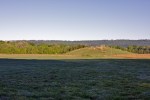
After I take a few shots of the training hills half wishing I were flying today, we walk to the top of the big hill.  I take only my tripod and camera with the 16-35mm lens on it.  At the top, one of the pilots asks if I’m selling pictures.  I laugh.  He says he was hoping maybe he could buy some from me.  I take his email address and tell him I’ll email some photos to him for free.  Now I have a client.

I take some rapid-fire shots of his flight, but the wide angle lens looking down isn’t the best view.  Tisen and I walk back to the bottom of the hill and I set up again with my 100-400mm plus 1.4x teleconverter.  I shoot my client a second time, but this time looking up at 560mm.  It looks like I’m standing next to him.

Unfortunately, I cannot pan and focus manually at the same time, so I only get a few good shots during the launch before he drops out of my frame and then I lose focus when I find him again.  This is exactly why I don’t ask for money to shoot people.

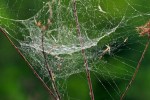
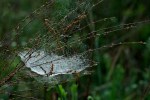
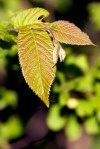
I pack up, load myself with all my gear, and Tisen and I head back up the road, stopping to enjoy the sun on more spider webs and the contrasting colors of bright, new leaves against dark evergreens.

When we make it back to the car, Tisen hops in like he wasn’t sure we were going to survive this adventure.  He’s tired.  Come to think of it, so am I.

Walkin’ in a Spider Web

Tisen and I arrive at the gate to the training hills; there are already two trucks waiting for the arrival of the instructors.  I pull off as far as I can so cars can fit between us, hop out and start putting on my pack mule costume.

My costume consists of: a rain jacket, a book-bag sized backpack that weighs over 30 pounds, my tripod bag, my loupe, my camera with my 16-35mm lens, my five-in-one reflector, and my extension tubes.  I hang each accessory off of my body in a fashion best described as “sherpa.”

A man waiting in a truck rolls down his window and asks if I’m a professional photographer.  I assure him I am not, but I’d like to play one on TV.  After swapping stories about professional photographers, I excuse myself on the basis that the sun is rising rapidly.

Tisen gets very excited when he realizes we’re going for a hike.  He runs ahead of me doing his happy-dance-prance, with tail wagging, and turns to look back at me as if he thinks this is too good to be true.  I love his happy-dance-prance.  Never fails to make me smile.

We make our way down the gravel road until we reach an open field at the base of the mountain.  This field provides a home to what might as well be an infinite number of life forms, but today, I am mainly interested in the homes built by spiders.  Every time we’ve driven by this field early in the morning, the light has hit these dew-covered condos that are shaped roughly like a ball.  I’ve said at least a dozen times that I want to come out some morning and shoot these spider webs; today is the day.

Tisen gets a little frustrated that our walk is so short, but he amuses himself by running around exploring in the vicinity, occasionally disrupting my shot by brushing against the plant holding the spider web I’m shooting.  But once the vibration settles down, the spider web itself is undisturbed.

Interestingly, even though I end up shooting at least a dozen different spider webs, I never see a spider.  This could be because I didn’t put on my reading glasses to look at the spider homes, but it at least implies that the spiders who build these webs are small and hard to see.

Eventually, I decide I have enough spider web pictures and we head down the road to see what else we can see.  I grab a quick shot of a bend in the creek with the mist rising off of it with the 100mm lens still on my camera.  When I hear a Pileated Woodpecker call, I switch to my 100-400mm and 1.4x teleconverter in the hope he’ll fly our way.  We never see the woodpecker, but I do get a couple of shots of flowers high up in the trees.

What the . . .???

Today, Tisen and I are on a mission.  I’ve often said I wanted to go to the training hills some morning when I wasn’t flying in order to shoot.  Today seems like the perfect day for that.

My plan is to arrive at the entrance to the training hills no later than 7:00AM so I have time to hike down the gravel road and get set up before sunrise.

As Tisen and I get on the highway, I have a clear view of the full moon.  It’s still too high to make an interesting shot, but I want to shoot it before it sets completely.

Now I’m racing the moon.  Each time we go up a hill, the moon disappears behind the mountains.  I watch it set over a ridge on 4 separate occasions during our drive, only to reappear moments later.

As we enter Trenton, the moon is close to the ridge and I’m sure I’m out of time.  But as I drive on down into the valley towards our destination, the moon rises up above the ridge, giving me more time.

Unfortunately, I pull over where there’s a bad angle.  I hop out of the van, grab the tripod from the back and run up the road about 100 feet or so where the angle is better.  I set up the tripod and run back to the van.  Fortunately, my 100-400mm lens with the 1.4x teleconverter is already on my camera because that’s the only way it fits in my backpack.  I run back to the tripod.  The moon is getting closer to the ridge line; it’s already sunk behind some of the topmost trees.

As I get into position, I realize I didn’t grab my glasses or loupe and I don’t have time to get them.  I turn on live view, enlarge the image, and stand back as far as my arms will let me to try to focus.

The moon keeps sinking rapidly.  I fire off as many shots as I can before it disappears.  When I play them back in my viewfinder, I think they look OK.

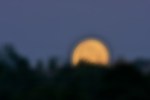
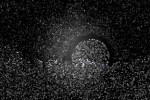
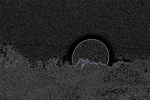
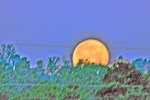
Much later, when I view my moonset shots on the big screen of my computer with my glasses on, I almost spit a mouthful of beer on my screen.  I didn’t realize my vision was quite that bad!

Besides not having focused properly, I also had too slow a shutter speed so I’m getting movement blur in the moon.  I also have had some movement in the lens.  I don’t recall it being that windy, but that’s a possibility.

This leads to the age old question:  you’ve blown the shot, now what do you do with it?  I probably should just delete these images, but I decide to see how far photo editing can go.  I used Aperture, Photomatix, Lightroom, and Photoshop Elements (the majority are from the latter) to see just what can be done with a completely blown shot of the setting moon.

Reflection

It’s been a long week.  I’m tired and feeling uninspired.  On days like this, I really want to do something quick and easy by crossing the street to the park, but how many times can a person shoot in the same park?  I’m not in the mood to go macro.  It’s late enough that the light is getting really nice and I hate to not shoot landscape.

As I’m deciding what to do, an email with a blog post that’s a collection of images of reflections.  I immediately think of the wetland in the park and feel suddenly inspired.

I put my 16-35mm lens on my camera and take nothing else except my tripod and my loupe.  Tisen looks at me hopefully and I realize I won’t be going alone.

I sling my tripod bag over my shoulder, hold my camera up off my neck along with my loupe and then pick up Tisen’s leash in my free hand.  Tisen grabs Puppy Love and we head out.

We walk down the street, making many motorists smile (I assume this is because Tisen has a purple stuffed heart in his mouth that says “Puppy Luv” and not because I am wearing five finger shoes, my hair is sticking up weird because it dried while I had my glasses on my head, or because I’m carrying an oddly shaped bag over my shoulder.

We make it across the street and down to the wetland where I set up my tripod very low to the ground.

People are standing on the end of the viewing deck above the wetland and I can hear them talking about me.  They are wondering what I’m doing.  I do not hear any words like “insane” or “dangerous” and no cops come running up, so I assume they at least realize I’m unarmed (I’ve heard stories about people calling the cops because of a photographer’s tripod making people think they were a crazed gunman).

Tisen is not being the most cooperative photographer’s dog today.  He winds himself around the legs of my tripod and lays down right in the middle.  I have to untangle the leash and adjust the legs so they’re not in contact with Tisen to avoid him introducing vibration and blur into my photos.  I hear the people overhead chuckling.

We have a lovely time working our way around the wetland looking for interesting shots–and trying to keep Tisen out of them.  I only got a few of reflections, but at least I found something to capture my interest.

We pass a mourning dove whose been nesting on an abandoned nest from last year.  I try to get a shot, but, of course, one of the hazards of leaving the house only with a 16-35mm lens is that when these opportunities present themselves, it’s tough to get a shot worth looking at.

Tisen is worn out from our adventure and quickly makes himself comfortable on the couch when we return home.

Exposed

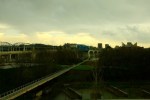
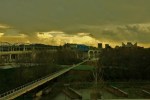
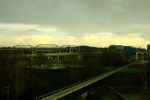
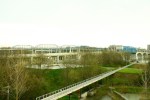
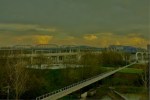
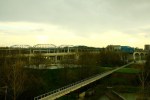
I am on a quest to get the exposure I want.  The scene is one I enjoy daily, but this particular day there was a stunning cloud display in the background.

The problem is a classic one.  A camera cannot correctly handle the same range of light that our eyes can.  Especially not when I’m looking at the world through polarized sunglasses. 🙂  It’s an issue that photographers have struggled with since the beginnings of photography.  You see a stunning sky and a lovely foreground view.  The camera can only properly expose one or the other.

I took shots of the scene with multiple exposures, hoping I could combine them successfully into one image.  High Dynamic Range (HDR) photography has been both rejected and embraced by the “serious” photographers of our time.  I believe it’s not the combination of exposures that troubles more traditional photographers but the special effects that can make an image hover on a line between a drawing and a photo.  I get this impression because many traditionalists extol the value of having a camera that will combine multiple exposures into a single image but have no interest in “HDR” post processing software like Photomatix.

Not that anyone is looking to me for guidance on the subject, but I continue to be on the fence.  I don’t care for photos that make you wonder if it’s a photo or a drawing. but I don’t mind an image that looks clearly like one or the other.

I also don’t like spending hours editing a photo I could have captured in the camera in by making better decisions.  However, when it comes to the age old problem of limited range of proper exposure when I really want to see the sky and still see the details in the foreground, I feel a little more fond of HDR processing.

For today’s exercise, I made an attempt to get a photo that combined the dramatic sky with enough detail in the foreground to keep it interesting.  Unfortunately, I forgot I’d changed my camera setting to JPEG, so I’m afraid I have limited resolution to work with and each edit step diminishes the resolution further.  But, I’ve given up on ending up with something I want to print and hang on the wall at this point.

Attempt 1:  Underexposed image with the shadows lifted a lot, the highlights pulled down a little, and a few other minor adjustments.

Attempt 2:  Overexposed image with the highlights pulled down a lot, the shadows lifted a little, and a few other minor adjustments.

Attempt 3:  3 images 2 stops of light apart combined in Photomatix with no other post processing.

Attempt 4:  2 images 2 stops of light apart combined manually in Photoshop Elements (and looking very weird).

Attempt 5:  3 images 2 stops of light apart combined in Photomatix (with different settings than attempt 3) and then adjusted further in Aperture.

In the end, let’s just say I wish I had a camera that could combine two exposures.  🙂

This is the Point

. . . Continued from “What’s the Point?

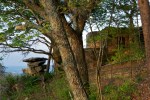
High on top of Lookout Mountain’s Northern point, we make our way around the paved path that leads to the museum.  The museum itself is perched on the edge of the mountain, built of stone and probably a civil war relic, but we didn’t go check it out thinking I wanted to get set up on the West side of the point in time for sunset, which was fast approaching.

However, when I got set up on the West facing overlook, the light was just right for shooting back towards the museum–golden and dappled through the leaves that have appeared from no where in the past week.

The cliff face below the museum makes me think that whoever fell of the earlier rock formation was lucky it wasn’t here that they lost their balance.

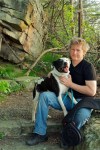
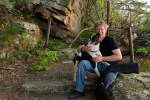
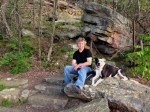
We consider briefly taking the metal stairs down to the trail below, but the thought passes quickly as I stare down the stairs and imagine my knees after going down them.  I content myself with shooting Pat and Tisen seated amongst rock outcroppings while we wait for the sunset.

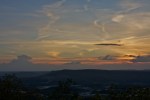
As I watch the light hitting different parts of the clouds, I contemplate why I still shoot sunsets.  When I’m looking through hundreds of sunsets images, I get bored almost immediately.  Yet, I can’t look out the windows and see interesting clouds at sunset without rushing up to the roof with my camera.  For some reason, I never grow tired of watching sunsets (or shooting them), but I quickly tire seeing pictures of them.

As the light fades, a line of cumulus clouds becomes more interesting.  As I line up a shot, a park ranger approaches and tells us the park is closed and we have to leave.  The park sign says they close at sunset (which officially isn’t for 4 more minutes), but he seems tired and I don’t really need the additional images to bore myself with later, so I don’t argue.

We walk out of the park with him and a group from Seattle.  We learn that a man did, indeed, fall and that he broke some ribs.  We also learn that the park ranger is from East Liverpool, Ohio originally–near the town Pat grew up in.

The group from Seattle is amazed by the weather.  They ask us if it’s like this all the time.  I laugh and tell them we moved down last August on a day when it was 110 degrees and that we had to use our AC in March.  They seem to think that sounds nice.

As a side note, I added a photo of Tisen from my iPhone.  I had my camera all set up for the sunset and didn’t want to swing it around to capture Tisen perched on a rock like a lion (although his Holstein fur doesn’t really conjure images of lions), so I pulled out the iPhone instead.  Another reason I need to get that second camera body!  🙂

What’s the Point?

This evening, I realized I didn’t do anything “bloggable” on Sunday, so I was out of topics to write about.  I pondered writing about my work laptop crashing and having to get a replacement sent to my home office, but that’s pretty much the whole story in one sentence.  I could have writen about having maintenance people in the apartment installing an air duct while trying to work, or Tisen’s return to day care, or perhaps even my workout this morning.  But, let’s face it, I’m obsessed with photography and no other subject will do.

Therefore, the only solution was to go out and shoot.  However, I’m tired of going across the street to the riverfront and taking pictures of the Market Street Bridge and the Tennessee Aquarium.

One of the places near Chattanooga Pat and I have wanted to explore is Point Park.  Point Park is one of the battlefield monuments to the Civil War in the area.  It’s also known for spectacular views.

It’s located on Lookout Mountain, which would be better described as a ridge.  The point is literally just that–it’s the end of the ridge, affording views in three directions.  This was the destination I picked for tonight.  We loaded up my gear, Tisen, water, and rain gear and headed out.

When we arrived at the park entrance, a police officer pulled up in front of the gate and was pulled out a backpack.  We wondered if he was there to check to make sure that everyone in the park had purchased a pass and made sure we stopped to get ours before going in.

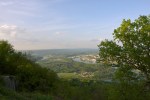
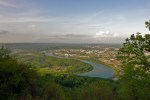
We wandered along the paved trail around the landscaped park area enjoying the views.  I set up my tripod and took some shots towards downtown Chattanooga, finding our building off in the distance.  The meander in the river that goes through the downtown area was fascinating.  I always knew the river bent back upon itself, but I never realized just how narrow the land in the middle gets just West of us.  Looking at it from up on the point made me realize why it’s called moccasin bend–the land mass resembles a snake’s head.

As we worked our way along slowly, several police cars squeezed by on the paved trail.  Then, an ambulance went by.  We watched them setting up a gurney and wondered if someone was injured.

As we headed down the path towards the museum on the point, we passed a large rock formation that seemed to be begging people to climb it to see the view.  I might even have been tempted myself except that the base of the rock was surrounded by a variety of medical equipment that the paramedics hadn’t yet returned to pick up.  It was fairly obvious why the ambulance was there.  We stuck to the path.

Even Tisen only went off trail once when he accidentally ducked under the rail without realizing it.

To be continued . . .

Winging It

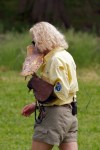
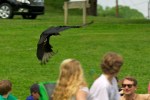
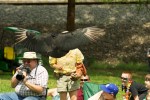
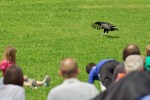
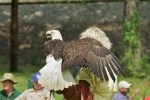
On Saturday afternoon, I went to a Chattanooga Audubon Society fund raising event as a volunteer for S.O.A.R.  S.O.A.R. was there to do their 45 minute long educational program on birds of prey in support of the Audubon.

The challenge for John and Dale was that the program was in a large field outdoors, potentially tempting free flying birds to head for the trees.

The challenge for me was to see if I could get any good shots of the birds.  I am planning to make a screensaver to give away in exchange for donations at an upcoming event.  Unfortunately, I’ve never seen the program before, so I am completely winging it (yes, a pun).

I chose my new 70-200mm lens thinking because it’s faster, it will help me freeze more movement.  Given that it was a bright sunny day, I probably would have done better with my 100-400mm since I didn’t really need the speed.

I put my camera on a tripod and set it at its maximum height thinking I’d have a better angle catching the birds flaring before they land.  Unfortunately, I didn’t consider the need to separate the birds from the audience.  I would have been better off getting really low–well, not sure my knees would have been better off, but my pictures would have been.

I also needed to be as unobtrusive as possible so the birds didn’t get confused and fly to me.  No one wants a bird of prey to land on their unprotected flesh.  As a result, I tried to stay in one spot and not move around much.

In addition to being in a fixed position, up high, with too short a lens, all my subjects were in motion.  John and Dale are constantly moving.  When I am looking through my lens, I can only track one of them, but I need to know where the other one is to predict what direction the bird will fly.  Looking away to locate the destination person caused me to miss more than one good shot.

My lack of experience using the continuous focusing mode also did not help.  I had issues with losing focus. I’m not sure what I did wrong, but I’m going to have to do some more practice with continuous focusing mode.  It was depressing to see perfectly framed and timed shots that were totally out of focus.

In the end, I have some fun snap shots, but nothing to put in the screensaver.  I spent an insane amount of time trying to salvage one of the photos by blurring away the distracting background.  Unfortunately, the photo doesn’t look right now–see if you can tell which one I majorly doctored.

At least I learned a lot for the next time.  And, none of the birds flew away.

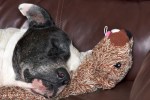
As for Tisen, he couldn’t come to the event with me–birds and dogs don’t mix well.  But, I included another shot from his nap with Red Dog.

Models and Dogs

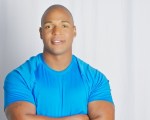
My trainer from the gym was kind enough to sit for me for portrait practice with a more cooperative model than Tisen or Pat.  We did simple head shots with the same lighting (well, continually adjusted as I tried to figure out what I was doing) throughout.

There were two major challenges to this session.  First, I had a hard time not over exposing my model.  In particular, his skin kept washing out and I found his teeth were blowing out.  I had my lights turned down as low as they would go and I kept stopping down, but I was still struggling.  I tried changing the shutter speed to reduce the ambient light.  It did not help.  I finally moved the lights back to reduce the intensity, but I was still blowing out his teeth.

Here’s the thing, I know very well how to control exposure.  If there is one thing I know extremely well, it’s how to get the exposure I want in ambient light. But for some reason, when I feel pressure of any kind, I forget something critical.  On St. Patrick’s Day, it was sync speed and then my lens hood.  This time, it was something as basic as my ISO setting.  It never occurred to me to look at what I had the ISO set on.  It wasn’t until reviewing photos that I discovered I was on ISO 400!  How on earth can I forget something so ingrained and basic?

I remind myself even if I never get the photo I want, at least I’m exercising my brain.  It would be nice if exercising my brain were as effective as lifting weights in the gym–I’d love to see some evidence of muscle development.

Thanks to post processing, I was able to recover most of the data in the blown out teeth and salvage the photos.  Several are usable for things like a LinkedIn profile or maybe a business card, but they’re awfully boring.

The second challenge (in case you thought I forgot) was Tisen.  He practically attached himself to Kory while he was in the apartment.  At one point, Kory was poised to sit down and Tisen was standing in front of him with his gaze fixated on a part of Kory it’s not polite to look at.  Kory froze and was afraid to move.

When I called Tisen to me, he tucked his tail and sulked off to hide under the desk.  As soon as I stopped calling him, he was right back to facing off with Kory.  At one point, he put his front legs in Kory’s lap like he wanted to be petted but kept growling.  I’m not really sure what he means by this, but my best guess is something like, “I’m willing to be friendly to you, but I’ve got my eye on you.”  I guess if I am going to have any more models coming in, I’m going to have to teach Tisen better manners.

Tisen’s Night Out

Tisen had a hard day on Thursday.  Normally, Tisen’s day is filled with the following duties:

  1. Guarding Mommy from displays of affection from Daddy
  2. Cleaning his food bowl with his tongue
  3. Taking Duck, Mr. Beaver, Lamb, ‘Possum, Eddie, or Minnie for a walk around the park 3 times a day
  4. Taking Daddy for a walk around the neighborhood to make sure all is secure before bed
  5. Rolling the lawn at the park to make sure it’s bump free by using his own body weight
  6. Looking adorable
  7. And, most importantly, napping.

Since we had a date night Thursday night, Tisen had to spend the night with some friends.  The pooch party started late in the afternoon–he went to the tail end (hee hee!) of day care so he could have play time with his new friends before bedding down for the night.

I had a very hard time with this.  I’ve never sent a dog on a sleep over before.  We always had dog sitters who could come to our house.  Now, we were leaving Tisen in the care of relative strangers overnight.  And we didn’t even know the other kids invited to the party!

I thought since he’s been going there to play, it wouldn’t be so hard on him or me.  But, he didn’t want to go in with the other dogs when we got there.  Even though I’ve watched him on the webcam and know once he gets inside, he has a good time, it broke my heart to have to walk back with him to get him to go in.  I left quickly and tried not to cry on the way home.

He was absolutely livid with me when I went to pick him up in the morning.  I gave him Duck to hold in his mouth so he wouldn’t try to grab my hands with his teeth.  I had trouble paying because he was trying to drag me out the door.  I guess he thought he was going back to a dog kennel for good.

Today, he seems to be back in his normal routine.  Napping every thirty minutes (assuming he bothered to wake up between naps), taking a walk every 4 hours, and being generally cute.

But, yesterday, I thought he might have permanent psychological damage.  He followed me around like he was afraid I’d disappear.  When he napped, he napped at my feet with some part of him in physical contact.

Is sleeping in a kennel in his own bed really so different from sleeping at the foot of our bed?

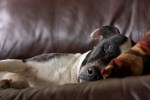
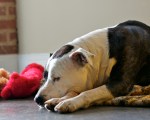
As for the pictures, having gotten advice from a friend to work with one light until I can predict what it will do, I’m happy to catch Tisen napping on the couch.  By keeping the light far away, he only opens his eyes into tiny slits every once in a while.  The other two pictures used available (if bad) light.  Tisen’s a good model when he’s trying to catch up on sleep.