Oops, I did it again

I’m not sure how it happened, although it’s possible 2-for-1 margarita night at Taco Mamacitos is related.  Somehow, the Canon EF 70-200mm f/2.8L IS II USM lens ended up at my door.  Having lusted after this lens since its release, the combination of that second margarita and the best price I’ve seen caused me to click a button I shouldn’t have clicked.

Having taken an online workshop by Zack Arias in which he repeatedly admonishes budding photographers not to spend money on equipment until getting to know the equipment we already have intimately, you would think I would have more self control.  Zack recommends shooting with a new lens for 6 months and only that lens until you can see the world through that lens and know exactly what you’re going to get (and not get).  He has a valid point that until you know every bit of capability you can eek out of a lens, you really don’t need to buy another one.  In my defense, it’s been more then 6 months since I added a lens to my bag.

Having spent the money, I decide I should apply the second half of Zack’s advice and get to know my new lens intimately.  Since it overlaps with my 100-400mm lens, I figure doing some comparison is a good idea.

Walking over to my favorite park, I head down to the ridge between the wetland and a creek.  Since I want to see how the extra light helps out, I shoot with a wide open aperture with both lenses.  The 100-400mm lens is a f/4.5-5.6, which is annoying since the maximum aperture changes as you zoom.  But, the extra 200-400mm is sure nice.

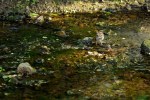
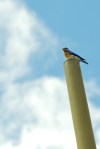
A bird I thought was an Eastern Phoebe poses for me for a bit–I am unsure of what kind of bird it actually is.  I snap a few shots with the new lens.  I switch lenses and take some comparison shots.  I switch back and get some shots of a Song Sparrow in the creek.  I switch lenses and try with the 100-400mm.  I switch back and shoot some more.  I catch a cardinal posed in the sun.  Then, on the way out of the park, I manage to spot an Eastern Bluebird who won’t quite step into the sun for me, but lets me get many shots with the new lens.

I shoot both lenses wide open and hand held.  I find that most of my shots with the 100-400mm missed the focus.  I’m not sure if I was waving around the lens too much when focusing or whata, but it’s hard to see direct comparisons because so many shots were so completely off.  The 70-200mm focused much faster in all cases, which might explain why I had an easier time focusing on my subject.

All in all, when I look at the images from the new lens, there is something about them I just like better.  Maybe it’s because I’m still trying to justify the purchase?

Double Sunset

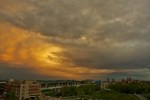
Between working on a self-portrait, working my way through another online photography workshop, and taking a break from from both by shooting outside, I’ve managed to spend nearly all of my weekend on photography.  I pick up my camera and start to tuck it back into my bag when I look out the window.  The sun is doing something amazing.  It’s setting in the East.

I am reminded of a conversation I once had with a directionally challenged friend.  It went roughly like this:

I said, “Look at the sunset!”

She said, “Oh wow!  It’s really beautiful.  I always thought that was the East.”

I replied, “What?”

She repeated, “I always though that was the East.”

Confused, I said, “The sun always sets in the West, so that has to be the West.”

She replied, “Oh, I know the sun always sets in the West, but that’s the East.”

At this point I gave up.

However, I am not confused.  The sun, of course, is setting in the West, but the light is bouncing around in inexplicable ways that make it look like it is also setting in the East.  I cannot explain why the clouds reflect the sun so brilliantly in the Eastern sky tonight, but it’s beautiful.

Frozen with my camera still in my hands, mid-way to being put away, I look at the camera and immediately head to the balcony, grabbing my tripod on the way.  The obstacles from the balcony quickly frustrate me.  I return inside, tripod over my shoulder, and head on up to the roof.

The double sunset motivates me to try to shoot a set of photos that I can stitch together into a panoramic image.  I start in the East and work my way around to the real sunset.  I end up with 12 overlapping photos.  I consider reshooting on the vertical, but the light is starting to change and do other interesting things.

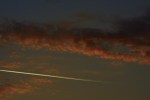
A small wisp of clouds forms just over the ridge in the distance, turning brilliant red.  I decide not to risk missing the last of the light by reshooting the panoramic and shoot the changing light instead.

When I return inside and try to figure out how to stitch the photos, I learn that my Canon software is so outdated it won’t run on any of my computers anymore.  I do some googling to figure out I can use Photoshop Elements to stitch a panoramic and go to work.

Something has gone awry in my 12-photo series and one photo seems to be out of place.  It’s as if I changed focal length in one shot.  I don’t remember doing that, but maybe I bumped the lens and magically bumped it back.  In any case, I don’t much like the panoramic with 12 pictures.  I create one of the East and one of the West instead and am much happier with the results.

I still want that full frame camera, though.

Take 2 (or 3)

Imagine this:  A white sheet with two pieces of $1.75 metal conduit running through folds in the top and bottom hangs from the ceiling, suspended by pieces of nylon twine tied to a large nut.  Loops in the twine tied in random places indicate it took more than one try to get the sheet the right height.

To the left of the sheet, a light stand points towards the center of the sheet with a large white umbrella.  It stands about 7 feet high.  Underneath the umbrella light, centered in front of the sheet, sits a small, black ottoman daring a passerby to take a seat.

Barely to the right, almost in front of the ottoman, stands another light.  This one is covered in a giant rectangular box, black on the sides and translucent white in front.  There is something ominous about the way it leans in towards the ottoman, suggesting it’s a trap poised to spring.

In front of all of this sits a low, half-moon of shelves, loaded with electronics that appear to be unrelated to the lighting set up except for one item:  a laptop.  On top of what appears to be a large projector, an old Macbook Pro sits with the screen facing the sheet.  A cable runs from the laptop to a camera.  The camera sits on a large tripod.  The tripod straddles a low console that sits in front of a large sofa.

The room is large and should be spacious, but it’s run out of space.  What isn’t occupied by furnishings and photography equipment seems to be covered in cables.

Two cables come from the camera, the second going to the large light with the rectangular shade.  It’s as if the camera has a history of getting up and leaving and someone wanted to make doubly sure it couldn’t get away.

Along the floor, a mess of cords squiggle their way in a multitude of directions.  Following one cord reveals a vacuum cleaner sitting at the ready in a shadowed corner.  The rest seem to be associated with the lights, the laptop, and the collection of power strips going to the rack of electronics in the middle of the room.

A black and white dog lies on the couch taking it all in, but with insufficient curiosity to justify moving.  Perhaps he knows exactly what kind of trap it is.

Then, in comes me.  I sit on the ottoman, control the laptop using a bluetooth touchpad, and get up and down, up and down, adjusting the camera.  I find myself getting the urge to search Amazon for a remote controlled tripod.

I learn several things during this exercise:

  1. Being a model is extremely boring.
  2. Being over exposed is like a virtual peel–your skin looks younger, but you’re left a funny color.
  3. Predicting shadows from 4 lights sources is challenging.
  4. Focusing from a touchpad is less than ideal.
  5. Hair is a pain; next time, I may shave my head.

Break Time

Taking a break from my first attempt at a self portrait, I pack up my gear and head to the park across the street.  My collection of gear seems to be growing.  I have to leave a lens behind to make space for my loupe with a 3x magnifying viewer (which, by the way, kicks the but of any pair of reading glasses–not only can I actually tell if I’m in focus or not, but I can even use it to read the impossibly small icons on the control panel on the top of the camera).  I tuck in a garbage bag in case I want to lay in any mud (you never know when the urge will strike), and I stuff in my new 5-in-one 22” reflector in the event I decide to do some macro photography while I’m over there.

I go to the park prepared  to shoot macro, wildlife, and/or landscape.  I’m nothing if not flexible.  I am also prepared for rain.  Besides my trash bag, I carry my rain jacket just in case.

I swing my camera bag and my tripod bag over my shoulder with my camera hanging around my neck.  As I pass the gym across the street, I see my reflection in the windows.  I look down at my feet, clad in five finger shoes.  I find myself thinking it’s a good thing I don’t have children–they would never go anywhere with me in public.

As I enter the park, I see an eastern blue bird.  It looks like it may have a nest on the light–it’s carrying a bug and acting like it’s feeding something.  I cannot see any baby beaks from where I’m standing, however.

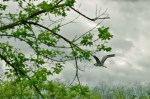
Next, a great blue heron lands in the wetland.  I creep behind the cattails, hoping to get a shot.  As I get close, I see him standing with a frog hanging out of his beak.  But he flies off and I am left wondering why I didn’t change to my longest lens before sneaking up on him.

I head back towards the paved path, looking for a spot to shoot clouds, and then blooming trees.  I switch back and forth between shooting macro and landscape, wishing I had that second camera.

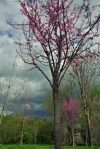
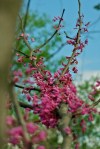
I make good use of the trash bag getting a new angle on blooming trees.  My reflector comes in handy when I need some shade on the red bud blooms.  However, the wind is picking up and macro shooting at 3 feet above the ground does not go well.

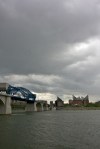
I shift back to shooting landscape.  As I stand overlooking the Tennessee River, it starts to rain.  My garbage bag transforms into a rain cover for my camera.  My rain jacket goes on, the hood goes up, and I head back home.

Tisen is frantic when I return home.  He jumps at my legs as if demanding an apology for being gone for so long.  Maybe someday he’ll be OK.

The Other Side of the Lens

Today, I planned to spend some time shooting portraits with off-camera lighting.  However, I have the challenge of needing a model.  My trainer at the gym agreed to model for me next week, but I’d like to have some trial runs before then.  Since Pat and Tisen are strobe intolerant (I think it’s linked to the lactose intolerance gene), I decide I should try doing a self-portrait instead.

I get as far as installing the live-view software on the big computer so I will be able to see myself, but once I get the camera tethered to the computer and start remembering how to use the software (it’s been years since I tried this), I get distracted.

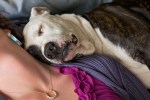
Tisen has hopped up on the sofa with Pat and, as usual, I cannot resist him as a model.  I take a few shots of Tisen laying next to Pat’s legs, then I decide to try to put myself in the frame.

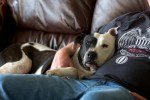
Since I’m shooting with my 100mm lens in our living room, I manage to get my throat in the frame by sitting on the floor in front of the sofa.  Tisen appreciates having my shoulder to rest his head on–he was starting to slide of the edge of the couch.

While there are a lot of shadows, I like the natural light and the way it seems to highlight Tisen’s face.  I also like that Tisen doesn’t run away when I shoot in natural light.

I discover it’s very difficult to come up with a pose that captures both my face and Tisen’s in the same frame without causing some rather frightening looking twists in my neck.  (I won’t mention how quickly I delete most of the photos when I see the folds in my skin!)

It’s a bit awkward to readjust a camera when you’re the model, especially when you’re counting on a dog to lie still so he’s still in the frame while you get up, go over to the tripod, adjust, sit back down, try to get back into position, and then, finally, shoot some more.  Tisen is amazingly complacent.  He looks somewhat miffed when his head rest gets up and walks away, but as soon as I sit back down, he snuggles his head in deeper against my neck.  How could anyone not love this dog?

I realize that if I’m going to do a self-portrait with the studio lights (which will be tomorrow’s exercise since we’re not hang gliding), I’m going to need something to focus on.  If only Tisen were 5’ 10”.  Well, maybe not.  Pat is working tomorrow, which is why we’re not going hang gliding, so he’s out.  Perhaps I can figure out how to attach Mr. Beaver to a broom handle and prop him up where my eyes should be?  That should be interesting!
The other thing I realize is that I need a white background.  Looks like I’d better go figure out how to hang a sheet.

Crayons and the Camera

I was reflecting today on what first excited me about photography.  I always appreciated others’ work, but the expense of film and printing photos just to discover if they were crap seemed like overwhelming deterrents to me when I was young.

There were two things that gave me the push to get started.  First, there was the advent of digital photography, providing immediate feedback and reducing the cost of learning.

The second was a work friend, Rick, who was (and is) a wonderful photographer.  He advised me on the camera purchase that started my endeavor to learn the fundamentals.  It was not a DSLR, however.  That would have been a waste of money for me back in early 2003 given that I had never heard the words “aperture,” “shutter speed,” or “depth of field.”

Instead, my friend advised me to look into the PowerShot G3.  It had one of the best lenses in a point-and-shoot with . . . wait for it . . .4x optical zoom and . . . drum roll . . . 4.0MP!

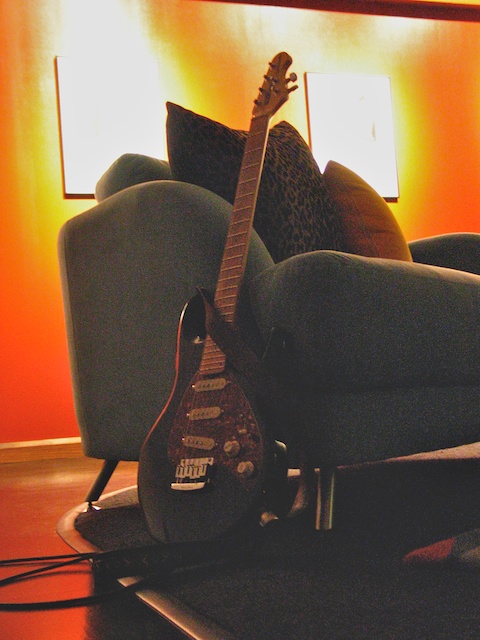
This photo was the first picture I took that made me think photography might be the most exciting hobby on the planet.  Who knew you could make it look like the wall was on fire with a camera?

While I won’t be putting this in my portfolio, I love it all the same.  The reason I love it so much is because it evokes the utter glee I felt in discovering that creating such an image was possible.  It was like handing a child their first box of crayons and a blank piece of paper.  I didn’t know enough to be self-critical; I was just having fun.

That camera with that attitude got me through my first five years of sporadic shooting.  It wasn’t until 2008 that I upgraded to a DSLR.  This was because I wasn’t shooting frequently enough to improve beyond my camera’s capabilities until 2007.  That year, I shot frequently enough to be frustrated repeatedly by the limitations of a point-and-shoot.  I knew exactly why I needed a DSLR when I bought one.

As I contemplate my next camera body, I pull out some of my photos from the old PowerShot G3.  Have I improved as a photographer since upgrading to a DSLR?

My photos with my latest gear are sharper, cleaner, and quieter.  But, I am reminded of when I was doing triathlons and I was choosing between Shimano Ultegra vs 105 components for my new road bike–would the extra $400 to shave a fraction of a second off how long it takes to shift make as much difference as, say, training more?

This helps me get clear in my own head on when to invest in gear.  In the end, I really don’t need to buy anything if I am not being frustrated by the current limitations of what I have.

Note on today’s dog picture:  Tisen is taking a break from modeling today due to having had too much fun at doggy daycare to pose for mommy in any position other than “sleeping on the couch,” which I think we’ve seen enough of for now.  So, here is another one of my favorites from my PowerShot G3 instead–this is Katie, who died along with a piece of my heart in April 2007:

My Cloudy Clouds

I have been studying clouds quite a bit lately.  Not only am I obsessed with getting a landscape shot with sharply focused clouds from front to back, but I am also learning how clouds help predict changes in weather, which is helpful in hang gliding.  Apparently hang gliding pilots are the best weather (wo)men–at least the ones who survive.

Plus, I just like clouds.  Who doesn’t really?  There’s something fascinating about the way they swirl and swoosh and dissolve in front of our eyes.

When it comes to my photographic goals with clouds, I’ve come to several conclusions.

  1. A fast shutter speed freezes the movement caused by wind.
  2. A small aperture is essential for expansive clouds that range from front to back in the frame.
  3. Lower ISO settings prevent graininess that can make clouds look less sharp.
  4. All of the above makes it very difficult to get sharp looking clouds in low light.
  5. Finding a focus point about 1/3 of the depth keeps things sharp front to back.
  6. Even if you do everything perfectly, the clouds may not be sharp in real life.

Number 6 is my latest discovery in my endeavor to capture sharply focused clouds.  Given that “cloudy” is used to mean “1. lacking definite form or limits” and blurred is considered a synonym for “cloudy,” this might have occurred to me sooner.

I find myself relieved to realize that my images are, in some cases, every bit as sharp as the clouds themselves were.  I have been walking Tisen through the park gazing upwards, smiling at the blurry looking clouds.  I try to pretend I’m bird watching so bystanders don’t think I’m crazy.  I’m not sure it helps.

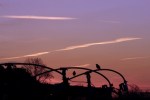
For today’s experiment, I tested this theory.  I went up on the roof and got some shots of the sunset.  I found an angle that had parts of a roof top in the very near foreground that angles away from the camera towards a ridge line in the mid-depth of the photo and then a second ridge further back.  I figured this gives me landmarks so I can tell if I have depth of field even if the clouds appear blurry.

I also looked carefully at the clouds and determined that they hurt my eyes when I try to bring them into focus just with my eyes–especially the dark, large, foreground mist.

In post processing, I lifted the shadows beyond my personal preference in the first shot just to be able to see the sharpness of the focus better:

I look at the landmarks at each distance through the loupe in Aperture at 200%.  They are acceptably sharp.  Perhaps they could be sharper if I were shooting more towards the middle of the aperture range for my lens, but there is no discernible difference in the level of sharpness between the foreground and the background.  This makes me happy.

I can now stop calling myself names for having cloudy looking clouds.

Portrait Anyone?

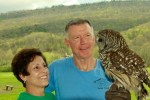
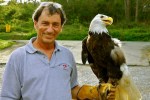
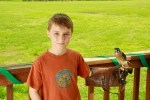
The S.O.A.R. event on St. Patrick’s Day went wonderfully.  Over 200 people came and I think the event exceeded their expectations.  Watching children hold birds was especially a treat–how many people get to hold a bird of prey on their arm before they’re even a ‘tween?

As far as my venture in trying to get people to donate in exchange for photos, well, it turned out to be quite the challenge.

I did a few things right:

  • I practiced with my new lighting as much as possible beforehand.
  • I worked out a workflow ahead of time.
  • I setup my camera to shoot in JPEGs since there would be no time for post processing.
  • I took all my equipment out to the site the night before and did lots of testing to pick a good location to set up.
  • I tested my 100mm f/2.8 lens in the space I had to work in and prepared to shoot with my 17-55mm f/2.8 lens based on the results.
  • I did a lot of test shooting with my strobes at home with the 17-55mm lens.
  • I brought Pat along so he could help solve some of my more difficult problems.

I also did a few things wrong:

  • I should not have tried to use recently purchased lighting equipment at an event given my lack of experience with artificial lighting in general–it created extra stress
  • I didn’t set a custom white balance, which I really needed because of no post processing.
  • I forgot my CF card reader, which blew away my workflow until Pat went to Wal-Mart.
  • My extension cord crossed a major traffic area; Pat and a roll of duct tape to the rescue!
  • I didn’t test the process for burning CDs beforehand.  Having not burned a CD in about 10 years, this wasn’t wise.  My workflow resulted in drive failures, ruining several CDs.  I found a work around, but it wasn’t easy.
  • Finally, and most humiliatingly, a weird shadow suddenly appeared in my photos and I couldn’t figure out why.  After rearranging lighting about 1000 times, Pat came along and asked, “Are you sure it’s not the thing on your lens?”  Apparently, I bumped my lens hood and the wide part was in the wrong position, causing the shadow in the frame.  I can only explain the failure to recognize the problem immediately as a brain malfunction given this is something I’ve seen in the distant past.  Unfortunately, it’s one of those things that screams, “SHE DOESN’T KNOW WHAT SHE’S DOING!” to your potential customers.  <sigh>

While these mishaps didn’t negatively affect my fund raising in the end, they did negatively affect my confidence.

As you can see from the gallery, I did not exactly produce stellar images.  While the circumstances were challenging, I have to face the fact that I didn’t have the skills for the challenge–yet.  So many things to work on!

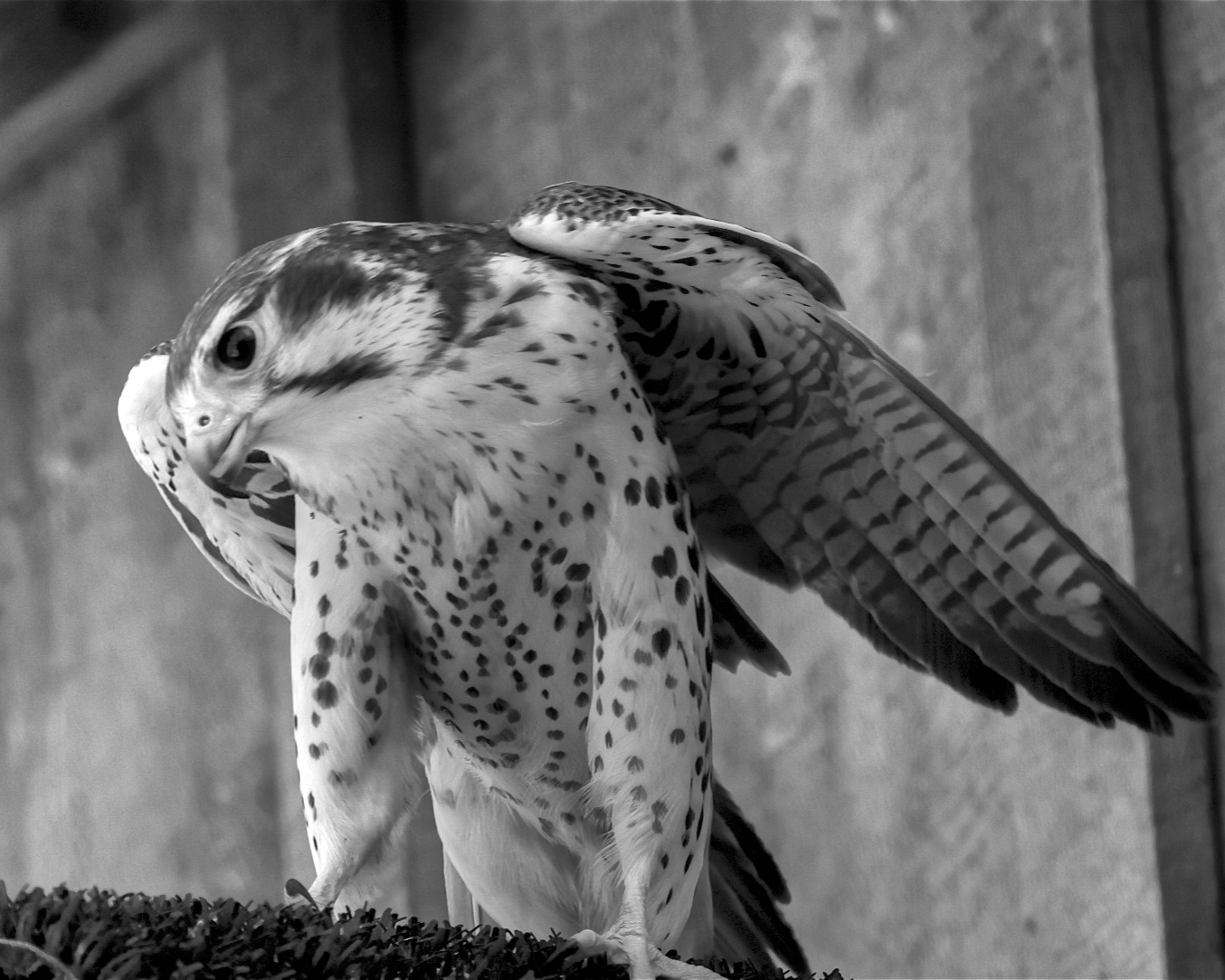
On the up side, my black and white Prairie Falcon portrait sold in the silent auction.

Anticipation

It’s early Saturday morning.  Today is a big day.  I am nervous.  Taking on getting the word out about the event with a $100 budget for printing materials was a new challenge.  It’s an interesting comparison to have a corporate event where you know exactly who your target audience is–all their emails are in your contacts list, you have a budget in the 10’s of thousands (it was a small users conference for about 150 customers back in the days when corporations still spent money on such things), and you plan your activities based on your known audience.

In comparison, this event is the opposite in every way.  You plan your activities based on what you can do, then you try to find people who might be interested in attending what you’re planning, and you spend as little as possible to try to find them.  Social networking was not really an option for me although the other planners were able to leverage their Facebook pages and email lists.  Since no one on my facebook friend list lives in the vicinity who isn’t already participating in the event, my social networking was pretty limited.

I reached out to every person I knew in Chattanooga (which was 3 people) to find ways to get publicity.  My trainer hooked me up with a newscaster and we did the early morning news spot that I posted previously.  I sent emails to several radio show hosts and newscasters I’d heard about through my second contact (a small business owner in the same building as Pat).  That resulted in one radio spot.  So, we got a little free publicity from that.  A connection through other organizers resulted in a second news spot yesterday at noon.  Maybe, just maybe, people will know about it.

Now the question is, will they come?  The skies in Chattanooga are overcast.  There is a steady rain falling.  The weather says it’s supposed to clear for a few hours in the afternoon and then turn into thunderstorms later in the day.  We have indoor areas, but will people come out to Wildwood, GA if the weather is bad?

I’m crossing my fingers that this work will result in a huge turn out and lots and lots of funds raised for S.O.A.R.

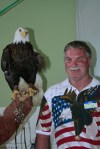
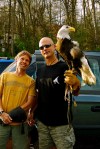
For today’s photography lesson, I look at my impromptu portraits in the parking lot with Osceola from last night.  I see that I have taken on a rather challenging photography assignment.  Getting enough field of view for both bird and person means either using a shorter focal length or getting further back, which may not be possible.  I used the shorter focal length last night and am not pleased with the results.  There is no bokeh effect (background blur) yet in some shots I don’t have enough depth of field for both the people and the eagle to be sharp.

The classes I’ve taken don’t happen to mention how to get great shots of people holding birds.  Maybe I can find a niche for myself yet!

Sunrise, Day Care, and Separation Anxiety

Tisen has become highly attuned to my whereabouts.  For example, the other day he was lying on the couch next and I was sitting at the computer.  His head was at an angle where it seemed impossible for him to see me and he appeared to be asleep.  If I turned my head towards him, an immediate “thump, thump” of his tail followed.  When I looked away, silence.  I got up and started walking towards him, thump thump.  When I backed up, silence.  When I walked all the way up to him, THUMP THUMP THUMP.

He’s equally good at telling when I’m near the door.  No matter how quietly I slip away or what he is in the middle of, he always appears in the entrance hall before I can make it all the way to the door.

When we started putting him in his crate at night, he stopped coming into the bedroom at all.  Not just at night, but at any time of day.  We stopped trying to put him in the crate and started leaving the bedroom door open.  His desire to be near me apparently overcame his fear of the bedroom because he started sneaking in at night and where do you think he started sleeping?  In his crate.  As long as the door is open, it’s his preferred place to sleep.

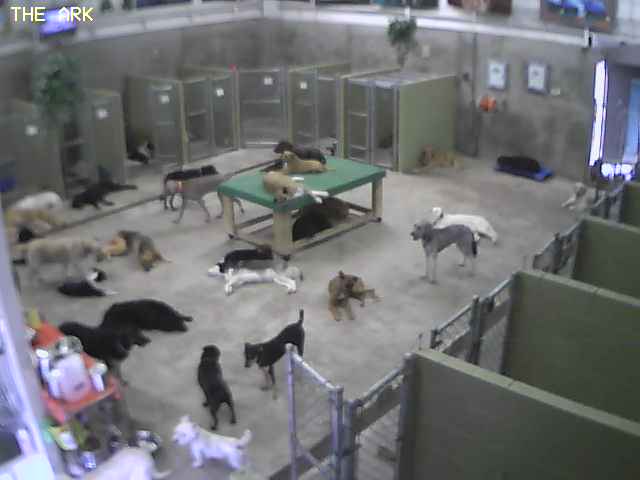
Today, I took him to dog daycare.  I was nervous about whether he would be OK with the other dogs.  I had the video cam web page up on my personal computer and periodically checked in on him to see how he was doing.  He spent the vast majority of the time in a kennel.  The door was open, but he wouldn’t go out.

A couple of dogs came in and hung out with him from time to time.  The staff told me a greyhound was cuddled next to him taking a nap at one point.  This makes me feel a little better.

But when I pick Tisen up, he wants to go home.  He’s thirsty and distressed.  I suspect he didn’t drink any water the whole time he was there.  I thought it would be good for both of us to have some time apart, but I’m not sure I can handle the stress of being separated.  I’m encouraged that he made a couple friends, though.

You can just barely make out Tisen in the open kennel in the upper left:

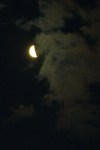
This morning, I managed to get in about 10 minutes of shooting time at sunrise.  I wish I would have been in less of a hurry–I might have noticed I has the ISO set on 1000 and turned it down sooner.  The moon looked so cool with the clouds around it.  One of these days I’m going to figure out how to expose the moon and the clouds in the same shot.  Or maybe my future camera will.  The one I want will process two exposures into one picture.  Can’t wait!