Olympic Adventure

Whenever I go through old photos, I look for things I’ve learned as a photographer.  Sometimes it’s a little depressing.  It’s hard to say what improvements have come from skill vs luck vs improvement in technology.

However, I found one obvious improvement that can only be attributed to me having learned something–straight horizon lines.

Well, it’s not actually true that only my skill has straightened my horizon lines.  In truth, it wasn’t until I recently upgraded cameras and started using the in-camera electronic level that I can truly claim I had straight horizon lines.  But, setting that aside for a moment, as I look through images taken on my first trip to the Olympic Peninsula, shortly after I’d purchased my trusty old Powershot G3 circa 2003, I realize I didn’t even think about straight horizon lines back then.

So, there you have it. Solid evidence that I have retained one piece of information about how to have better images in 9 years.  I feel much better now.

The trek to the Olympic Peninsula from just North of Seattle seemed somewhat epic.  When you look on a map, Olympic National Park looks like it’s right next to Seattle–like it should take a couple of hours to drive there.  But the first hint that maybe it’s not so straight forward is when you try to get driving directions from Seattle to Olympic National Park–google says, “We could not calculate directions . . .”

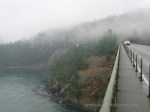
Our route may not have been the most direct.  We went North through Deception Pass to Whidbey Island and, from somewhere in the general vicinity, we took a ferry over to Port Angeles on the Northern end of the Olympic Peninsula.  From there, we made our way along the coast down into the park where we visited an ancient lodge and trekked through an even more ancient rain forest.

Oh wait . . . that’s how we got there on our second trip to Olympic National Park.  Sorry.  On our first trip, we went South to Mount St. Helen first and then North to Olympic and then back via Port Angeles and Whidbey Island.  I had things reversed.

If Olympic were in the Northeastern United States and you asked someone for directions, they would tell you, “You cahn’t get theyah from heeah.”

I would love to go back to Olympic for a week.  Both times we went before, we did more of a drive by, taking only a couple of very short hikes.  I would love to do a through hike of many miles in the rain forest.  The number of elk that we saw in just a mile or so of walking in the midst of the deep shadows of giant trees was amazing–it wasn’t the kind of terrain I expected to find elk in.

It’s too bad it’s so difficult to get to–otherwise we would probably go every year as a short side trip from Portland when we’re out visiting my dad.

Maybe next year.

Portraits in Suburbia

It’s that time of year again:  graduations.  I have begun to divide my life into stages by the kinds of events we celebrate.  Long ago, it was our own graduations and those of our friends.  Then it was weddings.  Next, it was baby showers, followed by divorces (well, that wasn’t usually a celebration).  Then there were second marriages (and occasionally third).

Now, I seem to be participating in the same cycle of events one generation removed.  Because I have friends in many age groups, these events continue in waves depending on how old my friends are.

The high school graduations of my friends’ children started ten years ago.  Those were followed by weddings, and a few baby showers (although babies seem to be coming later and later in people’s lives).

But, this time, it’s my nephew who completed high school.  This event led to us taking Tisen on his longest road trip ever.  Fortunately for us and for Tisen, my brother’s family is willing to accommodate Tisen so he didn’t have to stay in a kennel.  I’m not sure either one of us would have survived the separation anxiety.

The other unintended consequence is that I gained a couple of new models for portrait shooting.  It’s a good thing my nephews were unwarned of my intention to shoot some portraits or I might not have seen either one of them during our visit.  However, I managed to get a few minutes of their time before they got too impatient with me.  What is it about the men in my family that they can’t sit for more than 10 minutes to let me practice portraiture?

They might have been a little intimidated posing next to my strobe on an umbrella stand–I don’t think either one of them has ever posed in front of an umbrella before.

I had fun trying to create some more dramatic lighting by casting shadows with the light.  My youngest nephew seemed to think the lighting was a little too dramatic, but he played along patiently anyway.

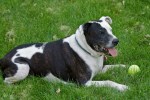
Tisen, never one to pose in front of a flashing umbrella, spent his modeling time discovering the joys of the ‘burbs.  I believe the thick, green grass right outside the door was a first for him.  At home, he can cross an asphalt parking lot to find a small patch of grass or walk to the park to roll in a short, spongy variety of grass.  Before he came to us, I doubt there was much grass in his life.

Unleashed and let out the door in the heart of an Indiana suburb, Tisen seemed at first confused and then overjoyed by the large yard to play ball in.  Although there was no fence, Tisen stayed well within the invisible confines of the property lines as if he was  afraid he would get lost if he got too far from me in that endless expanse of grass.  I am now worried he will resent returning to his urban life.

Native Song

Having survived the Japanese garden at Gibb’s Gardens, I moved on with my co-shooter, John, to another part of the park.  This time, we entered an area that looked like natural woods.

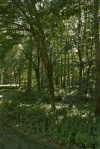
As much as I enjoy gardens, natural woods are still my favorite.  By “natural,” I mean woods with plants that belong there.  This is not the same as, say, a woods covered in kudzu or so overgrown with privet or honeysuckle, you can’t even see through it.

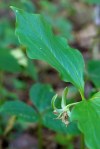
Here, the woods had only native plants and we were both tickled when John discovered a Jack-in-the-Pulpit.  Soon, we were finding more of them.

Near by, we also found some spent Trillium, Solomon’s Seal, Virginia Creeper, and the one native I don’t like to see, Poison Ivy.  I should rephrase that.  I like to see it (it is a beneficial native), but I don’t like to be anywhere near it.  I’m starting to itch just thinking about it.

As we hunted for wild flowers, a wood thrush started serenading us.  The wood thrush’s song is my favorite.  Thrushes can sing more than one note at the same time–they harmonize with themselves.  The wood thrush in particular has a haunting, flute-like song that always makes me want to stop and listen.  You can play a clip of its song here (scroll down a bit).

Although I have heard a wood thrush many times–in fact, one used to summer near our house and was my alarm clock many mornings–I have only actually seen one once.  I have never even gotten close to getting a picture of one.  This relative of the robin is reclusive by comparison.  Wood thrushes hang out in the lower story and underbrush of the woods, magically disappearing behind the tiniest of leaves.  Their brown camouflage helps them disappear, I guess.

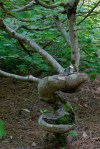
We eventually moved on from the wood thrush and made our way towards the rose gardens.  Along the way, John pointed out a tree that was growing at a nearly 90-degree angle.  He told me native americans used to train trees to grow at angles as a directional indicator towards water or other resources.  However, he felt this tree was too young to be an example of a pointer.  We never did get an explanation for it.

When we got to the base of the hill covered with roses, I was pooped.  Carrying around my 40+ pound backpack and tripod all day had wiped me out.  I suddenly realized I hadn’t had any water since 9:30AM and it was now nearly 3:30PM.  I looked up the hill and decided I really didn’t need to shoot any roses.

John, carrying less than 3 pounds of equipment including a bottle of water, was still feeling energetic enough to head on up to not only the roses, but also the day lilies at the top of the hill.  I guess that’s what a lifetime of experience shooting does for you.

A Mini Krash

Perhaps this is a good time to mention that I am extraordinarily clumsy.  In fact, I was given the name “Krash” many years ago by some friends who were amazed by my ability to hurt myself (thanks, Mike and Bart).  I really should have a blog dedicated to the ridiculous ways in which I’ve hurt myself.

It only follows that, on my first field trip with a new group of people, while hanging out with someone I’ve just met, I would do something embarrassing and at least mildly alarming.

After lunch at Gibbs Gardens, my cohort (let’s call him John in case he doesn’t want to be included in my blog) and I headed off to the Japanese garden.

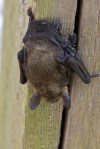
As we walked towards an arbor-like structure, several people were gathered around looking at what turned out to be bats.  I happen to be extremely fond of bats.  I would say my fondness for bats is in direct proportion to how much mosquitoes like to bite me.  Besides, bats are really quite cute.

Two of the bats had gone astray and were clinging to the post of the structure close to the ground.  One appeared to be quite young.  I happened to have my macro lens on my camera, so there was no question but that I was going to get some shots of at least one of the bats.

I opened up my tripod’s legs so I could place my camera very low to the ground, level with one of the bats.  Then, I bent over to look through the view finder.  This is when the 40+ pound pack on my back slipped forward and conked me in the back of the head.

This is also when I discovered I had mounted my camera backwards on my tripod head.  I never really worried about which way was forwards or backwards, but now I will.  When you mount your camera backwards in the clamp on my tripod mount, there is a metal lever facing you.  This doesn’t seem like a big deal until a 40+ pound backpack smacks you in the back of the head and shoves your lip into the metal clamp.  Fortunately, I lost only a little blood and no teeth.  Poor John kept trying to find ways to carry things for me after that incident.

It reminds me of a former boss who used to watch for things I might run into and steer me around them when we were walking together.  He started this practice after I bounced off a wall turning a corner too soon while I was mid-sentence.

I’m thinking about teaching a photography workshop on how to prevent injury while shooting.  Most people probably worry about that when they’re shooting on a cliff or going on a safari in Africa or shooting for a newspaper in the middle of a war.  I have to worry about it when I bend over to look through my view finder.  But, hey, it could be a niche market.

Gear Envy

Continuing the Gibbs Garden field trip, my cohort and I made our way down from the Manor house back towards the main entrance in time for lunch.  Along the way, we frequently paused to shoot.

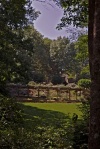
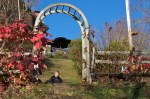
Below the Manor House, looking back up the hill, an arbor stretched across the hillside below the house, surrounded by flowers.  It was so beautiful, we had to stop to shoot.  Unfortunately, the sun was high and the house was lost in dark shadows.

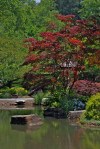
As we worked our way back down, we found numerous water features.  Between natural looking creeks and man-made ponds and streams, each had a distinct character.  The bridges that accompanied them were just as varied.

It’s funny how I can look at a scene, know that the lighting is not going to allow me to get the image I want, but not be able to resist trying anyway.  I wonder if this is the difference between digital and film?  Between knowing I can just delete any bad shots and that I can do quite a bit in post processing to improve the harshness of the light, I can’t walk away without shooting.

I haven’t quite figured out how to fix bad lighting in software, though.  While I can lift the shadows and pull down the highlights and do all kinds of interesting adjustments, in the end, it’s still bad lighting.

My first impulse in dealing with harsh lighting is to reach for a polarizer.  While it can’t fix the light, it can at least remove a lot of glare.  Two things have recently changed, however.  First, I have been shooting wide angle with a lens I added a couple months ago, which requires an 82mm filter.  My polarizing filter is 77mm.   So, I had to switch lenses to my most recent addition, a 24-70mm, which takes a 77mm filter.

After switching lenses just so I could use a polarizer, the second recent change come into effect.  I now have enough gear that I need two bags.  This has created a whole new problem.  I only brought one bag with me and I forgot to put my filters in it before I left.  So, I had picked a lens to fit a filter I didn’t have with me.

It seems like getting more stuff complicates photography in the same way it complicates the rest of my life.  The cost of more gear is more than the price–it also means more time organizing it, looking for it, and switching back and forth.  I think I’m about to hit my limit on wanting to further complicate my hobby.

Interestingly, the photographer I shot with at Gibbs Garden has been into photography since he was a boy.  Once film became too expensive and inconvenient, he switched to a high-end point-and-shoot with full manual control.  He carried his small, light-weight camera, a proportional tripod, and nothing else.  I was extremely envious by the time we sat down for lunch.

Field Trip

Today, I went on my first field trip with the photography club I recently joined.  We went to Gibbs Gardens in Ball Ground, Georgia.

While it was quite a drive (2 hours), driving in this part of the country is always scenic, which makes the time pass quickly.  Today’s drive was no exception, although I did feel a bit guilty for not riding with someone else to limit gas consumption.  But, I’m having some back issues and thought I might need to leave early.  Fortunately for me, my back made it until 3:30.

Gibbs Gardens is a private garden created by someone who owns a landscape company and recently opened to the public (for a price).

Getting there was interesting.  As has often happened when I’ve ventured out with a group, I ended up on what seemed like remote, two-lane highways that go from 55 to 45 to 35 mph as they pass through small . . . let’s say “villages,” these places are too small to call towns.

And, another common occurrence, I inevitably find myself behind someone who wants to go at least 10 mph slower than the speed limit.  Today, I was afraid I was going to end up going 35 mph for 30 miles.  Fortunately, the very sweet looking little old lady ahead of me turned after only a few miles.

As I accelerated back to the speed limit and entered some sharp turns, I found myself wishing I’d driven our old BMW instead of the mini-van.  Let’s face it, even a bicycle would be more fun to drive than a mini-van.

When everyone arrived, we gathered and posed for a group photo and then scattered to go shoot.  Luckily, one of the guys I’d met before was company-tolerant and we ended up shooting together.  Otherwise, besides the $2 discount on the entry price by coming as a group, there wouldn’t have been any advantage to going with the group.

The one big disadvantage was that we didn’t get started until after 10AM by the time everyone arrived.  The light was already starting to get bad.  That is the one thing I would suggest to Gibbs Gardens–they should offer early or late entry to photography groups.

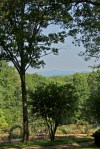
We headed up to the Manor House first, hoping to get to see the view of the mountain before it got hazy.  We didn’t immediately figure out where the mountain was visible from, so it was quite hazy by the time we found the view.

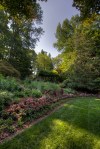
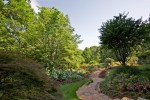
Regardless of the less than optimal time of day, the manor house and its surrounding gardens were amazing.  There is so much stone in the garden walls and walkways that I have to wonder how they got it all there.  The pool was so inviting, it’s a good thing we didn’t go there latter in the day–I probably would have jumped in.  I’m pretty sure they kick you out if you start swimming in the pool.

Dogs and Nomads

It was a big day for Tisen.  We drove to Atlanta last night and stayed in a La Quinta (did you know they allowed dogs for free?).  Pat hung out with Tisen until my work meetings were over and I could take the rest of my meetings from the car while he drove us back home.

Tisen did not seem like he felt well from about an hour into the drive to Atlanta until we returned home today.  He was clearly nervous about traveling.

After returning home, we took Tisen with us to McKamey Animal Center to officially adopt him.  Nearly every staff member on duty came to see Tisen and to thank us for adopting him.  I’m not sure why they were thanking us–we are so grateful to them for saving him.

I have spent much of the evening with eyes brimming with tears, overwhelmed with gratitude.  Gratitude for the people who saved Tisen.  Gratitude for Tisen himself.  Gratitude that my sister-in-law fosters cats (which gave me the ides to foster dogs).  Gratitude that Anna introduced us to Tisen.  Gratitude that Tisen picked us as much as we picked him.

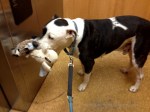
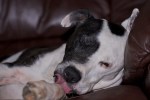
While we are at the shelter, Tisen flirts with a boxer/bulldog mix named Rosie through a glass door.  She has the opposite eye patch from him and they seem like they were made for each other.  She is so ridiculously cute, we are suddenly tempted to bring home a friend for Tisen.  But, when we do the “meet and greet” to see how they get along, Tisen will not allow Rosie to get any affection from any human in the room.  When someone starts to pet her, he dives between human and Rosie, making growly noises.  We decide Tisen wants to be an only dog, which is probably for the best.

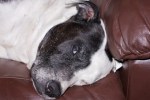
After another stop at PetsMart for a couple of items we forgot last trip (which results in the purchase of yet another squeaky toy), we return home.  I cuddle Tisen on the couch.  He lays across my lap and sighs like life just doesn’t get any better.  As I sit here petting him, I think he might be right.

But, I am trying to write my blog.  Tisen seems to want to be between me and my laptop.  I tease him that he is both helping me write my blog by providing a subject and preventing me from writing my blog by physically interfering.  He doesn’t seem to get the joke, but he sighs again and readjusts, hoping for a belly rub.

As I contemplate the long-term commitment we have just made, I realize I might have to change my domain name.  We came to Chattanooga thinking we would live here 6-12 months and then move on to a new area.  Instead, we have extended our lease on our apartment, committed to lease a manufacturing space for 3 years, and taken in a dog.  So much for being nomads!


Catch the Moon

I have been using the moon as a model a lot, but I find it is not as cooperative as I expected.  While, like a model, it’s a heavenly body, unlike a model, it presents itself on a predictable schedule.  As such, you would think it would be easy to schedule a shoot.  However, I have learned that a) there is such a thing as cloud cover, b) the moon doesn’t always rise before I go to bed, c) the moon often rises out of sight from where I am looking.

As a result, I have started to worry more about missing the shots of the moon rising behind the Walnut Street bridge in August.  I now wonder if perhaps that was a once-in-a-lifetime opportunity that I missed.

Now that I have a lunar calendar that tells me what time the moon rises, a good tripod, and the ideal composition in mind, I just need the moon to return to it’s former position in the sky.  In doing a little research, I found www.photoephemeris.com for planning outdoor shoots in advance and even tools to figure out where the moon will rise and the path it will travel.  (Maybe we can all be Ansel Adams after all?)

However, this doesn’t answer my question as to how long it will be before the moon rises in the same location.  I am having some troubles finding an answer to this.  I have found articles on the difference in appearance of the moon at apogee vs perigee, the repeating cycle of maxima and minima delineation that takes 18 1/2 years, and calculating the differences in brightness, but I still can’t find how long it takes for the moon to rise in the same location.  I’m guessing that it will repeat within my lifetime, but probably not soon.  In the meantime, I keep watching the moon when it chooses to show itself and looking for opportunities to shoot it rising.

The shot here is a full moon rising through clouds, shot with my iPhone (which was convinced it needed to flash) from a rest area while driving back to Chattanooga from Columbus.  While this looks more like something I might, say, paint during a continuing education class on impressionist painting, I am still impressed by the improvements in the iPhone camera from the 3GS to the 4S–just don’t expect to get good landscape photos at night.

I am particularly impressed with the LCD flash on the iPhone 4S.  I was a little surprised by how brightly it flashed when I took a picture, but when I discovered the flashlight app now has a setting that lets you turn on the LCD light continuously to use it as a flashlight, I was amazed.  I was able to find my workout clothes in the dark this morning and successfully determined the difference between black and dark purple.  If you haven’t upgraded, it’s time.

The Musings of a Passenger

It’s our final day in the Smokies.  Checkout time is at 11:00AM and I have a massage scheduled at 11:00AM.  As it turns out, it’s the last day the lodge will be open for the season.  Having fed us all breakfast, packed us all one last lunch for the road, and checked us all out, they are closing down the lodge for the winter.  I feel a little bad about the timing of my massage, but since I didn’t pick the time, I decide not to worry about it.

Pat takes another walk out to sunrise point while I head off to the massage room with the massage therapist.  After he walks, he will sit in the lodge lobby, in front of the giant fire place, reading something from the large library accumulated there.

The massage is wonderful.  I feel like jelly afterwards, oozing back into my clothes, out into the cold, and into the car.  It’s a nice state to go for a ride in, actually.  I try to sit so I’m not hunching up my shoulders, maintaing the state of relaxation I’ve obtained.  I look out the windows and absorb the limited view with little going on in my head (for once) besides the occasional reminder to relax a muscle that’s tightened up again.  After several minutes, Pat asks me if I’m sleeping.  I laugh at this–like I must be asleep if I am this relaxed.

I rouse myself a little.  Enough to engage in conversation with Pat.  I try to keep part of my mind checking in to make sure I’m staying relaxed periodically.  This gets a little tricky as we wind our way along the Cherahola Skyway where a storm apparently went through last night.  Fallen trees and other debris surprise us around many curves.  Fortunately, any of the trees that were all the way across the road have been cut and hauled away by now.  I find myself wondering if Snowbird Mountain was not hit by the storm or if we just slept through it.

The thick fog makes the views limited today.  I’m grateful that we had a couple of days of great visibility to see the spectacular views.  While I’ve never been one to go for scenic drives unless it was on the way to somewhere else, on a clear day, this drive is one that would be well worth going out of the way for.  Even from the car, it makes you feel connected to the world around you in a spectacular way.

One of the things that has caught both Pat and me by surprise since moving to Chattanooga is how beautiful this part of the country really is.  Even though we have both been to this region many times earlier in our lives, we both sort of dismissed it.  Perhaps it’s like the way we tend to mind our manners less with people we know will continue to love us anyway–the Smokies were accessible.  You would think this would make them more desirable, but we both tended to prefer trips out West when we started planning vacations.  The Rockies and Sierra Nevadas seemed far more appealing than the Smokies.

Now, discovering another incredibly beautiful place nearly every time we turn a corner, I feel dismayed that we missed earlier opportunities to more fully explore this area of the country.  Like I’ve been a bad friend, taking the Smokies for granted, thinking they would be there waiting for me to find time for them.  As it turns out, they did.  But, to use a photography analogy, I previously saw “the Smokies” through a wide angle lens–a single scene to take in one shot.  I now see “the Smokies” through a macro lens–an infinite collection of possibilities, each with their own virtues.  I don’t have enough life left to see the things I now want to see just in this area.  Then again, I suppose even a full lifetime wouldn’t be enough time anyway.

This causes me to ponder the whole concept of being nomadic.  If the purpose is to see and experience new things, can’t that be achieved while standing in one place?  After all, when I get out my macro lens, I discover the closer I get to a subject, the more of its details that are revealed, the more magnificent my subject seems.  Each time I experience this, I am awed by the things I never noticed before.

Here is an example of a Katydid (I think), which I normally would just see as a large, green bug, but its beauty is revealed in its intricate details and varying colors when viewed up close:

I am reminded of an experience I had back in Columbus that I may have mentioned before.  I used to ride my bike to work regularly.  My favorite part of the ride was the short stretch along the Olentangy multi-use trail.  I would enter a section of the trail that was in thick woods.  Then, the woods fell away abruptly to an open field that had been turned into a prairie habitat, full of wild flowers.  I could hear the birds all around me and I felt certain there were birds all over the flowers in that field, but I could never see any.

Then, on a Sunday, I went roller blading on the same trail.  At that speed, I was able to see some song sparrows and goldfinches popping in and out among the flowers.  I was surprised I didn’t see more birds, though.

One day, on a weekend, I went for a walk and ended up strolling through the prairie.  I spotted motion and stopped and stood still to better see.  When I stopped moving, it was like a curtain lifted.  For the first time, I saw that the prairie was buzzing (literally) with life–bees, hummingbirds, several types of sparrows, chipmunks, mosquitos, so many forms of life moving all around me that I couldn’t begin to count them all.  But I had to stand still to notice they were there.

I suppose, as is true of virtually everything in life, it’s all about balance.  A balance between seeing the forest and seeing the trees means a balance between moving and standing still.  A balance between seeking and finding means a balance between dreaming and realizing.  I wonder how you know when you’ve found the balance point?

A Little Gratitude

It’s Thanksgiving Day.  And today, I am full of thanks.  I remember reading once that it’s easy to be grateful when things are going well, but the trick is to be grateful when they’re not.  Fortunately or unfortunately, as the case may be, this is an easy year to be grateful.  I count my blessings as we make our way from Chattanooga to the Smokies, where we will spend the long weekend.

We arrive at the lodge right around 1PM.  The Thanksgiving buffet has just started.  We get checked in, drop a few things off in our room, and then head to the dining room.  We walk down the buffet table checking out each dish, trying to decide what to leave room for and what to skip.  The inn keeper tells us there’s a menu printed on the table that lists all the dishes.  I laugh and tell him that would be great if I’d brought my reading glasses.  He laughs and we continue to peek at the food.  In the end, the preview was a wasted effort on my part.  The only dish I skip is the salad.  I take at least a small spoonful of everything else.  I will try it all and be grateful for the chance to try something new.

At least, that was my intention.  My swelling gratitude trips a little when I take a mouthful of whipped sweet potatoes and discover pieces of celery hiding in the mix.  A personal favorite complicated by an unexpected flavor.  I have to pause and figure out what I’m eating.  When I realize there is celery in my potatoes, I am both shocked and relieved. After all, celery is edible and I like it, but it is a surprising ingredient in sweet potatoes.  I return to gratitude and enjoy selecting the next bite of food.

In the background, a large family eating their Thanksgiving dinner together joins hands and one of the men at the table says a long and loud prayer.  I suddenly feel like an eavesdropper overhearing a private conversation.  It somehow feels wrong to me to hear this family sharing their form of gratitude.

My own sense of gratitude is a bit strained.  I refocus on the food, which is wonderful if different.  I think about the fact that I didn’t have to cook, we didn’t have to drive very far, we have a comfortable place to stay, and, best of all, we’re in the middle of the Smokies with a spectacular view.  If we had family or friends with us now, that would be the only thing that would make it more perfect.  But part of me feels like we’re missing the most important thing.  Then, I decide that instead of missing them, I will think of each of them.  I hold each family member and each friend in my mind for a moment, feeling gratitude for their presence in my life.  It’s a centering experience, reminding me of what’s important to me and how much I have to be grateful for.

When we finish eating, we go outside to take in the view.  We take a slow stroll in our city clothes along a short path to the Sunrise Viewpoint.  We pause to sit in a porch swing hung along the way.  We sit and talk over a leaf blower, a workman approaches, clearing all the leaves off the path.  He turns off the blower when he sees us, but we tell him to go ahead and finish his work.  He removes the leaves from the entire length of this short trail.  Given that this is a dirt path through the woods, I’m a little surprised that they blow the leaves off of it.  I am wearing my favorite new boots and would prefer that they didn’t since the leaves would prevent my boots from getting muddy.  When we continue our walk, I step carefully, trying not to let my boots sink into the dirt.  I am reminded of someone recently commenting that they had a hard time imagining me roughing it.  This comment surprised me at the time, but as I imagine what I look like in my urban clothes gingerly stepping around the mud, I think to myself, “Oh what a difference a change of clothes can make!”

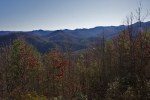
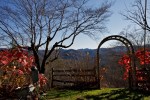
At the sunset point, there is a deck with adirondak chairs to sit and watch the sun come up.  There’s a lovely view of the lake and mountains below.  Even better, there’s a bell hanging from a post with a mallet to strike it with.  When I give the bell a tap, it rings out with a sound that makes you think, “Ahhh.”  If peace were a sound, this is what it would sound like.  It rings on and on in a growing sort of sigh.  I am amazed at how long it continues from one gentle tap.

We sit for a bit, but then head the opposite direction towards the sunset point.  The view is less open from the sunset point and I want to get back to the lodge so I can capture some of the end of sunset, so we hurry back, me still trying to keep my boots from getting muddy.  After shooting, we find a spot to sit and relax where there is still some sunlight that keeps us warm.  As we sit and absorb the last rays of light, a group gathers  on a deck above and starts singing hymns.  Unfortunately, while some individuals seem to have good voices, as a group, they are painful to listen to.  We decide to head inside.  We enter the warm lobby and, after dropping off my camera, head to the bar.  With a glass of wine, we sit in front of the fire and relax until it’s time for dinner.

As we sit and unwind, I think again of friends and family and how much fun it would be to have them all here now.  Well, maybe not all at once.  I have the overwhelming urge to tell them all I love them.  I end up posting on Facebook instead.  I’m sure there’s an expression for posting on Facebook when you are overly emotional and possibly a little tipsy.

After sandwiches and dessert, we retire to our room and decide we might as well go to bed.  It’s been an amazingly relaxing day.  In fact, I can’t recall having ever had such a low stress day.  Another thing to be grateful for.

But I lay in bed awake, feeling a little guilty for having this day.  I decide to call my parents, but discover I have no phone signal.  Since the lodge does have WiFi, I send them an email instead.  It’s still early enough where they are that they are probably just now eating Thanksgiving dinner anyway.  Pat sends his mom an email while I write to my dad.  I feel a little better now that we’ve at least made some contact.  Then I check my Facebook page and feel like I’ve stayed in touch with my friends all day.  i decide Facebook is another thing to be grateful for.  Then, I set aside my mobile devices, roll over, and do my best to fall asleep, feeling grateful for a warm bed.