Cayce Rocks the House

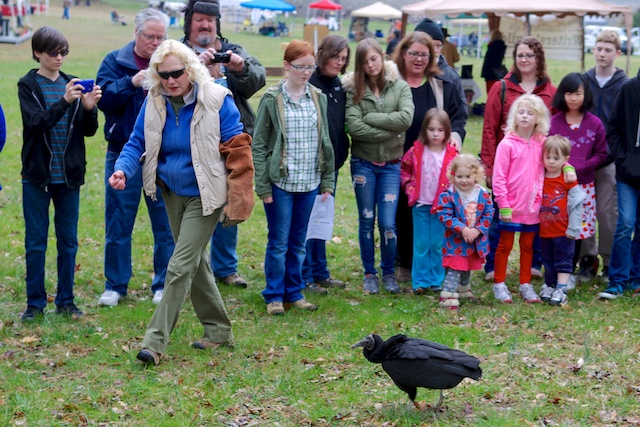
Cayce follows Dale around much like a faithful dog

Cayce follows Dale around much like a faithful dog

Cayce is my favorite vulture.  Is it normal to have a favorite vulture?

Normal or not, I suspect anyone who has ever met Cayce falls into the same camp–Cayce is their favorite vulture.  Of course, for most people, there’s a high probability that Cayce is the only vulture they’ve ever seen (or at least realized they’ve seen).
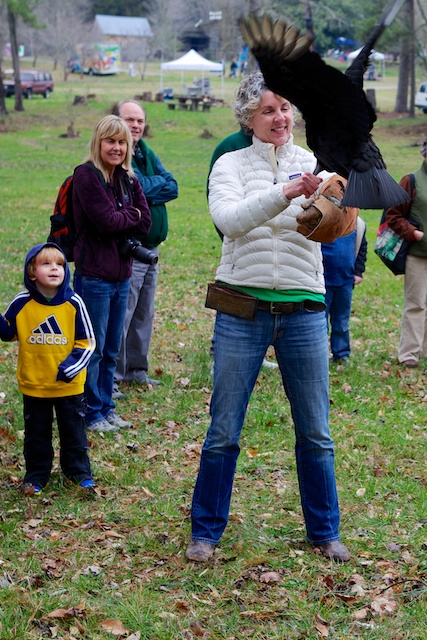
Cayce hops to my glove in exchange for a piece of beef

Cayce hops to my glove in exchange for a piece of beef

This reminds me of when Pat and I went on a tour of Taliesin West (Frank Lloyd Wright’s Arizona-based school of architecture) and the tour guide told us that on almost every tour someone says, “Frank Lloyd Wright is my favorite architect.”  He said he always has to stop himself from asking who their second-favorite architect is–he’s pretty sure most people who say this can’t name a second architect.

Sometimes Cayce prefers to hop from glove to ground, run, and then hop up to the next glove--it's pretty funny the way she hops

Sometimes Cayce prefers to hop from glove to ground, run, and then hop up to the next glove–it’s pretty funny the way she hops

Like Wright, Cayce has the advantage that vultures (and apparently architects) don’t usually become household names.  However, unlike the stories we heard about Wright, Cayce has an irresistible personality.

Dale spends a few minutes setting the stage by telling the audience about vultures, their role in preventing the spread of disease and their importance to the environment.  Then she explains how Cayce was erroneously rescued and became a human imprint.

The young lady celebrated her birthday holding a vulture

The young lady celebrated her birthday holding a vulture

When everyone is wondering what it’s going to be like to see a Black Vulture up close, Dale calls “Here’s Cayce!”  and I open Cayce’s travel crate.  Cayce comes charging out and starts looking around like she’s trying to get oriented.  I toss a small piece of beef towards the center of the circle formed by the audience and Cayce runs front and center.  Once she sees Dale, she is good to go.

Cayce heads back to my glove having just passed over the heads of the surprised audience

Cayce heads back to my glove having just passed over the heads of the surprised audience

As Dale continues to tell the small audience about Cayce, she walks along the circle of spectators with Cayce following at her heels.  It’s pretty clear that Cayce would follow Dale anywhere.

Usually, when the birds are going to fly during a program, they get their breakfast during the show, flying for their meal.  This both keeps them properly fed and motivated to fly.  However, on this day, Dale forgot and fed Cayce her full breakfast.  Often, a bird of prey won’t fly if it isn’t hungry–after all, their instinct is to expend energy flying purely for the purpose of seeking food.

Fortunately for us, Cayce loves to please a crowd.  In spite of her full stomach, she launched perfectly several times, buzzing the heads of the audience.  Everyone ducked as Cayce barely clearer their foreheads–her feathers brushed back the hair of one taller gentleman.  This is always a crowd pleaser.

The second time Cayce buzzes the audience, they are a little better prepared and start to duck early

The second time Cayce buzzes the audience, they are a little better prepared and start to duck early

One of the reasons an unreleasable vulture makes a great entertainer is because, unlike Cayce’s raptor relatives, vultures don’t have talons.  Their feet more closely resemble a large chicken’s, making close fly-by’s much safer.

Of course, we humans would be happier if Cayce could live out her life in the wild.  But I doubt Cayce agrees–after all, she returned to humans after being released several times.  I think she found her calling.

Cayce comes in for a surprisingly gentle landing

Cayce comes in for a surprisingly gentle landing


*Photography credit goes to Pat, my wonderful husband who took all shots of the birds of prey program.

Family Act

Posing for Granma's Camera

Posing for Granma’s Camera

Sometimes I think I’m a bit odd.  Maybe just slightly kooky, a little nerdy, maybe even a bit eccentric.  Then, every once in a while, I discover how truly normal I am.  It’s almost disappointing, really.

For example, I thought maybe getting so excited about spending time with the wonderful birds of SOAR that it evoked childhood memories of the night before Christmas might be unusual.

Paul introduces Artie to one of the younger audience members

Paul introduces Artie to one of the younger audience members

But what I’ve learned is that it’s not unusual at all to grin ear-to-ear when encountering wildlife up close.  In fact, I believe every person I’ve seen attend any birds of prey program has responded with a similar grin.  It really comes as no surprise that my brother and sister-in-law, joining us for the weekend, also exhibited the same jaw-cramping grin while helping out with an intimate show at the Little Owl Festival here in Chattanooga this weekend.

Megan holds Jerry up for all to see

Megan holds Jerry up for all to see

The rain started early, turning into a light drizzle by the time we arrived at Audubon Acres for the festival.  The organizers were fairly certain it was going to be dry for the duration of the festival.  We were a bit nervous.  But, we chose a back corner of the meadow, as far from the train tracks as possible, and started setting up.

We waited to start the program until after the civil war re-enactor had fired his musket a few times.  Thankfully, one of the event planners thought to warn us so we left the birds in their carriers until after the smoke from the gun shots had cleared.

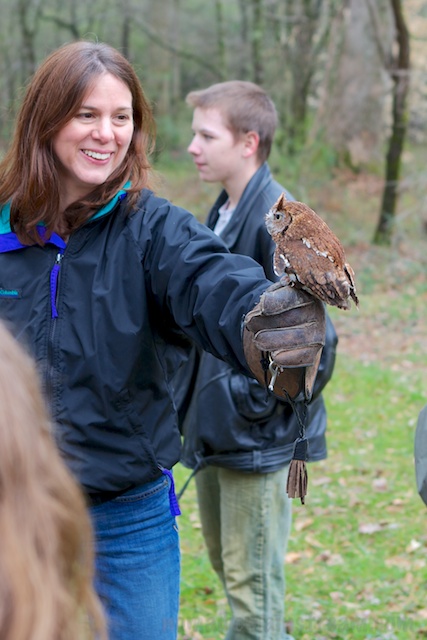
This birthday girl got quite a treat petting Jerry

This birthday girl got quite a treat petting Jerry

Once things had settled down, the small crowd that had braved the early weather headed our way and we got ready to start the show.  We had a small enough group to have them in a circle around us, which allowed everyone to get a front-row view of each bird, with time to pause for photos.

Megan was walking with Jerry, a Screech Owl, who was the only bird there that could be touched.  Megan got the added pleasure of seeing children’s faces as they touch an owl for the first time in their lives.  It’s a look that makes me smile so hard, my TMJ issues kick in and cause stabbing pain in my face.  It’s worth it.

Seeing my brother with Artie makes me smile, too.  I asked him what was going on in this image:

Paul trying to read Artie's mind

Paul trying to read Artie’s mind

He said, “He was looking at me.”  The angle makes it a little hard to tell, but my brother is still grinning ear-to-ear.  I kind of get the feeling that if Artie could grin, he would be, too.

By the way, I should mention that today’s photos are all by my favorite guest photographer, my husband.  I put my camera on Automatic and handed it to him.  Although I had to crop quite a bit because I should have put a longer lens on the camera, he did a fabulous job in a difficult shooting situation.
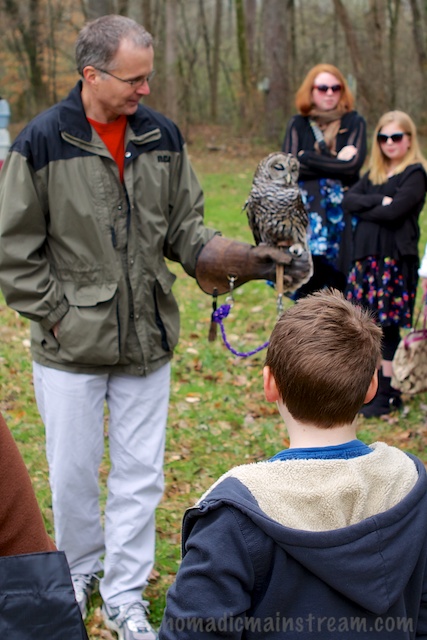
Paul squats to let the shortest audience members get a good look at Artie

Paul squats to let the shortest audience members get a good look at Artie

Gilbert’s Sour Grape

In spite of our non-compatible species issues, Gilbert always makes me smile

In spite of our non-compatible species issues, Gilbert always makes me smile

Gilbert is a special boy.  He’s an American Kestrel who was “rescued” by some well-meaning people when he didn’t need to be rescued.  He became a “human imprint.” Perhaps you’ve heard stories about ducks following around a person after seeing them immediately after hatching, but imprinting behavior applies to all birds and isn’t limited to the first thing a newly hatched bird sees–a young bird can imprint on whoever its caretaker is after it hatches.

Besides not being able to survive in the wild, there are some other problems associated with human imprints.  Gilbert is experiencing one of those right now–he has biological urges.  But, as a bird who thinks he’s a person, this is rather complicated.

Poor Gilbert wants a girl, but he’s more interested in humans than he is in other Kestrels.  This seems to be true in spite of the fact that it’s not clear Gilbert can distinguish between a female human and a male human.  He talks continuously as soon as he hears a voice, clamoring for affection.

If Gilbert were a dog, we would say he was barking up the wrong tree.  Gilbert isn’t so different from humans in this respect.  While he may be suffering from species confusion, many of us humans suffer from equally self-destructive confusion when it comes to selecting a mate.  From what I remember, Gilbert could relate to human dating confusion such as:

Showing off Gilbert's wings and tail

Showing off Gilbert’s wings and tail

  1. Confusing being liked by someone with liking someone.  These are not the same thing.
  2. Trying to chase a potential love interest without appearing to chase.  This usually results in the kind of humiliating goofiness responsible for the creation of the movie genre called “romantic comedy.”  It’s much easier to maintain our dignity by just being direct about our interest.  Even if we get shot down, we don’t have to waste a lot of time delaying what was inevitably going to happen anyway.
  3. Becoming someone else.  If Gilbert could morph himself into someone much taller with longer legs, lose the beak, feathers, tail, wings, and, perhaps most importantly, trade his talons in for feet, he would have a better chance at landing himself a hot woman.  While we might laugh at the prospect of a tiny Kestrel transforming himself into a handsome, human prince, it’s amazing how often humans try to make similarly impossible transformations to win their love interest.  Really, the secret to happiness is to love someone who can love you back just as you are.
Small children were fascinated by Gilbert

Small children were fascinated by Gilbert

I wish I could explain to Gilbert why he needs to either figure out how to be attracted to female Kestrels or join the priesthood, but I don’t speak Kestrese.  In the meantime, Gilbert sings to me, telling me how handsome he is, how energetic he is.  He tries to convince me we will make a beautiful couple.  I don’t have the heart to tell him that he and I can never be together.

Instead, I make cooing noises and hope he finds it comforting.

Gilbert may have trouble getting a girl, but he sure is a crowd pleaser

Gilbert may have trouble getting a girl, but he sure is a crowd pleaser


*Note:  All photographs in today’s post taken by my husband; edited by me.

Winter Bird Walk

A male cardinal looks remarkable brilliant--he seems to be ready for spring

A male cardinal looks remarkable brilliant–he seems to be ready for spring

I managed to crawl out of bed early enough to lead a bird walk at 9AM this morning.  It was cold.  Yesterday, it wasn’t.  Yesterday, when I slept in until 8AM and stayed indoors all day, it was warm.  Today, there were snow flurries blowing around by mid-afternoon.

Fortunately, it was clear and sunny for the bird walk this morning.

A small group of us met for a mid-winter bird walk.  I kicked us off with a quick look and listen at a few birds I expected us to see who aren’t around for the spring and summer bird walks.

One of them is among my favorite birds.  It’s the White-Throated Sparrow.  This is a bird who is actually quite common in the winter months, but one that I personally failed to notice until I was in my 30’s.  Many of us go through life believing there is only one kind of “sparrow” and not knowing that the sparrow we most frequently see is an invasive import from Europe.  In reality, there are many native species of sparrows in the US.  The white-throated and the white-crowned are my two favorites.  There is a simple reason for this.  They have bold black and white stripes on their heads, making them easy to identify compared to many of the other sparrows.

A white-throated sparrow picks through a pile of leaves

A white-throated sparrow picks through a pile of leaves

The White-throated sparrow also has a distinct and beautiful song that makes them an easy bird to learn by sound as well as sight.  I won’t attempt to describe it, but it’s very high-pitched and clearly whistled.  Canadians claim it’s singing “O Canada,” but I can’t say that’s what I hear.

A second bird I planned for us to see was the yellow-rumped warbler.  These winter visitors are always a cheering sight with their bright-yellow rumps in the middle of winter.  Unfortunately, the only one anyone saw today flew off before the rest of us got to see it.

We had a nice surprise when we spotted a swamp sparrow while watching some white-throated sparrows.  It took us a while to realize what we were seeing.  After all, it doesn’t have bright white stripes on its head to neatly narrow down the possibilities.

In lieu of a shot of the swamp sparrow, here is another shot of the white-throated sparrow

In lieu of a shot of the swamp sparrow, here is another shot of the white-throated sparrow

Meanwhile, the Song Sparrows flew in and out, singing all the while in the background.  I hate to ignore the song sparrow–they are such great singers and they manage to keep it up year round.  But, it’s hard not to see a song sparrow in the park, they are so prevalent.

My one regret on the bird walk is that I didn’t look closely enough at the lens on my camera when I grabbed it.  I thought I had the 100-400mm lens on my camera when, in fact, I had the 70-200mm lens on it instead.  This resulted in a lot of “where’s waldo” shots like this one:


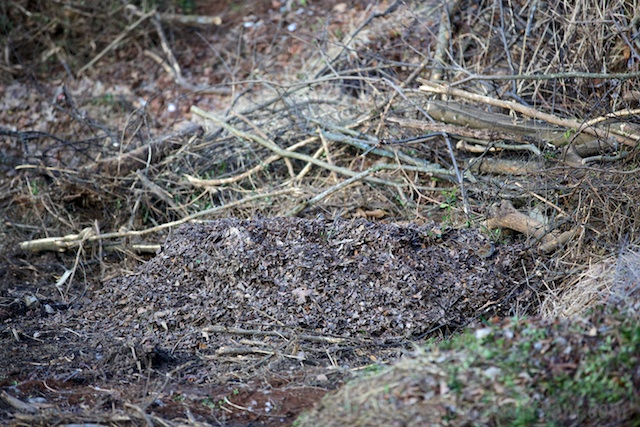
Can you spot the bird?

Can you spot the bird?

The earlier images are heavily cropped to make it a little easier to spot the bird.

One for the Road

Bald Eagle over Hiwassee Refuge

Bald Eagle over Hiwassee Refuge

At the Sandhill Crane Festival, some of the volunteers spotted a bald eagle and what I believe they said was a Northern Harrier.  I didn’t get a good look at the Northern Harrier and, unfortunately, the birds were circling far enough away that my 400mm lens wasn’t sufficient to get a good shot.

Circling Eagle and Hawk

Circling Eagle and Hawk

Smaller birds circled outside the frame, periodically diving at the much larger birds of prey, trying to convince them to move along and feed elsewhere.  The eagle and the hawk seemed to run into each other almost by accident.

They soared around in a big, oblong loop like they were discussing their winter vacation plans and trying to arrange a carpool.  Eventually, they must have realized they were headed different directions.  They split off and flew out of sight in opposite directions.

I am puzzled by how birds navigate on their long migration journeys–especially those that don’t travel in flocks or who are migrating for the first time.

Migrating ducks stopping over to recover before continuing South

Migrating ducks stopping over to recover before continuing South

Apparently I am not the only one puzzled by this feat.  Scientists seem to think birds are able to identify the direction they’re going, perhaps using the sun, moon, and stars for orientation.  However, it’s unknown how birds find an actual place when they do things like fly across an ocean and return to their nest from the year before.  In some experiments, birds were captured and moved via aircraft to a distant location.  They still managed to find their way back without wandering.

I used to think I had a great sense of direction.  I remember being lost in Dallas back when I was in my late 20’s.  I was with my boss, but I was driving since the rental car was in my name.  We had gone to see the West End in Dallas–a place everyone kept telling us we had to see.  Then, it was time to return to the airport for our flight home.  The airport is a good 30 minute drive from the West End of downtown if you don’t run into any traffic..  This is almost an impossibility in Dallas.  I ended up doing a 6-month temporary assignment down there and during that time, I experienced getting stuck in traffic at 11PM on a weeknight on more than one occasion.

Sandhill Cranes on the bank

Sandhill Cranes on the bank

I managed to determine what direction we needed to go without a map and got us to the airport on time.  My boss was impressed.

More recently, having moved to Chattanooga, I’ve had the realization that my sense of direction isn’t a sense of direction at all.  Rather, it’s a way of orienting myself to direction by noticing what direction I’m going relative to where I started from.  I can only do this when I’m in a place whose streets form mostly straight lines.  In Chattanooga, even after a year and a half, I remain hopelessly disoriented and often lost.  Imagine if I were a bird flying over the ocean–I would drown.

AU0A9072

Cherokee Removal

Wide view of map of the removal routes of the Cherokee

Wide view of map of the removal routes of the Cherokee

The Hiwassee Refuge, like many natural areas in the vicinity of Chattanooga, was once part of the Trail of Tears.  As such, it includes the Cherokee Removal Memorial Park.  This park honor the Cherokee and memorializes those who died during their passage from Blythe’s Ferry or the after-math of living in a much harsher climate.

Looking at the routes from Chattanooga

Looking at the routes from Chattanooga

The memorial includes a map of the routes the Cherokee took to get to Oklahoma where they were given land in the form of a reservation.  It’s hard to imagine making one’s way from this part of Tennessee all the way to Oklahoma by foot–especially when there were no direct routes.

The road from the Memorial to the Overlook

The road from the Memorial to the Overlook

I try to imagine what it would be like to have someone tell me that I was no longer to live in my home and if I didn’t relocate to some reservation some 800 miles away (by highway today), I would be removed forcibly by the military.  It’s not the kind of thing one associates with being an American.

We like to think we are the land of the free.  As a culture, we believe we have the right to the pursuit of happiness.  It’s hard to understand that the Cherokee were seen as hostile non-American inhabitants who were preventing progress.  Those were different times.

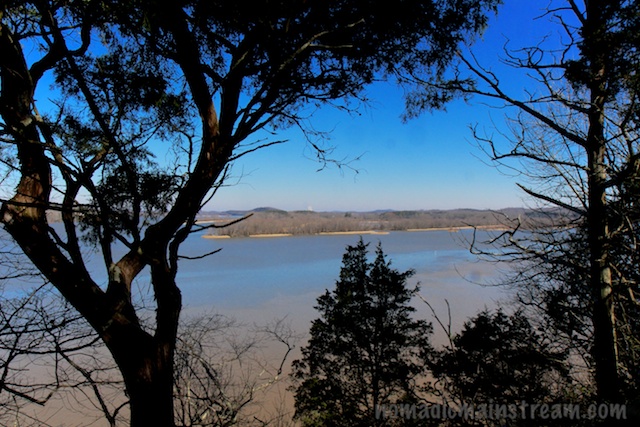
View from the Overlook at Cherokee Removal Memorial Park

View from the Overlook at Cherokee Removal Memorial Park

In the US today, we allow people to establish their own religions, create their own communities, and even exempt them from US laws that apply to other US citizens (for example, the Amish are exempt from registering for being drafted into the military; many groups are exempt from federal taxation).  I guess our willingness to allow these divergent views is based largely on whether these groups are perceived as a threat.

TOS volunteer with a scope on a Bald Eagle Nest

TOS volunteer with a scope on a Bald Eagle Nest

The Cherokee, who supported the British during the American revolution and periodically raided settlers’ establishments after, were perceived as a threat.  Yet, we were the foreigners at that time and we wanted what they had.  It didn’t really occur to people that perhaps it wasn’t right to take over land and displace the people who were living there.

I guess we came by our desire to conquer new lands honestly.  After all, our ancestors were Europeans who had a long history of seeking new land and taking over wherever they went.  If I recall my Western Civilizations history correctly, there were centuries of people committing genocide to claim new territories.

Another view from the overlook

Another view from the overlook

Unfortunately, it took a couple of world wars to figure out that when we try to destroy other cultures, it only leads to more pain.

The accessible walkway up to the overlook

The accessible walkway up to the overlook

Yet, maybe this lesson isn’t over.  I think of the contentious issue of illegal immigrants and the challenges people who wish to move to the US now face.  It’s as if we have become the Cherokee–we have a lifestyle and we want to maintain it.  We perceive newcomers to our land as a potential threat to that lifestyle.  I suppose the Cherokee were not the first to claim the land–and we probably won’t be the last.

How to tell when your sensor is covered in dust (taken with Pat's camera)

How to tell when your sensor is covered in dust (taken with Pat’s camera)

Distant Bugles

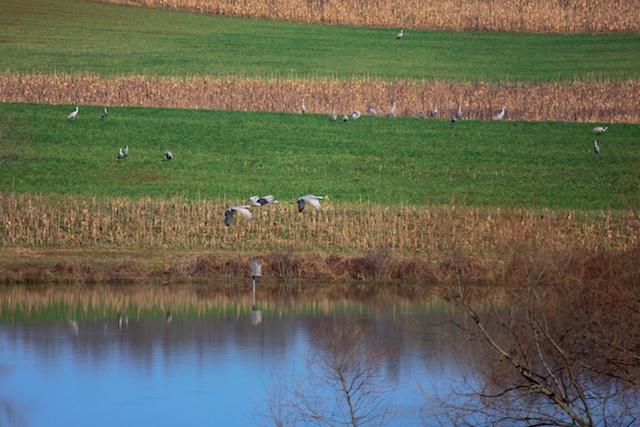
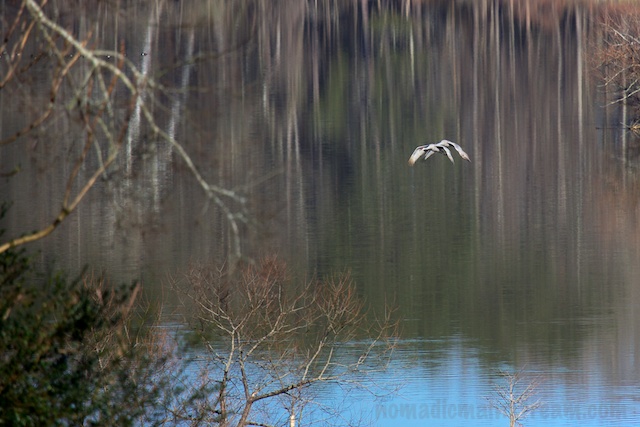
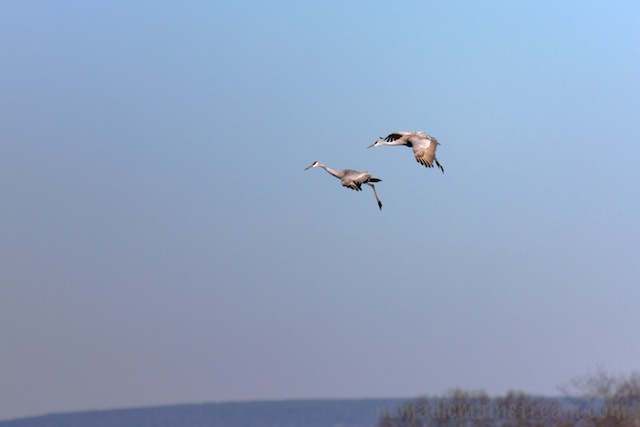
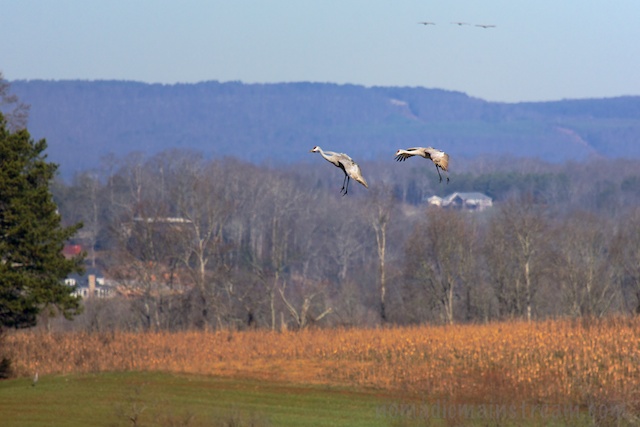
Flying in front of reflected trees

Flying in front of reflected trees

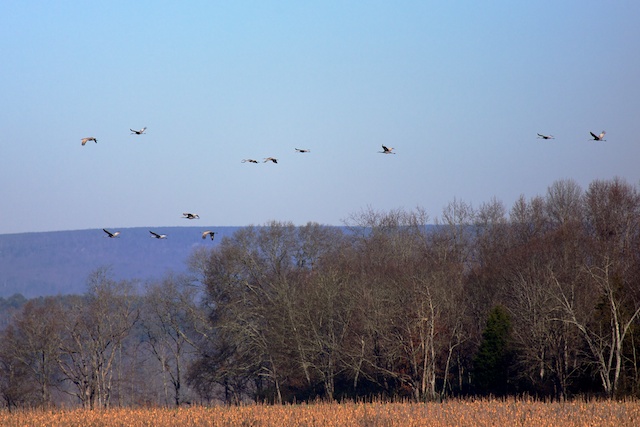
When we went to the Sandhill Crane Festival, we noticed some things about the cranes.  First, they are noisy.  They seem to spend a lot of time flying around, forming groups, calling to each other and circling.

It’s kind of like watching marching band practice when the band hasn’t been training together very long.  They seem uncertain about how to line up, who’s in the lead, or where they’re going.

They bugle their unique call endlessly.  It can be heard for miles.

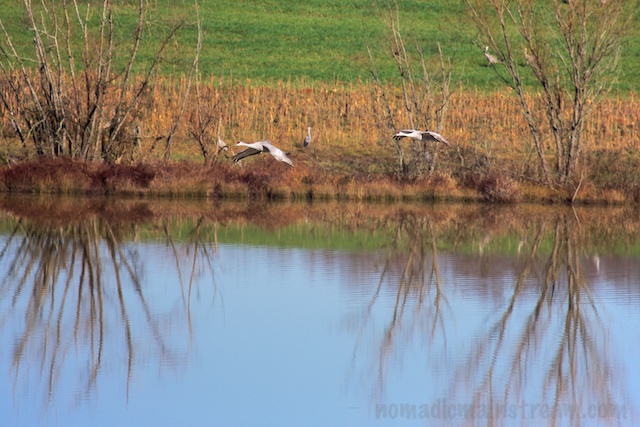
Synchronized flapping

Synchronized flapping

Their call is somewhat reminiscent of the sound my brother used to make when he’d sneaked up on me and was trying to terrify me.  My husband thinks it sounds more like a loud turkey, but he never heard my brother.

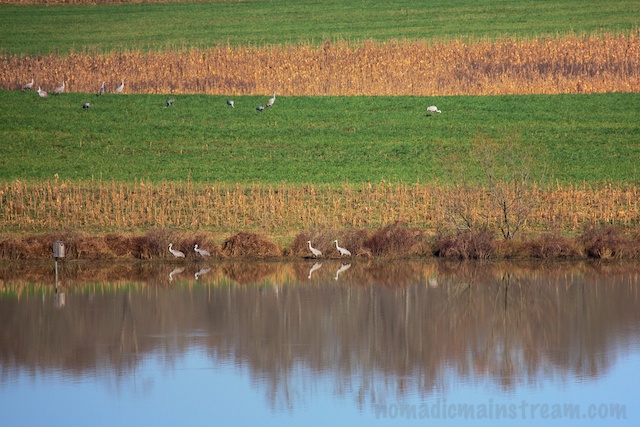
A “heard” (yes, it’s a pun) of cranes grazed in the grasses across the refuge from us.  The one bad thing about the Hiwassee Refuge and the Sandhill Crane Festival is that the birds are mostly very far away.  I know this is best, especially when there’s a crowd.  After all, the idea of a refuge is to give wildlife a place to be wildlife without being harassed or stressed by the presence of humans.  But, it does make it difficult to get good photos.  If it weren’t for the circling cranes who seemed to want to check us out, I wouldn’t have gotten much detail at all (see previous posts to see these photos).

You can probably tell we were far away from the group of cranes on the ground from this photo:

The "heard"

The “heard”


But it might not be obvious just how far away that really is–I shot it at 400mm.  In fact, almost all of my shots (except those with a long line of cranes flying) posted over the last several days were shot at 400mm.   Mind you, the Sandhill Crane is the largest bird found in Tennessee.  They are up to 4’ tall and have a wingspan of up to 90” (that’s 7.5’).  These are big birds.  And I was shooting with as long a lens as I can afford.  The only answer is to get closer.

Of course, not during the festival.  There are two ways to get closer to the birds.  They both involve getting on the water.  One is to go kayaking–Outdoor Chattanooga offers an annual kayaking tour in the refuge in December.  We did that last year.  It was pretty tough to get good pictures from the kayak.  Plus, we weren’t allowed in the area with the densest population of cranes.  Thankfully for the birds (but not my photos), the wildlife folks take protecting these birds seriously.

AU0A9047

The other way is to take a Blue Moon cruise through the refuge.  This might be the best option for photographic opportunities.  We’ll have to see if we can work that into our schedule.  Worst case, there are soon going to be a couple of unreleasable cranes at the Chattanooga Nature Center.  I ought to be able to get a close-up.

AU0A9058

Tree tops reflected in water below group of cranes

Choosing Lessons

Reflected cranes at Hiwasee Refuge

Reflected cranes at Hiwasee Refuge

What does it look like to be a whole-hearted person (to borrow Brene Brown’s term)?  Do whole-hearted people rage against the unfairness of life from time to time?  Do they experience inexplicable irritation or anger?

Brene talks a lot about practice.  Not about being perfect, but about embracing imperfection and learning to correct mistakes where you can and trying again.  I kind of feel that’s what my life has been like.  Trying to take a lesson from a situation and then going out there and trying again.

This circling pair just kept going around and around

This circling pair just kept going around and around

The part I struggle with is repeating the same lesson over and over without seeming to grasp it.

I recently told a good friend a story about choosing the lesson we take.

I was keeping emails.  Neatly filed in organized folders with the thought I might need to produce one someday.  On the rare occasions I needed an old email, I had it.  No matter if it was from 3 years ago.  I had it.  Never mind it might take me an hour to find it–I had it!  And that felt like a triumph somehow.

I wonder what compels a Sandhill Crane to fly in endless circles?

I wonder what compels a Sandhill Crane to fly in endless circles?

Then, my mail file got too big and started having problems.  I had to clean out a bunch of old emails.  As soon as I did, someone needed something from 2 years earlier.  I no longer had the email.

I turned to my office mate (who was and is also one of my best friends) and said, “It just figures.  A day after I finally get rid of an old email, someone needs it.  No wonder I never want to get rid of email!”

She either didn’t hear exactly what I said or chose to ignore it.  Her response was, “Yeah, all this time keeping track of all that junk and when you don’t have it, it turns out not to be a big deal.”

Perhaps they're practicing getting their wing flaps in sync?

Perhaps they’re practicing getting their wing flaps in sync?

She was right.  It really wasn’t a big deal, I just thought it was.  This is a great example of choosing the lesson.  Without thinking about it, the lesson I was going to take was “I can never, ever, ever get rid of another email because I never know when I’ll need it.”

My friend reframed the experience to the exact opposite.  Had she not said that, I never would have realized I could choose which lesson I took from the experience.

I can’t say I’ve gotten over email hoarding, but when I do purge, I do it without guilt or fear now.  Although, I still probably keep more than I should.

Reflections melting away in the ripples

Reflections melting away in the ripples

Perhaps what I need is to have a committee of friends help me figure out what the possible lessons are I can take from the more challenging events in life that shake me to my core.  Perhaps where I fall short is not in failing to learn “the” lesson but on thinking there’s only one possible lesson to learn and missing the one that works for me.

Life Lesson Selection.  How’s that for a committee name?

Lost in the reflections from the trees

Lost in the reflections from the trees

Balancing Act

"Keep going, come on!  Pick up the pace!  We're going to catch them!"

“Keep going, come on! Pick up the pace! We’re going to catch them!”

I’ve been thinking about the feeling that there are things I have to do.  I find myself wondering if there is a way to bring the joy I feel when I do the things I want to do to the things I think I have to do.

After all, do I really have to do anything?

"Let's go!  Let's go!  Let's go!  We're getting there!"

“Let’s go! Let’s go! Let’s go! We’re getting there!”

Yes, I have to eat.  Yes, I have to drink (at least water).  And, yes, I have to sleep.  I enjoy all of those things none-the-less.  For example, I can eat just to fill my belly, grabbing whatever happens to be convenient and edible (which I still enjoy, truth be told) or I can make a really delicious and nutritious meal that makes me feel cared for and grateful.

Similarly, I can drag myself off to bed far too late and flop myself between the sheets feeling like I wasted another day.  Or, I can be aware of when I’m getting sleeping, decide I need to rest and enjoy sliding into bed, allowing myself to sink into the mattress with a feeling of bliss.

"We're going the wrong way!  We're never going to catch them now!"

“We’re going the wrong way! We’re never going to catch them now!”

Is it what we do that counts or how we do it?

Having a job means getting things done whether we want to do them or not.  Is it possible to learn to really enjoy what we do day-to-day?  I enjoy feeling like I can take complex problems and break them down to tasks that can be achieved.  I enjoy feeling like I came up with an idea that will work.  I enjoy feeling like I can bring my own unique contribution to the table.  Is that enough?

Realistically, it’s hard to enjoy every single thing that we do from the moment we get out of bed to the moment we retire.  I mean, can I really learn to take joy in taking out the trash?  How does the concept of “I am enough” apply when it comes to the mundane aspects of life?

"They're too far away.  Let's head back to the lake."

“They’re too far away. Let’s head back to the lake.”

I don’t think the implication is that we should set limits that say “I’m not going to take out the trash because it’s not a task I enjoy.”  After all, I do not enjoy having trash laying around my home.  I do enjoy having a house clean and orderly enough to look like it’s inhabited by humans.

Perhaps this is really another balance point.  Spending enough time on housework to feel comfortable in the space without doing things for the sake of what I think other people would think if they stopped by.  Is that enough?

AU0A9007

“This looks familiar. How many times have we flown over this lake?

And how do I take the concept of enough to work?  It is impossible for me to ever do enough to feel like I’ve done everything I could do–there aren’t enough hours in the day.    I guess enough means finding the balance between feeling like I’ve made progress and allowing myself the time I need to do other things that are important to me.

Is “enough” just a new word for “balance”?

Off in the distance

Off in the distance

For the Joy of It

"Should we land?"  "Maybe."  "I need to know--I've got my landing gear down!"  "Well, I don't know . . ."

“Should we land?” “Maybe.” “I need to know–I’ve got my landing gear down!” “Well, I don’t know . . .”

I recently read “Daring Greatly,” which has led to the concept of “enough” reappearing in my life for yet another lesson since I haven’t internalized it.

It’s a hard concept.  It means acknowledging that we are flawed, incomplete, wrong, and sometimes downright ornery, and it’s enough.  It’s about knowing our limits, ending perfectionism, and focusing on the completeness of “enough” rather than on what we aren’t, what we haven’t gotten done, and what we don’t have.

"Naw--not yet.  Let's fly another circle."

“Naw–not yet. Let’s fly another circle.”

I’m not so good at enough.  People who know me well say things about me like, “she doesn’t do anything at less than 110%.”  I get obsessed.  I go all-in.  Then I get frustrated by my imperfection and usually move on.

I’m pretty good at balancing enough when it comes to time management skills.  It can be measured and monitored and limited in ways I understand well.

"Are you serious?  Now you decide!"

“Are you serious? Now you decide!”

Where I have more trouble with the concept of “enough” is figuring out when I’m doing something for the joy of it vs the desire to please.  I find that when I do things out of the desire to please, it ends up pleasing no one, least of all me.  Who wants to be around someone who is feeling resentful and put upon because they’re fulfilling an obligation they don’t feel up to fulfilling?

On the flip side, when I do something for the joy of doing it, the only pain I experience is cramping in my smile muscles.  There are certain things that just make me feel joyful.  Sharing something I love with someone else who’s interested is a biggie.  It’s the same experience as giving someone a really great gift–it just feels like I have the ability to make a difference when I can give someone else something they want–especially if they never knew they wanted it.

"Let's join that group!"

“Let’s join that group!”

This begs the question:  what is the difference between joyfully sharing something I love and getting joy from people enjoying it vs trying to please others?

Perhaps the difference is how vested I am in the others enjoying it?  Maybe there is only a hair-breadth’s difference between sharing my joy in something without needing someone else to approve vs feeling more or less lovable based on whether others approve or not?

After all, when someone is just sharing what they love without the expectation of reciprocation, it’s hard not to catch their joy.

If I do something purely out of joy, I can allow the space for someone not to be as excited as I am.  In allowing that space, it almost guarantees they will at least appreciate my joy if not experience their own.

If I do something because I think it will please someone, I need them to be pleased.  That need creates a sense of expectation that can cause push back or resistance–why should they be obligated?  It reduces the chances of pleasure all the way around.

I’m not sure I really understand this, but I think I’m making progress.

Soaring over the lake

“We’re never going to catch them now–More altitude!”