Catching the Moon

AU0A9194

The moon.  What a subject it is.  I cannot help but shoot it.  Perhaps I take the phrase “shooting the moon” a bit too literally.  At least I’m not trying to shoot it with a gun.

I got up this morning and decided to see if the sunrise was interesting.  I headed down the hall, back to the common area and onto the balcony.

The wind was not any calmer than it had been two nights ago when I was waiting for the almost-full-moonrise that never showed.  The temperature, however, was probably 20 degrees colder.

I’d decided to do a little experiment.  Instead of shooting with a wide-angle lens as I usually would, I decided to use my 70-200mm lens to see if I could get something a little different from the tried and true views of the riverfront.

As the sun came up from behind the bluff, I waited to see if the light would get interesting in the sky.  I was pretty focused (no pun intended) on the sun rising.  Sometimes, I have to stop myself from staring because it gets hard to tell when the light has changed if you watch it too intensely.  I guess it’s like living with someone who loses weight really gradually compared to running into someone you haven’t seen in ages who’s dropped 20 pounds since the last time you saw them.

So, when I realized I was staring for too long, I decided it was time to look around and see what the rest of the view looked like.  When I turned, there it was.  The lost moon, found again, centered in a clearing in the clouds.  I swung my camera around on the tripod, zoomed in, and found focus just in time for the clouds to blow back over the *$%^ moon.  Argh!

But, with a few adjustments, I kind of liked the shot anyway.  It was the only chance I got–the cloud coverage just kept getting thicker until there was just one small, bright spot in the clouds barely bright enough to be noticeable if I didn’t already know where the moon was.

I turned back to the sunrise, but I kept looking over my shoulder just in case the moon decided to change its course and head back to the clearing.  The moon made no such decision.  Instead, it followed its predictable trajectory.  At least, that’s what I assume it did–it’s not as if I could actually watch its progress.  For all I know, it jumped out of the sky and will never be seen again.

Just for kicks, I google the moonrise time for tonight.  I don’t know if I have it in me to stand on the cold balcony waiting for the late rise of a waning gibbous moon–it’s just not as exciting as a full (or almost full) moon.  I’m relieved to discover the moon won’t rise until after my bedtime.  Maybe I should start shooting moonset?

One for the Road

Bald Eagle over Hiwassee Refuge

Bald Eagle over Hiwassee Refuge

At the Sandhill Crane Festival, some of the volunteers spotted a bald eagle and what I believe they said was a Northern Harrier.  I didn’t get a good look at the Northern Harrier and, unfortunately, the birds were circling far enough away that my 400mm lens wasn’t sufficient to get a good shot.

Circling Eagle and Hawk

Circling Eagle and Hawk

Smaller birds circled outside the frame, periodically diving at the much larger birds of prey, trying to convince them to move along and feed elsewhere.  The eagle and the hawk seemed to run into each other almost by accident.

They soared around in a big, oblong loop like they were discussing their winter vacation plans and trying to arrange a carpool.  Eventually, they must have realized they were headed different directions.  They split off and flew out of sight in opposite directions.

I am puzzled by how birds navigate on their long migration journeys–especially those that don’t travel in flocks or who are migrating for the first time.

Migrating ducks stopping over to recover before continuing South

Migrating ducks stopping over to recover before continuing South

Apparently I am not the only one puzzled by this feat.  Scientists seem to think birds are able to identify the direction they’re going, perhaps using the sun, moon, and stars for orientation.  However, it’s unknown how birds find an actual place when they do things like fly across an ocean and return to their nest from the year before.  In some experiments, birds were captured and moved via aircraft to a distant location.  They still managed to find their way back without wandering.

I used to think I had a great sense of direction.  I remember being lost in Dallas back when I was in my late 20’s.  I was with my boss, but I was driving since the rental car was in my name.  We had gone to see the West End in Dallas–a place everyone kept telling us we had to see.  Then, it was time to return to the airport for our flight home.  The airport is a good 30 minute drive from the West End of downtown if you don’t run into any traffic..  This is almost an impossibility in Dallas.  I ended up doing a 6-month temporary assignment down there and during that time, I experienced getting stuck in traffic at 11PM on a weeknight on more than one occasion.

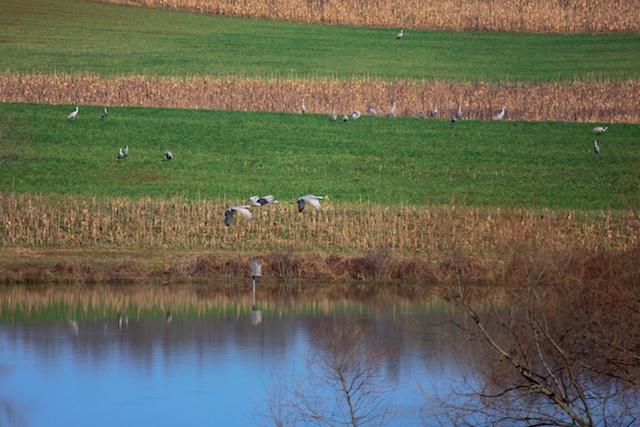
Sandhill Cranes on the bank

Sandhill Cranes on the bank

I managed to determine what direction we needed to go without a map and got us to the airport on time.  My boss was impressed.

More recently, having moved to Chattanooga, I’ve had the realization that my sense of direction isn’t a sense of direction at all.  Rather, it’s a way of orienting myself to direction by noticing what direction I’m going relative to where I started from.  I can only do this when I’m in a place whose streets form mostly straight lines.  In Chattanooga, even after a year and a half, I remain hopelessly disoriented and often lost.  Imagine if I were a bird flying over the ocean–I would drown.

AU0A9072

No Moon

I really wanted the white house to be the moon, but no matter how many times I shot it, it was still a house

I really wanted the white house to be the moon, but no matter how many times I shot it, it was still a house

Once again, the moon has disappointed me.  I suppose it’s my own fault.  I lost track of when the full moon would occur this month.  I discovered this when we were walking home from dinner and I looked up and there it was, high in the sky shining brightly the way only a full moon can.

I thought, “No worries, it will still look full tomorrow night.”  I googled the moonrise time for the following evening.  I put it on my calendar.  I got out my camera, put on the 1.4x extender and my 100-400mm lens.  In plenty of time to get setup, I walked to the common room and setup my tripod and camera on the balcony.  Then, I waited.

Now, I was mentally prepared for the moon to be late.  I have enough experience with this now to know I can’t expect the moon to appear over the high ridge in front of me at the same time it crosses the horizon at sea level.  What I couldn’t remember was just how late it usually is.  I thought about the last time I was parked in the cold wind waiting on the moon.  Was it 20 minutes after official moonrise time?  Or was it 30?  Maybe it was even 45?

Had I been thinking, I might have looked up my last moonrise post to see how late it was.  According to that post, it was over 30 minutes late.  I can’t think of any reason why it would be more or less late at various times of the year if it’s rising behind the same ridge, shouldn’t it rise with the same lateness?

In any case, since I wasn’t thinking, I stood on that cold balcony in a blustery wind waiting.  And while I was waiting, I kept imagining I saw the moon.  In particular, the house in the image above reflected light in such a way that every time I scanned the ridge, I thought, “there it is!”  I ended up with about 10 pictures of this house during the hour I waited on the moon.

By the time it was an hour past moonrise, I figured it was time to call it quits.  I was tired of jogging in place to keep the blood flowing to my toes.  My nose was also running–like it was training for a marathon.  I took one last look at all the visible sky and saw no sign that the moon was anywhere to be found.  Not even a bright spot in the clouds.

I guess this is a case where even the best-laid plans go awry.  On the other hand, the best-laid plan might have been to check the weather forecast before the full moon and to decide to shoot a night earlier when the moon was truly full and the sky was clear.  But, I would have had to miss dinner with good friends to do that.

As my best friend reminded me, there will be plenty of moonrises in the future.

Jumping In

AU0A9186

Momentum is a funny thing.  The tendency of an object at rest to stay rest often feels overwhelming when that object is me.  Conversely, once I start moving, momentum carries me away, often making it hard for me to return.

On Sunday afternoon, curled on the couch and disappointed that I hadn’t been able to actually nap, the thought of putting on my coat and boots, packing up my gear and heading outside to shoot seemed just silly.

But, between the motion of my husband (is motion contagious?) and my need to have photos to post for the next week and a half, I managed to get up and get myself and Tisen ready for the park.

I liken the feeling of steeling myself to unwrap from a blanket and step into the cold to the feeling of preparing to jump into a pool.

I love to swim.  Moving through the water feels like being home.  The feeling of being buoyed up makes me feel weightless.  I’m not fast, but I re-learned how to swim when I undertook triathlons about a dozen years ago.  In the process, I found a relaxed, meditative way of moving through the water that I could sustain well beyond the time I had to swim.  In fact, I often ran late getting out of the pool because I was enjoying being in the water so much.

None-the-less, even now, just sitting here thinking about how much I like to swim, the thought of going out into the night and taking that initial step into the cold water makes me recoil.  There’s something shocking about going from being warm and dry to being suddenly immersed in water that feels like an ice bath (even when it’s actually a little too warm for swimming laps).  It takes a little extra push to move momentum from rest to motion when I feel like I’m about to jump in the pool.

But having made the leap and gotten myself and Tisen out the door, I was soon kneeling on a garbage bag in the mud finding interesting things I’d never seen before.  Once I got started I didn’t want to stop.  The image above is the last image I shot that day.  It was shot after I got the call from my husband that he was making dinner.  I had already collapsed my tripod and put the lens cap back on, determined to head straight home when I saw this plant.

I don’t know what it is.  I don’t know if the image was worth being late to dinner for, but I was perplexed by the arrangement of the dried stems (or were they shriveled petals?) laced with the silk of milkweed.  At least it looks like milkweed.  There are apparently many, many varieties of milkweed, so it seems reasonable this might be one.

The tones of reddish brown intermittent with the silk against the green grasses in the background just caught my eye.

Leaving the Pod

Waiting for the perfect moment

Waiting for the perfect moment

This was a first for me.  Inside the same milkweed pod spilling its guts in yesterday’s post, a single row of seeds remained, waiting for the order to jump.

Just like the silk dangling from the edge of the pod, these quiet soldiers let go of the pod one filament at a time as I watched.  Their progress was faster than their siblings hanging below.  I watched several threads spring free before my eyes in a matter of minutes.  And they really did spring.  They recoiled from their attachment point as if they’d been pulling against it trying to get free and were suddenly released when they least expected it.  A miniature wrestling match taking place in slow motion.

Having never watched the silk in a milkweed wind itself from its cocoon before, I was disappointed when the show was interrupted by the ring of my cell phone.  My husband hard returned home as was making dinner.  It was time to pack up my gear and make my way back home.

As I was rushing to try to get one last shot, hoping to get something sharp (the blowing wind was not helpful–my moving subject kept blurring on me), two men walked along the walkway.  They looked like they could have been homeless.  Or they could have been something entirely different.  It’s hard to tell.

They stared at me with an intensity that made me nervous.  So, I did what I always do when I’m nervous:  I smiled.

They smiled back at me.  I admit that their smiles did not exactly put me at ease.  Sometimes when someone smiles at you, you feel like you’ve just been smiled at by a shark or an alligator who’s thinking you might make a tasty next meal.

But Tisen looked nonplussed.  I can’t say that Tisen has necessarily demonstrated good judgment of character, but I think he would at least be alert if there were any eminent danger.

As the men walked by, one looked at Tisen and then smiled even bigger at me and said, “That’s an awesome dog.”  I smiled again and said, “Thanks.”  I don’t know who those men were, but at least they had good taste.

I can’t remember having ever been afraid in the park.  The park has an entire collection of security cameras.  There can’t be a square inch that’s out of range of one of them.  I’ve never seen or heard of any crime being committed in the park.  Although, I’m not sure I would know about it–I tend to shy away from the news.

I sometimes feel like I’m the dangerous one lurking in the dark when I walk Tisen long past sunset.  Not that I’m normally dangerous–just don’t make me mad.

As I put the lens cap back on my lens and collapsed the legs of my tripod, I found myself grateful for this pod of a park that provides a safe haven to shoot milkweed.

Escape

Milkweed silk dangling from the pod

Milkweed silk dangling from the pod

As Tisen and I made our way around the park with me keeping an eye out for small things to shoot up close, I spied a milkweed plant with an open pod.  The pod dangled in the breeze with a waterfall of filaments cascading out the front.  It would have resembled a frozen waterfall had it not been bouncing in the wind.

I climbed down the embankment between the walkway and the milkweed, coaxing Tisen to follow once he had sniffed the tall weeds along the way to his satisfaction.  I setup my tripod so the lens was at eye level with the spillage from the pod.

As the wind blew, the filaments moved.  They didn’t just move in the breeze; they were gradually released one by one from whatever force suspended them.  In all the time I stood there waiting on cycles of wind, I saw only 3 or 4 filaments spring free.

I wondered about this process.  I always imagined a milkweed springing open and firing its downy interior into the wind, releasing all of its seeds at once.  Instead, like a parent terrified of becoming an empty nester, it clings to its progeny in a delicate finger hold.  And there the seeds stayed (even the next day), hanging by a thread between the safety of the pod and the freedom of the wind.

Perhaps this allows the milkweed to ensure its seed is spread further–it must take a pretty strong wind to blow the down out of the shell.  But what happens if the seeds remain forever suspended?  Eventually, the shell must rot and fall off the plant.  Are the seeds still viable by the time this happens?  Do they plant themselves at the base of the parent plant?  Do they end up living next door to their parent?  Are there advantages to having an extended family all on the same block?

In this arrangement, what I really see is me.  The feeling of being perched on the edge of freedom with a finger hold on security is a familiar one.  What I yearn for and what I’m willing to give up are diametrically opposed.  I want to jerk the pod off the stem and take it with me as I fly into a new world.

Yet, in the effort to keep the pod, I expend the time and energy I need for flight.

I wonder how the milkweed feels about it.  Does the milkweed silk contemplate whether it really wants to fledge while the pod wonders why it was foolish enough to spring open?

Is it a uniquely human attribute to debate what it is we need to do?  Is it a uniquely human attribute to have choice in what action we will take?  Every time someone makes a statement about what distinguishes humans from the rest of life on the planet, someone makes a discovery that debunks the assertion.  I will not make the mistake of presuming ambiguity is unique to humanity.

Tiny Brushes

Naturally occurring brushes

Naturally occurring brushes

As I wandered Renaissance Park looking for small, interesting things to shoot, I noticed these little guys.  The entire length from the base of the “flower” to the tip of the bristles is between ½ – 1 inch.

I didn’t have my glasses on, so I couldn’t see them all that clearly.  Through the blur, I thought an artist had dropped her paint brushes as she made her way out of the park.

When I saw the high-resolution version of the image on my 27” screen, I was even more amazed by how much they really do resemble tiny paint brushes.  I’ve never noticed these little bristles before, but I probably would recognize the flower if it were still blooming.

This is yet another example of how the brain filters out information that seems irrelevant.  This filter is a great tool–we’d be completely overwhelmed if our poor brains had to process all the information within view every second of every day.  But it also can prevent us from seeing what’s in front of us even when it’s really important that we see it.

Take, for example, a data point I heard when I was taking a motorcycle skills course quite a few years ago.  In interviews with car drivers and motorcyclists following non-fatal collisions between the two, in the vast majority of cases, the motorcyclist reported having made eye contact with the driver shortly before realizing the driver wasn’t going to yield.  The driver reported having never seen the motorcyclist.

While this may seem unbelievable, think about the number of times you’ve been looking for something and it was right in front of you the whole time, but it was a different shape or color than you remembered.

Your brain was pattern matching and the object didn’t match the pattern you were looking for.  That’s what happens with motorcycles (and bicycles)–they don’t match the patterns the brain is most familiar with when looking for “objects to avoid hitting,” so the image doesn’t make it from your eyes into your brain.

When it comes to really small stuff, we probably see it, but like an impressionist painting, we mentally allow all the tiny dots to blend into a single image with varying colors.

From a distance

From a distance

As I’ve learned from photography, the eye goes to light spots and bright colors if they’re large enough to register on the radar.  We’re more likely to notice a tiny metal object twinkling in the sun (which also taps into our predator roots that hone in on movement) than a small red flower.  We’re more likely to notice a small red flower than a small yellow one.

These little paint brushes are unlikely to get noticed.  They’re small.  They’re tan and dark brown.  They don’t reflect light.  They’re low enough to the ground to hold perfectly still.

Perhaps the difficulty of seeing them is partly what makes having captured them satisfying.

Early Dandelion

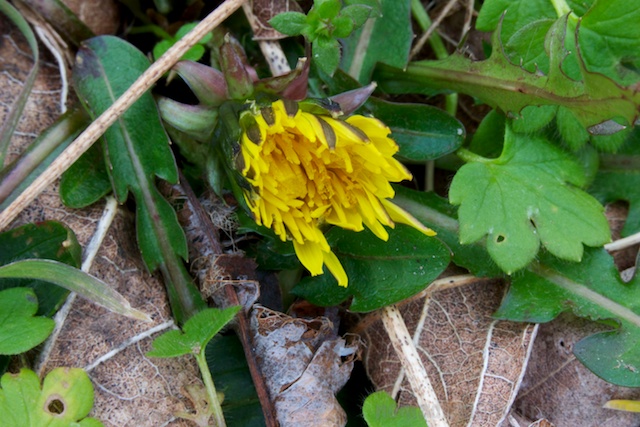
Dandelion in half-bloom

Dandelion in half-bloom

About this time of year, I find myself searching for signs of life.  This used to be more challenging when the ground was covered in snow and the temperatures were far below freezing.  Having move about 500 miles South, I don’t have to search hard to find a little color even at the end of January.

That said, I was still surprised to discover a dandelion attempting to bloom.  In fact, it was making some darn good progress.  I expect it will be fully open in another day or two if we don’t get a severe freeze.

Dandelions are one of those plants that I want to hate but I just can’t help but enjoy.  I know they’re an invasive introduced by European immigrants.  I know people hate to see them in their lawn (although I prefer a yard full of dandelions over a yard with nothing but grass).  Yet, there is something eternally cheerful about a dandelion.

perhaps it’s their sunny color against what is often a field of green.  Or maybe it’s the pure audacity of these little buggers in their insistence in popping up in the tiniest crevice.  How many times have you seen a dandelion blooming from what seems like an endless expanse of concrete only to discover a microscopic crack the flower has magically sprung from?  I suspect dandelions have some sort of jack hammer technology that allows them to forge through every manmade surface we can invent and make their way to the sun.

It’s probably not about the color or the persistence, to be honest.  It’s probably about my childhood memories of growing up in a house with an herbicide-free lawn (more because of the frugalness of my parents than because of any environmental or health concerns) that always had a healthy population of dandelions.

I used to pick them and make what seemed like giant bouquets for my mother.  She was always so pleased by the thoughtfulness that she would put them in a vase and act like I’d brought her a dozen roses.  In fact, I think she preferred them to roses.  They were the only flower I was allowed to pick.  I assume this was because it was the only one I could readily identify, so my mom didn’t have to worry about me picking any intentionally grown flowers this way.

I remember learning how to tell if you like butter by holding a blooming dandelion under your chin to see if it reflected yellow light onto your skin.  Of course, it always did unless it was near dark.  And, of course, we blew dandelion seeds off the head as we made a wish, just sure it would come true.  When I was a little older, I learned to tie the dandelion stems together to make crowns and bracelets and necklaces.

Dandelions were a renewable, cheap, and available resource that required only a little imagination to turn into something incredibly fun.  <sigh>  Life was so simple.