Canon on Cannon

One of the great things about Portland, Oregon is its proximity to the Pacific Ocean.  Portland, about an hour’s drive inland, tucked inside the elbow of the Columbia River Gorge (and spilling over it a bit), has its own water front, but when you want to see an ocean, it’s an easy day trip.

On our second full day in Portland, we headed to the coast.  Our first stop was Cannon Beach.  Pacific Northwest beaches are right up our alley.  They offer interesting rock formations, sand dunes, and hikes through complex coastal ecosystems with more plant varieties than one typically associates with a beach.  The Pacific coast is also open to the public–no private beaches are allowed–so you always know you can access the ocean.

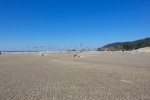
Cannon Beach offers rock formations immediately off the coast and lots of sea gulls.  Unfortunately, one of the more disturbing memories I brought back was of two headless seagulls, and both heads strewn further down the beach.  I’d rather not think about what would behead two seagulls and not eat them.  I’d like to think a predator like a beach-combing coyote or a large bird of prey (pterodactyl?) got interrupted.

Dead seagulls aside, we walked from the car across soft sand (which is a really great workout for your shins, should you be looking for one) to firmer but colder sand close to the waters edge.  Then, we headed along the shoreline towards the largest rock formation within walking distance.

We discovered an inlet where the ocean hit the beach from two directions simultaneously.  A channel had been created in the beach where the salt water ran far back, creating a large pool.  Since the tide was coming in as we were going out, the channel was deep enough to reach to our knees.  We rolled up our pants and crossed it.

As soon as we sunk our legs into the water, we started looking around for icebergs–it seemed impossible the water could be so cold without any nearby.

Seagulls in the distance flared up into a cloud of wings, rising like a stadium crowd doing the wave and then settling back down to continue loitering in the sun.  Perhaps they were impressed by our daring.

After walking out to the rock formations, we turned to come back.  We walked and walked, feeling like our destination wasn’t getting any closer.  It’s funny how skewed distances can seem on a beach.  When we’d started out, we thought the rock formations were less than 500 yards away.  On the way back, we realized we must have walked closer to a mile.  It was like one of those dreams where you keep running, but you’re not actually going anywhere.

At last, we returned to the seagull hang out in time to watch both a small boy and a teenage girl chase the gulls.  The birds floated barely above the boy’s head, taunting him.  I swear they were laughing.
Mt Hood and the Mighty Ducks

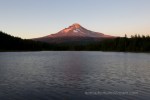
If the Tualatin River Wildlife Preserve wasn’t enough for one day, taking a drive up to Trillium Lake by Mt Hood sure did top it off nicely.  Trillium lake has a lovely two-mile trail  around it and we were promised a great view of Mt Hood by the internet, which is always right.

We decided to get there a couple hours before sunset so we’d have plenty of time to walk the two miles and pick out the perfect spot to shoot Mt Hood as the light changed.

We didn’t get there two hours ahead of sunset.  In fact, by the time we parked and were walking to the lake, sunset was about 45 minutes away.

Thankfully, the best view of Mt Hood was about a 5 minute walk from the car.  In fact, they built a deck there and put some benches on it so we could be comfortable while we watched the sunset.

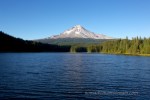
Instead of sitting and relaxing, I got busy setting up the tripod I’d borrowed from my father and getting my camera ready to go.  Moving quickly kept me warm–even with my many layers (a light fleece plus a leather jacket plus a huge, thick fleece borrowed from my dad), it wasn’t exactly toasty.  The wind was whipping up a pretty good froth on the lake, meaning there were no glass-like reflections to be had of Mt Hood.  But, it was still beautiful.

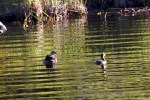
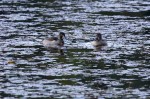
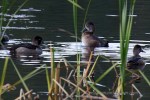
And, sunset took long enough that we had time to take a break from shooting the mountain to walk part way around to get up close enough to identify some ducks that eluded me.

After looking at them through binoculars, shooting them with a 400mm lens, and after enlarging the images to look closely at them, I’m pretty sure the little ones are Pie-billed Grebes and the larger ones are Ring-necked Ducks.  I feel more certain about the Pie-billed Grebes than I do about the Ring-necked Ducks.  They were fun to watch in any case.

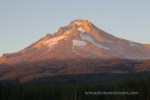
We returned to the deck so I could shoot as the sun faded.  The light turned amber and the mountain shifted from gray rock to glowing orange.  The trees below timber line moved from green to purple on the color wheel.  It’s almost hard to believe I didn’t change the tint or white balance between the early and late shots, but the sun did all that for me.

I kept hoping the wind would die and let me get one good shot of the mountain reflected on smooth water, but the wind only got stronger and I only got colder.  About the time we were going to call it quits, we spotted two otters making their way towards us across the lake.  This was the first time I’d seen wild otters anywhere other than the ocean.

Pie-billed grebes, check.  Ring-necked ducks, check.  River otters, check.  Mt Hood at sunset, check.  Definitely time to call it a day.

Two Strangers at Tualatin

While in Portland, we made a stop at the Tualatin River Wildlife Preserve to see what birds had stopped over on their way South.

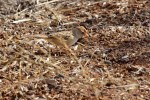
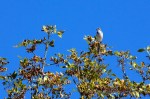
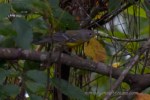
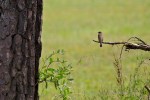
When a sparrow appeared to me, I was hoping it was going to be something I don’t see at home.  However, I would say it’s either a Chipping Sparrow or a young White Crowned Sparrow, both of which are also found out east.  I’m rooting for a White Crowned Sparrow–it’s more exciting than a Chipping Sparrow.  Plus, it has an orange beak–although this isn’t normal for a young White Crowned Sparrow as far West as we saw this one according to Sibley.  But a Chipping Sparrow doesn’t have an orange beak, either, so I’m going with the White Crowned.

Sparrows are often tortuous to identify.

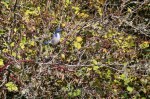
This leads me to a species definitely not seen East of the Mississippi–the Scrub Jay.  I don’t know who named this poor guy after something that sounds like it should be used to clean toilets, but they really must have been annoyed with these noisy, persistent buggers when they named them.  After all, the Scrub Jay is a beautiful, brilliant blue bird with gorgeous markings.

My appreciation of the Scrub Jay reminds me of a visit from a Korean family when I was a teenager.  They were amazed by the Northern Cardinal.  We had dozens of them visiting the feeders during their visit and the Korean children couldn’t get over how beautiful they were.

What is it about rarity that makes us prize beauty more?  Once it becomes a common occurrence, we forget to be amazed.  This seems related to the old adage, “we only want what we can’t have,” usually applied to dysfunctional relationships.

Instead of appreciating the ubiquitous Northern Cardinal when we are in the East and the equally ubiquitous Scrub Jay when out West, we look for the birds that are hard to find.  We revel in sighting the birds yet to get a check mark on our life list.  We yearn to see a bird we’ve never seen before.

I admit I fall into this thinking.  I was excited to add two birds to my life list while at the preserve.  First, there was the Cackling Goose (or the Crackling Goose as it seemed to come out more often than not).  I had dismissed them as Canada Geese to be honest.  I had no idea there even was such a thing as a Cackling Goose.

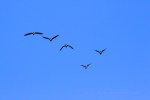
Fortunately, my father had recently learned about the Cackling Goose, which led me to play its call compared to a Canada Goose.  Sure enough, different calls.  All of the birds in flight were Cackling Geese.  They seemed to be confused as they tried to create a formation.  Perhaps that’s why they were still as far North as Portland in October.

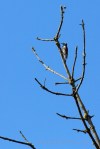
But more exciting than the Cackling Goose, we also got to see a Red-breasted Sapsucker.  Definitely a nice treat, although probably a daily sighting in this preserve.

Little Things

We have just returned from our annual trek to Portland, Oregon to visit my dad and his wife.  We made this a relatively low-key trip.  In the past, we’ve taken longer trips to Portland to allow time to meet our friends in Seattle and do things like take a side trip to Olympic National Park in Washington or spend a week in Glacier National Park.

This time, we spent a lot of time debating if there was a way to go to Portland with Tisen.

The reality was that we would need to spend 6 days driving if we didn’t fly and there was no way I was going to load Tisen into the cargo hold of a plane.  If we were going to take 6 days to drive to Portland, I wanted to make it an adventure through Yellow Stone–a place I have yet to go.  But, neither Pat nor I could afford to take that kind of time off work.

In the end, we opted for asking our friends to watch Tisen and keeping our trip short.  Our friends from Seattle offered to come down to Portland to spend a day with us so we didn’t have to take 2 or more days to see them.  My dad didn’t plan any multi-day side trips; we would have plenty of flexibility in our schedule to visit with our friends.

So, last Monday morning, the alarm went off at 4:00AM and I hopped out of bed like that was the time I got up every day.  By 5:45AM, Tisen was fed and walked and we were packed and ready to roll.  Tisen excitedly ran for the van just sure he was going on a new adventure with us.  I had a hard time dropping him off at our friends’ house.

We made it to Portland a little early and by 2PM were sitting in my dad’s family room with full bellies (having stopped for lunch on the way from the airport) and suffering from only mild separation anxiety.

It felt good to just sit and hang out, catching up.  I, of course, got out my camera and started looking for things to shoot.

Pat sat across from me with his feet up on a foot rest.  I noticed for the first time that his shoes, which he has had for at least a couple of years, have outlines of the shoemakers on the soles.  I couldn’t resist trying to shoot the soles of his shoes.

Then, my dad was telling a story and chuckling.  I had to capture some of his facial expressions (although most of them didn’t come out so flattering).

Finally, I put my macro lens on my camera and went out to the garden.  My dad’s wife is an amazing gardener and can always be counted on to have beautiful flowers.  Although the surprisingly cool temperatures sent be back inside after only shooting a couple of flowers.

In a New York Minute

New York City is . . . You could finish that sentence with just about anything. For me, it’s mostly been a place I go for work or a place I go through on the way to somewhere else. However, there have been a few times when I’ve gotten to spend a justo here for fun.
The most recent time was a few years ago now. I stayed with a friend for the 4th of July weekend on a lagoon in NJ. Most of the Jersey shore lagoons are trapped in concrete and look like man made creations, much like the characters on the reality show (sorry, couldn’t help myself). But it’s surprising to someone who has spent as much time in “The Garden State” as I have just how much of the inner inner coastal areas are as dedicated to boating as the actual coastline is.

As someone who grew up as inland as it gets, the coast always seemed like a definitive line between land and ocean. In reality, the ocean gives way gradually to land, meandering its way deeply into every crevice. While me might intuitively guess at the movement of water, I tend to think of it as moving outward from the land to the ocean and had been oblivious to the interplay of water coming in.

My friend and I took a day off work and took the train from Brick, NJ to somewhere in New York City. We saw so many boats on the way, I thought we had taken a train to Miami.
Once we arrived in the city, however, the boats were all but forgotten. It’s hard to remember Manhattan is an island. It’s amazing it doesn’t just sink under the weight of all the sky scrapers it supports.

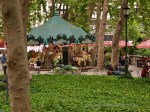
I suppose it comes as no surprise that of the dozen or so photos I took in the city, the majority were in the one park we stopped in. As much as I love visiting cities, I’m always relieved to find a bit off green space producing enough oxygen I feel I can breathe again. We were no where near Central Park, but Bryant Park provided exactly what I needed.
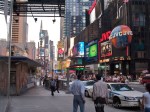
We had a fantastic dinner at a place that specialized in artisan cheeses and then headed to Times Square and Broadway where we saw Mama Mia–it had been running for so long, we had no trouble getting tickets.

The usher/bouncer yelled at me for taking a picture before the show had even started, so I put my camera away and enjoyed the show. I’ve only seen two broadway shows on Broadway, but it is way better than seeing the Columbus, Ohio version. Only London compares to New York for Broadway shows in my limited experience.

At about 11PM, we hauled our shopping bags from Broadway to the train and made our way back to Brick feeling like we couldn’t have stayed awake through one more New York minute.

Quiet Giants

Even as a dedicated tree hugger, I never thought going to stare at trees was particularly exciting. Arboretums, for example, fail to move me.

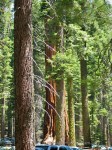
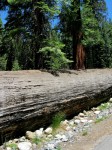
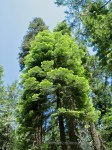
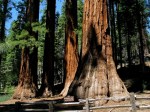
But, several years ago, after 6 days of backpacking in Yosemite, it was a nice respite to head to Mariposa Grove and see the giant sequoia there.

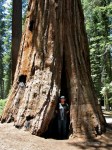
In the same inexplicable way in which the mountains evoke a quietude, these giant trees spoke to me like individual mountains standing amongst a forest of tiny hills. They are the largest living things on the planet by volume.

I once read a historical novel about the settlers of the Pacific northwest in the 1800’s. In that book, they had an intense hatred of trees. The trees stood between them and fertile farmland, sustenance, and shelter.

When I saw the sequoia looming down, as they had in some cases for over 3000 years, among some of the world’s oldest living creatures, I found myself wondering what the early settlers thought of these giants. The Sequoia survived in part because they were fire resistant, bug resistant, rot resistant, and not particularly useful for building anything.

The settlers couldn’t burn them–in fact, fires are quite helpful in promoting Sequoia reproduction and over-controlling forest fires led to a demise in their population.

Their seed cones are tiny pods that pop open and spread seeds when properly dried. The heat of fire, which has the additional benefit of clearing out most of the Sequoias’ competitors, dry out the cones and allow the seeds to disperse.

The Chickaree squirrel can also help disperse sequoia seeds. This little guy will eat sequoia cones and help spread the seeds in part by storing the cones.

Luckily for both the sequoia and the Chickaree in Mariposa Grove, controlled burns are helping to restore the natural ecosystem of the area, encouraging new generations of giant sequoia trees.

The famous “California Tunnel Tree” in the middle of the park probably serves as the best representation of how the early settlers felt about these giant trees. They cut a big hole through the middle of a tree wide enough to drive a wagon and a team of horses through it. Not exactly a sign that they had a sense of awe and wonder about the trees. Seems more like a Graceland tourist trap than a healthy respect for the diversity of life.

In any case, we are all fortunate that Galen Clark did come along with a healthy respect. He saw the testament to grace these trees represented and managed to preserve them.

I imagine life from the trees’ perspective, in which thing move at a pace proportional to a 3000+ year life expectancy. I imagine what a tree “sees” in the course of 3000 years as the make up of the air, the water, and even the very soil at its feet shifts and changes. I wonder if the older trees complain about kids these days or if evolution occurs at an altogether different pace?

Product Testing

In yesterday’s post, I mentioned that I was convinced I was born to row because I made it through a Learn to Row class without falling in the water.  Let me take another moment to brag–I made it through the entire two weeks of classes without falling in.

Fortunately, one of the requirements for the class was to get back into the boat from the water.  This is fortunate in that, having not fallen in, I didn’t get to learn this on my own.

Getting back into a sculling shell from the water is no easy task.  You have to get your body up onto the boat while holding the oars into position so the boat doesn’t tip back over again.  It took me several tries and I was badly bruised by the time I made it back into the boat.

Since then, I’ve been feeling like I was never going to fall in.  I’ve been rowing twice a week and I’ve managed to catch myself every time I started to tip.  Then, the other morning when it was about 54 degrees out, I did my usual route around a section of the river that is mostly still within sight of the rowing center.

When I got to the downstream end of my rowing route, as usual, I stopped rowing to drift by part of Maclellan Island and see what birds were out.  Just then, four Great Blue Heron came swooping overhead.  I turned to see where they were headed and the next thing I knew, my head was completely underwater.  I didn’t feel the boat tip at all; I was just suddenly submerged.

Fortunately, the river was still toasty warm.  But, I had a moment of panic.  Once I got my mind around the fact that I was, in fact, in the water, I realized several things:

  1. One oar had come out of the oarlock and was floating away from me and the boat
  2. The boat was completely upside down
  3. My iPhone was strapped to the boat in a waterproof case and cute little lifejacket
  4. I had lights suction cupped to the boat since it was dark when I’d started rowing–they were now completely submerged.

Accepting that there was nothing to do but get the boat back together and myself back in it, I swam after the lose oar, pleased to find that it does, as advertised, float.  I got the boat righted and was equally pleased to discover that my lights were not only still attached, but also still it.

I got the oar back in the oarlock and managed to get myself back into the boat in one smooth try like I’d been tipping sculling boats for years.  And, the moment of pure delight came when I confirmed that my iPhone had floated and remained dry inside its case.

For once, all products performed as expected!

The only down side was riding my bike home in 54 degree weather soaking wet.

Learning to Row

I took the Learn to Row class offered by the Lookout Rowing Club here in Chattanooga back in July, but rowing a sculling shell and cameras don’t mix well.

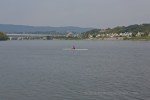
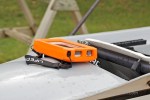
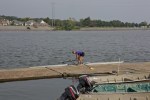
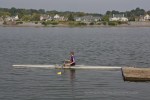
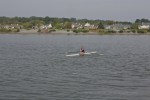
At long last, I got my husband out to the rowing center to help do some shooting.  In these shots, I am demonstrating some of the basic skills we learned in the class:  carrying the boat by yourself, getting into the boat without falling in, getting off the dock without falling in, and rowing without falling in.


Note the “without falling in.”  That is an important qualifier.  A sculling shell is a long and narrow boat; the fact that it doesn’t roll all the time is a denial of physics (and the result of long oars that float on the water’s surface).

In fact, during the first class in which we got into boats and pushed off the dock, I was the only person in my class who didn’t end up in the water, including the instructor.  This is such a remarkable fact that I have to think that perhaps I was born to be a rower.  After all, I once scraped my face eating a breakfast bar; the odds that I would be the only one to make it through the class without falling in at some point are pretty astronomical.

I did not fare so well on learning how to carry the boat.  In fact, I found that to be the most challenging part of the class.  It was also something I was determined to master because I knew I was going to be coming out to row by myself early in the morning and there was no way I was going to ask anyone for help.

First, I tried carrying the boat on my shoulder instead of my head.  I thought this would be more stable and give me better control over the boat.  It did.  However, I couldn’t see one entire side and I kept running into things like railings, buildings, other boats, and occasionally other people.

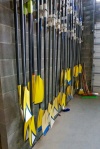
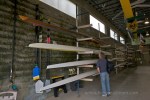
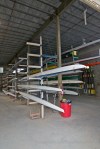
I eventually found carrying the boat on my head gave me much better visibility and the only time I ran into things was trying to put the boat back onto the racks.  I eventually learned to carry the boat in and out of the boathouse on my hip, place it on the slings out front, and then put it on my head to walk to the dock.  So far, I haven’t broken anything.

On this day, as I was rowing, my port oar popped out of the oarlock.  I was pretty proud that I managed to get the oar back into the oarlock without tipping the boat.  This is no easy feat–the oars are like training wheels and keeping both of them on the water evenly keeps the boat from rolling over.  For some reason, my husband didn’t shoot my amazing dexterity.  Maybe he was waiting for the moment when I would fall in?

Visitors at the Visitor’s Center

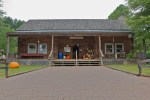
Last Saturday, I watched the visitor’s center at Audubon Acres from 9AM-1PM.  It’s one of those volunteer jobs I don’t mind doing, but the visitor’s center isn’t often a busy place.

I guess it’s helpful for a volunteer to be there to deal with visitors who stop by so the various other folks who might be there can work on projects uninterrupted.  The property manager was off running an activity, which was a tour of a wetland at the local VW factory.  I was covered the front desk until he got back.

After taking advantage of the quiet to finish up some work of my own, I got out my camera.  I took the cordless phone with me, staying close enough that I could get back inside before a visitor could pull in, park, and walk in.

Someone had spent quite a bit of time decorating the front of the center for halloween.  They had found or grown giant pumpkins and strategically placed them in front of the center to make it look like a pumpkin patch.  I’ve never seen such large pumpkins.  I thought they were fake until I knocked on them.

A Brown Thrasher perched in the open across the parking lot from the center.  I, of course, couldn’t resist crossing to the other side to see if I could get a shot of him.  Brown Thrashers are amazing teases.  I believe they instinctively recognize a camera even if they’ve never seen one before.  They perch where they can be seen clearly with no obstructions just until the moment when the camera achieves sharp focus.  Then, they hop behind a bunch of leaves, disappearing completely out of the frame and forcing the photographer to take her eye away from the camera to locate said bird again.

Now, this kind of hide-and-seek is expected when you’re shooting a hummingbird or a warbler.  Tiny little birds that move quickly can disappear completely behind a single leaf.  But a Brown Thrasher is a big bird.  It’s bigger than a Robin and has a much longer tail.  It should NOT be able to evade my lens so effectively.  Yet, there it is and there it isn’t.  I rarely get a shot of a thrasher even though I see them almost daily here.  I hear their loud clicking and know they are making fun of me from their favorite hiding spots.

Fortunately for me, although I had no luck getting a shot of a thrasher, I did get to spend a few minutes walking around the property before I left for home.  Within minutes I’d spotted some warblers flitting around in the trees.  The first one I got several shots of was a Magnolia Warbler in fall colors.  The second was a Wilson’s Warbler–one I’ve never seen before.  I love it when I get to add a bird to my life list!  Unfortunately, 400mm is not enough for warblers, so the photos are heavily cropped.

Night Lights

I haven’t shot the Chattanooga skyline at night for a long time.  And I probably shouldn’t have now, either.  The sky wasn’t doing anything particularly interesting.  What attracted me though, was the changing lights on the aquarium.

The aquarium hadn’t been lit at all for many months.  Then, suddenly, the lights turned on and they were red.  As were the lights on the Blue Cross Blue Shield building.  And the lights running along the pier, the lights on the Riverwalk on this side of the river, and even the lights running along the  Walnut Street bridge were covered in red film.

I asked someone if they knew why the lights had suddenly appeared in red.  They guessed it was for the upcoming “Wine over Water” event, but that really didn’t make sense.

I googled Chattanooga and red lights.  I got hits on all the traffic cameras at intersections in Chattanooga.

Then, on the night when I finally broke out the camera, the Blue Cross Blue Shield building was lit in pink and the aquarium lights started changing colors.  The aquarium lights rotated from pink to red to orange to yellow to pale blue to dark blue to purple to pink, and finally, back to red.

I guess I should have just made a video of it because I ended up taking way too many pictures trying to get one of each color.

Then, like a kid suffering from ADD, I was more taken by the streaking head and tail lights of the traffic going through the scene than by the lights on the aquarium.  What is it about long exposures with steaks of car lights going through them that’s so much fun?

But, back to the mystery of the colored lights.  After shooting these, several things happened that made me suspect the red and pink lights were for breast cancer awareness.  It started when I saw a “Save the Tatas” bumper sticker on a car in the grocery store parking lot.

Then, when I crossed the Walnut Street bridge, I realized there was a lighted ribbon symbol that could have been for heart disease awareness, but that’s in February.  Then,  the building lights were appearing in pink more often than in red.  And, I learned that the 30th was the Chattanooga Race for the Cure.

So, I have concluded that the colored lights are supposed to be for breast cancer awareness and that they just started a little early (October is breast cancer awareness month) in honor of the race.  That’s my theory anyway.

I still haven’t figured out why most of the lights are red instead of pink.  Perhaps my theory will be proven or disproven as the month of October progresses.

In the meantime, I’m having fun with lights of all colors.