Fall Color

Wanderlust is a chronic illness for which there is no known cure.  Treatments range from acceptance and indulgence to denial and deprivation.  Every once in a while, a little indulgence really pays.  Especially in the fall.

If there is one thing I miss about the midwest, it’s the intense colors of the fall leaves.  But, a road trip through Northern Tennessee and Kentucky provided a fantastic surprise.  The leaves are amazing here in the South this year.  There was one major drawback, however:  I didn’t get to take any pictures.

The images in the gallery were taken several years ago in Columbus, Ohio.  One of the big problems about wanting to take photos of leaves in Columbus is that it’s really flat.  It makes it difficult to find a perspective that really shows off the leaves.  It hadn’t occurred to before why everyone goes to Vermont for fall color viewing.  Not only does it have more hardwood trees that provide the intense colors we see in the midwest only multiplied, but it also provides lovely mountains completely covered in these brilliant leaves.  Until I drove through the Southern version of Vermont today, it had never occurred to me what a difference mountains make, and, specifically, mountains in the East, in how spectacular the color looks.  You don’t get that in the Rockies.

I really wanted to pull off the highway, get out my camera and start shooting.  I was worried about two things however.  First, I was really tired and I wanted to make it back home before I started falling asleep at the wheel.  Second, I’m pretty sure the shoulder of a freeway is for emergencies only.  Would the highway patrol accept perfect lighting hitting brilliantly colored leaves as an emergency condition?  If there would have been an exit with an obvious route to the same view I had from the freeway, I definitely would have pulled over when beams of sunlight burst through dark clouds and highlighted some of the trees on the hillside.  Or, when the sun was setting and the light was hitting the tops of the mountains while thick cloud cover above provided the perfect contrast from above.

I started plotting whether I could find time to take another drive on Sunday.  But, the sun went down and left me guessing as to how colorful the leaves were as I got closer to home.  I was still two hours away when the light faded.

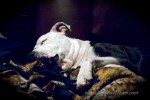
Tisen curled up on the passenger seat and took no notice of the leaves.  Maybe it’s true that dogs only see in black and white.

Fright Night

Halloween is perhaps the most magical holiday there is.  After all, you get to transform yourself into a princess, a witch, a football player, a horse, or whatever your imagination can come up with.  People hand you goodies.  It’s suddenly socially acceptable to scare the pants off of everyone.  And best of all, you don’t have to struggle to figure out what to get in the way of gifts–candy comes in fantastic variety packs that pretty much provide something for everyone.

And, it’s at the best the time of year in the US–the leaves vibrant in the golden light of the sun and the air dry, crisp, and cool–refreshing as a dip in the ocean after a day on a hot beach.  And the harvest moon lighting the night sky with a brilliance not often seen in the summer time.

When you combine all that with bonfires, haunted mazes, s’mores, and scary story telling, there’s just no beating Halloween.

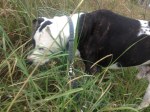
My husband and I have been debating on a costume for Tisen.  We’ve never costumed a dog before, but there’s an upcoming dog party.  I want to dress him as a cow.  Pat wants to dress him as a poodle.  Pat’s idea has two advantages:  first, there are no logistical issues involving an udder and boy-dog naughty bits; second, it’s funnier.  However, neither of us knows how to transform a pit bull into a poodle.

In the meantime, I’ve gotten into the spirit by volunteering at the annual “Acres of Darkness” event at the Audubon Society.

My job is to greet visitors at the entrance to the haunted woods and attempt to scare them with the history of how the woods became haunted, and then send them on their merry way into the pitch-black of the woods at the right time.

It’s a fun job.

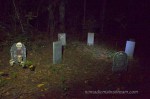
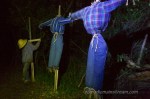
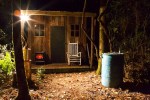
Since the first weekend the event ran was a little slow, I took my camera and tripod out with me to see if I could get some pictures of the trail.  It was really dark, but with the ISO set on 25,600 (every time I type that it still blows my mind–I remember when people used to talk about 800 ISO film being really fast), I managed to capture a few images.  In fact, some of them were over exposed.

Capturing the glow-in-the-dark faces on the trees was easy enough–I could shoot them from my position at the entry to the haunted woods.  The rest of the images required walking through the haunted woods.  Since I couldn’t leave my post until after we closed for the night, I was wandering down an already dark trail turning off lights and stopping to shoot every once in a while.  Fortunately for me, the zombies and monsters has worn themselves out on all the earlier visitors, so I made it through the trail unmolested.  Unfortunately, that made for less exciting photos than I was hoping for.

The Pearl

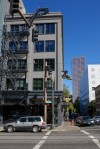
The Pearl District in Portland is a fun place to visit whether you prefer books, food, architecture, history, or beer.  Oh, or hippies.

It’s the kind of place where no one stares at me for walking around in hiking socks with my hiking sandals.  I guess with a North Face store and an REI in the neighborhood, it might even be considered fashionable.

There are also two breweries:  Rogue and Deschutes.  And, of course, a wide assortment of pubs and restaurants.

If you happen to be off work on a sunny afternoon in downtown Portland with great friends who have driven down from Seattle, this is the perfect place for a pub crawl.  Well, in our case it wasn’t so much a pub crawl as a stuff-yourself-silly-and-drink-a-flight-of-beer crawl.

It started when we decided we were starving for lunch.  My friend asked a mail carrier who happened to be walking by and he suggested Jake’s Grill at the Governor’s Hotel.  We ate way too much.

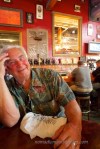
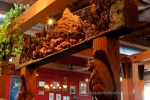
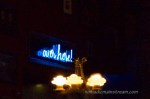
Then, after wandering around, we decided to check out the Deschutes brewery since it just happened to appear in front of us.  Deschutes has its own ambience with lots of high ceilings and dark woods and even elaborately carved decor.  But my favorite part of the decor was the “Restrooms Over There” sign with an arrow pointing to a large neon sign over the door to the restrooms that said “Over Here!”

But maybe that seemed funnier after we finished our flight of beer samples?

I think the blurry shots inside the pub perfectly captured the way it looked to me.

The beers were interesting.  A couple of them had an after taste that made me think someone had emptied an ash tray into the keg.  What was really interesting was that Pat tasted ashes in brews that finished smoothly for me and one of our friends.  But our friend and I tasted ashes in brews that Pat couldn’t taste it in.  Our theory is that Pat’s German taste buds are tuned differently than our more watered-down American taste buds.

Having finished our flights, the only thing left to do was to wander around some more and start to plan for dinner.  Never mind we’d eaten just 3 hours earlier.  We found an interesting seafood place we wanted to try from my iPhone. As we walked in the general direction of the restaurant, we thought maybe we would stop at another pub first just to kill some time.  But, everywhere we stopped, the bar was full.

We eventually and accidentally ended up at Jake’s Seafood, which was not the restaurant we had selected.  Giving up on the idea of having a drink at the bar, we got a table.  Once we were seated, we felt obligated to order dinner.

As it turned out Jake’s Seafood had been around for 120 years.  The food was fabulous, but my advice is don’t go there when you’re not hungry–it’s a shame to waste the experience.

Powell’s Books

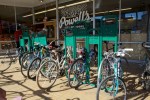
Every town has a store that everyone who visits must go to.  It’s a rule.  If you’re going to build a town and people are going to come visit it, there must be at least one retail establishment that everyone wants to go to while they’re there.  I don’t know what this place is for a lot of towns I’ve been to, but I know it’s there.  In Portland, Powell Books is the must-see tourist store (although it seems to have a lyal local following too, which has to help financially).

I used to think the OSU library was enormous.  Towers and towers of books.  I don’t know if a city block of book is larger or not, but it sure feels bigger.  When you walk into Powell’s, you have to reference a map with a color-coded key that tells you where different types of books are.  I guess you don’t have to reference it, really.  But, having spent a considerable amount of time wandering around looking for something, I strongly advise it.

Once you figure out which wing of the building the book you’re looking for resides in, you still must navigate the building that corresponds to that selection to find it.  It’s one of those bookstores that makes you understand why bookstores have librarians on had to find books you’re looking for and direct you to it.

There was a time when I could spend an entire day wandering around a book store.  These days, only the Apple store could keep me occupied that long.  Instead of lingering among books that smell like they’ve been lingering far longer, I have gravitated to the electronic version of books.  Given that I carry an iPad and iPhone with me virtually everywhere I go, it seems like a better use of the products I already own to double up the value of my investment.

Besides, who wants to haul more than 1 big dusty volume from the 18th century or earlier?

We are at Powell’s Books with our friends from Seattle today.  They have never been inside before, so we suddenly feel like tour guides.  We step inside and consult the map.  We point to different sections of the store.  My friend wants one particular book.  she asks for assistance to find it.  It’s located right next to where we’re standing.  We go get in line, check out, and leave.  We walked out without remembering to take them through the entire building.  Some tour guides!

Shooting Elk

I really enjoy wildlife.  The more wild, the better (well, until I start to look like dinner).  I get a bigger thrill out of seeing a deer in the park than I do at the zoo.  I get an even bigger thrill seeing a deer in the backwoods than I do at a park.  The more remote an area, the bigger the thrill.

Elk are more exciting than deer proportional to their weight.  I think there’s probably an algorithm out there that someone has developed to calculate the level of excitement any given creature produces based on their size, elusiveness, rarity, and number of people they encounter in an average year.

Seeing an elk is more exciting both because it’s bigger and because it’s more rare.  At least for someone who’s lived East of the Mississippi for most of her life it’s more rare.  Where elk can be found in the East, they have been recently reintroduced.  They wear large tags around their necks that I suspect say things like “My name is Leroy.”

I don’t know why they look less wild than their relatives in the West, but they do.  Even though it’s more likely that you’ll run into an Elk while cruising down a highway in the Canadian Rockies than in Great Smokey National Park, when you see the Elk in Great Smokey National Park, you’ll swear it’s one of the ranger’s pets.  The “more rare = more wild” equation just doesn’t hold true in the East.

What all this adds up to is an inappropriate level of excitement about seeing a bunch of elk who live about an hour from Portland.  I thought we would have the best chance of seeing the Elk at dusk, so we stopped on our way back from Astoria at the Jewell Meadows Wildlife Preserve.  Granted, the website told us that the best time to see the elk was between November and April, but since we weren’t planning to be in Oregon between November and April, we figured we’d better take our chances.  Besides, it was pretty much on the way back to my dad’s.

We did not get to see the full herd of 200 elk, but we did get to see a couple dozen elk from a distance.  I thought they would be roaming around grazing a bit more than they were–I guess they go to bed earlier on the coast.

For about the thousandth time during our trip I wished I had a lens longer than 400mm.   I shot the elk anyway, hoping the resolution of my camera would be enough to allow me to crop the heck out of the photos.  Unfortunately, the photos didn’t withstand the crop.  Between the motion of me hand-holding the camera and the motion of the elk, the images are just not sharp enough.

Regardless, I’m still glad we stopped to shoot the elk.  I’m also glad I was shooting with a camera.  🙂

The Open Road in Sepia

Hanging out on the tip of Washington in a place called “Dismal Nitch” might sound depressing.  However, according to the National Park Service, its name was derived from the journal of Capt. William Clark who referred to the site as a “Dismal Nitch” after being stuck there for 6 days in a storm waiting for supplies.  For the Lewis and Clark expedition, it was the last miserable stop on the Columbia River between them and the Pacific ocean.

For us, it was a beautiful, sunny day that gave us great views of the Astoria-Megler Bridge, the Columbia River, and the mountains beyond.  However, having driven over the ridiculously long bridge, stopped at Dismal Nitch, watched the pelicans diving after fish, and watched the sun start to sink lower in the sky, we decided it was time to start heading back towards Portland.  We had one more stop in mind and we wanted to get there by dusk.

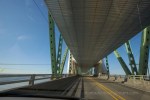
On the way back, I did some more “through the windows” shooting.  I’m fairly certain there is some law of photography that starts with, “Thou shalt not do landscape photography from a moving vehicle.”  Oh well, rules are made to be broken.

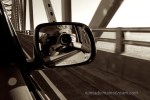
I know for sure there is some law of photography that says all photographers must at some point take a shot of themselves in a mirror.  I’ve resisted for a really long time.  But when I caught my reflection in the side-view mirror, my will power crumbled.  Like being drawn into a black hole, I felt compelled to press the shutter button.  Too bad I didn’t have try a slower shutter speed–it might have been interesting with the bridge blurred in the background.

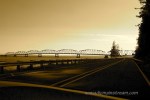
Having captured some similar images of the bridge going the opposite direction, I found myself somewhat bored with today’s selection of photos.  I decided to change them all to the sepia preset.  I went a little wild with the orange tones in the first image–it evoked the idea of sunset for me.

The pairs of images are yet another semi-happy accident I wish I would have thought of when I was shooting because I would have shot them a little differently.  Maybe with the road going left and then right or something.

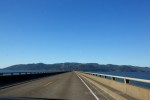
Regardless of what I might have shot differently or whether I shot something similar before, there is still something evocative to me about looking down the road.

What is it about an empty road that seems so prophetic?  My nomadic desires were suddenly reawakened by the sight.  The possibilities promised by going somewhere new seemed irresistible.  But on this day, the road didn’t lead to a place we hadn’t been before.  Just like life, sometimes we drive in circles.

Pelican Jarts

While birds are pretty darn fascinating to watch, there is no bird like a Brown Pelican for entertainment.  I don’t know what it is about watching their repetitive pattern of rising over the water, nearly hovering as they reposition their bodies for a dive, and their sudden transformation from giant seabird to giant feathered jart as they dive, leaving behind a splash that probably wouldn’t get them a gold medal if this were the Olympic diving competition.  But, I could watch them perform this dance between feast and famine over and over again.

On the Washington side of the Astoria-Megler Bridge, which, if I were inclined to bet, I would bet is called “Megler,” we found a park where we could sit and watch the Brown Pelicans in their unique approach to dinner.  It’s amazing to me that such a large bird can so completely disappear under the water for several seconds after diving head first after a fish.  I feel certain the military could learn a lot from these birds.

The Brown Pelican is, in fact, the only pelican who dives from the air after its prey.  If I were a White Pelican and I watched the Brown Pelicans I shared my territory with snatching up fish from below the surface of the water this way, I would probably want to give it a try–it looks awfully fun.

Through the Glass

There is only one thing disappointing about the Astoria Megler Bridge:  there’s no place for pedestrians.  I guess it would be expensive to add a pedestrian walkway to a bridge that spans over 4 miles, but the views from the bridge stretch over the bay to the distant mountains in Washington and back to the South in Oregon.  Plus, the pelicans and gulls fly over the bridge at eye level.  It would be a great place to shoot.

I decided to try shooting through the windshield.  I have a lot of experience shooting through car windows–one of the sadder ironies in life is that wildlife tends to be more afraid of humans walking in the woods than of cars racing down a freeway, often to their own demise.  This leads to me trying to capture images of moose, elk, bears, etc through car windows more often than on foot.

On the positive side, I have learned a few tricks.  First and always applicable, get as close to the glass as possible.  This puts all the crap stuck to the glass completely out of focus so it doesn’t show up in the photos (the spots in the last image are actually birds that were flying too fast to be in focus).

Second, if you can’t roll down the windows and stick your head out, shoot through the front windshield if you’re shooting wide angle.  There is just nothing appealing about a composition that looks like this:

Third, if you’re shooting with a long lens, it’s easier to shoot out the side window, but watch for the blasted rearview mirror.  Shoot tighter, sit cross-legged to get up higher in your seat, roll down the window and prop the lens on top of the rearview mirror (not recommended in a rapidly moving vehicle).  Do something to get that mirror out of the frame.

Fourth, don’t forget about reflections.  If you have a polarizer, you might be able to get rid of them that way.  Unfortunately, sometimes you have to live with them (like in the first photo in the gallery).

Fifth, if you’re shooting though the windshield of a car going 50+ MPH down the road and you’re trying to get lots of depth of field, you can focus on whatever spot is in front of the car and then shoot, even though the spot you just focused on is gone by the time you push the button.

Finally, if you are shooting while the car is in motion (hopefully because someone else is driving it), remember that the speed your moving affects the shutter speed you want to use, depending on whether you want sharp or blurred images.  Oh! I just had a great idea for shooting the drive down the far side of the bridge (yes, I just smacked myself in the forehead since I am not planning to be back in Portland again for a year).

Bridge Over Troubled Water

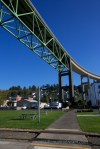
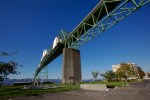
On our trip to Portland oregon, we made a stop at Astoria, a town as on the corner of Oregon as it gets.  In fact, the 4 mile long Astoria Megler bridge crosses from The north-most, west-most corner of Oregon to Washington.

We planned to drive across the bridge, but decided to make a stop to see the under-side of the bridge before making the crossing.  To be honest, this was because we couldn’t figure out how to get onto the bridge and were circling around confused when we spotted a Naval memorial under the bridge.  We pulled off and checked out the nautical monument and coastal scene.

The nautical monument is like a miniature wall that captures the names of those who have died in service to the sea.  The roles of the people range from boat captains to daughters of boat captains.  It’s an interesting exercise to read the names of the people and what is described as their job. I wonder if it was difficult work to be a sea captain’s daughter?

Seaside Seagulls

From Cannon Beach, we drove North to Seaside.  Perhaps we needed to do a little more research and there is a really beautiful beach somewhere in Seaside.  However, what we found was a ridiculously overdeveloped tourist trap looming over a nondescript stretch of sand with more litter than we’d seen in downtown Portland.

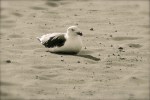
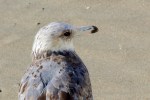
Having just come from Cannon Beach, I was so unimpressed that I didn’t shoot a single beach scene.  Instead, I put my 100-400mm lens on and started shooting the gull stragglers that didn’t seem to know the gull party scene was down at Cannon.

Two observations about photography:

  1. While 100mm sometimes surprises me with how tight it really is when I point it at a landscape scene, 400mm always surprises me at how wide it really is when I point it at a bird.  Even a big bird that’s relatively close to me physically.
  2. Number 1 often leads me to shoot the eye of the bird near the middle of the frame to make cropping easier.  Unfortunately, by focusing both the lens and my brain on the eye of the bird, sometimes I all together lose sight of composition.

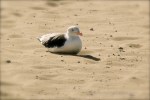
With regard to the first observation, the 4th photo in the gallery is the original, unadjusted image out-of-the-camera (other than having been converted to JPEG and greatly reduced in resolution for the purpose of posting).  As you can see, the gull appears quite far from the camera.  This isn’t helped by the fact that I was standing on an observation area raised well above the beach.

As for the second observation, it frustrates me when I sit down at my computer and look at my shots on my big bright screen and smack myself in the forehead and say, “Man–that would have been a great shot if . . . ”

For example, the young Herring Gull checking out its own shadow probably would have been a more interesting shot than the one I brought home.  I don’t know if he was actually checking out his shadow, but that’s the story the image would have told if I’d back up far enough to get the entire shadow of the bird into the frame.

Sometimes my husband walks up behind me and says, “Oh, that would have been great if you would have . . .” when I am reviewing images.  That’s even more frustrating.  A word of relationship advice:  if you’re in a relationship with a wannabe photographer, don’t ever say that.

As it is, these gulls gave me a good opportunity to expand my horizons a bit in Aperture.   Normally, I don’t do much beyond cropping, adjusting the levels, and balancing highlights and shadows.  The poor lonely Herring Gull looked like it really needed something more than that.  So, I played with edge blur and antique effects and Black and White.  Nothing ground breaking here, but it was fun.