Big Dog in a Flash

Today, a mysterious brown box showed up outside our door.  I hadn’t ordered anything and yet a package arrived.  The address was hand written like maybe it came from someone we knew.  It was addressed to both my husband and me.  When Pat came home, we opened it together.  It turned out, it was a gift for Tisen!

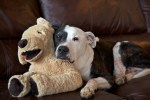
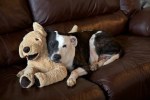
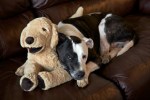
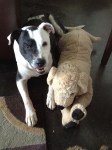
Tisen’s very thoughtful grandma sent him his own dog friend!  This is not just a little squeaky toy to add to his collection.  No, this is a life-sized stuffed dog that’s so incredibly soft, I tried it out as a pillow.  It makes a great pillow.

Since Tisen was at puppy daycare when we opened the package, we set Big Dog up on the couch with Lion.  When Tisen came home, he ran to the couch, grabbed Big Dog and threw him on the floor, snagging Lion in the process.  I guess he thought Big Dog had no business playing with Lion.

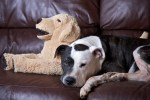
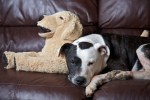
After a while, Tisen started carrying Big Dog around, which was pretty amusing because Big Dog is about the same size as Tisen.  Eventually, he settled down on the couch with Big Dog and discovered just how comfy a pillow Big Dog makes.

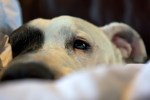
This gave me an opportunity to get a little portrait practice in.  Having just gotten my new flash before leaving for Columbus last week, I hadn’t tried it at home yet.  Interestingly, when I use my monolights (which can only be turned down to 1/8 power), Tisen gets up and leaves.  With my flash on an umbrella stand and turned down to 1/64 power, he seems to actually pose for me instead.  I could be onto something.

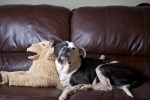
One of the challenges of properly exposing Tisen is that he is black and white.  As you can see from the last photo (taken with my iPhone), the whites tend to blow out and/or the blacks get clipped.  This is fine for an iPhone photo, but not really what I’m shooting for (a pun!).  I started with the umbrella on the white side of his face first because the black side of his face was in lots of ambient light.  Then, I tried speeding up the shutter to exclude the ambient light and moving the flash to the black side of his face.

One discovery from this experiment:  pleather makes a very bad background for shooting with a flash–the glare makes it pretty obvious that a flash is in use.  That said, you should now be able to tell which of the photos were taken with ambient light only and which of the photos used the flash on the umbrella stand.

Tisen was not too concerned about the glare.  He was just happy to have something soft and cushy to snuggle with.  He decided he liked Big Dog so much that when we went out to pick up a pizza, Tisen grabbed Big Dog for the ride.  Here’s a video of Tisen with Big Dog for your enjoyment.

Audience Participation

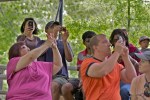
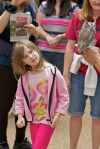
While working on getting great pictures of birds of prey (as in, trying very hard, not necessarily achieving), I had the realization that the people are as fascinating as the birds.  Especially the children.

I’ve spent the better part of my life ignoring most children.  Not that I have anything against children; I just tend to gravitate towards people who are old enough that they would be insulted if you called them a child.  I blame this, in part, on my height.  I have a tendency not to notice much that’s shorter than about mid-thigh height unless it barks, meows, or flies.  I don’t know why this is, but I do know I have walked right into small children on more than one occasion because I just didn’t see them–they snuck into range under my radar.

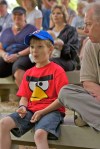
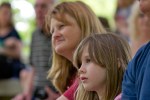
But on Sunday, when I sat in the amphitheater at Rock City watching the birds interact with the audience, it was the children who were the standouts.  Perhaps they haven’t yet developed the stiff facial muscles of adults whose faces repeat the same patterns over and over again.  Perhaps they don’t change their facial expressions to reflect what they think someone else expects of them, so their expressions seem more genuine.

I’m not sure exactly what quality of children’s expressions makes them so much more . . . well, expressive, but I cannot help but swing the camera around to catch a child practicing hooting when John teaches the audience how to call a Barred Owl.  I cannot but wish for a second camera body so I could have a wide-angle lens ready to go to catch the reactions of the children as the birds soar over their heads.

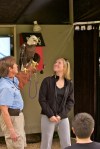
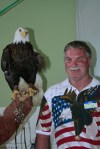
After the first show, John stands on the stage with Atsa, the bald ealge, while Dale takes Buddy, the screech owl, down the sidewalk.  I stay with John and take pictures of the people stepping up to have their picture taken with Atsa.

I sneak in a shot before they pose for their camera.  There is a moment for most people when they look up at Atsa, this magnificent bird, and their face expresses their genuine amazement, joy, or nervousness.  That’s the moment I want to capture.  Once they face their camera, they paint on the smile they’ve been using since their kindergarten class picture and I am instantly bored.

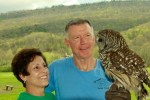
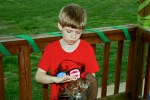
After the second show, I follow John up the walkway with Buddy and try to stand back far enough to shoot without anyone noticing.  I find myself wishing I could push the people aside blocking my view of the wonderful children petting Buddy.  Their faces made my whole day.  In a matter of moments, I witnessed fear, nervousness, surprise, joy, curiosity, and a hundred more emotions I can’t name.  I don’t know how many of those I captured in these images, but I sure have fun looking at the photos and realizing that these people were fascinated, engaged, and enjoying learning about birds of prey.

One Light Burning

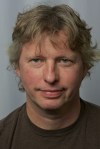
I talk Pat into sitting for me so I can play with lighting.  Having just returned from 2-for-1 margarita night at Taco Mamacitos, he’s a little more patient than usual.

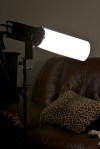
I want to play with one studio light with an umbrella and I want to try a snoot.  I think it’s a life requirement to try something called a “snoot.”  How often do we get an opportunity to participate in a real-life Dr. Seuss scene?

First, I try aligning the umbrella light with the ambient light.  This is possibly because of the margaritas.  I read an article about lighting in which the photographer “chased the sunlight” with off-camera lighting, but I can’t remember why.  I decide to try it.

The shadow is unpleasant (see first photo in gallery).  Scratching my head trying to remember what conditions call for that setup, I decide to scrap that idea and move on to placing the umbrella very close to Pat at various heights and angles.  I have to move the umbrella many times.

Through this process, I learn why my “great deal” on lights may not have been such a great deal–the power goes no lower than 1/8th.  I have to move the umbrella stand further away to reduce light further, but then I don’t get the effect I want.

I play around and find that raising the light high above my head and pointing it down on Pat gives the most even lighting with a nice shadow under the chin.  However, it’s not exciting.  I play around some more.

By this time, my marriage may be in jeopardy.  I attempt to engage Pat’s inner MacGyver by asking him to make me a snoot.  A snoot is just a tube that goes around a light to basically turn it into a spot light effect.  It might have just as easily been called a snout or a spout.  Totally Dr. Seuss.

Pat, who has no interest in playing model, is more interested in thinking about creating a homemade snoot.  Pat’s idea is to get a PVC pipe, but the size we need isn’t available at the local home depot.  I suggest we create one from a cereal box, but in the end, Pat uses a piece of poster board he happens to have laying around.  This is surprisingly effective.

However, Pat doesn’t want to model anymore.  I have to move my setup to the couch so he can do some work on his laptop while I shoot.  Tisen doesn’t seem to want to model anymore than Pat does.  Add “carpool dummy” to my list of essential equipment for the aspiring photographer.

The snoot creates such tight light that Pat and Tisen don’t fit inside it together.  I’m also at the end of my leash and can’t try different angles–the cords are stretched tight.  I switch back to the umbrella to see the difference (see the last photo).

Pat and Tisen both breathe a sigh of relief when I put the camera away.

A Shot in the Dark

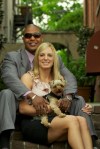
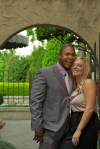
I arranged to meet my trainer and his fiancee at the sculpture garden in the Bluffview Art District an hour and a half before sunset.  I have no portable lighting, so the timing is critical.  They have agreed to model for me so I can try shooting portraits on location for the first time.

I get there early so I can walk around and look for good places to shoot.  I discover the tall building across the street from the park casts an enormous shadow and the shadow is growing rapidly.

When my models arrive, the light is not good in the park any longer.  But we take a quick stroll through the middle of the district (it’s a bit optimistic to refer to it as a district; it’s more like a short block) reveals some interesting architecture between historical buildings with a nice gate with an arch over it.  Of course, it’s even darker between the buildings, but we give it a try while it’s still bright enough.

We work our way around the area, trying shooting against a variety of backdrops–Bluffview affords a lot of interesting choices in a really short walk, so it’s perfect for this.  We end up at the Hunter Museum on the porch of the Georgian style mansion portion of the museum, sticking with the historical theme rather than walking over to the extremely modern side of the museum.

We play on the porch with the sun setting in the background.  Some red stripes start to appear in the sky and I attempt to get a few shots with the sun-streaked sky as a background.  This does not work at all.  I keep trying to get my subjects positioned so the spot lights on the building are lighting them, but, as shocking as this may be, architectural lighting doesn’t really work well for lighting people.  My shutter speed is way too slow–I coach my models to hold as still as possible, but let’s face it, I need a strobe.

When I review the photos later, I realize one reason why professional photographers often have an assistant.  I failed to notice when my subjects’ clothing did awkward things (like an errant tie that pops out of the bottom of a jacket like a pet snake).  This makes some of the shots I otherwise like annoying.  While the fiancee asked me to watch for her bra straps showing and my trainer was worried about his jacket not fitting properly, I really had trouble remembering to think about it.

I will have to bring Pat next time so I don’t get overwhelmed with trying to figure out how to use whatever portable strobe arrangement I end up with and watching clothing at the same time.

Tisen was happy to see me when I got home.  He thinks he’s my assistant and was mad I went without him.  I didn’t tell Tisen that Princeton, my trainer’s dog, was at the shoot while Tisen stayed home.

Models and Dogs

My trainer from the gym was kind enough to sit for me for portrait practice with a more cooperative model than Tisen or Pat.  We did simple head shots with the same lighting (well, continually adjusted as I tried to figure out what I was doing) throughout.

There were two major challenges to this session.  First, I had a hard time not over exposing my model.  In particular, his skin kept washing out and I found his teeth were blowing out.  I had my lights turned down as low as they would go and I kept stopping down, but I was still struggling.  I tried changing the shutter speed to reduce the ambient light.  It did not help.  I finally moved the lights back to reduce the intensity, but I was still blowing out his teeth.

Here’s the thing, I know very well how to control exposure.  If there is one thing I know extremely well, it’s how to get the exposure I want in ambient light. But for some reason, when I feel pressure of any kind, I forget something critical.  On St. Patrick’s Day, it was sync speed and then my lens hood.  This time, it was something as basic as my ISO setting.  It never occurred to me to look at what I had the ISO set on.  It wasn’t until reviewing photos that I discovered I was on ISO 400!  How on earth can I forget something so ingrained and basic?

I remind myself even if I never get the photo I want, at least I’m exercising my brain.  It would be nice if exercising my brain were as effective as lifting weights in the gym–I’d love to see some evidence of muscle development.

Thanks to post processing, I was able to recover most of the data in the blown out teeth and salvage the photos.  Several are usable for things like a LinkedIn profile or maybe a business card, but they’re awfully boring.

The second challenge (in case you thought I forgot) was Tisen.  He practically attached himself to Kory while he was in the apartment.  At one point, Kory was poised to sit down and Tisen was standing in front of him with his gaze fixated on a part of Kory it’s not polite to look at.  Kory froze and was afraid to move.

When I called Tisen to me, he tucked his tail and sulked off to hide under the desk.  As soon as I stopped calling him, he was right back to facing off with Kory.  At one point, he put his front legs in Kory’s lap like he wanted to be petted but kept growling.  I’m not really sure what he means by this, but my best guess is something like, “I’m willing to be friendly to you, but I’ve got my eye on you.”  I guess if I am going to have any more models coming in, I’m going to have to teach Tisen better manners.

The Other Side of the Lens

Today, I planned to spend some time shooting portraits with off-camera lighting.  However, I have the challenge of needing a model.  My trainer at the gym agreed to model for me next week, but I’d like to have some trial runs before then.  Since Pat and Tisen are strobe intolerant (I think it’s linked to the lactose intolerance gene), I decide I should try doing a self-portrait instead.

I get as far as installing the live-view software on the big computer so I will be able to see myself, but once I get the camera tethered to the computer and start remembering how to use the software (it’s been years since I tried this), I get distracted.

Tisen has hopped up on the sofa with Pat and, as usual, I cannot resist him as a model.  I take a few shots of Tisen laying next to Pat’s legs, then I decide to try to put myself in the frame.

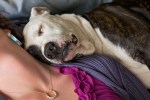
Since I’m shooting with my 100mm lens in our living room, I manage to get my throat in the frame by sitting on the floor in front of the sofa.  Tisen appreciates having my shoulder to rest his head on–he was starting to slide of the edge of the couch.

While there are a lot of shadows, I like the natural light and the way it seems to highlight Tisen’s face.  I also like that Tisen doesn’t run away when I shoot in natural light.

I discover it’s very difficult to come up with a pose that captures both my face and Tisen’s in the same frame without causing some rather frightening looking twists in my neck.  (I won’t mention how quickly I delete most of the photos when I see the folds in my skin!)

It’s a bit awkward to readjust a camera when you’re the model, especially when you’re counting on a dog to lie still so he’s still in the frame while you get up, go over to the tripod, adjust, sit back down, try to get back into position, and then, finally, shoot some more.  Tisen is amazingly complacent.  He looks somewhat miffed when his head rest gets up and walks away, but as soon as I sit back down, he snuggles his head in deeper against my neck.  How could anyone not love this dog?
I realize that if I’m going to do a self-portrait with the studio lights (which will be tomorrow’s exercise since we’re not hang gliding), I’m going to need something to focus on.  If only Tisen were 5’ 10”.  Well, maybe not.  Pat is working tomorrow, which is why we’re not going hang gliding, so he’s out.  Perhaps I can figure out how to attach Mr. Beaver to a broom handle and prop him up where my eyes should be?  That should be interesting!

The other thing I realize is that I need a white background.  Looks like I’d better go figure out how to hang a sheet.

Portrait Anyone?

The S.O.A.R. event on St. Patrick’s Day went wonderfully.  Over 200 people came and I think the event exceeded their expectations.  Watching children hold birds was especially a treat–how many people get to hold a bird of prey on their arm before they’re even a ‘tween?

As far as my venture in trying to get people to donate in exchange for photos, well, it turned out to be quite the challenge.

I did a few things right:

  • I practiced with my new lighting as much as possible beforehand.
  • I worked out a workflow ahead of time.
  • I setup my camera to shoot in JPEGs since there would be no time for post processing.
  • I took all my equipment out to the site the night before and did lots of testing to pick a good location to set up.
  • I tested my 100mm f/2.8 lens in the space I had to work in and prepared to shoot with my 17-55mm f/2.8 lens based on the results.
  • I did a lot of test shooting with my strobes at home with the 17-55mm lens.
  • I brought Pat along so he could help solve some of my more difficult problems.

I also did a few things wrong:

  • I should not have tried to use recently purchased lighting equipment at an event given my lack of experience with artificial lighting in general–it created extra stress
  • I didn’t set a custom white balance, which I really needed because of no post processing.
  • I forgot my CF card reader, which blew away my workflow until Pat went to Wal-Mart.
  • My extension cord crossed a major traffic area; Pat and a roll of duct tape to the rescue!
  • I didn’t test the process for burning CDs beforehand.  Having not burned a CD in about 10 years, this wasn’t wise.  My workflow resulted in drive failures, ruining several CDs.  I found a work around, but it wasn’t easy.
  • Finally, and most humiliatingly, a weird shadow suddenly appeared in my photos and I couldn’t figure out why.  After rearranging lighting about 1000 times, Pat came along and asked, “Are you sure it’s not the thing on your lens?”  Apparently, I bumped my lens hood and the wide part was in the wrong position, causing the shadow in the frame.  I can only explain the failure to recognize the problem immediately as a brain malfunction given this is something I’ve seen in the distant past.  Unfortunately, it’s one of those things that screams, “SHE DOESN’T KNOW WHAT SHE’S DOING!” to your potential customers.  <sigh>

While these mishaps didn’t negatively affect my fund raising in the end, they did negatively affect my confidence.

As you can see from the gallery, I did not exactly produce stellar images.  While the circumstances were challenging, I have to face the fact that I didn’t have the skills for the challenge–yet.  So many things to work on!

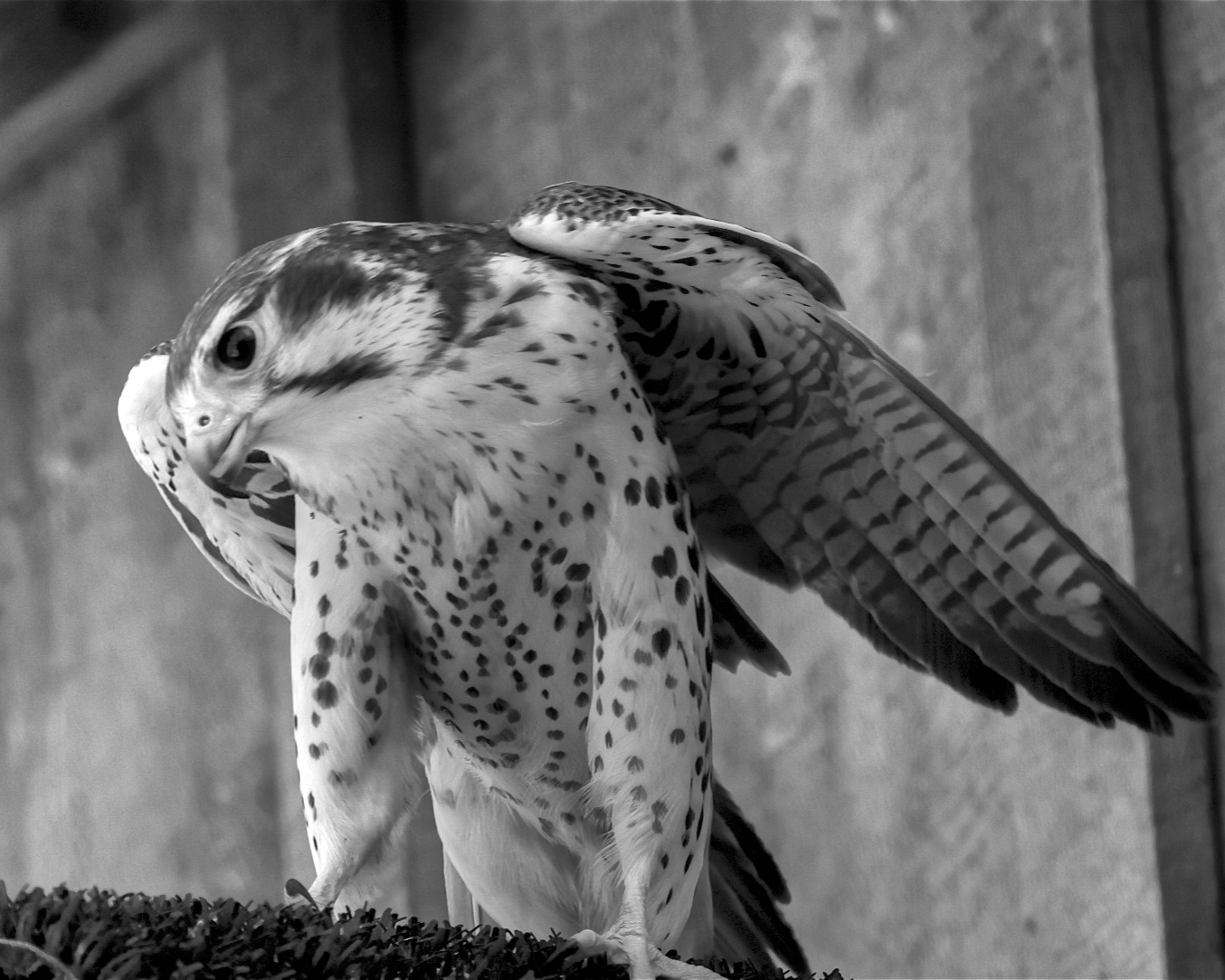
On the up side, my black and white Prairie Falcon portrait sold in the silent auction.

Portrait Model

As little as I know about photography, I know even less about portrait photography.  What I do know is mostly from a lifetime of smiling and nodding at people’s pictures.  My only formal training on the topic came in one evening of a class I was taking.  The main things I took away from that evening were:

  1. Zoom in.  Only include the important parts.
  2. Turn the camera to the vertical.  Whether it’s a head shot or full body, people fit better vertically.
  3. Use a long enough lens you can be a comfortable distance away.  This will prevent unflattering distortion like enlarged noses as well as help with the last item I remember . . .
  4. Get your subject to relax.  This is the most important skill of the portrait photographer.

The instructor also talked about different types of lighting, but I prefer to shoot outdoors and never had much interest in studio lighting. I confess I didn’t pay much attention to that part of the class.

A guy in the class showed me what a great shot he got of the model.  About 2/3 of the photo was occupied by the chair, floor, wall, ceiling, lights.  Seems he also ignored part of the class.

Tonight, I have the sudden urge to practice a few portrait shots.  What I don’t have is a model.  But, I forgot, I always have a model.  I just have to get him to lie still.

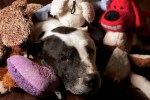
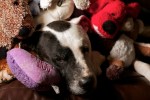
I coax Tisen up on the couch under a soft light and pile his collection of squeaky toys around him.  I step back to the tripod and discover an interesting difference between dogs and people–dogs follow you when you walk away.  I try again.  This time, I hold out my hands and tell him to stay.  I make it to the camera and manage to get off a few shots before he gets up again.

By the third try, he seems to have caught on that I want him to hold still while the camera does something.  I have the camera set on 2 second delay, which is normally not a good choice when shooting a subject that suddenly gets up and leaves without warning, but he seems to be taking a cue from the yellow light that flashes until the camera fires.  He watches the light and holds still until he hears the click of the shutter.  Maybe he makes a good model after all?

The down side is that he looks tense.  He watches me and the camera for any sign that he can get up.  The pile of toys look like they are leering at him, reminding me of something out of a horror film.  I take pity on my patient model and tell him he can get up.  He immediately takes one of the offending squeaky toys, Red Dog, by the . . . body? . . . and gives him a shake for all he’s worth.  Red Dog won’t be leering at Tisen again any time soon.