

Food and Water

After a few hours of wandering around Chattanooga and the Tennessee Aquarium, it was time to eat.  The six of us headed towards Big River Grille and Brewery.  Although Pat and I have been there a few times, it was the first time for dinner.

The 7-month old entertained us through the whole meal.  She is one of those babies that smiles and laughs and looks amused most of the time.

The 4-year old did some interesting things with his food.  He created a whole new presentation by rolling it into balls.  Since we had just come from the aquarium, perhaps he was thinking about fish bait–he is apparently quite the fisherman.  He already knows far more than I do about fish.

After filling our bellies, we took a brief break so we could play with the dogs and the four-year old could change.  Then, we headed over to Coolidge Park to check out the water fountain.

This is a fun feature in Coolidge Park.  Large animal sculptures surround the fountains, providing nice climbing structures.  I enjoyed shooting the 4 year old at play.

I recently had a conversation with a couple of photographers about using the “aperture priority” setting.  (Aperture priority allows you to set the aperture manually and then the camera automatically adjusts the shutter speed.)

Apparently, this was stressed as the setting to use all the time at a recent workshop.  I’m of the opinion that there is nothing that applies all the time, but aperture priority is nice when you’re shooting a subject that is moving quickly through different lighting situations.  However, I’ve found that shooting a subject where the background changes but the lighting on the subject doesn’t in aperture priority causes the subject to be incorrectly exposed depending on how light the scene is behind the subject.  For this reason, my default mode is manual.  If I change to aperture priority, I make a conscious decision to do so and I know why I’m doing it.

The irony of this is that I either had a mental malfunction that caused me to not check my exposure or my camera malfunctioned when it read the exposure.  Since I’ve not had this problem before or since, I’m guessing it was user error.  I ended up with about 300 shots that were either horribly over exposed or horribly under exposed.

If aperture priority were my default, I might not have gotten the depth of field I wanted, but I would have at least gotten properly exposed images.

The best default would probably be to always check my settings and my exposure before I fire off 300 shots.  🙂

I’m going to write to Canon and suggest an alarm that goes off if you start shooting without changing settings or viewing a shot.  It can be called the “Alzheimer’s Indicator.”  If it goes off more than 50% of the time, it’s time to get an evaluation.  Photography as diagnosis–who says it’s just a hobby?

Valley View and Difficult Decisions

Decision making is something I do all day.  In fact, I get paid for it.  I’m not claiming the decisions I make are important or life changing or even interesting.  I’m only claiming that I make decisions.  And I do it all day long.

The thing is, I’m pretty quick at deciding.  In fact, I’ve spent a couple of decades learning how to slow down and not jump to conclusions.  I don’t need to know every possible piece of information; only a reasonable amount to feel confident that I can make a choice between options.

So, I ask, why is it that once I put my work away, I can’t seem to make even the simplest decision?

Is decision making a non-renewable resource?  Do you only have so many decisions you’re allowed to make during the day and then all decision-making brain cells are drained until they are recharged over night?

I don’t know why, but deciding things like “what do I feel like eating?” often feels like I’m trying to decide whether to wage war on a neighboring country.

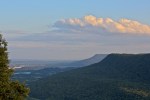
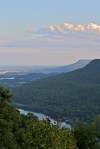
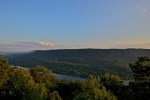
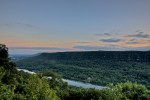
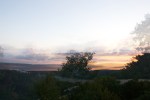
Similarly, tonight as I looked through the remaining shots from Signal Point trying to decide which ones to include in today’s post, I look at the first shot and think it’s not bad.  Buth then I look at the second shot and prefer the framing.  In the first example, the bank of clouds is entirely visible.  There is no view of Venus in either shot, but the temptation to keep both images overwhelms.  Instead of choosing the one I like the best, I now have doubled the storage required.

Oh, and wait, what about the vertical version?  Or the wider angle view of the valley at 18mm?  Or what about the slightly less wide angle view at 28mm?

I know that there should ultimately be only one best image but whose best am I shooting for?

Then, there’s the HDR processed images.  After all, given that i went through near heart failure to get multiple exposures of several images, shouldn’t I keep the processed versions of these negatives, combining the many exposures and trying to output a combined photo that exposes all parts at the same time.  I’m pretty sure the entire collection of exposures should be kept just in case I want to recombine them all differently in the future.

I would also share the in-camera HDR settings, but I haven’t actually figured out how to do that yet.  Figuring out how to do brackets of 7 exposures was challenging enough and then that failed.  It makes it a little difficult to get motivated to figure out how to use the more advanced features like in-camera multi-exposure processing.

Maybe next post . . .

Someting Wong

I have a beef.  For months, I deliberated about whether a new camera was worth it to me or not.  I cut back on expenses and saved until I could afford the camera I wanted.  I waited for it to arrive for weeks while it was on backorder.  Finally, it arrived and I thought for sure it would take my photography to a new level.

(Alas, you know what they say:  it’s not the ingredients, it’s the chef.)

What I didn’t expect was to have some bizarre problem with my brand new camera.

Yesterday, after attempting to shoot the Transit of Venus, I nearly had a heart attack when I placed my loupe up to the LCD and saw some of the images included in this post.  Having previously seen a video that shows how you can ruin the sensor in a digital camera by pointing it at a laser light, and having also read enough of the camera manual to know it says “never point the camera directly at the sun,” my heart took a pause when I considered the possibility that I had just destroyed the sensor in my 3-week old camera.

The images looked like half of sensor had been completely blown.

I stood there at my tripod and tried to breath.  My heart was racing, my stomach doing flips–had I just ruined my biggest single investment in photography?  I tried to calm down by reminding myself that I have shot sunsets numerous times without a filter and it’s never burned my sensor.  This time, I had a 10 stop filter on the lens–surely that protected my camera?
Taking a few deep breaths, I managed to dissipate the panic enough to do the only thing one can do when anything operated by a computer starts to malfunction:  reboot.

I turned off the camera and turned it back on.  Thankfully, it started working again.  My heart slowed down and I almost cried with relief.

When I looked at my photos on my computer, it became clear that there was indeed a malfunction.  Some of these images look like double exposures–I didn’t think that was possible with a digital camera.

In looking at the problematic images, I discovered several things.  First, it happened when I was shooting bracketed exposures (e.g., the camera automatically shoots 7 images in a row with a shutter speed that is one stop of light apart for each shot).

I also recalled several times when I was expecting to get 7 shots, I ended up with 2.    When I looked at the pairs of photos that were most likely associated with these misfires, they have identical metadata.  By that, I mean the shutter speed, ISO, aperture, date, and time (down to the second) matches exactly.  Yet, the exposures and even the subject in some cases look wildly different.

I have googled to no avail.  I seem to have a unique problem.  I always knew I was different.  😉

If anyone knows what this problem is, please comment!

P.S.  Title is an exact quote of my all-time favorite error message in a software program circa 1994.

Portraits in Suburbia

It’s that time of year again:  graduations.  I have begun to divide my life into stages by the kinds of events we celebrate.  Long ago, it was our own graduations and those of our friends.  Then it was weddings.  Next, it was baby showers, followed by divorces (well, that wasn’t usually a celebration).  Then there were second marriages (and occasionally third).

Now, I seem to be participating in the same cycle of events one generation removed.  Because I have friends in many age groups, these events continue in waves depending on how old my friends are.

The high school graduations of my friends’ children started ten years ago.  Those were followed by weddings, and a few baby showers (although babies seem to be coming later and later in people’s lives).

But, this time, it’s my nephew who completed high school.  This event led to us taking Tisen on his longest road trip ever.  Fortunately for us and for Tisen, my brother’s family is willing to accommodate Tisen so he didn’t have to stay in a kennel.  I’m not sure either one of us would have survived the separation anxiety.

The other unintended consequence is that I gained a couple of new models for portrait shooting.  It’s a good thing my nephews were unwarned of my intention to shoot some portraits or I might not have seen either one of them during our visit.  However, I managed to get a few minutes of their time before they got too impatient with me.  What is it about the men in my family that they can’t sit for more than 10 minutes to let me practice portraiture?

They might have been a little intimidated posing next to my strobe on an umbrella stand–I don’t think either one of them has ever posed in front of an umbrella before.

I had fun trying to create some more dramatic lighting by casting shadows with the light.  My youngest nephew seemed to think the lighting was a little too dramatic, but he played along patiently anyway.

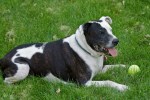
Tisen, never one to pose in front of a flashing umbrella, spent his modeling time discovering the joys of the ‘burbs.  I believe the thick, green grass right outside the door was a first for him.  At home, he can cross an asphalt parking lot to find a small patch of grass or walk to the park to roll in a short, spongy variety of grass.  Before he came to us, I doubt there was much grass in his life.

Unleashed and let out the door in the heart of an Indiana suburb, Tisen seemed at first confused and then overjoyed by the large yard to play ball in.  Although there was no fence, Tisen stayed well within the invisible confines of the property lines as if he was  afraid he would get lost if he got too far from me in that endless expanse of grass.  I am now worried he will resent returning to his urban life.

Gear Envy

Continuing the Gibbs Garden field trip, my cohort and I made our way down from the Manor house back towards the main entrance in time for lunch.  Along the way, we frequently paused to shoot.

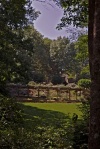
Below the Manor House, looking back up the hill, an arbor stretched across the hillside below the house, surrounded by flowers.  It was so beautiful, we had to stop to shoot.  Unfortunately, the sun was high and the house was lost in dark shadows.

As we worked our way back down, we found numerous water features.  Between natural looking creeks and man-made ponds and streams, each had a distinct character.  The bridges that accompanied them were just as varied.

It’s funny how I can look at a scene, know that the lighting is not going to allow me to get the image I want, but not be able to resist trying anyway.  I wonder if this is the difference between digital and film?  Between knowing I can just delete any bad shots and that I can do quite a bit in post processing to improve the harshness of the light, I can’t walk away without shooting.

I haven’t quite figured out how to fix bad lighting in software, though.  While I can lift the shadows and pull down the highlights and do all kinds of interesting adjustments, in the end, it’s still bad lighting.

My first impulse in dealing with harsh lighting is to reach for a polarizer.  While it can’t fix the light, it can at least remove a lot of glare.  Two things have recently changed, however.  First, I have been shooting wide angle with a lens I added a couple months ago, which requires an 82mm filter.  My polarizing filter is 77mm.   So, I had to switch lenses to my most recent addition, a 24-70mm, which takes a 77mm filter.

After switching lenses just so I could use a polarizer, the second recent change come into effect.  I now have enough gear that I need two bags.  This has created a whole new problem.  I only brought one bag with me and I forgot to put my filters in it before I left.  So, I had picked a lens to fit a filter I didn’t have with me.

It seems like getting more stuff complicates photography in the same way it complicates the rest of my life.  The cost of more gear is more than the price–it also means more time organizing it, looking for it, and switching back and forth.  I think I’m about to hit my limit on wanting to further complicate my hobby.

Interestingly, the photographer I shot with at Gibbs Garden has been into photography since he was a boy.  Once film became too expensive and inconvenient, he switched to a high-end point-and-shoot with full manual control.  He carried his small, light-weight camera, a proportional tripod, and nothing else.  I was extremely envious by the time we sat down for lunch.

60mm (Almost)

Does 14mm really matter?  For my non-photographer readers, in this case, I’m talking about focal length.  In short, focal length determines how close or far the subject appears through the lens.  The more millimeters, the closer things look.

I tend to like zoom lenses, which offer a range of focal lengths in one lens.  This may be because when I am done working for the day, I don’t want to make any more decisions.  When I get out my camera, I don’t want to have to decide if 50mm is going to be what I need.  However, generally speaking, lenses with the biggest range of focal lengths often have the poorest image quality.  I guess to get all that range, you have to give up something.  As such, I try to buy the best quality lenses with a reasonable range of focal lengths I can.

Over the course of several years, the range of focal lengths I could cover has grown from 17-55mm and 70-300mm to 16-55mm and 70-560mm.  Yet, I never could cover that 14mm gap from 56-69mm.

For a long time I thought I could live without those 14mm.  But then I started running into situations where I really needed a focal length between 55 and 70mm and I didn’t have it.  Granted, moving is often an option.  However, when you’re shooting from a train, a car, a boat, a balcony, a roof, or even a hilltop, moving may not be within your control.

Since I am waiting patiently for my new full-frame camera and my 17-55mm lens will not work with a full frame camera, I figured it was time to fill the gap.  After 5 years of no 56-69 coverage, I have now expanded the focal range to 16-560mm–with no gaps.

As exciting as this may be to me, comparing what I get at a previously unavailable focal length to other, available focal lengths seems like the best thing to do.  I set up on the balcony and shoot the view I have shot so many times before.  This time, I aim for 60mm–right in the middle of my new range.   Unfortunately, there are no markings between 50 and 70mm on my lens, so I have to guess where 60mm is.  When I load my photos into Aperture, I learn that I was shooting at 57 and 58mm.  Oh well.  Still within the previously missing range.

Tisen, who is suffering from a combination of allergies and a nasty rash and has been put on steroids and antibiotics, is so groggy, he barely drags himself out onto the balcony to help me shoot.  As soon as I sit down at the computer, he returns to the sofa.  Apparently he has grown tired of the view faster than I have.

The new photos are compared to old shoots from similar views at different focal lengths.  It’s funny what a difference a few mm can make!

In Search of a New View

On Friday night, Pat decided it was time for us to try Nikki’s, a Southern Fried Chicken and Seafood drive in that we’ve been going past regularly ever since we started taking Tisen to doggy daycare.  Pat’s idea was to get take out and go have a picnic.  I decided this was the perfect opportunity to find a new location to shoot sunsets from.

After getting two fried shrimp dinners with coleslaw, fries, and hush puppies, we follow google maps up the hill to a nearby conservation area.  There isn’t a picnic area, so we wolf down 3 weeks worth of saturated fat sitting in our mini-van.

The conservation area is a shady woods that, unfortunately, has been invaded by many foreign plants that block the view through the forest.  The trail is an abandoned road that looks wide with easy walking, but we decide to forego a hike since I’m hoping to shoot the sunset.  There is no hope of getting any views of the sunset from where we are.  Not only are there no views through the thick growth, but we’re on the East-facing side of the ridge.

We decide to drive to the other side of the ridge to a different trailhead to see if we can get a view from there.  After crossing under the ridge through a tunnel and driving around to the other side, we wind our way around to the next trailhead only to find that we are still on the wrong side of the ridge.  It’s like some kind of joke.  There is no explanation as to how we still ended up facing East.

As we head back out, the trill of a wood thrush catches my ear.  I suddenly realize I haven’t heard one since we moved to Tennessee.  As I listen to its sweet flute-like voice, I suddenly ache for the ravine we left behind.  But I am soon distracted by the search for a view of the sunset.

We end up on the backside of the ridge facing the freeway.  There is a big, bald hillside on the other side of the freeway where a new complex is under construction.  It looks like the developer hired strip miners to do the excavation.  It breaks my heart.  I cannot bring myself to shoot with this eyesore in the frame and I cannot shoot around it.  Perhaps I will have to think about how to capture the ugliness of this site, but tonight I’m seeking beauty.

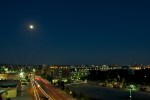
After trying every road we can get access to along the ridge, we give up on having a really good view and return to our roof at home.  We are in time for twilight.  The almost full super-moon has already risen high, shining so brightly I cannot resist shooting it.  Equipped only with my wide-angle lens, I play with long exposures.

All-in-all, it’s been a fun little adventure even though we never strayed far from home.

Big Moon

Yes, it’s that time of the month again–the full moon!  But not just any full moon.  No, this is the super-moon!  Not only is the moon at perigee tonight, but it’s also Cinco de Mayo.

Seems like a recipe for disaster, but according to one article, there is no truth to the belief that crime and wild behavior increases with the full moon.  I’m not so sure.

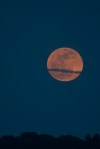
Another special aspect about tonight’s moonrise is the time.  The moon will rise before the sun sets.  This means there will still be light on the trees along the ridge top.  I’m excited about the possibility of capturing the moon in this kind of lighting.

Pat and I had some logistical issues in our plan today.  I volunteered at the Audubon Society’s visitor’s center most of the day and Pat worked.  Tisen got to go to doggy daycare.

By the time Pat came home, it was 6:30PM.  We wanted to celebrate Cinco de Mayo at Taco Mamcito’s next door, so Pat jumped in the shower while I took Tisen for a walk.  Then Tisen had to be fed and we had to wait for him to eat before we could leave (he won’t eat when I’m gone).  By the time we were headed out the door, it was past 7:30PM.

While this may seem plenty early to begin a Cinco de Mayo celebration, the problem was that the moonrise was going to happen at 8:21PM and I didn’t want to miss it.  By that, I mean I wanted to be set up on the roof of our building with my camera ready to start shooting by the time the super-moon appeared on the horizon.

We went next door quickly, but when we saw the crowd, we gave up all hope of getting food and just ordered margaritas.  Fortunately, the margaritas were small because a margarita was probably the last thing I needed having still not eaten.

We drank our margaritas quickly as we huddled in a corner of the patio, trying not to crowd the people sitting next to us.  At 8:15PM, we are racing out the back door to get me up to the roof on time.

I manage to grab my gear and Tisen and get set up on the roof before the first glimpse of the moon appears over the ridge.  I am helped by the fact that it takes an extra 10 minutes for the moon to get from sea level to the top of the ridge.

I shoot and check focus and exposure and shoot some more.  I don’t know what it is about this giant, orange moon rising over the ridge that I find so exciting, but I wish the moon would pause for a few minutes so I could get all the adjustments just right and perfectly capture it as it hangs as a glowing backdrop to the ridge.  I never get tired of the moon.

Blowing the Top

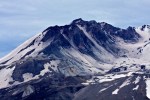
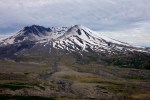
Mount St. Helen is one of those places everyone should see.  Or at least anyone who is interested in what happens when a mountain explodes.  It’s one of those fascinating places that I have no problem returning to.  I’ve been there three times, which is a lot considering I live about 2500 miles away and there are a lot of places I haven’t been that are higher on my bucket list.

Our last trip out to Portland, my brother, sister-in-law, and nephew wanted to see Mount St. Helen and we decided to do a 6 mile hike while we were there.  My dad and his wife would hang at the visitor’s center while we did our through-hike.  They would pick us up at the end of the trail.  Timing was a bit tricky.  With no working cell phones, we had to predict how long it would take us to go 6 miles.

I have read a lot of books about backpacking where people say things like “20 minutes a mile with a full pack is a good pace.”  I have yet to go on a day hike where we were able to maintain a 20 minute mile pace, let alone a hike with a full pack.  So, when my sister-in-law (who likes to do things like run marathons at an 8 minute/mile pace) guestimated we could hike 6 miles in 1 1/2 hours, I was less optimistic.  A 15 minute pace sounds painfully slow to a runner, I suppose, but maybe that’s why I don’t enjoy running?

Before we departed, I told my father we would take at least 2 hours and that he shouldn’t worry if we took 3.  I set the panic time for 7:00PM, figuring that would give us three hours–I felt confident we could manage a 30 minute pace even in the worst of conditions.

The views in the Mount St Helen area are haunting.  The landscape looks almost foreign.  Yet, each time I’ve returned here, there were more signs of life–more green, more elk, more birds.  Given that it’s been nearly 10 years since my first trip, the progress is slow, but it is progress.

As it turned out, we got confused about which trail we were on.  Our only trail map was a flyer from the visitor’s center that gave us so little information we couldn’t find the trail we wanted to be on and eventually decided to turn back.  We walked back quickly to an overlook we’d passed.

After hitting up a few tourists until someone agreed to give me a ride down to the meeting place, I made it to the rendezvous spot about 1 minute before the panic time.  My dad and his wife were quietly napping, so I don’t think we were in danger of them panicking.

On the way home, we stopped one last time to enjoy the view of Mount St. Helen–majestic even without her peak.

Tennessee Hocking Hills

Hocking Hills is . . . An area? A collection of parks? A collection of hills? Perhaps all of the above. Whatever the name refers to, for me, it a part of growing up.

Something that my friends in Tennessee might not quite understand about growing up in Ohio is the experience of growing up where the land is flat. While Ohio has its river valleys, in Central Ohio, they tend to create long, slow slopes that are barely noticeable in a car.

The steeply angled streets of Chattanooga that climb, descend, and climb again seem as foreign to me as a river that flows North. When I was growing up, we had to drive somewhere to experience substantial hills and, more often than not, that somewhere was Hocking Hills.

Hocking Hills is about an hour or so South of Columbus. It marks the edge of a glacier that planed down the irregularities in the landscape to the North, leaving behind what was once plains and then forests and is now some of the flattest farmland around (except maybe for Kansas). But just beyond this geological boundary, the land rolls. The hills are high and cut deep by ancient rivers, leaving fascinating ravines with sandstone outcroppings and lush ferns.

It’s the kind of place that brings people from several states back over and over to experience in every season. In the spring and fall, it’s hard to find a parking place in any of the state parks if you get there after late morning. Flat landers rush to the hills in droves, seeking the experience of driving the winding roads as well as hiking the ravines.

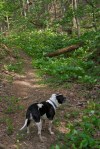
On Sunday, Pat and I took Tisen for what may have been his first hike in the woods ever. We went to a section of the Cumberland Trail and picked our way through incredibly large and voracious looking poison ivy plants.

As we entered the woods, the bright sunlight dimmed under the trees and we had to blink, waiting for our eyes to adjust.

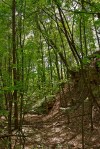
We started near the top of a large hill that would put Hocking Hills to shame and ascended several more times until we were walking along the very edge of the ridge line of the slope. As we worked our way along the ridge, the large outcroppings of stone protruding from the opposite side of the ridge immediately made me think of the kinds of formations we would see at Hocking Hills. It’s funny how you can hike to the top of a mountain and find only what you brought with you.

Tisen, having never seen Hocking Hills, cannot appreciate the similarity, but he appreciates being allowed to run ahead on the trail–something he could never be allowed to do in the crowds at Hocking Hills. Today, we are the only car parked at the trailhead and we neither see nor hear any other hikers on the trail. This solitude makes the walk that much more satisfying.