Secret Island

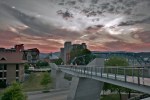
In the Tennessee River, between the Bluff View Art District and the North Shore, there is an island.  Most people call it Maclellan Island.  The owners call it Audubon Island.  Long ago, it was Chattanooga Island. Before that, it was Ross’s Landing Island.  Whatever you call it, it’s a tough place to get to.

It’s a place I’ve wanted to see since we first came to Chattanooga.  It’s inaccessibility made it that much more desirable of a destination.  I tried a group who does kayaking tours, a business that rents paddle boards, and a water taxi service to no avail.

But finally, the Chattanooga Audubon Society is offering a tour.  Today is the big day with the Chattanooga Duck Tours providing transport.

Captain Alex takes us through downtown Chattanooga, educating us on the history of the buildings.  We had no idea that so many of them had been around since the 1800’s.  Then, we take a running dive into the river in our 1940’s DUKW vehicle, built by Rosie Riveters during WWII.  She still holds water.

We make it to McClellan Island safe and sound–and knowing a lot more about the riverfront development effort, too.

The island has 1.5 miles of trails that have been freshly groomed, but there is already poison ivy reappearing all over the trail.  Now, poison ivy is a native plant that’s good for birds and I have nothing against poison ivy.  I just don’t want to come in contact with it.  We step gingerly to avoid coming in contact, although it’s pretty much impossible.

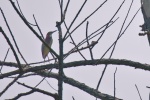
A great-crested fly catcher sings a greeting for us, although we only catch an occasional glimpse of him flying from one tree top to the next.  We also hear a wood thrush, an Eastern towhee, and many other common birds.

Sadly, it’s hard to see anything through the dense privet, honey suckle, and vinca taking over the woods.  It makes me sad to see how devastated this tiny island is by plants that have invaded here.  Poison ivy is by far the most prolific native growing on the island, but even it is out-competed by the invasives.

The first wild-growing oak-leaf hydrangea in this county was discovered here on this tiny island just days before.  It represents a glimmer of hope that the ecosystem of this tiny green space can still be saved.  The clusters of white flowers shine through the shadows and remind us how beautiful nature, on its own, can be.

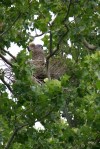
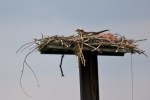
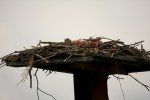
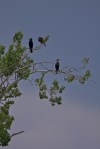
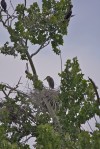
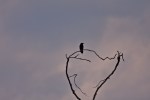
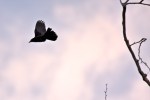
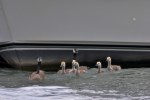
Back on the duck, we get the best view possible through fully leafed-out trees of a heron rookery.  There is also an Osprey on its nest on a platform at the end of the island.  As we come around the far side of the island, a group of double-crested cormorants perch in the trees.

I only wish we could spend more time sitting (far from poison ivy) and listening for all the birds that call this tiny sanctuary home.
The High Desert

Going back in time again to a previous trip to Oregon, I’ve pulled together a few photos from the High Desert Museum in Bend near Lava Lands National Park.

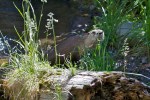
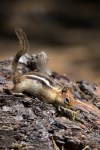
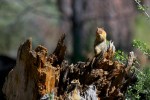
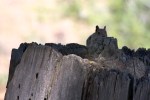
A recurring theme is the number of golden mantle ground squirrels that posed for me.  I noticed a marked improvement in the poses at the museum over the ones at the park.  I suspect the ground squirrels at the museum are professionals.

Besides the ground squirrels who scurry along the many paths, they also have native creatures on display.  Since shooting captive wildlife is far easier than sitting around waiting for it in the wild, I took full advantage of the opportunity.

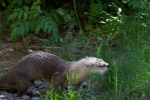
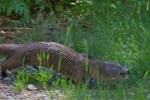
Given that it was mid-afternoon, many of the animals were content to lie in the sun and let me shoot.  However, the river otter was not so cooperative.  I can only recall having been to a facility with river otters who were actually visible and active once in my life–it was nearby at the Seattle aquarium.  There must be something about the Pacific Northwest that makes otters more active.  I guess that makes sense since the people of the Pacific Northwest tend to be more active, too.

In any case, first I tried getting shots of the river otter through a glass wall on one side of the “pond” he was swimming in.  I thought it would be really cool to have underwater shots.  With little light, I was stuck with a slow shutter speed, so none of the underwater shots are worth looking at.  Just dark, blurred shapes moving through water.

Next, I headed outside hoping for better light to shoot in.  I did get more light, but it wasn’t exactly better light considering the time of day.  It was enough that I was able to shoot at 1/160th of a second, though.  That allowed me to stop at least some motion.  My favorite pictures of the otter are the two that show him shaking off.  The first one is the start of the shake with only his head in motion.  The second one is slightly later.  The shake has propagated down to his neck.  If I would have taken a bunch of shots, you could have seen how the shake moves from the head all the way down the length of the otter’s body.  It’s pretty amusing to watch.

Another critter that posed for me was the porcupine (hedge hog) who was part of the animal show we caught the tail end of (pun!).  He didn’t pose just for me–there was a big crowd in the amphitheater, but the porcupine remained amazingly focused on the bottle his handler was feeding him.

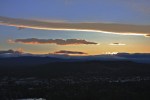
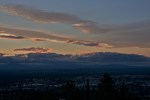
At the end of our day, Pat and I went to Pilot Butte State Park to enjoy the sunset.  It’s basically a giant hill in the middle of an otherwise flat town.  At the top, we were treated to spectacular views of the mountains, the clouds, and the setting sun.

Wild Ride

Having gotten a decent shot of a red-shouldered hawk at Audubon Acres yesterday, I have the itch to practice wildlife photography today.  I also have the itch to ride my bike.

I slather on several layers of 50 SPF and head off.  It’s about 2PM in the afternoon–not exactly prime time for either wildlife or light.

I cruise casually along the Tennessee Riverpark–the 94 degree heat dissipates as I coast down hills and suffocates me when I go uphill.  At least riding generates a breeze.

I continue on to the Amnicola Marsh.  I find a shady spot to set up and I wait.  This is where I start to question just how much desire I have to be a wildlife photographer.  It’s ridiculously hot for early May.  I feel the heat pounding at me the way I feel the beat of a bass drum at a high-powered rock concert.

Then, the bugs find me.  I am the incarnation of Pig Pen–I have my own cloud.

Sweaty, bitten, itchy, and aching from my heavy pack, I have a hard time being patient.  I have been in the field 5 minutes.

Then, low-and-behold, two green herons fly in and land in a dead tree.  The lighting is horrible, and I’ve arrived without my polarizer, but I do my best to get a decent shot.

I am too far away.  I decide I should try to get closer.  I carefully creep through the scratchy weeds, leaving my bike behind, but hoisting my pack back onto my sore shoulders.  I pick my way around thorns, through spiderwebs, and avoid poison ivy until I am all of 10 feet closer to the tree in question.

I consider moving further in, but the underbrush looks a little thick, I won’t be able to keep an eye on my bike from there, and, well, it looks like my feet might get wet.  I decide to shoot from where I am.

I see a flash of white in my peripheral vision and I swing the lens around to find a snowy egret landing among the lily pads.  Then, it disappears so completely that I believe I’ve imagined it.  The lily pads blow in the breeze and flash white glare back at me, fooling me into thinking there was never a snowy egret at all.

A belted kingfisher makes an appearance.  Although the light is pretty hopeless, I fire off a few shots anyway.  Then, the green heron starts to make his way from a low perch to a high one, catching my attention once more.

Eventually, I head on home. Tisen, having spent 2 whole hours at home alone, had foraged through my not-yet-unpacked suitcase and found the squeaky balls I brought back from Columbus.  I’m happy he entertained himself.  I’m even happier when I see my photos on the big screen and realize there really was a snowy egret!

Not a bad way to spend a Sunday afternoon.

Squirrel!

Every year, we go to Portland, Oregon to visit my father and his wife.  Every year, we discover some new and fascinating part of Oregon that makes us think about living there.

For example, I thought hiking in Hawaii Volcanoes National Park was the kind of experience that nothing on the mainland could even suggest.  As it turns out, Oregon has Lava Lands National Park.  While you can’t creep out over still crackling hot lava that’s only a couple of weeks old, you certainly can experience walking through a vast stretch of nothing but cooled lava.  Who knew?

The entire area is amazing.  The Three Sisters mountains stand watching over the lava fields, a reminder of where the lava originated from.

But an interesting reality came home to me while we explored the area:  there is something about me that attracts mosquitoes and chipmunks.  To be honest, I discovered the mosquito thing many years ago when I realized that I averaged anywhere from 5 to 10 times as many mosquito bites as the people sitting around me at a campfire.  Anytime I need to feel attractive, I just take a walk in the evening while the mosquitos are buzzing.  But, it wasn’t until we were walking around lava lands that I realized chipmunks seem to follow me wherever I go–especially when I’m carrying a camera.

To be more accurate, these are golden-mantled ground squirrels, but they look like overgrown chipmunks to a mid-westerner.

I have nothing against chipmunks.  They are extremely cute.  I was slightly embarrassed when I tried to identify a bird I kept hearing for about two years until I finally saw a chipmunk making the mysterious chirping I could never identify.  But, I don’t hold it against the chipmunks.

I appreciate their willingness to pose for me when no other wildlife dares to appear.  I particularly enjoy the range of caution these little guys display.  Some seem to be out trying to attract attention while others appear to practice careful camouflage.

They all freeze when they see me swing my lens their way.  I wonder what they think?  I suspect what they think is something like, “I wonder if I sit real still and let that woman take pictures of me if she’ll eventually throw me something to eat?”

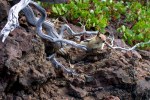
The lava fields make for an incredible playground for the ground squirrels.  They have an infinite number of crevices to jump into, tunnels to run through, and rocks to sun on.  If it weren’t for the predators, I imagine there would be a ground squirrel on every rock, every one of them hoping for a hand out.

As it is, they appear and disappear frequently enough to demonstrate that the static field of lava pulses with life.  The rhythm of their movements becomes the heartbeat of a place that might appear dead to the casual observer.  They remind me to stop and look closely.

Anticipation

It’s early Saturday morning.  Today is a big day.  I am nervous.  Taking on getting the word out about the event with a $100 budget for printing materials was a new challenge.  It’s an interesting comparison to have a corporate event where you know exactly who your target audience is–all their emails are in your contacts list, you have a budget in the 10’s of thousands (it was a small users conference for about 150 customers back in the days when corporations still spent money on such things), and you plan your activities based on your known audience.

In comparison, this event is the opposite in every way.  You plan your activities based on what you can do, then you try to find people who might be interested in attending what you’re planning, and you spend as little as possible to try to find them.  Social networking was not really an option for me although the other planners were able to leverage their Facebook pages and email lists.  Since no one on my facebook friend list lives in the vicinity who isn’t already participating in the event, my social networking was pretty limited.

I reached out to every person I knew in Chattanooga (which was 3 people) to find ways to get publicity.  My trainer hooked me up with a newscaster and we did the early morning news spot that I posted previously.  I sent emails to several radio show hosts and newscasters I’d heard about through my second contact (a small business owner in the same building as Pat).  That resulted in one radio spot.  So, we got a little free publicity from that.  A connection through other organizers resulted in a second news spot yesterday at noon.  Maybe, just maybe, people will know about it.

Now the question is, will they come?  The skies in Chattanooga are overcast.  There is a steady rain falling.  The weather says it’s supposed to clear for a few hours in the afternoon and then turn into thunderstorms later in the day.  We have indoor areas, but will people come out to Wildwood, GA if the weather is bad?

I’m crossing my fingers that this work will result in a huge turn out and lots and lots of funds raised for S.O.A.R.

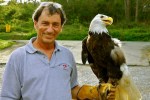
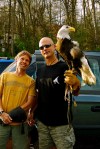
For today’s photography lesson, I look at my impromptu portraits in the parking lot with Osceola from last night.  I see that I have taken on a rather challenging photography assignment.  Getting enough field of view for both bird and person means either using a shorter focal length or getting further back, which may not be possible.  I used the shorter focal length last night and am not pleased with the results.  There is no bokeh effect (background blur) yet in some shots I don’t have enough depth of field for both the people and the eagle to be sharp.

The classes I’ve taken don’t happen to mention how to get great shots of people holding birds.  Maybe I can find a niche for myself yet!

Training for the Birds

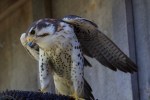
Over the weekend, I had my first lesson in bird handling.  While we previously met these birds of prey during a “Raptor Experience” a couple months ago, I am now learning how to handle them so I can assist during educational programs.

The first thing I learned was how to grab a handful of chopped mice and shove it into a training pouch.  This is one of those things that really makes you want to go “Ewww!” Especially when you get chunks with tails and faces attached.

First task accomplished, I now get to watch how to properly enter an enclosure.  First and foremost, there is a sort of foyer area enclosed in chicken wire that you must enter and close behind you before opening the door to the birds quarters.  Second, you don’t actually walk in with the bird in there.  Rather, you put a nice fresh chunk of mouse on your glove, stand behind the door, and hold your arm out for the bird to land on.  This way, you don’t have to worry about being “footed” in the face.  The bird lands nicely on the glove and starts eating, giving you time to secure its jesses.

The jesses are the equivalent of a collar for a dog.  They are leather thong things that go around each leg of the bird and hang down a couple inches, allowing a leash to be hooked to them that can then be secured to the glove.  They allow the handler to keep the bird from flying off, essentially.  I am warned that securing the jesses can be a vulnerable time and that Cody, the Red-tailed hawk, is known for footing people if they get their hand too close to the glove while securing the jesses.

I also learn that “footing” means talons seizing flesh.  Not a fun thing to experience, but something that happens to varying degrees of seriousness ranging from scratches to talons driven through cheeks.  None of which really sounds like something I want to try.

We fly Theo, a Barn Owl, and Kayse the Black Vulture in addition to Cody .  I practice holding my arm out to make an appropriate target, as well as securing the jesses when a bird lands on my glove.  It looks simple, but I am befuddled by how to wrap the jesses between my fingers without getting the bird’s foot caught.  Fortunately, they are patient with me.

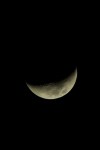
Since I don’t have pictures of the birds, I decided to do some more night sky shooting tonight for my morning post.  I’m feeling a bit lazy after yoga class and just shoot from the balcony.  I kind of like the roof of the balcony I caught in the frame in the wide angle shots.  I also switch lenses and grab a few shots at 560mm.  I did a little more experimenting with HDR and was disappointed I couldn’t get a properly exposed moon into the shot.  I guess I will have to try again.

Eating Virtual Space

I mentioned before that I am volunteering to help organize a fund raising event for S.O.A.R.  Well, I decided to donate a matted and framed photo for the silent auction.  It seemed like a simple enough thing to do.  After all, I have thousands of photos, a handful of ones I actually like, and the matting and framing part can be taken care of inexpensively.

But, today, I spent time culling out the handful of photos I would consider hanging on my wall.  Then, I pulled in the few that were of birds (since S.O.A.R. is all about birds) and a couple from hang gliding.  It’s a difficult thing to judge.  First, I have to step back and see photos the way normal people see photos.  It’s hard.

I find myself noticing when the rule of thirds hasn’t been applied and trying to decide if it works anyway.  Then I notice when bits of things in the foreground have popped into the frame when I’d rather they weren’t there.  Then I try to decide if the color looks off or if it’s just my imagination.  In the end, I’m down to 16 photos I will put in front of Dale, the woman running the show, to see if she thinks any of them will inspire bids.  If not, we can always make it a raffle item.

The process of filtering through the past 8 months of photos (thank goodness I stuck to the Chattanooga theme–otherwise I’d be going through 9 years of photos!) was an interesting one.  First, I realize how little time I’ve actually spent doing wildlife photography, supposedly my preferred form of the art.  Second, I realized how I don’t like to choose.  I end up with collections of extremely similar photos where the lighting is slightly different and the angle might change just a hair, but I can’t come to a conclusion as to which one I like better.

I have gotten quite strict with myself on that point.  I am trying to limit the number of photos I keep.  Given that most of my pictures are over 13 MB (and I’m shooting with an older camera–I can’t imagine what will happen the next time I upgrade), I’ve run my 120 GB hard drive on my laptop out of space more than once.  I now have a collection of disk drives lingering about in various stages of fullness.  I am constantly worried that my  2 TB backup drive will fill and overwrite some critical photo I’ll never get back.  Not sure what it would be critical for, but who knows?

What amazes me is for the number of photos I have and the amount of disk space I’m maintaining, there are so few pictures I really like.  There are even fewer I would say I’m proud of.  I wonder if this is the unintended consequence of digital photography or if film photographers have the same problem?

Rescuing a Heron

I woke up at 3AM, pinned under the covers by the weight of a sleeping dog and too content with him by my side to move him.  I eventually squirmed my way out, managing to heed the call of nature without waking either my husband or my dog.  But when I returned to bed, I was left out in the cold.  I think I got another half an hour of sleep before finally getting up at 6AM.

In those 3 hours, Tisen moved only if chasing something in his dreams and Pat snored quietly, marking the time.

I get Tisen walked, fed, and into his create in time for me to get to the gym.  We are using the create when I go to the gym.  Tisen rather likes his crate with his new bed and collection of squeaky toys–we’re getting close to trying going out to dinner again.

After the gym, I buckle down to work and try to focus.  It goes like this:

  1. Start to work on presentation
  2. Think, “I need the dates in that email from yesterday”
  3. Open inbox, see 18 unread messages have arrived in the past 5 minutes.  Start reading and responding to each one, opening files until there are 40 files open and 16 applications running.
  4. Remember I was looking for an email for my presentation, I return to the inbox to find new messages and start over again–I’m in danger of an endless loop.
  5. A reminder it’s time for my first conference call pops up and interrupts my interruption.
  6. Remember I was trying to get my presentation done before my first conference call.
  7. Look at calendar for meetings I can cancel later in the day.

In the midst of this, Pat returns from Tisen’s second walk and reports he spotted a Great Blue Heron with a broken wing.  I start juggling phones with the conference call in one ear and a call to S.O.A.R. in the other.

Pat is able to meet John (from SOAR).  When my morning conference calls end and Tisen insists he needs to go out, we are able to check on the heron rescue progress.  We arrive as Pat dives into the bushes with a large butterfly net, just missing the heron.  I get out my iPhone and snap a few pics.

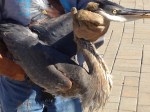
John catches the heron moments later.  John asks me to remove a stick from its mouth.  I reach out and gently pull the stick free, hoping it will be a little more comfortable.  This poor bird has exposed bone where its wing has snapped and bent backwards.  John will take it to a licensed bird rehabilitator, but he doesn’t seem optimistic.

Much later, John’s wife, Dale, tells me the heron had to be euthanized.  I am sad this one could not be saved.  But, I am happy there are people like John and Dale to make sure if there is a chance a bird will survive, the bird will get it.

Now, I need to finish that presentation . . .

Night Walks

I love walking at night, but I also apply lessons from self defense class and pay attention to what’s around me.  Had I not been listening carefully, I might have missed the calls of the nighthawk or the yips of what I suspect is a family of foxes.  I would have been mystified by the sudden sting of a mosquito’s bite had I not heard one buzzing moments before.  Yes, there really are mosquitos on January 31st.

I listen to small rustling noises in the brush and try to imagine the size of the creature causing them.  I’ve learned that small things make big noises in the dark.  I imagine a tiny mouse scurrying under layers of leaves. Then, the sound of a small bird startled from its roost is followed by the vague impression of a shadow diving through the foliage.

This is when Tisen stops to poop.  Pooping is not my favorite subject, but this dog does the strangest thing.  He lifts his leg to pee on something and then he swings his raised leg around like he’s getting on a horse or a bicycle, but goes straight into poop position.  Whatever his target was ends up pressed up against his bum.  He often deposits his poop in out-of-the-way places like among tall grasses or weeds.  I am getting a little tired of trying to figure out how to remove semi-liquid dog poo from strands of grass and shrubs without ending up with it on my hands.  Tonight, I fail and after wiping the worst of it in the grass, start heading towards the restroom so I can wash my hands.

As we return from the darkest part of the park, we see two silhouettes coming towards us.  Perhaps the combination of being backlit and uphill from us is what makes them seem like they are giants.  Tisen freezes in position.  I freeze, too.  I watch the pair of ambling shadows approach, trying to get a make on them.  I get the idea there is a dog with them, but I cannot see the dog in the dark.  As they get closer, I realize the dog registers about the same color as the concrete sidewalk below him, giving him great camouflage for walking in a park on a sidewalk at night.

I also realize that the pair is a normal-sized couple out for an evening stroll with their dog, but the dog is the giant.  If you kept the basic outline of an irish wolfhound and colored it in like a golden retriever, I think you’d end up with something that looked related to this dog.

Tisen lunges.  I grab the middle of the leash with my clean hand and hold him back.  Then, I start walking away, shortening the leash by increasing my distance.  I somehow manage to keep Tisen under control without getting poop on anything.  But, to be safe, we head straight for the bathroom sink and anti-bacterial soap.

Faster than a Foster Cat

My sister-in-law likes cats.  However, she and my brother, like us, are at a place in their lives where they don’t want to tie themselves to an animal for the next 15-20 years.  My brother often jokes about looking for animals with a short life expectancy for this reason.

My sister-in-law, Megan, being more practical, has come up with an ingenious solution to the problem of how to have pets without having a long term commitment.  She provides foster care for a local cat shelter.

Megan has fostered numerous pregnant cats who gave birth under her watchful eye as well as taken in young litters with no mother.  Keeping kittens with no mom fed, emptied, and cleaned up is a big chore that has to be performed diligently and regularly.  It’s not for the faint of heart.

Megan nurtures these kitties through the tough part of their early lives or supports their mom in doing so.  When they are weaned, healthy, and confident, they are returned to the shelter until they find permanent homes.  Megan takes a break from fostering if she has a heavy travel schedule or needs a break and then takes on another set when she can.

Other than the heartache of getting emotionally attached to animals that you will eventually hand off to someone else, it’s the perfect way to have pets without taking on permanent ownership.

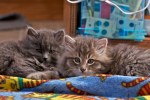
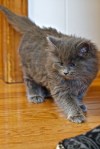
Chibs and Clay, named by the shelter (perhaps by a fan of Sons of Anarchy?), are the current kittens staying with my sister-in-law (see photos).  Chibs needs to see Clay do something before he is willing to give it a try.  Even when he finally joined Clay in my lap and laid there purring, when something moved, he would dart off again to hide.

Getting even these few pictures was quite a chore.  First of all, they were doing something cute and my 100mm prime lens was on my camera.  While I really like this lens, I could have used the 400mm of my telephoto zoom given Chibs’s skittishness.  But, I started shooting and gradually crept forward, crawling across the floor slowly and shooting every few seconds so I didn’t lose out on a decent shot because I was holding out for a better one.

Here’s what I learned:

  1. Rapid fire shooting mode is a must.  The faster the better.
  2. Focus, focus, focus.  Rapidly moving critters in low light make this difficult.  I often end up with out of focus faces and sharply focused feet or rear ends or backgrounds.
  3. A little more depth of field is better–otherwise, I end up with just the eyes in focus and then the surrounding face is too soft (see the second photo).
  4. When flash is not an option, the animal is fearful of cameras, and the light is low, I just have to live with a shallow depth of field.
  5. Most animals will not pose.  Bribing domestic animals with treats and toys can be helpful, but requires an assistant.