
Safety Portraits

Graduations seem to be a bit more complex than they used to be.  My older nephew graduated on Memorial Day two years ago.  I can see why that might not have been so popular–especially in a suburb right outside of Indianapolis.  Improving upon that plan this year, graduation was on the Thursday before Memorial Day.

However, it was also the last day of the school year.  Graduates were supposed to go from school to graduation and be there at 4PM for rehearsal.  Then, they would be fed dinner while their families arrived and filled the stands.

Following graduation, the graduates return their caps and gowns before being released to join their families.  It wasn’t clear that there would be any opportunity to get a picture of my nephew (let’s call him Sam) in his cap and gown.

So, the night before graduation, we took a few shots in the back yard just in case.  While we were at it, I took a few of my brother and sister-in-law, too.  My sister-in-law is wonderfully easy to shoot–I caught an all-out crack-up with one eye closed in one shot (not shown) and she still looks great.  My brother and nephew are a bit more challenging.  I don’t know why.
As I worked with the strobe on a stand with an umbrella out in the yard, I was reminded of a recent class I attended back in Chattanooga.  The instructor expressed disgust at the cliche shot of a graduate in front of the school sign.  While we were lacking a school sign, I realized I was shooting extremely run-of-the-mill portraits.  But, honestly, I had no idea what else to shoot.

Later, I did some searching for cool shots of graduates.  What I discovered is that the interesting images were either interesting because they were shot in really cool locations or they were so abstract, you couldn’t see the person who graduated.

Given no control over time of day or the location of the shoot and assuming that we all wanted pictures where we could actually tell it was Sam in them, I need more experience to come up with a really creative approach.

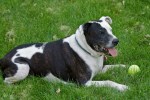
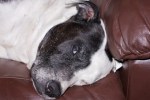
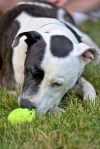
As it is, we got some cute shots of Sam in his cap and gown along with some nice shots of my brother and sister-in-law.  And, Tisen had a great time playing ball with whoever wasn’t involved in a shot.

Although, Tisen did have a bit of a run-in with the screen door.  He didn’t realize I had to open two doors to let him out and did a complete face plant into the screen in his hurry to join the party.  Later, when only the screen was closed, I slid it open and he stopped dead in front of the open door, poking with his nose to make sure it was really open.  The dog is not only a fast learner, he can count!

Portraits in Suburbia

It’s that time of year again:  graduations.  I have begun to divide my life into stages by the kinds of events we celebrate.  Long ago, it was our own graduations and those of our friends.  Then it was weddings.  Next, it was baby showers, followed by divorces (well, that wasn’t usually a celebration).  Then there were second marriages (and occasionally third).

Now, I seem to be participating in the same cycle of events one generation removed.  Because I have friends in many age groups, these events continue in waves depending on how old my friends are.

The high school graduations of my friends’ children started ten years ago.  Those were followed by weddings, and a few baby showers (although babies seem to be coming later and later in people’s lives).

But, this time, it’s my nephew who completed high school.  This event led to us taking Tisen on his longest road trip ever.  Fortunately for us and for Tisen, my brother’s family is willing to accommodate Tisen so he didn’t have to stay in a kennel.  I’m not sure either one of us would have survived the separation anxiety.

The other unintended consequence is that I gained a couple of new models for portrait shooting.  It’s a good thing my nephews were unwarned of my intention to shoot some portraits or I might not have seen either one of them during our visit.  However, I managed to get a few minutes of their time before they got too impatient with me.  What is it about the men in my family that they can’t sit for more than 10 minutes to let me practice portraiture?

They might have been a little intimidated posing next to my strobe on an umbrella stand–I don’t think either one of them has ever posed in front of an umbrella before.

I had fun trying to create some more dramatic lighting by casting shadows with the light.  My youngest nephew seemed to think the lighting was a little too dramatic, but he played along patiently anyway.

Tisen, never one to pose in front of a flashing umbrella, spent his modeling time discovering the joys of the ‘burbs.  I believe the thick, green grass right outside the door was a first for him.  At home, he can cross an asphalt parking lot to find a small patch of grass or walk to the park to roll in a short, spongy variety of grass.  Before he came to us, I doubt there was much grass in his life.

Unleashed and let out the door in the heart of an Indiana suburb, Tisen seemed at first confused and then overjoyed by the large yard to play ball in.  Although there was no fence, Tisen stayed well within the invisible confines of the property lines as if he was  afraid he would get lost if he got too far from me in that endless expanse of grass.  I am now worried he will resent returning to his urban life.

Lessons from the Archives: Toronto

This is another set of photos from my archive of the past. These were taken on a business trip to Toronto. I had gotten my PowerShot G3 a few weeks before the trip and was too excited not to bring it. I’m glad I did for several reasons.

First, it turned out to be the only trip to Toronto where I flew in on a Sunday and had time to explore downtown Toronto. I had many great photo ops as a result.

Second, I got to experiment with several challenges, which taught me why photographers use polarizing filters, tripods, and unexpected angles.

Third, and most importantly, it was the last business trip I went on with my office mate at the time, who was a great traveling companion. A dedicated family man and an all around considerate person, he had a knack for putting everyone at ease. Plus, he was up for exploration, which is always more fun with a companion than by yourself.

Sadly, he suffered a major heart attack and died at the age of 44 only a few months later. I was grateful to have a few photos of him to share with his wife.

It’s something we don’t think about much, but we often spend more time with colleagues (especially office mates) than we do with the people we love. Yet, our relationships often do not extend outside the office. As a result, all of those hours become a mystery to our families. It’s so rare to have photos of colleagues who are “work friends.”

I have chosen not to share the pictures of my former office mate, but the pleasure of seeing Toronto with such an unassuming, easy going colleague who died far too soon is one that I continue to cherish.

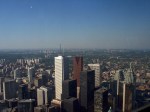
From a photographic perspective, I learned several things from shooting in Toronto. From the top of the CN Tower, looking down upon the world, I discovered the challenges of shooting through glass. Later, when I shared with a photographer friend how problematic the glare was, he suggested a polarizer might help.

From the bottom of the tower, I learned how changing your angle changes perspective. Shooting up the height of the CN Tower against the blue sky was a whole new view of the world, not just of the tower.

Down the walk from the tower, a giant Pileated Woodpecker statue clinging to a pole provided a whole new way to play with perspective. Already giant in its dimensions, with the sky scrapers in the background far enough away to appear tiny by comparison, the woodpecker appears to be Godzilla-sized.

That night, alone in my hotel room, I tried to shoot my first long exposure through the window. Those pictures turned out so horrible that I couldn’t include them, but that was when I first understood why my photographer friends kept telling me to get a tripod.
All in all, it was one of the best business trips I was ever on.

New Camera, Same Photographer

I love amazing shots of lightening. Perhaps because I’ve never managed to capture one? I have tried many times, but I always miss. At one of the workshops I attended recently, they mentioned a few tips on how to capture lightening, and then, not having any opportunities, I forgot about it.

But, at last, as I was sitting on the couch reading the instructions for my new 5D Mark III the other evening, a brilliant flash lit up the sky. I grabbed the tripod and set my camera up on the balcony, attempting to remember those tips.

I tried a low ISO with a small aperture and a very long shutter speed. I tried a high ISO with a small aperture and a fast shutter speed. Then I remembered the suggestion to set the shutter on bulb (stays open until you close it). Of course, I hadn’t gotten that far in the instructions yet and the bulb setting isn’t where it was on my 40D, so I went with 30 seconds.

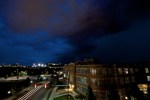
This led to several images that looked like it was daylight out except for the streaks of the car lights.
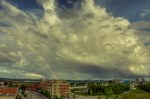
You may have noticed by now that none of the photos in the gallery actually contain any lightening. At least not obvious lightening. I think part of the problem was that the lightening was so far behind cloud cover that it wasn’t bright enough to make a huge difference in the exposure. While the clouds lit up like paper lanterns to my eye, the difference in light over a 30 second exposure was too subtle for my camera.

This theory led to me remembering another tip.

The tip was to cover the lens with a piece of paper or your hand and uncover it only when the lightening flashes. In case you were wondering what the dark shadow is over some of my shots, that’s my hand. Apparently, I didn’t actually cover the entire lens, so I have some fun finger shadows. I can see this turning into a whole new style of shooting. Look forward to many photos with animal shadows cast over them in the future!

I thought if I could block all light until the moment when the lightening was flashing, maybe the difference would be great enough to capture the flickering clouds.
I think I need to try this again with a different way of covering the lens to see if my theory has any merit.

Another thing I would like to try is shooting lightening from out in the country where there is little ambient light. The street lights in my neighborhood contribute to the problem, I believe.

I googled shooting lightening to see what other tips I could find. The biggest one I hadn’t considered before–and perhaps the skill I most lack–is to be patient.

I guess I was secretly hoping my new camera would magically solve these kinds of difficulties for me. Next time, I’ll upgrade the photographer instead of the camera.

Learning from Dogs

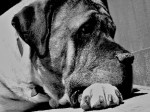
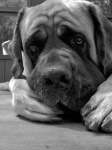
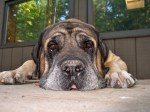
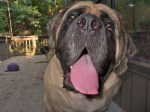
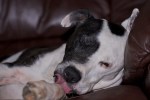
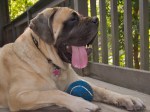
Having recently restored an old archive of photos, I rediscovered a collection of photos of our mastiffs. I re-lived not only the joys and sorrows of having loved and lost these gentle giants, but also of the things I learned from shooting them.

They were my first high-contrast subjects. Their fawn colored fur and their deep black masks gave me exposure fits. After losing their eyes a thousand times, I learned how the spot meter setting worked. Of course, then I was forever over-exposing their light fur.

They were also the subjects that drove me to want a DSLR instead of my PowerShot G3, which was a pretty awesome point-and-shoot for its time, allowing me to take full manual control of the settings.

But looking at my dogs through the G3 view finder made me miss. The closer they were to me, the bigger the problem. If you couldn’t use the LCD, you were just guessing as to what you were going to get. Since I couldn’t use the LCD during rapid-fire shooting, I often missed.

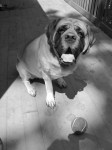
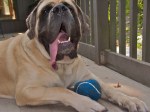
The photos in this collection were all taken with the PowerShot G3 (except the one of Tisen). During one of these shoots, I did a long series of rapid-fire shots with Katie (the only mastiff I ever heard of who loved to fetch). Going through them rapidly looks like a movie of a giant dog romping on a deck.

I also did a rapid-fire series of Bogart. In his series, he turns his head about 45 degrees and then turns it back. That’s pretty representative of their personalities. Bogart was a mastiff through and through–excellent judge of character, laid back, gentle with children, subtly protective, and excellent at the “down” command. Just don’t ask him to get back up.

Katie was more of a lab trapped in an over-sized body with droopy jowls. She wanted to play ball all the time. She wanted your undivided attention all the time. She was as hyper as hyper can get in a mastiff. Unfortunately, her body betrayed her personality (or maybe it was the other way around) and her knees and elbows could not handle her desire to chase, spin, and retrieve her ball. She spent a depressing amount of time restricted from playing at all.

Tisen often reminds me of both our mastiffs. He has the laid back but protective temperament of Bogart. But he also has the fierce neediness of Katie. I sometimes call him Bogart by accident when he does something Bogart-like. I often tell Tisen he’s the best boy in the whole wide world–something I used to tell Bogart as well. One day, I spontaneously completed what I used to say to Bogart and Katie: “And we’re the luckiest people in the whole wide world because we have you.” I started to tear up. We are the luckiest people to have had three such amazing dogs in our lives.

Getting Wide

Ah! I realized I didn’t get my blog post written on time today! I think this is the first time I missed my self-imposed deadline of 6AM since I established it.

But, here I am. And, I am here to report that after many months of trying to decide whether I really needed a second camera, then more time debating what features were most important, and then finally waiting patiently for another month because my new camera was on back order, it arrived late last week.

My new Canon 5D Mark III has given me a whole new set of things to learn!

But, today, I want compare the field of view between my old camera (a cropped, 1.6 sensor) vs the field of view with the full frame. I’ve matched some recent test shots with some similar past shots in the gallery to show just how much wider a full frame sensor let’s you go.

I love, love, love shooting wide with the full frame! It’s amazing how much of the scene suddenly fits into the frame! The one down side is that the distortion created by a wide angled lens becomes much more noticeable in the full frame because now, the image captured includes the area from the outside edge of the lens, where the most distortion occurs.

You can see this distortion well in several of the images. By comparison, the buildings in the cropped-sensor version look straighter, although the large brick buiding in the foreground near the bridges always looks warped. This building is built going up a hill and curved to the street–it looks warped to my eye, too. Although, not quite as much as it does through a lens.

I decided to go full frame (meaning the sensor is the same size as one frame of 35mm film) in part because I really like to shoot wide, but also because of what I learned about sensor size. The larger the sensor, the more room for bigger photosites and micro lens that collect and record data, the better quality image you get. This is especially true in low-light shooting conditions.
Since I also like to shoot in low light, I did a little experimenting with different ISO settings. I found that I could get as much noise into an image by under exposing it and trying to post-process it to the correct exposure as when I shot at the highest ISO setting, which was 25,600 (an insane number!). I’m really impressed with the quality of the image at ISO settings that compare to my 40D, which maxed out at 1600 but pretty much sucked once you got above 400 in low light scenes). However, the need to get the exposure right hasn’t changed, which makes sense.

I have much to learn about this new beast–the number of new features over my 4 year old 40D is astonishing. For one thing, it adds video. That’s a whole new world!

Native Song

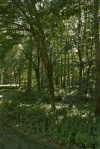
Having survived the Japanese garden at Gibb’s Gardens, I moved on with my co-shooter, John, to another part of the park.  This time, we entered an area that looked like natural woods.

As much as I enjoy gardens, natural woods are still my favorite.  By “natural,” I mean woods with plants that belong there.  This is not the same as, say, a woods covered in kudzu or so overgrown with privet or honeysuckle, you can’t even see through it.

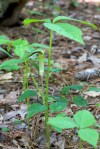
Here, the woods had only native plants and we were both tickled when John discovered a Jack-in-the-Pulpit.  Soon, we were finding more of them.

Near by, we also found some spent Trillium, Solomon’s Seal, Virginia Creeper, and the one native I don’t like to see, Poison Ivy.  I should rephrase that.  I like to see it (it is a beneficial native), but I don’t like to be anywhere near it.  I’m starting to itch just thinking about it.

As we hunted for wild flowers, a wood thrush started serenading us.  The wood thrush’s song is my favorite.  Thrushes can sing more than one note at the same time–they harmonize with themselves.  The wood thrush in particular has a haunting, flute-like song that always makes me want to stop and listen.  You can play a clip of its song here (scroll down a bit).

Although I have heard a wood thrush many times–in fact, one used to summer near our house and was my alarm clock many mornings–I have only actually seen one once.  I have never even gotten close to getting a picture of one.  This relative of the robin is reclusive by comparison.  Wood thrushes hang out in the lower story and underbrush of the woods, magically disappearing behind the tiniest of leaves.  Their brown camouflage helps them disappear, I guess.

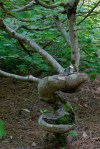
We eventually moved on from the wood thrush and made our way towards the rose gardens.  Along the way, John pointed out a tree that was growing at a nearly 90-degree angle.  He told me native americans used to train trees to grow at angles as a directional indicator towards water or other resources.  However, he felt this tree was too young to be an example of a pointer.  We never did get an explanation for it.

When we got to the base of the hill covered with roses, I was pooped.  Carrying around my 40+ pound backpack and tripod all day had wiped me out.  I suddenly realized I hadn’t had any water since 9:30AM and it was now nearly 3:30PM.  I looked up the hill and decided I really didn’t need to shoot any roses.

John, carrying less than 3 pounds of equipment including a bottle of water, was still feeling energetic enough to head on up to not only the roses, but also the day lilies at the top of the hill.  I guess that’s what a lifetime of experience shooting does for you.

A Mini Krash

Perhaps this is a good time to mention that I am extraordinarily clumsy.  In fact, I was given the name “Krash” many years ago by some friends who were amazed by my ability to hurt myself (thanks, Mike and Bart).  I really should have a blog dedicated to the ridiculous ways in which I’ve hurt myself.

It only follows that, on my first field trip with a new group of people, while hanging out with someone I’ve just met, I would do something embarrassing and at least mildly alarming.

After lunch at Gibbs Gardens, my cohort (let’s call him John in case he doesn’t want to be included in my blog) and I headed off to the Japanese garden.

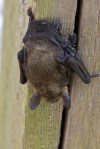
As we walked towards an arbor-like structure, several people were gathered around looking at what turned out to be bats.  I happen to be extremely fond of bats.  I would say my fondness for bats is in direct proportion to how much mosquitoes like to bite me.  Besides, bats are really quite cute.

Two of the bats had gone astray and were clinging to the post of the structure close to the ground.  One appeared to be quite young.  I happened to have my macro lens on my camera, so there was no question but that I was going to get some shots of at least one of the bats.

I opened up my tripod’s legs so I could place my camera very low to the ground, level with one of the bats.  Then, I bent over to look through the view finder.  This is when the 40+ pound pack on my back slipped forward and conked me in the back of the head.

This is also when I discovered I had mounted my camera backwards on my tripod head.  I never really worried about which way was forwards or backwards, but now I will.  When you mount your camera backwards in the clamp on my tripod mount, there is a metal lever facing you.  This doesn’t seem like a big deal until a 40+ pound backpack smacks you in the back of the head and shoves your lip into the metal clamp.  Fortunately, I lost only a little blood and no teeth.  Poor John kept trying to find ways to carry things for me after that incident.

It reminds me of a former boss who used to watch for things I might run into and steer me around them when we were walking together.  He started this practice after I bounced off a wall turning a corner too soon while I was mid-sentence.

I’m thinking about teaching a photography workshop on how to prevent injury while shooting.  Most people probably worry about that when they’re shooting on a cliff or going on a safari in Africa or shooting for a newspaper in the middle of a war.  I have to worry about it when I bend over to look through my view finder.  But, hey, it could be a niche market.

Gear Envy

Continuing the Gibbs Garden field trip, my cohort and I made our way down from the Manor house back towards the main entrance in time for lunch.  Along the way, we frequently paused to shoot.

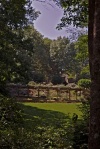
Below the Manor House, looking back up the hill, an arbor stretched across the hillside below the house, surrounded by flowers.  It was so beautiful, we had to stop to shoot.  Unfortunately, the sun was high and the house was lost in dark shadows.

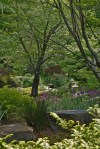
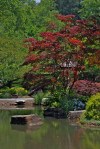
As we worked our way back down, we found numerous water features.  Between natural looking creeks and man-made ponds and streams, each had a distinct character.  The bridges that accompanied them were just as varied.

It’s funny how I can look at a scene, know that the lighting is not going to allow me to get the image I want, but not be able to resist trying anyway.  I wonder if this is the difference between digital and film?  Between knowing I can just delete any bad shots and that I can do quite a bit in post processing to improve the harshness of the light, I can’t walk away without shooting.

I haven’t quite figured out how to fix bad lighting in software, though.  While I can lift the shadows and pull down the highlights and do all kinds of interesting adjustments, in the end, it’s still bad lighting.

My first impulse in dealing with harsh lighting is to reach for a polarizer.  While it can’t fix the light, it can at least remove a lot of glare.  Two things have recently changed, however.  First, I have been shooting wide angle with a lens I added a couple months ago, which requires an 82mm filter.  My polarizing filter is 77mm.   So, I had to switch lenses to my most recent addition, a 24-70mm, which takes a 77mm filter.

After switching lenses just so I could use a polarizer, the second recent change come into effect.  I now have enough gear that I need two bags.  This has created a whole new problem.  I only brought one bag with me and I forgot to put my filters in it before I left.  So, I had picked a lens to fit a filter I didn’t have with me.

It seems like getting more stuff complicates photography in the same way it complicates the rest of my life.  The cost of more gear is more than the price–it also means more time organizing it, looking for it, and switching back and forth.  I think I’m about to hit my limit on wanting to further complicate my hobby.

Interestingly, the photographer I shot with at Gibbs Garden has been into photography since he was a boy.  Once film became too expensive and inconvenient, he switched to a high-end point-and-shoot with full manual control.  He carried his small, light-weight camera, a proportional tripod, and nothing else.  I was extremely envious by the time we sat down for lunch.

Field Trip

Today, I went on my first field trip with the photography club I recently joined.  We went to Gibbs Gardens in Ball Ground, Georgia.

While it was quite a drive (2 hours), driving in this part of the country is always scenic, which makes the time pass quickly.  Today’s drive was no exception, although I did feel a bit guilty for not riding with someone else to limit gas consumption.  But, I’m having some back issues and thought I might need to leave early.  Fortunately for me, my back made it until 3:30.

Gibbs Gardens is a private garden created by someone who owns a landscape company and recently opened to the public (for a price).

Getting there was interesting.  As has often happened when I’ve ventured out with a group, I ended up on what seemed like remote, two-lane highways that go from 55 to 45 to 35 mph as they pass through small . . . let’s say “villages,” these places are too small to call towns.

And, another common occurrence, I inevitably find myself behind someone who wants to go at least 10 mph slower than the speed limit.  Today, I was afraid I was going to end up going 35 mph for 30 miles.  Fortunately, the very sweet looking little old lady ahead of me turned after only a few miles.

As I accelerated back to the speed limit and entered some sharp turns, I found myself wishing I’d driven our old BMW instead of the mini-van.  Let’s face it, even a bicycle would be more fun to drive than a mini-van.

When everyone arrived, we gathered and posed for a group photo and then scattered to go shoot.  Luckily, one of the guys I’d met before was company-tolerant and we ended up shooting together.  Otherwise, besides the $2 discount on the entry price by coming as a group, there wouldn’t have been any advantage to going with the group.

The one big disadvantage was that we didn’t get started until after 10AM by the time everyone arrived.  The light was already starting to get bad.  That is the one thing I would suggest to Gibbs Gardens–they should offer early or late entry to photography groups.

We headed up to the Manor House first, hoping to get to see the view of the mountain before it got hazy.  We didn’t immediately figure out where the mountain was visible from, so it was quite hazy by the time we found the view.

Regardless of the less than optimal time of day, the manor house and its surrounding gardens were amazing.  There is so much stone in the garden walls and walkways that I have to wonder how they got it all there.  The pool was so inviting, it’s a good thing we didn’t go there latter in the day–I probably would have jumped in.  I’m pretty sure they kick you out if you start swimming in the pool.