Weathered

Taken last June before the drought dropped the water levels

Taken last June before the drought dropped the water levels

Water, water everywhere

Water, water everywhere


We had ridiculously warm weather last week accompanied by what looked likely to be 40 days of rain, which brought with it gradually colder temperatures.

Today, they predicted of a dusting of snow downtown and up to 3 inches at higher elevations.

For those of you who have never lived in the South, there aren’t any road crews with snow plows and salt trucks to keep the roads ice and snow free.  And, while the mountains may be relatively small down here, they’re still plentiful and steep enough to send vehicles careening off the road with only a bit of ice.  So while it might seem a little silly to get all worked up when you’re from Ohio and living in a flat part of the city, it actually makes sense as to why the town is shutting down.

It started at noon with early dismissal of the schools.  Given that it was still in the 40’s at noon, that seems a little overly cautious, but the kids were sent home early to ensure the bus drivers weren’t having to navigate steep slopes coated in ice.

Then, the businesses started sending people home and closing early.  I was supposed to get my hair cut today.  In fact, I was supposed to get it cut last week.  My stylist was sick last week and they decided to close a hour before my appointment this week.  I guess I will let my hair grow for a while.  That’s OK–if it’s going to be cold, I’d kind of like a little extra insulation.

Not getting my hair cut also freed up some time to walk the dog.  Since my husband’s building closed early, he came home at a decent time and joined us for the walk.  We walked through Renaissance amazed at the water levels.  The manmade wetland has turned into a pond.  The barriers that slow the flow of water are completely submerged.  The little creek that runs through the park swelled and overflowed and turned the woods into a swamp.  There is no division between the creek and the wetland.

When we walked along the river, we realized the Tennessee River was higher than we’ve ever seen it before and rushing downstream so quickly, I’m surprised there weren’t rapids.  But I guess all the things that would cause rapids were too far below the surface.

The boat launch ramp under the Market Street Bridge has disappeared.  In fact, it looked like the sidewalk across the river was submerged as well.  We began to imagine the city being swallowed by the swelling river.

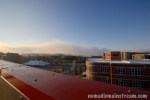
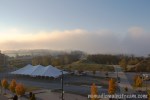
While I don’t think there’s much danger of that, I did make time to go shoot from the common area balcony again.  I’d taken a shot from the same spot while attending a photographic society field trip here last June.  I dug that up and was amazed by the comparison.

The good news is that it’s supposed to stop raining for a while.  Just in time!

Flowers and Fungi

These early bloomers captured rain drops

These early bloomers captured rain drops

On a nature walk on Saturday, we were surprised to discover spring wild flowers in full bloom tucked amongst the leaf litter on the forest floor.  I don’t remember the name of these blooms, but they are often among the earliest to appear in the spring.  The thing is, it’s not spring.  We haven’t even reached Imbolc yet–it seems horribly risky for a delicate spring flower to appear so early.

The likelihood that it will manage to set seed before the weather turns too cold for survival seems very slim.  But it blooms anyway.

A completely different kind of "bloom"

A completely different kind of “bloom”

A flower, presumably, doesn’t ask questions about risk and reward.  It simply responds to the external events of water, sun, and temperature.  It doesn’t check the calendar before the seed begins to sprout.  Collectively, perhaps the seeds will have slightly different trigger points and only a few will sprout now.  The rest will require more warmth longer before they come to life.  And, in this way (I hope), the next generation will come from the seeds whose triggers allowed them to survive long enough to produce more seed.

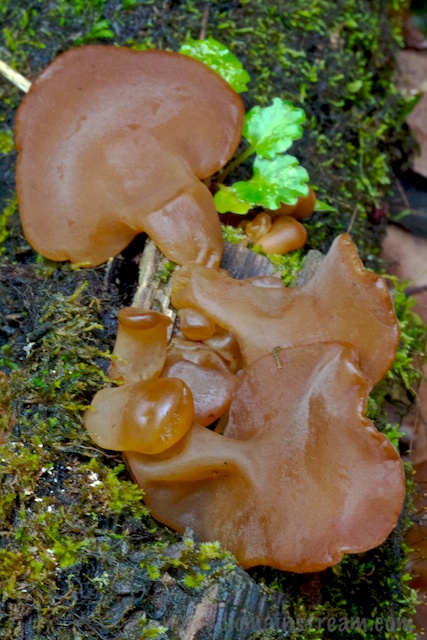
Wood ears may not quite qualify in our traditional definition of "bloom," but they sure are interesting

Wood ears may not quite qualify in our traditional definition of “bloom,” but they sure are interesting

If we think of these flowers as a single entity instead of individual flowers, perhaps the lesson is more applicable to us as individuals.  Otherwise it may be tempting to take a lesson along the traditional lines of “only the strong survive” when the reality is that often it is not the strong that survive, it is the timely.

If we think of those early bloomers as the first attempt in the process of trial and error, perhaps the lesson is more applicable to our own lives.  After all, being timely requires a lot of luck.  If we sit around dormant until the exact right time, we’ve already missed it when we realize it’s come.  But if we put up a few sprouts too early, we get to practice and practice some more.  And when the right time comes, we’re there, ready and blooming at just the right time.

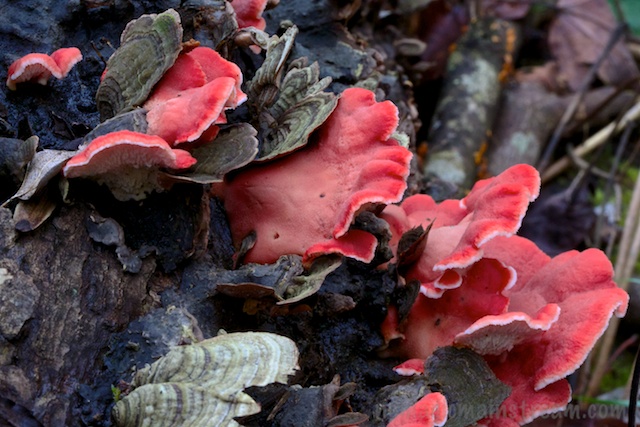
Layers of mixed fungi make a fascinating display on a rotting log

Layers of mixed fungi make a fascinating display on a rotting log

Fungi work differently.  They largely reproduce via spores, which are different from seeds in that there’s no pollination.  While I know very little about fungi, reportedly, at least some of them produce spores on their own time clock without regard for environmental conditions.  Others require environmental factors that include nutrient levels, carbon dioxide levels, and and light levels (see microbiologybytes.com).  Another study I found suggests that atmospheric moisture (which I assume is the same thing as humidity) has the greatest impact on how much fungus grows.  This seems a bit like saying the ground will be wet when it rains to me–after all, do we really need a study to tell us that more humidity drives more fungal growth?

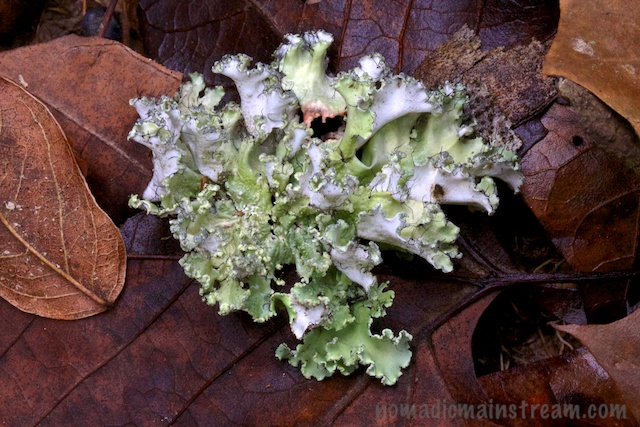
This is neither a flower nor a fungus--it's a Lichen

This is neither a flower nor a fungus–it may look like lettuce, but it’s a Lichen

That being beside the point, the continual, misting rain for the past few weeks has created a unique kind of bloom.  Although the fungi had faded a bit from their peak, there were still some really beautiful colonies.  Beautiful fungi–words I never expected to write together.

Final look at the more colorful fungus we saw

Final look at the more colorful fungus we saw

Open Mouths

Continuing our visit to the Tennessee Aquarium, I discovered a topic I never expected to write a blog post about.  Let’s talk about mouths for a moment, shall we?

Some mouths are terrifying.  Think Jaws.  Think Tyrannosaurus Rex.  Now, think Alligator.  Not so very different, in my book, than thinking about being bitten by a dinosaur.  After all, the American Alligator actually did live with the dinosaurs.

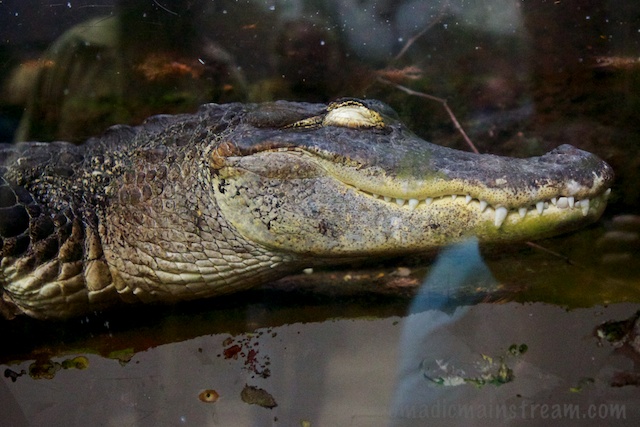
Even sleeping the alligator looks menacing

Even sleeping the alligator looks menacing

The relatively small Alligator that lives in a rather cushy environment in the Tennessee Aquarium by Alligator standards (I should think), chose a rather interesting spot to hang out for an afternoon nap.  The only thing that would have made his choice of places to sleep better would have been if the glass would have been antiglare.  Since I can’t imagine the aquarium staff has been training the alligator to nap where it can be viewed up close, I’m guessing this little nook was designed to be exactly what an alligator looks for when it comes to nap nooks to increase the odds that visitors would get to admire this guy’s teeth up close.  They sure are white.  There is something disturbing about an animal whose teeth are so prominent they don’t fit inside its mouth when it’s closed.

I think this might be as close to cuddling as alligators get

I think this might be as close to cuddling as alligators get

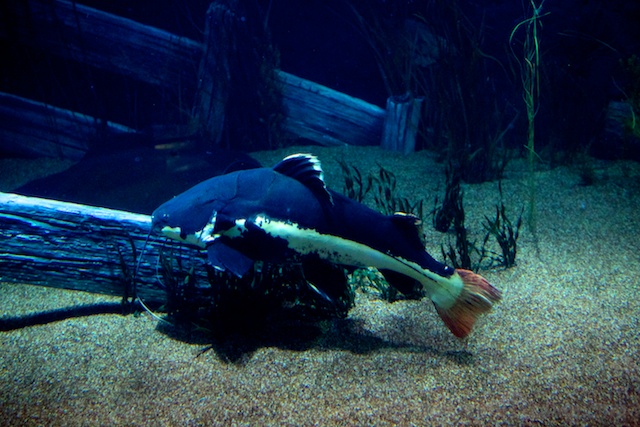
Catfish are another creature that has a scary mouth.  They also co-habitated with T-Rex.  Perhaps I have stumbled upon a pattern?  While the teeth of a catfish may not be so prominent or sharp as the alligator’s, there is just something downright menacing about the way their mouth looks to me.  It comes as no surprise that there are several types of catfish who have been rumored to kill people (although not substantiated).  This catfish was enormous.  While not even close to the top of the scale for big catfish, he seemed big enough to swallow a small child whole.  I don’t think this catfish actually has any interest in eating small children, fortunately.  His markings make me think of my dog, making him a whole lot cuter than most catfish.

This guy doesn't look so scary with his back turned

This guy doesn’t look so scary with his back turned

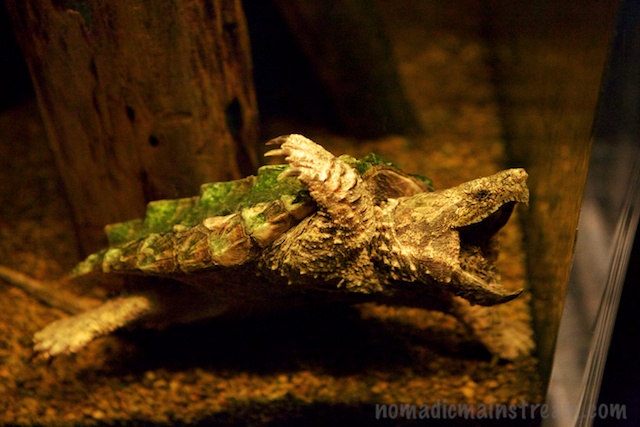
The next in our series of mouths is a crazy turtle.  An alligator snapping turtle, to be exact.  Unfortunately, his lure doesn’t show in the shot (through thick glass), but this guy hangs out with his mouth open and wiggles a lure that is part of his tongue to attract fish.  An underwater fisherman.  I’m just guessing, but I suspect this guy may be even older than the alligator–he looks like a rock.

So frozen people stop to ask if he's dead, this guy waits for imaginary fish to swim by

So frozen people stop to ask if he’s dead, this guy waits for imaginary fish to swim by

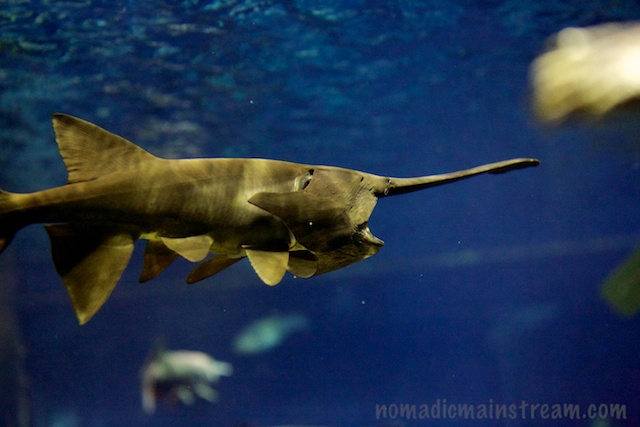
I don’t recall the name of the next open-mouth participant in today’s post.  I assume he is gathering something edible by filtering the water, but he kept swimming around with checks billowing like sails.  I missed a shot of the inside of his mouth reflecting light and shimmering like a silver bowl.  He just glided by with his billowing mouth below his paddle of a nose looking some sort of bizarre submarine.

If this doesn't speak to the diversity of the planet, I don't know what does

If this doesn’t speak to the diversity of the planet, I don’t know what does

This guy's cheeks puff out as he takes in water while swimming with a wide open mouth

This guy’s cheeks puff out as he takes in water while swimming with a wide open mouth


In the end, I was the one who left open-mouthed.

Descent Below Stone Door

Once we reached the bottom of the Stone Door, we continued downward beyond both sets of manmade stairs.  If we’d been feeling more in shape, we might have gone all the way to the bottom of the valley.  However, it was Christmas Day and we weren’t prepared to make the return climb back up, so we limited our descent to a distance we could comfortably climb back up.

The path went through fallen outcroppings of rocks.  Rough natural steps were formed (or maybe occasionally placed) from the fallen limestone.  But the steps were uneven with cracks and slippery spots.  I nearly fell on more than one occasion while working my way down one of the larger rocks.  All I could think was “protect the camera.”

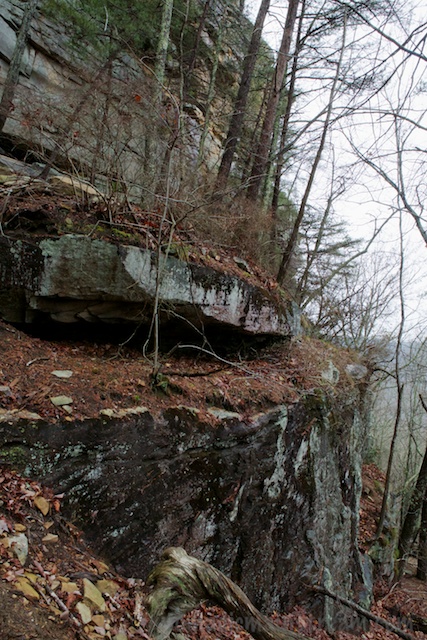
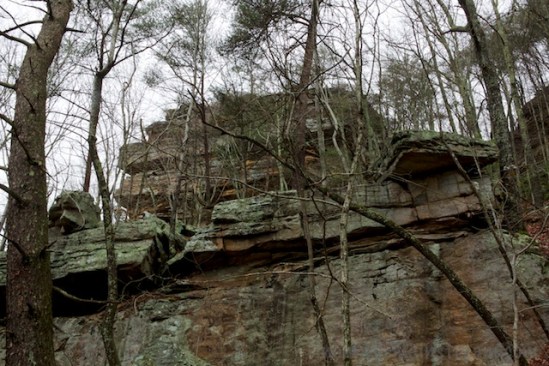
When we reached the point we decided would be the end of our descent, we stopped and looked back.  The outcropping we’d been standing on earlier looked a little more frightening in the context of the enormous chunk of fallen rock we’d just scrambled down–particularly when we saw just how much that overlook juts out from the cliffside.

An example of a rock shelf that looks like it will slide off down the hill at any time

An example of a rock shelf that looks like it will slide off down the hill at any time

Looking back at the overlook we'd been standing on, we realize how much of an overhang their is

Looking back at the overlook we’d been standing on, we realize how much of an overhang their is

So much of the stone looked like it was precariously perched, just waiting for the wind to pick up enough speed or water to pour down hard enough or lightening to strike or a few too many hikers to jump up and down on the overlook to break free and find its way down to the valley below.

Tisen and Twiggy were unimpressed by the scene.  They were busy searching through the leaves for interesting new scents.  Did they find evidence of a bear?  Perhaps just a deer.  Whatever smells they found, they buried their noses in them and wagged their tails feverishly.

Thankfully, Pat had them back on leashes and was able to keep them from running off on down the valley tracking whatever scent they’d picked up.  To be honest, Twiggy probably knew exactly what scent she’d found–she’s a true hunter.  Tisen was more likely to just be imitating Twiggy, going through the motions, trusting that Twiggy had found something really good.

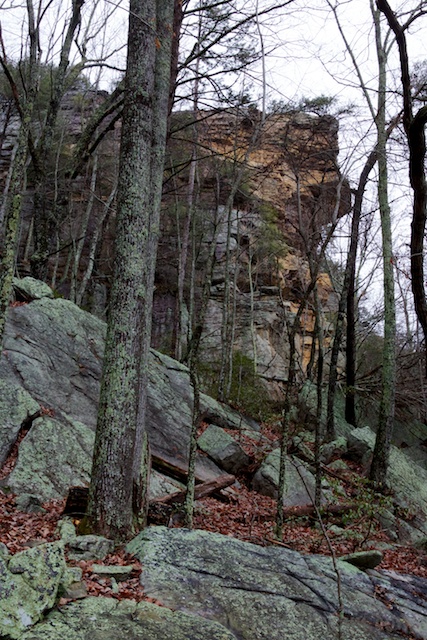
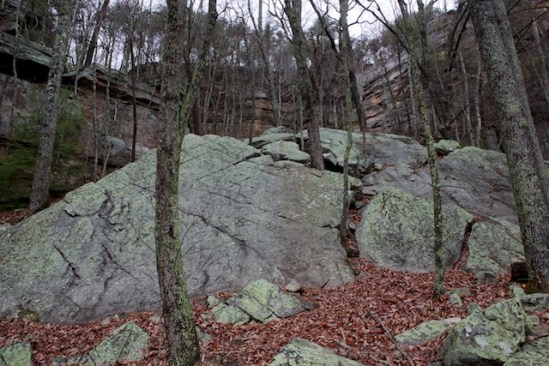
We stood gazing at the fallen rocks with trees growing out of them and tried to guess how long those rocks have been lying there.  I have no idea how to guess how old the trees decorating them are–they could be 20 years or 100 years old.  The rock no longer looks like a disaster scene but rather like it’s settled into the earth it met with some time ago.  The sharp edges have softened and fissures have opened in the rock, allowing for more trees to grow.

AU0A7976 AU0A7978 AU0A7981 AU0A7986

I like this metaphor.  A big crash that seems like total destruction creates a place for new life to flourish. Lichens cover the rocks.  Leaves decompose on and around the stone, creating rich new soil.  The rock collects and redirects water into the fissures, watering the seeds the have fallen in the cracks.  Life reclaims the fallen and uses them anew.

True Colors

As Tisen and I stroll along Stringer’s ridge, my feet drag through a thick layer of leaves.  As they crunch and swirl in front of my feet, I remember what fall meant to me as a child.

Halloween was, of course, central to the fall experience.  Dressing up in some costume that never quite looked as glorious as I expected it to (except the year my mother cut and sewed her wedding dress into a Cinderella gown for my costume), parading through the yards of our neighbors to go door-to-door for halloween candy.

Even though it was a special occasion, we were only allowed to walk through the yards where adjacent neighbors had their porch lights on and were giving out candy.  Some yards, we got to crunch our way through un-raked leaves while other yards were sparsely dotted only with leaves that had fallen in the past hour.

Stringer’s ridge has no gardener to obsessively clear the leaves away.  They fall and create a weaving of color over the broken and dilapidated asphalt that marks the ridge’s recent history.  As we leave the nearby urban residential area and enter into the preserve, the leaves become denser and the views become more colorful.

Tisen has taken his time getting here.  Me with my camera stopping to shoot frequently had nothing to do with how long our walk has taken, I’m sure.  Tisen needed to sniff and mark every mailbox on the way through the neighborhood.  I tried to coax him on his way, but he insisted in at least making an attempt to leave his mark, even if it was only a gesture by the time we got to about the 10th mailbox.

As we crunch our way through the leaves now, I don’t hurry him, but I do occasionally try to get him to sniff a yard or two in one direction or another so I can shoot while he sniffs.  I wonder how many photographers struggle to get the angle they want because they are walking a 70 pound dog who doesn’t always cooperate?  Sometimes it makes me wonder if I’m the one on the leash.

Given the slowness of our progress and my need to be somewhere in the near future, we take the shortest route to the overlook.  It’s not an overlook in the sense that anyone built a structure or anything.  But, they did clear a few small trees so the view of downtown was unobstructed.

I love this view.  You can see the best part of the riverfront as you look across a sea of colorful trees.  It’s hard to believe there are so many trees between me and home as I look down the ridge and across the neighborhood Tisen and I have just walked through.

I say a silent thank you to the good people of Chattanooga who had the foresight to make this a preserve and then we turn to walk home.

Fall Impressions

With no yard, no rake, and no worries, I was feeling a little detached from the experience of fall.  But a long walk up to Stringer’s Ridge, currently peaking in color, got me back to a childhood full of crunching through leaves.

As Tisen and I made our way up to the ridge, I looked up and there was an oak tree shaking its top like my grandmother shaking out a rug.  It looked like it was trying to shake its loose leaves free like a dog shaking water out of its fur.

By the time I was ready to shoot, it stopped.  I stood still and waited.  I could hear the wind, I figured it would start again.  I just had to be patient.  Tisen pulled at the lead, catching a new smell just out of reach.  I took a step forward to give him something to do and then stood still again, waiting.

We were still at the edge of urban neighborhood and nature preserve, standing in the middle of a residential street.  I had to step to one side when I realized a car was barreling down the hill.  We walked a little ways further and I stopped again, Tisen stopping and giving me a puzzled look as I once more turned my eyes to the tree top.

Eventually, I turned and shot some brilliant leaves across the street until I realized there was a car stopped, waiting for me to finish so it didn’t drive through my shot.  I smiled and waved and turned back to my tree.  It was starting to wear me out.  I checked my watch and realized I couldn’t afford to stand there waiting much longer; we were going to run out of time for our walk.  I sighed and off we went with no shots of the swirling cloud of leaves.

Somewhere between that uncooperative tree and the start of the Stringer’s Ridge trail, I thought of trying to pan with a falling leaf.  I don’t know exactly what made me think about trying it, but I sure did amuse myself in the process.  It’s not easy to pan in general.  You have to start the motion of the camera so you’re smoothly following the thing in motion, then press the shutter while you continue to smoothly pan.  This is more difficult than it sounds.

A falling leaf is not predictable.  It gets picked up, shot off course, and suddenly picks up speed when the edge starts slicing through the air.

I didn’t think a single one of my panning shots turned out when I was standing there reviewing my shots.  But when I looked at them on the computer, I was actually quite pleased.  These are minimally processed, although in some cases I brushed in adjustments to the single leaf I was panning with to make it more noticeable.

I am beginning to see a wall covered with images of falling objects in my future.

Foggy Moments

The fog comes

on little cat feet.

It sits looking

over harbor and city

on silent haunches

and then moves on.

–Carl Sandberg, 1878

Fog whispers secrets in barely audible hisses

Hinting of terror shrouded in its mist.

I watch as it crawls and creeps

Rises and disappears

Revealing nothing.

I love fog.  Now that the weather has been cool long enough, the water temperature has dropped.  This results in a giant, natural fog machine running through downtown.

At sunrise, if I happen to be down at the river at the right time, I love to watch the tiny wisps of fog swirling off the water’s surface, rising and joining the large cloud of fog above.  It’s so fascinating to watch the formation of a cloud that I may have to figure out how to make a video of it.

Eventually, a large cloud forms over the river, with strands of fog still connecting it to the river like a balloon vendor at a carnival with an endless collection of monochromatic balloons.  From up high, the fog looks so thick you wouldn’t be able to see your own hand in front of your face.  But when you’re actually down on the ground, the fog just looks more like an low-lying cloud.

On this particular morning a day or two ago, I had been meaning to go up on the roof to try to shoot some of the fall colors at sunrise.  When I saw the fog, I figured it would be a good morning to go shoot.  I shot from 3 corners of the roof.

I’m still trying to figure out how to shoot Stringer’s ridge well.  There’s a lot of crap between our building and the ridge that I can’t quite figure out what to do with.  I also seem to end up with more sky than I want in the frame.  I’m talking myself into shooting it with my 70-200mm so I can get in much tighter.  I’ll have to try that before the leaves fall.

I’m amazed how long the leaves are lasting down here.  They just keep getting brighter and brighter in color (still not as bright as midwestern color, but getting pretty close).  I keep thinking one morning I will wake up and all the leaves will be gone.

Of course, I couldn’t stay on the Stringer’s Ridge side of the roof for long.  Switching back to the opposite side of the roof, I tried to get an angle on the smoke monster crawling up the river.  It almost looked like it had a head on the other side of the smoke coming out of the chimney.  Unfortunately, it wasn’t a great angle.

As I watched the fog shift, the BlueCross/BlueShield building peeked through a sudden window that appears in the fog.  It looked like it had been hung in the sky and was floating on a cloud.

It was a lovely morning.

Raised Hands

Today’s photos provided by my guest photographer and husband, Pat.

Today, I did a volunteer gig instead of eating lunch.  The company I work for provided a grant to fund taking an educational program using birds of prey to underfunded schools that can’t afford special programs.  I’m psyched about having the opportunity to work with both the kids and the birds.

But, when I arrived at the school, I got a text message from one my best friends in the world, Gina.  She was having a bad day.  Her text to me was representative of something I feel all the time.  It was along the lines of “I feel invisible.”  Dismissed, unheard, unimportant, irrelevant.

These are the words that describe the worst feelings any person who regards herself as a valuable asset in the workplace can have, except maybe fired.  But, I suspect it’s the fear of being fired and what that represents to us that makes these feelings so difficult to deal with.  We all want to feel indispensable.  Invisible and indispensable don’t work in the same sentence (except, of course, this one).

I returned from vacation vaguely disappointed that the entire company didn’t come to a halt while I was gone.  It hurts my ego to realize the company didn’t even skip a beat.

But there I was, about to meet two 3rd grade classes with a bunch of birds and I’m getting this text that reminds me about my own fears of inadequacy in a corporate, adult world that often feels foreign to me.

I set my phone aside and focus on the event at hand.  The 3rd graders file in and the program begins.  The children are fascinated.  They smile, laugh, and look amazed.  Not mildly interested and politely faking amazement.  No, they ARE amazed.  And I don’t mean that in the over-used, can’t-think-of-a-better-word sort of amazed.  I mean they were surprised and delighted that something so wondrous as the opportunity to pet a Screech Owl and feed a Black Vulture was happening to them.

And then, they start raising their hands.  They want to be called on.  As each takes their turn, it becomes evident they often don’t know the answer to the question they volunteered to answer or they don’t actually have a question even though that’s why they were supposedly raising their hand.

I had the sudden realization that these were children who feared invisibility.  They raised their hands not because they had something to say but because they didn’t want to disappear in the crowd of their peers or the rules of their teachers who seemed to largely focus on making sure they behaved.

Behaving seemed to be an act of making oneself invisible.  But raising your hand, speaking out, those are acceptable actions that allow you to stand alone and be recognized.  A statement of being worthwhile, important, relevant, and noticeable.

It all suddenly seemed so simple–it’s all about raising your hand.

Fall Color

Wanderlust is a chronic illness for which there is no known cure.  Treatments range from acceptance and indulgence to denial and deprivation.  Every once in a while, a little indulgence really pays.  Especially in the fall.

If there is one thing I miss about the midwest, it’s the intense colors of the fall leaves.  But, a road trip through Northern Tennessee and Kentucky provided a fantastic surprise.  The leaves are amazing here in the South this year.  There was one major drawback, however:  I didn’t get to take any pictures.

The images in the gallery were taken several years ago in Columbus, Ohio.  One of the big problems about wanting to take photos of leaves in Columbus is that it’s really flat.  It makes it difficult to find a perspective that really shows off the leaves.  It hadn’t occurred to before why everyone goes to Vermont for fall color viewing.  Not only does it have more hardwood trees that provide the intense colors we see in the midwest only multiplied, but it also provides lovely mountains completely covered in these brilliant leaves.  Until I drove through the Southern version of Vermont today, it had never occurred to me what a difference mountains make, and, specifically, mountains in the East, in how spectacular the color looks.  You don’t get that in the Rockies.

I really wanted to pull off the highway, get out my camera and start shooting.  I was worried about two things however.  First, I was really tired and I wanted to make it back home before I started falling asleep at the wheel.  Second, I’m pretty sure the shoulder of a freeway is for emergencies only.  Would the highway patrol accept perfect lighting hitting brilliantly colored leaves as an emergency condition?  If there would have been an exit with an obvious route to the same view I had from the freeway, I definitely would have pulled over when beams of sunlight burst through dark clouds and highlighted some of the trees on the hillside.  Or, when the sun was setting and the light was hitting the tops of the mountains while thick cloud cover above provided the perfect contrast from above.

I started plotting whether I could find time to take another drive on Sunday.  But, the sun went down and left me guessing as to how colorful the leaves were as I got closer to home.  I was still two hours away when the light faded.

Tisen curled up on the passenger seat and took no notice of the leaves.  Maybe it’s true that dogs only see in black and white.

Mt Hood and the Mighty Ducks

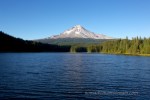
If the Tualatin River Wildlife Preserve wasn’t enough for one day, taking a drive up to Trillium Lake by Mt Hood sure did top it off nicely.  Trillium lake has a lovely two-mile trail  around it and we were promised a great view of Mt Hood by the internet, which is always right.

We decided to get there a couple hours before sunset so we’d have plenty of time to walk the two miles and pick out the perfect spot to shoot Mt Hood as the light changed.

We didn’t get there two hours ahead of sunset.  In fact, by the time we parked and were walking to the lake, sunset was about 45 minutes away.

Thankfully, the best view of Mt Hood was about a 5 minute walk from the car.  In fact, they built a deck there and put some benches on it so we could be comfortable while we watched the sunset.

Instead of sitting and relaxing, I got busy setting up the tripod I’d borrowed from my father and getting my camera ready to go.  Moving quickly kept me warm–even with my many layers (a light fleece plus a leather jacket plus a huge, thick fleece borrowed from my dad), it wasn’t exactly toasty.  The wind was whipping up a pretty good froth on the lake, meaning there were no glass-like reflections to be had of Mt Hood.  But, it was still beautiful.

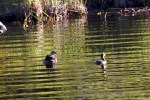
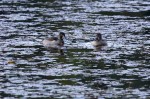
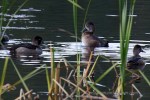
And, sunset took long enough that we had time to take a break from shooting the mountain to walk part way around to get up close enough to identify some ducks that eluded me.

After looking at them through binoculars, shooting them with a 400mm lens, and after enlarging the images to look closely at them, I’m pretty sure the little ones are Pie-billed Grebes and the larger ones are Ring-necked Ducks.  I feel more certain about the Pie-billed Grebes than I do about the Ring-necked Ducks.  They were fun to watch in any case.

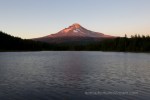
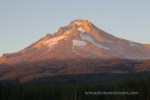
We returned to the deck so I could shoot as the sun faded.  The light turned amber and the mountain shifted from gray rock to glowing orange.  The trees below timber line moved from green to purple on the color wheel.  It’s almost hard to believe I didn’t change the tint or white balance between the early and late shots, but the sun did all that for me.

I kept hoping the wind would die and let me get one good shot of the mountain reflected on smooth water, but the wind only got stronger and I only got colder.  About the time we were going to call it quits, we spotted two otters making their way towards us across the lake.  This was the first time I’d seen wild otters anywhere other than the ocean.

Pie-billed grebes, check.  Ring-necked ducks, check.  River otters, check.  Mt Hood at sunset, check.  Definitely time to call it a day.