Crossing Bridges

I love my dog.  I love him for many reasons, but today, it’s because every day he reminds me that we can learn, we can grow, we can be completely different than we were before.

How many times do we hear people say “you can’t teach an old dog new tricks”?  As someone who strives to learn every day, I know first hand how hard it can be to undo decades of habit to do the thing I will myself to do.  Many days, I feel like it’s an impossibility.  Then, I have days when I do things like fly off a mountain in a hang glider and I know that anything is possible.  But, sometimes I walk away thinking that maybe flying off a mountain in a hang glider doesn’t ultimately change anything at all.

That’s where Tisen comes in.

Tisen has transformed himself from a nearly-dead street dog to a urban-dwelling, middle-class gentleman who likes to hike.  He wants to make me happy.  That’s his bottom line.  While I’m not sure I could handle a person being so into me, in a dog, it’s kind of nice.

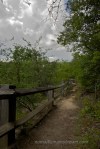
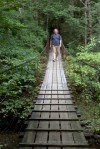
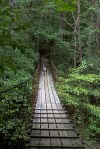
When we went to Savage Gulf Natural Area to hike the other day, we encountered something called a suspension bridge.  The dreaded structure was not the kind of suspension bridge you drive over, but rather a flexing, swinging, bouncing rope-and-wood bridge meant for no more than 2 pedestrians at a time.  These bridges make me nervous; I have no idea what they are like for a dog.  For Tisen, it was clearly a gauntlet of terror.

First, he would not step onto the bridge at all.  I walked across first to give him a reason to cross.  Then Pat came behind, encouraging Tisen to come with him.  Tisen considered climbing down a sheer rock cliff to the stream below over walking onto the bridge, but Pat managed to get him up the entrance ramp to the bridge.  But there, he stopped.  It wasn’t until Pat had crossed and Tisen was left standing alone that he decided he’d better cross.

He made it all the way across the gulch (which really wasn’t so far below as to be completely terrifying), got to the top of the exit ramp, stared down at me with his longing eyes, then eye-balled the ramp down to me and decided he’d had enough.  He turned around and went all the way back across the gulch.

We managed to coax him back across and all the way to land on the other side.  We completed our hike to Savage Falls and then wondered what was going to happen on the way back across.  When we got to the suspension bridge, I went across first, Pat coaxed Tisen up to the bridge, and Tisen led the way across looking like he’d been crossing suspension bridges most of his life.

In about an hour, Tisen transformed himself from a ‘fraidy cat to a top dog.  He’s my hero.

The Fungus Among Us

I’m a big fan of mushrooms.  I like to eat them (when someone else has tested them first) and I like the way they look.
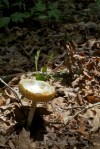
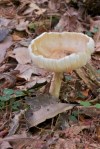
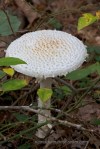
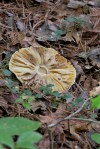
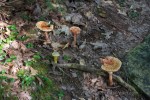
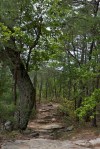
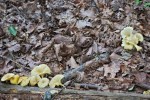
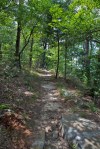
When we started off down the Savage Gulf Day Loop trail, it seemed like there was a new mushroom we’d never seen before every 10 feet or less.

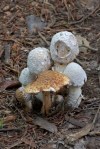
In fact, sometimes there were whole families of mushrooms and, in some cases, it looked like the children were adopted.

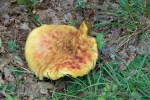
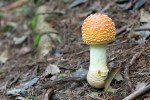
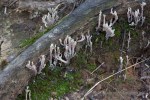
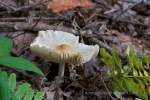
I was blown away by the colors and sizes and varieties of mushrooms that added color to the trail in a way previously left to flowers.

Unfortunately, after toting the tripod around for 2.5 miles at Laurel Falls and Stone Door, I’d decided I didn’t want to tote it around for potentially 5 miles on the loop trail.  I opted for my camera with the 24-70mm lens and a 100-400mm lens in my bag in the hope of having less weight on my shoulders.  I also made a mental note to myself to, in the near future, look for a backpack with a hip belt that I can use to carry photography equipment–I have got to get the weight off my shoulders.

I’m fairly certain that the decision to leave my 100mm macro lens and tripod behind actually caused a massive mushroom bloom from the time we left the car to the time we started down the trail.  I would bet a lot of money that had I carried my tripod and macro lens, we wouldn’t have seen a single thing interesting enough to shoot up close.

As it was, I was left to try to simulate shooting macro in a dark environment with a hand held camera.  I was thankful that my Canon 5D Mark III has such awesome higher ISO performance (well, compared to my 40D, which I also left behind).  Were it not for that, I wouldn’t have captured a single mushroom.

On the way out, I shot mushrooms at 70mm, getting as close as possible, which isn’t that close since it’s not a macro lens.  The images are all cropped as a result.

On the way back, I shot mushrooms at up to 400mm, standing back further and desperately trying to hold the lens still.  I’m impressed that I got any decent shots at all.  I think this speaks to the amazing technology of image stabilization built into the lens.

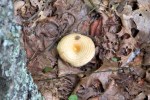
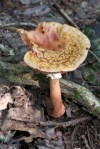
Granted, some of the shots are a bit blurred from too much movement with too long of a shutter speed.  The second image is an example of this.  It’s one I should probably just delete.  But, when I looked at it in post processing, I was so pleasantly surprised to discover what I assumed was leaf debris was actually a tiny snail sitting on the mushroom cap, I couldn’t think of deleting the image.

It’s funny how sometimes the most pleasure comes not from executing a shot well but by discovering something in a shot completely by accident.

Stone Door

Continuing our weekend adventure, having made it from the asphalt to the “unimproved” part of the trail (does anyone actually think asphalt is an improvement?), we continued on our journey to the Stone Door.

I don’t know exactly what image “Stone Door” conjures in your mind, but in my mind, when I read the description that said:

Stone Door, a 10 ft. wide by 100 ft. deep crack, forming from the top of the escarpment into the gorge below. It looks like a giant door left ajar and was once used by Indians as a passageway.

What I envisioned was a giant slab of rock standing straight up in the middle of two cliffs and standing ajar so that one can walk between the “door” part and the cliff part.  I guess I skipped over the “deep crack” part.

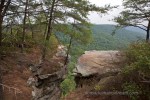
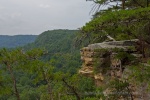
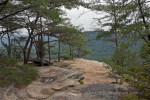
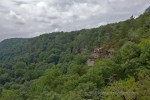
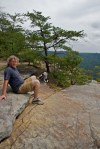
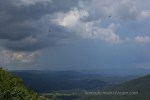
When we arrived at Stone Door, the view of the valley was fantastic.  Plus, the top of the cliffs provides some really interesting scenery in and of itself.  The only part I didn’t like was being anywhere near the edge.  The drop off was terrifying.

Pat and Tisen sat patiently while I worked my way around the top of the cliff, shooting everything I dared to shoot.  I really wanted to get a great shot looking down on the crack in the cliff, but it was tough to get a good angle without rock climbing gear.  I always knew I should have become a rock climber.

I have to pause here for a moment to do a mental double take on whether those words actually came out of my fingers.  Me . . . a rock climber?  Well, maybe not.

In any case, I couldn’t get the shot I wanted mainly out of pure fear.  Or perhaps fear in this case was good sense?  I was pretty determined not to fall into the crevasse never to be found again.

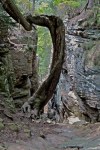
We worked our way back down with me stopping to shoot straight on to the crack.  There was a large tree in the opening that created a key hole sort of image for me.  I played with that for a while and contemplated walking down the steps a bit to see what kind of interesting views I could get, but Pat was concerned about time and we needed to drive to the other side of the park to see the next part of our adventure:  Savage Gulf Day Loop.

So, I packed it in without getting a great shot of the crack.  As we walked away, Pat said to me, “I wonder where the Stone door is?”  I wasn’t the only one who didn’t picture a big crack!

Tisen seemed nonplussed by the whole stone door thing.  I imagine there are certain advantages to being a dog.  One of them is probably no expectations.  Don’t get me wrong, Stone Door is really cool and definitely worth the effort to get there.  Just don’t expect something that looks like a door.

In Lieu of Backpacking

We are trying to get a hike in at least once a weekend.  Since it’s a big reason we chose to move to Chattanooga, we figured we ought to take advantage.  However, the hot and humid August weather has made hiking slightly less enticing.

I did a little research to pick a place to hike that wasn’t too far away.  I learned about South Cumberland State Park and the Savage Gulf State Natural Area, located inside the park.

There was a 17 mile hike that sounded intriguing, but 17 miles for us means spending the night.  Since I had a lot going on this past week, we didn’t have time to prepare for backpacking.  Plus, we weren’t quite sure where Tisen would sleep given that our 2 person tent is really only big enough for a person and a half.

So, we opted to do two short day hikes instead.

We headed out Saturday morning loaded down like we were spending the night after all (the joys of too much photography equipment).

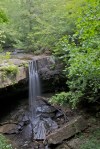
When we arrived at the Stone Door ranger station, we saw a sign that said Laurel Falls was only 250ish yards from the parking lot.  So, of course, we had to walk there first.  What they didn’t mention was that it was 250 yards down a bunch of stairs and 250 yards back up those stairs.  But, still, who wouldn’t go 250 yards to see a waterfall?

I’m not sure how excited Tisen was about the waterfall after the stairs, but he made it and I was happy I had my tripod so I could shoot with long exposures, creating smooth water.

We headed back up the steps and on towards Stone Door from there.

The walk to Stone Door started on a paved path.  Paved as in asphalt.  We noticed blazes on the trees marking the trail and Pat commented that he was glad they’d marked the trail because otherwise we might have gotten lost.  It did seem a bit odd to hang metal trail blazes on the trees along a trail that was paved, but I guess they haven’t lost anyone yet.

The first overlook was the end of the asphalt, thankfully.  Although, we passed a woman coming back the other way with only one leg.  I don’t know if she was able to walk on the unpaved portion of the trail or not, but it did make me appreciate the asphalt.

From the overlook, we not only got a nice panoramic view of the mountains, but we spotted a rocky outcropping in the general direction we were headed.  We suspected it was our destination.

Tisen was not any more excited by me setting up my tripod at the overlook than when I pulled it out at Laurel Falls, but he waited fairly patiently once Pat took him off the asphalt and into the shade.

If there was one thing that would have made the day nicer, it would have been cooler temperatures and less humidity.

Monkey Feet

It all started on the hike to Grinnell Glacier in Montanna.  Pat and I were working our way up the mountain trail with me in my hiking boots that felt like giant led-filled balloons when we passed a couple on their way back down.  They looked impossibly fresh.  They weren’t limping.  They looked relaxed and comfortable.  As I looked down to find footing, I noticed their feet.  Low and behold, they were wearing fivefingers shoes.  I had heard of fivefingers before, but it hadn’t occurred to me people would wear them on the trail.

After limping our way back at the end of the hike with me barely able to put weight on my knees and hips, I found myself wanting to try fivefinger shoes.

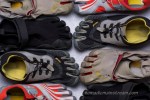
When we got home, I bought a pair like the ones we saw on the trail–black neoprene.  Although I didn’t give them a true trail test for many months, they turned out to be a miracle on the treadmill.  My knees and hips felt better than they’d felt in years after the initial adjustment period.

There definitely is an adjustment period!  A whole bunch of tiny muscles in my feet and ankles had to be reborn and developed before I could walk as fast or as far as I had been walking.  But, once I’d adjusted my stride and footfall and developed weakened muscles, I was pretty sure I could walk forever without getting the shooting pains I’d become accustomed to.

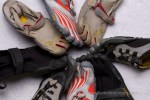
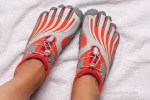
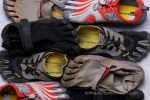
Alas, the neoprene was hot.  It was hot indoors and hot in the fall and spring, but not warm enough for the colder temperatures I’d hoped to wear them in.  That led to the trekking pair.  They have a mesh weave that breathes.  Unfortunately, they weren’t made to be drug across the ground on their tops, which is exactly what happens when one is learning to hang glide, resulting in excess wear and tear.  My feet also do not like the tread on those shoes.  If I walk on hard surfaces in them, I get blisters on my big toes.

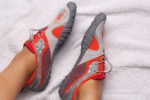
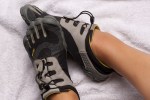
This led to the much softer and cushier black and gray pair, which I love.  However, they are a little too soft for the trail, which brings us to the orange pair.  They are supposed to have some extra support to protect against rocks.  I’m testing them tomorrow for the first time on the trail.

There are definitely tradeoffs.  Kicking a rock or stepping on something sharp feels a lot different (and not good!) in fivefinger shoes than in hiking boots.   They are also not good in cold and/or wet conditions.  My feet turned to blocks of ice on a short 2 mile walk that started off slogging through mud last November.  I was glad I’d brought my boots for the longer hike we did right after that.  For this reason, I bought a new pair of boots, too, much lighter than my previous pair.  I wish I didn’t need them.
Three Sisters

Perhaps because I don’t have any sisters, I am particularly attracted to the area called Three Sisters in Oregon.  In this case, however, they are mountains.

The area is one of those places you don’t expect to see in the lower 48 when you grow up in the midwest.  I assume people who live in the Northwestern US know better.

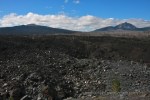
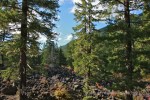
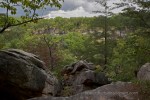
Approaching the lava fields is astounding.  It’s as if some giant construction company in the sky dumped an enormous load of asphalt in great big chunks all over the landscape.  At the edge of a lava field, there is a miniature cliff formed where the lava suddenly comes to a halt.  I never would have predicted the transition from lava to none lava would be so distinct.  I guess having been to Hawaii Volcanoes National Park, I expected the lava to have melted together in a single, molten form, freezing into a solid black river.  But in Oregon, the lava is in giant rock form.  I imagine a mountain spewing out black boulders like a BB gun aimed towards the sky.  The image is as mysterious as the reality.

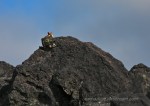
Besides lots and lots of black rocks, the Three Sisters are offers spectacular views and many golden-mantle squirrels.  There are also some un-lava’d areas of forests that offer really good hiking.

We picked a short, flat trail that went to a couple of waterfalls.  This was mainly because my dad’s wife had a lot of knee issues at the time.  But, in the end, we were glad we picked the trail we did regardless of the ease–it was gorgeous.

The only thing that would have made that trail better was if it would have been easier to get a good angle on the water falls.  It was extremely challenging to get into a position where the falls were fully visible.  Not that I would ask anyone to cut down any trees to improve my images.

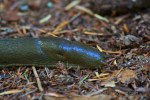
Perhaps the most amazing thing we saw was the biggest slug I’ve ever encountered in my life.  I don’t know if it was an actually banana slug or not, but it was bigger than some bananas!  I’m not a huge fan of slugs.  I know they serve their purpose and all, but it’s just not a species I find it easy to connect with.  But maybe it’s just a matter of size.  Looking at this 6-inch long beauty, I felt appreciative of slugs in a whole new way.

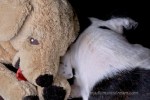
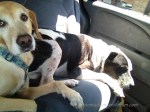
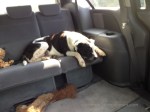
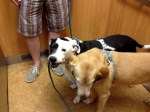
Back in the present day, we dropped Twiggy off to her parents today.  When we put the dogs in the car, they each picked their own seat and were sitting up side-by-side.  Of course, by the time I got my phone unlocked to take a picture, Tisen had laid down.  I also missed–it’s surprisingly difficult to shoot over one’s shoulder holding an iPhone while sitting in a car going down the road (I was not driving, just for the record).

Snow Surprise

Because I am taking a learn to row class 5 days a week and recovering from said rowing class the other 2 days a week, I have not been doing a lot of shooting lately.  As such, I have returned to my photos from our 2010 trip to Glacier National Park.

We stayed at Glacier Park Lodge a couple of nights at the end of our stay in the park.  Getting to the lodge is not difficult.  It’s an easy drive from West Glacier.  What is less easy is the long drive up the East side of the park to St. Mary’s Lake.

The memory of one early morning drive up the East side of the park still haunts me.  Montana has a “fence out” rule about livestock–if you don’t want them on your property, put up a fence.  Otherwise, they’re free to range.  While I don’t know enough about the advantages and disadvantages of this approach to argue for or against, I do know that it resulted in two dead horses spread across the road at about 7AM one morning.  As we drove past, my stomach lurched and I hoped they died quickly.  We were debating who one is supposed to call when there are two dead horses on the road when, a couple miles down the road, we passed a front loader headed at full speed toward the gory scene.  I had to look away.  The thought of the horses being scooped up in a front loader was a little too much for me.

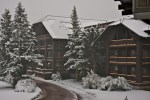
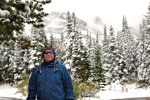
But, on to happier thoughts.  When we awakened our first morning in the lodge, we discovered an unexpected snow had moved in overnight.  While Pat slept in, I wandered around the lodge looking for photo ops.

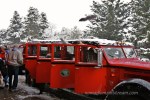
A red jammer was parked in front of the lodge loading up a group of senior citizens for a tour.  I perched up on a walkway above the scene and started shooting this historic vehicle.  About then, the snow started sliding off the roof of the hotel in enormous chunks.  One tiny lady (the top of her head is just visible through the window of an open jammer door if you look closely in the photo) got pummeled repeatedly by chunks of snow before someone ran over and shielded her.  I felt a little guilty standing there shooting, but I was quite out of reach.

When Pat got up, we drove to the small town nearby (Browning) in the Blackfeet Indian reservation (and yes, it is called “Indian” and not “Native American” there for whatever reason) where we found a trading post that sold rubber boots.  Pat bought a pair and we proceeded to go take an easy walk around a lake before driving up to St. Mary’s.

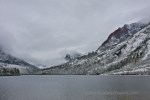
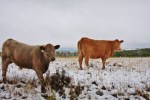
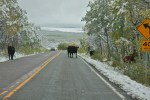
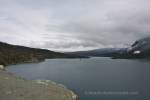
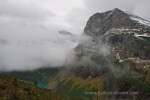
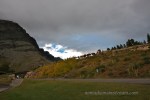
On the way to St. Mary’s, we encountered many cows on the road.  We also had to pull over so I could shoot some of the scenery with snow.  It might have been unseasonably cold, but it was beautiful.

Cloudland

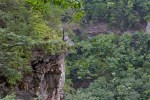
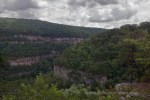
We made it back to Cloudland Canyon for the 3rd time a weekend ago.  We managed to hike the West Rim trail after going there once completely unprepared to hike and once just to show friends the views from the parking lot overlooks.

This time, we went prepared.  Well, semi-prepared.  I decided to wear my monkey feet (as Pat calls them)–my black five fingers shoes–since they’re by far the most comfortable shoes I’ve ever hiked in.  However, they’re not so good on sharp stones and there were plenty of those.  That led to Tisen and Pat having to wait on me while I picked my way over the trail.

The other issue was that I opted not to bring a tripod, but I had a polarizer on my wide angle lens since we were hiking during some of the worst light of the day.  I love my polarizer when I need it.  I does wonders to cut out the bright reflections and remove glare from a scene.  However, there are two problems with a polarizer.  First, a stop and a half of light is a pretty high cost to pay when you are tripod-less.  Second, a polarizer works best when it is used at 90 degrees to the sun.  When hiking, one does not have control over what the angle to the sun is.  So, sometimes it does it’s thing well and sometimes it doesn’t.

The part I didn’t think about before taking off down the trail was whether I would want to remove the polarizer and, if so, what I would do with it when I did.  This meant I either had to shoot with it on or I had to recruit Pat to hold it for me.  Given that it was mostly overcast that day, I probably would have been better off without it.  I had to scrap many photos because of movement blur due to slow shutter speeds.

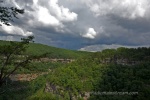
But enough technical talk.  Cloudland Canyon was beautiful that day.  With big puffy clouds appearing and disappearing as sunshine streamed around them one minute and rain streamed from them the next.

We got wet more times than I counted.  This was another thing I was unprepared for, rain.  It was so hot, I had no need for a rain jacket–the water simply steamed off of my skin.  But, my camera wasn’t that hot.  Fortunately, I had packed a wide-brimmed hat which worked well to shield my camera each time it rained.

Tisen did amazing on the trail.  He stayed much closer than he has in the past and stopped when told to stop.  He could teach Pat a thing or two.

After completing the 5 mile hike around the West Rim of the canyon, we got a nice shower on our way to the car.  We piled in as quickly as possible–the rain started to pour down hard about the time we were ready to go.

It was a great day.

The Long Walk Home

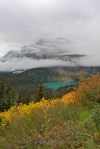
We decided we had to hike the Grinnell Glacier trail while we were in Glacier National Park in 2010.  However, given that we weren’t exactly in top hiking condition and the trail gains 1600 feet in about 3 miles, we thought we’d better take a short cut by taking the Glacier boat across Josephine Lake, cutting a little over a mile and a half off the total distance.  While the part we skipped was a flat, easy hike, I knew my knees would thank me by the time we descended the 1600 feet on our way back.

We made our way gradually up the trail.  Pat hiked in rubber boots he’d bought at the Indian Trading Post the day before.  He was wearing these boots because, for whatever reason, he hadn’t packed his hiking boots and the sudden fall of about 5 inches of snow made his running shoes impractical for hiking.  So, we’d taken a detour to the trading post and gotten him some socks and muck boots.  He said they were the most comfortable boots he’d ever hiked in.

My boots were not feeling so comfortable.  In fact, they were feeling a lot like lead weights designed for use when you need to drown someone and concrete isn’t readily available.  But, the scenery was so beautiful, it was easy to ignore my boots on the way up.

As we hiked, the sun came out, the temperature rose, the snow melted, and we worked up a sweat.  Pat stripped down to a cotton T-shirt (don’t get me started on cotton on the trail!) and shorts.  But as we made our way up higher, the temperature dropped, the wind became fierce, and the ground was once more snow covered.

People coming down the trail gave Pat looks as the passed us in fully zipped winter shells with hoods up.  I stopped to pull out my warm winter hat, put on mittens, and add a fleece under my rain jacket.  Pat kept putting off adding more layers.

When we reached the top of the trail, the wind was so strong, I had to brace myself against it to keep from losing my balance.  Pat finally pulled on a jacket.  We didn’t spend a lot of time at the top because of the bitter cold, but the entire hike was so spectacular, we didn’t feel cheated.

We had to make double-time on the way back down to catch the last boat back to the hotel.  This downhill trek was the first time I ever experienced sharp stabs of pain in my knees with every step.  By the time we got to the ferry, I could barely walk.  This was our 4th hike in 3 days (and, more problematically, also our 4th hike in about 3 months).  I would not have made it without my trekking poles.

In spite of the sore knees (which did heal for the most part), this was one of my all-time favorite hikes.

Reconstructing History

While in the Canadian Rockies at Jasper National Park several years ago (still shooting with the PowerShot G3), we decided to take a “rest” day by hiking a relatively easy trail to a lake at the base of Mt Robson.  We drove from Jasper Park in Alberta to the Robson Provincial park in British Columbia in about an hour.

When we started out, the sky kept promising rain (in fact, it even sprinkled briefly), but then the clouds would part and a deep blue sky would appear.  When the sun was out, we broke a sweat working our way up the easy, but uphill, trail.  When cloud cover moved in, it was like someone had cranked up the air conditioning and I would get chilled almost immediately.

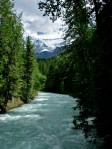
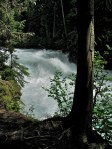
For most of the walk, the trail ran parallel to a treacherous but beautiful stream swelling with the “spring” snow melt (this was in July).  We didn’t see anyone attempting to navigate the stream, so I’m guessing the water was too intense for even really good kayakers.  It seemed like getting in the stream would be a really bad idea with or without a kayak to me.

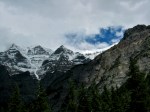
When we arrived at Moose Lake, we were further away from the base of Mt. Robson than we expected, but given that Mt Robson is the tallest mountain in the Canadian Rockies, we still had plenty of good views of it, including the glacier nearby.

As I went through these photos from 2005, I discovered an interesting phenomenon.  I believe I was feeling lazy on this particular day not only in choosing an easy trail, but in my shooting.  I notice that the metadata in my pictures indicated I was mostly shooting with a wide-open aperture, with the smallest aperture setting being an f/8.

This was remarkable to me in two ways.  First, this is another thing to add to my list of things I’ve learned–I would not shoot these scenes with that setting today.  Second, it seems like they have much more depth of field than I would expect for such wide aperture settings.  This caused me to look at focal lengths.  They are mostly under 20mm with the shortest being 7mm (if I recall correctly).  Is that even possible?  Assuming my metadata is correct, the extremely short focal lengths are most likely contributing to the extra depth of field.  I assume I was shooting with an open aperture because we were walking in the shade quite a bit, so perhaps there wasn’t much light.

It’s always fun to try to reconstruct what happened 7 years ago based on the evidence collected in the metadata of your photos!

What I do remember clearly about this hike is that Pat and I were quite irritated with one another at the beginning of the hike, but back to laughing together by the time we were ready to return to the car.  Maybe that’s why I love hiking so much–it’s restorative in more ways than one.