Cayce’s Turn

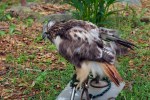
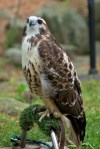
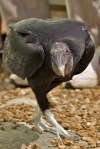
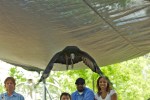
Perhaps three posts on one birds of prey program is a bit excessive?  But, I feel that Cayce requires her own post.  After all, how many Black Vultures do you know that get a standing ovation?  For that matter, how many Black Vultures do you know at all?

Vultures happen to be one of my favorite birds.  I always enjoy watching them soar on the wind, hardly ever flapping their wings.  But I really fell in love with vultures when we had a house in the country with a large pond.  One spring day, we had a inversion.  I honestly can’t say I fully understand this, but apparently the water on the top of the pond becomes cooler than the water on the bottom and, as the water switches places, the oxygen escapes and the fish suffocate.  When I say the fish suffocate, I mean hundreds of fish suffocate.  I mean more fish than we would have ever guessed lived in that pond suffocated.  I mean the entire surface of a 1 acre pond was covered in dead fish.

Enter the vultures.

Any bird that can come onto the scene of such a stinky mess and leave less than 3 days later with the place looking like nothing happened (besides a few stray skeletons)  is welcome at my house any time.  I can’t imagine how much we would have had to pay a person to clean up that mess.

My appreciation for nature’s sanitation engineers (as Dale of S.O.A.R. would say) meant I had an open mind the first time I met Cayce.  But Cayce doesn’t really require you to have an open mind–she will win you over regardless.

First of all, Cayce likes to run around on the ground.  This is in and of itself is funny.  Black Vulture run by hopping and skipping across the ground.  It’s funny.  Trust me.  Or, watch the video:

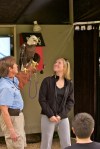
Second, Cayce flies over the audience with a particular glee.  She seems to know she’s a star and that getting as close as physically possible to the audience makes her more of a star.  In fact, she hit me in the head with her tail as she flared to land on Dale’s glove during the second show.  The audience loved it.

Third, Cayce chases John, pecking at his legs, demonstrating he is below her in the pecking order.  The entire audience cracks up as John runs from Cayce.  While he is being slightly theatrical, Cayce can draw blood, so moving quickly to avoid her beak is not just for show.

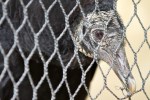
An interesting tidbit I learned about vultures from John and Dale is that Black Vultures have a strong beak for piercing and tearing through thick flesh while Turkey Vultures have a great sense of smell.  Together, both species eat well.

But today, no one is really thinking too much about what Cayce eats, even though Dale is throwing her chunks of dead mice.  My only complaint about Cayce is that she’s hard to photograph.

Audience Participation

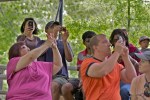
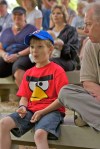
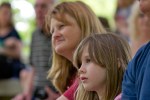
While working on getting great pictures of birds of prey (as in, trying very hard, not necessarily achieving), I had the realization that the people are as fascinating as the birds.  Especially the children.

I’ve spent the better part of my life ignoring most children.  Not that I have anything against children; I just tend to gravitate towards people who are old enough that they would be insulted if you called them a child.  I blame this, in part, on my height.  I have a tendency not to notice much that’s shorter than about mid-thigh height unless it barks, meows, or flies.  I don’t know why this is, but I do know I have walked right into small children on more than one occasion because I just didn’t see them–they snuck into range under my radar.

But on Sunday, when I sat in the amphitheater at Rock City watching the birds interact with the audience, it was the children who were the standouts.  Perhaps they haven’t yet developed the stiff facial muscles of adults whose faces repeat the same patterns over and over again.  Perhaps they don’t change their facial expressions to reflect what they think someone else expects of them, so their expressions seem more genuine.

I’m not sure exactly what quality of children’s expressions makes them so much more . . . well, expressive, but I cannot help but swing the camera around to catch a child practicing hooting when John teaches the audience how to call a Barred Owl.  I cannot but wish for a second camera body so I could have a wide-angle lens ready to go to catch the reactions of the children as the birds soar over their heads.

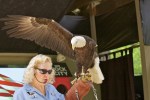
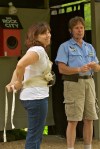
After the first show, John stands on the stage with Atsa, the bald ealge, while Dale takes Buddy, the screech owl, down the sidewalk.  I stay with John and take pictures of the people stepping up to have their picture taken with Atsa.

I sneak in a shot before they pose for their camera.  There is a moment for most people when they look up at Atsa, this magnificent bird, and their face expresses their genuine amazement, joy, or nervousness.  That’s the moment I want to capture.  Once they face their camera, they paint on the smile they’ve been using since their kindergarten class picture and I am instantly bored.

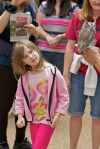
After the second show, I follow John up the walkway with Buddy and try to stand back far enough to shoot without anyone noticing.  I find myself wishing I could push the people aside blocking my view of the wonderful children petting Buddy.  Their faces made my whole day.  In a matter of moments, I witnessed fear, nervousness, surprise, joy, curiosity, and a hundred more emotions I can’t name.  I don’t know how many of those I captured in these images, but I sure have fun looking at the photos and realizing that these people were fascinated, engaged, and enjoying learning about birds of prey.

Birdie, You’re a Star

Continuing the theme of birds, on Sunday, I had the opportunity to go to Rock City, a local attraction on Lookout Mountain, to see the S.O.A.R. raptors perform.

S.O.A.R. performs regularly at Rock City throughout the warmer months, educating the public about the role raptors play in the ecosystem and giving people a close encounter with birds of prey.

I’d never seen the S.O.A.R. program before, so I plan to watch it twice. I’m hoping to collect enough photos to put together a screen saver we can use to raise money for the program.

One of the unique things about Rock City is that dogs are welcome. Unfortunately, dogs make birds of prey (and really, most birds) quite nervous, so while they are welcome in Rock City in general, they are not permitted in the vicinity of the bird program.  This meant that while Tisen got to come with us, he had to be escorted away from the vicinity of the performance before the show.  So, both Pat and Tisen missed out.

My goal for the first run was to learn the pattern of what they did so I could do a better job getting shots of the birds in flight during the second performance.  However, it’s almost impossible to sit with your camera in your lap and not shoot a single frame when you’re surrounded by super stars!

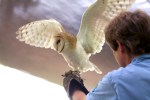
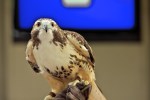
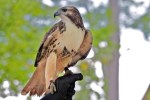
The performance is in a nice amphitheater large enough to accommodate probably 100 people.  It’s small enough to create an intimate setting.  It also makes it possible for Dale and John to walk through the entire audience with the birds, giving people an up-close view.  And, if walking around with the birds isn’t exciting enough, they fly a barn owl, Theo, a red-tail hawk, Cody, and a black vulture, Cayce, right over people’s heads.

While the birds are busy capturing the audience’s interest, John and Dale sneak in an enormous amount of information about the birds.  Between the live birds and several videos, people witness incredible feats that only birds of prey can perform.  And while it’s one thing to see a video of a Peregrine Falcon pulling in his wings to achieve a dive of over 250 MPH, it’s completely another to feel the wind from a raptor’s wings as it soars just above your head.

The thing that I really like about John and Dale’s approach is that they are serious about raising awareness about the importance of these birds to the highly interconnected network of life we are part of.  At the same time, they understand that to raise awareness, you have to get someone’s attention first.  And there is no one, I contend no one, who can fail to be fascinated by the kind of close encounter John and Dale provide.  If having a bird soar over your head doesn’t do it for you, petting a Screech Owl after the show probably will.

These birds have a special skill at attracting attention and keeping it.

Hunting Herons

After attending a photography workshop in the morning and volunteer training at the Audubon Society in the afternoon, I decided spending some time shooting would be a nice way to end the day.

Tisen, feeling better after his bout of upset stomach, and I packed up and headed on over to the park.  I can’t decide what I want to shoot today, so I take everything I own.  Worst case, I get some extra exercise, although the sofa is a little unwieldy  😉

When we arrive at the entrance to the park, a blue bird flies over my head.  I haven’t even taken my camera out of the bag yet!  I stop right there and get out my camera and opt for the 100-400mm lens, deciding I’ve been neglecting it since getting the 70-200mm lens.  Besides, I could use the extra length for birds.

Of course the blue bird is long gone.  I guess that’s what I get for letting fate decide what kind of shooting I’m going to do.

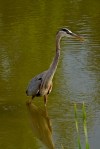
We head on down towards the wetland.  When we get there, a great blue heron is stalking the water.  I hand hold the camera for a change–it feels strange in my hands having worked on a tripod so much lately.

Tisen and I walk around to the shore of the wetland to see if I can get a better angle on the heron.  On the way, some people eye my lens and ask if I’m taking pictures of the wedding. Confused, I explain I was shooting a blue heron and the people laugh.  I look around and see a bride and groom disappearing down the path.  Is it funny that I am more attracted to birds than brides?

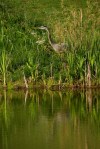
The blue heron stalks a fish, coming up onto the shore and then back down into the water.  It hangs out for awhile on the way, peeking at me from between blades of tall grass.  It amazes me how a giant, blue bird that resembles a pterodactyl can disappear amongst blades of grass.

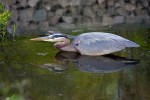
As he wades through the water, moving in slow motion, he crouches until he suddenly strikes and nabs a fish.  I missed the strike with this one, but, lucky me, I get to try a second time when another blue heron hunts on the other side of the wetland.

One thing I learned is that a shutter speed of 1/250 is not fast enough to stop the motion of a striking heron!

Unfortunately, he turns away from me to swallow the fish and I only get a view after the fish is deep in his gullet.  Both heron give themselves a big shake after a hunt–it reminds me somehow of Tisen marking a tree after having an encounter with another dog.

Sorry for the excessive number of pictures, but I love the succession of the second heron crouching lower and lower next to his reflection in the water until he strikes.  Just for fun, a movie version:

A Shot in the Dark

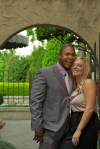
I arranged to meet my trainer and his fiancee at the sculpture garden in the Bluffview Art District an hour and a half before sunset.  I have no portable lighting, so the timing is critical.  They have agreed to model for me so I can try shooting portraits on location for the first time.

I get there early so I can walk around and look for good places to shoot.  I discover the tall building across the street from the park casts an enormous shadow and the shadow is growing rapidly.

When my models arrive, the light is not good in the park any longer.  But we take a quick stroll through the middle of the district (it’s a bit optimistic to refer to it as a district; it’s more like a short block) reveals some interesting architecture between historical buildings with a nice gate with an arch over it.  Of course, it’s even darker between the buildings, but we give it a try while it’s still bright enough.

We work our way around the area, trying shooting against a variety of backdrops–Bluffview affords a lot of interesting choices in a really short walk, so it’s perfect for this.  We end up at the Hunter Museum on the porch of the Georgian style mansion portion of the museum, sticking with the historical theme rather than walking over to the extremely modern side of the museum.

We play on the porch with the sun setting in the background.  Some red stripes start to appear in the sky and I attempt to get a few shots with the sun-streaked sky as a background.  This does not work at all.  I keep trying to get my subjects positioned so the spot lights on the building are lighting them, but, as shocking as this may be, architectural lighting doesn’t really work well for lighting people.  My shutter speed is way too slow–I coach my models to hold as still as possible, but let’s face it, I need a strobe.

When I review the photos later, I realize one reason why professional photographers often have an assistant.  I failed to notice when my subjects’ clothing did awkward things (like an errant tie that pops out of the bottom of a jacket like a pet snake).  This makes some of the shots I otherwise like annoying.  While the fiancee asked me to watch for her bra straps showing and my trainer was worried about his jacket not fitting properly, I really had trouble remembering to think about it.

I will have to bring Pat next time so I don’t get overwhelmed with trying to figure out how to use whatever portable strobe arrangement I end up with and watching clothing at the same time.

Tisen was happy to see me when I got home.  He thinks he’s my assistant and was mad I went without him.  I didn’t tell Tisen that Princeton, my trainer’s dog, was at the shoot while Tisen stayed home.

Uphill Battle

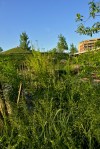
After a day of shooting on Saturday, one might think I am all shot out for the weekend.  However, upon rising Easter morning, I look out upon that early morning light and think “I should go shoot the flowers on the bank!”

Pat decides he will come with us.  This is awesome because it’s hard to do a lot of macro shooting with Tisen trampling over everything.

Deciding to travel light, I put my 100mm macro lens on my camera and attach my camera to the tripod.  I grab my 5-in-one reflector and my extension tubes and that’s all I’m taking with me.  Pat takes Tisen and the three of us cross the street.

I suppose we might look a little odd to the families arriving in droves at the park parking lot.  There is apparently some live music event for Easter at Coolidge park and many folks are parking here at Renaissance park and walking the short distance on the riverwalk to get to Coolidge.  There are all kinds of children in their Sunday best carrying Easter baskets.  I am wearing a pair of cropped hiking pants and a black pullover also made for hiking accessorized with my five finger shoes.  Plus, I am carrying my reflector fully open, although it’s only 22” in diameter, I’m sure it looks odd.  The tripod over my shoulder might help explain some of this to those who are curious, but I’m sure it seems strange to be focusing (pun!) on flowers when there’s an Easter event going on next door.  I guess we all celebrate in our own way.

But this morning, the light is indirect, glowing like only morning light can, and it’s dry.  I manage to make my way down the steep hillside without trampling anything that won’t recover.  I try to fluff up the grass where I’ve stepped in the hope of not leaving any trail of where I’ve walked.  I work around the outskirts of the flowers, looking for a few isolated blooms that I can get to without crushing anything.  It’s a struggle to stand up the tripod and get really close to the bloom on the steep hill without either falling or smashing other flowers.  I manage to arrange things carefully so that when I’m done, there won’t be any permanent damage, but standing with my feet carefully placed in areas that were recently cleared of weeds causes me to bend over at a weird angle, straining my back.  I am getting quite a workout bending over the camera while balancing myself and trying to support my back with my stomach muscles.  Who knew photography was really a sport?

In the end, I’m reasonably happy with the shots I got.  A little more physical comfort might have led to some better shots, but to have had more physical comfortable, I would have done damage to the plants on the hillside, so I’ve decided less than perfect photos are better than damaged plants.

What the . . .???

Today, Tisen and I are on a mission.  I’ve often said I wanted to go to the training hills some morning when I wasn’t flying in order to shoot.  Today seems like the perfect day for that.

My plan is to arrive at the entrance to the training hills no later than 7:00AM so I have time to hike down the gravel road and get set up before sunrise.

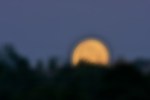
As Tisen and I get on the highway, I have a clear view of the full moon.  It’s still too high to make an interesting shot, but I want to shoot it before it sets completely.

Now I’m racing the moon.  Each time we go up a hill, the moon disappears behind the mountains.  I watch it set over a ridge on 4 separate occasions during our drive, only to reappear moments later.

As we enter Trenton, the moon is close to the ridge and I’m sure I’m out of time.  But as I drive on down into the valley towards our destination, the moon rises up above the ridge, giving me more time.

Unfortunately, I pull over where there’s a bad angle.  I hop out of the van, grab the tripod from the back and run up the road about 100 feet or so where the angle is better.  I set up the tripod and run back to the van.  Fortunately, my 100-400mm lens with the 1.4x teleconverter is already on my camera because that’s the only way it fits in my backpack.  I run back to the tripod.  The moon is getting closer to the ridge line; it’s already sunk behind some of the topmost trees.

As I get into position, I realize I didn’t grab my glasses or loupe and I don’t have time to get them.  I turn on live view, enlarge the image, and stand back as far as my arms will let me to try to focus.

The moon keeps sinking rapidly.  I fire off as many shots as I can before it disappears.  When I play them back in my viewfinder, I think they look OK.

Much later, when I view my moonset shots on the big screen of my computer with my glasses on, I almost spit a mouthful of beer on my screen.  I didn’t realize my vision was quite that bad!

Besides not having focused properly, I also had too slow a shutter speed so I’m getting movement blur in the moon.  I also have had some movement in the lens.  I don’t recall it being that windy, but that’s a possibility.

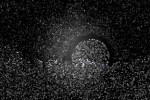
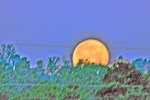
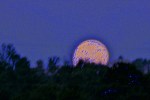
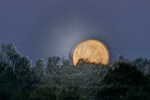
This leads to the age old question:  you’ve blown the shot, now what do you do with it?  I probably should just delete these images, but I decide to see how far photo editing can go.  I used Aperture, Photomatix, Lightroom, and Photoshop Elements (the majority are from the latter) to see just what can be done with a completely blown shot of the setting moon.

Reflection

It’s been a long week.  I’m tired and feeling uninspired.  On days like this, I really want to do something quick and easy by crossing the street to the park, but how many times can a person shoot in the same park?  I’m not in the mood to go macro.  It’s late enough that the light is getting really nice and I hate to not shoot landscape.

As I’m deciding what to do, an email with a blog post that’s a collection of images of reflections.  I immediately think of the wetland in the park and feel suddenly inspired.

I put my 16-35mm lens on my camera and take nothing else except my tripod and my loupe.  Tisen looks at me hopefully and I realize I won’t be going alone.

I sling my tripod bag over my shoulder, hold my camera up off my neck along with my loupe and then pick up Tisen’s leash in my free hand.  Tisen grabs Puppy Love and we head out.

We walk down the street, making many motorists smile (I assume this is because Tisen has a purple stuffed heart in his mouth that says “Puppy Luv” and not because I am wearing five finger shoes, my hair is sticking up weird because it dried while I had my glasses on my head, or because I’m carrying an oddly shaped bag over my shoulder.

We make it across the street and down to the wetland where I set up my tripod very low to the ground.

People are standing on the end of the viewing deck above the wetland and I can hear them talking about me.  They are wondering what I’m doing.  I do not hear any words like “insane” or “dangerous” and no cops come running up, so I assume they at least realize I’m unarmed (I’ve heard stories about people calling the cops because of a photographer’s tripod making people think they were a crazed gunman).

Tisen is not being the most cooperative photographer’s dog today.  He winds himself around the legs of my tripod and lays down right in the middle.  I have to untangle the leash and adjust the legs so they’re not in contact with Tisen to avoid him introducing vibration and blur into my photos.  I hear the people overhead chuckling.

We have a lovely time working our way around the wetland looking for interesting shots–and trying to keep Tisen out of them.  I only got a few of reflections, but at least I found something to capture my interest.

We pass a mourning dove whose been nesting on an abandoned nest from last year.  I try to get a shot, but, of course, one of the hazards of leaving the house only with a 16-35mm lens is that when these opportunities present themselves, it’s tough to get a shot worth looking at.

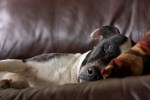
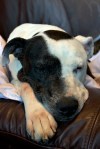
Tisen is worn out from our adventure and quickly makes himself comfortable on the couch when we return home.

Exposed

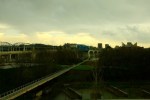
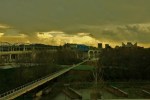
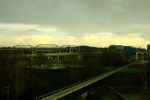
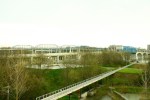
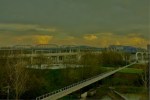
I am on a quest to get the exposure I want.  The scene is one I enjoy daily, but this particular day there was a stunning cloud display in the background.

The problem is a classic one.  A camera cannot correctly handle the same range of light that our eyes can.  Especially not when I’m looking at the world through polarized sunglasses. 🙂  It’s an issue that photographers have struggled with since the beginnings of photography.  You see a stunning sky and a lovely foreground view.  The camera can only properly expose one or the other.

I took shots of the scene with multiple exposures, hoping I could combine them successfully into one image.  High Dynamic Range (HDR) photography has been both rejected and embraced by the “serious” photographers of our time.  I believe it’s not the combination of exposures that troubles more traditional photographers but the special effects that can make an image hover on a line between a drawing and a photo.  I get this impression because many traditionalists extol the value of having a camera that will combine multiple exposures into a single image but have no interest in “HDR” post processing software like Photomatix.

Not that anyone is looking to me for guidance on the subject, but I continue to be on the fence.  I don’t care for photos that make you wonder if it’s a photo or a drawing. but I don’t mind an image that looks clearly like one or the other.

I also don’t like spending hours editing a photo I could have captured in the camera in by making better decisions.  However, when it comes to the age old problem of limited range of proper exposure when I really want to see the sky and still see the details in the foreground, I feel a little more fond of HDR processing.

For today’s exercise, I made an attempt to get a photo that combined the dramatic sky with enough detail in the foreground to keep it interesting.  Unfortunately, I forgot I’d changed my camera setting to JPEG, so I’m afraid I have limited resolution to work with and each edit step diminishes the resolution further.  But, I’ve given up on ending up with something I want to print and hang on the wall at this point.

Attempt 1:  Underexposed image with the shadows lifted a lot, the highlights pulled down a little, and a few other minor adjustments.

Attempt 2:  Overexposed image with the highlights pulled down a lot, the shadows lifted a little, and a few other minor adjustments.

Attempt 3:  3 images 2 stops of light apart combined in Photomatix with no other post processing.

Attempt 4:  2 images 2 stops of light apart combined manually in Photoshop Elements (and looking very weird).

Attempt 5:  3 images 2 stops of light apart combined in Photomatix (with different settings than attempt 3) and then adjusted further in Aperture.

In the end, let’s just say I wish I had a camera that could combine two exposures.  🙂

This is the Point

. . . Continued from “What’s the Point?

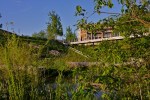
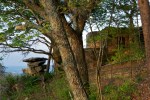
High on top of Lookout Mountain’s Northern point, we make our way around the paved path that leads to the museum.  The museum itself is perched on the edge of the mountain, built of stone and probably a civil war relic, but we didn’t go check it out thinking I wanted to get set up on the West side of the point in time for sunset, which was fast approaching.

However, when I got set up on the West facing overlook, the light was just right for shooting back towards the museum–golden and dappled through the leaves that have appeared from no where in the past week.

The cliff face below the museum makes me think that whoever fell of the earlier rock formation was lucky it wasn’t here that they lost their balance.

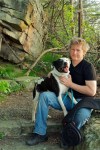
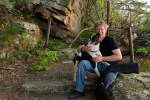
We consider briefly taking the metal stairs down to the trail below, but the thought passes quickly as I stare down the stairs and imagine my knees after going down them.  I content myself with shooting Pat and Tisen seated amongst rock outcroppings while we wait for the sunset.

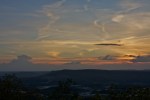
As I watch the light hitting different parts of the clouds, I contemplate why I still shoot sunsets.  When I’m looking through hundreds of sunsets images, I get bored almost immediately.  Yet, I can’t look out the windows and see interesting clouds at sunset without rushing up to the roof with my camera.  For some reason, I never grow tired of watching sunsets (or shooting them), but I quickly tire seeing pictures of them.

As the light fades, a line of cumulus clouds becomes more interesting.  As I line up a shot, a park ranger approaches and tells us the park is closed and we have to leave.  The park sign says they close at sunset (which officially isn’t for 4 more minutes), but he seems tired and I don’t really need the additional images to bore myself with later, so I don’t argue.

We walk out of the park with him and a group from Seattle.  We learn that a man did, indeed, fall and that he broke some ribs.  We also learn that the park ranger is from East Liverpool, Ohio originally–near the town Pat grew up in.

The group from Seattle is amazed by the weather.  They ask us if it’s like this all the time.  I laugh and tell them we moved down last August on a day when it was 110 degrees and that we had to use our AC in March.  They seem to think that sounds nice.

As a side note, I added a photo of Tisen from my iPhone.  I had my camera all set up for the sunset and didn’t want to swing it around to capture Tisen perched on a rock like a lion (although his Holstein fur doesn’t really conjure images of lions), so I pulled out the iPhone instead.  Another reason I need to get that second camera body!  🙂