Birdie, You’re a Star

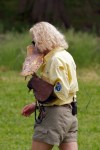
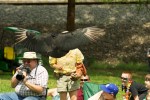
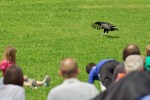
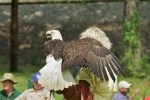
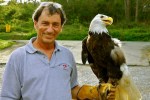
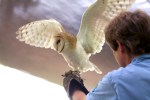
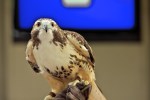
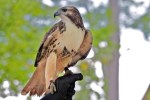
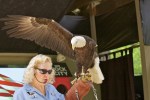
Continuing the theme of birds, on Sunday, I had the opportunity to go to Rock City, a local attraction on Lookout Mountain, to see the S.O.A.R. raptors perform.

S.O.A.R. performs regularly at Rock City throughout the warmer months, educating the public about the role raptors play in the ecosystem and giving people a close encounter with birds of prey.

I’d never seen the S.O.A.R. program before, so I plan to watch it twice. I’m hoping to collect enough photos to put together a screen saver we can use to raise money for the program.

One of the unique things about Rock City is that dogs are welcome. Unfortunately, dogs make birds of prey (and really, most birds) quite nervous, so while they are welcome in Rock City in general, they are not permitted in the vicinity of the bird program.  This meant that while Tisen got to come with us, he had to be escorted away from the vicinity of the performance before the show.  So, both Pat and Tisen missed out.

My goal for the first run was to learn the pattern of what they did so I could do a better job getting shots of the birds in flight during the second performance.  However, it’s almost impossible to sit with your camera in your lap and not shoot a single frame when you’re surrounded by super stars!

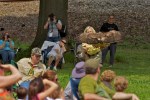
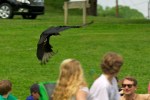
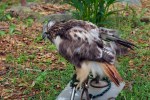
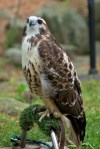
The performance is in a nice amphitheater large enough to accommodate probably 100 people.  It’s small enough to create an intimate setting.  It also makes it possible for Dale and John to walk through the entire audience with the birds, giving people an up-close view.  And, if walking around with the birds isn’t exciting enough, they fly a barn owl, Theo, a red-tail hawk, Cody, and a black vulture, Cayce, right over people’s heads.

While the birds are busy capturing the audience’s interest, John and Dale sneak in an enormous amount of information about the birds.  Between the live birds and several videos, people witness incredible feats that only birds of prey can perform.  And while it’s one thing to see a video of a Peregrine Falcon pulling in his wings to achieve a dive of over 250 MPH, it’s completely another to feel the wind from a raptor’s wings as it soars just above your head.

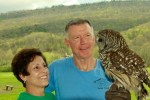
The thing that I really like about John and Dale’s approach is that they are serious about raising awareness about the importance of these birds to the highly interconnected network of life we are part of.  At the same time, they understand that to raise awareness, you have to get someone’s attention first.  And there is no one, I contend no one, who can fail to be fascinated by the kind of close encounter John and Dale provide.  If having a bird soar over your head doesn’t do it for you, petting a Screech Owl after the show probably will.

These birds have a special skill at attracting attention and keeping it.

Waiting for a Bird Like You

Tisen and I take a loop around Renaissance park looking for something interesting to shoot.  Well, to be fair, Tisen is more about looking for vertical objects to mark while I am looking for something to shoot.

Today, I’m out for birds.  I cock my head to one side as we walk, listening to the songs and identifying the ones I recognize as I decide whether they’re worth trying to wait for them to appear.

The thing is, song birds are really tough to get a decent shot of.  Especially when the longest I can go with autofocus is 400mm.  Since I don’t see well enough to focus manually unless the subject is sitting still, I figure I need the autofocus.

This means that unless a song bird flies down and perches on a branch about 10 feet away, I’m not going to get a very usable image.

So, I forego waiting to see if I can find the song sparrows, the carolina wrens, or even the yellow-rumped warbler I hear singing.  However, when we cross the bridge over the wetland. I notice a white-throated sparrow down in the creek below.  White-throated sparrows are winter birds in this part of the country, but they seem to be hanging out late here in Chattanooga–I still hear them every morning.

This white-throated sparrow isn’t singing, though.  He’s taking a bath.  I’m amazed as he completely submerges himself in the creek.  Then he fluffs out his feathers like he’s sitting in some kind of pool float.

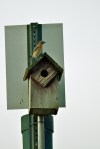
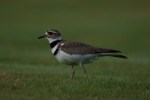
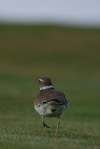
Next, on the hillside above the wetland, a killdeer wanders back and forth above us.  Having staked out the blue bird house a few yards behind the killdeer, I ignore it, waiting for the blue bird to return.  The killdeer charges me like we’re playing chicken.

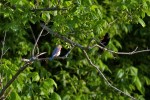
I manage to get a few shots of the killdeer without missing the return of the blue bird.  And when the blue bird flies off to the other side of the wetland, it lands in a tree right next to a red-winged black bird.  They are so close together, it’s hard to believe they manage to ignore one another, but they do.

As I sit focusing on the song birds, a large, mostly white bird flies through my peripheral vision.  I pull away from the camera just in time to see it fly out of sight.  It’s shaped something like a mourning dove, but it’s too big.  I find myself wondering if it’s a bird of prey, but it’s probably a giant pigeon.  When I go back to shooting the song birds, it flies by again and I miss getting a good look for a second time.

Tisen is getting impatient.  It has been an hour and a half since we started shooting, so I supposed I can’t blame him.  I skip waiting for the return of the mysterious bird, pack up, and head on home.

Hunting Herons

After attending a photography workshop in the morning and volunteer training at the Audubon Society in the afternoon, I decided spending some time shooting would be a nice way to end the day.

Tisen, feeling better after his bout of upset stomach, and I packed up and headed on over to the park.  I can’t decide what I want to shoot today, so I take everything I own.  Worst case, I get some extra exercise, although the sofa is a little unwieldy  😉

When we arrive at the entrance to the park, a blue bird flies over my head.  I haven’t even taken my camera out of the bag yet!  I stop right there and get out my camera and opt for the 100-400mm lens, deciding I’ve been neglecting it since getting the 70-200mm lens.  Besides, I could use the extra length for birds.

Of course the blue bird is long gone.  I guess that’s what I get for letting fate decide what kind of shooting I’m going to do.

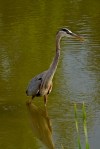
We head on down towards the wetland.  When we get there, a great blue heron is stalking the water.  I hand hold the camera for a change–it feels strange in my hands having worked on a tripod so much lately.

Tisen and I walk around to the shore of the wetland to see if I can get a better angle on the heron.  On the way, some people eye my lens and ask if I’m taking pictures of the wedding. Confused, I explain I was shooting a blue heron and the people laugh.  I look around and see a bride and groom disappearing down the path.  Is it funny that I am more attracted to birds than brides?

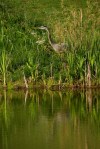
The blue heron stalks a fish, coming up onto the shore and then back down into the water.  It hangs out for awhile on the way, peeking at me from between blades of tall grass.  It amazes me how a giant, blue bird that resembles a pterodactyl can disappear amongst blades of grass.

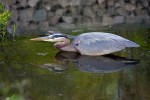
As he wades through the water, moving in slow motion, he crouches until he suddenly strikes and nabs a fish.  I missed the strike with this one, but, lucky me, I get to try a second time when another blue heron hunts on the other side of the wetland.

One thing I learned is that a shutter speed of 1/250 is not fast enough to stop the motion of a striking heron!

Unfortunately, he turns away from me to swallow the fish and I only get a view after the fish is deep in his gullet.  Both heron give themselves a big shake after a hunt–it reminds me somehow of Tisen marking a tree after having an encounter with another dog.

Sorry for the excessive number of pictures, but I love the succession of the second heron crouching lower and lower next to his reflection in the water until he strikes.  Just for fun, a movie version:

Winging It

On Saturday afternoon, I went to a Chattanooga Audubon Society fund raising event as a volunteer for S.O.A.R.  S.O.A.R. was there to do their 45 minute long educational program on birds of prey in support of the Audubon.

The challenge for John and Dale was that the program was in a large field outdoors, potentially tempting free flying birds to head for the trees.

The challenge for me was to see if I could get any good shots of the birds.  I am planning to make a screensaver to give away in exchange for donations at an upcoming event.  Unfortunately, I’ve never seen the program before, so I am completely winging it (yes, a pun).

I chose my new 70-200mm lens thinking because it’s faster, it will help me freeze more movement.  Given that it was a bright sunny day, I probably would have done better with my 100-400mm since I didn’t really need the speed.

I put my camera on a tripod and set it at its maximum height thinking I’d have a better angle catching the birds flaring before they land.  Unfortunately, I didn’t consider the need to separate the birds from the audience.  I would have been better off getting really low–well, not sure my knees would have been better off, but my pictures would have been.

I also needed to be as unobtrusive as possible so the birds didn’t get confused and fly to me.  No one wants a bird of prey to land on their unprotected flesh.  As a result, I tried to stay in one spot and not move around much.

In addition to being in a fixed position, up high, with too short a lens, all my subjects were in motion.  John and Dale are constantly moving.  When I am looking through my lens, I can only track one of them, but I need to know where the other one is to predict what direction the bird will fly.  Looking away to locate the destination person caused me to miss more than one good shot.

My lack of experience using the continuous focusing mode also did not help.  I had issues with losing focus. I’m not sure what I did wrong, but I’m going to have to do some more practice with continuous focusing mode.  It was depressing to see perfectly framed and timed shots that were totally out of focus.

In the end, I have some fun snap shots, but nothing to put in the screensaver.  I spent an insane amount of time trying to salvage one of the photos by blurring away the distracting background.  Unfortunately, the photo doesn’t look right now–see if you can tell which one I majorly doctored.

At least I learned a lot for the next time.  And, none of the birds flew away.

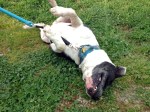
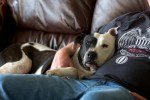
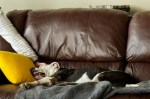
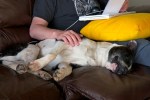
As for Tisen, he couldn’t come to the event with me–birds and dogs don’t mix well.  But, I included another shot from his nap with Red Dog.

Oops, I did it again

I’m not sure how it happened, although it’s possible 2-for-1 margarita night at Taco Mamacitos is related.  Somehow, the Canon EF 70-200mm f/2.8L IS II USM lens ended up at my door.  Having lusted after this lens since its release, the combination of that second margarita and the best price I’ve seen caused me to click a button I shouldn’t have clicked.

Having taken an online workshop by Zack Arias in which he repeatedly admonishes budding photographers not to spend money on equipment until getting to know the equipment we already have intimately, you would think I would have more self control.  Zack recommends shooting with a new lens for 6 months and only that lens until you can see the world through that lens and know exactly what you’re going to get (and not get).  He has a valid point that until you know every bit of capability you can eek out of a lens, you really don’t need to buy another one.  In my defense, it’s been more then 6 months since I added a lens to my bag.

Having spent the money, I decide I should apply the second half of Zack’s advice and get to know my new lens intimately.  Since it overlaps with my 100-400mm lens, I figure doing some comparison is a good idea.

Walking over to my favorite park, I head down to the ridge between the wetland and a creek.  Since I want to see how the extra light helps out, I shoot with a wide open aperture with both lenses.  The 100-400mm lens is a f/4.5-5.6, which is annoying since the maximum aperture changes as you zoom.  But, the extra 200-400mm is sure nice.

A bird I thought was an Eastern Phoebe poses for me for a bit–I am unsure of what kind of bird it actually is.  I snap a few shots with the new lens.  I switch lenses and take some comparison shots.  I switch back and get some shots of a Song Sparrow in the creek.  I switch lenses and try with the 100-400mm.  I switch back and shoot some more.  I catch a cardinal posed in the sun.  Then, on the way out of the park, I manage to spot an Eastern Bluebird who won’t quite step into the sun for me, but lets me get many shots with the new lens.

I shoot both lenses wide open and hand held.  I find that most of my shots with the 100-400mm missed the focus.  I’m not sure if I was waving around the lens too much when focusing or whata, but it’s hard to see direct comparisons because so many shots were so completely off.  The 70-200mm focused much faster in all cases, which might explain why I had an easier time focusing on my subject.

All in all, when I look at the images from the new lens, there is something about them I just like better.  Maybe it’s because I’m still trying to justify the purchase?

Portrait Anyone?

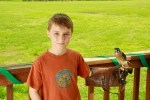
The S.O.A.R. event on St. Patrick’s Day went wonderfully.  Over 200 people came and I think the event exceeded their expectations.  Watching children hold birds was especially a treat–how many people get to hold a bird of prey on their arm before they’re even a ‘tween?

As far as my venture in trying to get people to donate in exchange for photos, well, it turned out to be quite the challenge.

I did a few things right:

  • I practiced with my new lighting as much as possible beforehand.
  • I worked out a workflow ahead of time.
  • I setup my camera to shoot in JPEGs since there would be no time for post processing.
  • I took all my equipment out to the site the night before and did lots of testing to pick a good location to set up.
  • I tested my 100mm f/2.8 lens in the space I had to work in and prepared to shoot with my 17-55mm f/2.8 lens based on the results.
  • I did a lot of test shooting with my strobes at home with the 17-55mm lens.
  • I brought Pat along so he could help solve some of my more difficult problems.

I also did a few things wrong:

  • I should not have tried to use recently purchased lighting equipment at an event given my lack of experience with artificial lighting in general–it created extra stress
  • I didn’t set a custom white balance, which I really needed because of no post processing.
  • I forgot my CF card reader, which blew away my workflow until Pat went to Wal-Mart.
  • My extension cord crossed a major traffic area; Pat and a roll of duct tape to the rescue!
  • I didn’t test the process for burning CDs beforehand.  Having not burned a CD in about 10 years, this wasn’t wise.  My workflow resulted in drive failures, ruining several CDs.  I found a work around, but it wasn’t easy.
  • Finally, and most humiliatingly, a weird shadow suddenly appeared in my photos and I couldn’t figure out why.  After rearranging lighting about 1000 times, Pat came along and asked, “Are you sure it’s not the thing on your lens?”  Apparently, I bumped my lens hood and the wide part was in the wrong position, causing the shadow in the frame.  I can only explain the failure to recognize the problem immediately as a brain malfunction given this is something I’ve seen in the distant past.  Unfortunately, it’s one of those things that screams, “SHE DOESN’T KNOW WHAT SHE’S DOING!” to your potential customers.  <sigh>

While these mishaps didn’t negatively affect my fund raising in the end, they did negatively affect my confidence.

As you can see from the gallery, I did not exactly produce stellar images.  While the circumstances were challenging, I have to face the fact that I didn’t have the skills for the challenge–yet.  So many things to work on!

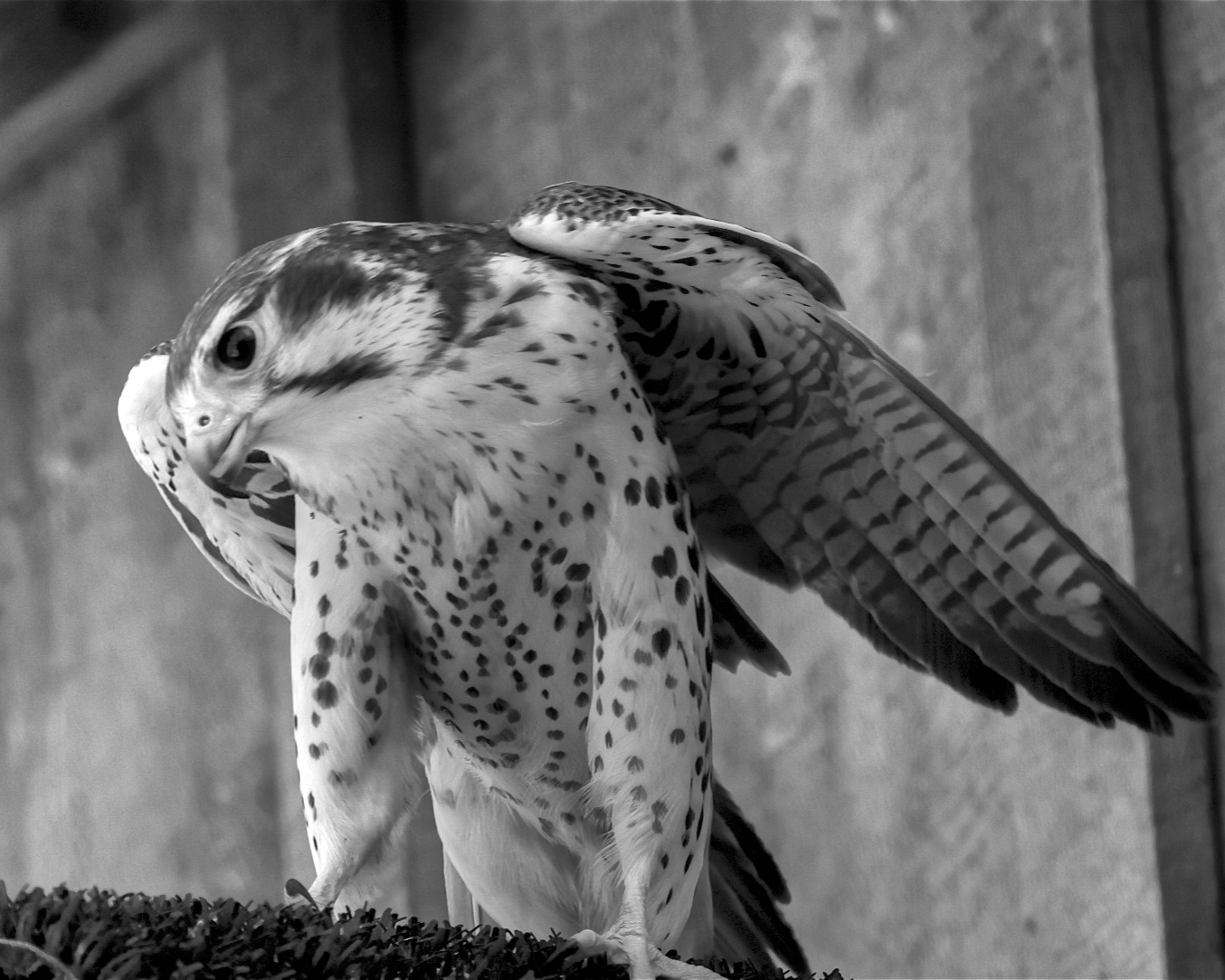
On the up side, my black and white Prairie Falcon portrait sold in the silent auction.

Anticipation

It’s early Saturday morning.  Today is a big day.  I am nervous.  Taking on getting the word out about the event with a $100 budget for printing materials was a new challenge.  It’s an interesting comparison to have a corporate event where you know exactly who your target audience is–all their emails are in your contacts list, you have a budget in the 10’s of thousands (it was a small users conference for about 150 customers back in the days when corporations still spent money on such things), and you plan your activities based on your known audience.

In comparison, this event is the opposite in every way.  You plan your activities based on what you can do, then you try to find people who might be interested in attending what you’re planning, and you spend as little as possible to try to find them.  Social networking was not really an option for me although the other planners were able to leverage their Facebook pages and email lists.  Since no one on my facebook friend list lives in the vicinity who isn’t already participating in the event, my social networking was pretty limited.

I reached out to every person I knew in Chattanooga (which was 3 people) to find ways to get publicity.  My trainer hooked me up with a newscaster and we did the early morning news spot that I posted previously.  I sent emails to several radio show hosts and newscasters I’d heard about through my second contact (a small business owner in the same building as Pat).  That resulted in one radio spot.  So, we got a little free publicity from that.  A connection through other organizers resulted in a second news spot yesterday at noon.  Maybe, just maybe, people will know about it.

Now the question is, will they come?  The skies in Chattanooga are overcast.  There is a steady rain falling.  The weather says it’s supposed to clear for a few hours in the afternoon and then turn into thunderstorms later in the day.  We have indoor areas, but will people come out to Wildwood, GA if the weather is bad?

I’m crossing my fingers that this work will result in a huge turn out and lots and lots of funds raised for S.O.A.R.

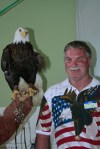
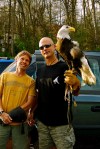
For today’s photography lesson, I look at my impromptu portraits in the parking lot with Osceola from last night.  I see that I have taken on a rather challenging photography assignment.  Getting enough field of view for both bird and person means either using a shorter focal length or getting further back, which may not be possible.  I used the shorter focal length last night and am not pleased with the results.  There is no bokeh effect (background blur) yet in some shots I don’t have enough depth of field for both the people and the eagle to be sharp.

The classes I’ve taken don’t happen to mention how to get great shots of people holding birds.  Maybe I can find a niche for myself yet!

Day Off

Today I took a much needed day off.  Well, mostly off.  We headed out to the training hills bright and early.  Since it’s been more than four days since I last cleared for the mountain launch, I have to return to the training hills to reclear before I can head up for my elusive first mountain launch.

Unfortunately, there is enough fog to mess up the reclearing process.  Part of what we’re expected to demonstrate is our ability to hit a target.  In the heavy fog of the early morning, there aren’t any targets visible.  We spend a lot of time waiting.  First on the fog and then on the tailwind.  Eventually, I reclear, but when we arrive at the mountain launch, the wind is crossing it’s way over the launch pad.  I can’t launch in a crosswind until I have more experience.

So, we return home once more, me still safely in one piece, but with no mountain flight under my belt.  After doing a little work, I return to the flight park.  Not to fly but to help setup for the fund-raising event I’ve been helping plan for S.O.A.R.

If you happen to be anywhere near Lookout Mountain Flight Park tomorrow, the festivities start at 1PM with kids activities, a silent auction, artists booths, photo opportunities, and interactions with owls, hawks, and Osceola, the hang gliding bald eagle.  At 4PM, the birds from S.O.A.R. will educate and amaze us, doing things like fling over the audience’s heads.  At 6PM, there will be a dinner and beer with a live band.

It will be a spectacular event, especially with hang gliders taking off and landing in the background.  Guests can even purchase a ride in a tandem glider while they’re there.  I’m pretty sure this is the way St. Patrick’s Day was traditionally celebrated in Ireland, right?  Birds of Prey and Hang Gliders–isn’t Ireland known for that?

In any case, we’re hoping to raise lots of money to help rebuild many of the bird enclosures that are in need of improvement.

While we’re setting up for our big event, John arrives with Osceola.  He pulls him out of his kennel and we all take turns holding him.  Unfortunately, I didn’t have time to process the photos from today yet.

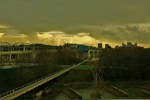
Instead, for today’s photos, I have a collection of shots from last night in the early evening.  I had the classic problem of an exciting but bright sky and dark foreground.  I did a lot of shots at different exposures, hoping to be able to HDR process them together into a correctly exposed whole.  I consider using my gradient neutral density filter, but it’s round and doesn’t line up with the horizon line properly.  I probably should have tried it anyway.

I’m disappointed with the HDR results.  In the end, I like the underexposed shots with minimal processing that show the most detail in the sky the best.  Call me old fashioned.

Apple Blossoms

A bag of trash sits tied and waiting to be carried out to the dumpster.  I grab it and Tisen and we head out, back towards the dumpster.

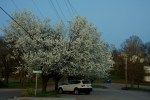
This takes me into view of the street behind our parking lot lined by trees.  The trees look odd.  For a moment, I can’t process what’s so wrong about them.  Then, I realize they are covered in frost.  But that doesn’t seem right.  I look again.  It’s not frost, it’s blossoms.  I look away and look back again to make sure I didn’t imagine it.  No, they really are in full bloom.

I’m pretty sure they didn’t look like that yesterday.

We head towards to the park and I realize the trees that line our lot are not far behind, partially blooming as well.  I notice the shapes of dozens of mourning doves roosting as I look.  The birds are unperturbed by our presence, but then it takes a lot to roust a roosting mourning dove.

As we make our way through the park, I hear the brown thrasher I’ve been seeing lately.  A small group of yellow-rumped warblers flit by, landing on the ground in front of us before scattering into shrubs.  As I look for the warblers, a large flicker flashes his big white rump as he crosses the path.  Colorful rumps is the bird theme this morning.

Tisen does not appreciate the birds.  Although he is occasionally entertained when they land close, tantalizing enough for him to take a run at them.  I keep telling him he doesn’t chase birds; he keeps assuring me he does.

I notice the fruit trees in the park are also blooming.  It seems a month early to me, but who knows when the trees normally bloom down here.  I hope they aren’t too far off from their normal timing.

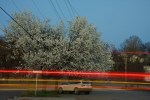
It’s a long work day, but since the sun is setting later, I manage to carry my tripod and camera down to the intersection near the blooming apple trees before the last light disappears.  I set up and shoot across Market St.  This makes for some interesting photos as traffic whizzes through my frame during long exposures.

I decide to get a shot of the hill beside the trees.  Getting a decent angle requires setting up in the middle of the crossroad.  Since there isn’t a lot of traffic on this road, I go for it.  I set up and, of course, several cars come my way almost immediately.  One lady stops to ask if I’m shooting the apple trees and remarks on how pretty they are.  A man glares at me, clearly thinking I’m crazy.

I suppose it’s a little crazy to set up expensive gear in the middle of a road when it’s getting dark and I don’t have so much as a reflective jacket.  I shoot quickly and get out of the road.  I carry my tripod home feeling like I’ve just completed some rite of passage for a photographer.