Tiger Key and the Manatee

The tiny keys that dot the Gulf Coast of the Everglades are countless.  But the ones that are big enough to land a canoe on and pitch a tent have names.  They are supposedly named after the shape of the key when viewed from the air, but I suspect Tiger Key was actually named in honor of the ferocity of the insects there.

Fortunately for us, when we climbed cautiously out of our tent on Boxing Day, the wind had kicked up and we were spared the brutal attack of the night before.  It was an enormous relief not to do battle again first thing in the morning.

It was time to return to the mainland.  We were somewhat concerned that we would not be able to find our way back having gotten so lost on our way out.  Fortunately, we were traveling via major channels most of the day.  While this made navigation easier, it greatly reduced the wildlife we saw.

By the time we were in the main channel, we got into a rhythm like we’d been paddling a canoe every day of our lives.  We laughed at a couple heading out.  They were struggling to go downstream because they were paddling against each other–the wife was literally paddling backwards.  We felt like canoe paddling champions as we dug into the water and pulled our canoe against the current.

Then, we got to the final stretch.  We could see our destination.   It was a short distance compared to the many miles we’d paddled over the last three days.  But the current was so strong that it pushed us sideways across the channel.

We spotted a small island along the way where we could land and catch our breath.  We made it to the closest end of the island.  After resting for a few minutes and saying a few choice words, we pushed off for what we thought would be our final launch.

We paddled for all we were worth, but the current pushed us back to the far end of the island we’d just left.  We’d have spent less energy walking the canoe along the shore.  Neither of us felt much like a champion paddler anymore.

We took a longer rest.  We ate a snack.  We got out of the canoe.  We stretched.  Then, we rallied and drove that canoe right across the current until we suddenly found ourselves in calm waters and could relax for the final 50 yards of our trip.

As we slowed down, a large, dark mass rose towards the surface of the water.  Pat yelled, “Manatee!”  We were so excited we nearly capsized the canoe after 3 days of remaining afloat.

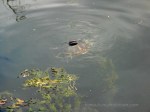
As we glided closer to the slowly moving mass, we felt ourselves blush as we realized it was a mass of algae.  No manatees in sight.

Despite the disappointment, we really felt like we’d done something when we beached the canoe for the final time.  It was the best Christmas ever.

Jumping the Moat

Continued from Lost and Found.

Christmas morning we woke up early and laid there in the dark, realizing we could no longer hear the Gulf slapping the banks of our tiny island.  Even when we held our breath, we couldn’t hear the waves.

When at last dawn lightened the sky, we decided to get up and get an early start in our canoe.  We had about 8 miles of paddling in store for us and we were already sore from paddling yesterday.

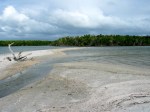
When we stepped out of the tent, we discovered our tiny island had become a giant island at low tide.  Actually, it was still a tiny island, but now it was surrounded by a giant moat.  The Gulf was suddenly so far away, it was almost unbelievable last night we were worried our canoe would get washed away by high tide.

We ate breakfast slowly.  We walked around the island and watched the sunrise.  We packed up our campsite.  We loaded up the canoe.  All the while, the water was slowly rising, coming closer, but it still looked hopelessly far away.

Having nothing left to do, we sat and waited.  But then, the wind died and we were sitting ducks for biting insects.  We were suddenly motivated to find a way across the moat, dragon or not.

We slid our canoe along the murky shore while we walked as far as we could on dry land.  We found that the opposite end of the island was closer to deep water than our end, so we edged our way through thick mangroves until we finally stepped into the muck and pushed our canoe and gear through the shallows until there was enough water that we could get in and paddle away.  We were itchy with drying muck as we paddled off into the sun.

We hadn’t been out too long when we saw a strange line of evenly spaced white dots stretched across the horizon.  As the dots got larger, we realized it was a large group of American White Pelicans flying in precise formation, sweeping the surface in search of prey.  They flew to a shoal where a huge conglomeration of pelicans gathered.  That might have been the best Christmas present ever.

When we stopped for lunch somewhere between Rabbit Key and Tiger Key, we discovered a family of Osprey.  The young were nearly the size of their parents and angrily demanded to be fed while their parents seemed to argue that it was time for them to leave their nest.

We arrived at Tiger Key without any navigational hiccups.  But the wind soon died and we discovered “no-see-ums.”  I tried a trick someone told us–smearing baby oil on my exposed skin.  I ended up looking like human fly paper and they still bit me–my skin looked like a basketball.

Thankfully, we managed to keep the bugs out of the tent and fell asleep with smiles on our faces, dreaming of Osprey and Pelicans.

Lost and Found

The first day of our canoeing adventure along the Gulf Coast in the Everglades, I discovered a key difference between canoeing in the Everglades and canoeing down a river.  There’s only one way to get lost when you canoe downstream on a small river:  failure to stop at the pick up point.

Canoeing in the Everglades was a completely different story.  We had a permit to camp on a particular Key each night of our trip.  Our first day, we were supposed to paddle about 7 miles to Rabbit Key.  Unfortunately, we started out heading down the wrong channel through the mangroves.  As we paddled around trying to identify openings between tiny mangrove islands that matched shapes on our map, I realized how little a map drawn from an aerial perspective reflects what land looks like from the water.

As the navigator, I eventually gave up on the map all together, picked a channel that pointed generally Southwest, and took us through the maze of mangroves until we hit the Gulf.  Assuming we were West of our destination, we paddled East.

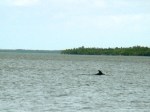
Paddling along the Gulf Coast through swells of salt water in a canoe identical to the canoes we’d paddled as children was a completely surreal experience in and of itself.  Then, we spotted a dolphin about 50 yards from our canoe.  It was a joyful sort of strange.

After having paddled long and hard in the Gulf (which is not at all like paddling down a river) we decided to break for food and try to locate ourselves on the map.  We figured we might just stay where we were.  We were rapidly running out of daylight and we really wanted to have our campsite setup before dark.

We took a walk around the island we’d stopped on, trying to get a sense of what it might look like on our map.  Fortunately, we stumbled across a sign that identified the Key we had landed on.  It was Rabbit Key, the key we were supposed to spend the night on.  While this was mostly pure luck, Pat was still impressed by my sense of direction (too bad it doesn’t seem to work in the Chattanooga area).

Taking some advice someone had given us, we found a suitable spot to pitch our tent where there was plenty of wind.  Then, we pulled our canoe well up out of the water so it wouldn’t float away at high tide.  We ate quickly and went to bed, exhausted.

In the middle of the night, I woke up and went out to heed the call of nature.  When I looked up at the night sky, I’d never felt so close to the stars.  I’ve been to the top of Maunakea, which is supposed to be one of the best places in the world to see the stars, but here at sea level on a tiny key in the Everglades, it seemed like the stars were within arms reach.  It was astonishing.

See Ya Later

Nearly a week into our 2008 Christmas road trip, we made it to Everglades City, Florida.  We were looking forward to 3 days of canoeing and camping along the Gulf Coast.  But, the day we arrived, we decided just to enjoy the surroundings and spend the night comfortably in a local bed and breakfast (who also happened to rent canoes).

Before we could really enjoy ourselves, we decided to head to the local grocery store and stock up on supplies for our camping trip.  This did not take long because the local grocery store was about the size of a large convenience store at a gas station.  There was very little selection and only one brand of anything they carried.  This had the advantage of making decisions very easy.  Do you want bottled water?  1 liter or 2 gallons?  Do you want beef jerky?  Oh, they’re buy 3 get one free.  Do you want granola bars?  1 box or 2?  I love easy decisions!

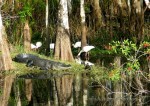
On the way back to the hotel, we discovered a roadside park with a lovely swamp occupied by so much wildlife, at first I thought it was a zoo.  I couldn’t get over the birds.  If all birds were that big, birding would be so much easier!

The Cormorants stood around drying their wings.  The Little Blue Heron posed while stalking fish.  And the Anhinga, well, they were the most amazing of all.  I saw a stick poking up through the surface of the water and suddenly realized it wasn’t a stick at all!  It was the beak of an Anhinga who was walking along the bottom of the pond with its beak sticking up through the surface like a breathing tube.  I don’t know if it was really breathing, but I was blown away by the scuba diving bird!

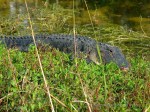
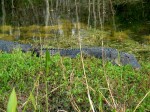
If the birds weren’t enough, the alligators added a whole new level of excitement.  While you can’t tell from the photos, there was a fence between the closest alligators and us.  Although, it was a fence they could have run around to get to us.  I’ve heard alligators are pretty fast, but Pat kept an eye on the gators to make sure none were sneaking up behind me when I was looking at his brother.  You have to respect any animal that has been around for as many millennium as the alligator.  They reek of ancientness.

Amazed, loaded with images, and stocked with food for our trip, we decided to try a local restaurant that was recommended to us by the bed and breakfast.  It was one of those hyper casual places that served on picnic tables with paper plates.  But I had the best salad I’ve ever had in my life there–the greens, herbs, and flowers (yes flowers) were all grown in the restaurant’s own garden.  Just writing about it makes me want to return just to have another one of those salads.

It was a great way to prepare for our canoeing adventure.

Swamp or Park?

When I planned our route and where we would stop on our way to the Everglades and Key West back in 2008, I picked some places on the map I had never been to, including Congaree National Park.  When I googled it, I discovered that it had, until recently, been called Congaree National Swamp.  I guess I can understand why someone might think Congaree National Park was a better name.  After all, how many people think pleasant thoughts when they think of a swamp?

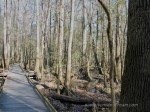
It only made me more curious to see it, however.  As we started down the very fancy boardwalk that kept less enthusiastic hikers’ feet dry, we spotted several woodpeckers and a couple of warblers in about 5 minutes.

We continued well beyond the boardwalk and onto the trails for those with waterproof boots.  As we walked, a Barred Owl called over and over, completely oblivious to the fact it was 2 o’clock in the afternoon.  We heard a Pileated Woodpecker and saw it fly.  We followed it as long as the trail allowed, but I never did get a shot of it.  Of course, still toting my Powershot G3 that trip, I’m not sure how much of a shot I would have gotten anyway.

We continued along to a beautiful stream with giant swamp trees growing along the banks.  I assume they were Cyprus–the number of knees that threatened impalement to anyone who dared to trip was overwhelming.  I expected to see a few knees popping up here and there–the fact that acres of swamp were nothing but knees was quite a surprise to me.

But the biggest surprise was when we heard some rustling in the underbrush as we approached a darkly shadowed part of the woods.  We paused and looked at each other, unsure of what we were hearing.  Then, suddenly, several boar jumped up from their cover and went squealing off through the woods.

While I generally seem to lack the appropriate level of fear of wild animals, I have to admit that I definitely jumped when those pigs ran off through the woods.  Although I was disappointed I didn’t get a picture, I preferred missing the shot over having them run towards me.

At the time, I didn’t know that wild board were supposedly introduced here in the 16th century for hunting.  Who knew that the boar would go nuts and start taking over?  The amount of damage they can do is pretty frightening.  I don’t mean just to humans (although that’s frightening too) but to land, farms, and ecosystems in general.

I was a lot less excited about our wild boar encounter when I learned just how common they had become in the region and what a problem they are.  Much more recently, I discovered there’s a reality TV show about boar hunters.  Like most of the reality TV shows I’ve heard about, that just seems wrong.

In spite of the boar, I highly recommend hiking in the Congaree.

Almost Shenandoah

In 2008, I took my trusty PowerShot G3 for it’s final trip.  While I would have preferred my Canon 40D by then, since our plan included canoeing/camping in the Everglades, I was content to take a camera I wasn’t worried about ruining.

On our way to the Everglades and Key West, we stopped in Shenandoah.  It was on a list of places to see before you die, so we thought we’d check it out.  On our way through Virginia, we entered the North end of the park and managed to get in a short hike in thick fog before heading on toward lower elevations.  The fog was forming hoarfrost on the trees as we exited the trail.  We crept along the main road through the park, barely able to see a young buck walking along the road.

We made it safely to our hotel, where it was completely clear and much warmer.  The next morning, we learned the entire park was closed due to ice, but we were told to call back in a few hours–things might improve.

We decided to go for a cave tour nearby to kill the morning.  Luray Caverns was interesting. Although, because it’s privately owned, it’s treated commercially instead of for preservation purposes.  This means there were formations we could touch, lots of colored lights, a wishing well, and an organ that played a song by triggering mallets that hit various formations.  The cave was pretty astounding none-the-less.  I just hope it survives being shown off long enough for many to enjoy.

Returning to daylight, the valley was sunny and relatively warm for late December.  We decided we needed to get on the road whether we were able to hike in Shenandoah or not, so we drove on up to the park.
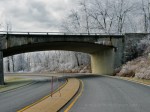
As we continued upward in elevation, the skies got cloudier and more and more of the scenery was blanketed in white.  As it turned out, all of the trees and roads were still frozen in a coat of ice.  It was beautiful to see, but the entrance to the park was closed.

Instead of hanging out for an extra day to see if things improved, we decided to take the Blue Ridge Parkway South and enjoy the scenery as we drove.

This turned out to be a surprisingly good decision considering the weather.  The further South we went, the sunnier the skies and we encountered no ice at all.  I guess the Parkway South of the park is a little lower in elevation.
We not only got to enjoy beautiful views of the valley below, but we were treated to spotting a couple of mountain goats tussling at the side of the road.  They were so entangled with one another, they looked like a two-headed goat.

We were sorry to leave the parkway behind, but we did make it to Congaree National Park early enough to take a long hike there and work the kinks out.

Fearless and Foolish

When I returned to Yosemite with my husband in 2004, after spending a night up on Clouds Rest, we hiked over to Sunrise Lakes and spent a night there.

Sunrise Lakes consists of three lakes that are at different elevations on the mountain.  We hiked our way up to the top lake, eventually coming to an area that was a popular place to camp.  As we passed a group’s campsite, a young woman stepped out of a tent.  She told us her friends went on a day hike and she decided to stay behind and read.  After chatting for a bit, we continued on, hiking over a ridge and finding a spot to set up our own, much smaller camp.

After getting our site setup, we were about to take a dip in the lake when the girl from next door appeared.

“Uh. . . can I hang out with you guys for a little bit?” she asked.

As it turned out, there was a black bear in her campsite.  I insisted we go back and chase it away or it would never leave them alone.

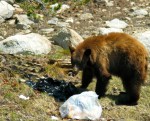
So, we returned to her site to discover a relatively small black bear (who was actually brown) had found a bag of trash that had been left in an open bear canister.
I have to take a moment to get on a soap box here.  We had never backpacked in a park where you had to use bear canisters before.  But, when we got our permit, the ranger explained to us why we needed them and how to use them.  We followed the instructions carefully.  They were simple:

  1. Anything that has a scent must go into the bear canister.
  2. Your kitchen area must be at least 50 feet from your tent
  3. Any and all leftover food, pot scrapings, wrappers, trash, etc have scent; refer to rule 1.
  4. The bear canister must be properly closed.
  5. A properly closed bear canister can be set on the ground in the kitchen area.

Although we found evidence the next morning that a bear had come through our campsite, as the rangers promised, when it discovered all the goodies were unobtainable in our canisters, it quietly moved along without even knocking over a canister.

But, back at our neighbors’ campsite, I should have been afraid of a roughly 400 pound bear with scary claws, but, he just seemed like a bigger version of our dog.  I experienced no fear.  I led the three of us as we shouted, clapped, and threw rocks.  Between throwing and clapping, I took as many photos as I could.  I can’t say I spent a lot of time on composition.

We chased the bear away, but, unfortunately, our neighbors didn’t learn their lesson.  A13 year old in the group left a container of Gatorade in her backpack and the bear harassed them all night long.

It makes me sad to think that bear may have eventually paid the ultimate price because people couldn’t follow simple instructions.

Gaslight

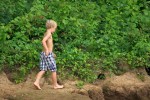
While we were on Maclellan Island, several of us got ahead of the rest of the group.  When we arrived at the meeting place to wait for our ride home, one of the women suddenly asked, “One of you doesn’t have a tow-headed boy on the island, do you?”

None of us did.  She explained that she had just seen a boy in a pair of plaid bermuda shorts on the path.

We all looked.  No boy.

A few seconds later, she said, “There he is!” We all turned to look.  No boy.

This repeated at least 3 times.  The boy was playing hide-and-seek.  The poor woman was sure we all thought she was crazy.

Eventually, we all saw him, but he immediately ran away.  We decided he was a wild boy.  Of course, I’m not sure how common it is for wild children to wear plaid bermuda shorts.

On the theme of unusual sightings, I continue to try to create photographic evidence of my white-tailed starling.  I have, over the course of the last few days, come to think of this bird as my own personal starling.

I have made a habit of taking my camera with a long lens every time I take Tisen to the park.  But having seen it 3 times when I couldn’t get a picture, I have yet to see it when I’ve had my camera at the ready.

I managed to get a few shots of other birds, including a cedar waxwing.  The cedar waxwing, like the wild boy, always plays hide-and-seek with me.  I feel fortunate to have gotten one in my frame at all even though it’s not a great image.

I also spot a very strange looking turtle.  I’ve seen one like it at the aquarium.  I guess I will have to go back to find out what it is.  It has a long neck and a pointed nose and a very long tail.  I couldn’t hold still enough without a tripod to get a good shot of it–it really is like some of the pictures of big foot you see!

This morning I slept in.  When I got up, poor Tisen had decided to let me sleep even though he couldn’t hold it anymore because of his medication.  We had quite a puddle.

I rushed outside with him feeling guilty that I was so late taking him out.  It was raining and Tisen really didn’t want to spend a lot of time in the rain, so he started heading on the short route we usually only take at night.  When we got to the parking lot, there, pecking at some trash from Krystal burger, was a group of starlings.  Sure enough, the white-tailed youth I’ve been hunting was among them!  And, as one might predict, I was there without even a cell phone.

Oh well.  At least I know it’s still hanging out in the neighborhood.

Secret Island

In the Tennessee River, between the Bluff View Art District and the North Shore, there is an island.  Most people call it Maclellan Island.  The owners call it Audubon Island.  Long ago, it was Chattanooga Island. Before that, it was Ross’s Landing Island.  Whatever you call it, it’s a tough place to get to.

It’s a place I’ve wanted to see since we first came to Chattanooga.  It’s inaccessibility made it that much more desirable of a destination.  I tried a group who does kayaking tours, a business that rents paddle boards, and a water taxi service to no avail.

But finally, the Chattanooga Audubon Society is offering a tour.  Today is the big day with the Chattanooga Duck Tours providing transport.

Captain Alex takes us through downtown Chattanooga, educating us on the history of the buildings.  We had no idea that so many of them had been around since the 1800’s.  Then, we take a running dive into the river in our 1940’s DUKW vehicle, built by Rosie Riveters during WWII.  She still holds water.

We make it to McClellan Island safe and sound–and knowing a lot more about the riverfront development effort, too.

The island has 1.5 miles of trails that have been freshly groomed, but there is already poison ivy reappearing all over the trail.  Now, poison ivy is a native plant that’s good for birds and I have nothing against poison ivy.  I just don’t want to come in contact with it.  We step gingerly to avoid coming in contact, although it’s pretty much impossible.

A great-crested fly catcher sings a greeting for us, although we only catch an occasional glimpse of him flying from one tree top to the next.  We also hear a wood thrush, an Eastern towhee, and many other common birds.

Sadly, it’s hard to see anything through the dense privet, honey suckle, and vinca taking over the woods.  It makes me sad to see how devastated this tiny island is by plants that have invaded here.  Poison ivy is by far the most prolific native growing on the island, but even it is out-competed by the invasives.

The first wild-growing oak-leaf hydrangea in this county was discovered here on this tiny island just days before.  It represents a glimmer of hope that the ecosystem of this tiny green space can still be saved.  The clusters of white flowers shine through the shadows and remind us how beautiful nature, on its own, can be.

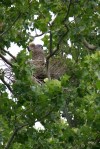
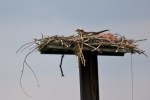
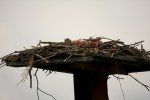
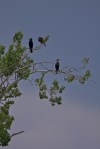
Back on the duck, we get the best view possible through fully leafed-out trees of a heron rookery.  There is also an Osprey on its nest on a platform at the end of the island.  As we come around the far side of the island, a group of double-crested cormorants perch in the trees.

I only wish we could spend more time sitting (far from poison ivy) and listening for all the birds that call this tiny sanctuary home.

The High Desert

Going back in time again to a previous trip to Oregon, I’ve pulled together a few photos from the High Desert Museum in Bend near Lava Lands National Park.

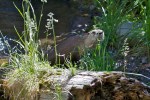
A recurring theme is the number of golden mantle ground squirrels that posed for me.  I noticed a marked improvement in the poses at the museum over the ones at the park.  I suspect the ground squirrels at the museum are professionals.

Besides the ground squirrels who scurry along the many paths, they also have native creatures on display.  Since shooting captive wildlife is far easier than sitting around waiting for it in the wild, I took full advantage of the opportunity.

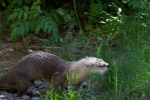
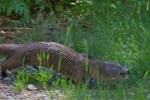
Given that it was mid-afternoon, many of the animals were content to lie in the sun and let me shoot.  However, the river otter was not so cooperative.  I can only recall having been to a facility with river otters who were actually visible and active once in my life–it was nearby at the Seattle aquarium.  There must be something about the Pacific Northwest that makes otters more active.  I guess that makes sense since the people of the Pacific Northwest tend to be more active, too.

In any case, first I tried getting shots of the river otter through a glass wall on one side of the “pond” he was swimming in.  I thought it would be really cool to have underwater shots.  With little light, I was stuck with a slow shutter speed, so none of the underwater shots are worth looking at.  Just dark, blurred shapes moving through water.

Next, I headed outside hoping for better light to shoot in.  I did get more light, but it wasn’t exactly better light considering the time of day.  It was enough that I was able to shoot at 1/160th of a second, though.  That allowed me to stop at least some motion.  My favorite pictures of the otter are the two that show him shaking off.  The first one is the start of the shake with only his head in motion.  The second one is slightly later.  The shake has propagated down to his neck.  If I would have taken a bunch of shots, you could have seen how the shake moves from the head all the way down the length of the otter’s body.  It’s pretty amusing to watch.

Another critter that posed for me was the porcupine (hedge hog) who was part of the animal show we caught the tail end of (pun!).  He didn’t pose just for me–there was a big crowd in the amphitheater, but the porcupine remained amazingly focused on the bottle his handler was feeding him.

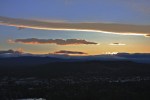
At the end of our day, Pat and I went to Pilot Butte State Park to enjoy the sunset.  It’s basically a giant hill in the middle of an otherwise flat town.  At the top, we were treated to spectacular views of the mountains, the clouds, and the setting sun.