Biking, Birding, and Bystanding

Biking and birding reminded me of several life lessons I have learned, forgotten, and learned again.  First, speed causes us to miss details.

I think back to the native prairie by the bike path back in Columbus, Ohio.  I used to ride by wondering why I didn’t see more birds.  When I went by on roller blades, I saw more birds, but was surprised I didn’t see any hummingbirds.  When I walked by, I saw hummingbirds but was surprised there weren’t any bees.  When I stood completely still, it was like a magical veil was lifted and suddenly I saw an amazingly dense array of life, buzzing and hovering and dipping among the flowers.  I am frequently reminded that sometimes, to really see the abundance of life, you have to sit still.

The second lesson was:  it probably isn’t a good idea to point out birds–even really big ones–to a bunch of people on bicycles.

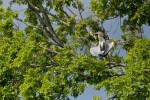
When we all pulled well off to the side of the path to stop and look, everyone was able to see the differences between a Turkey Vulture and Black Vulture, and many got to see an Osprey soaring overhead with no injuries.

As I watched these birds of prey, I had to wonder if they experienced the same kind of joy in catching a thermal and soaring on the wind as I was experiencing pedaling my bike through the early autumn breeze.  Some may think that birds just do what they do for the purpose of finding food, but I have to believe there is a joy that comes from doing what you were born to do that even birds experience, particularly on a beautiful day.  I find it impossible to watch the grace of soaring raptors without being moved.

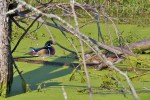
As we made our way up the Riverwalk to the Curtain Pole Road swamp area, I learned the third lesson of the day.  Sometimes, it’s not the birds that are the most interesting part of a bird walk.  One of the other participants spotted turtles and frogs.  Although the wood ducks were still my favorite (see photos from yesterday’s post), the turtles and frogs were pretty darn fascinating.  By the way, one attendee pointed out that in the last Wood Duck photo in yesterday’s post, there is a camouflaged turtle right in front of the Wood Duck.  I totally missed that!

The final lesson for the day was that we all have different levels of excitement about the same birds.  I was so excited to stand and watch the Belted Kingfishers at Amnicola Marsh.  I could have stood there all day with them swooping across the marsh, chattering away.  In the meantime, most everyone else was looking for something more interesting.

Regardless, I think we all enjoyed the outing. For me, it doesn’t get any better.  A beautiful day, a bike, a new group of interesting people to meet, some really cool birds, and my camera.  What more could anyone ask for?
Bike and Then Bird

I have been riding the Tennessee Riverwalk twice a week for a few months now.  It’s one of those places that makes me happy.  It’s just a beautiful way to wake up.  Riding along the river on the mostly quiet trail, exchanging smiles with the dozen or so pedestrians who also haunt the riverwalk just after dawn–there just isn’t a better way to start the day.

I have also been leading bird walks a couple times a month.  And, I went on a biking tour of the Chickamauga and Chattanooga National Military Park last year, which was organized by Outdoor Chattanooga.

Thus, it was only natural that, as I rode past great birding spots along the riverwalk, I would think “I should organize a bike and bird!”

Allow me to clarify for safety reasons:  I am not advocating birding while riding a bike.  That would be dangerous.  However, a bird walk is a usually a slow meander through a relatively small area with a good bird population and does not afford the opportunity to cover much distance without driving.  It seems counter-intuitive to me that we would increase the amount we drive in order to pursue an activity motivated by the desire to learn about and appreciate creatures quite dependent on an unpolluted environment.

To give credit where credit is due, a friend of mine back in Columbus, OH previously organized “eco bird walks” where all participants agreed to walk, bike, or take public transportation to the starting point and they walked from there.

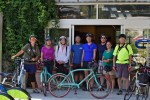
So, I my idea was not exactly unique.  Regardless, I get a special pleasure out of combining activities.  I formed a plan:  Outdoor Chattanooga organizes bike tours all the time.  Why not ask them to do a bike and bird?  They have a fleet of bicycles so even people without bikes could join.  I would invite the Chattanooga chapter of TOS and the Audubon Society and we could have a lovely morning of riding and birding.  Or, to be more accurate, riding, stopping, and then birding.

And so it was.  It took a few emails and phone calls, but that was it.  Outdoor Chattanooga did the rest–and what a great group of people they are!

Finally, the Saturday selected was upon us.  I’m not sure which of the folks at Outdoor Chattanooga was in charge of arranging the weather, but they did a fabulous job.  I suppose if it would have been a little less breezy, we might have had an easier time spotting small birds among the trees, but the clear blue sky with little humidity and the cool breeze kept me smiling the entire ride.

We saw quite a few good birds, although not quite the bonanza I was hoping for.  As I told our guide from Outdoor Chattanooga, it was such a beautiful day that I would have enjoyed it even if we hadn’t seen a single bird.

Renaissance Rodents

Across the street, Renaissance Park beckons.  It calls to me with its manmade hills hiding secrets left behind by the manufacturers who occupied this park long ago.  And before that, the civil war soldiers who crossed the Tennessee here at Ross’ Landing.  And even before that, the Cherokee on their tragic walk on the Trail of Tears.

I don’t know what all was encapsulated in the mounds of Renaissance Park, but Renaissance is a good name for it.  Reborn from the pit of industrial waste it had become, it’s now a haven for birds, butterflies, the occasional deer, perhaps a fox family, and for sure coyote.

The thing is, you don’t get predators if you don’t have prey.  Fortunately, prey doesn’t care if the hills are manmade or if the wetland was created by a backhoe, or that the plants were carefully inserted into the earth by the hands of a human being.

The fact that the western hill in Renaissance is covered in native grasses and flowers means it’s a living feeder.  It feeds the American Goldfinches who love to cling to the stems of flowers that have gone to seed while they munch away.  And, underneath the foliage, it also feeds a more mysterious colony of life.

This colony becomes massive in the fall when the young have matured enough to rustle amongst the long grass on their own.  They scamper and disappear quickly enough that all I’d been able to determine is that they were rodents.  I’ve been afraid to consider the possibility that they’re rats.  Not because I’m afraid of rats but because I fear the reaction of the public to the notion of a large population of rats nesting in the park.

To me, this just makes the hillside a better feeder–it provides food for more than one link in the food chain.  But, for many, the word “rat” causes a different reaction.

When Tisen and I walked into the park a few evenings ago, these mystery creatures were showing themselves.  In fact, one sat on top of a clump of grass staring at me.  I was so caught off guard, having tried to see what they looked like for so long without success, that I barely had time to process what it looked like before it took a closer look at Tisen and decided to duck back under cover.  It looked a lot like a small brown rat.  I decided I’d better bring my camera over the next evening.

Back we went, me armed with my 70-200mm lens.  As Tisen’s tags jingled, the little critters scampered around, not holding still long enough for me to get a look, let alone a shot.  But, finally, I spotted one sitting still.  I am happy and relieved to report that it is not a rat; it’s a Meadow Vole (I think).  After all, no one ever got up in arms about exterminating a bunch of cute little voles, did they?  My favorite hawk feeder is safe.

Birding with Enthusiasm

Tuesday night, I set up the coffee maker and set the timer so it would start brewing at 5:15AM.  I put out the clothes I would wear for rowing.  Everything I needed was ready to go so that when the alarm went off at 5:30AM and I was stumbling around disoriented and wondering why in god’s name I continue to get up at 5:30AM, I wouldn’t have to think.

Wednesday morning, hot coffee in hand, I looked at my schedule for the day and there, low and behold, was a bird walk on my calendar for 7:00AM.  As in a bird walk I was leading!

Startled by my oversight in planning, I shifted gears, pulling together my bird walk backpack and gathering binoculars and my camera.  I pulled up the flashlight app on my iPhone and went searching in the darkness for a different outfit.

I admit I was feeling slightly resentful about giving up my rowing time as I imagined sitting alone in the park waiting for others who never show up.

At 6:50AM, it wasn’t even the crack of dawn yet.  I sat in darkness until I was surprised by a silhouette that turned out to be the Audubon property manager.  Next, a father with 4 enthusiastic children arrived.  Then, a regular from the condos arrived.  I stopped feeling bad about missing rowing.

I started my lesson about birding during fall migration.  I talked slowly and told more stories, hoping the sun would rise.  Every time a shadow went by, one of the children would turn, point, and shout, “What was that bird?”  I need to find out what kind of coffee they drink in the morning!

The amazing thing was how much the kids knew about birds.  They knew which birds were locals and which birds would not be found in Tennessee (even during migration).  The girl immediately recognized a Brown Thrasher she had barely seen for a split second.  Her older brother told me all about the birds he sees at his feeder at home.  Their father told me the interest in birds was the kids passion.  I thought that was pretty cool–also an advantage of home schooling.

I didn’t do so well on photography that morning.  First there wasn’t enough light.  Then I was just a bit flustered by all the questions and exclamations (LOOK!!!  THERE’S A CARDINAL!!!  LOOK!!! THERE’S A TURTLE!!!  LOOK THERE’S A BLUE HERON!!!  LOOK!!! THERE’S A SQUIRREL!!!).

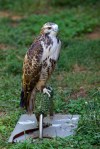
As much fun as it is to be surrounded by little people who think everything is fascinating, it does make it a little more challenging to take a moment to shoot.  I’ve filled in the photos a bit with some leftovers from the previous walk and one shot of Cody, an unreleasable Red-tailed Hawk who has appeared in this blog several times as part of the S.O.A.R. raptor program.  I saw Cody again over the weekend, but that’s another blog post.

Butterfly Business

I’m embarrassed to admit that I am capable of naming only one butterfly.  The monarch.  There are 125 butterflies found in Tennessee, according to a local chapter of butterfly enthusiasts.  I have heard of exactly 1 of them.  Yes, it’s still the Monarch.

These are the kinds of things that make me wonder what I’ve been doing all my life.  I mean really, as someone who spends as much time outdoors as I do and who particularly enjoys wildlife, how did I make it this far without realizing there were so many kinds of butterflies right outside my door?

I am trying to stick to working on birding rather than shifting over to butterflies now.  I’m a bit jealous because it seems like many of my new birding acquaintances are as good at identifying butterflies as they are at identifying birds.  I’m still working at getting good at identifying birds.  It’s been a couple decades in the making, so if I start in on butterflies, too, I will never be good at either of them.

Failing identification, I figure I can at least capture the butterflies permanently as an image.  So, I sneak up on a tiny little yellow butterfly flitting in the grass.  Apparently I am not so good at sneaking.  It flies away with a particularly aggressive flap, which I take as an expression of its disgruntlement over having its meal interrupted.

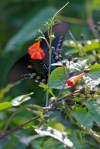
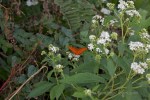
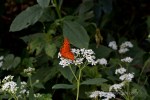
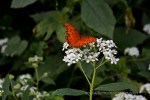
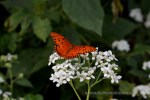
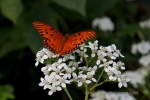
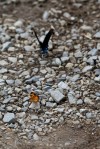
The next butterfly I chase is a red and black one.  It lands on a plant briefly, right next to a grasshopper and then immediately flies away again.  This is a great survival strategy as I am, of course, now interested in shooting the grasshopper instead of trying to chase the butterfly into tall weeds.  The grasshopper, however, is no more cooperative, just more of a tease.  It stays still just long enough for me to get it in focus and then hops just far enough away to require me to refocus.  We play this game for several minutes before Tisen gets impatient and insists we go on our way.

(Photographers note:  Do I get bonus points for not only hand-holding macro shots, but doing it while holding my dog’s leash?  I just can’t help multi-tasking.)

Next, we encounter a larger black and red type butterfly who seems content to be photographed.  I take no chances, shooting from far back, taking a step closer, refocusing, shooting again.  I work my way closer and closer until I get almost the shot I wanted.  Then, when I am so close to getting exactly what I was hoping for, my new model decides it has had enough and abandons its post.

I have similar luck with some kind of skipper (did you know there was such a thing as a skipper?) on a dark purple flower.  I’m fascinated by it’s big, fake eyes.  It doesn’t fly far, but it won’t hold still.

Once again, Tisen gets impatient with me and we head back towards home.

The iPhone is Not Enough

On Labor Day, I was hiking my way back from an overnight in the backcountry.  The next morning, I was up at 5:30AM so I could get on a plane to Orlando for a work conference at Disney World.

Because our conference hotels overflowed, I was moved to The Animal Kingdom Lodge.  Having not been inside the Disney World gates since I was 9, I didn’t know that there would be an actual animal kingdom outside my window.

Had I known, I might have figured out a way to pack my camera.

Having reduced our worldly possessions by about 80% over the course of many years and moved into a small apartment with ridiculously limited storage space, one of my greatest challenges has been not to keep acquiring more stuff that won’t fit anywhere.

I make this point because I am starting to think about getting a small, point-and-shoot camera.  Something that will do a better job than my iPhone camera.  And something I can carry backpacking without getting an ache in my neck.

Now, some might argue that I should think about trading in my iPhone 4S for a phone that has a decent built-in camera.  But, I’ve had my iPhone for less than a year and I really don’t believe there is a phone with a built-in camera that’s going to suffice.

Let’s look at the camera in the iPhone 4S. Like all built-in phone cameras, all zoom capability is digital.  By this, I mean that when you are zooming, it’s enlarging the image in software, no moving glass around to magnify the image before it is captured digitally (also known as Optical Zoom).

When you look at the images in the gallery, you can see that as you move from left to right, the buffalo get bigger and the quality of the image gets worse.  This is the same thing that happens when you enlarge a low resolution photo on your computer and the pixels get spread too far apart for the image to look good.

In comparison, when optical zoom is used, the image is magnified by the glass and then captured on the sensor at that size, so there is no loss of resolution in the image.  Maybe instead of a point-and-shoot, I just need an adapter so I can use my lenses with my iPhone?  They really exist:

http://photojojo.com/store/awesomeness/iphone-slr-mount/


But, then I’d have to carry heavy lenses plus an adapter.  Besides, that little adaptor costs $250.  I’m pretty sure I can get a really good point-and-shoot for that much money.

I started investigating MILCs (Mirrorless Interchangeable Lens Cameras), which are smaller and lighter.  I’m not ready to spend that much money on a new technology that’s step down in quality, although they do seem quite promising.

Maybe fuzzy animal pictures on work trips and an aching neck on backpacking trips will just have to do for now.

Wild Things

One of my favorite past adventures was in Columbus, Ohio shortly before we moved to Tennessee.

One of the curious things about living in a place the vast majority of one’s life is the propensity to take it for granted.  For me, making friends with someone who was more connected to the Columbus scene introduced us to some experiences we would have missed completely.

These images are from one such experience.  Our friend learned of a behind-the-scenes tour available at the Columbus Zoo and organized a group of people to divide up the fee.  Even better, much of the money went to a Cheetah rescue program.

The animals we met were the animals who travel with Jack Hannah when he appears on television.  Jack himself was off at his Montana home, so we didn’t get to meet him.  I don’t think any of us felt like the experience was diminished by his absence; after all, it’s the animals who are the stars.

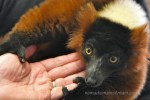
What was so cool about the experience is that these are animals who are used to educate people about endangered species and who have been handled enough to be touchable.  How often do you get to go to the zoo and pet a Lemur or cradle a baby Wallaby?

There are two things about the program I particularly like.  First, they are very serious about trying to save the extremely endangered Cheetah.  Not only do they operate a breeding program, but they also use the funds raised to donate Anatolian Shepherds to farmers where Cheetahs are still wild.  The Anatolian Shepherds protect the farmers’ flocks from the Cheetahs and, inversely, protect the Cheetahs from being shot by the farmers.  It’s a novel approach to solving a root cause that’s win-win.

At the Columbus Zoo, you can buy a children’s book about an Anatolian Shepherd raised with a Cheetah and those funds go to help save the Cheetahs too.  This is a somewhat ironic twist on the plot.  At the Columbus Zoo, instead of scaring the Cheetahs, the dogs provide comfort and confidence to otherwise skittish cats.  I don’t recall the story of what made them decide to raise the first cheetah-dog pair, but the result was a happier cheetah, so they have been raising puppies with the captive cheetahs ever since.

The puppy friend we met along with the cheetah babies there that day was a frisky yellow lab who didn’t seem to quite understand his place in the food chain next to his best friends.

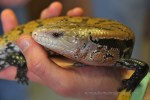
The second part of the program I particularly liked was the number of rescues who were part of it.  The tortoise, the puppy, and the Python were all rescued critters.  In the case of the tortoise and the python, the Humane Society wasn’t equipped to deal with them.  The python had been released in a Columbus Metro Park and was at risk of freezing to death when it was rescued.  What a beautiful snake it is!

Snow Surprise

Because I am taking a learn to row class 5 days a week and recovering from said rowing class the other 2 days a week, I have not been doing a lot of shooting lately.  As such, I have returned to my photos from our 2010 trip to Glacier National Park.

We stayed at Glacier Park Lodge a couple of nights at the end of our stay in the park.  Getting to the lodge is not difficult.  It’s an easy drive from West Glacier.  What is less easy is the long drive up the East side of the park to St. Mary’s Lake.

The memory of one early morning drive up the East side of the park still haunts me.  Montana has a “fence out” rule about livestock–if you don’t want them on your property, put up a fence.  Otherwise, they’re free to range.  While I don’t know enough about the advantages and disadvantages of this approach to argue for or against, I do know that it resulted in two dead horses spread across the road at about 7AM one morning.  As we drove past, my stomach lurched and I hoped they died quickly.  We were debating who one is supposed to call when there are two dead horses on the road when, a couple miles down the road, we passed a front loader headed at full speed toward the gory scene.  I had to look away.  The thought of the horses being scooped up in a front loader was a little too much for me.

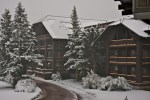
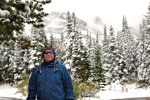
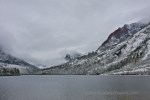
But, on to happier thoughts.  When we awakened our first morning in the lodge, we discovered an unexpected snow had moved in overnight.  While Pat slept in, I wandered around the lodge looking for photo ops.

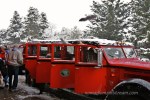
A red jammer was parked in front of the lodge loading up a group of senior citizens for a tour.  I perched up on a walkway above the scene and started shooting this historic vehicle.  About then, the snow started sliding off the roof of the hotel in enormous chunks.  One tiny lady (the top of her head is just visible through the window of an open jammer door if you look closely in the photo) got pummeled repeatedly by chunks of snow before someone ran over and shielded her.  I felt a little guilty standing there shooting, but I was quite out of reach.

When Pat got up, we drove to the small town nearby (Browning) in the Blackfeet Indian reservation (and yes, it is called “Indian” and not “Native American” there for whatever reason) where we found a trading post that sold rubber boots.  Pat bought a pair and we proceeded to go take an easy walk around a lake before driving up to St. Mary’s.

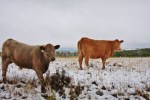
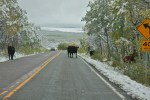
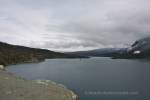
On the way to St. Mary’s, we encountered many cows on the road.  We also had to pull over so I could shoot some of the scenery with snow.  It might have been unseasonably cold, but it was beautiful.

Feeder Watch

Apparently there were more exciting things going on in Chattanooga last Saturday than sitting around watching bird feeders because I was the only one at the visitor’s center diligently watching the feeders.  However, this gave me the opportunity to get some shots of the birds that I wouldn’t have been able to get had a crowd of people showed up, so it worked out just as well.

The House Finches were the most plentiful by far.  There seemed to be a couple of males who had collected large harems.  Or, perhaps they were couples who had many almost-adult daughters but no sons?

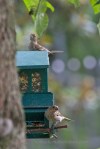
The cardinals and titmice were close seconds in number.  One of the feeders at the visitor’s center has a mechanism that closes off access to the seed if something heavy lands sits on the perch.  This keeps squirrels off of the feeder.  However, it also means only one bird can perch and feed at a time.  This creates a great study of bird learning.

Some arrive, see another bird on the feeder eating and attempt to join it.  If the bird eating is an experienced and assertive bird, it will flap and squawk at the newcomer, attempting to deter it from landing.  If successful, the newcomer will go perch nearby and wait until the first bird leaves or it gets impatient.

If it gets impatient, it may land on the perch far enough away from the second bird so that it leaves it alone.  However, the extra weight causes the perch to lower and the doors to the seed close.  Then both birds fly away and, usually, a third bird swoops in to take advantage of the opening before the other two birds can regroup.

Some birds simply give up and join the squirrels on the ground hoping for someone to knock out a bunch of seed while eating.  They are joined by the birds that prefer to eat off the ground regardless.

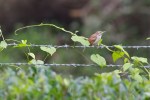
For me, I got a rare close look at both a male and female Eastern Towhee.  I say rare because I rarely saw them in Columbus and so far, in Chattanooga, they have mostly been perched high in the tree tops when I’ve seen them.  Apparently all I needed was a feeder.  Chipping Sparrows seemed to keep them company.

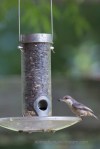
Even though the brown-headed nuthatch is a common bird here, having never seen one before, I was pretty stoked to get to see three of them gathering at the feeder.  They don’t make it up North, so I’ve only seen white-breasted and red-breasted nuthatches in the past.

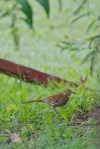
Not at the feeders, but nearby, a Carolina Wren called from the gate.  Then, a Brown Thrasher showed up under a feeder-less tree.  If that wasn’t enough, a wild tom turkey went strutting by the parking lot fence and crossed the railroad tracks in plain view.  We’d seen a whole family the last time I was there, but Tom was fun to watch, too.

Not a bad birding day.

Birding 101

Birds reveal themselves to me slowly.  I must see them many times before I understand who they are, what they look like, what interests them, what they sound like, and I can recognize them like an old friend.

When I hear a bubbling American Goldfinch flying by behind me, I smile to myself, envisioning it’s scooping flight pattern, called “zooming” in hang gliding school.  How the goldfinch must love the zip of the dive followed by the lift, stalling and diving again and again, riding its invisible roller coaster and able to stay airborne because, unlike a hang glider, it can flap.

When I see a Great Blue Heron gliding in for a landing at the wetland, I know that the theory that dinosaurs did not all become extinct but some evolved into birds is true.  If ever there was a remnant of a pterodactyl, surely it’s the great blue heron with its crooked neck gliding awkwardly on giant wings, miraculously able to perch high in a tree on it’s fragile, stilted legs.

And now, I am pursued by brilliant Indigo Buntings.  They perch and sing their songs to me, over and over, determined that I will recognize the sound of their voice.  At long last I have learned to know them by their song.  I can smile and look and see a tiny silhouette off in a distant tree top, point, and say, “There is an Indigo Bunting.”  It seems like magic to those who have not listened to the bunting’s song 3x a day for months.  It seems like magic to me, even though I have.

No matter how familiar a few birds have become to me, there is always another bird to meet.  My latest friends are fly catchers.  The Blue-Gray Gnatcatcher is easy to recognize.  But the Eastern Phoebe and the Eastern Wood Pewee still manage to confuse me even though I thought I knew what a Phoebe looked like for many years now.  My human friends play the same trick on me–I often recognize them only to discover I’m saying hello to a complete stranger.  At least the Phoebe tells me its name over and over again in its distinct call of “Fee – bee.”

These are things I like to share with others.  I love to see people get excited about seeing a bird for the first time that they’ve walked by without notice for decades.  I love to see someone realize that a bird they thought they knew looks completely different up close through binoculars.

For this reason, I have started leading beginning bird walks for the Audubon Society.  I am not the best birder in the world–there are many species I would be hard pressed to even guess at.  But, having struggled long and hard to learn what I do know, I know what’s helped me learn it.  Maybe that’s why people say “those who can’t do, teach”?

Regardless, I’m happy to share smiles, even if it’s over a robin.