Full Moon Risin’

This is my 100th blog post.  It’s not relevant to the rest of this entry, but feels like a milestone worth mentioning in any case.  100 days of 100 posts.  About 120,000 words.  That’s about 480 pages of blogging.  I wonder how many pages of interesting reading I would end up with if I went back and carefully edited it all?

Having shared that little milestone with you, it seems somehow appropriate to me that my 100th entry should be about the full moon.

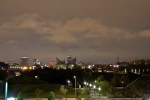
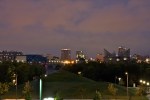
I’ve had a busy week–or should I say busier than usual?  But I’ve marked the full moon on my calendar.  It’s a moment I’ve been waiting for.  In August, I went out to the Market St bridge and shot the full moon rising behind the Walnut St bridge but I didn’t have a tripod that could hold my telephoto yet.  I thought I might get at least one or two good shots with my monopod, but the lens was too heavy and the wind was too strong and all my pictures were blurred, although I still found them interesting.

Since then, I’ve acquired a new tripod that’s up to the job.  However, we’ve been traveling a lot and I’ve missed the full moon until now.  In August, I didn’t think it was that big a deal I missed the opportunity to shoot the moon rising behind the bridge.  I forgot everything I learned in Astronomy 101, I guess, and didn’t think about the fact that the moon wouldn’t be rising there for long.  The moon now rises from behind the hills behind our building.  There is no opportunity to catch people walking in front of the moon.

But, I want to shoot the full moon anyway.  I am fascinated by the moon.  Having been shooting the moon for many nights the past few weeks, I’ve been experimenting with what I’ve learned from some of my photographer friends.  I’ve watched the moon moving across the LCD on my camera as I try to set up for a shot and realized how quickly you really have to move to keep up with it.

I’ve also learned to cut way back on the exposure if you want to see the craters in the moon.  And, that the fuller the moon is, the less interesting it actually looks in photos because the light flattens out all the details.  In spite of this new knowledge, I love capturing the full moon behind objects on the horizon.  Tonight, I take my camera and tripod up to the roof to see what the options are.

I go to the roof and discover gusting winds.  I position my camera on the tripod and experiment with holding the strap so it won’t catch the wind and introduce movement.  I am ready to go, but where is the moon?  It’s well past the official moonrise, but I’ve learned that the moon appears at the horizon later here, probably because of the hills.

I am poised and ready to pounce–the moments the moon will be at the horizon are so short and I have to focus manually before I start shooting.  I look along the horizon for signs of light in the approximate area I expect the moon.  For a moment, I am like a 50’s housewife with dinner on the table, scanning the street for her husband returning home late from work.

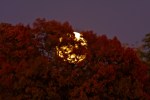
Then, I see light.  Through the red leaves of a tree being whipped about by the wind, a tiny bit of glow appears just above the horizon.  I have to wait for enough of it to rise that I can use it to focus and then start shooting.  I adjust the exposure again and again, torn between being able to see the color in the trees and not over-exposing the moon.  I keep shooting as the moon is released from the branches of the tree, making me think, oddly, of an egg bursting from an ovary.

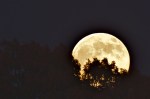
As the moon rises into the sky, I keep shooting, but the photos of just the moon really aren’t interesting to me.  They show a round disk, yellowish in the light from the setting sun, with splotches of brown on it.  Prime time is over and it’s time to shoot something else or go in.  Since the wind is getting only more fierce, I choose to go in.

I slide the legs of the tripod in enough that I can carry the whole thing over my shoulder without running into too many things.  Then, I head back down the stairs and into the apartment.  I pop out the CF card and pop it into the computer to see what I’ve got on the big screen.

My shutter speeds were slow enough that the tree in front of the moon appears in motion.  I decide I like that.  I decide my favorite shot is one that shows the color of the leaves in the tree with the moon flaring through it.  The leaves are in motion, the moon is frozen but overexposed.  I decide that I like that too.

I sit at my computer and stare at my shot for a while.  I consider whether it would have been better at a faster shutter speed so the tree was sharp instead of in motion.  Or if I should try to turn down the exposure on the moon in my editing software.  Or if I should crop it so the moon is less centered in the frame.  I consider copying the photo and trying all of these things.  Then, I decide once more that I just like it and to let go of how anyone else will judge it.  After all, the shot is for me.

Tripod Experiments

This morning, I am like a kid at Christmas–although I opened my “gifts” the night before.  I have finally invested in a good tripod and the pieces are now all here that will allow me to use it.  I am up before the sun (although that’s not saying a whole lot these days).  I have read all the directions (yes, I do that) and now I just need to screw the bullhead mount into the legs and attach the quick-release plate to the camera.  I’m too impatient to wait for the sunrise, so I contemplate which lens to use for long exposure experiments.  I decide on the 17-55mm lens, which will work equally well if I’m still shooting when the sun catches up with me.  I put the lens on the camera along with my other recent purchase, a wireless remote.

I put my head through the strap on the camera (a habit I’ve developed to prevent camera drops given my clumsiness) and pick up the tripod.  I walk out to the balcony and start setting up the tripod.  This is a challenge.  The balcony is not large and there are 2 chairs and a side table sitting on it.  Plus, it is set in an alcove of the building so that the opening is surrounded by brick and a large, wide “post” at the corner divides the view to the East from the view to the South, reducing the angles available.

I think about going up to the roof to shoot, but then I look at my watch.  It’s just now 6AM.  I imagine dragging all my gear down the hall and up the stairs and then walking across the roof to set up.  Now, this might not seem like a potential act of inconsideration to ones neighbors, but we happen to live under the corner of the roof where they installed a large deck with patio furniture and a grill.  Our next door neighbor lives under the deck as well.  Every night when neighbors who don’t live under the deck go up there to hang out, grill, or have a party, what we hear is a herd of elephants trumpeting and thumping across the roof.  We finally figured out that the trumpeting part is caused by dragging furniture across the deck (for some reason, no one seems to ever pick the furniture up).  The thumping is just walking.  I think about Pat still sound asleep in the bedroom and our next door neighbor (who may or may not be home) and decide that I will just stay on the balcony for this morning.

I find that with the two legs in front in a single plane, pressed against the railing, and the leg in back fully extended to brace the tripod in place, I achieve two things:  first, I reduce the floor space needed and, second, I get the camera lens out from behind the brick frame of the balcony opening.

Excited to start shooting and noticing there is plenty of traffic this morning, I decide to play with getting streaks of light from the traffic below.  I pick a composition and find that while getting the camera where I want it and getting it to stay there is far easier with my new equipment, I still feel restricted compared to not using a tripod.  But, I wouldn’t be able to get the shot I’m about to take at all without a tripod, so I figure I will learn to appreciate the increased flexibility in shutter speeds over the loss of speed in composition.

I’m all set and ready to shoot except for one thing–I forgot the radio control for my wireless remote.  Now I have a dilemma.  With the tripod set up the way it is, it’s possible that a strong wind could topple it over the balcony railing.  Plus, I have blocked myself in and will either have to climb over the one fully extended leg and a chair or move the tripod, which I just got set up.  I gently rock the tripod slightly to see how secure it is.  I stand still for a moment and just feel the wind to see how strong it is and if it’s steady or gusting.  You would think I was about to take flight vs run inside to get something.  I decide to shorten the fully extended leg without moving anything else.  This sets the tripod more firmly on the ground and gets the camera back away from certain disaster.  However, it still requires climbing over obstacles for me to get back inside to get the remote.  I manage this without bumping the tripod and without tripping–anyone who knows me would be proud.

Now, with remote in hand and tripod back in place, I discover a new challenge.  My camera won’t shoot if it’s not in focus.  And, because I’ve chosen a single-point focusing method (which I always use because I like to pick the one thing I really want to be in focus), it cannot focus with the current composition.  The single-point is off in the dark.  When I am not using a tripod, I just point at what I want to be in focus, press the button halfway down, and then compose my shot.  But I can’t easily use this process with the tripod.  I decide to set a different focusing mode.  However, it’s dark and the top of the camera is above eye-level, so I am standing on my tippy-toes trying to change controls I can’t see.  I decide to recompose so that the focus point has something it can focus on instead.  Now, finally, I start shooting.

Playing with the car lights is fun.  But, eventually, the sun does rise.  I try shooting clouds with just a hint of light catching their edges, but the wind is blowing them around too fast for my slow shutter speeds.  Then, as the sun makes it’s way above the horizon, the light turns gray.  As it turns out, the sky is so heavily overcast that not even the sun can make an impression.  There is no drama this morning–it’s just like someone turned up a dimmer switch.  Realizing that it’s time for me to move on with my day, I move my gear inside.  This is achieved far more easily than setting it up was–I just shorten the legs and bit and pull them together, walk through the door and stand the tripod back up on the floor.  There’s more space inside and I can leave the camera set up all the time if I like–it’s just one more thing for me to trip over.

While I can’t say that any of my photos turned out quite the way they looked in my head, I did get some good, long light trails.  It’s a fun effect to play with more in the future.  But for now, I must get to work.