Sassafras Falls

It’s our third day in the Smokies for the long holiday.  We take the same approach that we took yesterday–wake up slowly, lay around until hunger kicks in, throw something on and go to breakfast.  Then, we return to our room to choose today’s hike.  It’s a little cooler today and overcast.  Visibility is supposed to be poor.  The weather calls for clouds, but no rain.  We get out the guide in our room and I ask Pat if he’s up for a 9 mile hike.  There is a trail to a waterfalls nearby that’s supposed to be a nice easy walk. Neither one of us is up for a big physical challenge this weekend, still recovering from pulled muscles on the hang gliding training hills.

Much of the drive is alongside a stream that rolls and tumbles over rocks, creating white water.  There is trout fishing in this stream, a good sign that the water is clean.  I am too busy watching the scenery to be a lot of help navigating, but I interrupt gazing out the side window long enough to check the directions when Pat gets confused about a turn.  We manage to make it back to the trailhead with only one wrong turn.

We start up the trail as a light rain blows in, misting my face gently as we walk into the wind.  The trail used to be a railroad track, but was converted to a trail long before “rails-to-trails” meant bike trails.  As we start out, the climb is gradual, the trail is wide and flat, and we have no troubles finding our way.  We take our time.  We have 6 hours of daylight and emergency flashlights in our day packs.  If we need 6 hours to go 9 miles, we can take 6 hours.

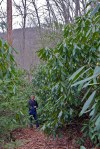
After a short distance, we enter what feels like a maze of Rhododendron.  The enormous shrubs on either side of the trail loom large, daring us to go off the path.  Pat and I both have flashbacks to our first backpacking trip together at Otter Creek Wilderness in Monongahela National Forest in West Virginia.  It was early in the spring–so early, it snowed our first night.  When it wasn’t snowing it was raining.  When we started out, the trail looked more like a stream than a trail.  Unfortunately, it rained so hard that after a while, there were hundreds of mini-streams all around us and we couldn’t tell which one was the trail.  We ended up bushwacking our way through giant Rhododendrons.  Each shrub was like a giant octopus, its twisting arms grabbing hold of our backpacks as we tried to belly crawl underneath.  I had visions of us being found weeks later, captured in the arms of giant greenery, suspended above the ground and frozen in postures of horror.  I’ve never felt quite the same about Rhododenrons ever since.

Thankfully, today they remain on the side of the trail, clearly demarcating where we are and are not supposed to be.  As a side benefit, because they keep their giant waxy leaves, they provide good hiding places when nature calls.  That doesn’t make me feel significantly better about them, however.

After about 3 miles of enjoying the view of the stream through the Rhododendrons, which has gotten steadily further below us, we arrive at a stream crossing in front of us.  We contemplate the best place to cross.  The water is high and moving fast.  These are dangerous circumstances for a water crossing; we want to find a safe route to ensure we don’t end up washed downstream.

I pick a route and make my way across.  In my hiking boots, I’m nervous about sticking to the wet rocks covered in moss.  It’s easy to lose footing and get caught in the current.  I make it OK with only one scary moment when I teeter on a rock waving my arms until I leap for the next rock and manage to land with firm footing.  Pat follows the route I took, probably figuring that if I can make it safely across, anyone can.

As we finish up our crossing, two dogs suddenly appear on the side of the creek we just left.  They are followed shortly by a family with a young daughter and teenage son.  They shout across the stream to us asking if this is the way to the falls, wanting to make sure they really needed to cross the stream before they decide whether or not to risk it.  As they contemplate, one of their dogs jumps in and is soon headed downstream in the rapids.  I run along the stream until I find a place that has an opening in the trees with an easy launch in and out of the water.  The dog hears me calling him and is able to swim over to the shore, climbing out and shaking every drop of water in his fur onto me.  My face and pants are dripping wet, but the dog is safe.  He runs back to his family who is now starting to cross.  As Pat and I walk away, we see the dog poised on the bank, about to jump back into the water and the family calling to him frantically to keep him from heading downstream a second time.  I imagine him thinking body surfing is great fun.

The next part of the trail gets steeper, narrower, rockier, and more overgrown.  We spot a faded sign after about 500 yards and make the turn to Sassafras Falls.  It’s supposed to go to the bottom of the falls, so we are surprised that it climbs even more sharply.

Now, the trail is on the edge of a drop off.  I do not have such a good track record when it comes to walking alongside cliffs.  Pat warns me that he’s not going to be able to catch me today (having grabbed me by the back of the pants in time to prevent me from falling to my death on more than one occasion).  Fortunately, this is not really a cliff and, when I look at it, if I were to fall, I would probably break a bone at worst.  Having broken quite a few bones and healed eventually, this thought is oddly reassuring.  Not worrying about falling helps me stay on the trail and I avoid any incidents.

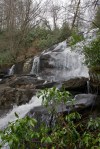
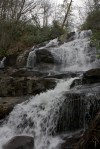
We make it to the falls and spend some time looking at the water crashing over the rocks with surprising force for a relatively small mountain stream.  It’s a beautiful falls, although I’d like to be able to back off from it so I can take in as a whole a little better.  We are so on top of it that I almost feel like I need the glasses I wear when I’m at the computer to fully appreciate it.

After I attempt to get some shots, we find a nice grouping of rocks to sit on and eat our lunch.  The rocks are moss covered, which makes them padded if slightly damp.  We sit facing the falls, enjoying our private table as we unwrap our sandwiches provided by the lodge.

We move at a much faster pace on the way back with most of the trail being downhill.  We do lose time trying to find a different place to cross the stream than the way we came over.  Our first route looks much more difficult from this direction.  It’s hard to explain how that happens–maybe it’s just an optical illusion–or maybe it a matter of stepping up vs stepping down depending on which direction you’re going.  In any case, we revisit our buschwacking-through-rhododendrons skills as we make our way along the stream, looking for a safe crossing point.

Pat finds a fallen tree and decides we should cross there.  I follow after he makes it safely, but have trouble not worrying about the camera around my neck.  If I fall in here, it’s deep and it won’t just be my feet that get wet.  I end up sitting on the log about halfway across and scooting forward until there is a branch sticking up that I can hold onto for balance.

We make it across the stream, back to the car, and even back to the lodge safely.  When we get out of the car, I stand and wait while Pat gathers some additional gear that he needs to bring into the hotel.  As I stand there, I hear the loud call of the Pileated Woodpecker.  My camera is around my neck still, although I have only my wide-angle lens with me, having opted to leave my other choices back in our room.  I spot the bird on a tree not too far away.  I decide to try to sneak up on him in the hope of getting a decent shot.  I do manage to sneak up closer, but not close enough to get a good shot before I make him too nervous and he flies away.  The brilliant red crest on his head practically looks neon in the light of dusk.

When the woodpeck flies away, he makes a giant arch around the parking lot and then flies over a deck where another guest is sitting.  We walk over and ask if she saw where he landed.  It turned out she never saw the bird that flew right over her and directly into her line of sight.  Given the size of a Pileated woodpecker, we are both (silently) amazed that someone could miss something like that.  She, however, seems nonplussed.  It makes me wonder how many birds have flown over my head that I never saw.

The sun setting behind the mountains tells us it’s time to go inside, clean up, and go to dinner.  We head on in, although we are in no hurry.  We have all evening.
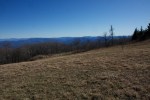
Sunny Black Friday

It’s the day after Thanksgiving.  For some people, going to the malls before dawn and waiting in lines is the best way to spend this day.  Our agenda is the extreme opposite.  We start by sleeping in.  Well, maybe not exactly sleeping.  I wake up earlier than I’d like, but I simply lay in bed and refuse to get up.  I’m not sure exactly what is so wonderful about being able to just lay in bed knowing you don’t have to go anywhere, but it is.

Of course, I eventually get hungry and start thinking about breakfast.  Pat is also awake and lounging.  We clean up enough to be presentable and then head to the dining room.  After a leisurely breakfast, we return to our room to change and pack for hiking.  We have no grand plans today.  I get out the notebook in the room provided by the lodge that has a section on nearby trails.

We overheard the innkeepers parents talking about Huckleberry Knob as a short hike with a spectacular view.  Today promises to be a clear and sunny day, so this seems like a good choice.  The hike is listed in the notebook.  Since it’s only 2 miles round trip, I select a second hike that’s 4 miles round trip that also goes to a high spot with a great view.

As we leave, we pick up our brown bag lunches from the cooler next to the lodge door.  They don’t serve lunch in their restaurant, but they pack everyone a lunch in either a brown bag or a backpack to take with them.

I decide to try my fivefingers trekking shoes on the first trail since it is short.  I want to test whether my feet will be warm enough to wear them on a longer hike or not.  If a trail isn’t very rocky, is dry, and the ground isn’t too cold, I prefer my trekking shoes.  But it is late November and my feet can get painfully cold.  I decide the first trail is a good test because it’s long enough that my feet will have time to warm up and short enough that I won’t be miserable for long if they don’t.

The trail is actually a forestry access road that’s wide and flat with ruts in it.  In many places, it’s still puddled and muddy from recent rains.  I do my best to walk around the mud, but the tiniest bit of moisture seeps into my shoes, soaking my feet.  Each time my feet get wet, they get very cold.  With movement, they warm up until I get to the next puddle.  I’m glad that I choose a short trail to try them on.

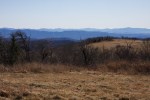
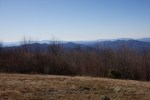
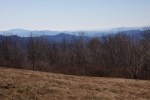
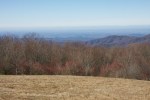
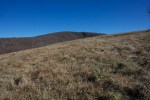
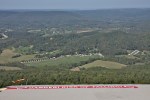
While the walk to the first “knob” is not particularly interesting, or if it is, I was so busy watching for mud that I missed it, the view from the knob is amazing.  If the mountains had snow covered peaks in the distance, I would feel like we were on the set of The Sound of Music.

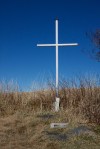
The first knob has a view of the second knob, which appears far away.  A huge cross looms up on the hill and we wonder what’s up there.  We enjoy the view a bit longer and then continue up to Huckleberry Knob.  We are upon it in no time–the distance is far less than what we thought from down below.  Oddly, the giant cross turns out to be a rather small.  So much so that we walk around the knob looking for the giant cross we saw from below.  I just recently relearned that looking up at something makes it appear larger, but this seems ridiculous.  Neither one of us can believe the 3’ cross that marks the grave of a man that died by getting drunk on the mountain and dying of exposure is the same cross we saw from below, but it has to be.

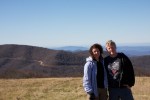
We run into a couple of women we saw at breakfast who are also enjoying the view.  We take turns taking pictures of each other.  It’s an incredibly beautiful day, but it’s noon and the lighting is not good for taking pictures.

Pat and I sit on the side of the knob for a while, looking at the sky and the mountains below.  It’s nice to just relax here for a bit.  After a while, we decide to walk back and go on to our next hiking destination, Mud Gap.

While Pat drives us to the next trail head, I slip out of my shoes and prop my feet up near the defrost vents so they can dry before I switch to my socks and boots for the next hike.  We eat our brown bag lunch while we drive and finish it in the parking lot at the trailhead.  Two other vehicles are in the parking lot.  One is a small pickup truck with Sierra Club stickers on it.  The other is a big pickup truck with an older man in an orange vest in it.  He is hunting.  It’s a little nerve wracking to realize we’re out hiking in a national forest the first official day of deer season.  It occurs to me we really should be wearing orange.  Fortunately, the trail is another well known trail that’s easily identified, so hopefully that will reduce our chances of being mistaken for deer.

We pause at the sign in the parking lot before heading up the trail.  I learn that this is actually part of the Benton-MacKaye trail.  This will be the second time I’ve hiked on part of this 275-mile trail that starts at the same point as the Appalachian trail, loops around, and then reconnects with the Appalachian trail in Smoky Mountain National Park.

As we study the sign, the hunter calls out to us.  He tells us about the hike, the view, and an alternate route that allows you to drive almost to the knob.  As we thank him and start walking, he calls out loudly, “I’m 77 years old; if I can walk up there, y’all sure can!”  We laugh and agree as we continue on our way.

As we make our way up the wet and rocky first 100 yards or so of the trail, I decide switching to my waterproof hiking boots was a good idea.  Pat interrupts my thoughts with, “How would that guy get a deer out of here if he shot one?”  We continue to contemplate that question as the trail gets steeper, rockier, and wetter.  I finally say, “Maybe he’s one of those guys that really just wants an excuse to go hiking.”

As we continue, we pause every once in a while to listen.  Sometimes we hear birds or squirrels, but more often, what we hear is the wind.  It starts like a far away swell, gathering in the distance.  Then it rolls its way up the side of the mountain, rising towards us as it gradually gets louder and louder.  Finally, it crashes over us and lifts my hair off my face.  The experience is like standing on the beach as the tide rolls in without getting wet.  I could stand and listen to the rise and fall of the wind all day, but we start moving again after the current wave starts to recede.

When we arrive at the knob, we are startled to see that it is littered with trash.  Then, two piles of trash jump up and start running towards us with wagging tails and a third assimilates itself into a man sitting up suddenly after having been caught in a nap.  As it turns out, it’s a couple with two dogs who have blankets and picnic gear with them.  We assume they are the owners of the Sierra Club pick up truck.

The dogs greet us and we pet them as the owners try to call them away.  I never know what to do in these circumstances.  The owners want the dogs to listen, but we want to pet the dogs.  Since these don’t seem like people who will abuse their dogs for being friendly, we go with petting them.

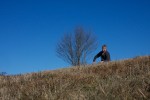
After being welcomed to the knob, we settle down on the side of it, slightly downhill from the Sierra Club couple and their dogs.  I work my way around the circumference, shooting the panoramic views even though the light isn’t any better than it was at Huckleberry knob.  I’m so happy to have finally gone somewhere with a spectacular view on a day when it’s clear.  Usually we only go to high spots on cloudy or foggy days.  I guess it pays to check the weather before you pick a hiking trail.

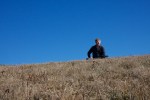
After shooting the view, we lay in the short, dormant grass on the knob and stare at the blue sky.  It’s so blue that I have a hard time focusing on it.  Not a single trace of cloud gives my eyes something to tell what an edge is.  I feel like the lens of my camera when I point it at a solid-colored surface.  I can’t say I’ve ever experienced that before.

As we lay there, Harry the dog suddenly appears standing over Pat’s head.  Apparently he was worried about us when he saw us lay down.  Pat pets him and he wags his tail.  Convinced we’re OK, he returns to his owners.

We get up and attempt to brush the dead grass off our shirts, but it really wants to stick to us.  We make our way back to the car, pausing to see a downy woodpecker, a grasshopper, and a squirrel.  By the time we get back down to the parking lot, my knees are starting to ache and I’m wondering if I should have worn my trekking shoes after all.  My feet are warm and dry, though, so I won’t be able to decide which was better until I know how long my knees will hurt.

We return to the van, hot inside from the sun.  We strip off some of our extra layers, extraneous in this sunshine.  We climb into the warm van and I am transported to the feeling of getting into a hot car after spending a summer day at the local swimming pool.  I love that feeling.  Any part of my skin that feels chilled suddenly feels like it’s been wrapped in a blanket.

We return to the lodge before sunset–enough time to shower, change, and sit and relax before dinner.  This has been a perfect day.  No crowds.  No traffic.  Just beautiful weather and a great view.  Sometimes I think that’s all I really need.

Letting Go: Not Just an Expression

It’s Saturday again.  We decided to return to the training hills this Saturday in the hope of making more progress by going back at the earliest possible time that we can.  However, we also decided to only plan on one day of hang gliding this weekend and to only try to add on Sunday once we see how we feel after Saturday.  We don’t want to be as sore as we were the last few times we went hang gliding.

We get up early–I get up at 5:30AM, to be exact.  Pat sleeps for another hour.  I take some time to write this morning since I am not taking as much stuff today.  I have decided to leave my camera behind since, well, let’s face it, grab shots of hang gliding start really looking pretty much the same after a few times.  Also, since we’ve not scheduled an afternoon tandem flight, there is no need to take a bunch of stuff to do during the time between the training hills and the tandem.

Once I’ve done my writing, had my coffee, and gotten dressed, I begin repeating my new mantra:  “Eyes on Target.  Light Hands.”  I try to visualize this in my mind.  I stand in the kitchen with my hands lightly placed on my imaginary control frame, my eyes locked on the top of the cabinets.  “Eyes on Target.  Light Hands.”  I even practice correcting the glider by pushing myself in my imagination left and right.  I realize that as my body shifts with the image in my mind, I am cross-controlling even in my kitchen.  This surprises me and I try again, this time shifting like I’m swinging on a pendulum as much as possible while standing in the kitchen.  I notice my eyes are on the kitchen floor.  Raising them back to the top of the cabinets, I abandon steering practice and say, “Eyes on Target.  Light Hands.”  Then, Pat is ready to go and I give up on my visualization.

We get to the training hills plenty early.  Mike still beats us there.  He advises us on which hang gliders to assemble and I am back in the smaller Falcon that gave me so many fits the last time.  I talk to Mike about whether it’s a good idea for me to go with that one or not and he assures me that it will pick me up just like a too-big one would.  I flash back to my 10 trips down the hill without feeling any lift, but decide that there is some wind today and that I might as well give it a try since I’m not going to make it off the bunny hill until I can fly in the correct sized glider.

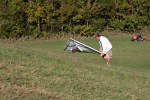
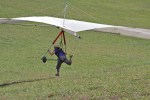
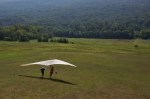
8 people have signed up for the bunny hill.  A crowd like that can make it tough to get a lot of flights in, especially if the wind starts kicking up early and we have to call it a day.  But, we get out to the hills as quickly as possible and start getting flights in.  I am relieved that I manage to launch on the first try, although I went into a dive immediately and realized I’d taken my eyes off target.  When my glider lands, my legs are smacked on the ground and my right quadricep hyper-extends slightly, just enough to give me a slight pull.  When I get to the top of the hill, I stretch before taking my next turn in the hope of preventing injury.  I launch successfully again and am happy with the launch, although I still go into a state of mental confusion and have difficulty correcting in the air.  When I launch the third time, Lauren tells me that my launch is 95% of the way there, but I need to focus on keeping my posture upright so that I leave the hill in an upright position.  As soon as I start thinking about my posture, my eyes drop and my hands tighten and I fail to launch and end up running down the damn hill again.

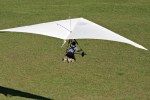
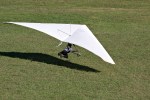
Now I am starting to limp.  At the top of the hill, I stretch thoroughly again before attempting to launch.  I suspect it will be my last time.  Lauren stands behind me this time and tells me when to let go completely.  She has me just release my hands on the control frame and do jazz-hands so that they’re there, but not grabbing at the frame.  I launch perfectly even though a cross-wind has me going crooked while I’m still running down the hill.  Lauren yells, “Run to your target!” at just the right time and I get my eyes back to where they should be, drag the glider back to straight, and launch into the air.  I even manage to correct in the air and do it correctly, although I don’t do it consciously, I just remember the feeling of swinging like a pendulum after I land.

We do a repeat the next time around, although now I am barely walking and I’m thinking this should be my last flight.  Now I’m having fun again and I’m willing to suffer through the pain of pulled muscles a couple more times.  I launch again even better this time by having Lauren yell at me and doing jazz-hands again.  Lauren tells me that she’s not really yelling at me, she’s yelling at my neurons.  She is right–I don’t have the right neuro-pathways yet.

I manage to get in one final flight, ending strong on 3 really great flights, but now my neck is going into spasms, I’ve pulled my quads, my inner thighs, and my groin.  I am walking like a cowboy once again.  But I hobble away happy, noting that letting go is ultimately what allows me to fly.  Who knew that when people say things like that they’re really referring to hang gliding?

Cloudland Canyon

Before we left this morning to watch the hang gliding, I did a little research on Cloudland Canyon, a park we keep passing signs for between going out to the hang gliding park and my bike trip to Chickamauga Battlefields a few weeks ago. I try to talk Pat into planning a hike there while we’re out that way when I see that it’s supposed to be one of the more scenic places to hike in the US. I find a short, 2-mile round trip trail and think I might have a shot at talking Pat into that one, but when I mention that it has about 1600 steps because it goes down to the base of a waterfall, he vetoes immediately. Unfortunately, the hamstring he pulled the last time we went hang gliding is still giving him troubles and he doesn’t want to risk pulling it again when we have our next hang gliding lesson scheduled next weekend.

However, after realizing there aren’t going to be any mountain launches today at the hang gliding park and seeing all that there is to see there today, we decide to make a detour to Cloudlands Canyon and walk out to whatever overlooks are convenient from the parking lot. I suggest that there may not be any, but Pat laughs at this. “We’re Americans. We always have to have a view accessible from the parking lot–think of all the people that won’t walk to see a view!” I have to agree. There are a lot of people who go to a lot of really beautiful places in this country without ever realizing that hiking to even more beautiful places is a possibility.

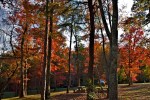
The park is a state park, it turns out. And it costs $5 to enter. I guess that’s the downsize of going to a park that’s listed as a top 10 destination. We drive in and find the first overlook. I decide to take my camera with me as the leaves are beautiful and the sun is getting lower in the sky, making for better lighting than my hang gliding shots earlier today. Pat takes my still-assembled tripod out of the back of the car and carries it over his shoulder. The legs are still extended and it hangs out far behind him.

As we cross through the grassy area on the path between the parking lot and the overlook, we pass amongst a group of teenagers playing a game of tag or something. They appear to be Mennonites or a more relaxed derivation–the girls all wear skirts with heavy stockings and have a cap covering their buns, but they have less of a uniform look than the Mennonites I’ve seen in the past. The boys could be mistaken for mainstream boys from their attire, although they don’t seem to be wearing anything with logos. They are so intent on their game that one of the boys nearly knocks his teeth out on my tripod–Pat moves it out of his way just in time.

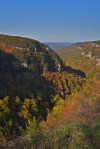
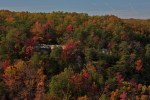
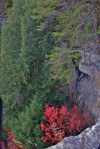
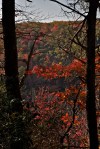
We make it to the overlook without injuring anyone and I set up my gear. It’s an amazing view from here. I had no idea that Northern Georgia has such incredible terrain. The canyon is deep and rocky, but sill mostly tree covered. The fall colors are far brighter than I expected to see in Georgia as well. Unfortunately, the setting sun creates deep shadows that contrast sharply with the brightly lit parts of the canyon and I struggle to capture just how amazing this canyon looks with my camera. After doing my best, we return to the car and, once again, the same boy nearly knocks his forehead into the end of the tripod. I suggest to Pat we need one of those orange flags used when driving with something hanging out of the back of the car. He suggests that the boy just needs to start paying attention to where he’s going.

We drive further down and find another parking lot at the far end where we can walk to the next overlook. There are fewer people here and we make it to the overlook unimpeded. A couple stands at the railing of the overlook trying to take a picture of themselves. I help out by taking a shot of the two of them. They hand me their cell phone and I take a picture for them. It’s kind of funny to have someone hand you a cell phone and ask you to take their picture, but I guess it’s common enough these days that it won’t be funny much longer.

The view from this side is just as beautiful, although there are fewer red trees on the slope across from us. We can hear a waterfall in the background. Stairs continue down from the overlook and I wonder if this is the trailhead for the walk to the waterfall I’ve read about. However, we are not prepared to hike–I’m wearing a pair of Italian boots comfortable for walking around in, but not safe for steep descents to waterfalls–and I don’t even broach the subject with Pat. Instead, I enjoy finding different angles to experiment with and shoot away.

Before we leave, I decide to take advantage of having the tripod and set up a shot of the two of us. Using the delay on my shutter, I give myself 10 seconds to get from behind the camera to in front of it. It takes two tries and using some flash because we’re back lit, but it’s kind of fun to actually have a record of me having been there instead of only having shots of everyone else.

Next, we walk along a paved path that takes us up to one more overlook. Here, a family is trying to get a group picture and they’re taking turns shooting. When they see me, they ask if I can take a shot for them. The mother hands me the camera. I think it might be a Canon Rebel, but I’m not sure. It’s considerably smaller than my old 40D and the lens on it seems miniaturized somehow. In any case, they tell me it’s all set and I just have to push the button. I compose and shoot, but the family is backlit and the exposure is set for them, overexposing the entire picture. I show it to the daughter (who appears to own the camera) and she changes a few settings and hands it back to me. She really needs some fill flash to get a good shot, but I decide not to comment. I take the shot again and ask her to see if it’s OK for her. She likes it, so I move on to set up out of their way so I can shoot the canyon.

While I’m shooting, the father of the family apparently stepped in dog poop left behind by an earlier visitor. He leaves along with one daughter to go remove poop from his shoes. The remaining mess on the rocks stinks something awful. The mother and daughter remain and the daughter seems to be playing model while her mother shoots using the daughter’s camera. I’m a bit confused because the daughter has to keep setting up the shots that her mother takes, and from her comments, she seems to want to learn how to shoot. However, one of the reasons why I’m rarely in my own shots is because composing the shot is the part I like best about shooting. To me, the composition is the most important thing that a photographer can individualize. While I suppose that’s not strictly true, it’s the part I understand enough to individualize. In any case, it’s not something I like to hand off to someone else to do.

I work my way around the rail of the overlook, avoiding the dog poop in the process. As I am finishing up with my final round of shots, another man joins the group on the rock and starts up a conversation with the daughter and mother. When they leave, he starts talking to me. He asks me what my intentions are with my photography. While this seems like an impertinent question for a stranger to ask, Pat happens to have asked me the same question on the way over to the park. I inform the stranger of this as a response rather than answering his question. But he probes further. When I say my intention is to get better at it, he dismisses this as vague. Finally, I tell him that I publish some of my shots on my blog. This somehow satisfies him, but he won’t stop talking.

I make all the physical signs of wanting to leave possible. I remove my camera from the tripod and hang it around my neck, I compact my tripod into its smallest form. I stand there holding my equipment with a lean towards the stairs, indicating he should start moving. He stands there between me and the steps like a wall. I take a step forward and he simply turns like a weathervane to maintain eye contact. I am at a loss. I finally interrupt his diatribe about his father and say I need to move on before I lose the light. He follows us up the stairs, still talking. When we get to the top, I start to go right and the man goes right. Then Pat steps back and says, “Honey, the car is this way.” Fortunately, the man continues off the other way instead of changing his mind, but I have now lost the opportunity to go shoot from the last overlook. Oh well, I have more photos than I can process anyway and we will be back another day.

We drive home in the fading light and I get home in time to do a little more shooting from the balcony. It’s funny how once I get on a roll, I don’t want to stop. Maybe that’s where the expression “get on a roll” comes from–back when photographers used rolls of film?

Hang Gliding Take 2

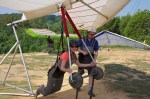
Still toying with the idea of getting our novice hang gliding certification (although also still not convinced I ever want to launch off the mountain), we signed up for a second round of hang gliding lessons.  We upgraded our introductory package to a weekend package, which gives us 15 more hill flights and 1 more tandem flight each.  Today is the kickoff of our weekend.  The alarm wakes us up early and we scramble to gather all the gear we’re taking with us.  We actually do not need anything other than a change of clothes and water, but I, of course, must take my camera.  And, the fact that we will be done on the hills by early afternoon but our tandem isn’t until 5PM means that we need things to do.  That means I’m taking two laptops, iPad, iPhone, and MiFi.  We also take air mattresses and pillows in case we want to take an afternoon nap.  We have more stuff than if we were traveling with an infant.

But, we get the car loaded and we make it out the door in plenty of time to fill up the gas tank and still get there early.  The entrance to the training hills is about 40 minutes from our place.  But once we get to that entrance point, there is a long dirt road full of pot holes, rocks, and ruts that we must make our way down.  It adds an extra 10 minutes, although it’s a little faster in the mini van that it was last time when we made the mistake of coming in Pat’s lowered BMW.

By the time we make it over all the bumps, I really need to use the restroom again.  Believing there are no facilities at the training hills, I start to head into the woods, but I see a man heading down a mown path and stop, thinking I don’t want to walk up on him if he’s headed into the woods for the same reason.  When he returns, I follow the same path he took to discover that there is an outhouse at the end of it.  Now, I have used many outhouses and, while none generally smell good, some are tolerable and some are really only appropriate for acts of desperation.  This outhouse appears to be occupied by mice.  I assume they have some rare disorder that causes a complete loss of smell.  The mice are not home right now, but their nesting and seed shells occupy the majority of one corner of the outhouse.  That is the most pleasant part.  I stand in front of the open door looking in and contemplate the pluses and minuses of just going in the woods anyway.  In the end, I opt to hold my breath and practice my balance inside the outhouse because I figure at least it’s private and I’m running out of time to find a good spot both because I have a very full bladder and because I’m supposed to be on the field by now.  Mental note:  make a pit stop at the nearest town tomorrow.

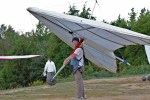
When I arrive at the field by the storage unit, I discover that I am supposed to be learning how to assemble my own glider and that Pat and the guy we will be sharing our glider with today, Craig, are already more than halfway through the process.  I get there in time to watch the final steps and perform the pre-flight check.  Pat tells me on the way to the hill that now that he’s seen how a glider goes together, he’s a little worried.  He was expecting it to have more parts that are fastened or something.  I decide not to think about it too much.

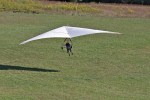
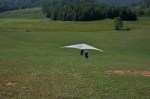
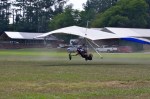
My first flight is not a flight at all.  It’s a run-and-crash.  I try to review what I did and didn’t do, but I have no conscious memory of what actions I took or didn’t take.  I assume that I stopped running too soon.  Pat, on the other hand, gets airborne like we were just hang gliding yesterday.  He seems to have retained what he learned last time.

My next turn, Gordy, the instructor, reminds me to loosen my grip and let the glider fly and to keep my eyes on my target.  I get a good start and launch well, but perhaps I loosened my grip a little too much because I am suddenly much higher than I expected.  I am also pointed towards the woods instead of my target and headed towards the 4-wheeler used to tow the hang gliders back to the top.  I confess:  I scream.  I know I did something to turn the glider back to straight, but my brain is not processing information at a conscious level, so I cannot say for sure what it was.  However, whether I did the wrong thing or just did too little, too late, I found myself diving towards earth, landing hard, and spinning out at the stop so that I ended up facing the hill.  The good news is that I landed before I hit the 4 wheeler.

Despite the crash landing, the feeling of flying stays with me.  The moment of lift off when my feet were running in air and the sudden realization that I am flying make me want to do this again.  I realize that I’ve been pushing myself into this.  This is the first time that it really felt fun.  Every run previously was more about “I can do this, too” than it was about wanting to be in the air.  I scraped my ankle on the first landing and it’s oozing blood.  My shoulders and upper arms are already bruised from carrying the glider.  My knees are bruised from landing too hard and too fast against the ground.  But now, I really want to get good at flying off this hill.

Unfortunately, there is a big crowd on the hill.  The wind is gusting and changing direction.  We need a calm, gentle headwind to safely launch and land.   There are 10 gliders up on the hill all vying for a turn at the precise moment the wind is right–we can launch only one at a time.  Plus, the morning ground school has now joined us on the hill to try to get their first flights in, adding 8 additional students and 3 more gliders.  But there are only short windows to launch in and everyone must launch into a headwind, so things slow way down as we take turns waiting for the wind to cooperate.

We stand-by as Gordy holds another trainee poised for take off, waiting for the wind to calm down.  When it does, it changes direction.  The student moves from one side of the hill to the other to try to catch a headwind.  Then the wind changes again.  This switching of direction slows the whole process down even more.  It’s not easy to move from one side of the hill to the other with a 90+ pound wing on your back in gusting winds.  Even more troublesome, the gliders start lifting off the ground on their own when the windspeed gets too high.  We start having trouble keeping gliders on the caddy coming up the hill.  First one flips in the wind, then another.

Between gusts of wind, Gordy manages to launch a few more students.  However, as I get on deck, I watch an experienced student in front of me get caught in a crosswind that causes one wingtip to catch the ground as she runs down the hill.  The glider goes airborne, spins, and then drops her on the ground hard.  She is OK.  She didn’t get high enough into the air to get seriously hurt, although I supposed she could have twisted an ankle or something easily enough given that she wasn’t launched yet.

Gordy announces that we’re going to call it a day and that we’ll try to fly down if the wind will let us, but we should take our gliders back after we land.  He looks at the windsock and looks at me and says, “I’m nervous about this wind.  Are you nervous?”  I say no.  I’m really not–I have confidence in my ability to heal.  He decides to walk me further down the hill so that I’m launching from a lower altitude.  The wind dies and I launch safely, but I get little lift because there is suddenly no wind at all.  It’s not quite the day on the hills we were hoping for, but we live close and walking away with only some bumps and bruises is far better than risking serious injury,

Pat and I discuss the odds that we’ll be able to take our tandem flight.  We decide to drive up to the pro shop at the mountain launch and reschedule since we don’t want to hang out all day only to have to reschedule anyway.  When we get up there, there is a crowd of disappointed tourists who were hoping to watch hang gliders launching from the mountain.  The wind is blowing the opposite direction needed for a safe launch, a tailwind, which we learn is called “over the back.”    The person in the pro shop thinks it’s a good idea for us to reschedule our tandem flights for tomorrow–apparently they have already moved people from Friday to Saturday and the schedule is over booked.

We head on home, tired and slightly disappointed, but still excited about the experience of flying and looking forward to returning tomorrow.

Southern Sledding

Whenever I go to a new place, I particularly enjoy discovering things that are different there. I grew up in the Mid-West where we had enough snow to go sledding every winter. In fact, I grew up feeling sorry for people who lived in places where they didn’t get snow and didn’t get to sled. Having recently moved to Chattanooga, I assumed it was one of those places. I have yet to discover if there will be enough snow for sledding in the winter, but what I did discover is that, in Chattanooga, no one actually needs snow.

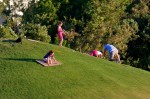
Here, grass sledding appears to be all the rage. The sled of choice is a simple piece of cardboard. Perhaps there are high-performance grass sleds available–teflon coated cardboard or maybe graphite would be slipperier–but I haven’t seen any so far. What I have seen is people having a ball sliding down grassy slopes on 95+ degree days without spending a penny. To boot, grass sleds are 100% recyclable. Now that’s what I call inventive.

I watch groups of children with their parents sliding down the grassy slope from my balcony. Summer fun at it’s finest. They begin to gather in the afternoon, making the most of the last days before school restarts. I think back to my own childhood summers. They lasted forever. Hanging out under a shady tree–or, more often, up in it. Once, a summer storm was blowing in, whipping the branches of our giant silver maple into a frenzy. I followed my brother high on the limbs, riding the tree like a crazy swing swaying frantically in the wind, our mother below yelling up at us to be careful. I remember seeing her face and recognizing her indecision–torn between letting us have fun and calling us down to safety. Then there was a bolt of lightening and her face shifted instantly into decision–she hailed us back down to earth.

I imagine the parents on the hill and their relief at having something to offer their children that is both fun and safe. After all, what is childhood without a few grass stains?

Shooting the Moon

People walk in Chattanooga a lot. It’s part of the city’s identity. It’s also part of the reason we ended up here. Chattanooga offers total coolness when it comes to places to take a walk–both literally and figuratively. The Walnut St Bridge tops the charts for popularity.  Connecting downtown to the North Shore, Walnut St Bridge was converted from an old wooden bridge for cars to a pedestrian walkway. The entire bridge is dedicated to people-not-in-cars–imagine that!  Paralleling Walnut St Bridge to the West, the Market St bridge also has sidewalks on both sides and a good share of its own pedestrian traffic, although there is plenty of car traffic too. There aren’t many places that you can’t walk safely in Chattanooga. Maybe that’s why they don’t have traffic problems?

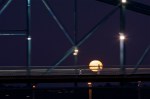
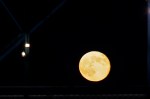
I intended to shoot the moon (I know it’s a pun, but it makes me giggle) after hang gliding last weekend, but I missed the true full moon because hang gliding was so exhausting that I slept right through the moonrise. So, I shot the almost-full moon the next night instead.  [Photography lesson learned: a monopod is not the right solution for long-exposure shots with a big, heavy 100-400mm lens. That said, some of the blurry shots are still interesting.]  We raced out to the Market St Bridge to find a place to shoot just before moonrise.

Standing on the bridge after another hot day provides the relief of the cool breeze that seems to be constantly blowing over the river. I admit that when we visited last January, we didn’t find this breeze so refreshing, though. People go by in all shapes, sizes, ethnicities, and fashion styles. My favorites are the cops on Segways. The blue lights on the Segways always make interesting light patterns as they travel across the bridge. You can hang out on the Walnut St bridge–there are benches. The Market St. bridge is not so hang-out friendly. As we wait for the moon to rise, our fellow pedestrians rush by without pausing, although usually with a friendly greeting.

No one seems to wonder what we are doing there–I suppose a camera offers it’s own explanation. I imagine this town is familiar with gawkers and photographers alike. I have seen photographers far better equipped than me wandering around the riverfront, shooting the fantastic views of Chattanooga’s downtown area–there are a lot of subjects to choose from.

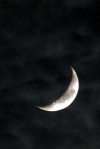
Shooting requires concentration. Trying to hold a big lens still in a strong breeze becomes a sort of meditation: position yourself, take a deep breath, set up for the shot, breathe out, hold everything as still as possible, snap the shot. The moon rises quickly–as if it’s worried it’s late for it’s nightly appointment. In the fading sunlight, it glows big and orange. I see the man in the moon clearly through my lens and wonder who decided it looked like a man. But, I feel the pull of it’s magic.  What is it about the moon that makes my blood run at a different pace?  It looks so naked hanging there in reflected light, yet what does its nakedness reveal?  That the moon still seems mysterious in a time when it has been picked clean of all its secrets speaks to just how magical it is.  This night, it looms large and poses for me only briefly.

Hanging on Air

When we decided to move to Chattanooga, one of the attractions was it’s proximity to Lookout Mountain Hang Gliding Park.  Hang gliding wasn’t really on my bucket list, but it was on my husband’s.  For me, I just hate to miss out on anything.  So, adventure number one was the Introductory Experience.

We arrived at the park office at quarter ’til 8AM.  The office perched high above the valley with an ominous looking concrete . . . slide?  The words that popped into my head when I saw it were, “Ramp of Death.”  But wasn’t so much a ramp as a concreted coating on the top of the mountain that started out looking reassuringly level and then took a nasty bend at almost a 90 degree angle, directing my gaze straight down a 2000 ft drop.   My stomach started doing flips–and not for joy.  Fortunately for me, the Introductory Experience package we’d signed up for did not include that kind of leap of faith!  Instead, after signing in, we were led down the mountain to the valley below to start learning on the bunny hill.

I love learning.  It’s the best part of life.  But the frustrating thing is how slowly new lessons sink in.  Especially when it includes making your body do something it’s never done before.  Picking up a hang glider and running across a field with it is one of those things.  It looks easy enough.  But finding the right spot on your shoulders to balance the weight of the glider is tricky and sometimes painful.  Then, there is wind.  There was no wind until I put a glider on my back, but as soon as I had wings, there was air moving me in directions I didn’t want to go.  The glider is designed to take flight.  You would think that would make it easier to carry.  But getting it to fly straight isn’t all that easy.  Especially when your airspeed is something less than 3 MPH.

Then there is the difference between knowing what you’re supposed to do in your mind and actually doing it.  I vaguely recall an article about how your brain has to build new neural pathways to allow you to perform an action that you have not performed before–being told what to do is not sufficient to allow you to do it until your brain finds a way to communicate the appropriate action for each muscle fiber to take and can coordinate all of those actions.  My brain seems a little stubborn.  For example, one of the things we were told when we graduated from the flat ground to the actual bunny hill was that we needed to run and keep running until we had taken three steps in the air.  Until you haven’t hit ground for three steps, you really haven’t launched.  The instructor repeated this message 9 more times as we each did our ground test hanging in a glider on a stand.  I said this to myself over and over as I prepared for my first launch.  “Keep running.  One, two, three steps in the air.  Keep running.”  But when I started down the hill and I felt myself lifting off the ground, what did I do?  I stopped running.  Then I landed hard, belly-flopped onto the ground and drug my body flat across the grassy slope at a rate of speed fast enough to make the tops of my feet feel like they were on fire.
But why did I stop running?  I know how to run.  I don’t need a new pathway to tell my legs how to move.  Yet, apparently, there is some message heavily coded in my brain that says, “Don’t run when you’re airborne.”  Where did that come from?  I’ve never run into the air before except in my dreams.  Maybe I stopped running when I was dreaming?

After gliding (dragging?) down the hill on my belly one more time, something in my brain clicked.  I couldn’t remember when I stopped running.  I couldn’t remember the feeling of running in the air.  It took two belly flops for me to even realize that I stopped running too soon.  The third run, that was a primary thought in my mind, “Just keep running.”  Not just before I started down the hill, but as I was picking up speed, feeling the harness pull against me, feeling myself lifting into the air, “Just keep running.”  And I felt myself running in the air, lifted off the ground, suspended by wings.  Then, I stopped running.  It was a glorious few seconds of flight.
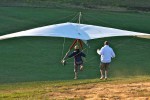
Later that afternoon, we went for a tandem ride, each of us gliding with an instructor.  Being sympathetic to beginners, Lookout Mountain uses ultralight airplanes to tow tandem rides from the ground rather than having us run off the cliff together.  Saved from jumping off the cliff!

My instructor, Clayton, checks in to see how I’m doing.  To tell the truth, I’m not sure how I’m doing.  During take off, the glider starts to climb almost immediately, but there are a lot of jerks and bumps while being towed.  Watching the plane in front of us bumping up and down in the turbulence creates visions of horrible crashes in my mind.  I keep reminding myself that a glider is forgiving and there is plenty of room for recovery.

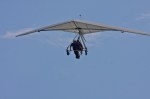
After detaching from the tow plane, we soar above the valley.  When you look out the window of an airliner, you don’t think about the experience of the wings.  Today, I am strapped to the wings–exhilaration and a small beep of terror compete for my attention as the air rushes around me.  Clayton finds a thermal and we circle our way up to nearly 3600 feet.  I’ve been in helicopters and a sailplane, but neither provides the view from a hang glider.  There is nothing between you and the ground.  I wonder how an eagle spots a fish.  I imagine spotting a fish and diving towards the earth with the assuredness of being born for flight.  I experience “eagleness” for a brief moment.

But the moments of exhilaration are clouded with fear.  I feel the tension in my body that indicates adrenaline is flowing.  I cannot relax although I try.  When I do relax for a moment, the glider bumps in an invisible shift of rising and sinking air and I am tense all over again.  I wonder how anyone can feel secure suspended from a giant kite?  I wonder why I am there.  Then, I return to that moment.  That instant of soaring above the earth experiencing lift and rushing air and the endless view.  There is no wondering and no fear when I am no where else in my head.  When I am mentally where I am physically, I am simply there.  No thoughts of crashing, no thoughts of falling, no thoughts of any kind.  I breathe in and I enjoy.