It’s Christmas all over again for me today. I have been playing with my new toys, a really great tripod and wireless shutter control, for a couple of weeks here and there, but today, I get to take them with me to a workshop. And not just any workshop, we’re going to shoot at the Tennessee Aquarium and along the water front. And, we don’t just get to shoot at the aquarium; we get to shoot before they open! I’m so excited, I wake up long before my alarm and can’t get back to sleep.
As I finish pulling everything together and get ready to walk out the door, Pat tells me he will drive me over to the aquarium. It seems a little silly to me, but it is early and I will be carrying a lot of stuff, so I accept his offer of a ride. It takes longer to clear the windows on the van, which have fogged up over night although it didn’t get cold enough for a frost, then it does to drive across the Market St Bridge, but it’s nice not to have to haul my gear over.
The aquarium is quiet. There are only a couple of grounds crew members sweeping up outside–in an hour, the place will be swarming with kids. I walk to the members entrance and find no one. I am a few minutes earlier than the stated time to arrive, but I’m also a few minutes later than they said someone would be at the door. Before I have time to worry about whether I’m in the wrong place, a woman appears and comes over to let me in. As it turns out, she’s guiding each attendee to the top of the escalator and pointing us in the right direction before returning to the door.
I find the classroom with no trouble and we sit and talk and drink coffee while we wait for the remaining attendees. A girl who works for the aquarium (or perhaps volunteers?) comes in to clean the turtle cages. While our instructor gives us a run down of where we’ll be going in the aquarium, the girl stands up and says, “Um, I have a situation here,” as calm as can be. She is holding up a small box turtle who has hold of a chunk of her finger. No one reacts for what must be nearly 30 seconds, thinking she knows what she’s doing, I suppose. Then, a woman next to the girl asks if she needs help. The girl nods and the woman and a man across from me spring into action trying to get the turtle to let go of the girl’s finger. I suggest trying to get the turtle to bite on a stick instead, but this causes the turtle to try to pull its head back in its shell, still holding onto the girl’s finger. It looks like he’s going to rip a chunk of her finger off the way her skin is pulling. At this point, the guy helping suggests putting the turtle back in the cage. When the girl sets the turtle down, he lets go. But, she is in pain and with all that adrenaline rushing through her body, starts to cry, adding to her embarassment. The woman takes her to the sink and runs cold water on the girl’s injury when one of the instructor’s returns with an aquarium employee. We learn that the best way to get a turtle to release is to dunk it under water. After we all settle down again, the aquarium employee says, “Well, I guess I don’t have to warn you about reaching into the turtle cages!”
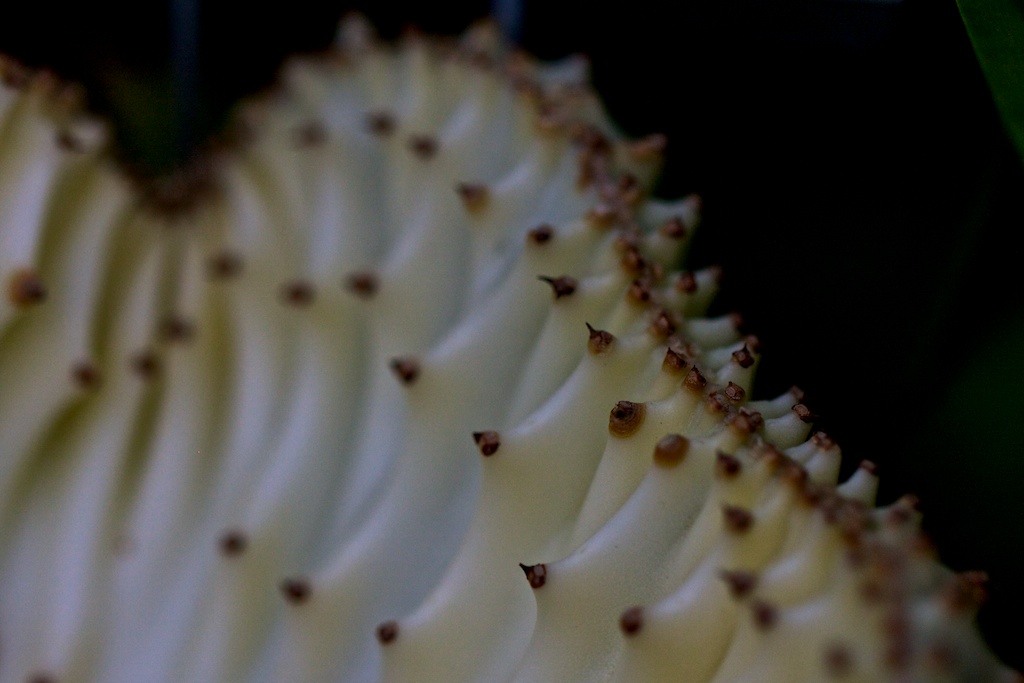
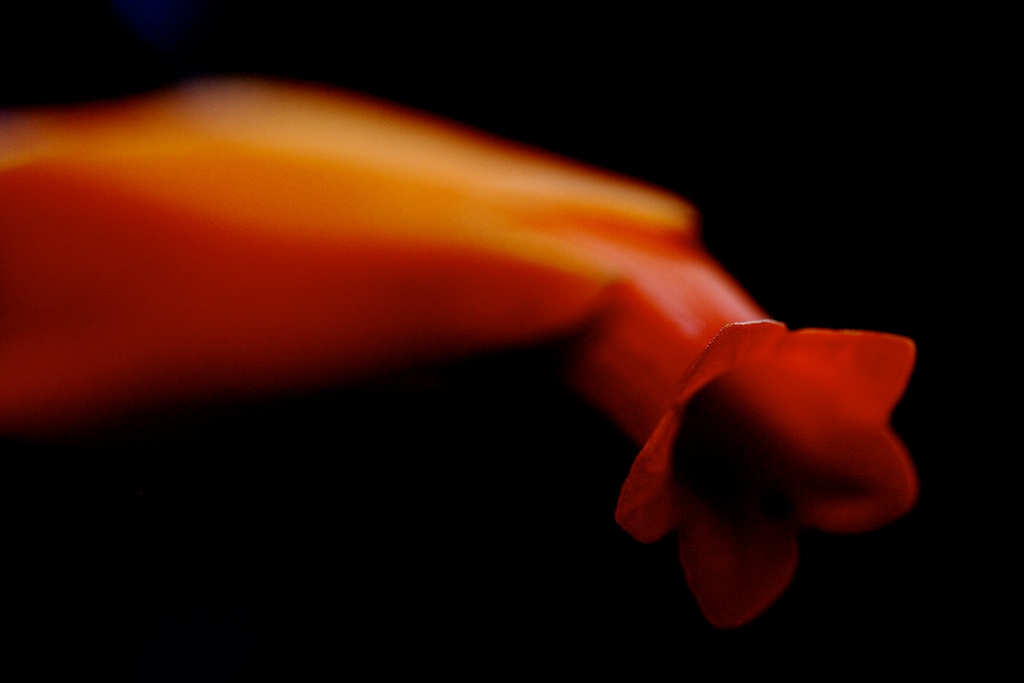
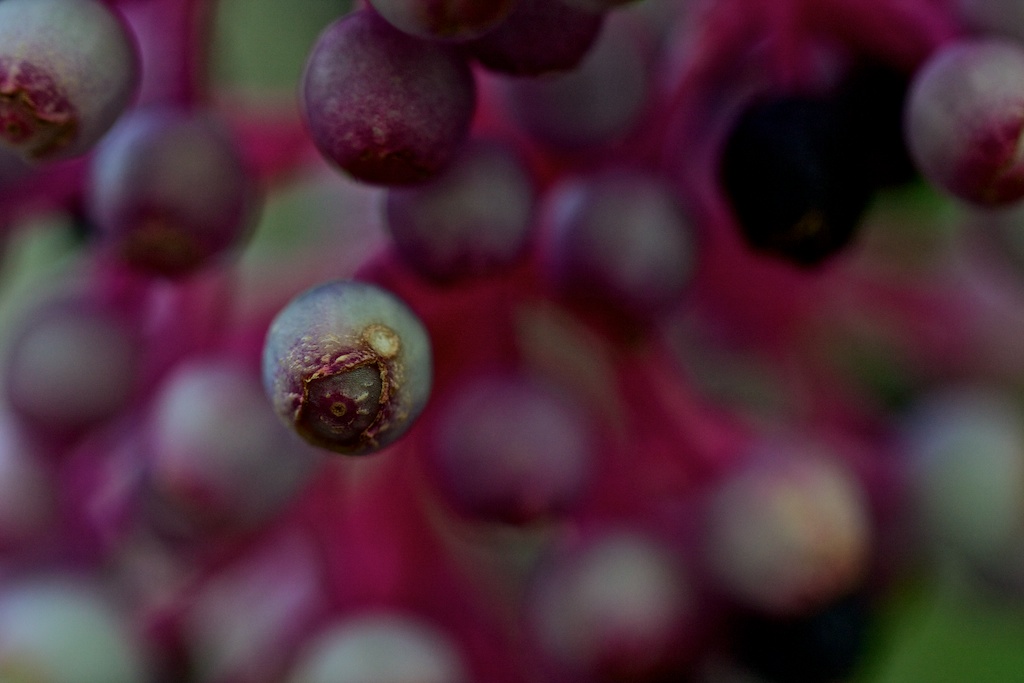
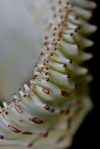
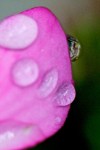
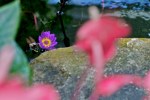
We head out to the aquarium to start shooting. We begin in the tropical setting where the Macaws are not yet on display, to my disappointment. There is a tank with rays for petting, but I decide I’m more interested in shooting the flowers in this area. I go back to the lobby area at the top of the escalators to do a lens change–it’s too humid in the tropical garden area. Then I return and practice some macro shots of flowers.
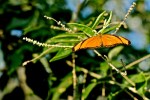
Next, I move into the butterfly garden, which is even more humid, and do my best to get a shot of the butterflies. I really want one of the butterflies that look mostly brown on the outside of their wings and then brilliant, metallic blue on the inside of their wings. I, like everyone else, want a shot of them with open wings. They are not cooperating. I find one alighted and wait and wait and wait. The instructor comes in and explains to me that they only open their wings when they need energy and are parked in the sun. The butterfly I’ve been waiting on is in the shade, so I look for another one to wait on. I manage to snap a few other butterflies in the process, but I never do get a shot of blue wings–we only have an hour before the aquarium opens and I want to make sure I get to the penguins before the kids come in.
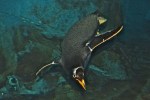
When I head down to the penguins, I pull out my tripod. I crank up the ISO setting, open up my aperture, and set up the tripod so I get some stability, but can still swing the lens around to follow swimming penguins. This turns out to be an impossible task. Fortunately, the instructor comes along and does something surprising: he stops down my aperture setting, turns down the ISO setting, and turns on my flash. I have never had much success with my flash and have pretty much avoided using it as much as possible instead of learning what I can do with it. Flash has been one of those things on my list of skills to worry about later. Today, I learn how much a flash, even the built-in variety, can help, even when shooting through glass. By choosing the proper angle to the glass, I’m able to get some halfway decent shots of swimming penguins. Although they do all have red-eye. Something to correct later.
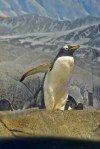
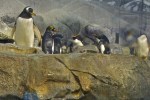
I have a harder time shooting the penguins on land. There is about 4 inches of glass between the top of the water and the bottom of the water spray splattered all over the glass. That 4 inches remains clear because the water sloshes back and forth as the penguins swim around, rinsing the glass. So, the trick to shooting the penguins on land is to shoot through those four inches when the water is sloshing the opposite direction. I have a hard time getting my timing of when the penguins are doing something interesting and when the water is sloshing the right direction down. Or perhaps the penguins are just toying with me. In any case, I can’t say I got a great shot of the penguins, but at least it was an improvement on what I was able to do on my own. Plus, I now have come face-to-face with my flash-phobia, the first step in getting better.
We spend some time in the classroom going through some shots of the instructors and talking about the choices they made given the circumstances to create the images they share. One trick that I’ve never heard before was that, if your sky is going to be white, make it go all the way across the top of the picture. I often end up with white skies. I will have to pay more attention to that the next time my sky is going to be overexposed. Alternatively, I could learn how to layer together two different exposures so I don’t have white skies, but I already feel like I spend more time than I’d like processing photos.
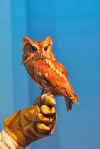
We return to the aquarium to watch a bird show where they bring out an Eastern Screech Owl and a Eurasian Eagle Owl. I love owls. My camera picks this moment to stop working. I take it to the instructor to see if he can tell what’s going on. In the end, I have to reboot. Turning the camera on and off solves whatever hiccup happened. But, now I am at a bad angle to the owls and they are in shadow. For having someone holding a bird posing to take a picture, you’d think I’d be able to get a really good shot.
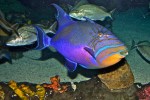
Next we head to the seahorses where we, once again, practice using flash in front of glass. It’s tricky to get my lens to focus on the seahorses. I’m using my 100mm macro lens and I have to focus it manually to get it close and then let it refocus automatically since I can’t see well enough without my reading glasses to tell if I’m in focus or not and the seahorses move enough that the focus changes rapidly. I spend so much time trying to get decent shots of the seahorses that I run out of time to shoot any jellies.
After another classroom session and lunch, we go outside. Unfortunately, it’s now early afternoon and the light is about as bad as it gets. I put my polarizer on my lens in the hope of getting rid of some of the glare, but the sharp shadows make it challenging to get good shots. I end up walking around with one of my the other attendees and as we talk, I learn that not only does he also work for the same company I do, but he works with the same guy that sat next to me on the way to Germany. While I suppose the fact that they all came from an acquired company based in Atlanta combined with the fact that Atlanta is close enough that a lot of people come from there to Chattanooga on the weekend for a get away makes it more probable that this guy and I would end up in the same workshop, but still. What are the odds?
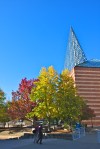
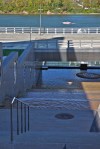
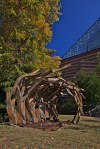
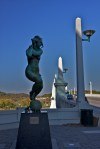
We work our way around from the Hunter Museum and Walnut St bridge to the Bluffview Art District and the sculpture garden. Then, we head back in the direction of the aquarium. We end up walking down the waterfall steps that go down the side of the aquarium. I’ve never walked down them before. They go under the street where there are interesting reflections and a cool view of the large fountain that shoots into the river. He shows me a gate that allows us to go through and walk out to the waterfront–I never knew you could get through there. We work our way back around to the aquarium until we return to the final part of the workshop.
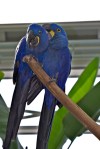
After we wrap up, I return to the tropical display to shoot the Macaws. They are out now, each performing their own tricks. One likes to groom on the other non-stop. The other periodically breaks away from the grooming to go hang on the end of the stand by his beak. He watches me shoot him as he performs this trick and I’m pretty sure he’s used to star treatment.
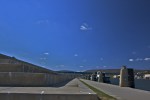
Leaving the aquarium, I decide to walk back instead of having Pat pick me up. Although I’m tired from lugging my gear around all day, I want to shoot our side of the river from the bridge. I don’t spend a lot of time doing this–I take only hand-held shots–but I do get a few nice views of our building and the falls colors on the hill behind it.
Returning home, I can’t wait to see what my pictures look like on the computer.































 nomadicmainstream