Flowers and Fungi

These early bloomers captured rain drops

These early bloomers captured rain drops

On a nature walk on Saturday, we were surprised to discover spring wild flowers in full bloom tucked amongst the leaf litter on the forest floor.  I don’t remember the name of these blooms, but they are often among the earliest to appear in the spring.  The thing is, it’s not spring.  We haven’t even reached Imbolc yet–it seems horribly risky for a delicate spring flower to appear so early.

The likelihood that it will manage to set seed before the weather turns too cold for survival seems very slim.  But it blooms anyway.

A completely different kind of "bloom"

A completely different kind of “bloom”

A flower, presumably, doesn’t ask questions about risk and reward.  It simply responds to the external events of water, sun, and temperature.  It doesn’t check the calendar before the seed begins to sprout.  Collectively, perhaps the seeds will have slightly different trigger points and only a few will sprout now.  The rest will require more warmth longer before they come to life.  And, in this way (I hope), the next generation will come from the seeds whose triggers allowed them to survive long enough to produce more seed.
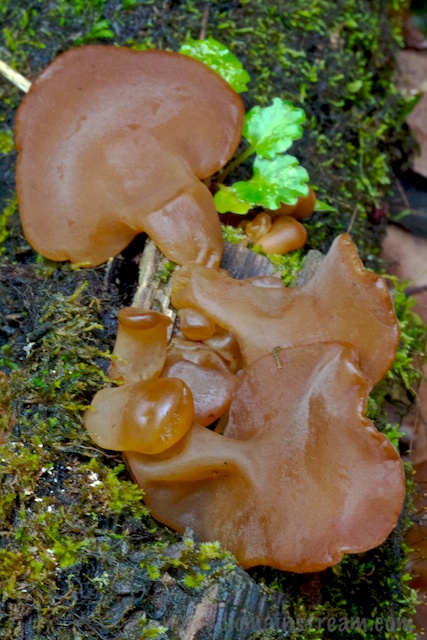
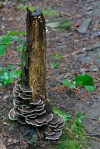
Wood ears may not quite qualify in our traditional definition of "bloom," but they sure are interesting

Wood ears may not quite qualify in our traditional definition of “bloom,” but they sure are interesting

If we think of these flowers as a single entity instead of individual flowers, perhaps the lesson is more applicable to us as individuals.  Otherwise it may be tempting to take a lesson along the traditional lines of “only the strong survive” when the reality is that often it is not the strong that survive, it is the timely.

If we think of those early bloomers as the first attempt in the process of trial and error, perhaps the lesson is more applicable to our own lives.  After all, being timely requires a lot of luck.  If we sit around dormant until the exact right time, we’ve already missed it when we realize it’s come.  But if we put up a few sprouts too early, we get to practice and practice some more.  And when the right time comes, we’re there, ready and blooming at just the right time.
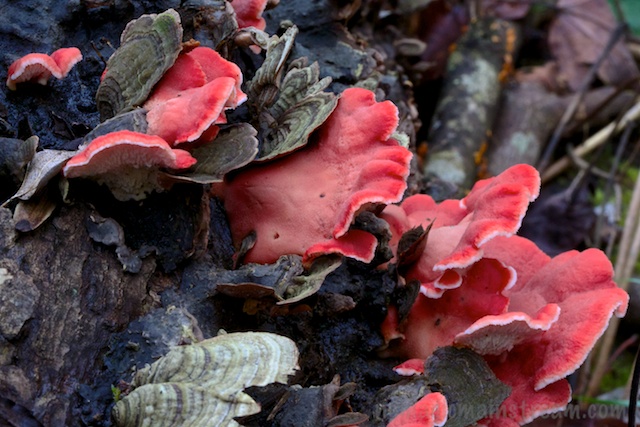
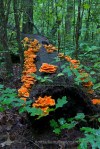
Layers of mixed fungi make a fascinating display on a rotting log

Layers of mixed fungi make a fascinating display on a rotting log

Fungi work differently.  They largely reproduce via spores, which are different from seeds in that there’s no pollination.  While I know very little about fungi, reportedly, at least some of them produce spores on their own time clock without regard for environmental conditions.  Others require environmental factors that include nutrient levels, carbon dioxide levels, and and light levels (see microbiologybytes.com).  Another study I found suggests that atmospheric moisture (which I assume is the same thing as humidity) has the greatest impact on how much fungus grows.  This seems a bit like saying the ground will be wet when it rains to me–after all, do we really need a study to tell us that more humidity drives more fungal growth?
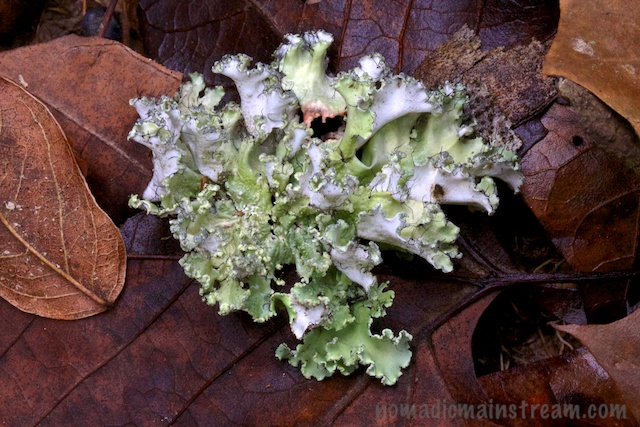
This is neither a flower nor a fungus--it's a Lichen

This is neither a flower nor a fungus–it may look like lettuce, but it’s a Lichen

That being beside the point, the continual, misting rain for the past few weeks has created a unique kind of bloom.  Although the fungi had faded a bit from their peak, there were still some really beautiful colonies.  Beautiful fungi–words I never expected to write together.

Final look at the more colorful fungus we saw

Final look at the more colorful fungus we saw
Up Close and Personal

I have decided I need to use my flash a lot.  Nothing fancy.  Just put it on the camera and use it so I can get used to what it looks like on camera.  Then, maybe I’ll be better able to see the differences when I take it off camera.

But what to shoot now that I’ve decided to undertake this learning process?  Tisen looks mighty relaxed laying on a comforter on the couch.  And he did just get a brand new hat from Twiggy’s mom.  Plus, he’s a little bored now that Twiggy has gone home.

I wrap a snoot around the flash and decide to start with capturing him in his hat.  I like the head-on image the best even though the flash catches the haze of blue in his eyes, probably indicating cataracts.

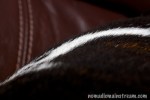
Then, I see my down jacket next to him on the sofa and decide to see what happens when I take a macro shot with my flash.  The snoot projects the light to the background, leaving the jacket in the foreground unlit.  When I look at the shot on the big screen, I’m surprised to discover the fabric has a distinct pattern.  I’d always thought it was perfectly smooth.

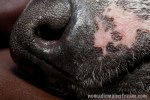
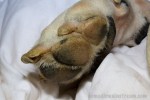
Then I decide to go macro on Tisen.  Poor guy.  I would feel sorry for him, but he barely moved once I took his hat off, seeming perfectly content to model for his crazy mom with the big black camera that kept flashing at him.

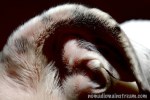
It’s interesting to see the parts of a dog up close.  For one thing, he’s dirty than I thought he was!  His little pig ears always makes me laugh.  When he walks, the tip bounces up and down, flopped over at about the halfway point.

I try to shoot his tail, another source of a smile.  He wags enthusiastically when we go for walks.  People pass us on the street and say, “Now that’s a happy dog!” as he goes by with a toy in his mouth and his tail keeping a steady beat.  But tonight no shot of his tail is to be had.  It’s the one part he keeps tucked underneath and I don’t want to risk annoying him to the point where he gets up and lies on his bed under the desk.

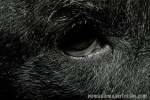
I do manage to shoot both sides of his face, but the white side keeps blowing out with the flash.  The black side makes for a creepy close up of his eye.  He stares at me, blinking from the flash.  I wonder what he thinks I’m doing to him.

The poor guy is still struggling with allergies and hot spots.  We’ve changed his diet again; it seems he’s allergic to the turkey we’ve been feeding him.  I’m about to give up and put him on antibiotics again.  It’s hard to wait to see if he will heal on his own when it’s obvious he’s uncomfortable.

Bubble Wrap

I mentioned in yesterday’s post that we will be home for Christmas this year.  I didn’t mention why.  We’re moving.  It’s not the kind of move that makes my Nomadic heart sing, but it’s a move none-the-less.  We are moving to a quieter place not far away from where we are now.

I have moved many times in my adult life.  My moving truisms:  1)  move often, 2) take little, and 3) start packing early.  1 and 2 are intricately related.

Toward this end, I start cleaning out excess stuff and packing what we want to keep even though we are several weeks away from our move.  It’s a busy time of year at work and at home, so the earlier I get started, the less stressed I’ll be.

This means pulling out the empty boxes from our last move along with the bubble wrap and paper packing material, and packing away the decorative things that make us feel at home.  I start with the photos displayed on our walls, mostly by photographers far more talented that I.

It takes yards of bubble wrap to safely package the photos framed under glass.  I wrap each one lovingly, remembering the photographers whose works I display on my walls.

I am tempted to pop the bubbles in some of the wrap.  It’s hard to resist the popping noise bubble wrap makes when you jump on it.  But, it doesn’t make for good protection once it’s been popped.

When I’ve packed the photos and most of the non-essentials in the bedroom, there is still a stack of bubble wrap left on the floor, perfectly sized for wrapping glasses.  It’s too soon to pack glassware, something we most definitely use every day.

I hold a piece of bubble wrap up in the early afternoon light streaming through the windows and get an idea.  What if I were to shoot the view through the bubble wrap?

I imagine reflections of the city skyline in the bubbles like those commonly seen in water droplets.   Then, I imagine a distortion that makes the city look like it’s inside a snow globe.  I can’t wait to give it a try.

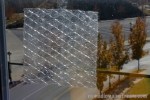
I tape a single square of bubble wrap to the window then press my lens close to the glass next to the bubble wrap and focus on the skyline in the distance.  I move my lens so I’m shooting through the bubble wrap and search for an image that might look like something.

Alas, there is so much distortion, most of the focus is lost.  There are no reflections in the air inside the bubbles like there would be in a water droplet.  The plastic creates flare, like when shooting into the sun, but it doesn’t really create a globe effect.

While I’m not fond of the resulting images (I like the macro shots of the bubble wrap better), at least I found a way to play with bubble wrap without destroying it.

Butterfly Business

I’m embarrassed to admit that I am capable of naming only one butterfly.  The monarch.  There are 125 butterflies found in Tennessee, according to a local chapter of butterfly enthusiasts.  I have heard of exactly 1 of them.  Yes, it’s still the Monarch.

These are the kinds of things that make me wonder what I’ve been doing all my life.  I mean really, as someone who spends as much time outdoors as I do and who particularly enjoys wildlife, how did I make it this far without realizing there were so many kinds of butterflies right outside my door?

I am trying to stick to working on birding rather than shifting over to butterflies now.  I’m a bit jealous because it seems like many of my new birding acquaintances are as good at identifying butterflies as they are at identifying birds.  I’m still working at getting good at identifying birds.  It’s been a couple decades in the making, so if I start in on butterflies, too, I will never be good at either of them.

Failing identification, I figure I can at least capture the butterflies permanently as an image.  So, I sneak up on a tiny little yellow butterfly flitting in the grass.  Apparently I am not so good at sneaking.  It flies away with a particularly aggressive flap, which I take as an expression of its disgruntlement over having its meal interrupted.

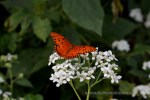
The next butterfly I chase is a red and black one.  It lands on a plant briefly, right next to a grasshopper and then immediately flies away again.  This is a great survival strategy as I am, of course, now interested in shooting the grasshopper instead of trying to chase the butterfly into tall weeds.  The grasshopper, however, is no more cooperative, just more of a tease.  It stays still just long enough for me to get it in focus and then hops just far enough away to require me to refocus.  We play this game for several minutes before Tisen gets impatient and insists we go on our way.

(Photographers note:  Do I get bonus points for not only hand-holding macro shots, but doing it while holding my dog’s leash?  I just can’t help multi-tasking.)

Next, we encounter a larger black and red type butterfly who seems content to be photographed.  I take no chances, shooting from far back, taking a step closer, refocusing, shooting again.  I work my way closer and closer until I get almost the shot I wanted.  Then, when I am so close to getting exactly what I was hoping for, my new model decides it has had enough and abandons its post.

I have similar luck with some kind of skipper (did you know there was such a thing as a skipper?) on a dark purple flower.  I’m fascinated by it’s big, fake eyes.  It doesn’t fly far, but it won’t hold still.

Once again, Tisen gets impatient with me and we head back towards home.

Fall Friends

Tisen and I have been discovering friends new and old on many of our walks of late.  The other day, for example, we crossed the street to enter the park and found Tisen’s girlfriend Twiggy out for a stroll with her mom and dad.

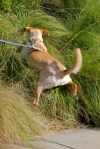
Twiggy wasn’t up for romance, however.  Today, her mind is all about the rampant rodent population living in the tall grasses growing on the hillside.  It’s fall, after all, and the busy critters have been breeding all summer.  Now, the entire population is fattening up for winter.  From Twiggy’s perspective, it probably seems like a buffet.

In spite of Twiggy’s amazing leaps and bounds, she comes up empty mouthed.  Tisen, however, looks at her with adoration like he can’t believe her athletic prowess and is imagining her bringing home venison for dinner.

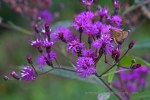
We say our goodbyes and are soon greeted by deep purple flowers that I’m going to guess are some sort of variety of fall asters, although they look far more cultivated than the wild variety that used to grow in our garden up North.

They bob and curtsy at us as our friends the Goldfinches, who are not looking so gold these days, land and depart on the dried seed pods of nearby plants.  I believe these were once our friends the purple coneflowers that have now shriveled into thin, brown mummies.  The goldfinches continue visiting them and harvesting their seed, storing it as fat for their winter coat.

I am reminded of the lateness of the season by all of this activity.  The days are shorter, the temperatures nearly tolerable, and the birds are far quieter.  I pause for a moment and listen.  A month ago, I would have heard a Titmouse, a Chickadee, a Cardinal, a Wren, a Towhee, a Robin, and an Indigo bunting in this park.  Today, all I hear are the cicadas buzzing away with their strange song.

While Twiggy may be too busy hunting to think about romance, for me, this is always the most romantic time of year.  A sense of nostalgia sets in along with the inevitable awareness of time passing that comes with it.  Another year wrapping up.  Autumn is more poignant than new year’s when it comes to reminding me of my own mortality.  In the fall, everything seems to be moving on in one way or another.  Perhaps as a nomad (at least in my imagination), I long for my own migration.

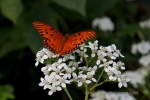
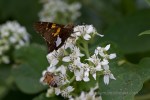
When Tisen and I encounter our next group of friends, the bees and butterflies, so dense on a brilliant white flower I don’t recognize that they’re sharing blossoms, I remember that this is migration season for the butterflies, too.  While the bees will hole up for the winter, the butterflies will take to the winds and head for warmer climates.  I look at these tiny, delicate insect-birds and wonder how they can possibly migrate a few dozen miles, let alone thousands.  One of life’s many wonders.

Through the Woods

Stepping silently is impossible, especially in the woods.  But under the refuge of a heavy rain, each step disappears, blunted and blended into the sounds of the rain.  If ever I needed to escape or evade, I would hope for a downpour to hide my sound, my scent, my very presence, truly allowing me to leave no trace.

Perhaps it is the feeling of being encapsulated in a rain shower that causes an illusion of privacy.  As we put one foot solidly in front of the other, I forget my companions.  I look around in a panic realizing I haven’t heard Tisen’s familiar jingle for quite a few yards.  He is close at my husband’s heels, still trying to keep his head dry by hanging out under the over hang of Pat’s pack.  He hasn’t yet learned rain is its own kind of shelter.

Stepping through the rain becomes a meditation.  I cannot hear my own breath nor even my thoughts.  My mind has gone still and I focus on planting a trekking pole, placing a foot, planting the other trekking pole, placing the other foot.  I feel the muscles in my arms flex as I push off the poles.  I feel the twinge in my knee that threatens to turn into a sharp stab should I push it too hard.  My shoulders are already screaming.  I shift my focus back to my steps.  I don’t think about the distance left or the distance behind.  For those moments, I am my feet, my arms, my shoulders, my legs.  My boots and the ground move together as if the earth moves with me and all of me has melted; I am the rain.

Then, it stops raining.  My metaphysical moment evaporates even before the sun dares to break in through the clouds.

Returned to my more mundane reality, we find a spot to stop for a snack.  I slide out of my pack and dump it, rain cover down, onto a log.  It looks like an overturned turtle who has given up and stopped waving its legs.

I can’t remember ever enjoying trail mix so much as I enjoy it standing on the trail with a grumbling stomach, wondering if we will make it back without stopping for lunch.  Tisen stretches out and opts for a quick nap while we finish eating our apples before strapping our packs back on.

Now, the wet forest demands my photographer’s eye.  Every stretch of the trail reveals even more beautiful mushrooms.  I do my best to capture some of them with my 24-70mm lens, but I wish there were such a thing as a weightless macro lens and tripod so I could get up close and not worry about camera shake.

We hike faster as we get near the end.  My mind is no longer in the moment.  I’m longing for when I can set down my pack and know I don’t have to pick it up again for a very long time.


Finding Sanctuary

I discovered tonight that I’m almost out of digital photos I haven’t used in a blog post!  Who knew a year of blogging could use up 9 years of digital photos?  I’m going to have to start searching the archives again–there have to be more photos in there!

I did discover these series of shots taken two years ago during an annual trip to Portland, Oregon.  Pat and I went to the local Audubon Society Preserve there and did a hike through their woods.

It’s an amazing property for many reasons.  First, it’s been meticulously maintained as a natural, native habitat.  Most people don’t associate “meticulous maintenance” with “natural, native habitat.”  Usually, we think of a golf course.  Unfortunately, as I know from volunteering at the Audubon Society here in Chattanooga, without ongoing hard labor to remove the invasive species that pop up every time one turns one’s head, they get out of control and turn native habitat into something completely foreign.  It’s unfortunate we humans can’t agree that invasive species shouldn’t be sold or planted.  Until we do, those of us who value preserving native ecosystems have a lot of work to do to prevent those habitats from being overrun by the rest of the population’s right to decide what to plant on their own property.  But, don’t let me get on that soapbox.

The Portland Audubon Sanctuary is a 150 acre property of dense forest, including a stand of old growth trees, a pond, and a creek that’s carved some small hills within the already hilly Portland topography.

Walking through the forest area made us think we were in the rain forests of the Olympic Peninsula of Washington state.  We didn’t see too many birds while we were hiking.  Those we did see were a tough for me to ID–somehow, even the birds that also live in the East looked different enough that I couldn’t feel confident I’d correctly identified them.

When we stopped at the lovely gazebo on the pond at the sanctuary, we discovered a group who was out watching a Northern Saw-whet Owl perched in a tree and up so high that without binoculars, it couldn’t be spotted.  Fortunately, a kind man let me look through his so I could see it, too.  It was about the size of a Screech Owl (tiny) and very adorable.

The Portland Audubon Sanctuary also boasted some spectacular fungal growths.  Between the mushrooms and the weird, coral-like growths, I didn’t mind my limited success at birding (especially since I was without binocs).

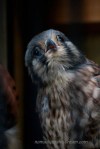
In addition to the Sanctuary, they also provide rescue services for injured birds and keep some unreleasable birds on display for educational purposes.  This mean being guaranteed to see some interesting birds even if nothing in the woods showed itself.  I particularly liked the Americal Kestrels on display.  They looked like they were making faces at me.

It’s a great place to visit and support if you’re ever in the Portland area.

Bloodroot

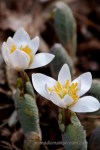
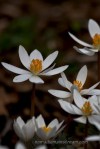
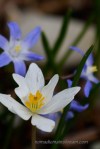
I don’t have photos to go with what I want to write about today (thankfully).  In looking for photos, I stumbled across these macro images of bloodroot flowers, blooming in the early spring, lasting only a few days, and then blowing away in the wind.  This seems like the perfect symbolism for the topic on my mind.

I scanned the names of the dead from the Aurora massacre, hoping not to recognize any of the names, having worked with many colleagues in the vicinity.  I didn’t.  But it broke my heart anyway.

I cannot imagine what makes a person start buying weapons for a war and then go wage that war in a local movie theater.  It’s the most troubling part of the whole thing:  Why?

There have been times when I have said I wanted to kill someone.  What I meant was I wanted to have the power to make the other person regret whatever it was they did that upset me.  Even in my fantasies this is accomplished via a stern and thoroughly brilliant speech.

I ponder this feeling for a moment.  I wonder where the line is between being angry and imagining some sort of reckoning where we are righteous and brave and we smite our enemy versus actually resorting to physical violence?

I also wonder how much the anger and frustration I unleash upon the world creates more anger and frustration in a domino effect.

When I used to ride my bike 26 miles to work and back, if I rode with the expectation that cars were going to run me over and the attitude that I wanted to “kill” them for it, I frequently got honked at, buzzed, and generally terrified by passing cars even though I did not perceive myself to be riding any differently.

When I rode so thoroughly enjoying the ride that I didn’t have any space left for anger, I realized I smiled and waved at drivers whenever they did anything considerate, feeling grateful they were thinking of me.  No one ever honked at me when I rode with this attitude.  I didn’t get buzzed and I wasn’t terrified.

Is it possible we ultimately can prevent killing sprees with something as simple as a smile?

If we can make a connection, can a potential killer see us as real?  That is, see us as they see themselves–intertwined, interdependent, beautiful flesh and blood?  Shouldn’t finding that connection, nourishing it, keeping it alive as long as possible be our top priority no matter where we are, who we’re with, or what we’re doing?

Maybe we can’t stop someone from becoming a killer, but maybe we can at least reduce the number of people who walk around fantasizing about killing people.  And maybe that will lead to more smiles and a little more joy all around.  After all, if I’m going to get gunned down by a homicidal maniac, I’d like to have spent the time I had smiling.

The Last Mimosa

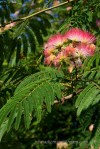
I’m saddened to learn that the Mimosa tree is an invasive tree from Asia that doesn’t belong here.  In fact, the Tennessee Exotic Pest Council ranks it as a severe threat.  This makes me sad because I was really enjoying the blossoms, but I feel strongly that invasive plant species need to be removed from non-native habitats.  Now I feel like a traitor–aggrandizing the enemy.

But, I can’t help but indulge my irresponsible self one last time before I turn my back on the Mimosa tree (don’t worry, I’m sure I’ll continue to indulge in the beverage on the rare occasions the opportunity presents itself–too bad it’s not the drink that’s invasive instead of the tree).

In case you are unfamiliar with the problem of invasive species, I confess it’s a bit of a sore spot with me.  Having spent many weekends trying to remove plants that were taking over my own yard as well as the neighborhood, I know how difficult these plants are to control first hand.

In the US, we tend to plant what we think is pretty and/or is easy to grow. We fiercely defend our property rights and believe what we plant in our yard is our own business.  Unfortunately, invasive plants don’t stay on our property.  They spread through an amazing variety of means and grow quickly out of control since whatever keeps them in check in their native habitat doesn’t exist in the ecosystem they have been introduced to.

While we sometimes call native plants “weeds” because we don’t like the way they look and they grow in places we don’t want them to, these aren’t the same as invasives.  Invasive species do outright harm to an ecosystem.

As we all know (I hope), every living thing has interdependencies with other living things.  Whether it’s for shelter, food, temperature control–all of the above, no creature can exist without other creatures to support it (depending on what you call a “creature,” I guess).  Plants are a critical component of this web.

Invasive trees like the Mimosa reek havoc upon the availability of necessities by crowding out the native trees and plants that would provide them.  Because invasives didn’t evolve with the rest of the ecosystem, they fail to provide the critical (and often subtle) requirements that the native plants would provide.

This is my plea:  the next time you plant something, remember that what you plant will spread far and wide whether you know it or not.  Make a choice that everyone can live with (including wildlife) instead of just what looks good.

A chunk of our tax dollars is spent trying to control these invasive species–even if you care nothing about your ecosystem, why would you want to make a choice that will be an ongoing cost to you and the rest of the tax-paying population for generations to come?

All right, I’m off my soapbox now.  Back to taking pictures.  🙂

Clutter vs. Hoar Frost

In the process of going through old photos and clearing out the masses of virtual junk that I have collected, I am reminded both of how much I prefer a life uncluttered and how much I enjoy reliving the past.

On the topic of de-cluttering, there was a time when this referred to clearing clothes out of closets, emptying the junk drawer that collects unrecognizable objects that we’re sure we’ll need someday, selling the collection of hobbits or beanie babies, and donating excess household goods.

For us, we started the process of reducing things several years ago.  But having focused for so long on getting rid of physical items, I completely ignored the virtual ones.  My main problem, as you might guess, is photos.  As long as all my images fit on the hardware I already owned, I don’t think of it as clutter.

But having grown my capacity to over 7 TB between old devices, new devices, backup devices, and spare devices, I’m thinking it’s time to start eliminating the multiple copies of the same photo, the really bad images, the slightly different angles of the same thing, the series of 300 shots of the same person making different facial expressions–in short, the crap.

Having cleared out this virtual junk, I find the important memories and the images I’m almost proud of suddenly jumping out at me.  Just as clearing out the 4 potato mashers, the endless collection of useless appliances (useless to me since I don’t cook), and the endless odds and ends that filled our kitchen cabinets made the kitchen a place I didn’t mind hanging out in (because I could suddenly, for example, find the corkscrew when I brought home a bottle of wine), I find myself suddenly having a hard time pulling away from perusing the past.

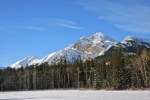
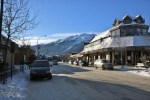
When I stumble upon photos from one of my favorite places, Jasper, Alberta, I decide to share a few from our hike near Pyramid Lake in December of 2009.

Jasper National Park is located in what I used to think was Northern Canada–until I looked at map.  It is North of Banff, but, it turns out that’s not even far enough North to be Northern Alberta, let alone Northern Canada.

Given that the town of Jasper is located within Jasper National Park, which encompasses a pretty big chunk of the Canadian Rockies, it was far enough North (or perhaps just far enough in altitude) that the high temperature those two weeks of December was -15 degrees Fahrenheit.

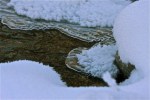
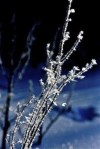
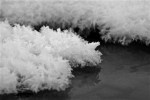
When we hiked around Pyramid Lake, we discovered something I’d only read about–hoar frost.  I never actually knew what hoar frost was until after I showed some of these shots to a friend.  If Pat wouldn’t have been with me, I probably would have frozen to death because I was so fascinated with the hoar frost, I would undoubtedly have forgotten to return until it was too dark to see.

I don’t consider these images clutter.