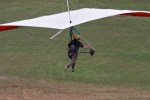
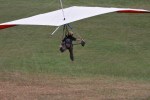
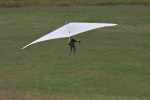
Letting Go: Not Just an Expression

It’s Saturday again.  We decided to return to the training hills this Saturday in the hope of making more progress by going back at the earliest possible time that we can.  However, we also decided to only plan on one day of hang gliding this weekend and to only try to add on Sunday once we see how we feel after Saturday.  We don’t want to be as sore as we were the last few times we went hang gliding.

We get up early–I get up at 5:30AM, to be exact.  Pat sleeps for another hour.  I take some time to write this morning since I am not taking as much stuff today.  I have decided to leave my camera behind since, well, let’s face it, grab shots of hang gliding start really looking pretty much the same after a few times.  Also, since we’ve not scheduled an afternoon tandem flight, there is no need to take a bunch of stuff to do during the time between the training hills and the tandem.

Once I’ve done my writing, had my coffee, and gotten dressed, I begin repeating my new mantra:  “Eyes on Target.  Light Hands.”  I try to visualize this in my mind.  I stand in the kitchen with my hands lightly placed on my imaginary control frame, my eyes locked on the top of the cabinets.  “Eyes on Target.  Light Hands.”  I even practice correcting the glider by pushing myself in my imagination left and right.  I realize that as my body shifts with the image in my mind, I am cross-controlling even in my kitchen.  This surprises me and I try again, this time shifting like I’m swinging on a pendulum as much as possible while standing in the kitchen.  I notice my eyes are on the kitchen floor.  Raising them back to the top of the cabinets, I abandon steering practice and say, “Eyes on Target.  Light Hands.”  Then, Pat is ready to go and I give up on my visualization.

We get to the training hills plenty early.  Mike still beats us there.  He advises us on which hang gliders to assemble and I am back in the smaller Falcon that gave me so many fits the last time.  I talk to Mike about whether it’s a good idea for me to go with that one or not and he assures me that it will pick me up just like a too-big one would.  I flash back to my 10 trips down the hill without feeling any lift, but decide that there is some wind today and that I might as well give it a try since I’m not going to make it off the bunny hill until I can fly in the correct sized glider.

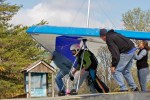
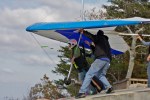
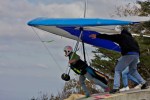
8 people have signed up for the bunny hill.  A crowd like that can make it tough to get a lot of flights in, especially if the wind starts kicking up early and we have to call it a day.  But, we get out to the hills as quickly as possible and start getting flights in.  I am relieved that I manage to launch on the first try, although I went into a dive immediately and realized I’d taken my eyes off target.  When my glider lands, my legs are smacked on the ground and my right quadricep hyper-extends slightly, just enough to give me a slight pull.  When I get to the top of the hill, I stretch before taking my next turn in the hope of preventing injury.  I launch successfully again and am happy with the launch, although I still go into a state of mental confusion and have difficulty correcting in the air.  When I launch the third time, Lauren tells me that my launch is 95% of the way there, but I need to focus on keeping my posture upright so that I leave the hill in an upright position.  As soon as I start thinking about my posture, my eyes drop and my hands tighten and I fail to launch and end up running down the damn hill again.

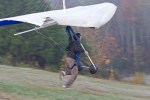
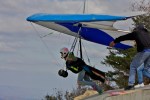
Now I am starting to limp.  At the top of the hill, I stretch thoroughly again before attempting to launch.  I suspect it will be my last time.  Lauren stands behind me this time and tells me when to let go completely.  She has me just release my hands on the control frame and do jazz-hands so that they’re there, but not grabbing at the frame.  I launch perfectly even though a cross-wind has me going crooked while I’m still running down the hill.  Lauren yells, “Run to your target!” at just the right time and I get my eyes back to where they should be, drag the glider back to straight, and launch into the air.  I even manage to correct in the air and do it correctly, although I don’t do it consciously, I just remember the feeling of swinging like a pendulum after I land.

We do a repeat the next time around, although now I am barely walking and I’m thinking this should be my last flight.  Now I’m having fun again and I’m willing to suffer through the pain of pulled muscles a couple more times.  I launch again even better this time by having Lauren yell at me and doing jazz-hands again.  Lauren tells me that she’s not really yelling at me, she’s yelling at my neurons.  She is right–I don’t have the right neuro-pathways yet.

I manage to get in one final flight, ending strong on 3 really great flights, but now my neck is going into spasms, I’ve pulled my quads, my inner thighs, and my groin.  I am walking like a cowboy once again.  But I hobble away happy, noting that letting go is ultimately what allows me to fly.  Who knew that when people say things like that they’re really referring to hang gliding?
Run Down

It’s Saturday morning and we are up even earlier than Friday. After rushing and arriving at the training hills late on Friday, last night I set the alarm for 5:30AM to give myself an extra half hour to get ready today. I also packed what I needed to bring the night before so that what I have to do this morning is less.

Now that the alarm is chiming in my ear, I am wishing I hadn’t set it so darn early. But, I get up and get moving. I am ready early. Really early. Like a half an hour early–the exact amount of time earlier that I set my alarm. This is called an over-correction in hang gliding lingo.

But, since I am ready to go, i find additional things to do with the extra time while Pat, who slept an hour longer than I did, finishes getting ready. I get the GPS set to the correct address today, for example, to ensure no repeat of yesterday’s fiasco. When Pat is ready, we gather up our bags of stuff and head down the hall.

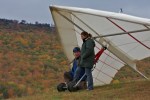
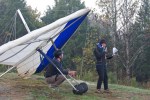
We make it to the hills plenty early. The only instructor there is Mike. We’re pretty sure he lives there and that it’s impossible to arrive before him. He tells us to each get our own Falcon. This is a good start–we have realized that we get more flights in when we each have our own glider than when we share. On the other hand, I’m a bit nervous still about assembling my own glider, worried that I’ll miss some vital step. But, I get my glider together and perform the pre-flight check without any problems. As it turns out, Pat is going to share his glider with another student in his weight range. The two of them and I are ready to go at about the same time. We load up a glider and take turns driving to get both gliders up the hill.

I am excited about flying today. I feel like I’m finally getting this down and that I’m going to make big steps forward towards learning to land on my feet. When I take my first flight, I do take big steps forward, but only literally. I run down the hill with that glider on my back taking bigger and bigger steps as I go over the ridge and down the slope, but the glider doesn’t lift. I drag that sucker all the way down until it is going faster than I am and it flops me over onto my belly on the ground and drags me across the grass. This is exactly how my first several runs went when we were in ground school back in August. I am thrown.

Fortunately, the instructor, Lauren, is extremely observant and can tell me exactly what went wrong. Her first question to me is, “How was that?” I tell her I feel like I just went back to ground school. She asks me where was my target and I have the ah-ha moment that I had forgotten to pick one. She informs me that I was looking at the ground the entire time. A phrase from motorcycle safety school pops into my head, “if you look down, you go down.”

Feeling confident that I now know the root of the problem and that my next flight will take me back to where I was yesterday, I line up and pick a nice, high target and try again. I end up running even faster down that hill, but with the same net result. When Lauren and I have our next recap, I am pretty sure that this is not my fault. I ask if the glider is too small for me, if I’m hanging too high in the frame, I blame the hiking boots I’m wearing on the hill for the first time. Lauren breaks the news to me: she assures me that I was doing the exact same things wrong yesterday but that I could get away with it yesterday because I was in an over-sized glider and there was wind. Today, I am in the appropriately sized glider and the air is depressingly still. Nothing is going to get me into the air except me performing correctly.

I am determined. I run down that hill again and again. Ten times in a row I drag that glider down the hill and it drags me across the field. I am getting so frustrated I want to quit hang gliding for good. This is when Lauren suggests I change gliders. She says that while maybe it’s cheating a little to go to a bigger glider, there is something to be said for not being so frustrated we you learn. I decide to give it a try.

My next flight, I launch successfully. My joy in hang gliding is restored. The feeling of the glider picking me up off the hill and raising my feet off the ground instead of me racing it down the hill and losing makes me giddy.

Through out the morning, I am reflecting on my own learning. I realize that my brain went all the way back to no function during my first run–I had no recollection of what happened during the run. Then, I gradually started to become more aware of what happened in each flight, I started realizing, for example, after the fact that I’d taken my eyes off the target. However, I couldn’t prevent myself from making the same mistake over and over again. I’m a little depressed by this realization. I thought that I would start where I’d left off in terms of being more conscious during the launch and flight. I am reminded of when I used to do triathlons and how I expected my times to get better each race without accounting for differences in the wind, the course, the temperature. I suppose i have learned skills specific to a given set of conditions and not the more general skills that allow me to adjust.

While I recognize that I am a slow learner when it comes to physical activities, I really didn’t think I was this slow. In the ad for our lesson package, they claim that you will learn how to land on your feet and earn your beginner rating in the number of lessons included. Here we are, already into the next package and I’m still trying to learn how to launch. This does not make me happy, I question the wisdom of upgrading our lesson package again and of contemplating launching from the mountain.

But, now that I have launched, I want to make sure I leave with the feeling of being airborne in my head, so I fly two more times. I lift off without too much difficulty and end feeling like maybe I will eventually catch on after all. The one thing I know for sure is that I do not want to run down that hill ever again! I am already feeling how sore I am going to be–there is nothing that can make a person feel as run down as running a hang glider down a hill over and over again.

A Very Blustery Day

We are running late.  I hate that.  I got up at 6:00AM in the hope of not running late, but it seems I needed to get up a half hour earlier.  We are running around frantically trying to gather up the last of our gear, knowing that we are now barely going to make it to the training hills on time.  We remember our bottles of water at the last possible second, grab them, and finally get out the door.

I set up the GPS in a hurry while Pat starts driving in the general direction.  We’ve been there enough times that the GPS should just be a back up.  However, Pat zones out and starts listening to it only to wonder why it’s taking us the way it’s taking us long after we’ve missed the correct exit.  As it turns out, I picked the flight park office, up on top of the mountain at the mountain launch, instead of the training hills.  This will cost us another 10 minutes at least.

We keep going because now it will be further to turn around.  Pat takes corners like he’s driving the BMW instead of the mini-van.  I bite my lip to stifle a scream.  We turn off before we get to the mountain office, saving ourselves a few minutes at least.  Then, Pat takes on the dirt road back to the hills with a gusto that should really only be attempted in an all-terrain vehicle–the road is full of pot holes big enough to swallow a VW beetle.  We do make it, but we are late.

Dan, one of the instructors, advises us to set up a condor and share it.  We are nearing the end of our weekend package, so there’s no reason for us to fly falcons, I guess.

We follow instructions and soon have the condor assembled, pre-flight checked, and loaded onto a trailer for a tow up to the hill.

We fly like never before.  I get airborne so easily, I’m sure that I’m almost ready to start learning to land on my feet.  It’s a great feeling to fly over the grassy field.  Unfortunately, the wind picks up quickly.  By my second flight, I get blown around in a cross-wind after I launch.  Although this is not particularly scary to me, the instructor calls it.  She doesn’t like beginners to fly in gusting winds.  She says it’s too hard to tell what we’re doing vs what the wind is doing to make it useful to us, not to mention the potential dangers.

I am left with the high of having flown.  Plus, I am prepared to take our first written test, required to graduate to the big hill.  This is a new milestone for me–I’ve not previously cared if I ever graduate to the big hill.  In fact, I’d grown convinced that I never would.  But today, I am full of myself.  I flew!  Not only am I excited about graduating, but now I have the fleeting thought that maybe, just maybe I could launch off that mountain some day.

We go into town and grab lunch after putting away the glider.  Then we head up to the top of the mountain and sit outside in the van studying.  Pat hasn’t done the required reading yet, but I’ve now talked him into taking the written test, too.  I’m reading the book to him because he didn’t bring a pair of reading glasses.   We make it through the 4 chapters covered in the test and then head indoors.

I finish the test in about half the time Pat does.  I do not suffer from test anxiety and I try not to go back and second guess myself when I finish a test.  Pat, however, not only has major anxiety about tests, but he also is not particularly well prepared given that I read the chapters to him.  But, we both manage to pass.  This emboldens us further and causes us to decide to take the dramatic step of upgrading our package to an Eagle Package.  The Eagle Package includes 4 mountain launches.  I, however, have been assured that I do not have to go off the mountain if I change my mind.  We get the full tour of the facilities and the orientation that we didn’t get when we signed up for the introductory experience.  We even get to see the repair shop and the sewing shop next door.  It’s pretty cool.

But coolest of all, when we go outside, there are two pilots waiting for the wind to calm a bit so they can take off from the mountain.  Finally!  After so many trips up the mountain to watch this event that I’ve lost count, we will get to see a mountain launch!

Unfortunately, in my rush to get out the door today, I only brought my worst lens.  Although the 70-300mm focal range will be good and the lens is light enough that I can usually get away with hand holding it, it mis-behaves on me frequently.  I’m sure this has nothing to do with the fact that I dropped it on a ceramic tile floor in Montana over a year ago and have yet to get it repaired.

As the first pilot sets up, I snap a few shots and then move down below the launch to try to get a good angle of the launch process.  The moment when he starts the launch is the moment my lens decides it doesn’t want to focus anymore.  And, of course, I have my camera set to not shoot if it’s not in focus.  I completely miss the launch.  Not only do I miss shooting it, but I miss seeing it because I’m so panicked over my camera.

I take a deep breath and fiddle with the camera until I get the lens focusing again.  I manage to accomplish this prior to the second pilot, Meg, launching.

The launch is every bit as exciting as I expected it to be, but much shorter.  The longest part is setting Meg up at the launch line with 3 people holding the wires of her glider to prevent her from blowing away prematurely.  Then, Meg, in her sock feet, calls, “Clear,” and takes 2 steps before she is airborne and tucking her colorful feet into her pod.  I stand in awe.

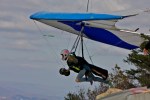
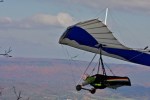
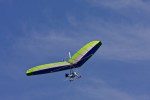
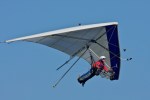
We watch the two of them soar back and forth along the ridge, gaining altitude from the wind rushing up the face of the mountain.  They look so pretty against the blue sky.  However, watching hang gliders after they’ve launched is not really all that exciting for me yet.  I suppose I don’t have enough knowledge to know what they’re doing up there enough to appreciate it.  In any case, we decide it’s time to call it a day for hang gliding and to head on back to Chattanooga in time to catch the Head of the Hootch.

Women Hang Gliding Festival

Today is the last day of the biannual Women’s Hang Gliding Festival at Lookout Mountain Hang Gliding.  We thought long and hard about whether we wanted to participate or not.  In the end, we decided not to because we figured it would be crowded on the training hills–crowds on the training hills mean fewer flights and less progress.

Instead, today we will drive out to the mountain launch in the hope of finally seeing someone take off from there.  We have been up to the mountain launch at least 5 times now, but each time, the wind has been blowing the wrong direction and no one was launching.  We’re hoping the wind will be with us today.

We take our time getting going this morning–after all, it is a Sunday morning. When we get to Trenton, GA, the closest town to the flight park, we’re both hungry and it’s almost lunch time.  We decide to stop for a bite to eat.  Where to eat in Trenton is always a question.  They have a lot of fast food choices and handful of family places, but we’ve not had a lot of luck with the places we’ve tried in the past.  Today, we decide to give the one Italian joint a try.

Perhaps they have good pizza, but we made the mistake of ordering pasta.  It was edible, but that’s about the best I can say about it.  The manicotti was over cooked and had the texture of something that had been cooked, frozen, and cooked again.  The sauce really had nothing going for it other than that it was wet, and the salad was entirely made up of iceberg lettuce that had seen better days.  The most amazing thing was the sweet tea.  I mixed half a glass of sweet tea with half a glass of unsweet tea and it was still too sweet.  But, we got through the meal and on our way with full bellies.

When we arrived at the mountain launch, it was about the time of afternoon when we’d expect to see hang gliders setting up.  No hang gliders in sight.  We look at the wind sock and sure enough, it’s a tailwind.  Having studied the first 3 chapters of the beginner hang glider’s training manual, I now know why this is so important.  While one might think a tailwind would make things easier because it pushes the glider along, a tailwind actually creates negative airspeed over the wing, which prevents the glider from lifting, which is very bad indeed.  So, hang gliders, because they rely on the wind and the wind alone when launching from the mountain, do not launch in a tailwind.

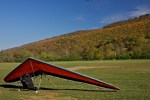
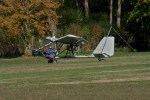
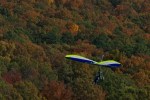
However, there are lots of aerotows going up this afternoon.  With a plane creating the airspeed needed for the glider to lift and an open field that lets the plane change the direction of takeoff according to the wind, aerotows are not so wind-direction dependent.  We stand and watch some of the gliders and I shoot, trying to capture both the gliders and the amazing fall leaves.  Unfortunately, once again I am shooting in the early afternoon and there is both sharp light and distant haze to make me wish I’d gotten there earlier.

A woman standing on the observation deck with two cameras around her neck walks over upon seeing my big lens.  She says she’s jealous of my lens.  We end up talking to her and her husband for several minutes.  Turns out they do people’s taxes for a living and only work from January to April.  The wife has gotten into photography of late, but it seems the husband is not so keen on the amount of money she’s spending on equipment, even though it appears she’s buying less expensive lenses.  She talks about wanting to start shooting portraits for money and how much she enjoys “making pictures” (this Southern expression has always thrown me, but when you think about it, it probably makes more sense than saying “taking pictures”).

The husband starts complaining about the expense again–he says, “I bought her that camera for $1000 and then she wanted another one so I bought her that one too and it was another $1000.”  I commiserate on the expense of good equipment and comment that the lens I really want is $12,000.  He turns to Pat and says, “I bet you said no to that!”  Pat and I both laugh at the notion and Pat says, “It’s her money.”  I say, “I said no–I’ll never be able to justify that expensive of a lens.”  I find it interesting that the husband has shared with us that he and his wife run their tax business together, yet he seems to think that their income is his income.  Even more interestingly, he assumes every man makes all buying decisions.  I feel sorry for the wife, although working 4 months of the year does sound fun.

We spend a little time in the hang gliding office before we head down to the landing zone to watch aerotows take off.  First, we talk about the different training packages and what would make sense for me given that I really don’t want to launch from the mountain, but I’m enjoying the training hills.  Then, we schedule coming out to the training hills next weekend and Pat takes a sudden interest in how much hang gliders cost.  This catches me off guard.  We learn that he and I could potentially share a glider and that a beginner glider starts around $3000 new.  I watch Pat’s face as he looks at the gliders the instructor points out to him on their website and I try to determine whether he is seriously thinking we’re going to be buying a hang glider or not.  I flash back to the months, even years, of getting rid of possessions in an effort to simplify our lives and try to imagine how a hang glider fits into this picture.  But, I let him look without comment.

Next, we drive down to the landing zone and sit for a while, watching aerotows.  For the first time, we see someone on a tow line that’s on a winch rather than an ultralight.  We’ve seen winch launches on TV before, but didn’t know this park had a winch.  The glider gets about 50 feet in the air before releasing and then comes back down and lands immediately.  I assume this is part of an aerotow training package.

We watch several tandem aerotows take off, and I practice focusing manually with my long lens with the extender attached.  I quickly learn that panning with an aerotow and manually focusing at the same time are not possible for me.  I’m not able to see clearly enough to tell if I’m in focus or not through the viewfinder and I can’t use live view in the LCD while panning.  I go for a small aperture opening in the hope of having enough depth of field to cover the difference.

After a while, Pat is bored and I have so many shots of hang gliders that I’ll be at the computer for hours, so we decide to leave.  As we drive out, we spot a flock of wild turkeys across a field.  Pat pulls over and I get out of the van slowly and grab my camera and tripod from the back.  By the time I get set up, another car has approached from the other side and a woman with a point-and-shoot gets out and starts walking towards the turkeys, spooking them.  I get only two quick shots in before they take flight and I have no time to make any adjustments to better capture them flying.  I make a mental note (not for the first time) that I really need to find a class on wildlife shooting or I’m going to end up always shooting landscapes.

Gaining Air

The alarm goes off at 5:45AM.  I groan.  It’s Sunday after all; shouldn’t I get to sleep in?  I roll out of bed and feel all the places that are kinked, sore, and bruised from yesterday’s hang gliding adventure.  My neck and shoulders are burning.  I remind myself that I am only going to feel worse tomorrow morning after doing this a second day, then I get moving.  Coffee, face wash, and a glass of water all wake me up.  Pat is up and in motion.

Once again, I run around gathering everything necessary for a morning on the training hills followed by tandem flights.  For someone who doesn’t own any hang gliding equipment, this is an amazing amount of stuff.  First, I pack my camera bag, then I pack a change of clothes and stuff it in my new tripod bag.  Next, I pack my laptop, Verizon MiFi, iPad, iPhone, and all required power cords along with my wallet, sunglasses, etc. into a laptop bag.  Now, you might wonder why I need an arsenal of electronics to go hang gliding.  The truth of the matter is, I don’t.  But, I need this bag for the same reason Pat is gathering up pillows while I’m packing my bags:  we are going to have 5 hours to kill between the morning hill flights and the 5PM tandem flight.  I might as well make it a productive 5 hours.  Next, I grab my bag with my five fingers shoes and our water bottles.  When at last we’re ready to roll, I hang such an assortment of goods off my appendages that it’s not clear I can fit through the door.  Pat relieves me of a couple of bags and go on our way.

Having learned from yesterday’s mistake, we stop at a gas station in Trenton, GA before we get to the country roads that lead back to the training hills.  They let us use their employee restroom and we buy a couple of granola bars.  When we get to the training hills, I, of course, have to go again.  Back to the nasty outhouse I go.  I wish I would have brought a nose plug, but I survive.

This time, I am not only on time to help put together the gliders, but I am required to put together my own.  Today, Pat and I will each have our own glider.  Assembling a glider is a little scary.  As you read the instructions and put each piece in, you think to yourself, “I’m going to fly in this thing and if I don’t do this right, I’m going to die.”  It’s a lot of pressure.  But, I manage to get the thing together and ask for some help when I’m not sure if I’ve got it right or not.  The thing that surprises me is that the ribs that make the wings rigid are rods that simply slide into pockets and rest loosely against the front bar that creates the leading edge of the wing.  Seems like they should be attached somehow.  The other thing that surprises me is the places where it’s OK for the glider to be severely bent.  For example, the bracket that attaches the wheels to the down tubes is completely askew, but I’m told that there’s no problem with that bracket.  However, bends in the wing ribs are bad.  Bends in the front tubes on the leading edge are especially bad.  While I understand why the wing needs to be a particular shape, I’d kind of like my landing gear to be just as straight.

I get my glider together faster than Pat (I had a little more help).  I load it up onto the trailer and hop on, holding the strap that keeps it from tipping backwards in one hand and bracing the front of the glider with the other to keep it down in the trailer.  We bump along over the grass and to the back hill, climbing to the top in no time.  I am the 3rd person to make it up the hill.  Dan, the instructor, arrives only minutes after I do and the first students start launching.  The air is calmer today and we hope for a good day with lots of flights.

My first flight is an improvement over the day before.  I am encouraged that I am able to get air right away, although I still fail to correct my direction and spin out when I land in the middle of an unplanned turn.  An interesting thing is happening as I gain confidence–I am starting to have one more conscious thought that I remember each flight.  I remember the feeling of running in the air.  I remember letting my hands loosen and slide down the bar.  I remember trying to turn the glider.  This is all a lot of improvement–earlier flights, I could not tell what I had or hadn’t done or if I’d had any actual thoughts at all.  Now, I am able to discuss my flight with the instructor and realize that I was not keeping my eyes on target.

My next flight, I realize when I am not looking at the target and correct a little earlier.  Each time, something new is achieved and remembered.  It’s interesting to observe myself learn.  While I wish I were one of those natural athletes who can take on any physical task and instantly conquer it, my slow learning process at least gives me the opportunity to understand how I learn.  I notice that there is a point in each flight where I go from experiencing the exhilaration of soaring to the fear of landing (I have an assortment of scrapes and bruises from yesterday).  When I shift from the feeling of flying to the fear of falling, I start to forget what to do.  But, each time, I get a little further before that panic sets in.  Even after a particularly painful landing the flight before.  In that flight, I am caught by a cross-wind and turned dramatically to the left.  I shift my weight but I don’t change direction.  I assume I’m shifting the wrong direction and shift the other way, which makes matters worse and then I fall to the ground, literally bouncing off the grass and getting completely airborne a second time before landing for good.  The entire flight from when I left the ground to the second time I landed lasted about 8 seconds (based on the times of photos Pat shot).  Both knees hit when I landed the first time; they are bruised and swell slightly.

But the next flight, I still get better.  Now I know that I was correcting in the right direction, I just didn’t have enough speed to be able to control the glider in the wind.  I work on moving the bar in and out.  When I push the bar away from me, I get more lift.  When I pull the bar in, I get more speed, but in a downward direction.  I realize I am moving the bar too much–I need to stay light in my hands while I adjust.  I realize this just as I come in for another landing after a 7 second flight.  I get in one last flight–8 today all together–before the wind starts to kick up.  Pat gets in his last flight right before me.  He pulls his hamstring as he launches himself from the hill.  He is done.  I’m already spent and am happy for the excuse to call it a day.  I get my last flight in.  It’s smooth and controlled, although the wind has died and I don’t get as much lift as I have on previous flights.  That’s OK.  I wanted to have a controlled landing and I did.  I am not breaking any learning records on the hill, but I’m OK with that.

With Pat hobbling badly, we decide to postpone our tandem flight again.  We make the drive back up to the pro shop at the top of the mountain.  Once again, a crowd of tourist has gathered around the launch ramp only to be disappointed that no gliders are launching today–the wind is from the wrong direction again.  However, a tandem flight is towed up from the landing strip below, so the tourists (us included) get to enjoy watching that flight soar by.  I go inside to get a book that we need to pass a test to graduate to the next training hill.  While I’m paying, I hear a girl screaming and many people laughing.  Pat tells me when I return outside that the glider buzzed the pro shop and scared the girl to death.  We were surprised–I wonder if this is a boyfriend taking his girlfriend for a tandem flight since none of the pilots we flew with in our previous tandem flight did anything to intentionally scare us.  In any case, we’re glad to see them land safely on the airstrip below.

Pat limps back to the car and I drive us home.  Once again, we are exhausted.  I find myself wondering if there is a workout we can do for hang gliding preparedness!