
Reconstructing History

While in the Canadian Rockies at Jasper National Park several years ago (still shooting with the PowerShot G3), we decided to take a “rest” day by hiking a relatively easy trail to a lake at the base of Mt Robson.  We drove from Jasper Park in Alberta to the Robson Provincial park in British Columbia in about an hour.

When we started out, the sky kept promising rain (in fact, it even sprinkled briefly), but then the clouds would part and a deep blue sky would appear.  When the sun was out, we broke a sweat working our way up the easy, but uphill, trail.  When cloud cover moved in, it was like someone had cranked up the air conditioning and I would get chilled almost immediately.

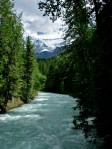
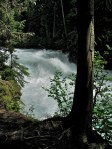
For most of the walk, the trail ran parallel to a treacherous but beautiful stream swelling with the “spring” snow melt (this was in July).  We didn’t see anyone attempting to navigate the stream, so I’m guessing the water was too intense for even really good kayakers.  It seemed like getting in the stream would be a really bad idea with or without a kayak to me.

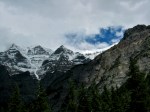
When we arrived at Moose Lake, we were further away from the base of Mt. Robson than we expected, but given that Mt Robson is the tallest mountain in the Canadian Rockies, we still had plenty of good views of it, including the glacier nearby.

As I went through these photos from 2005, I discovered an interesting phenomenon.  I believe I was feeling lazy on this particular day not only in choosing an easy trail, but in my shooting.  I notice that the metadata in my pictures indicated I was mostly shooting with a wide-open aperture, with the smallest aperture setting being an f/8.

This was remarkable to me in two ways.  First, this is another thing to add to my list of things I’ve learned–I would not shoot these scenes with that setting today.  Second, it seems like they have much more depth of field than I would expect for such wide aperture settings.  This caused me to look at focal lengths.  They are mostly under 20mm with the shortest being 7mm (if I recall correctly).  Is that even possible?  Assuming my metadata is correct, the extremely short focal lengths are most likely contributing to the extra depth of field.  I assume I was shooting with an open aperture because we were walking in the shade quite a bit, so perhaps there wasn’t much light.

It’s always fun to try to reconstruct what happened 7 years ago based on the evidence collected in the metadata of your photos!

What I do remember clearly about this hike is that Pat and I were quite irritated with one another at the beginning of the hike, but back to laughing together by the time we were ready to return to the car.  Maybe that’s why I love hiking so much–it’s restorative in more ways than one.

Olympic Adventure

Whenever I go through old photos, I look for things I’ve learned as a photographer.  Sometimes it’s a little depressing.  It’s hard to say what improvements have come from skill vs luck vs improvement in technology.

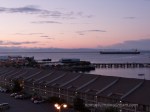
However, I found one obvious improvement that can only be attributed to me having learned something–straight horizon lines.

Well, it’s not actually true that only my skill has straightened my horizon lines.  In truth, it wasn’t until I recently upgraded cameras and started using the in-camera electronic level that I can truly claim I had straight horizon lines.  But, setting that aside for a moment, as I look through images taken on my first trip to the Olympic Peninsula, shortly after I’d purchased my trusty old Powershot G3 circa 2003, I realize I didn’t even think about straight horizon lines back then.

So, there you have it. Solid evidence that I have retained one piece of information about how to have better images in 9 years.  I feel much better now.

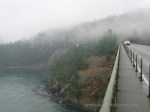
The trek to the Olympic Peninsula from just North of Seattle seemed somewhat epic.  When you look on a map, Olympic National Park looks like it’s right next to Seattle–like it should take a couple of hours to drive there.  But the first hint that maybe it’s not so straight forward is when you try to get driving directions from Seattle to Olympic National Park–google says, “We could not calculate directions . . .”

Our route may not have been the most direct.  We went North through Deception Pass to Whidbey Island and, from somewhere in the general vicinity, we took a ferry over to Port Angeles on the Northern end of the Olympic Peninsula.  From there, we made our way along the coast down into the park where we visited an ancient lodge and trekked through an even more ancient rain forest.

Oh wait . . . that’s how we got there on our second trip to Olympic National Park.  Sorry.  On our first trip, we went South to Mount St. Helen first and then North to Olympic and then back via Port Angeles and Whidbey Island.  I had things reversed.

If Olympic were in the Northeastern United States and you asked someone for directions, they would tell you, “You cahn’t get theyah from heeah.”

I would love to go back to Olympic for a week.  Both times we went before, we did more of a drive by, taking only a couple of very short hikes.  I would love to do a through hike of many miles in the rain forest.  The number of elk that we saw in just a mile or so of walking in the midst of the deep shadows of giant trees was amazing–it wasn’t the kind of terrain I expected to find elk in.

It’s too bad it’s so difficult to get to–otherwise we would probably go every year as a short side trip from Portland when we’re out visiting my dad.

Maybe next year.

Crayons and the Camera

I was reflecting today on what first excited me about photography.  I always appreciated others’ work, but the expense of film and printing photos just to discover if they were crap seemed like overwhelming deterrents to me when I was young.

There were two things that gave me the push to get started.  First, there was the advent of digital photography, providing immediate feedback and reducing the cost of learning.

The second was a work friend, Rick, who was (and is) a wonderful photographer.  He advised me on the camera purchase that started my endeavor to learn the fundamentals.  It was not a DSLR, however.  That would have been a waste of money for me back in early 2003 given that I had never heard the words “aperture,” “shutter speed,” or “depth of field.”

Instead, my friend advised me to look into the PowerShot G3.  It had one of the best lenses in a point-and-shoot with . . . wait for it . . .4x optical zoom and . . . drum roll . . . 4.0MP!

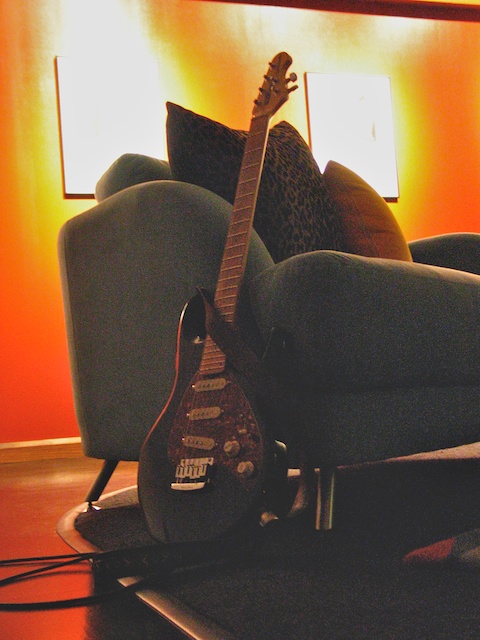
This photo was the first picture I took that made me think photography might be the most exciting hobby on the planet.  Who knew you could make it look like the wall was on fire with a camera?

While I won’t be putting this in my portfolio, I love it all the same.  The reason I love it so much is because it evokes the utter glee I felt in discovering that creating such an image was possible.  It was like handing a child their first box of crayons and a blank piece of paper.  I didn’t know enough to be self-critical; I was just having fun.

That camera with that attitude got me through my first five years of sporadic shooting.  It wasn’t until 2008 that I upgraded to a DSLR.  This was because I wasn’t shooting frequently enough to improve beyond my camera’s capabilities until 2007.  That year, I shot frequently enough to be frustrated repeatedly by the limitations of a point-and-shoot.  I knew exactly why I needed a DSLR when I bought one.

As I contemplate my next camera body, I pull out some of my photos from the old PowerShot G3.  Have I improved as a photographer since upgrading to a DSLR?

My photos with my latest gear are sharper, cleaner, and quieter.  But, I am reminded of when I was doing triathlons and I was choosing between Shimano Ultegra vs 105 components for my new road bike–would the extra $400 to shave a fraction of a second off how long it takes to shift make as much difference as, say, training more?

This helps me get clear in my own head on when to invest in gear.  In the end, I really don’t need to buy anything if I am not being frustrated by the current limitations of what I have.

Note on today’s dog picture:  Tisen is taking a break from modeling today due to having had too much fun at doggy daycare to pose for mommy in any position other than “sleeping on the couch,” which I think we’ve seen enough of for now.  So, here is another one of my favorites from my PowerShot G3 instead–this is Katie, who died along with a piece of my heart in April 2007: