The Last Mimosa

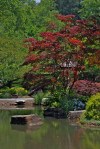
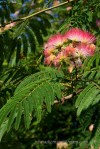
I’m saddened to learn that the Mimosa tree is an invasive tree from Asia that doesn’t belong here.  In fact, the Tennessee Exotic Pest Council ranks it as a severe threat.  This makes me sad because I was really enjoying the blossoms, but I feel strongly that invasive plant species need to be removed from non-native habitats.  Now I feel like a traitor–aggrandizing the enemy.

But, I can’t help but indulge my irresponsible self one last time before I turn my back on the Mimosa tree (don’t worry, I’m sure I’ll continue to indulge in the beverage on the rare occasions the opportunity presents itself–too bad it’s not the drink that’s invasive instead of the tree).

In case you are unfamiliar with the problem of invasive species, I confess it’s a bit of a sore spot with me.  Having spent many weekends trying to remove plants that were taking over my own yard as well as the neighborhood, I know how difficult these plants are to control first hand.

In the US, we tend to plant what we think is pretty and/or is easy to grow. We fiercely defend our property rights and believe what we plant in our yard is our own business.  Unfortunately, invasive plants don’t stay on our property.  They spread through an amazing variety of means and grow quickly out of control since whatever keeps them in check in their native habitat doesn’t exist in the ecosystem they have been introduced to.

While we sometimes call native plants “weeds” because we don’t like the way they look and they grow in places we don’t want them to, these aren’t the same as invasives.  Invasive species do outright harm to an ecosystem.

As we all know (I hope), every living thing has interdependencies with other living things.  Whether it’s for shelter, food, temperature control–all of the above, no creature can exist without other creatures to support it (depending on what you call a “creature,” I guess).  Plants are a critical component of this web.

Invasive trees like the Mimosa reek havoc upon the availability of necessities by crowding out the native trees and plants that would provide them.  Because invasives didn’t evolve with the rest of the ecosystem, they fail to provide the critical (and often subtle) requirements that the native plants would provide.

This is my plea:  the next time you plant something, remember that what you plant will spread far and wide whether you know it or not.  Make a choice that everyone can live with (including wildlife) instead of just what looks good.

A chunk of our tax dollars is spent trying to control these invasive species–even if you care nothing about your ecosystem, why would you want to make a choice that will be an ongoing cost to you and the rest of the tax-paying population for generations to come?

All right, I’m off my soapbox now.  Back to taking pictures.  🙂

Cloud 9

Every once in a while, things come together unexpectedly in small ways.  I say in small ways because, after all, creating an image that I like is not like curing cancer.  But, sometimes, just every once in a while, something happens that gives me hope.

I don’t know what for, exactly.  There’s the hope that maybe I can capture images that matter to me.  There’s the hope that life will have more moments of stunning beauty and the joy of witnessing them.  And then there’s the hope that life is really about these moments and none of the other crap really matters.

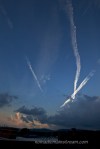
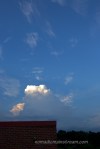
On this particular day, the three of us were loaded in our mini van.  Me in the front passenger seat, Pat driving, and Tisen riding in the back with Lion (or maybe it was ‘Possum?).  As we made our way to the Rice Boxx to pick up dinner (side note:  the food is decent, but if you judge chinese food by the quality of the fortunes in their fortune cookies, steer clear), I looked up and saw the most amazing clouds in the sky.  They were the fluffiest, most interestingly lit clouds I can remember.  Of course, the time to see the most interesting clouds is not when you’re in a car on your way to pick up dinner and camera-less.

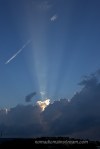
This is the part where things just came together.  We got dinner and went home and when I looked out the window, I saw an enormous ray popping through the clouds going straight up.  I had to choose between trying to capture an image that might last the rest of my life and eating a hot dinner that would last about 10 minutes.  It was an easy decision.

I grabbed my camera, tripod, an extra lens, and headed up to the roof.  I found a neighbor up there, already enjoying the sky.  She had her back to the sun rays coming through the clouds, enjoying the puffy clouds–although they were somewhat less puffy now.  Like me, she really enjoys unwinding on the roof.  Unlike me, she didn’t bring a camera.

While I set up and started shooting, she and I talked.  I managed to set up and get at least one image I’m happy with (well, at least on my monitor) and get to know a little about my neighbor at the same time.  This might be a new milestone for me.

One of the things I’ve discovered about my 5D Mark III that was a nice surprise is its built-in level.  I can push a button and it displays a level on the LCD.  Having discovered that I view the world at a tilt, this is an awesome feature for me.  Especially when shooting in Chattanooga–there are no straight lines on the horizon to line up with.

Returning to finish my dinner, I discovered Tisen was not at all interested in the clouds–only in getting comfortable on the couch.

Mimosa Anyone?

For those of us who appreciate an excuse to drink champagne for breakfast, a mimosa is a tasty beverage that someone invented most likely because they spent too much money on a bad bottle of champagne (my apologies to any French readers, I really mean sparkling white wine that may or may not be from the Champagne region of France) and didn’t want to waste it.  Sweetening up sparkling wine with orange juice was a stroke of genius in my opinion.

But it does not explain how it got its name.  For that, I am forced to google.  Apparently, I have never had a mimosa that was made correctly–they are supposed to have a foamy head that resembles the flower on the mimosa tree.

In Ohio, the crabapple trees bloom fantastically in the early spring.  But I can’t remember ever being over powered by their smell.  And they burst into blossoms that seem to disappear within a week.

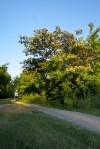
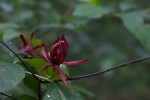
This is my first spring where mimosa’s are common.  In Ohio, you might discover this strange tree tucked into a protected corner of someone’s garden, but I can’t recall ever seeing one in the wild.  Here in Tennessee, they start a sneak attack with their sweet scent.  I walked through the park smelling the perfume in the air for days before I finally figured out what it was.  That was at least 2 weeks ago–they are still blooming like mad.

Unlike the crabapples, the mimosa trees tend to be tall, keeping their blooms out of reach.  This makes them a bit of a photographic challenge.  And, as you may know by now, I seem to gravitate towards challenges.  But it’s not the challenge of capturing them from a distance that attracts me, it’s the way the light hits them in the evening, suddenly spotlighting their pink foam flowers in golden light.

I may have to get a ladder and go back for some close-ups.  I wonder what the maintenance crew would do if they saw me carrying a step ladder?

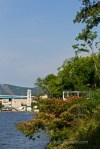
I spotted a small mimosa tree down by the river.  The best time to shoot it would be around 8AM when the sun is still low but high enough above the Eastern horizon to send a few rays over the steep bank above the tree.  But, I decided evening would be a good time to experiment with my flash outdoors.

I set up my flash on a stand so I could put it as close to the tree as possible while I shot further back and to the side enough to keep the flash out of my frame.  However, if there is any light on the mimosa, it’s because I lightened it in post-processing, not because the flash threw so much as a single random shiny spot on it.  A disappointing experiment.

The good news is that the mimosas seem to just keep on blooming.  Maybe I’ll get a chance for that close up over the weekend.

Lessons from the Archives: Toronto

This is another set of photos from my archive of the past. These were taken on a business trip to Toronto. I had gotten my PowerShot G3 a few weeks before the trip and was too excited not to bring it. I’m glad I did for several reasons.

First, it turned out to be the only trip to Toronto where I flew in on a Sunday and had time to explore downtown Toronto. I had many great photo ops as a result.

Second, I got to experiment with several challenges, which taught me why photographers use polarizing filters, tripods, and unexpected angles.

Third, and most importantly, it was the last business trip I went on with my office mate at the time, who was a great traveling companion. A dedicated family man and an all around considerate person, he had a knack for putting everyone at ease. Plus, he was up for exploration, which is always more fun with a companion than by yourself.

Sadly, he suffered a major heart attack and died at the age of 44 only a few months later. I was grateful to have a few photos of him to share with his wife.

It’s something we don’t think about much, but we often spend more time with colleagues (especially office mates) than we do with the people we love. Yet, our relationships often do not extend outside the office. As a result, all of those hours become a mystery to our families. It’s so rare to have photos of colleagues who are “work friends.”

I have chosen not to share the pictures of my former office mate, but the pleasure of seeing Toronto with such an unassuming, easy going colleague who died far too soon is one that I continue to cherish.

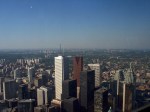
From a photographic perspective, I learned several things from shooting in Toronto. From the top of the CN Tower, looking down upon the world, I discovered the challenges of shooting through glass. Later, when I shared with a photographer friend how problematic the glare was, he suggested a polarizer might help.

From the bottom of the tower, I learned how changing your angle changes perspective. Shooting up the height of the CN Tower against the blue sky was a whole new view of the world, not just of the tower.

Down the walk from the tower, a giant Pileated Woodpecker statue clinging to a pole provided a whole new way to play with perspective. Already giant in its dimensions, with the sky scrapers in the background far enough away to appear tiny by comparison, the woodpecker appears to be Godzilla-sized.

That night, alone in my hotel room, I tried to shoot my first long exposure through the window. Those pictures turned out so horrible that I couldn’t include them, but that was when I first understood why my photographer friends kept telling me to get a tripod.
All in all, it was one of the best business trips I was ever on.

New Camera, Same Photographer

I love amazing shots of lightening. Perhaps because I’ve never managed to capture one? I have tried many times, but I always miss. At one of the workshops I attended recently, they mentioned a few tips on how to capture lightening, and then, not having any opportunities, I forgot about it.

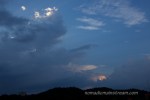
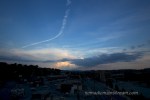
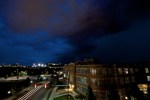
But, at last, as I was sitting on the couch reading the instructions for my new 5D Mark III the other evening, a brilliant flash lit up the sky. I grabbed the tripod and set my camera up on the balcony, attempting to remember those tips.

I tried a low ISO with a small aperture and a very long shutter speed. I tried a high ISO with a small aperture and a fast shutter speed. Then I remembered the suggestion to set the shutter on bulb (stays open until you close it). Of course, I hadn’t gotten that far in the instructions yet and the bulb setting isn’t where it was on my 40D, so I went with 30 seconds.

This led to several images that looked like it was daylight out except for the streaks of the car lights.
You may have noticed by now that none of the photos in the gallery actually contain any lightening. At least not obvious lightening. I think part of the problem was that the lightening was so far behind cloud cover that it wasn’t bright enough to make a huge difference in the exposure. While the clouds lit up like paper lanterns to my eye, the difference in light over a 30 second exposure was too subtle for my camera.

This theory led to me remembering another tip.

The tip was to cover the lens with a piece of paper or your hand and uncover it only when the lightening flashes. In case you were wondering what the dark shadow is over some of my shots, that’s my hand. Apparently, I didn’t actually cover the entire lens, so I have some fun finger shadows. I can see this turning into a whole new style of shooting. Look forward to many photos with animal shadows cast over them in the future!

I thought if I could block all light until the moment when the lightening was flashing, maybe the difference would be great enough to capture the flickering clouds.
I think I need to try this again with a different way of covering the lens to see if my theory has any merit.

Another thing I would like to try is shooting lightening from out in the country where there is little ambient light. The street lights in my neighborhood contribute to the problem, I believe.

I googled shooting lightening to see what other tips I could find. The biggest one I hadn’t considered before–and perhaps the skill I most lack–is to be patient.

I guess I was secretly hoping my new camera would magically solve these kinds of difficulties for me. Next time, I’ll upgrade the photographer instead of the camera.

Native Song

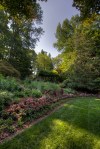
Having survived the Japanese garden at Gibb’s Gardens, I moved on with my co-shooter, John, to another part of the park.  This time, we entered an area that looked like natural woods.

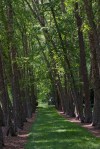
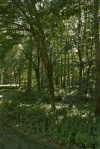
As much as I enjoy gardens, natural woods are still my favorite.  By “natural,” I mean woods with plants that belong there.  This is not the same as, say, a woods covered in kudzu or so overgrown with privet or honeysuckle, you can’t even see through it.

Here, the woods had only native plants and we were both tickled when John discovered a Jack-in-the-Pulpit.  Soon, we were finding more of them.

Near by, we also found some spent Trillium, Solomon’s Seal, Virginia Creeper, and the one native I don’t like to see, Poison Ivy.  I should rephrase that.  I like to see it (it is a beneficial native), but I don’t like to be anywhere near it.  I’m starting to itch just thinking about it.

As we hunted for wild flowers, a wood thrush started serenading us.  The wood thrush’s song is my favorite.  Thrushes can sing more than one note at the same time–they harmonize with themselves.  The wood thrush in particular has a haunting, flute-like song that always makes me want to stop and listen.  You can play a clip of its song here (scroll down a bit).

Although I have heard a wood thrush many times–in fact, one used to summer near our house and was my alarm clock many mornings–I have only actually seen one once.  I have never even gotten close to getting a picture of one.  This relative of the robin is reclusive by comparison.  Wood thrushes hang out in the lower story and underbrush of the woods, magically disappearing behind the tiniest of leaves.  Their brown camouflage helps them disappear, I guess.

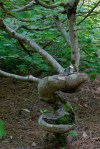
We eventually moved on from the wood thrush and made our way towards the rose gardens.  Along the way, John pointed out a tree that was growing at a nearly 90-degree angle.  He told me native americans used to train trees to grow at angles as a directional indicator towards water or other resources.  However, he felt this tree was too young to be an example of a pointer.  We never did get an explanation for it.

When we got to the base of the hill covered with roses, I was pooped.  Carrying around my 40+ pound backpack and tripod all day had wiped me out.  I suddenly realized I hadn’t had any water since 9:30AM and it was now nearly 3:30PM.  I looked up the hill and decided I really didn’t need to shoot any roses.

John, carrying less than 3 pounds of equipment including a bottle of water, was still feeling energetic enough to head on up to not only the roses, but also the day lilies at the top of the hill.  I guess that’s what a lifetime of experience shooting does for you.

A Mini Krash

Perhaps this is a good time to mention that I am extraordinarily clumsy.  In fact, I was given the name “Krash” many years ago by some friends who were amazed by my ability to hurt myself (thanks, Mike and Bart).  I really should have a blog dedicated to the ridiculous ways in which I’ve hurt myself.

It only follows that, on my first field trip with a new group of people, while hanging out with someone I’ve just met, I would do something embarrassing and at least mildly alarming.

After lunch at Gibbs Gardens, my cohort (let’s call him John in case he doesn’t want to be included in my blog) and I headed off to the Japanese garden.

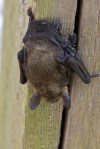
As we walked towards an arbor-like structure, several people were gathered around looking at what turned out to be bats.  I happen to be extremely fond of bats.  I would say my fondness for bats is in direct proportion to how much mosquitoes like to bite me.  Besides, bats are really quite cute.

Two of the bats had gone astray and were clinging to the post of the structure close to the ground.  One appeared to be quite young.  I happened to have my macro lens on my camera, so there was no question but that I was going to get some shots of at least one of the bats.

I opened up my tripod’s legs so I could place my camera very low to the ground, level with one of the bats.  Then, I bent over to look through the view finder.  This is when the 40+ pound pack on my back slipped forward and conked me in the back of the head.

This is also when I discovered I had mounted my camera backwards on my tripod head.  I never really worried about which way was forwards or backwards, but now I will.  When you mount your camera backwards in the clamp on my tripod mount, there is a metal lever facing you.  This doesn’t seem like a big deal until a 40+ pound backpack smacks you in the back of the head and shoves your lip into the metal clamp.  Fortunately, I lost only a little blood and no teeth.  Poor John kept trying to find ways to carry things for me after that incident.

It reminds me of a former boss who used to watch for things I might run into and steer me around them when we were walking together.  He started this practice after I bounced off a wall turning a corner too soon while I was mid-sentence.

I’m thinking about teaching a photography workshop on how to prevent injury while shooting.  Most people probably worry about that when they’re shooting on a cliff or going on a safari in Africa or shooting for a newspaper in the middle of a war.  I have to worry about it when I bend over to look through my view finder.  But, hey, it could be a niche market.

Gear Envy

Continuing the Gibbs Garden field trip, my cohort and I made our way down from the Manor house back towards the main entrance in time for lunch.  Along the way, we frequently paused to shoot.

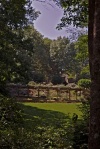
Below the Manor House, looking back up the hill, an arbor stretched across the hillside below the house, surrounded by flowers.  It was so beautiful, we had to stop to shoot.  Unfortunately, the sun was high and the house was lost in dark shadows.

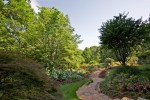
As we worked our way back down, we found numerous water features.  Between natural looking creeks and man-made ponds and streams, each had a distinct character.  The bridges that accompanied them were just as varied.

It’s funny how I can look at a scene, know that the lighting is not going to allow me to get the image I want, but not be able to resist trying anyway.  I wonder if this is the difference between digital and film?  Between knowing I can just delete any bad shots and that I can do quite a bit in post processing to improve the harshness of the light, I can’t walk away without shooting.

I haven’t quite figured out how to fix bad lighting in software, though.  While I can lift the shadows and pull down the highlights and do all kinds of interesting adjustments, in the end, it’s still bad lighting.

My first impulse in dealing with harsh lighting is to reach for a polarizer.  While it can’t fix the light, it can at least remove a lot of glare.  Two things have recently changed, however.  First, I have been shooting wide angle with a lens I added a couple months ago, which requires an 82mm filter.  My polarizing filter is 77mm.   So, I had to switch lenses to my most recent addition, a 24-70mm, which takes a 77mm filter.

After switching lenses just so I could use a polarizer, the second recent change come into effect.  I now have enough gear that I need two bags.  This has created a whole new problem.  I only brought one bag with me and I forgot to put my filters in it before I left.  So, I had picked a lens to fit a filter I didn’t have with me.

It seems like getting more stuff complicates photography in the same way it complicates the rest of my life.  The cost of more gear is more than the price–it also means more time organizing it, looking for it, and switching back and forth.  I think I’m about to hit my limit on wanting to further complicate my hobby.

Interestingly, the photographer I shot with at Gibbs Garden has been into photography since he was a boy.  Once film became too expensive and inconvenient, he switched to a high-end point-and-shoot with full manual control.  He carried his small, light-weight camera, a proportional tripod, and nothing else.  I was extremely envious by the time we sat down for lunch.

Field Trip

Today, I went on my first field trip with the photography club I recently joined.  We went to Gibbs Gardens in Ball Ground, Georgia.

While it was quite a drive (2 hours), driving in this part of the country is always scenic, which makes the time pass quickly.  Today’s drive was no exception, although I did feel a bit guilty for not riding with someone else to limit gas consumption.  But, I’m having some back issues and thought I might need to leave early.  Fortunately for me, my back made it until 3:30.

Gibbs Gardens is a private garden created by someone who owns a landscape company and recently opened to the public (for a price).

Getting there was interesting.  As has often happened when I’ve ventured out with a group, I ended up on what seemed like remote, two-lane highways that go from 55 to 45 to 35 mph as they pass through small . . . let’s say “villages,” these places are too small to call towns.

And, another common occurrence, I inevitably find myself behind someone who wants to go at least 10 mph slower than the speed limit.  Today, I was afraid I was going to end up going 35 mph for 30 miles.  Fortunately, the very sweet looking little old lady ahead of me turned after only a few miles.

As I accelerated back to the speed limit and entered some sharp turns, I found myself wishing I’d driven our old BMW instead of the mini-van.  Let’s face it, even a bicycle would be more fun to drive than a mini-van.

When everyone arrived, we gathered and posed for a group photo and then scattered to go shoot.  Luckily, one of the guys I’d met before was company-tolerant and we ended up shooting together.  Otherwise, besides the $2 discount on the entry price by coming as a group, there wouldn’t have been any advantage to going with the group.

The one big disadvantage was that we didn’t get started until after 10AM by the time everyone arrived.  The light was already starting to get bad.  That is the one thing I would suggest to Gibbs Gardens–they should offer early or late entry to photography groups.

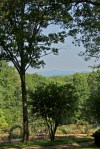
We headed up to the Manor House first, hoping to get to see the view of the mountain before it got hazy.  We didn’t immediately figure out where the mountain was visible from, so it was quite hazy by the time we found the view.

Regardless of the less than optimal time of day, the manor house and its surrounding gardens were amazing.  There is so much stone in the garden walls and walkways that I have to wonder how they got it all there.  The pool was so inviting, it’s a good thing we didn’t go there latter in the day–I probably would have jumped in.  I’m pretty sure they kick you out if you start swimming in the pool.

Clutter vs. Hoar Frost

In the process of going through old photos and clearing out the masses of virtual junk that I have collected, I am reminded both of how much I prefer a life uncluttered and how much I enjoy reliving the past.

On the topic of de-cluttering, there was a time when this referred to clearing clothes out of closets, emptying the junk drawer that collects unrecognizable objects that we’re sure we’ll need someday, selling the collection of hobbits or beanie babies, and donating excess household goods.

For us, we started the process of reducing things several years ago.  But having focused for so long on getting rid of physical items, I completely ignored the virtual ones.  My main problem, as you might guess, is photos.  As long as all my images fit on the hardware I already owned, I don’t think of it as clutter.

But having grown my capacity to over 7 TB between old devices, new devices, backup devices, and spare devices, I’m thinking it’s time to start eliminating the multiple copies of the same photo, the really bad images, the slightly different angles of the same thing, the series of 300 shots of the same person making different facial expressions–in short, the crap.

Having cleared out this virtual junk, I find the important memories and the images I’m almost proud of suddenly jumping out at me.  Just as clearing out the 4 potato mashers, the endless collection of useless appliances (useless to me since I don’t cook), and the endless odds and ends that filled our kitchen cabinets made the kitchen a place I didn’t mind hanging out in (because I could suddenly, for example, find the corkscrew when I brought home a bottle of wine), I find myself suddenly having a hard time pulling away from perusing the past.

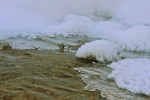
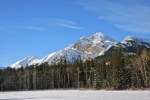
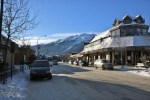
When I stumble upon photos from one of my favorite places, Jasper, Alberta, I decide to share a few from our hike near Pyramid Lake in December of 2009.

Jasper National Park is located in what I used to think was Northern Canada–until I looked at map.  It is North of Banff, but, it turns out that’s not even far enough North to be Northern Alberta, let alone Northern Canada.

Given that the town of Jasper is located within Jasper National Park, which encompasses a pretty big chunk of the Canadian Rockies, it was far enough North (or perhaps just far enough in altitude) that the high temperature those two weeks of December was -15 degrees Fahrenheit.

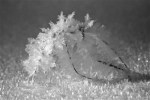
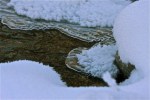
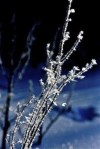
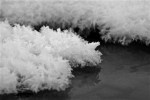
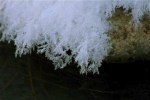
When we hiked around Pyramid Lake, we discovered something I’d only read about–hoar frost.  I never actually knew what hoar frost was until after I showed some of these shots to a friend.  If Pat wouldn’t have been with me, I probably would have frozen to death because I was so fascinated with the hoar frost, I would undoubtedly have forgotten to return until it was too dark to see.

I don’t consider these images clutter.