Quiet Giants

Even as a dedicated tree hugger, I never thought going to stare at trees was particularly exciting. Arboretums, for example, fail to move me.

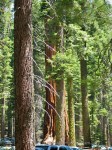
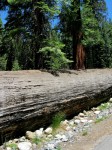
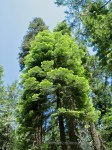
But, several years ago, after 6 days of backpacking in Yosemite, it was a nice respite to head to Mariposa Grove and see the giant sequoia there.

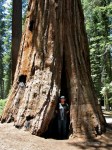
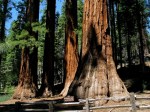
In the same inexplicable way in which the mountains evoke a quietude, these giant trees spoke to me like individual mountains standing amongst a forest of tiny hills. They are the largest living things on the planet by volume.

I once read a historical novel about the settlers of the Pacific northwest in the 1800’s. In that book, they had an intense hatred of trees. The trees stood between them and fertile farmland, sustenance, and shelter.

When I saw the sequoia looming down, as they had in some cases for over 3000 years, among some of the world’s oldest living creatures, I found myself wondering what the early settlers thought of these giants. The Sequoia survived in part because they were fire resistant, bug resistant, rot resistant, and not particularly useful for building anything.

The settlers couldn’t burn them–in fact, fires are quite helpful in promoting Sequoia reproduction and over-controlling forest fires led to a demise in their population.

Their seed cones are tiny pods that pop open and spread seeds when properly dried. The heat of fire, which has the additional benefit of clearing out most of the Sequoias’ competitors, dry out the cones and allow the seeds to disperse.

The Chickaree squirrel can also help disperse sequoia seeds. This little guy will eat sequoia cones and help spread the seeds in part by storing the cones.

Luckily for both the sequoia and the Chickaree in Mariposa Grove, controlled burns are helping to restore the natural ecosystem of the area, encouraging new generations of giant sequoia trees.

The famous “California Tunnel Tree” in the middle of the park probably serves as the best representation of how the early settlers felt about these giant trees. They cut a big hole through the middle of a tree wide enough to drive a wagon and a team of horses through it. Not exactly a sign that they had a sense of awe and wonder about the trees. Seems more like a Graceland tourist trap than a healthy respect for the diversity of life.

In any case, we are all fortunate that Galen Clark did come along with a healthy respect. He saw the testament to grace these trees represented and managed to preserve them.

I imagine life from the trees’ perspective, in which thing move at a pace proportional to a 3000+ year life expectancy. I imagine what a tree “sees” in the course of 3000 years as the make up of the air, the water, and even the very soil at its feet shifts and changes. I wonder if the older trees complain about kids these days or if evolution occurs at an altogether different pace?

Night Lights

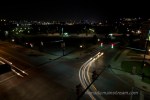
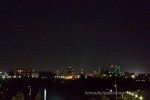
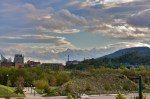
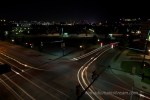
I haven’t shot the Chattanooga skyline at night for a long time.  And I probably shouldn’t have now, either.  The sky wasn’t doing anything particularly interesting.  What attracted me though, was the changing lights on the aquarium.

The aquarium hadn’t been lit at all for many months.  Then, suddenly, the lights turned on and they were red.  As were the lights on the Blue Cross Blue Shield building.  And the lights running along the pier, the lights on the Riverwalk on this side of the river, and even the lights running along the  Walnut Street bridge were covered in red film.

I asked someone if they knew why the lights had suddenly appeared in red.  They guessed it was for the upcoming “Wine over Water” event, but that really didn’t make sense.

I googled Chattanooga and red lights.  I got hits on all the traffic cameras at intersections in Chattanooga.

Then, on the night when I finally broke out the camera, the Blue Cross Blue Shield building was lit in pink and the aquarium lights started changing colors.  The aquarium lights rotated from pink to red to orange to yellow to pale blue to dark blue to purple to pink, and finally, back to red.

I guess I should have just made a video of it because I ended up taking way too many pictures trying to get one of each color.

Then, like a kid suffering from ADD, I was more taken by the streaking head and tail lights of the traffic going through the scene than by the lights on the aquarium.  What is it about long exposures with steaks of car lights going through them that’s so much fun?

But, back to the mystery of the colored lights.  After shooting these, several things happened that made me suspect the red and pink lights were for breast cancer awareness.  It started when I saw a “Save the Tatas” bumper sticker on a car in the grocery store parking lot.

Then, when I crossed the Walnut Street bridge, I realized there was a lighted ribbon symbol that could have been for heart disease awareness, but that’s in February.  Then,  the building lights were appearing in pink more often than in red.  And, I learned that the 30th was the Chattanooga Race for the Cure.

So, I have concluded that the colored lights are supposed to be for breast cancer awareness and that they just started a little early (October is breast cancer awareness month) in honor of the race.  That’s my theory anyway.

I still haven’t figured out why most of the lights are red instead of pink.  Perhaps my theory will be proven or disproven as the month of October progresses.

In the meantime, I’m having fun with lights of all colors.

Tent Cabins

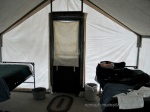
On our trip to Yosemite several years ago, we spent one night in a tent cabin at Tuolumne Meadows.  This was long before the recent scare related to the Hantavirus infection in Curry Village.  Plus, Tuolumne Meadows is a long way from Curry Village.

There are many differences between Curry Village and Tuolumne Meadows.  Curry Village is located in Yosemite Valley, where the temperature is far warmer.  It’s also the most popular part of the park, so Curry Village is larger and has more people in it.  This results in a lot more noise and a lot more bears.

It’s really hard to get that many people to comply with rules about keeping anything scented in a bear locker.  Even well-intentioned people overlook things like lost M&Ms in their cars or in pockets.  Cars parked at Curry Village are often in danger of bear raids.

By comparison, Tuolumne Meadows is cold.  It’s at a much higher altitude in a remote location above the valley, resulting in much cooler temperatures.

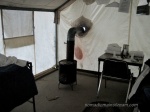
We were there in July–and it was even a warm July.  We slept in sleeping bags rated to -10 degrees.  We wore fleece, warm hats, and zipped our mummy-style bags securely around our heads to stay warm.  Thankfully, the bags were warm enough even after the fire in our tiny, inefficient wood-burning stove went out.  There is nothing about a tent cabin that is energy efficient, unlike our 2-person tent that can often get quite warm with our bodies in it.

But the advantage of the cold temperatures and more remote location is that it’s a smaller village with fewer, quieter people who tend to be more serious about hiking and more conscientious about storing their stuff properly.  There are far fewer bear encounters in Tuolumne Meadows as a result.

Another advantage was that, because of the remote location and smaller number of people, they served a really awesome hot breakfast right in the village.

The biggest challenge we faced was identifying our bear locker in the long row of lockers.  People used unique rock arrangements on the lockers to mark theirs.  We made the mistake of remembering the rock arrangement on the locker next to ours, which had changed by morning.

Anything with a scent must go in a bear locker.  This includes toothpaste, hair gel (if you happen to have brought hair gel), deodorant.  If it could possibly smell like food to a bear, into the locker it goes.

The black canisters are a portable equivalent of a bear locker–all things with scent go in one on the trail.  The Yosemite bears are so familiar with bear canisters they don’t even try to break into them if they see one that’s been properly closed.  We left extra stuff that didn’t go on the trail with us in a bear locker at the trailhead.

There was often evidence a bear had checked out our campsites, but they’d always left quietly without disturbing anything.

Stringer’s Ridge

Among the many places in the vicinity of Chattanooga to hike, Stringer’s ridge is both new and old.  It’s old in terms of having been there for a very long time.  But it’s new in that a group is now working hard on creating new trails throughout the ridge area.

For us, it made a great Sunday hike when Pat was tired, having been on his feet all week working on building guitars.  Instead of driving an hour and hiking a a strenuous path, we drove about 5 minutes to get to Stringer’s Ridge.

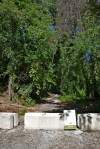
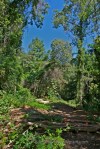
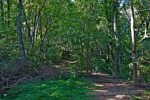
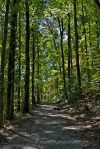
The area has many trails still under construction; they are marked with signs indicating they’re closed.  But, in spite of the closures, we found a lovely loop open by following the deteriorating roadway that seems to be a remnant from when people had homes in what is now a preserve.  It went from deteriorating asphalt to gravel, which was actually easier to walk on.

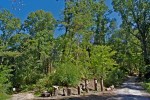
Where the road intersected several trails (most still under restoration efforts, but one open to traffic), it appeared someone had been expressing their artistic talents in wood.  A collection of what appeared to be bird houses lined the main intersection.  A giant sculpture of a hiking man created by creatively placing a forked log and adding appendages made a very cool trail marker.

We’re excited to see the progress.  We could see some of the trails under construction winding their way through the woods below us and were certain they would be a great walk when they’re open.

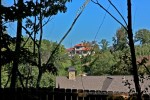
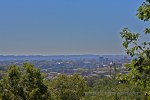
We were also thrilled to discover the fantastic view of the Chattanooga riverfront and north shore areas from the South side of the ridge road.  Who knew we could find such a view just minutes away from home?
Date Night Plus One

Last weekend, my husband suggested something fun, a little romantic, not strenuous, and inclusive of Tisen.  He suggested getting take out and going up to Signal Point to watch the sunset.

He had a craving for fried chicken.  This is monumental.  I have known my husband for going on 18 years now; he’s eaten chicken exactly twice in those 18 years.  The first time was last March.  I’m beginning to think southern culture is getting to him.

This craving resulted in me waiting inside NIkki’s Drive In for our dinners to be prepared while Pat waited in the car with Tisen.

While I sat, I pondered the meaning of “drive in.”  Nikki’s is a place that is most easily reached by driving.  However, there are certainly houses well within walking distance and even more within biking distance.  I’m certain they don’t turn customers away who get there by either of these means.  They aren’t one of those places where you can pull up and park and order through a microphone and they come out on roller skates to serve you.  In fact, they don’t even have a drive through window.  They have a parking lot.  Does having a parking lot qualify a restaurant as a “drive in”?
When I got our food, we drove up to Signal Point without using the GPS.  Pat took 2 wrong turns in spite of me pointing and saying, “turn, turn, turn! TURN!”  I think this is a common marital problem.

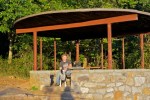
When we got to Signal Point, a couple was already at the only picnic table.  We picked a rock along the hillside to sit on while we ate.  Pat, my romantic husband, had spent an inordinate amount of time packing Tisen’s elaborate dinner so Tisen could eat with us.

Tisen is on a special diet.  It consists of all raw foods.  His fur is softer and stays cleaner longer.  His teeth look cleaner.  He has more energy and seems to limp less.  Yet, he still suffers from the allergies that caused us to change his diet in the first place.

He gets a mixture of reconstituted foods along with herbs and supplements that put our own diets to shame.  This is all mixed with organic coconut oil.  Pat prepared it all and had it ready to go for Tisen while we picked at our fried chicken.

Tisen was pretty sure the fried chicken would taste better than his health food.  I’m pretty sure he was right.

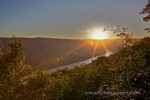
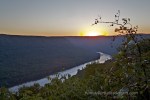
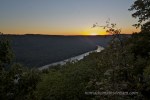
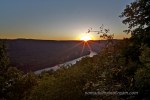
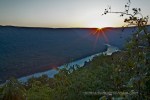
As the sun started to set, the moon rose higher in the sky.  I couldn’t resist trying to get a vertical shot with both the river valley and the moon.  Then, I couldn’t decide which one I liked better.  The one with the sun still hitting the foreground, the one with the foreground in shadow, or something in between?  There wasn’t much going on with the sky, but it was still a lovely evening as are most evenings on Signal Mountain, I suspect.

Nostalgia

One of the hazards of having a 2TB hard drive is the immediate accessibility of old photos.  There is something about fall that causes me to review.  With 9 years of photos on my hard drive, this can be quite a journey.

Along with review comes a sense of nostalgia.  As much as I appreciate my new life in Chattanooga, there are things I miss about my old life in Columbus, Ohio.

I try not to think about how much I miss my friends.  Although I have made a dozen or so friends in Chattanooga now and I would miss them, too, I don’t find that friends are replaceable or interchangeable.  Each is a unique relationship and each relationship is something I value.

I don’t need old photos to remind me how much I miss my friends.  What the photos do remind me of is there are other aspects of my old life that I miss as well.  Being within an easy 1/2 day’s drive of family is a big one.  Going from a 3 hour drive to a 7 and 10 hour drive is a big difference in how frequently we see family.

But there are small things I miss as well.  For example, I miss my gallery wall from our former living room.  Given that we somehow lost the prints on that wall in one of the two moves after selling the house, I miss the art as much as the wall to display it on.  It was one of those little pleasures I enjoyed everyday.

I also miss playing in the snow.  Although, I guess I would have missed that had we still been in Columbus this past winter given it was unusually warm.

Perhaps a bigger gap for me is the feeling of being part of the community.  Although I’ve found volunteer gigs I enjoy here in Chattanooga, it’s a little less immediate than being part of a neighborhood group that invests time and energy in improving the street we live on.

Along with changes that came from changing states, I also miss some of the things we left behind when we sold our house.  Like the raccoons on our deck that would eat peanuts left out for the birds.  Or being able to look out the windows and be eye-to-eye with birds ranging from Red-shouldered Hawks to Scarlet Tanagers to even occasional warblers.

I guess I am really missing living in a wooded ravine that not only brought the birds up close to our windows, but also allowed for a woodland garden, intense fall colors along our street, and a hummingbird nest above the deck in the summer time.

But even as I miss these things, I am also relieved.  After all, as much as I enjoyed life in the ravine and life in the house and community there, giving up those things has created an uncertain future that brings with it a sense of endless possibility.

Last Chance

Now that we’ve passed the autumnal equinox, all the signs that summer is over have become more prevalent.  Of course, there are the birds, having shed their breeding colors and stopped their incessant singing.  But, there are many other signs.

For one, the nights are cool and crisp, the air taking on a taste (or is it a touch?) that snaps as I move through it.  And the nights come faster, the sun setting earlier each night, while the mornings drag along, the sun too sleepy to rise.

Leaves have started blowing along the paths in the park, crunching underfoot and crackling against concrete as they dance in the breeze.  The leaves that remain on the trees have shifted from deep green to something a women’s clothing catalog might call chartreuse.

As I walk Tisen longer and longer before dawn, Venus continues to shine brilliantly as if it’s late at night.  Combined with the waxing moon, I find myself confused as to whether I’m getting up or going to bed.  With the morning temperatures calling for a fleece, I’m tempted to go to bed.


The pots of summer flowers on neighbors’ balconies have disappeared and been replaced with mums in fall colors.  Some even have pumpkins and halloween decorations displayed.  The stores have already stocked halloween candy (betting on compulsive sugar-eaters like me buying early and eating what they buy and having to replenish before trick or treat).

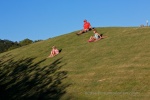
Yet, there are still persistent remnants of summer.  The Tennessee River remains the temperature of a warm bath (how I know that is a subject for another blog post).  The late afternoon temperatures still reach the mid to high 80’s.  And, on weekends, local families still gather on the sledding hill.

Just over a year ago, I did a post called Southern Sledding.  This was the most fascinating tradition to me.  It struck me as odd that up North, it had never occurred to us to sled on grass.  We waited around for 10 months out of the year day dreaming about when we could go sledding again, hoping against hope that we’d get enough snow over Christmas vacation (which never happened).  And then hoping for enough snow to close the schools so we could go sledding instead of going to school (which rarely happened).  Perhaps we liked the idea of sledding more than the reality of sledding and that’s what kept us from thinking of sledding in warmer weather on the grass?

Whatever the reason, the sledding hill seems to be more crowded now as if everyone who never got around to grass sledding during the summer is trying to get it in before the weather changes.

This is one tradition I have yet to try.  I keep waiting for someone to offer a class on proper technique.  I guess I, too, will have to try to get it in before the rains start.  Perhaps I will take a lesson from one of my subjects and wear a helmet.

Renaissance Rodents

Across the street, Renaissance Park beckons.  It calls to me with its manmade hills hiding secrets left behind by the manufacturers who occupied this park long ago.  And before that, the civil war soldiers who crossed the Tennessee here at Ross’ Landing.  And even before that, the Cherokee on their tragic walk on the Trail of Tears.

I don’t know what all was encapsulated in the mounds of Renaissance Park, but Renaissance is a good name for it.  Reborn from the pit of industrial waste it had become, it’s now a haven for birds, butterflies, the occasional deer, perhaps a fox family, and for sure coyote.

The thing is, you don’t get predators if you don’t have prey.  Fortunately, prey doesn’t care if the hills are manmade or if the wetland was created by a backhoe, or that the plants were carefully inserted into the earth by the hands of a human being.

The fact that the western hill in Renaissance is covered in native grasses and flowers means it’s a living feeder.  It feeds the American Goldfinches who love to cling to the stems of flowers that have gone to seed while they munch away.  And, underneath the foliage, it also feeds a more mysterious colony of life.

This colony becomes massive in the fall when the young have matured enough to rustle amongst the long grass on their own.  They scamper and disappear quickly enough that all I’d been able to determine is that they were rodents.  I’ve been afraid to consider the possibility that they’re rats.  Not because I’m afraid of rats but because I fear the reaction of the public to the notion of a large population of rats nesting in the park.

To me, this just makes the hillside a better feeder–it provides food for more than one link in the food chain.  But, for many, the word “rat” causes a different reaction.

When Tisen and I walked into the park a few evenings ago, these mystery creatures were showing themselves.  In fact, one sat on top of a clump of grass staring at me.  I was so caught off guard, having tried to see what they looked like for so long without success, that I barely had time to process what it looked like before it took a closer look at Tisen and decided to duck back under cover.  It looked a lot like a small brown rat.  I decided I’d better bring my camera over the next evening.

Back we went, me armed with my 70-200mm lens.  As Tisen’s tags jingled, the little critters scampered around, not holding still long enough for me to get a look, let alone a shot.  But, finally, I spotted one sitting still.  I am happy and relieved to report that it is not a rat; it’s a Meadow Vole (I think).  After all, no one ever got up in arms about exterminating a bunch of cute little voles, did they?  My favorite hawk feeder is safe.

Clouds Landing

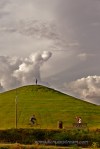
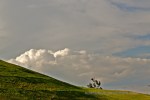
When a boy in a cape appeared at the top of the sledding hill (aka, “the volcano”) with a giant cloud rearing up like a monster behind him, well, who can blame me for snapping a few shots?

I took four shots of Super Boy up on the hill before he ran (flew?) away.  I couldn’t decide which one I liked the best, but in the end picked this one because it had the added bonus of the bicycle and the pedestrians moving through the frame below, oblivious to the superhero on top of the hill.  On one hand, the shot with no bike or pedestrians is less busy.  On the other hand, I feel like it’s a more complete story to have the tiny boy on top of the hill, potentially battling the cloud monster, while the adults go about their business like it’s just another ordinary day.

That pretty much sums up the difference between children and adults most days.

I try to imagine myself wandering around the park in a big red cape.  I picture myself at the top of the hill with some sort of mask and my cape blowing in the wind with a fist raised above my head as I shout at the clouds, daring them to transform into something dangerous.  I imagine running down the hill at top speed, pretending to fly as my cape billows out behind me.  It’s ridiculously fun.  I am tempted to start shopping for a cape.

In the meantime, I return to shooting the clouds as they hover close to the ground.  They billow on the horizon, sitting so low that they look like white hills of cotton stacked up against the green hills of the park.  It looks like you could run up the hill and jump onto the clouds.  Now that would have been a good shot of Super Boy–one of him leaping mid air, ready to bounce off a cloud.

I wonder if I bought Pat a cape if he would model for me?

In the meantime, my photographer’s assistant is not doing a very good job of assisting.

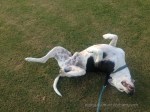
He is caught in his own imaginary game.  He is playing “hunter.”  This is a game in which he imagines himself as a pointer or a rhodesian ridgeback or some other great hunting dog.  He freezes in the midst of long grass, cocks his head and listens, sure that there is wild game hidden in the grasses nearby.  He raises one foot, bent at the elbow in a near-perfect approximation of a point.

I turn and watch, but cannot see any sign of prey hidden in the grass below.  Eventually, I sit down on the curb and just wait to see how long Tisen will continue to imagine himself a great hunter.  He outlasts me.  I say his name and he wags his tail as he returns from his imaginary world to follow me home.

Through the Woods

Stepping silently is impossible, especially in the woods.  But under the refuge of a heavy rain, each step disappears, blunted and blended into the sounds of the rain.  If ever I needed to escape or evade, I would hope for a downpour to hide my sound, my scent, my very presence, truly allowing me to leave no trace.

Perhaps it is the feeling of being encapsulated in a rain shower that causes an illusion of privacy.  As we put one foot solidly in front of the other, I forget my companions.  I look around in a panic realizing I haven’t heard Tisen’s familiar jingle for quite a few yards.  He is close at my husband’s heels, still trying to keep his head dry by hanging out under the over hang of Pat’s pack.  He hasn’t yet learned rain is its own kind of shelter.

Stepping through the rain becomes a meditation.  I cannot hear my own breath nor even my thoughts.  My mind has gone still and I focus on planting a trekking pole, placing a foot, planting the other trekking pole, placing the other foot.  I feel the muscles in my arms flex as I push off the poles.  I feel the twinge in my knee that threatens to turn into a sharp stab should I push it too hard.  My shoulders are already screaming.  I shift my focus back to my steps.  I don’t think about the distance left or the distance behind.  For those moments, I am my feet, my arms, my shoulders, my legs.  My boots and the ground move together as if the earth moves with me and all of me has melted; I am the rain.

Then, it stops raining.  My metaphysical moment evaporates even before the sun dares to break in through the clouds.

Returned to my more mundane reality, we find a spot to stop for a snack.  I slide out of my pack and dump it, rain cover down, onto a log.  It looks like an overturned turtle who has given up and stopped waving its legs.

I can’t remember ever enjoying trail mix so much as I enjoy it standing on the trail with a grumbling stomach, wondering if we will make it back without stopping for lunch.  Tisen stretches out and opts for a quick nap while we finish eating our apples before strapping our packs back on.

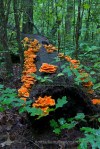
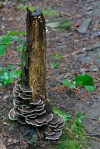
Now, the wet forest demands my photographer’s eye.  Every stretch of the trail reveals even more beautiful mushrooms.  I do my best to capture some of them with my 24-70mm lens, but I wish there were such a thing as a weightless macro lens and tripod so I could get up close and not worry about camera shake.

We hike faster as we get near the end.  My mind is no longer in the moment.  I’m longing for when I can set down my pack and know I don’t have to pick it up again for a very long time.