The iPhone is Not Enough

On Labor Day, I was hiking my way back from an overnight in the backcountry.  The next morning, I was up at 5:30AM so I could get on a plane to Orlando for a work conference at Disney World.

Because our conference hotels overflowed, I was moved to The Animal Kingdom Lodge.  Having not been inside the Disney World gates since I was 9, I didn’t know that there would be an actual animal kingdom outside my window.

Had I known, I might have figured out a way to pack my camera.

Having reduced our worldly possessions by about 80% over the course of many years and moved into a small apartment with ridiculously limited storage space, one of my greatest challenges has been not to keep acquiring more stuff that won’t fit anywhere.

I make this point because I am starting to think about getting a small, point-and-shoot camera.  Something that will do a better job than my iPhone camera.  And something I can carry backpacking without getting an ache in my neck.

Now, some might argue that I should think about trading in my iPhone 4S for a phone that has a decent built-in camera.  But, I’ve had my iPhone for less than a year and I really don’t believe there is a phone with a built-in camera that’s going to suffice.

Let’s look at the camera in the iPhone 4S. Like all built-in phone cameras, all zoom capability is digital.  By this, I mean that when you are zooming, it’s enlarging the image in software, no moving glass around to magnify the image before it is captured digitally (also known as Optical Zoom).

When you look at the images in the gallery, you can see that as you move from left to right, the buffalo get bigger and the quality of the image gets worse.  This is the same thing that happens when you enlarge a low resolution photo on your computer and the pixels get spread too far apart for the image to look good.

In comparison, when optical zoom is used, the image is magnified by the glass and then captured on the sensor at that size, so there is no loss of resolution in the image.  Maybe instead of a point-and-shoot, I just need an adapter so I can use my lenses with my iPhone?  They really exist:

http://photojojo.com/store/awesomeness/iphone-slr-mount/


But, then I’d have to carry heavy lenses plus an adapter.  Besides, that little adaptor costs $250.  I’m pretty sure I can get a really good point-and-shoot for that much money.

I started investigating MILCs (Mirrorless Interchangeable Lens Cameras), which are smaller and lighter.  I’m not ready to spend that much money on a new technology that’s step down in quality, although they do seem quite promising.

Maybe fuzzy animal pictures on work trips and an aching neck on backpacking trips will just have to do for now.

Treat Me Right (Even When I’m 86)

I have never seen B.B. King perform before.  When we saw he was coming to a small venue in Chattanooga, we had to go.  I am so glad we did.

B.B. King is 86 years old and still so full of life that you just want to stand where his light can shine on you.  He is so adorable that he could have just sat on the stage smiling and the audience would have been grateful.

I could not stop thinking to myself, this guy is the same age my aunt was when she died.  I cannot help but compare the sad shell of a woman my aunt was at the same age vs the belting-out-the-songs (albeit in short spurts) B.B. King.  What an inspiration.

I looked at Pat and said, “I wonder what it would be like to have a job you still want to be doing when you’re 86?”

What was really cool was the reverence the audience had for this octogenarian.  I think everyone there felt honored to be listening to B.B. King talk and play and sing.  I compare this to going to my aunt’s bell choir performance at her assisted living facility.  The attitude of the audience was one of amused patience; we were doing a favor for the performers by being there.

The B.B. King audience was there for the opposite reason–to have the honor of being in B.B. King’s presence.  That audience felt gratitude for B.B. King doing us the great favor of getting up on that stage.

I sometimes think about aging and what it means if, at the end of your life, who you are is taken from you in the form of dementia (something that happened to all four of my grandparents and half of my aunts).  I had a recent conversation with a friend about the Okinawa study.  There, the elderly are revered and good health reigns, even amongst centenarians.  And they have more centenarians than any where in the world.

My friend said the families there fight over who will get to take care of their aging parents.  It’s considered an honor and a privilege to take on this responsibility.

B.B. King made me feel honored and privileged; I have to wonder how much this ability contributes to the difference between a man who still lives life and a woman who sits idly in front of the TV while her memories slip away.

On a photographic note, the one disappointment of the evening was that I called ahead to make sure I could bring my camera, but when I got there, they told me I couldn’t take it in.  I should have tried a different security person because I met man with a very large point-and-shoot who said he was told just not to use flash.  I had to make do with my iPhone.  When I saw how horrible my pictures were, I understood why the promoters didn’t take away phones.

Blurring Lines

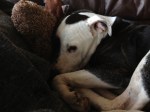
Tisen cuddles on the couch with Mr. Beaver while I’m on a conference call.  I’ve downloaded a new app on my iPhone and this is the perfect opportunity to give it a try.  It’s an HDR photo app.  HDR stands for High Dynamic Range and refers to a process where you take multiple photos and combine them into one.  That’s about all I know about it so far.

The iPhone app takes two photos, the first exposed for the darkest part of the picture and the second exposed for the lightest part of the photo.  Then, it magically combines them into one photo that is exposed properly for both extremes.  Getting Tisen exposed properly is difficult to do with a single shot.

The iPhoto app has some disadvantages.  First, it only uses two photos.  More sophisticated software allows you to use many images, getting the optimal exposure for many different levels of light.  Second, it’s very difficult to hold the iPhone still enough to not cause fuzz because you can’t move between the two shots for them to combine properly.  Finally, the app takes a long time, so if you have a subject that doesn’t hold perfectly still (like Tisen), more fuzz will be introduced.  In the photo gallery, the first image is underexposed, the second is overexposed, and the third is the fuzzy combination of the two.  It’s fun.

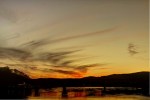
This little experiment motivated me to take my camera and tripod on my evening walk with Tisen, finally getting down to the river to shoot the sunset.  Tisen is amazingly patient while I take groups of 3 photos, using the bracketing feature on my camera so there is 4x more light in each successive shot.  We hang out on a pier over the river for 45 minutes watching the light fade, Tisen occasionally barking at other dogs, but mostly just hanging out.

I try a software program called Photomatix to create the HDR photos.  Some people say that HDR photos look more like what we see with our eyes.  While I like a lot of HDR photos, I don’t agree they look like what we see with our eyes.  It’s more like what you see when you look through your sunglasses at the sky and then take them off to look at the ground, but all in the same view.

As I look at the images, I can’t help but pick the darkest ones.  The ones that leave the black clipped and the land in silhouette–I’m pretty sure I’m missing the point of HDR.

Except for one.  The final photo I like in black and white.  But it’s right on the verge of “fake.”  I don’t know what that means, really.  But where is the line between being a photographer and being someone who knows how to use a software program?    And is one better than the other?  For me, it’s not just the combined photo that gets a little blurry.  Perhaps I am just getting old and clinging to out-dated thinking.

Missing the Moon

I am out walking late again.  It’s 11PM and the moon is full.  As I cross the street with Tisen, I realize I forgot to check the lunar calendar.  I’d been experimenting with shooting the full moon on the horizon.  It’s a more interesting subject that way.

Last August, I discovered the moon was rising behind the Walnut St bridge and attempted to capture people walking in front of it on the bridge.  This was a great concept, but the lack of a tripod led to poor execution.  Since then, I’ve only managed to catch the full moon in November.

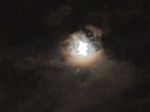
Tonight, I look up and see thin, high clouds blowing across the sky, making me feel like I’m watching time lapse photography of a moon rise.  As the clouds pass over the moon, the moon forms a brilliant ring.  As the clouds and light continue to shift, the ring turns a glowing red.  Inspired by a much better photographer, I pull out my iPhone and attempt to capture a shot.  The first picture in the gallery is the best I could do.

A couple of lessons learned on iPhone photography:  1)  even the iPhone 4S with it’s new improved camera doesn’t handle night landscape photography well, and 2) if you’re going to try to get a decent shot of the moon with an iPhone, it’s best not to be holding the leach of a feisty dog while you’re shooting.  No matter how adorable Tisen is, he only assists my photography when he is the model.

About the time I realize I cannot possibly get a decent shot, the ring around the moon shifts from a glowing red to a circular rainbow.  I’ve never seen anything like it.  Unfortunately, the colors do not show up in the iPhone shot and the clouds move on, the rainbow disappearing as quickly as it appeared.

As much as I want to return home to get out my DSLR and tripod, I know Tisen needs more time.  We complete our lap of the park until Tisen is satisfied.  Then, I rush us home as quickly as possible.  There is a huge bank of clouds blowing in and I’m sure I can get set up while it’s still passing over the moon.

I rush to grab my tripod bag.  I knock over a glass, drop the bag, and fall across the couch, waking my dozing husband.  After assuring him all is well, I get out my camera bag, pull out the camera, find the CF card and stick it back in the camera, attach the 1.4x extender and the 100-400mm lens, slide on the wireless remote, locate the remote, and snap the whole thing into the tripod.  I carry it all outside, locate the moon, position the tripod, and finally find the moon through my viewfinder just as the last wisp of cloud blows away.

All that’s left is the naked moon, overly bright and relatively uninteresting.  I’m fairly certain I can see the man in the moon laughing at me.

Double Play

I have come to realize I am down to three obsessions to write about:  Tisen, Photography, and Hang Gliding.  I was hoping to combine all three into a single post today, but hang gliding didn’t happen today due to weather.  Maybe tomorrow–my own little triple play (sorry, it’s a telecom joke from back when I worked in the telecom industry).

After driving to the training hills, getting about 10% into assembling a glider, and then having to put it away and drive home, I consider taking a nap.  However, I have volunteered to help organize a St. Patrick’s Day fund raiser for S.O.A.R., so I decide to do some work on that instead.  I have a photo that I want to use of Cody, a Red-Tail Hawk, but it had a noisy background.  It was also taken with my iPhone–what I can do with it is somewhat limited.  Nonetheless, I end up spending an hour figuring out how to cut the hawk out of the photo and put it in front of a different background.  No wonder I hate editing photos!

Before:

Cody Flaring for Landing - iPhone photo slightly retouched

After:

Cody with New Background

I end up putting a different busy background behind Cody because there are so many places where I either erased something I didn’t mean to or didn’t erase something I should have.  I need the background to distract from my mistakes.  Regardless, I think it will work for a brochure and it turned out better than I thought it would.

After creating a draft poster and brochure, I take Tisen for a long walk.  There are tourists on the Walnut St Bridge taking pictures.  I have to smile to myself–I can’t count the number of times I’ve been up on that bridge shooting.  But, today is not a good day for shooting at all.  It’s gray and misting and I feel lucky I can pick the days I haul my equipment up to Walnut St Bridge.

I realize today that I’ve decided without actually deciding to include photos with each post, even if means grabbing a few shots with the iPhone.  After finishing the walk, I decide to get out my real-deal camera with the 100mm macro lens and start playing.

After seeing some shots on a real photographer’s blog that make me think maybe dog photos can be artistic, I decide to stick with Tisen as my model, but to try to use the macro lens to get something a little different.  Unfortunately, until I am going through the photos later, I don’t realize how much having a logo showing detracts from a picture.  It looks like I was hired to do a shoot for Kong dog toys.  That would have been nice!  While I’m doing an unpaid ad, Tisen does prefer Kong’s tennis balls–they squeak.

If I weren’t tired of photo editing, I would edit out the logos.  But now, I have the great joy of watching Tisen’s tail wag as we head out the door.

Catch the Moon

I have been using the moon as a model a lot, but I find it is not as cooperative as I expected.  While, like a model, it’s a heavenly body, unlike a model, it presents itself on a predictable schedule.  As such, you would think it would be easy to schedule a shoot.  However, I have learned that a) there is such a thing as cloud cover, b) the moon doesn’t always rise before I go to bed, c) the moon often rises out of sight from where I am looking.

As a result, I have started to worry more about missing the shots of the moon rising behind the Walnut Street bridge in August.  I now wonder if perhaps that was a once-in-a-lifetime opportunity that I missed.

Now that I have a lunar calendar that tells me what time the moon rises, a good tripod, and the ideal composition in mind, I just need the moon to return to it’s former position in the sky.  In doing a little research, I found www.photoephemeris.com for planning outdoor shoots in advance and even tools to figure out where the moon will rise and the path it will travel.  (Maybe we can all be Ansel Adams after all?)

However, this doesn’t answer my question as to how long it will be before the moon rises in the same location.  I am having some troubles finding an answer to this.  I have found articles on the difference in appearance of the moon at apogee vs perigee, the repeating cycle of maxima and minima delineation that takes 18 1/2 years, and calculating the differences in brightness, but I still can’t find how long it takes for the moon to rise in the same location.  I’m guessing that it will repeat within my lifetime, but probably not soon.  In the meantime, I keep watching the moon when it chooses to show itself and looking for opportunities to shoot it rising.

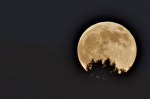
The shot here is a full moon rising through clouds, shot with my iPhone (which was convinced it needed to flash) from a rest area while driving back to Chattanooga from Columbus.  While this looks more like something I might, say, paint during a continuing education class on impressionist painting, I am still impressed by the improvements in the iPhone camera from the 3GS to the 4S–just don’t expect to get good landscape photos at night.

I am particularly impressed with the LCD flash on the iPhone 4S.  I was a little surprised by how brightly it flashed when I took a picture, but when I discovered the flashlight app now has a setting that lets you turn on the LCD light continuously to use it as a flashlight, I was amazed.  I was able to find my workout clothes in the dark this morning and successfully determined the difference between black and dark purple.  If you haven’t upgraded, it’s time.

Wind and Snow

On January first, we turned on the heat.  It doesn’t actually kick on until today, the 2nd, since it was so warm yesterday our apartment was 72 degrees and the thermostat was set on 68.  However, the temperature starts to drop into the range of temperature even us Ohioans call “bitterly cold” by this morning.  In fact, when I check the weather in Columbus, it’s the same temperature there as it is in Chattanooga–a whooping 21 degrees.

We drive out to Lookout Mountain hoping I will have my first flight off the big hill.  We aren’t optimistic when we check the weather and see 15 mph winds predicted.  When we step outside, I figure our only hope is that the valley where the training hills are located is somehow sheltered from this wind.

But, it is not to be.  We set up my glider as the instructors watch the wind socks.  An instructor takes a test flight off the big hill and does so many dips and dives as the wind tosses him around that we all know I won’t be flying today.  Instead, I get a thorough lesson in glider preflight checks, so I at least it’s not a waste of time.

Pat helps me disassemble the glider and then we head up to the office to work on our written tests.

After spending the day working on our tests, I watch the sunset through the back door of the hang gliding office.  The door opens onto a deck that hangs over the valley.  The wind is blowing so hard the air coming through the crack around the door blows the hair back off my face.  I think about opening the door to take a picture of the sunset, but it is so cold in the office already, I can’t bring myself to open the door.  I shoot through the door with my iPhone.

When at last we leave for the day, snow is blowing through the beams of the headlights.  After a half mile or so, the snow disappears as we move into lower elevations.  We are relieved, having been forewarned that everything shuts down if there is snow on the ground–the area doesn’t have equipment to clear the roads.

We make our way home and are grateful we’ve turned the heat on already.  As we settle in for the evening, Pat looks out the window and says, “Look, honey, it’s raining sideways!”  When I look out the window, there is snow blowing so fast through the light from a street light that it really does look like sideways rain.  But, it’s snow.  Because it is only visible in the light from the streetlight, it looks like the street light is some kind of snow machine blowing snow onto the street.  It stops as suddenly as it started.  There is no snow on the ground.  Not even the grass shows a dusting of white.  So much for our first snow.