Hipsta-Tilt

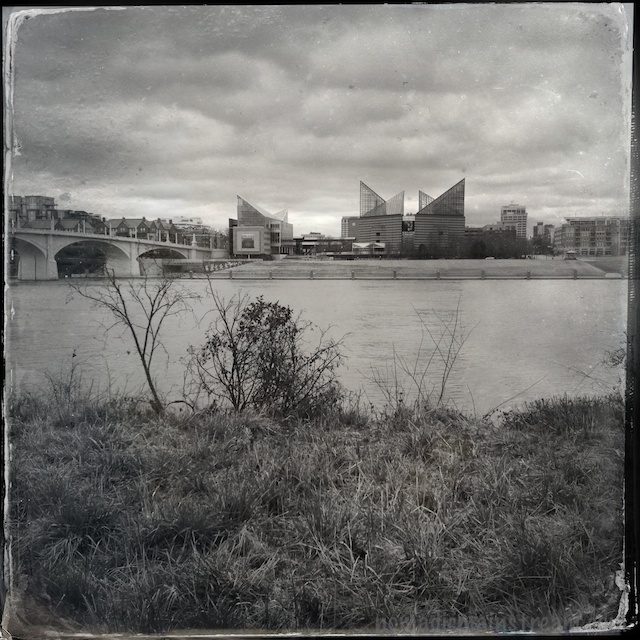
Looking down the walkway in the park and across the river at the Tennessee Aquarium

Looking down the walkway in the park and across the river at the Tennessee Aquarium

I learned one of the limitations of shooting with an iPhone using an app like Hipstamatic, which applies all of the edits as you shoot:  fixing tilt doesn’t work out so well.  Because the effects applied to the images include a noticeable border, when I tried to straighten some of the images, I ended up with a crooked border.

Hipstamatic doesn’t have a level (or at least I haven’t found it) that appears in the screen like some apps.  When I’m shooting a scene with lots of angles and curves, I have a hard time telling when I’m level and when I’m not.  Sometimes I suspect I walk around at an angle.

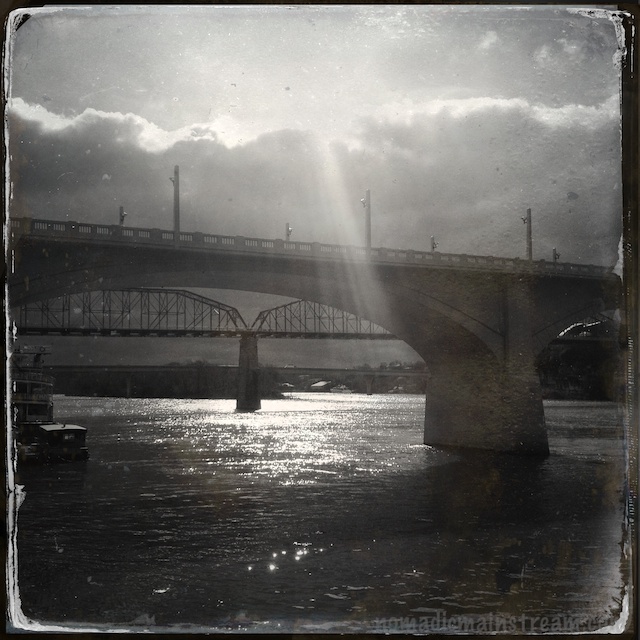
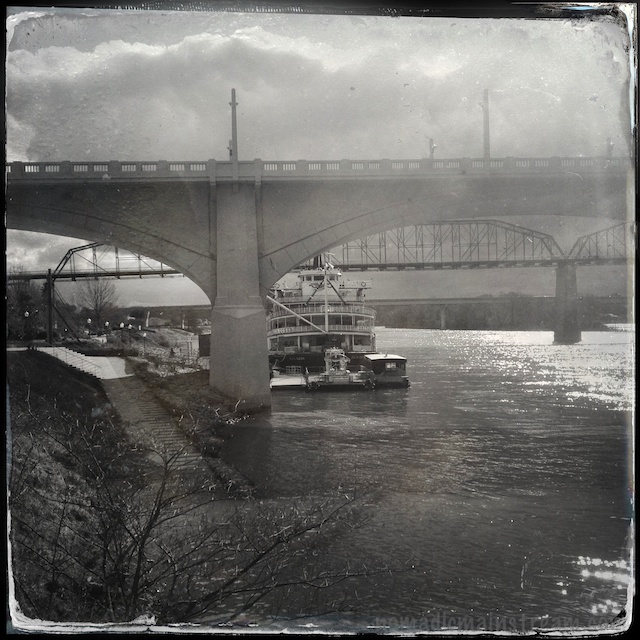
I really want to love the image below, but in order to get the bridge piers straight, I ended up with some weird looking edges.  Notice the upper left hand corner compared to the right hand and how weird the lower right edge looks.  It really bugs me.
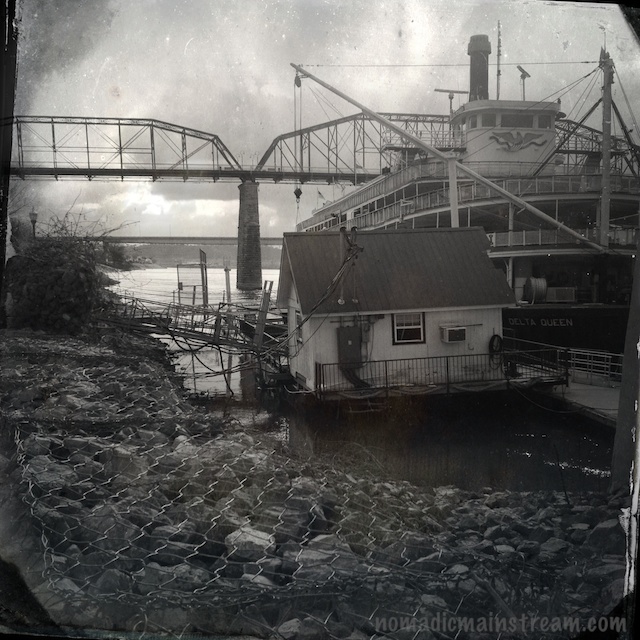
Bridge, clouds, steam boat, water taxi house--what more could I ask for?  Maybe a level.

Bridge, clouds, steam boat, water taxi house–what more could I ask for? Maybe a level.

The historic Walnut St pedestrian bridge in the background and the equally historic Delta Queen in the foreground with the little water taxi house/dock hovering over the water in front of it seemed like the perfect subject for tintype.  I’m starting to visualize me walking around with my iPhone in its Lifeproof case with a level glued to it.  That won’t look odd at all.

Tisen does not like Hipstamatic.  He probably doesn’t know this about himself.  None-the-less, his favorite part of photography is when I am sitting on the sofa with the laptop in my lap doing post-processing of the images and he is curled up next to me.

Looking up the street next to Market St bridge

Looking up the street next to Market St bridge

Hipstamatic reduced my post-processing to 5 minutes since I discovered doing much to the images besides adjusting levels was rather destructive.  That means less cuddle time for Tisen.

Unless, of course, it’s a Sunday morning, in which case it means setting aside my laptop sooner and giving him my undivided attention for an extra 20 minutes.  In that case, he probably likes Hipstamatic a lot.
The Delta Queen peeps from behind Market St bridge

The Delta Queen peeps from behind Market St bridge


However Tisen feels about Hipstamatic, he’s definitely been enjoying cuddling.  I’m not sure if it’s because the weather has been colder of late or if he’s just discovered the joys of being covered, but he suddenly needs to root under any available blanket.  This started when the weather was warmer, but he only wanted his head covered then.  We thought he was trying to block the light so he could nap more soundly.

Now, he burrows underneath until more or all of him is covered.  After a few minutes, he starts sounding like he’s wheezing and we move the blanket so at least his nose is exposed, worried that he’s not getting enough oxygen.  He often raises his head out from under the blanket and blinks at us as if he’s either confused or annoyed–or maybe both–when we do this.  But his breathing quiets and he keeps his head uncovered, so I’m thinking we’re doing the right thing.

Uh, honey?  Have you seen the dog?
Uh, honey? Have you seen the dog?

Hipstamatic Hype

IMG_1588

Hipstamatic stores the settings used with each image! Tinto 1884 Lens and Ina’s 1982 Film. Interesting blur effect.

Here’s a statistic for you:  in 30 minutes, I took 36 shots with my Hipstamatic app on my iPhone.  That’s while walking around a park with a dog (who was not exactly helpful when it came to setting up shots) by myself.

After shooting, I spent about 5 minutes on post-processing the photos making only a few slight adjustments to a few of the images.  I ended up with 15 images I liked well enough to share on my blog and 4 I’m seriously considering hanging on my wall (we’ll see how they look in print).

So, in 35 minutes, I netted 15 shareable images.  Comparatively, on our Christmas hike,  hand-holding my DSLR and using only 1 lens, I took 165 shots in about 5 hours, spent at least another hour on post-processing, and netted 35 shareable images and none I would consider hanging on my wall.  That’s nearly 2 minutes per shot.

In total, I invested over 10 minutes per shareable image with my DSLR compared to over 3 minutes per shareable image with Hipstamatic.  Hmm .  . .

Of course, I’m not ready to stop using my DSLR–the images I got with my DSLR are higher quality and better technically.   I just don’t decide what to hang on my wall based on those criteria.

Sunbeams suddenly make their way through the clouds

Sunbeams suddenly make their way through the clouds

One of the big challenges I discovered on my meander through the park is the bright sunlight problem.  This is a universal problem for LCD display screens–you can’t see them in bright light.  I literally held the phone up completely blind and tried to guess if I was pointing at the bridges at a good angle.  While I might have framed the sun beams differently had I been able to see them, I was pretty impressed with the images.

Maybe not quite the framing I would have chosen, but not bad for shooting blind

Maybe not quite the framing I would have chosen, but not bad for shooting blind

That is one of the huge advantages of a camera with a view finder:  you can see what’s in the frame no matter how much sunlight there is.  Although, supposedly pointing the lens directly at the sun puts you in danger of damaging your eyes.  That might explain why my vision seems to be failing.

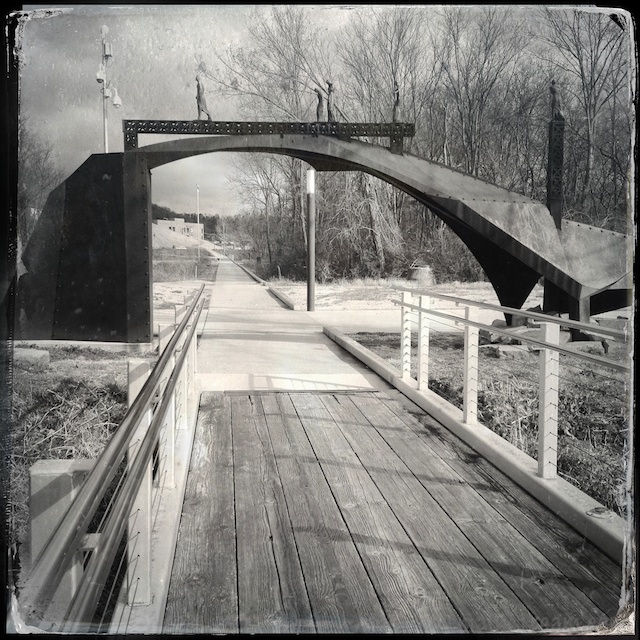
Trail of Tears sculpture shot from observation pier

Trail of Tears sculpture shot from observation pier

I love the trail of tears sculpture in the tintype settings in Hipstamatic.  I also like it shot from this position–I’ve shot it from the other side many times, but this is the first time I incorporated the observation pier in front of it.  The pole for the security cameras in the background doesn’t really work for me, but maybe I’ll see if it’s possible to remove that from the image without messing up the look.

Tisen ready to go sniff elsewhere

Tisen ready to go sniff elsewhere

Tisen quickly lost patience while I was shooting at the end of the observation pier overlooking the river.  I guess there weren’t any interesting scents on the pier to keep him entertained.  He kept picking up on scents he needed to run to check out each time I was pushing the shutter button.  I really need to provide better on-the-job training if he’s going to be my assistant.

Getting Hip to Hipstamatic

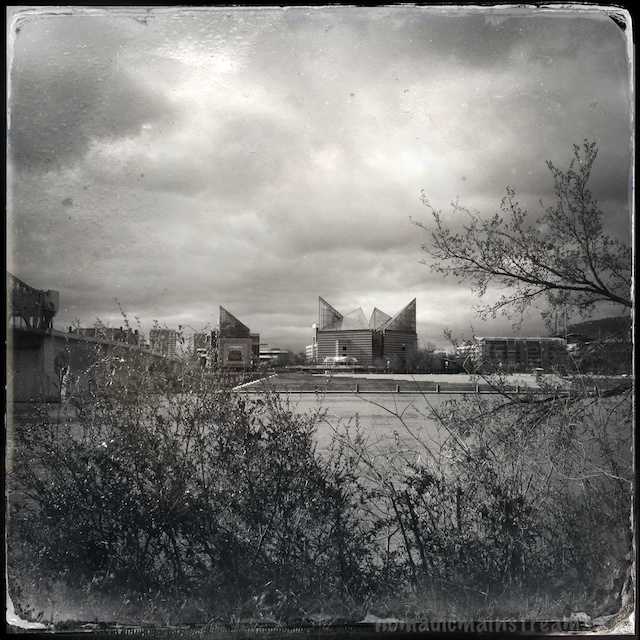
The aquarium takes on a whole new (old?) look in Hipstamatic

The aquarium takes on a whole new (old?) look in Hipstamatic

I did some searching on what other people are doing with their iPhones. I’ve been following Davide Capponi’s blog for quite a while now; he demonstrates that it’s possible to create art with the iPhone.

For now, I’m not after art so much as just discovering what’s achievable for people who don’t want to be photographers. I’ll worry about the next level when . . . well, when I’m ready for the next level.

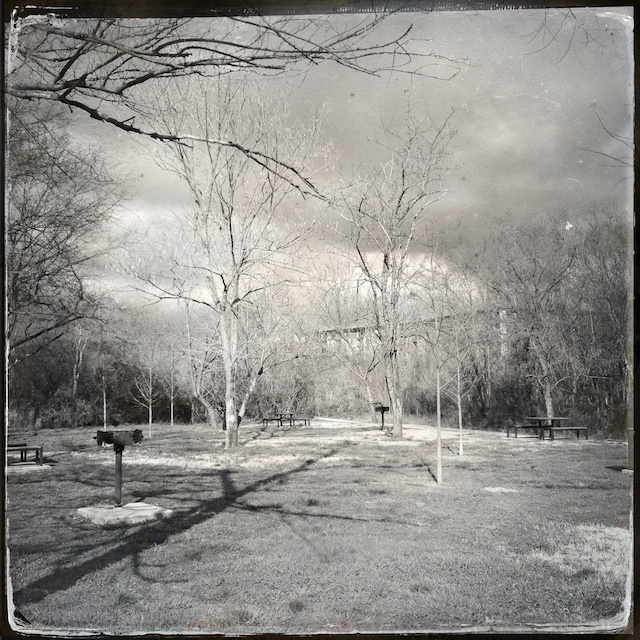
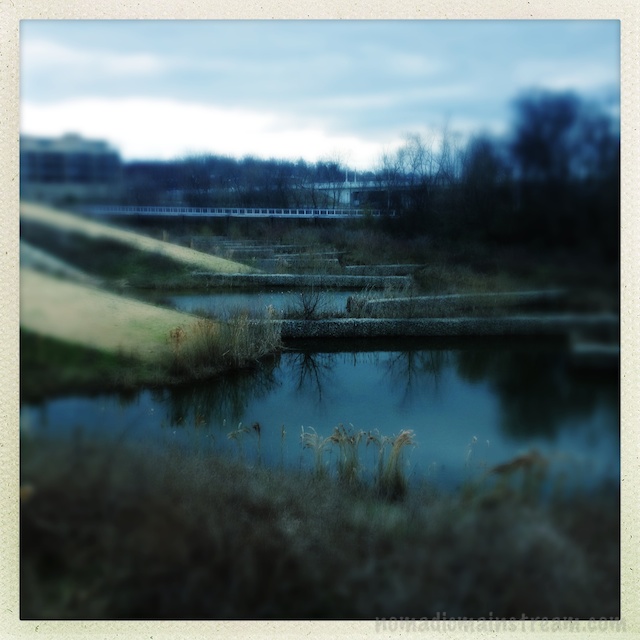
This modern park shot with retro effects seems like an anachronism

This modern park shot with retro effects seems like an anachronism

I decided to further explore the Hipstamatic app. I found a blog post by photo journalist Antonio Olmos; he shares inspiring street images shot with Hipstamatic in Derry, Northern Ireland.

I learned Hipstamatic creates effects based on three components: the “film” you choose, the “lens” you choose, and the “flash” you choose (if you use flash). Basically, it mimics the effects of retro equipment in software. I also discovered that while it comes with one package of lens, film, and flash choices, you can purchase more for $.99 a pack.

A relatively uninteresting scene takes on a completely different character in tintype

A relatively uninteresting scene takes on a completely different character in tintype

I decided to start by imitating. I purchased the pack that included the lens and film options used by Antonio Olmos (at least, I thought they were the same).

On my next walk with Tisen through our daily haunt, I went armed with the Hipstamatic app set with what I thought was the Helga lens and the c-type Tintype film. Somewhere along the line, I ended up with the D-Type film and some other lens. This may have been because a) I was holding the phone and Tisen’s leash in the same hand, and b) Hipstamatic has a feature that randomly selects settings if you shake the camera.

This sculpture/structure seems like a good fit for the tintype effect

This sculpture/structure seems like a good fit for the tintype effect

A few words about using Hipstamatic.

First, I left the app on the entire time I was walking and discovered my iPhone 4S battery died after only 30 minutes. This was the shortest period of time my phone ever lasted. I need to upgrade iOS, which might help, but I suggest turning off the screen (by pressing the button on top of the phone until the screen goes dark) when not shooting. On the plus side, Hipstamatic did not lose any of my images when the phone shutdown unexpectedly.

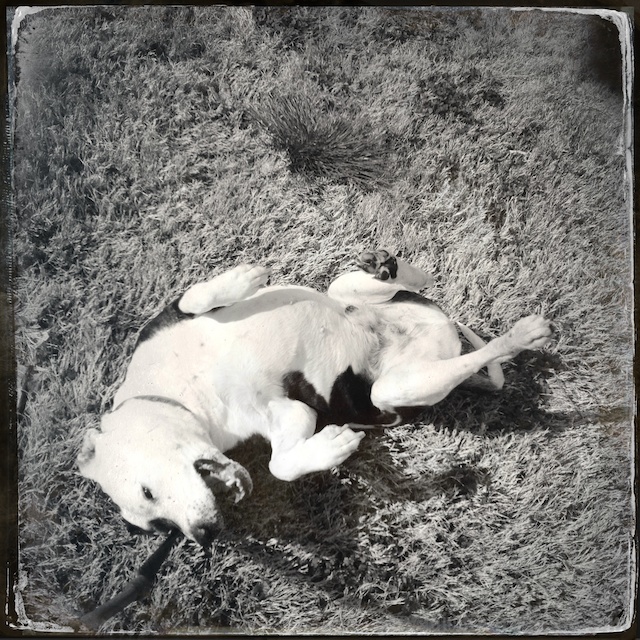
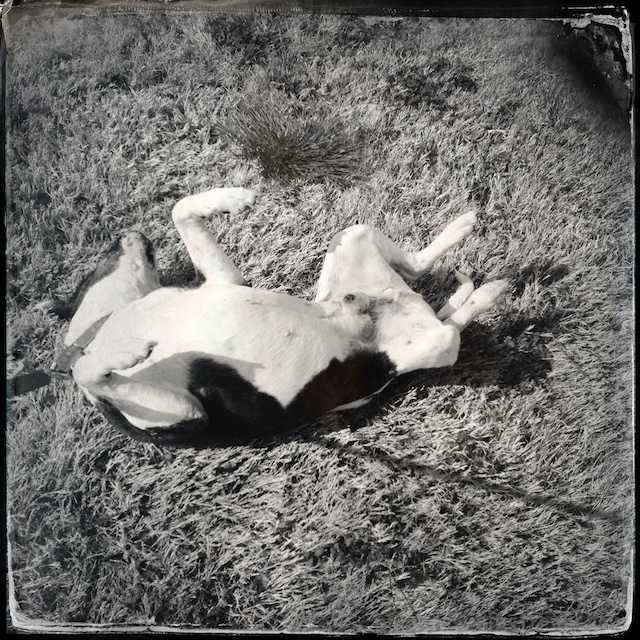
Tisen rolls for the camera

Tisen rolls for the camera

Second, the Hipstamatic mimics medium-format film, which, in a word, is square. Having practiced viewing the world through a rectangle for many years now, I found this disconcerting. For example, I kept looking at the scene and making decisions like, “I think I’ll shoot that vertically so I can get some sky.”

In fact, I turned my phone vertically on several occasions, feeling rather foolish by the third time I made that mistake. I mentally smacked my forehead and said out loud, “Oh yeah, it’s a SQUARE!” Tisen seemed perplexed by my commentary, but he’s pretty used to me talking to myself by now.

Third, some images have vignetting (in this case, dark corners) and some don’t. Sometimes it occurs in the top two corners, sometimes only one. I haven’t quite figured out what causes the variability.

Finally, even Tisen looks nostalgic using this combination of settings in the app. While the effect is fun, the one thing I don’t like about Hipstomatic is you get what you get. You can’t undo the tintype effect and try something else.

I like the tintype effect on the clouds in particular

I like the tintype effect on the clouds in particular

Photo Apptitude

Tisen takes a roll in a brief beam of sunlight on an otherwise gray day

Tisen takes a roll in a brief beam of sunlight on an otherwise gray day

While I was experimenting with iPhone camera apps yesterday, I also decided to try out two photo editing apps recommended by elessar78 (aka, a friend of mine and a far better photographer).  I also included Hipstamatic in the category of “photo editing” because the output from this app always has effects applied to it.

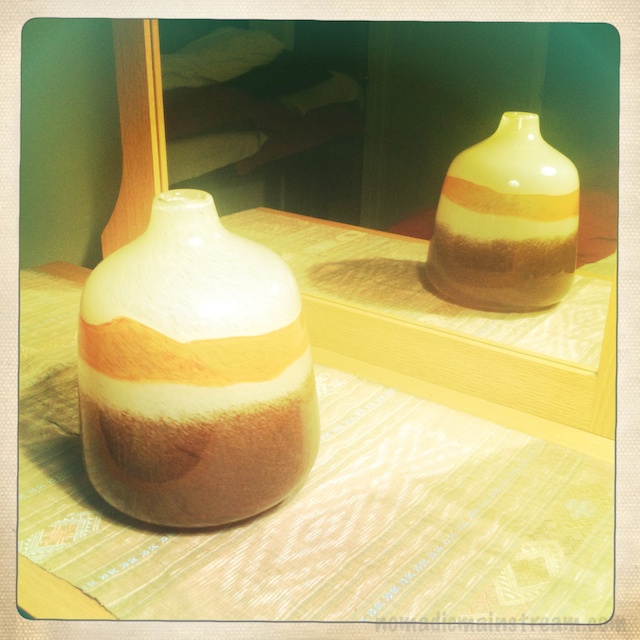
The unedited version used with Photoforge and Snapseed

The unedited version used with Photoforge and Snapseed

For ease of use, Hipstamatic gets a gold star.  Although, I did not find it intuitive to figure out how to get different effects.  I shot this image with the settings it had for that reason.  I will have to play more with this app to figure out what else it will do–I wasn’t too impressed with the effect I got with the current settings.

Hipstamatic shot without changing any settings

Hipstamatic shot without changing any settings

Snapseed was, in fact, a snap.  It had the advantage that I could apply different adjustments to an unaltered photo, meaning I could get many different looks from one shot instead of, like Hipstamatic, getting one set of adjustments that can’t be undone or redone differently.  The disadvantage, of course, is that you take the photo with one app and then do the editing in a separate app, which may be more than the average iPhone shooter wants to deal with.

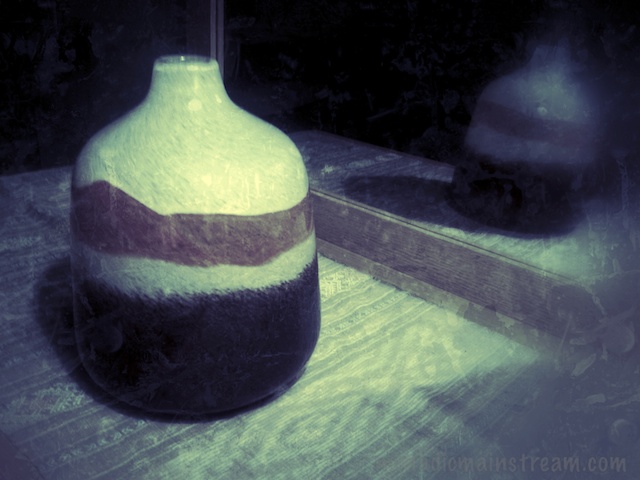
Snapseed edited using black and white slider

Snapseed edited using black and white slider and texture effects

To create this version of the image, I changed it to black and white and then used the very simple slider to make it slightly less black and white, allowing some of the color to remain.  This is the same effect using a saturation slider has, but it was easier and more intuitive for someone who doesn’t normally do any photo editing.

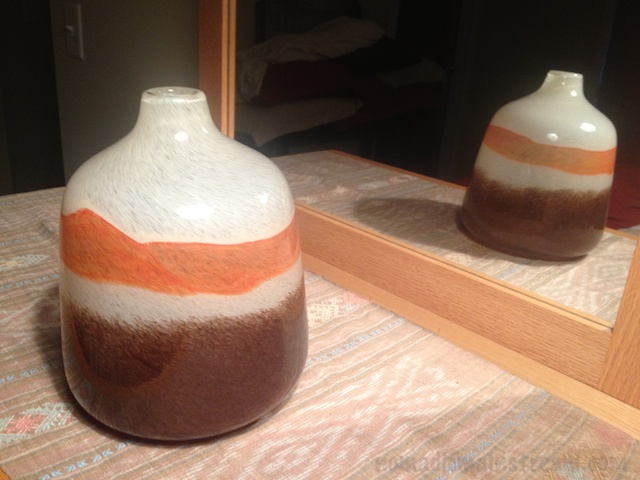
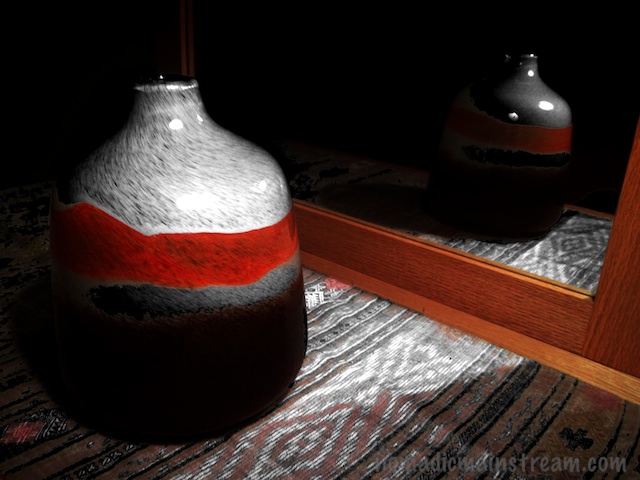
Photoforge has many more editing tools than Snapseed and may, for that reason, be less appealing to the photo-editing-fobes of the world.  I stuck with only one menu of tools (filters) and played with some of the adjustments to get this very dark version of the image.

I like the way the detail in the weaving under the vase pops in this edit as well as the strong contrast between the light and dark areas.  I also like that the background went to black and left only a partial reflection of the vase in the mirror.

Imaged edited with Photoforge

Imaged edited with Photoforge

The best feature of Photoforge that I used was the undo button.  It allowed me to try whatever adjustment I wanted and then undo it if I didn’t like it.

A fun aspect of doing photo editing on the iPhone is that, because I use the Apple iCloud service that syncs all devices via the internet, once I saved my edited versions, they automatically showed up in my Aperture photostream on my laptop.  I could have done further adjusting in Aperture easily, although I didn’t for the sake of comparing effects from the apps themselves.

Tisen remains unimpressed by technology.  All he wants to know is when I will stop playing with my phone and take him for a walk.  I obliged.  Although the photo of Tisen was actually taken the next day–more on that later.