Book Smarts

There’s an expression about being book smart vs street smart.  The idea suggests people are either smart in theory or smart in practice.  In reality, of course, no one is really all one or the other.

For example, I can study how people move their bodies up stairs, determine an appropriate exercise regimen, and create a plan that will make me better at climbing stairs using book smarts.  But I can’t actually get better at climbing stairs except by, well, climbing stairs.

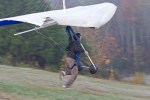
Since there is no room for trial and error when hang gliding, knowing what we’re doing and why helps.  And, since hang gliding truly is the application of physics, it makes sense that getting rated as a pilot would require some book smarts.

Here is where I run into a line that divides book smarts from street smarts.  I am able to read the material through once, review it quickly, and then score what would be an “A.”  However, when I return to the training hills, I am unable to translate what the material said into what my body does.  This disparity between concepts in a book and physical application frustrates me.

But today, we are in my element.  We are taking our final two tests.  I read through the materials and took notes the day before.  I think we will be done around noon given that it’s only 10AM.

As it turns out, I finish up my second test shortly after noon.  Pat, on the other hand, has not finished the reading material for the first test yet.  Mind you that Pat is someone who fully understand mechanics and physics in a way I never will.  However, his in depth understanding of how things work doesn’t seem to help him speed through test taking.

At 2PM we run out and grab a bite to eat at the closest place around. It’s a combination gas station, convenience store, hamburger joint–an honest to goodness family owned place.  After filling our stomachs, we return to the office and Pat takes his first test.  I, thankfully, have my iPad for amusement.

I’ve gotten through an episode and a half of Glee by the time Pat takes his completed test up to the desk.  After a while, I hear him talking.  He has met Matt Tabor, the owner of Lookout Mountain, and they are gabbing.  I finish the second half of the episode I’m watching and decide I need to intervene.

It’s an interesting conversation and I get sucked in.  I eventually remember that my goal was to get Pat on task and I remind him I am waiting on him to finish his second test.

At 6PM, we have to leave because they are closing for the night.  Pat has 15 questions to go on the test, but he calls it a night and we head on home.  Since completing the test now requires backtracking, I am more irritated than he is.  I remind myself that this is fun.

One Man’s Trash

We are up before the crack of dawn, on our way to the hang gliding training hills.  We arrive early–the gates are still locked.  As soon as we settle in to wait, two dogs come running down to greet us.  They are collarless, thin, very young, and very adorable.  There aren’t any homes near enough to explain why these dogs would be hanging out here before dawn.

When the instructor arrives, we drive on, deciding to worry about the dogs on the way home, but the dogs chase us down the dirt road for as long as they can keep up.  We lose them when they tire, but they arrive at the parking lot about the time we get out my glider.  They jump all over me, wanting to be petted some more.  I turn my back on them when they jump and pet them when they have all four paws on the ground.  It takes three times and they figure out they can get what they want by standing still.  They are smart dogs.

As I go through my flying lessons, the dogs chase me when I fly off the hill and run up and start licking my face if I land on my belly.  I’m not sure if they’re worried about me or just having fun, but it’s cute.

After a few flights, they run off to explore something else.  I am relieved–these dogs are breaking my heart.  But, I don’t want to jump into a 12-14 year commitment because they’re cute and hungry.

When we call it quits for the day, the dogs reappear to “help” disassemble my glider.  They remember not to jump on me and I am impressed with how quickly they have learned that lesson.  When I am done, I sit on the ground and let them share my lap.  They are so sweet.  I remind myself they’ve been running around and are exhausted.  Tired dogs usually are sweet.

But my husband looks at me sitting on the ground with these hungry, adorable dogs and says, “All right, get them in the van.”  They ride comfortably with us to Wendy’s where they wolf down burgers.

We discuss the choices we’ve made since the death of our sweet Mastiffs to make it easy for us to travel.  We decide to take the dogs to a shelter and volunteer to foster them.

The shelter is large and clean and the man at the desk is reassuring.  I meet the volunteer coordinator and she is equally friendly.  I fill out paperwork and we bring in the dogs.  It will take 5-7 days for the dogs to get vet care (including spaying and neutering), have their behavior assessed, and be ready for foster care. I am sad as we walk out.  I cannot shake a feeling of unease, like I have shirked a responsibility.  I imagine their disappointment at being left behind.  I feel my own disappointment.  I resist the urge to run back inside and ask for them back.

Graduation Day

Today, I went to the hang gliding training hills.  It was one of those days that combined ridiculous mistakes with unexpected successes.  Although I had my share of spills and chills today (see video), in the end, I passed the required test of successfully executing 4 Hang I flights in a row.  This means I move to the big hill.  Not the mountain yet (thank goodness!) but from the bunny hill to the big hill.  It’s a momentous occasion.  As my instructor said, I’ve worked hard for this moment.

I pause and think about this for a moment.  I don’t believe I’ve ever worked so hard for so long on achieving a novice skill level in my life.  This is a point of pride–to have stuck it out for so long just because it was fun.  I let go of my expectations, goals, and frustrations and just had fun.  Had I done anything else, I would have quit after the 3rd day out on the training hills.

As it is, I’ve flown down that baby hill so many times, I’ve gotten attached to it.  I can tell stories about the community on that hill.  The women who inspired me to keep trying–especially one who told me she’d been coming out for over a year and was still learning to land on her feet (she’s been coming out infrequently).  The student who was 60 years old and learning to hang glide for the first time. The dogs who have accompanied me through my journey from ground school.  The instructors who insisted it was OK to be on the slow plan.  Even the view from the hill of the mountain ridge, the big hill, the trains, the deer that would occasionally wander by.

All of it together kept me coming back.  And now, I find myself attached to that small hill.  As I ride the Kubota over to the big hill, I find myself actually tearing up a little.  This catches me by surprise.  I’m confused as to whether I am sad or overjoyed.  Having never given much thought to this day, not really believing it would ever happen, I find myself unprepared for the sudden emotion.

I perch on the edge of the big hill looking down and am amazed at how much bigger it really is.  I look across the training grounds and realize that while I have been enjoying the journey instead of focusing on the destination, I managed to arrive at the destination full of wonder and excitement.  This is a new lesson for me after a lifetime of holding so tightly to goals that I squeeze the life out of them.

The wind doesn’t cooperate today.  There is only one direction to fly off the big hill and we decide today is not the day for my first flight.  As I head back down, I am neither disappointed nor relieved.  After all, it’s taken me 5 months to get here, I’m in no hurry.

Landing on My Feet

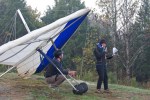
We have returned to the hang gliding hills.  The instructor, Dan, tells me to run like I’m on Baywatch.  I try to channel David Hasselhoff as I take my next run down the hill, although I’m certain Dan had someone blonde and female in mind.

The rest of the morning, my flights seem to get better and better.  Dan asks me if I want to start trying to land on my feet.  I have seen many people land on their feet.  They swoop in low and then allow the nose to reach trim, move their hands up on the bars, and then push up, tipping the nose back so that the glider is like a super-hero cape behind them.  Then, they lower gently to the earth and land on their feet, just like any modern-day super hero should.

My first attempt, I get close, but when I try to flare, my arms go out fully extended and the glider is just barely tipped back.  I get enough lift to almost put my feet down, but then I crash to the ground with a thud.

I go through several more attempts, making mistakes each time.  My closest attempt culminates with me falling flat on my face.  I didn’t think it was possible to actually hit your face on the ground while strapped into a hang glider, but I manage it.  Pat pulls up on the Kubota and says, “Are you OK?  You landed flat on your face!”  I assure him I am aware I landed on my face.

After a final roll-in landing, I decide it’s time to call it quits for the day if I want to make sure I can get up tomorrow.

As I change into my dry clothes, I count the bruises.  I have a scraped ankle, bruises on both knees and both hips.  My shoulders are bruised, my arm is bruised, and my wrists and forearms ache.  For a moment I wonder why I continue beating myself up.  I smile to myself as I remember the feeling of having a really good flight.  The feeling of being lifted up into the air and then riding the ground effect for that brief moment before the wheels touch down.

I look at my bruises a second time and smile knowing I earned them because I took a major step forward today.  I think, “This is fun.  I’ll stop when it’s not fun anymore.”

I’ve always believed the saying, “it’s about the journey, not the destination,” but I’ve never really done anything that way.  Learning to hang glide is the first time I’ve taken on learning something with no goal in mind. I don’t know if I will ever do a mountain launch.  All I know is I really like the way it feels to glide off the training hill.  I’m having a ball right where I am and I’m having a ball learning one small skill at a time.  Why would I give that up?

Pain in the Neck

The alarm goes off at 5:30AM even though it’s Sunday morning–I have to remind myself we’re going hang gliding.  I get out of bed feeling stiff and sore.  My right shoulder and the right side of my neck are especially sore.  I move my head gently trying to loosen things up.  Then, I get the coffee brewing and start on my morning routine.

When I lean over the sink to wash my face, the entire right side of my neck goes into muscle spasms.  I can barely hold my head up long enough to rinse the soap off my face.  My shoulder is likewise screaming–stabbing pain shoots down my right arm.  I reach up with my hands and hold the weight of my head in them.  Carrying my head, I walk into the living room and, as carefully as possible, lay down on the floor.  With the weight of my head supported, the pain lessens.  Instead of feeling like someone is stabbing me in the neck with a slightly dull knife, I feel like the stabbing has stopped and now I’m just in pain.  I lay there and think, “Oh. I am not going hang gliding today.”  Apparently I paddled my kayak unevenly yesterday.

I manage to get up off the floor after about 10 minutes, get a cup of coffee and move to my office chair where I can prop my head on the headrest.  This feels good, although I’m still very ouchy–I try not to move my head in any direction that offsets the weight of my head from directly over my neck.  I drink my coffee with my left hand so as to prevent using my right shoulder by accident.

Turns out my eye-hand coordination is even worse with my left hand and I dump hot coffee down my chin, onto my shirt and into my lap.  I’m in too much pain to worry about it.  Since I’m wearing dark fleece, I figure the stains won’t show much.  I wipe my chin off with the back of my hand and keep sipping coffee.

Pat gets up and I explain to him what’s going on.  I decide I will get ready to go just in case by some miracle my neck rights itself by the time we get there.  If it doesn’t, I will drive the Kubota and tow hang gliders.  If it does, I will fly.

The hardest part is putting on shirts over my head.  But, I need multiple layers to stay warm driving the Kubota, so I suffer through.  I pull on my down jacket before pulling on my rain jacket.  My rain jacket is still stained from the mud I drug myself through last Sunday.  I make a mental note to wash it when we get back.

The drive to the training hills is so uncomfortable I worry that I won’t even be able to drive the Kubota.  But, given that there won’t be any traffic passing me, I won’t have to worry about looking over my shoulder before changing lanes, so I think I might be OK.

It’s still in the 20’s when we get there.  The sun is rising, but the almost full moon hasn’t set yet.  I attempt to take a picture of the moon hanging just above the horizon over the small hill.  I have only my iPhone and I use a camera app with zoom.  Unfortunately, I guess I don’t know how to save the picture from this app because it disappears on me.

I help Pat assemble his glider by reading the directions to him so he doesn’t have to put his reading glasses on.  I don’t even attempt to bend over to do any actual assembling.  So far, as long as I turn my whole body when  I want to look at something, I’m doing OK.

When the first pilot is ready, which turns out to be Pat, I pull up the Kubota and let him load his glider.  When we get to the top of the hill, I hold the nose while he gets down and picks the glider up instead of taking the glider off the trailer myself.  I won’t be carrying any gliders today; that much is for sure.

I make several more runs back and forth picking up 5 more gliders and students.  By the time I’m done, there are already 3 students at the bottom of the hill waiting for a ride back up to the top.  One has given up and is walking his glider up.  I circle around and start picking up students and gliders and driving them back up top.  With 6 flying and a 7th on his way, I can’t seem to keep up.

By the time the 7th student looks ready, I need to use the facilities.  I hand the Kubota over to Pat to drive while I walk down to check on the last student and use the outhouse.  With everyone off on the hills, I opt for the woods over the outhouse–much more pleasant.  Then, I get on the four wheeler to tow the last student out to the hill.

I’ve never driven a four wheeler before.  The angle is bad for my neck, but not so bad that I’m not going to drive it.  The shifter is like a motorcycle–down at my left foot.  The other student keeps telling me to raise it up to put it in gear.  I keep telling him I can’t find the clutch, but he can’t hear me.  What should be the clutch doesn’t squeeze like one.  I finally turn around so he can hear me and he informs me that there is no clutch.  I’m a little confused as to why it has a shifter like that with no clutch, but sure enough it works.  The accelerator, however, is like a waverunner–a tiny little lever that you push with your thumb.  When I push it, I have trouble accelerating gently and I jerk the trailer hard.  I’m sure that student number 7 is wishing he had just driven himself up by now.

As the wind starts to pick up, there is a pause in the flights.  I actually get ahead on picking up students.  I make it to the bottom of the hill and sit well out of range so I can watch Pat’s next flight.  Pat is now learning to land on his feet.  I’ve only gotten to see one of his flights so far today, I’ve been so busy driving.  I watch him soar off the hill, speed up, slow down, and then flare.  He still has too much airspeed when he flares and he balloons up a bit too much, then drops the nose (which you’re never supposed to do) and, remembering, quickly brings it up again.  In the end, he lands on his knees instead of his feet, but not hard enough that he gets hurt.

When I pick him up, he’s disappointed that I saw his crappy landing instead of one of his good ones.  I’m disappointed that I couldn’t get my iPhone out in time to get a video. He’s happy I didn’t.

At the end of the morning, I’m actually tired from driving the Kubota.  But, what I notice is that my neck and shoulder feel considerably better.  Instead of laying around feeling sorry for myself, the activity not only kept me distracted from the pain, but it seems to have loosened up some of the tight muscles.  I still can’t turn my head far enough that it would be safe for me to drive on the highway, but I’m glad that I came out.

Going to the Birds

After spending the morning hang gliding, we change into dry clothes and head off to spend our afternoon with some of the best pilots ever born. They are a group of slightly crazy and/or disabled raptors. Raptors as in the family of birds that includes hawks, owls, eagles, and vultures–in other words, birds of prey.

I have been looking forward to this for weeks. We originally saw a poster for a Raptor Experience at the hang gliding office a month ago. The Raptor Experience is offered by a non-profit organization called SOAR (Save Our American Raptors). They care for non-releasable raptors and train them so they can be used for educational programs to teach people about birds of prey. They also have a Peregrine Falcon release project and are tracking a falcon who is currently vacationing in South America.

As a bird lover and one who is particularly fascinated by birds of prey, I am excited about this beyond belief. I’m hoping we will get to actually handle the birds, but in my excitement, I can’t remember if the person I talked to said we do or not. Even more exciting, I’ve been wanting to volunteer for a raptor rescue program for years, and now this looks like it might be an opportunity.

We arrive at the designated meeting spot a little early. My nerves kick in about meeting people a bit, but since we just talked with Dale, the wife of the husband and wife team who run the organization, I’m not too nervous. John, the other half of the team, arrives only a couple minutes after we do. He’s driving a jeep with a hang glider on the roof, so it’s not too hard to guess it’s him. Dale told me on the phone that she and John are both hang gliding pilots and I enjoyed watching a video of John taking a one-winged bald eagle hang gliding on their web site.

John offers to drive us up to their property where the birds live, explaining that the road is pretty rough. Pat, being a man, decides that he can drive the mini-van up it and save John the trip back down later. As we make our way down the dirt road with large holes, ridges, dips, and rocks, the car drags enough time to make me wish we’d just ridden with John. We make it without losing any parts of the van, although Pat comments that it’s a good thing that I’d already knocked off the front lip spoiler (whatever that is) dragging the front bumper over a parking block.

When we arrive, Dale comes out to greets us, although one of their rescued dogs beats her to the punch, and invites us into the house where she offers us freshly baked, homemade cookies and gives us a run down of what we’re going to experience and why these birds are here. We learn that, yes, we will get to handle the birds. (Yay!) We also learn that none of the birds here at SOAR are able to return to the wild either because of injuries or mental problems. Interestingly, “mental problems” are defined mostly as birds who were raised by humans and, because they imprinted on the humans, don’t know how to do what they were born to do.

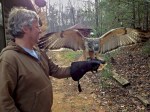
After the orientation, we head outside and are equipped with leather gloves. We are going to start with Eastern Screech Owls. Small, docile, and probably sleepy, they sit quietly on our gloves and even enjoy being petted on the back of the head. John tells us that owls understand touch as affection, but other birds we will handle do not and warns us not to attempt to pet the hawks.

I am so amazed by these tiny little owls. They weigh nothing. John points out that we can see the ruffled edges of their feathers, the secret to the silent flight of owls. And, even more amazing, John shows us their ears. They actually have little human-like ears under those feathers! The ears are offset, apparently to help locate where sounds are coming from in the dark.

I could have been happy just sitting there with these little owls all day, but Dale puts them away so John can bring us a Barred Owl–since Barred Owls will eat Screech Owls, everyone is happier when they’re not together.

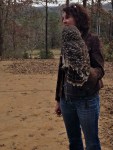
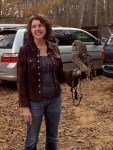
We used to live in a wooded ravine where Barred Owls also lived. They are enormous. Or, at least they look enormous. In contrast to their size, hollow bones and feathers make birds weigh far less than other types of animals of the same volume. I’ve read this before, but having never held a bird, the reality of the gap between how much this bird looks like it should weigh and how much it actually weighs surprises me when Dale puts this great big owl on my glove. This owl weighs less than 2 pounds.

Next, John returns with a Barn Owl. We don’t get to hold this owl who is about halfway between the size of the Screech and Barred Owls. At least not right way. He doesn’t like to sit on the glove–he wants to fly. And that is exactly what he gets to do.

John stands at one spot behind the house and we go to the other. Dale accompanies us with a pouch full of small mouse parts. I ask her who gets to chop mice–she makes a face when she admits it’s her. Clearly, it’s not her favorite part of the job.

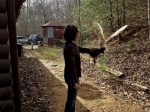
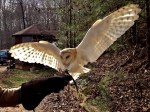
I hold out my gloved arm and Dale places a small piece of mouse on my fist. John releases the owl and he flies to me, swooping low to the ground and then flaring upward so that he lands feet forward on the glove. Having just come from hang gliding, we are fascinated watching how the owl instinctively uses ground effect (the rising air close to the ground) to get lift in time to flare, which is what Pat is now learning to do, so he can land on his feet.

It’s an amazing experience to stand there waiting for a bird of prey land on your fist. As he glides towards me, the owl’s tiny body is dwarfed by his enormous wingspan. The sunlight shines through the feathers on his wings, making him look as angelic as a bird of prey can. I wonder if he minds performing in the early afternoon when he should be sleeping. He looks pretty darn happy when he picks up a mouse chunk and swallows it down.

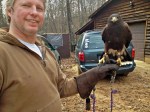
Next, we get to fly Cody, a Red-tail Hawk who refuses to hunt. Cody glides even closer to the ground, skimming just inches above the surface, and then swoops up in a sharp arc just before reaching me. I notice he flares with his feathers as well as his wings. Every feather spreads, his tail dramatically opening like a fan. Just as with the owl, this flare brings him nearly to a halt so that when he lands on my arm, there is no impact. It’s like he parachuted down gently.

After flying Cody, we get to meet Franklin, an American Kestrel, and a Harris’s Hawk whose name escapes me. I’ve never seen a Harris’s Hawk before. He is beautiful–rich browns blend into black, which contrasts with the white in his tail.

Next, we get to meet Casey, the Black Vulture. Casey seems to think she is a dog. She circles around Dale, who tickles Casey on the back and Casey responds with what appears to be a happy Vulture sound, but comes out a lot like a hiss. Casey gallops along on the ground, preferring to walk even though she is perfectly capable of flying. Dale tells us that she sometimes walks Casey in the woods–she really does think she’s a dog!

We attempt to fly Casey, but Casey is in the mood to run instead. She flies up to our gloves to collect treats, but then hops back to the ground to run the distance between us instead of flying. Cameraless today, I switch my iPhone into video mode and try to capture her running on video–there is just something too funny about watching a vulture run.

I appreciate the work that vultures do, having once had a pond where hundreds of fish died all at once, it was an amazing thing to have a few dozen vultures show up and clean up the mess in about 3 days. However, I never thought the words “cute” and “vulture” went together. Today, I change my mind. Casey is adorable. Dale tells us that Casey is used to being the star of the show; I am not surprised.

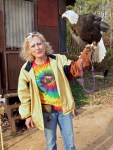
We finish off our Raptor Experience with a Bald Eagle. I can’t recall this eagle’s name, but it is a Navajo word that means, “The Littlest Eagle.” It’s a good name. This poor guy lost a wing due to a shooting. I’m not sure if the missing wing contributes to how small he looks, but he definitely is small for an eagle. I am sad to learn this eagle has not been hang gliding yet because it means that there are two one-winged eagles living out their lives in captivity.

It’s an appropriate finale to the day, though. After all, it’s hard to beat a Bald Eagle for majesty. We go inside to wash our hands and talk for a while before wrapping up and heading home. Dale talks us into one of her cookies before we go–a peanut butter blossom with a soft hershey’s kiss in the middle, yum! We get in the car and I feel like I should pinch myself–it’s hard for me to believe that I just spent the afternoon playing with raptors. Instead, as Pat creeps back over the bumpy dirt road, I look at the pictures Dale took for us on my iPhone and smile.

These Boots Were Made for Walking

Today, we return to the hang gliding training hills.  I am part nervous and part excited.  I love the 7 seconds of flying when I launch properly, but I hate the race down the hill when I don’t.  I’ve been getting better at launching, but not consistently enough that I feel confident I will get airborne every time.

When we arrive at 7:30AM, it’s frosty out.  The water puddles shine with a thin layer of ice.  And there are plenty of puddles–there have been many rainy days of late.  We assemble the gliders as quickly as we can, pausing periodically to warm our hands when they get so cold they refuse to work.  I am wearing my hiking boots with warm socks, but my feet have solidified inside my boots before I’ve finished assembling my glider.  I jump up and down to get the blood flowing back into my toes before finishing up and loading the glider on the trailer.

As I stand on the trailer holding the nose of the glider, my feet slide across the wet metal platform I’m standing on.  I realize that it, too, is covered in a thin layer of ice.  I have to switch hands on the metal bar my glider is hitched to–my hand goes numb in a matter of seconds even with my gloves on.  It’s hard to believe we’re South of home–or that it will probably be over 60 degrees today.

The trailer bounces along the rough ground as we make our way to the small hill.  We break through the ice on many puddles along the way.  As we climb up the side of the hill, we leave a trail of mud in our wake.  I’m happy to see the mud only because it means a softer landing than ground that’s frozen solid.

As I get set for my first flight, I line up with a target that will take me to the right of two large puddles; the ice on their surfaces is just starting to crack in the rising sun.  I tell myself not to worry about those puddles and to just stay focused on my target.

I am relieved that I launch successfully.  I launch, I fly straight, and I land on the wheels.  It all goes quite smoothly.  I seem to have learned how to keep my eyes on the target and how to let go when I launch.  These are two key steps forward and I’m pleased that I’ve retained these skills since we last flew, which has now been three weeks.

I take my second turn.  As I launch, I get a bit of a cross-wind and I need to turn to get back towards my target.  However, I move my shoulders instead of my hips, which pushes my feet the wrong direction and prevents the glider from turning.  I actually have the wherewithal to realize I’m cross-controlling and to swing my hips over and turn the glider properly just before landing.  I am ecstatic that I managed to have sufficient brain function to accomplish this.  It’s the first time I’ve realized I was cross-controlling while still in flight.

My confidence increasing, I line up for my third flight.  The wind is blowing more from the right now.  I point the nose of the glider as much to the right as possible, aiming for trees that will take me to the right of the biggest puddle.  I get set, I launch successfully, all is well, and then, I have the realization that I am now headed straight for the giant, still melting puddle below.  I panic.  My eyes lock on the damn puddle below me.  I try to tell myself to look back at my target, but now I am trying to remember how to turn at the same time.  My brain does a complete scramble and by the time I attempt to turn the glider, I am completely cross-controlling.  Then, it’s too late.

Instead of turning, I land squarely on the near-side of the puddle and roll all the way through what must be a 20 foot wide puddle with at least 4 inches of water–perhaps a small pond would be a more accurate description.

My chest is about a foot and a half above the ground and my belly and legs are dragging on the ground when I land.  As a result, all the water plowed up by the wheels forms a wave that dumps directly up my nose, into my ears, and down the top of my waterproof jacket.  My lower body drags through the water directly, shooting up a rooster tail that would rival a professional slalom water skier.  I burst out laughing about half way through the roll, which results in muddy water dumping into my mouth as well.

When my glider comes to a stop in the mud on the far side of the pond, I am laughing so hard I’m actually cackling.  I see the entire landing in my mind as if I were one of the spectators up on the hill and I can’t stop laughing.  This is a good thing because otherwise I might have noticed how cold I was.  Cheryl, our friendly Kabota driver, pulls the trailer around and I set the glider on it, climbing on the trailer and grabbing the strap.  Cheryl looks at me and asks, “Back in?”  I give her a confused look.  She tries again, “You calling it a day?”  Surprised, I tell her I’m going back up for another run.  If there’s one thing I know about trying to learn something new, unless you’ve really broken something, don’t stop on a low note.  Stop when you’re starting to get tired, but you just had a really good run.

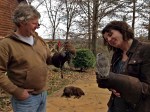
She looks surprised and says, “Bless your heart!” as she turns to face front and starts back up the hill.  The rest of the group at the top of the hill is serious.  They all want to make sure I’m OK and not too cold.  However, once they’ve established that I’m not hurt, not horribly cold, and still laughing, the jokes start.  My husband describes watching the water and how unbelievably much water there was shooting up as my body drug through the pond.  One of my fellow students who flies with a helmet cam apparently stood there watching and then quietly said, “Oh, damn.  My camera’s not on.”  I would love to have had a video or even a photo of that landing!  I, of course, decided not to bring my camera today (the photo above is from earlier this year).

Fortunately for me, I am wearing all hiking clothes.  Everything I have on retains most of its insulating properties when wet and dries fast.  The only exception is my waterproof boots.  Funny thing about waterproof boots–they’re not so waterproof if you turn them upside down and drag them through water like you’re trying to scoop all the water out of a pond.  And, because they’re waterproof, once you fill them with water, your feet are pretty much like goldfish in a too-small bowl.  Fortunately, the temperature is going up, so I start warming up again almost immediately.

However, I start having troubles launching on my next run.  The pond is now occupying so much of my mind that I can’t keep track of what I’m doing.  It’s like I went backwards 3 months again.  The more I try not to think about that damn pond, the more I find it in my head.

On my next turn, I’m determined to do better.  I manage to launch, but then find myself flying towards the damn pond again.  This time, I push my hips over hard, determined I will turn before I hit that water another time.  However, turns out you’re not supposed to push your hips over; you’re supposed to pull.  I think I knew this at one time, but I forgot.  In any case, pushing lifts the nose and lifting the nose while turning puts the glider into a flat spin.

Fortunately for me, I’m not far enough off the ground for it to be much of a problem.  I make a hard right turn more or less straight for the ground.  It’s not the kind of flight that makes me proud, but it sure beats another dunking.

I struggle the next flight and the next as I try to pull my attention back from the pond.  Each good flight is followed by a bad one.  Finally, I decide I need to get one last good flight in and then call it a day.  I manage to get my head back to this flight and this flight only.  I launch, I fly, I turn without putting myself into a spin, and I land.  It’s a good flight and it’s just in time–I am spent and my toes feel like reconstituted prunes inside my wet boots.  All I can think about is how I need to find some shoes made for flying as I ride back towards the parking lot.

Special Ed

When Pat drops me off at the office, I head to the cafeteria to grab some breakfast.  I decide to stop by the gym to say hello to my former workout buddies.  The gym looks dark.  I swipe my badge anyway, but the door doesn’t unlock.  I stand there perplexed for a moment.  If I felt like a visitor yesterday, I feel doubly so today–I worked on this campus for 5 1/2 years and the only time my badge failed to open the fitness center door was when I broke it in half.  I’m a bit indignant about being locked out of the gym, but I remind myself that it’s lucky I decided not to show up un-showered and in my gym clothes only to discover I couldn’t get in.

After a full morning of back-to-back conference calls, I dash down a flight of stairs to meet up with a couple of my friends who are taking time out to have lunch with me.  I arrive still on the phone, but manage to get off the phone before we get into the car.  We decide on Chinese and head to a local favorite.

An interesting phenomena of having a blog in which you record much of your life is how conversations go with your friends when you see them again.  Many seem to feel obligated to read your blog and will apologize for not keeping up with it.  I am not offended by people not reading my blog.  While I like having an imaginary audience because it seems to keep me writing, which is my real goal, knowing that my real audience is busy and often doesn’t have time to read my blog takes away some of the anxiety about “what will people think?”

Vince, however, does not feel obligated or apologetic when it comes to reading my blog.  He simply says, “too many words.”  I am not offended by this either.  After all, I’ve made a personal choice to write my blog because I want to develop a habit of writing.  While I know I should be reading too, I’ve not made the choice to make time for reading.  I do not surf other people’s blogs except to take a quick look at people who leave an indication that they’ve read mine.  When someone who also has a blog clicks the “like” button on one of my blog entries, I take a quick look at what they are posting out of a curiosity to understand what they liked about mine.

Recently, a photographer and blogger “liked” several of my blog entries.  When I go to his blog, I see that he is an artist–someone with vision.  When I look at his work, I immediately see the difference in what I do and what he does; the stark contrast between “having fun with it” and creating actual art.  I ponder why he reads my blog at all and wonder what he likes about it.  I am too intimidated by his talent to give him a “like” in return.  I find myself hoping he reads this entry and than alternately worrying that he will.  My admiration makes me feel foolish.

The fact that my friends do not read every entry in my blog is actually helpful–otherwise, I really would have nothing new to say to them after not seeing them for 6 weeks.  I tell them about my realization that I suffer from a learning disability when it comes to hang gliding and the empathy that I have suddenly discovered for all the people whom I’ve known in my life whom I judged as stupid because they didn’t have a talent that I had.  If nothing else comes from hang gliding, I am at least reminded of the Zen lesson of allowing the ego to be diminished.

Humility is a difficult lesson in the end.  In my complete incompetence, I have realized that a lifetime of making humiliating experiences into funny stories is not the same thing as having humility.  It seems I have taken the approach of creating a good defense by taking the offense in the form of discovering and revealing my personal weaknesses before anyone else does.  As if me announcing I suck at something before anyone else does makes it all right.

What I learn now is that humility felt purely comes not from a fear of others finding you out before you do, but from compassion and empathy and the understanding that I am no better than anyone else.  I am reminded of a recording of Marianne Williamson a dear friend loaned me for 3 years until I finally listened to it out of guilt.  The quote I recall vividly from that multi-CD set is: “You are not special.”

This is what I do not explain to my friends:  What I get from hang gliding is the visceral realization that I am not special; I am as limited and inadequate as everyone else. I have intellectually feared and suspected this all along, but when I hang glide, I feel the truth of it physically.  The physical realization of this fact leads to the physical sense of humility.

Turns out that when I thought I was feeling humility before, I was really feeling shame.  The difference between the two is striking.  Humility sneaks over me gently, making me feel more connected to others, more part of the whole of life.  Shame strikes suddenly at my gut, causing me to shrink within myself, feeling alienated and alone.  When I am shameful, I am full of fear.  When I am humble, I feel remarkably safe.  I hold on to this fleeting feeling just long enough to understand that it’s a breakthrough moment.  But like all breakthroughs (at least for me), they appear suddenly and briefly, only to retreat to be learned all over again at a later date.

I shake away a sense of sudden vulnerability I feel and return to my social self.  I become effusive; I can’t stop talking.  It’s as if I shield the soft places with a torrent of words, distracting from what’s important but frightening.  Afterwards, I think about my friends and wonder why they even make time for me when all I do is babble at them.  I think about how lucky I am to have patient and caring people in my life.  Maybe my luck with friends makes me special?  No, no.  I am not special.

Letting Go: Not Just an Expression

It’s Saturday again.  We decided to return to the training hills this Saturday in the hope of making more progress by going back at the earliest possible time that we can.  However, we also decided to only plan on one day of hang gliding this weekend and to only try to add on Sunday once we see how we feel after Saturday.  We don’t want to be as sore as we were the last few times we went hang gliding.

We get up early–I get up at 5:30AM, to be exact.  Pat sleeps for another hour.  I take some time to write this morning since I am not taking as much stuff today.  I have decided to leave my camera behind since, well, let’s face it, grab shots of hang gliding start really looking pretty much the same after a few times.  Also, since we’ve not scheduled an afternoon tandem flight, there is no need to take a bunch of stuff to do during the time between the training hills and the tandem.

Once I’ve done my writing, had my coffee, and gotten dressed, I begin repeating my new mantra:  “Eyes on Target.  Light Hands.”  I try to visualize this in my mind.  I stand in the kitchen with my hands lightly placed on my imaginary control frame, my eyes locked on the top of the cabinets.  “Eyes on Target.  Light Hands.”  I even practice correcting the glider by pushing myself in my imagination left and right.  I realize that as my body shifts with the image in my mind, I am cross-controlling even in my kitchen.  This surprises me and I try again, this time shifting like I’m swinging on a pendulum as much as possible while standing in the kitchen.  I notice my eyes are on the kitchen floor.  Raising them back to the top of the cabinets, I abandon steering practice and say, “Eyes on Target.  Light Hands.”  Then, Pat is ready to go and I give up on my visualization.

We get to the training hills plenty early.  Mike still beats us there.  He advises us on which hang gliders to assemble and I am back in the smaller Falcon that gave me so many fits the last time.  I talk to Mike about whether it’s a good idea for me to go with that one or not and he assures me that it will pick me up just like a too-big one would.  I flash back to my 10 trips down the hill without feeling any lift, but decide that there is some wind today and that I might as well give it a try since I’m not going to make it off the bunny hill until I can fly in the correct sized glider.

8 people have signed up for the bunny hill.  A crowd like that can make it tough to get a lot of flights in, especially if the wind starts kicking up early and we have to call it a day.  But, we get out to the hills as quickly as possible and start getting flights in.  I am relieved that I manage to launch on the first try, although I went into a dive immediately and realized I’d taken my eyes off target.  When my glider lands, my legs are smacked on the ground and my right quadricep hyper-extends slightly, just enough to give me a slight pull.  When I get to the top of the hill, I stretch before taking my next turn in the hope of preventing injury.  I launch successfully again and am happy with the launch, although I still go into a state of mental confusion and have difficulty correcting in the air.  When I launch the third time, Lauren tells me that my launch is 95% of the way there, but I need to focus on keeping my posture upright so that I leave the hill in an upright position.  As soon as I start thinking about my posture, my eyes drop and my hands tighten and I fail to launch and end up running down the damn hill again.

Now I am starting to limp.  At the top of the hill, I stretch thoroughly again before attempting to launch.  I suspect it will be my last time.  Lauren stands behind me this time and tells me when to let go completely.  She has me just release my hands on the control frame and do jazz-hands so that they’re there, but not grabbing at the frame.  I launch perfectly even though a cross-wind has me going crooked while I’m still running down the hill.  Lauren yells, “Run to your target!” at just the right time and I get my eyes back to where they should be, drag the glider back to straight, and launch into the air.  I even manage to correct in the air and do it correctly, although I don’t do it consciously, I just remember the feeling of swinging like a pendulum after I land.

We do a repeat the next time around, although now I am barely walking and I’m thinking this should be my last flight.  Now I’m having fun again and I’m willing to suffer through the pain of pulled muscles a couple more times.  I launch again even better this time by having Lauren yell at me and doing jazz-hands again.  Lauren tells me that she’s not really yelling at me, she’s yelling at my neurons.  She is right–I don’t have the right neuro-pathways yet.

I manage to get in one final flight, ending strong on 3 really great flights, but now my neck is going into spasms, I’ve pulled my quads, my inner thighs, and my groin.  I am walking like a cowboy once again.  But I hobble away happy, noting that letting go is ultimately what allows me to fly.  Who knew that when people say things like that they’re really referring to hang gliding?

Run Down

It’s Saturday morning and we are up even earlier than Friday. After rushing and arriving at the training hills late on Friday, last night I set the alarm for 5:30AM to give myself an extra half hour to get ready today. I also packed what I needed to bring the night before so that what I have to do this morning is less.

Now that the alarm is chiming in my ear, I am wishing I hadn’t set it so darn early. But, I get up and get moving. I am ready early. Really early. Like a half an hour early–the exact amount of time earlier that I set my alarm. This is called an over-correction in hang gliding lingo.

But, since I am ready to go, i find additional things to do with the extra time while Pat, who slept an hour longer than I did, finishes getting ready. I get the GPS set to the correct address today, for example, to ensure no repeat of yesterday’s fiasco. When Pat is ready, we gather up our bags of stuff and head down the hall.

We make it to the hills plenty early. The only instructor there is Mike. We’re pretty sure he lives there and that it’s impossible to arrive before him. He tells us to each get our own Falcon. This is a good start–we have realized that we get more flights in when we each have our own glider than when we share. On the other hand, I’m a bit nervous still about assembling my own glider, worried that I’ll miss some vital step. But, I get my glider together and perform the pre-flight check without any problems. As it turns out, Pat is going to share his glider with another student in his weight range. The two of them and I are ready to go at about the same time. We load up a glider and take turns driving to get both gliders up the hill.

I am excited about flying today. I feel like I’m finally getting this down and that I’m going to make big steps forward towards learning to land on my feet. When I take my first flight, I do take big steps forward, but only literally. I run down the hill with that glider on my back taking bigger and bigger steps as I go over the ridge and down the slope, but the glider doesn’t lift. I drag that sucker all the way down until it is going faster than I am and it flops me over onto my belly on the ground and drags me across the grass. This is exactly how my first several runs went when we were in ground school back in August. I am thrown.

Fortunately, the instructor, Lauren, is extremely observant and can tell me exactly what went wrong. Her first question to me is, “How was that?” I tell her I feel like I just went back to ground school. She asks me where was my target and I have the ah-ha moment that I had forgotten to pick one. She informs me that I was looking at the ground the entire time. A phrase from motorcycle safety school pops into my head, “if you look down, you go down.”

Feeling confident that I now know the root of the problem and that my next flight will take me back to where I was yesterday, I line up and pick a nice, high target and try again. I end up running even faster down that hill, but with the same net result. When Lauren and I have our next recap, I am pretty sure that this is not my fault. I ask if the glider is too small for me, if I’m hanging too high in the frame, I blame the hiking boots I’m wearing on the hill for the first time. Lauren breaks the news to me: she assures me that I was doing the exact same things wrong yesterday but that I could get away with it yesterday because I was in an over-sized glider and there was wind. Today, I am in the appropriately sized glider and the air is depressingly still. Nothing is going to get me into the air except me performing correctly.

I am determined. I run down that hill again and again. Ten times in a row I drag that glider down the hill and it drags me across the field. I am getting so frustrated I want to quit hang gliding for good. This is when Lauren suggests I change gliders. She says that while maybe it’s cheating a little to go to a bigger glider, there is something to be said for not being so frustrated we you learn. I decide to give it a try.

My next flight, I launch successfully. My joy in hang gliding is restored. The feeling of the glider picking me up off the hill and raising my feet off the ground instead of me racing it down the hill and losing makes me giddy.

Through out the morning, I am reflecting on my own learning. I realize that my brain went all the way back to no function during my first run–I had no recollection of what happened during the run. Then, I gradually started to become more aware of what happened in each flight, I started realizing, for example, after the fact that I’d taken my eyes off the target. However, I couldn’t prevent myself from making the same mistake over and over again. I’m a little depressed by this realization. I thought that I would start where I’d left off in terms of being more conscious during the launch and flight. I am reminded of when I used to do triathlons and how I expected my times to get better each race without accounting for differences in the wind, the course, the temperature. I suppose i have learned skills specific to a given set of conditions and not the more general skills that allow me to adjust.

While I recognize that I am a slow learner when it comes to physical activities, I really didn’t think I was this slow. In the ad for our lesson package, they claim that you will learn how to land on your feet and earn your beginner rating in the number of lessons included. Here we are, already into the next package and I’m still trying to learn how to launch. This does not make me happy, I question the wisdom of upgrading our lesson package again and of contemplating launching from the mountain.

But, now that I have launched, I want to make sure I leave with the feeling of being airborne in my head, so I fly two more times. I lift off without too much difficulty and end feeling like maybe I will eventually catch on after all. The one thing I know for sure is that I do not want to run down that hill ever again! I am already feeling how sore I am going to be–there is nothing that can make a person feel as run down as running a hang glider down a hill over and over again.