You Get What You Pay For

Remember what it was like to be really scared?  Scared when you knew there was nothing to be afraid of, but you were scared anyway?  What is it that’s fun about that?  Yet we seek it out from the time we’re little.

Like hide-and-seek.  We know the people are out there, but when we find them, we’re often startled or even terrified when at last we stumble across those we seek.

Going to a Halloween haunt is a return to our childhood roots.  We know we are safe.  We know no one is going to hurt us.  Yet we go to be scared.  There’s an underlying hysteria to the whole process of gearing up for a haunt.

It starts with the gathering of the group.  And the group psychology is important to the whole experience.  There’s an optimal group size.  If the group is too big, there’s too much safety in numbers.  You can hide in the middle of the bunch.  If the group is too small, the contagious nature of fear is lost.  I think 4-6 people with a couple of total scaredy-cats is perfect.

It’s small enough that the fear of 2 can spread to the rest of the group vs. the swagger of several buoying up the rest of the group’s courage.

And, let’s be honest, as much as I hate to admit it, there’s a gender difference.  We women haven’t spent our live pretending to be brave.  We’ve been taught to be afraid for our safety in so many subtle ways; we’re more likely to be startled, frightened, and even terrified than our male counterparts.

We’re also more likely to fully enjoy the experience of a haunt.  This is also true of children–the younger, the more disbelief is suspended.

I ponder the attraction of being scared.  It’s a reminder of our vulnerability, a feeling of helplessness.  Why do we enjoy this feeling of not knowing what’s going to jump out at us?  Is it the rush of having experienced terror and having survived?  Is it significantly different from the rush of thrill seekers who sky dive, climb Mt. Everest, or go cave diving?

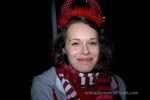
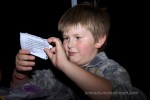
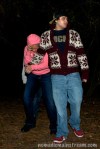
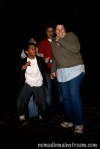
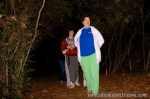
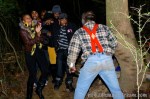
These images were taken on the haunted trail at the Acres of Darkness event.  I was hidden in the shadows, waiting for the moment when the victims were suddenly startled by the various actors on the trail.  While I can’t claim there great images in terms of lighting, framing, or composition, they captured a moment of true fear for at least some of the guests.

I laugh when I look at their faces.  I laugh because of the complete abandon of their expressions.  Is it macabre of me to enjoy having captured fear?  In my own defense, if they would have been in real danger, it wouldn’t be funny to me.  But these are “we got you!” moments.  They came to be scared and they were.

It’s photographic evidence that the haunt achieved what the audience paid for.
The Blind Shooting Blind

One of the skills in photography I try to work on is composition.  The easiest aspect of composition to focus on (pun!) is what is in or out of your frame.  For example, not ending up with a sign post in the background sticking out of the head of your subject.  Or, not cutting off your subject’s hand.  Or not chopping off the edge of a shape in an awkward and inexplicable way.  These are things I pay attention to.  Sometimes, I pay attention to them after the shoot, in which case, I say “shoot!” in a different way.

Shooting loose is a cheat.  This means leaving lots of space around your subject so you can crop later to get what you want in the frame.  I’m not very good at shooting loose.  I always end up with some awkward position where I have to either cut off the subject’s hand or foot to get the framing I want.

For this reason, I try to come home with at least the framing right.  This is not to imply that how you frame a shot is the only thing to think about when it comes to composition.

In any case, shooting at the haunt over the weekend was a completely new lesson in composition.  When I was shooting in unlighted areas, I literally could not see my subject at all when I looked through the viewfinder.  My technique was to take a shot with my flash, look at it on the LCD screen, and then try to guess where I was positioned and which way I needed to move to get the subject completely in the frame.

This is a case where shooting loose was absolutely necessary.  I ended up with a lot of headless people on my first shot.  Then I would zoom out a bit to make sure I at least got the heads included in the second shot.  After a few dozen wasted shots, I finally started getting to where I could get the subjects into the frame in one shot.  On the one hand I was excited I was managing to get subjects into the frame.  On the other hand, I was really wishing I had a floodlight I could use to frame up the shot I wanted.

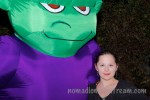
As a side effect of shooting blind, I ended up with a lot of strange things in the background.  This is also the side effect of shooting at an event.  There are lots of people milling about so you end up with someone’s nose sticking out of your subject’s ear or a rear end in the background next to the head of your subject–sometimes my flash was just a little more powerful than I really wanted it to be.  This all led to more time in Aperture cloning black areas over top of unwanted objects.

Perhaps that’s a life lesson:  shooting blind leads to spending more time cleaning up the mess.

Event Shooting

I am gaining a greater and greater appreciation for event photographers.  Think about it.  You show up, you’re supposed to get great photos in what may be the most difficult of circumstances to shoot in and you’re supposed to do it without distracting from the event.

We went to a wedding reception Friday night and I found myself feeling incredibly grateful that I am not a wedding photographer.  I’m not sure I could take the pressure of shooting that kind of once (or twice or thrice) in a lifetime event.  I watched the two photographers at the event and they seemed so calm and collected.  They were both young.  They shot for a while, took a break to eat cake, and then started shooting again.  They seemed to feel no stress at all.  I admire that.

I got to play event photographer Saturday night in the lowest stress situation possible when it comes to event photography.  First, it was a volunteer job, so I didn’t have to worry about people feeling like they didn’t get what they paid for.  Second, the group is fun and appreciative, so I felt like they would be patient.  And finally, this is a recurring event, so it will happen again next year and there will be more opportunities to get better shots.

However, what did create stress is that it was a Halloween Haunt.  And that means it was dark.  Very dark.  And I am not exactly an expert with a flash.  In fact, I had kind of given up on learning how to use my flash a few months back when I broke a hot shoe adapter that allowed me to put it on an umbrella stand.

I seem to take little interest in flash photography until the moment of panic when I realize I’m going to need to shoot with a flash.  Then I suddenly wish I’d spent a lot of time becoming an expert with the thing.

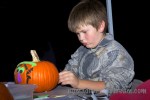
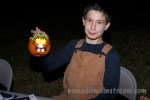
Saturday night, I decide to warm up in the family area.  This area is well lit by comparison.  It still requires a flash, but people are sitting at tables for pumpkin decorating and face painting, so I have the opportunity to shoot and reshoot without having to worry about missing the action.

With my flash unit attached to my camera directly, I couldn’t shoot vertically.  It was like having a hand tied behind my back.  Having a manual flash turned out to be quite a bit more difficult than I expected.  For one thing, it has no auto focus assist feature so I had to pull out my iPhone and use the flashlight app to find focus in the dark.  It was also hard to see to adjust the settings.

I found myself creating a shopping list:  flash bracket, speedlite, portable battery pack.  I guess I’d better decide if I like event shooting or not before I start buying more equipment!