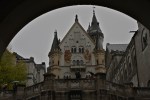
Linderhof Castle

After touring Neuschwanstein castle in Schwangau, we head towards Linderhof castle. Linderhof is close to an hour drive from Neuschwanstein, which is why Pat and I didn’t go see it on our last trip to Germany. But I am immediately glad that we came when we approach the grounds. Crazy King Ludwig was obsessed with Louis XIV and built this castle with the intention of creating a miniature Versailles. The grounds, however, are more beautiful just because of the surrounding mountains and forests and the resulting vertical rise on either side of the castle. When we go inside for our tour, we learn that this is the smallest castle Ludwig built and the only one he actually finished. All but one room is decorated in gold leaf, all of it looking remarkably like Versailles in style. Even the statues and paintings are of French kings and court members from the time when France was a absolute monarchy. However, Ludwig must not have paid attention to French history given that he came along nearly 100 years after the French Revolution. In any case, he apparently created this castle as a little playhouse for himself where he could disappear into his fantasy that he was a real king in a time when kings had real power. I am less and less confused about why he was declared insane.

The castle is beautiful, however. Although, a horrific waste of resources considering Ludwig’s main intention was to be completely alone in it. He had his small dining table made on a platform that could be lowered into the kitchen below and completely set with his meal and then raised back into his room so that he didn’t have to see any servants at meal time. The table was barely big enough for a spread fit for a king, let alone for any guests.

Oddly, in spite of his desire to be left alone, he constructed an “opera house” in a fake cave off the garden. It is another salute to Wagner and apparently comes from the Rings. It has stalactites and stalagmites molded out of something like stucco. At the back, a pool simulates a lake and a swan-shaped gondola sits, still waiting to take the king adrift in the water where he apparently liked to listen to music. Even more oddly, it’s in this cave where the first electric lights in Germany were installed. They were even colored by putting colored plates of glass in front of them. The coup de grace is the waterfall that the tour guide turns on after giving her spiel. Water flows over fake stones and down into the pond. It’s so noisy, it would be impossible to hear music over the falls. I find myself wondering if Ludwig ever actually had a concert in this cave or if he just listened to the music in his head.

The castle is wonderful in its own way–strangely beautiful and certainly fascinating to see. The smallness of it makes it somehow more intimate and enjoyable than the real Versailles, although, I admit I haven’t been there since I was a teenager.

We return to our hotel in time for the dinner. Tonight’s soup is called “Leber Spaetzle.”. When they set a bowl in front of me, I am troubled. The “spaetzle” looks suspiciously like deer poop–nearly black and shaped in pellets. I look at Pat and ask, “What kind of soup is this?” and he replies, “It’s deer poop soup,” without cracking a smile. I laugh out loud and take a spoonful, glad I’m not the only one who thinks that’s what it looks like. I can’t give a comparison of the flavor to deer poop, having never eaten any, but I have to imagine deer poop wouldn’t taste worse provided you added salt. The saltiness got to me worse than the flavor of the liver, but neither was exactly pleasing. I gave up once I got down a respectable amount. The entree was more to my liking, but also very salty. It was a traditional German dish made of something described as pork meatloaf, but Pat told me it was like a piece of sausage shaped like a slice of ham, fried and served with an egg sunny side up on top. Had it been less salty, I might have been able to eat the whole thing, but I gave up about 7/8 of the way in.

Tonight, we are all tired and don’t sit as long over beers after dinner as we did the night before. A larger portion of the conversation is in German, as well, a sign of fatigue in my bilingual friends, I think. It’s tiring even for me to tell stories in English using vocabulary our friend are likely to know vs the casual idioms and expressions I would use with my American friends; communicating in a second language must be even more fatiguing for them. I wish I would have spent more time learning German before this trip–it’s been a couple of years since I took continuing education classes in German and I didn’t get very far. My mouth twists around many German sounds and the words come out unrecognizable. I am far more self-conscious attempting German than I ever was speaking French, Italian, Spanish, or evan Korean. But, I was younger then and I didn’t have a native speaker laughing at my pronunciation (well, except the Italians when I pronounce “penne” as “pene”, which means something entirely inappropriate for the dinner table). Oh well, I guess I will have to try again. Maybe Pat and I can start speaking German when we’re alone together if I can get him to stop laughing at me. 🙂

Return to Neuschwanstein Castle

When we wake up, it’s raining steadily. The temperature makes the rain feel bitterly cold. Up in the surrounding mountains, it’s snowing. But we will not be going that high. I layer up with silk long underwear under my jeans and an extra warm Underarmour shirt under my sweater. I put on my thin leather jacket and then pull my rain jacket on–loose enough to fit over everything, it will keep me dry as well as help trap my body heat. I even dig out the thin pair of Windstopper gloves I shoved into my bag just in case. We all pile into the mini-van and we are off.

First stop is Neuschwanstein, the castle started by King Ludwig II of Bavaria intended to capture the opera The Rings in architecture. However, the castle was only 1/3 complete when Ludwig died mysteriously by drowning in a lake with his psychiatrist at the age of 40. He had been declared insane and removed from power only days before. We came to this castle years ago, but had taken the German tour. I’m happy that this time, we will take the tour in English. First, we must park. Then, we must walk part way up the mountain to buy tickets. Then, we must get ourselves from the ticket office to the castle, which is estimated to be a 40 minute walk up a very steep incline. There are three choices: walk in the rain, ride a bus, or take a horse drawn carriage. We head for the bus, but the line is so long to get a ticket that Dieter and I (at the head of the pack) think we must walk. But, a chorus of protest rises from behind us and we turn and go back to get a horse drawn carriage instead.

We start off in front of a couple walking arm in arm. Two average-sized horses pull the wagon loaded with 10 adults slowly up the steep road. The couple falls slightly behind, but when we are halfway, we pause to give the horses a short break and the couple nearly catches up with us while we wait. But then we are off again and either the horses are so revived that they move faster or the couple is so fatigued they move slower, but we leave them far behind.

When we arrive at the end of the wagon ride, we are told that the walk to the castle is 15 more minutes. But it is not too strenuous and we make it in less than 10. We are 15 minutes early for our tour. We stand under the arch of a giant gate leading to the courtyard, huddled together with about a hundred people from nearly as many different countries. When it is time for our tour, a lighted sign in the courtyard displays our tour number and we move back into the rain briefly to walk through the cattle gates with the rest of the English speakers on our tour. The girl who leads our tour speaks loudly and slowly, over enunciating each word, but in the first room, her voice bounces off the tiles and echoes so that it’s nearly impossible to understand what she says. The Germans in our group do not think she is German, as her accent sounds so strange. I ask her where she is from originally as we walk to the next room and she tells me she is from here originally; I assume Schwangau, the small village near the castle. That doesn’t explain her strange accent, though.

We learn a bit more about the crazy king who wanted his life to be a fairytale. We see rooms on two floors, starting in the servants quarters and ending in the concert hall. Unfortunately, there was an actual concert recently and the floor is completely covered to protect it. We did get to see the mosaic tile floor in the receiving room–we’re told that there are over 2 million tiles that were individually laid in the floor. The crazy pattern has a mixture of animals I can’t make sense of, but perhaps if I were an expert on Wagner operas, it would all become clear to me. Our tour guide offers no explanation for the decor choices and is too far away with nearly 50 people on the tour for me to ask. We are told that the tour is over and we should check out the kitchen on the way out.

A narrow spiral staircase takes us down four floors to where the king’s meals were prepared (with a detour through the gift shop, of course) and we wonder if he ever had a hot meal given that his dining room was at the top of the stairs. The kitchen is enormous and, apparently quite modern for the times. After looking at the signs, trying to figure out the layout, we return to the cold and rain outside.

Next, we walk back down to the drop off point to take a wagon back down. We are shoved into the back of the wagon with a strange man between me and Giesala who clearly doesn’t understand English or German. Then, three more people join. The four are all Asian, but the strange man is Japanese while the other three are Chinese. The strange Japanese man introduces himself to Giesala, but then keeps repeating her name. He won’t look up and remains in a hunched position, eyes on the floor. Then, when no one is talking to him, he starts muttering to himself. I don’t know lots of people from Japan, but I’ve never seen anyone act like this from any country that didn’t have some kind of problem going on. In any case, we are distracted by the group from China. They tell us they are from the Tsing Tao museum and the man produces many beer labels and gives them to Pat after Pat tells him that be likes Tsing Tao beer. We really aren’t sure if there is a museum or if they were from the brewery, but we laugh with them the whole way down the mountain. The man and Pat got into a beer belly contest with each of them pulling up their jackets and extending their bellies to show . . . well, I’m not sure what they’re trying to prove. Pat won in any case. Then, the man’s cell phone rings and his conversation has the two women he is with in stitches. One of them explains that the person on the other end of the phone had told the man to hurry up and he replied, “It’s not up to me, it’s up to a horse.” We all laugh, too. Pat asks if he can buy the man a beer since he’s given us so many labels, but he and his colleagues have to rush off.

We decide to wait to eat lunch until we got to the second castle on today’s itinerary–Linderhof. We walk back to the mini van and take off in the rain.