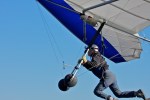
Fledgling Part II

Recovering from a long day on the mountain.

Continued from Fledgling:

After breaking a down-tube on my first mountain launch, I have to figure out how to pick up my glider and carry it off the field.  I make it across the field and a couple of instructors run over to help.

All-in-all, I am not sure I’m ready to launch again.  But, back up to the top of the mountain we go.  I spend the ride back to the top hoping the wind has shifted.

But, no.  The wind is still good and there are plenty more gliders for me to break.

I set up the next glider with my hands shaking.

When it’s my turn, I am feeling nauseous.  I contemplate backing out.  But, I step up onto the launch ramp for the second time.  I get set, the instructor tells me the wind is perfect, I call clear and start the approach without hesitation.

This time, the launch is good.  However, when I look at the airspeed indicator, it tells me I’m flying too slow.  I pull in for speed, but the glider starts oscillating like I’m flying too fast.  I go back and forth trying to decide if the airspeed indicator is wrong or not.  Then I hit a small bump in the air.  My glider rises suddenly and then drops back down like a giant puppeteer has just jerked an invisible string.  I experience a moment of panic.  I start talking to myself out loud, trying to keep my wits about me.  I keep it together through a few more small bumps and find myself safely over the landing zone.

I have a repeat problem with suddenly being out of altitude.  As I start to make the final turn for the landing approach, I realize I’m too low and I square up the glider and roll it in instead.  No broken down tube this landing.

However, I do end up far from the breakdown area.  Gliders are really not meant to be taken for a walk.

The instructor who helped me after my first landing comes over and congratulates me.  He compliments me for my decision making.  It’s like a consolation prize–in spite of all my mistakes, I didn’t make a final, critical mistake.  I appreciate the compliment none-the-less.  Focusing on small achievements is, after all, how I ended up here one minuscule step at a time.

On the way back to the top, I experience a sense of disappointment.  I remind myself that my learning process has often been one step forward and two steps back.  I remind myself that I just launched from about 1500 feet higher than I ever imagined I would.  I remind myself that I stepped off that launch ramp, focused on the horizon, knowing that I could.  And I did.  I did something I didn’t think was possible until two weeks ago.  I launched, I flew, I landed, I survived.  Twice.  Maybe I’ll suggest a new T-shirt for the pro shop.

Fledgling

Today, we drive up to Lookout Mountain.  It’s my 4th attempt at my 1st mountain launch and the wind looks promising.

When the glider is assembled, I do the pre-flight check of my life.  I check every nut, bolt, wire, and thread as if my life depends on it.  Oh, that’s right, it does.

Shortly after 8AM, I am standing on the launch, ready to go.  I am having progressively more difficulty breathing.  I take a few deep breaths.

Alas, so does the wind, and in the wrong direction.  I sit on the ramp and we wait, hoping the wind will settle.  It doesn’t.  I back up off the ramp and set my glider down.

Three of us wait for our virgin flights.  We’ve been there 2 hours when at last, it happens.  The wind dies and starts to come in as a slight headwind.

I watch my 15-year-old fellow student launch like a pro and then step up for my turn.  I remind myself to breathe.  The instructor reminds me to breathe.  I stand ready.  I call clear and start my approach.  My eyes are on the horizon; I don’t see the ramp at all.  I have no sense of falling, but I’ve made a major mistake–I’ve let the nose of the glider pop up during the approach, which means I am, in fact, falling off the launch for a split second.

Thankfully, due to the design of the glider, I’m not in serious danger as the glider will recover on its own.  Even better, I realize the nose is high and pull in quickly, making the recovery almost instantaneous.

Surprisingly, I am not scared by this mishap.  I go through the checklist:  1) Fly away from the mountain.  As I look around and try to decide what the definition of “away” is, I am overwhelmed with giddiness–I am actually flying.  I cackle with glee.

Then, I move on in my checklist:  2)  Check your speed.  I look at the speed indicator and I am flying nearly 25 MPH.  I ease out a bit, take a deep breath, and remind myself to relax.  That’s about as far as I get before it’s time to start the box pattern around the landing zone.

I can only judge my altitude when I am level with a landmark; I completely lose track as I begin the final landing pattern.  I cut the approach pattern short when I realize how low I am.  I pull in for speed, begin the round out, and then suddenly go into brain freeze when my feet drag the ground.

Proximity to the ground does not determine when you flare and I know this.  I flare anyway.  I balloon up and then, even worse, I let the nose drop.  I try to flare again, but this never works.  I land hard on the wheels. I am unharmed but the left down tube breaks.  I get up, unhook and feel grateful for modern engineering.

To Be Continued . . .

If Daedalus Were a Photographer

We get to sleep in today–we don’t have to be at the mountain launch until 8:30AM.  At 3:17AM, I am awakened by a dog looking intently at me, wagging his tail and a cloud of stench that makes me think he’s had an accident.  I illuminate my iPhone and find he has not had an accident, yet.  I pull on footwear, grab a jacket, and race outside with him.  We make it outside with time to spare, but I’m about to have an accident by the time Tisen’s needs are met.

I spend the next 3 hours nodding off and waking up every 15 minutes.  Tisen snores loudly at my feet.  I finally fall back into a deep sleep about 10 minutes before the alarm goes off.  I lay in bed willing myself to wake up my husband and get out of bed.  Today is a big day–Pat’s first mountain launch.

We make it to the top of the mountain and find a couple of guys from Minnesota have already launched for the first time.  They and the instructor, JC, return about the time we’re done assembling Pat’s glider.  JC goes through the flight plan with Pat again, making sure he knows exactly what he’s supposed to do.

While she launches our Minnesota classmates again, I busy myself getting my equipment ready.  There’s the GoPro helmet cam, my iPhone video camera, and, of course, my DSLR.  I’ve found a spot below the launch ramp to shoot from.  Unfortunately, I’m too close to the ramp with the 100-400mm lens to get the field of view I want.

Since I am also manning the iPhone video camera, I’ve mounted it into a TomTom iPhone mount to make it easier to hold on top of my lens.  Whatever I’m pointing at will also be the subject for the video.  Pat, aka MacGyver, came up with this idea.

I learned several things trying to shoot this launch.  First, don’t be both the still photographer and the videographer at the same time.  I couldn’t pan well while holding the iPhone mount and missed the most interesting parts of the launch with my camera.  Second, the iPhone is a fine way to make a video if your subject is no more than, say, 50 feet away.  After that, Pat was a white dot floating over the trees.  Third, keeping yourself busy with equipment really distracts you from the overwhelming anxiety created by watching your life partner of over 16 years run off the edge of a mountain.  Unfortunately, it also distracts you from fully experiencing the moment.  I felt like I hadn’t seen the launch at all.  The moment my husband stood on top of a mountain with a kite on his back and ran off that mountain like he’d been doing it all his life, in that moment, I was distracted.  I wanted to be inside his head at that moment, but, instead, I was outside, looking through a viewfinder.