Owl Prowl

As my regular readers know, I love birds.  I can’t help it.  There’s something profoundly beautiful about birds.  I love watching them maneuver in the sky completely denying gravity.  I particularly admire birds of prey.

It only follows that I would end up volunteering for the Chattanooga Audubon Society.  And, when they scheduled an owl prowl, that I would sign Pat and me up.  (Unfortunately, Tisen is not welcome on the Audubon property–it’s a wildlife preserve and domestic animals and wildlife don’t mix well.)

Pat and I arrived just before 8PM, in time to deliver a load of bird seed I’d picked up for the feeders at the visitors’ center.  Then, Kyle, the property manager, gave a presentation on owls including their “songs” to remind us what we were looking for.

Kyle had been hearing Barred Owls on the property even in the middle of the afternoon; we were confident we would at least hear one.

Kyle had also recruited an owl expert to lead the walk who was extremely good at calling the owls.  Barred Owls are known for flying in to see who’s imitating them when called.  I once went birding with a group of experts in Columbus.  We started at 5:00AM.  The leader called twice and had 4 Barred Owls show up within minutes.  It was very cool.  I think the owls were just as amused by us.

However, here, the Barred Owls must have been up too much during the day–they had no interest in checking us out although our leader called and called.  Even in the area where they were most frequently seen, they remained silent.  He also tried Screech Owls, but we were not rewarded.  As our expert pointed out, it’s best to call Screech Owls first–they won’t go near Barred Owls (because Barred Owls will eat the much smaller Screech Owl).

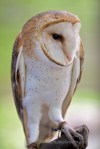
While a Barn Owl might also find Audubon Acres a suitable place to live (especially if it could find a way into one of the many buildings), none had been spotted on the property, so we really didn’t expect to find any of those.

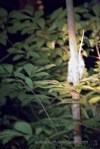
While the owls were not cooperative, we had started off the walk with an Indigo Bunting catching a late-night snack at the feeder.  We also saw many spiders and bats.  At one point, we were sure there was a silent owl in a tree, but it turned out to be a young opossum.  It blinked in our bright flashlights and gradually decided to move.  We watched it with fascination as it slowly made its way down the tree trunk.  Every part of it was help perfectly straight, including its tail, as is calmly made it’s way head down the side of the tree.

At the end of the walk, the moon was shining and we stood outside chatting.  While we talked, we heard a Barred Owl calling, “Who cooks for you all?”  Or maybe it was saying, “Who are the fo-ols?”

Fourscore

Fourscore years ago, Rock City was created.  80 years later, in honor of their anniversary, Rock City held a naming contest for a rescued Peregrine Falcon recuperating on their property.  The winning name was Fourscore.

Fourscore was the offspring of a mom who wasn’t mature enough to take motherhood seriously.  His more mature father took over incubating the eggs and doing the feeding.  But, as the two brothers grew, the father couldn’t keep up with their eating needs without the help of the mother.

One of the chicks died before a human intervened.  The other, Fourscore, survived, but he was too weak from underfeeding to survive on his own.  Fortunately for Fourscore, his rescuer turned him over to S.O.A.R. and Rock City for rehab.

Kept safe inside a box perched high on Lookout Mountain, the little guy gained in strength until he was well prepared to fledge for real.

Pat and I were invited to Fourscore’s launch.  It meant getting up at 4:30 AM to have time to take care of the dogs before driving up to the top of Lookout Mountain, but we were game.  I, of course, packed my backpack full of camera gear.  I wanted my 100-400mm lens to get a good shot of the falcon launching, but they were opening the box at 6:00AM–the light would be low.  Since my 70-200mm lens is faster, I figured I would have a better chance of getting something usable with the extra speed than with the extra length.

As the Eastern horizon started to show the first signs of dawn, I crouched behind a shrub while John and Dale lowered the front of the box, creating a shelf that the falcon could step out on.  I sat with my face pressed against my viewfinder, resting the lens on my knee in an attempt to hold still while we waited.  Nothing happened.

John had warned us that sometimes it can take a couple of hours for a bird to fly when released after being rehabbed.  We waited.

I realized I could not possibly keep my face pressed up against my camera for two hours.  I was getting a cramp in the muscles I use to close my left eye.  I pulled back and started to relax my arms, which were also cramping.  Then I realized we’d only been waiting about 3 minutes.

This was not the first time I questioned my desire to shoot wildlife.

Then, just as I was about to stretch my wrists, there was a noise.  I got back into position as quickly as I could, but I missed.  I managed to catch a dark silhouette against the sky when Fourscore circled back around and flew for the woods.  Not exactly what I was hoping for.

We spent the next half hour with John wielding an antenna to track a radio transmitter on Fourscore.  As we were about to leave, we saw him being chased by a group of swallows.  He looked like he was having a ball.


Finding Big Foot

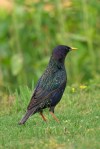
It all started several days ago when Tisen and I were on a typical walk.  Noisy European Starling toddlers tormented their parents, which has become a common scene of late.

On this particular day, Tisen charged a starling family grazing on a slope.  They flew away together in a little flock, just as one expects.  The adults were clearly starlings.  The juveniles were all the same shape and size.  But there was a flash of unexpected white.

I did a double and then a triple take trying to make sense of what I was seeing–it was a white tail. I have seen thousands of starlings and I have never seen one with a white tail.  I have read descriptions of starlings dozens of times and never has anyone mentioned a starling with a white tail.

But, there it was.  A bird who acts like a starling, looks like a starling, hangs out with starlings ought to be a starling.  It was the right size and shape, but what’s with the white tail?

I could not think of a single possible bird it could have been.  I began to think I had either imagined it or the bird had somehow dipped its tail in a bucket of white paint.

Then, two days later, I saw it again.  This time, it flew across the path just about 10 feet ahead of me.  I watched it whiz by, still harassing its parents, and felt certain it had to be a starling with a white tail.

I asked a knowledgable friend of mine.  She asked an ornithologist and informed me that, yes indeed, starlings do, on rare occasions, have white tails.  Unfortunately, we were having cell phone challenges and I didn’t catch the explanation.  Amazingly, I’ve not had any luck finding an explanation online.

Today, for the third time, I saw the white-tailed juvenile hanging out with its parents in the park.  This time, I got a long look at it as Tisen was too groggy to give chase.  I even managed to get out my iPhone, unlock it, and bring up the camera app before it flew away.  Unfortunately, I didn’t actually get to take a picture first!

This evening, I am on the hunt.  It’s like a quest for Big Foot, I think.  The elusive white-tailed starling lurks in the park across the street and I aim to catch it in pixels. . .

No luck tonight.  I found normal starlings galore.  And I saw song sparrows, mocking birds, brow-headed cowbirds, cliff swallows, carolina wrens, and even a downy woodpecker.  But, no white-tailed starling.

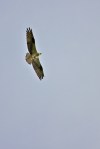
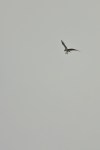
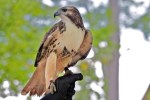
I did, however, seen another interesting thing.  A hawk was circling overhead.  When I looked at the photos enlarged, I realized it was probably a red-tailed hawk, but it has a fish in its claws.  I never saw that before, either.

Maybe a red-tailed hawk with a fish is like finding Nessy?  Big Foot, however, will have to wait for another day.

Broken Heart Birdsongs

When Tisen and I go to the park, the Cliff Swallows buzz over our heads.  I took my binocs over with me one morning to figure out what they were.  They gave me quite a run for my money making me chase them with my lenses, getting just enough of a glimpse of their details to know for sure what category to place them in, what name to give them, what song to expect from them.

There is something about swallows diving through the air that makes me want to forget all about what kind of bird they are and simply join them in the freedom of flight.  The level of emotion I feel watching them is inexplicable except maybe, at an unconscious level, they connect me to my mother.

It was, after all, my mother who first introduced me to the wonder of birds.  Although the most exotic bird I remember my mother identifying was the American Goldfinch, her fascination with them was contagious.  My mother wasn’t really about identifying them or photographing them or getting up close to them.  She was all about birdness in its purest form.

She just felt joy when she saw a bird.  Any bird.  As long as it wasn’t in a cage.

Perhaps that’s what the swallows remind me of.  Because I was unsure of what name went with them, for weeks I watched them swoop and dive with the kind of delight my mother would have taken in seeing them.

I am reminded of a reoccurring dream I used to have as a child.  In it, I was running down the street I grew up on.  Running as fast as the wind.  Then, my steps would grow longer and I would soar through the air further and further between foot falls.  The feeling of flying between foot steps was so profound that when I woke up, I could feel the remnants of the dream physically in my stomach.  I so loved that feeling.

I wonder if my mother used to dream about flying?

There are times when her absence is still so painful I cannot bear to think of her.  Even though it’s been 13 years since her death, I so wish I could take her to see the swallows across the street.  I so wish I could point out the Eastern Towhee calling from the tree tops.  I so wish she could see the Eastern Bluebirds nesting in the bird house.  As if showing her birds might somehow make up for all the times I broke her heart.  As if a birdsong might heal the remnants of the hurt.

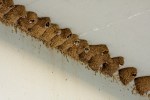
In lieu of sharing these birds with her, I share them with you.  Unfortunately, the swallows are too quick in flight for me to photograph.  But, having discovered their nests clinging to the Western side of the Market Street bridge, I can capture them there.  Frozen in a frame–I hope it’s not too much like a cage.

Cayce’s Turn

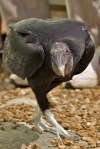
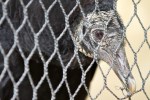
Perhaps three posts on one birds of prey program is a bit excessive?  But, I feel that Cayce requires her own post.  After all, how many Black Vultures do you know that get a standing ovation?  For that matter, how many Black Vultures do you know at all?

Vultures happen to be one of my favorite birds.  I always enjoy watching them soar on the wind, hardly ever flapping their wings.  But I really fell in love with vultures when we had a house in the country with a large pond.  One spring day, we had a inversion.  I honestly can’t say I fully understand this, but apparently the water on the top of the pond becomes cooler than the water on the bottom and, as the water switches places, the oxygen escapes and the fish suffocate.  When I say the fish suffocate, I mean hundreds of fish suffocate.  I mean more fish than we would have ever guessed lived in that pond suffocated.  I mean the entire surface of a 1 acre pond was covered in dead fish.

Enter the vultures.

Any bird that can come onto the scene of such a stinky mess and leave less than 3 days later with the place looking like nothing happened (besides a few stray skeletons)  is welcome at my house any time.  I can’t imagine how much we would have had to pay a person to clean up that mess.

My appreciation for nature’s sanitation engineers (as Dale of S.O.A.R. would say) meant I had an open mind the first time I met Cayce.  But Cayce doesn’t really require you to have an open mind–she will win you over regardless.

First of all, Cayce likes to run around on the ground.  This is in and of itself is funny.  Black Vulture run by hopping and skipping across the ground.  It’s funny.  Trust me.  Or, watch the video:

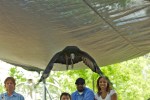
Second, Cayce flies over the audience with a particular glee.  She seems to know she’s a star and that getting as close as physically possible to the audience makes her more of a star.  In fact, she hit me in the head with her tail as she flared to land on Dale’s glove during the second show.  The audience loved it.

Third, Cayce chases John, pecking at his legs, demonstrating he is below her in the pecking order.  The entire audience cracks up as John runs from Cayce.  While he is being slightly theatrical, Cayce can draw blood, so moving quickly to avoid her beak is not just for show.

An interesting tidbit I learned about vultures from John and Dale is that Black Vultures have a strong beak for piercing and tearing through thick flesh while Turkey Vultures have a great sense of smell.  Together, both species eat well.

But today, no one is really thinking too much about what Cayce eats, even though Dale is throwing her chunks of dead mice.  My only complaint about Cayce is that she’s hard to photograph.

Audience Participation

While working on getting great pictures of birds of prey (as in, trying very hard, not necessarily achieving), I had the realization that the people are as fascinating as the birds.  Especially the children.

I’ve spent the better part of my life ignoring most children.  Not that I have anything against children; I just tend to gravitate towards people who are old enough that they would be insulted if you called them a child.  I blame this, in part, on my height.  I have a tendency not to notice much that’s shorter than about mid-thigh height unless it barks, meows, or flies.  I don’t know why this is, but I do know I have walked right into small children on more than one occasion because I just didn’t see them–they snuck into range under my radar.

But on Sunday, when I sat in the amphitheater at Rock City watching the birds interact with the audience, it was the children who were the standouts.  Perhaps they haven’t yet developed the stiff facial muscles of adults whose faces repeat the same patterns over and over again.  Perhaps they don’t change their facial expressions to reflect what they think someone else expects of them, so their expressions seem more genuine.

I’m not sure exactly what quality of children’s expressions makes them so much more . . . well, expressive, but I cannot help but swing the camera around to catch a child practicing hooting when John teaches the audience how to call a Barred Owl.  I cannot but wish for a second camera body so I could have a wide-angle lens ready to go to catch the reactions of the children as the birds soar over their heads.

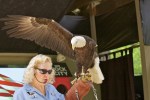
After the first show, John stands on the stage with Atsa, the bald ealge, while Dale takes Buddy, the screech owl, down the sidewalk.  I stay with John and take pictures of the people stepping up to have their picture taken with Atsa.

I sneak in a shot before they pose for their camera.  There is a moment for most people when they look up at Atsa, this magnificent bird, and their face expresses their genuine amazement, joy, or nervousness.  That’s the moment I want to capture.  Once they face their camera, they paint on the smile they’ve been using since their kindergarten class picture and I am instantly bored.

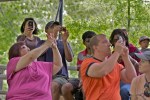
After the second show, I follow John up the walkway with Buddy and try to stand back far enough to shoot without anyone noticing.  I find myself wishing I could push the people aside blocking my view of the wonderful children petting Buddy.  Their faces made my whole day.  In a matter of moments, I witnessed fear, nervousness, surprise, joy, curiosity, and a hundred more emotions I can’t name.  I don’t know how many of those I captured in these images, but I sure have fun looking at the photos and realizing that these people were fascinated, engaged, and enjoying learning about birds of prey.

Birdie, You’re a Star

Continuing the theme of birds, on Sunday, I had the opportunity to go to Rock City, a local attraction on Lookout Mountain, to see the S.O.A.R. raptors perform.

S.O.A.R. performs regularly at Rock City throughout the warmer months, educating the public about the role raptors play in the ecosystem and giving people a close encounter with birds of prey.

I’d never seen the S.O.A.R. program before, so I plan to watch it twice. I’m hoping to collect enough photos to put together a screen saver we can use to raise money for the program.

One of the unique things about Rock City is that dogs are welcome. Unfortunately, dogs make birds of prey (and really, most birds) quite nervous, so while they are welcome in Rock City in general, they are not permitted in the vicinity of the bird program.  This meant that while Tisen got to come with us, he had to be escorted away from the vicinity of the performance before the show.  So, both Pat and Tisen missed out.

My goal for the first run was to learn the pattern of what they did so I could do a better job getting shots of the birds in flight during the second performance.  However, it’s almost impossible to sit with your camera in your lap and not shoot a single frame when you’re surrounded by super stars!

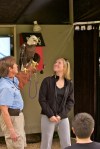
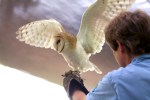
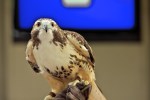
The performance is in a nice amphitheater large enough to accommodate probably 100 people.  It’s small enough to create an intimate setting.  It also makes it possible for Dale and John to walk through the entire audience with the birds, giving people an up-close view.  And, if walking around with the birds isn’t exciting enough, they fly a barn owl, Theo, a red-tail hawk, Cody, and a black vulture, Cayce, right over people’s heads.

While the birds are busy capturing the audience’s interest, John and Dale sneak in an enormous amount of information about the birds.  Between the live birds and several videos, people witness incredible feats that only birds of prey can perform.  And while it’s one thing to see a video of a Peregrine Falcon pulling in his wings to achieve a dive of over 250 MPH, it’s completely another to feel the wind from a raptor’s wings as it soars just above your head.

The thing that I really like about John and Dale’s approach is that they are serious about raising awareness about the importance of these birds to the highly interconnected network of life we are part of.  At the same time, they understand that to raise awareness, you have to get someone’s attention first.  And there is no one, I contend no one, who can fail to be fascinated by the kind of close encounter John and Dale provide.  If having a bird soar over your head doesn’t do it for you, petting a Screech Owl after the show probably will.

These birds have a special skill at attracting attention and keeping it.

Waiting for a Bird Like You

Tisen and I take a loop around Renaissance park looking for something interesting to shoot.  Well, to be fair, Tisen is more about looking for vertical objects to mark while I am looking for something to shoot.

Today, I’m out for birds.  I cock my head to one side as we walk, listening to the songs and identifying the ones I recognize as I decide whether they’re worth trying to wait for them to appear.

The thing is, song birds are really tough to get a decent shot of.  Especially when the longest I can go with autofocus is 400mm.  Since I don’t see well enough to focus manually unless the subject is sitting still, I figure I need the autofocus.

This means that unless a song bird flies down and perches on a branch about 10 feet away, I’m not going to get a very usable image.

So, I forego waiting to see if I can find the song sparrows, the carolina wrens, or even the yellow-rumped warbler I hear singing.  However, when we cross the bridge over the wetland. I notice a white-throated sparrow down in the creek below.  White-throated sparrows are winter birds in this part of the country, but they seem to be hanging out late here in Chattanooga–I still hear them every morning.

This white-throated sparrow isn’t singing, though.  He’s taking a bath.  I’m amazed as he completely submerges himself in the creek.  Then he fluffs out his feathers like he’s sitting in some kind of pool float.

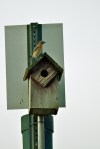
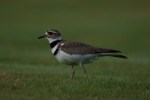
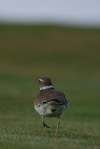
Next, on the hillside above the wetland, a killdeer wanders back and forth above us.  Having staked out the blue bird house a few yards behind the killdeer, I ignore it, waiting for the blue bird to return.  The killdeer charges me like we’re playing chicken.

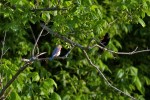
I manage to get a few shots of the killdeer without missing the return of the blue bird.  And when the blue bird flies off to the other side of the wetland, it lands in a tree right next to a red-winged black bird.  They are so close together, it’s hard to believe they manage to ignore one another, but they do.

As I sit focusing on the song birds, a large, mostly white bird flies through my peripheral vision.  I pull away from the camera just in time to see it fly out of sight.  It’s shaped something like a mourning dove, but it’s too big.  I find myself wondering if it’s a bird of prey, but it’s probably a giant pigeon.  When I go back to shooting the song birds, it flies by again and I miss getting a good look for a second time.

Tisen is getting impatient.  It has been an hour and a half since we started shooting, so I supposed I can’t blame him.  I skip waiting for the return of the mysterious bird, pack up, and head on home.

Hunting Herons

After attending a photography workshop in the morning and volunteer training at the Audubon Society in the afternoon, I decided spending some time shooting would be a nice way to end the day.

Tisen, feeling better after his bout of upset stomach, and I packed up and headed on over to the park.  I can’t decide what I want to shoot today, so I take everything I own.  Worst case, I get some extra exercise, although the sofa is a little unwieldy  😉

When we arrive at the entrance to the park, a blue bird flies over my head.  I haven’t even taken my camera out of the bag yet!  I stop right there and get out my camera and opt for the 100-400mm lens, deciding I’ve been neglecting it since getting the 70-200mm lens.  Besides, I could use the extra length for birds.

Of course the blue bird is long gone.  I guess that’s what I get for letting fate decide what kind of shooting I’m going to do.

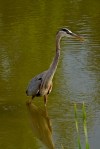
We head on down towards the wetland.  When we get there, a great blue heron is stalking the water.  I hand hold the camera for a change–it feels strange in my hands having worked on a tripod so much lately.

Tisen and I walk around to the shore of the wetland to see if I can get a better angle on the heron.  On the way, some people eye my lens and ask if I’m taking pictures of the wedding. Confused, I explain I was shooting a blue heron and the people laugh.  I look around and see a bride and groom disappearing down the path.  Is it funny that I am more attracted to birds than brides?

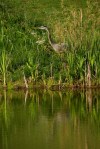
The blue heron stalks a fish, coming up onto the shore and then back down into the water.  It hangs out for awhile on the way, peeking at me from between blades of tall grass.  It amazes me how a giant, blue bird that resembles a pterodactyl can disappear amongst blades of grass.

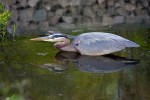
As he wades through the water, moving in slow motion, he crouches until he suddenly strikes and nabs a fish.  I missed the strike with this one, but, lucky me, I get to try a second time when another blue heron hunts on the other side of the wetland.

One thing I learned is that a shutter speed of 1/250 is not fast enough to stop the motion of a striking heron!

Unfortunately, he turns away from me to swallow the fish and I only get a view after the fish is deep in his gullet.  Both heron give themselves a big shake after a hunt–it reminds me somehow of Tisen marking a tree after having an encounter with another dog.

Sorry for the excessive number of pictures, but I love the succession of the second heron crouching lower and lower next to his reflection in the water until he strikes.  Just for fun, a movie version:

Winging It

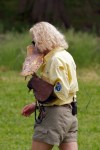
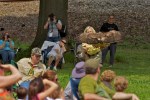
On Saturday afternoon, I went to a Chattanooga Audubon Society fund raising event as a volunteer for S.O.A.R.  S.O.A.R. was there to do their 45 minute long educational program on birds of prey in support of the Audubon.

The challenge for John and Dale was that the program was in a large field outdoors, potentially tempting free flying birds to head for the trees.

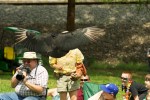
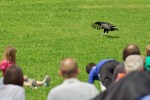
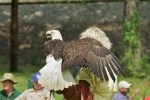
The challenge for me was to see if I could get any good shots of the birds.  I am planning to make a screensaver to give away in exchange for donations at an upcoming event.  Unfortunately, I’ve never seen the program before, so I am completely winging it (yes, a pun).

I chose my new 70-200mm lens thinking because it’s faster, it will help me freeze more movement.  Given that it was a bright sunny day, I probably would have done better with my 100-400mm since I didn’t really need the speed.

I put my camera on a tripod and set it at its maximum height thinking I’d have a better angle catching the birds flaring before they land.  Unfortunately, I didn’t consider the need to separate the birds from the audience.  I would have been better off getting really low–well, not sure my knees would have been better off, but my pictures would have been.

I also needed to be as unobtrusive as possible so the birds didn’t get confused and fly to me.  No one wants a bird of prey to land on their unprotected flesh.  As a result, I tried to stay in one spot and not move around much.

In addition to being in a fixed position, up high, with too short a lens, all my subjects were in motion.  John and Dale are constantly moving.  When I am looking through my lens, I can only track one of them, but I need to know where the other one is to predict what direction the bird will fly.  Looking away to locate the destination person caused me to miss more than one good shot.

My lack of experience using the continuous focusing mode also did not help.  I had issues with losing focus. I’m not sure what I did wrong, but I’m going to have to do some more practice with continuous focusing mode.  It was depressing to see perfectly framed and timed shots that were totally out of focus.

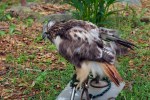
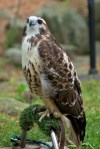
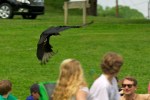
In the end, I have some fun snap shots, but nothing to put in the screensaver.  I spent an insane amount of time trying to salvage one of the photos by blurring away the distracting background.  Unfortunately, the photo doesn’t look right now–see if you can tell which one I majorly doctored.

At least I learned a lot for the next time.  And, none of the birds flew away.

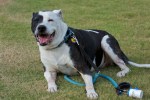
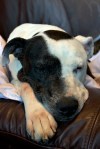
As for Tisen, he couldn’t come to the event with me–birds and dogs don’t mix well.  But, I included another shot from his nap with Red Dog.