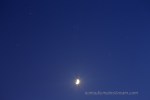



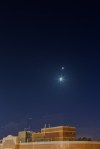


When Pat called to tell me that Mars, Saturn, and Spica were all going to be in the vicinity of the moon the other night, I, of course, had to get out my camera. It’s a funny thing about astronomical events. I get all excited because I get a chance to get a picture of white dots in the sky. I could probably put white dots in a shot of twilight a lot more easily and I wouldn’t have to wait for the actual event to occur.
But, as it turns out, I’m somewhat old fashioned when it comes to photography. This is rather strange given that I’m a relative new comer to the art. For whatever reason, I prefer to attempt to capture the real white dots in the sky as opposed to creating my own.
That said, what does one do when one walks away from shooting and, the next day, looks at the images and smacks oneself in the forehead and rolls one’s eyes while wondering what in the heck one was thinking during the previous evening’s shoot?
I had a vague notion that maybe I could take a bunch of exposures and then combine them using Photomatix to create star trails, I guess. I think I would have needed to shoot for about 3 more hours to create decent star trails.
But there were other problems with my shooting. First, I couldn’t see Saturn, Spica, or Mars when I looked through the view finder. As a result, I didn’t shoot as tight as I should have and I ended up with the moon lower in my frame than I would have liked because I guessed wrong as to where they were.
I have to pause here for a moment. Why is it you can look at the sky and see something plain as day and then look through your viewfinder and have it disappear? It was even worse trying to use live view mode. I had to give up on that entirely. Perhaps if I would have waited longer after twilight the planets and star would have shown up better in the sky. As it was, I was trying to catch the deep blue of twilight–was there ever a better color of blue?
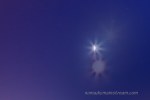
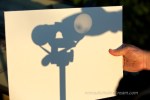
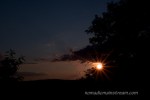
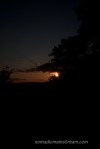
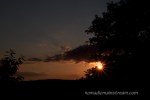
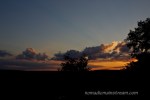
Having come up with mostly crap, I decided to play with HDR processing a bit more than usual. I tried combining photos that were not actually shot in a sequence for combining. I turned off the features that align images and remove ghosts. I created a scene where we have two moons in one image. In another, I just ended up with what looked like sun spots reflected in the lens. It was fun to play with it even though I didn’t really get anything I like out of it.
As an aside, Tisen’s girlfriend, Twiggy, is staying with us again this week. I caught them napping on the couch together. They swore they were just napping. I believe them.




 nomadicmainstream