Mine Sweeping

We attempt to go for a walk this morning.  But it’s getting late by the time we leave so we are forced to do the short loop through the park.  We realize that someone new must have moved into the neighborhood because of the dog poop on the sidewalk.  There are three separate piles along the way.  Each one looks older than the last, like the piles are from three separate days.  I wonder if the new dog owner is French–they’re not allowed to pick up dog poop because it’s someone’s job.

Stopping short of doing forensics on the dog poop piles, we walk around cautiously, avoiding getting any on our shoes successfully.  Then, we are greeted by three women, each with a small dog.  We’ve met these women and their dogs before–these women pick up after their dogs.  The little dogs have fun racing around together, but they don’t stop for a pet.  Although one is willing to let you throw its ball.  Today, we let them go on by without attempting to pet them.

Convinced that there is no dog poop to step around in sight, my eyes go to the sky.  I am hoping to see the Red-Shouldered Hawks who hunt in the park, but instead, I spot a flock of much smaller birds hanging out in the tree tops where they are back lit and there is no hope of getting a good look at them.  From their size and shape, I would guess they were a group of Cedar Waxwings, but who knows.  The call of the White-Throated Sparrow catches my attention.  I point it out to Pat, but he doesn’t know what I’m talking about, having failed to notice a bird was singing.  I realize he is probably thinking about our dogs, long gone, and missing them.

I try to imagine having a dog again.  I feel certain that some day, a dog will walk into our lives and stick.  But, for now, we are dogless and content to remain so for a while.  In the meantime, we console ourselves by petting other people’s dogs.

We return home and I work.  Our walk seems to have been symbolic of what I will face during my work day–I seem to spend most of my day trying to avoid land mines.

At the end of the day, it’s getting late and we have nothing to eat in the house.  It’s been raining since mid-morning, but it’s not that cold.  We decide to walk over to the Japanese restaurant by Coolidge park.  I pull on a rain jacket with a hood and find an umbrella.  We make our way carefully, leaping over deep puddles that have formed, dodging the splash from cars, and peeking from under our hoods before crossing the street.  I can’t help but feel my entire day has been about avoiding traps and obstacles.

When we get to the Japanese place, we discover it’s not open on Mondays.

We head for the Italian place at the end of the street.  It’s the restaurant furthest from our place on this strip, which means another block of dodging puddles.  But, we are happy to learn that tonight there is a special.  Fat Tire for $2.50 a pint and 20% off all pizzas.  We decide to give their pizza a try.  At the end of our meal, we discover that we’ve just eaten the cheapest meal we’ve ever had in Chattanooga.  Since the Japanese place tends to be the most expensive, we’re happy that they were closed today.

Now that we are warm and full, it’s time to go back out into the rain.  I pull on my raincoat and steel myself mentally.  We rush through the darkness, holding the umbrella so that it partially covers both of us. When Pat tips the umbrella, the water runs off onto my shoulder and into my purse.  I straighten the umbrella in his hands several times before I finally take over holding it.

We run across the streets, black silhouettes against headlights.  I realize we should have worn something with reflective strips on it.  Instead of avoiding mines, now we are dodging bullets.  When we make it back to our building, a man with a backpack is sitting on the steps up to the entry.  The steps are sheltered.  We assume he is homeless and trying to get out of the rain.  We greet him and continue on by, entering the security code to get into the building and making sure no one follows us in.

We walk into our place dripping with rain.  I strip off my rain jacket and find a spot to set the umbrella so it can dry.  After shaking away the wet, I get myself ready for bed.  I feel as if I survived some sort of test today.  Walking in the rain, especially after dark, always feels like an adventure.  I wish the end of my work day gave me the same rush that walking in the rain does.

Going to the Birds

After spending the morning hang gliding, we change into dry clothes and head off to spend our afternoon with some of the best pilots ever born. They are a group of slightly crazy and/or disabled raptors. Raptors as in the family of birds that includes hawks, owls, eagles, and vultures–in other words, birds of prey.

I have been looking forward to this for weeks. We originally saw a poster for a Raptor Experience at the hang gliding office a month ago. The Raptor Experience is offered by a non-profit organization called SOAR (Save Our American Raptors). They care for non-releasable raptors and train them so they can be used for educational programs to teach people about birds of prey. They also have a Peregrine Falcon release project and are tracking a falcon who is currently vacationing in South America.

As a bird lover and one who is particularly fascinated by birds of prey, I am excited about this beyond belief. I’m hoping we will get to actually handle the birds, but in my excitement, I can’t remember if the person I talked to said we do or not. Even more exciting, I’ve been wanting to volunteer for a raptor rescue program for years, and now this looks like it might be an opportunity.

We arrive at the designated meeting spot a little early. My nerves kick in about meeting people a bit, but since we just talked with Dale, the wife of the husband and wife team who run the organization, I’m not too nervous. John, the other half of the team, arrives only a couple minutes after we do. He’s driving a jeep with a hang glider on the roof, so it’s not too hard to guess it’s him. Dale told me on the phone that she and John are both hang gliding pilots and I enjoyed watching a video of John taking a one-winged bald eagle hang gliding on their web site.

John offers to drive us up to their property where the birds live, explaining that the road is pretty rough. Pat, being a man, decides that he can drive the mini-van up it and save John the trip back down later. As we make our way down the dirt road with large holes, ridges, dips, and rocks, the car drags enough time to make me wish we’d just ridden with John. We make it without losing any parts of the van, although Pat comments that it’s a good thing that I’d already knocked off the front lip spoiler (whatever that is) dragging the front bumper over a parking block.

When we arrive, Dale comes out to greets us, although one of their rescued dogs beats her to the punch, and invites us into the house where she offers us freshly baked, homemade cookies and gives us a run down of what we’re going to experience and why these birds are here. We learn that, yes, we will get to handle the birds. (Yay!) We also learn that none of the birds here at SOAR are able to return to the wild either because of injuries or mental problems. Interestingly, “mental problems” are defined mostly as birds who were raised by humans and, because they imprinted on the humans, don’t know how to do what they were born to do.

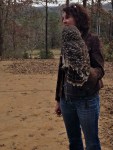
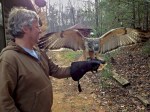
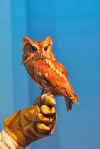
After the orientation, we head outside and are equipped with leather gloves. We are going to start with Eastern Screech Owls. Small, docile, and probably sleepy, they sit quietly on our gloves and even enjoy being petted on the back of the head. John tells us that owls understand touch as affection, but other birds we will handle do not and warns us not to attempt to pet the hawks.

I am so amazed by these tiny little owls. They weigh nothing. John points out that we can see the ruffled edges of their feathers, the secret to the silent flight of owls. And, even more amazing, John shows us their ears. They actually have little human-like ears under those feathers! The ears are offset, apparently to help locate where sounds are coming from in the dark.

I could have been happy just sitting there with these little owls all day, but Dale puts them away so John can bring us a Barred Owl–since Barred Owls will eat Screech Owls, everyone is happier when they’re not together.

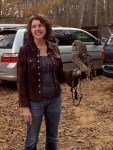
We used to live in a wooded ravine where Barred Owls also lived. They are enormous. Or, at least they look enormous. In contrast to their size, hollow bones and feathers make birds weigh far less than other types of animals of the same volume. I’ve read this before, but having never held a bird, the reality of the gap between how much this bird looks like it should weigh and how much it actually weighs surprises me when Dale puts this great big owl on my glove. This owl weighs less than 2 pounds.

Next, John returns with a Barn Owl. We don’t get to hold this owl who is about halfway between the size of the Screech and Barred Owls. At least not right way. He doesn’t like to sit on the glove–he wants to fly. And that is exactly what he gets to do.

John stands at one spot behind the house and we go to the other. Dale accompanies us with a pouch full of small mouse parts. I ask her who gets to chop mice–she makes a face when she admits it’s her. Clearly, it’s not her favorite part of the job.

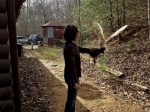
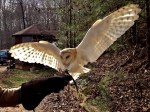
I hold out my gloved arm and Dale places a small piece of mouse on my fist. John releases the owl and he flies to me, swooping low to the ground and then flaring upward so that he lands feet forward on the glove. Having just come from hang gliding, we are fascinated watching how the owl instinctively uses ground effect (the rising air close to the ground) to get lift in time to flare, which is what Pat is now learning to do, so he can land on his feet.

It’s an amazing experience to stand there waiting for a bird of prey land on your fist. As he glides towards me, the owl’s tiny body is dwarfed by his enormous wingspan. The sunlight shines through the feathers on his wings, making him look as angelic as a bird of prey can. I wonder if he minds performing in the early afternoon when he should be sleeping. He looks pretty darn happy when he picks up a mouse chunk and swallows it down.

Next, we get to fly Cody, a Red-tail Hawk who refuses to hunt. Cody glides even closer to the ground, skimming just inches above the surface, and then swoops up in a sharp arc just before reaching me. I notice he flares with his feathers as well as his wings. Every feather spreads, his tail dramatically opening like a fan. Just as with the owl, this flare brings him nearly to a halt so that when he lands on my arm, there is no impact. It’s like he parachuted down gently.

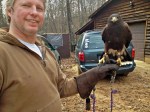
After flying Cody, we get to meet Franklin, an American Kestrel, and a Harris’s Hawk whose name escapes me. I’ve never seen a Harris’s Hawk before. He is beautiful–rich browns blend into black, which contrasts with the white in his tail.

Next, we get to meet Casey, the Black Vulture. Casey seems to think she is a dog. She circles around Dale, who tickles Casey on the back and Casey responds with what appears to be a happy Vulture sound, but comes out a lot like a hiss. Casey gallops along on the ground, preferring to walk even though she is perfectly capable of flying. Dale tells us that she sometimes walks Casey in the woods–she really does think she’s a dog!

We attempt to fly Casey, but Casey is in the mood to run instead. She flies up to our gloves to collect treats, but then hops back to the ground to run the distance between us instead of flying. Cameraless today, I switch my iPhone into video mode and try to capture her running on video–there is just something too funny about watching a vulture run.

I appreciate the work that vultures do, having once had a pond where hundreds of fish died all at once, it was an amazing thing to have a few dozen vultures show up and clean up the mess in about 3 days. However, I never thought the words “cute” and “vulture” went together. Today, I change my mind. Casey is adorable. Dale tells us that Casey is used to being the star of the show; I am not surprised.

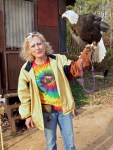
We finish off our Raptor Experience with a Bald Eagle. I can’t recall this eagle’s name, but it is a Navajo word that means, “The Littlest Eagle.” It’s a good name. This poor guy lost a wing due to a shooting. I’m not sure if the missing wing contributes to how small he looks, but he definitely is small for an eagle. I am sad to learn this eagle has not been hang gliding yet because it means that there are two one-winged eagles living out their lives in captivity.

It’s an appropriate finale to the day, though. After all, it’s hard to beat a Bald Eagle for majesty. We go inside to wash our hands and talk for a while before wrapping up and heading home. Dale talks us into one of her cookies before we go–a peanut butter blossom with a soft hershey’s kiss in the middle, yum! We get in the car and I feel like I should pinch myself–it’s hard for me to believe that I just spent the afternoon playing with raptors. Instead, as Pat creeps back over the bumpy dirt road, I look at the pictures Dale took for us on my iPhone and smile.

Sunrise Spectre

This morning, as I wait for Pat to get ready for our morning walk along the riverfront, I decide to take my camera.  After all, I missed some really great shots on our last walk and I hate that.  As I change the lens on my camera, I look out the window and see a large cloud hanging so low that it has to be fog rising off the river.

It’s lower than the roof of the 4-story building across the street and stretches in a long tube just over the trees along the river.  I call Pat to come look while I finish getting my camera ready.  Pat comes out and says, “It’s like the Smoke Monster!”  That is exactly what it looks like–the smoke monster in Lost.

By the time I can get a shot, it’s already shrinking.  I rush to get out the door hoping we can get down to the river and get another shot before it dissipates all together.  Pat is walking better today–his pulled hamstring is still somewhat touchy, but it’s healing.  We make it down to the river, but all that is left is a puff of cloud hanging over the water.

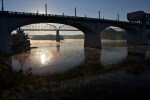
Although I’m disappointed that I missed the smoke monster at its peak, I’m happy that I’ve brought my camera with us this morning.  The sun is rising behind Veteran’s bridge and fog continues to swirl and rise off the surface of the water.  I play with getting different angles of the rising sun, but make a note to myself to do some reading on dealing with shooting directly into the sun–I can’t seem to avoid sun spots, even with my polarizer on.  But I love the effect of the sun backlighting the scenery anyway.

As we work our way along the riverfront with me shooting from various vantage points and Pat patiently waiting for me, we spot a hawk sitting on the paddle wheel of the Delta Queen.  The Delta Queen is an old riverboat that’s been converted into a permanently parked hotel.  It sits at anchor in front of Coolidge park and adds a nice touch to the riverfront scenery.

I, of course, did not bring a telephoto lens this morning, not wanting to have to do any lens changes while on a walk or have to carry my tripod.  I do not immediately recognize the hawk because it’s backlit.  I’m hoping to get a few shots good enough to blow up so I can identify it later.  With a 17-55mm lens and low light, that’s not going to be easy.  I snap as many shots as I can, trying to get as close as possible without spooking the hawk.

As we get closer and on the front-lit side of the bird, it appears to be a Red-tailed Hawk, but it doesn’t have a red tail.  Probably a young one, but I will double check when I get home.  Now that I am less worried about getting a shot good enough to ID the hawk, I go back to shooting landscape shots.  The hawk must like being the focus of my attention, because it flies up onto the Walnut St Bridge and perches in the sunlight for me.

About this time, a woman walks up and start asking me about my camera.  She is shooting with a point-and-shoot and carrying the smallest tripod I’ve ever seen that still has plenty of height.  She is a small person, so I suppose it might even be at eye level for her.  She also carries a larger tripod.  She tells me she’s shooting with her point and shoot this morning but that she has a Canon 7D in her bag.  She asks what I’m shooting with.  I feel embarrassed to tell her it’s a 40D for some reason.  She talks about the zoom in the point and shoot she’s using, which I guess is why she’s using it in lieu of carrying around multiple lenses, but I’m still confused as to why she would have a 7D and leave it in her bag.

This morning, I alternately yearn for a full size sensor that will allow me to include more of what I see before me and the full 400mm of my telephoto zoom lens on the smaller sensor of my current camera so I can shoot the hawk.

When I was at a photo workshop at the Tennessee Aquarium and asked one of the instructors for advice on selecting a focal length, she told me that it just depends on whether I like to be tight on my subjects or if I prefer a wider view.  She went on a bit of a diatribe about how some photographers preferred one look over the other.

I was completely perplexed by this.  In my mind, some scenes call for a wide angle and some call for a telephoto.  Isn’t that the whole point of having a selection of lenses in your bag?  Given that we were shooting wildlife in tanks, it seemed clear to me that getting up as close as possible on individuals would make the most dramatic images, but maybe that’s where others have a different opinion.

Another woman in the class started talking about how she never changes lenses and does’t even use a zoom lens.  She has one focal length and that’s what she works with.  I am reminded of a story I read where a photographer took a 35mm fixed focal length lens (on a 35mm film camera) on a trip and how it forced him to be very creative in his photography because the lens was so poorly suited for some of the things he wanted to shoot.

This is a constant battle for me–is the effort required to carry extra lenses and the risk of changing lenses worth the difference it makes in my shots?  Given that I tend to shoot very wide or very telephoto, I have to say yes.  After all, a shot of a hawk 100 yards away perched on the side of a bridge shot at 30mm makes the hawk a tiny surprise–the photo is all about the bridge.  A shot of a hawk 100 yards away at 400mm eliminates everything except the hawk–the photo is all about the hawk.  They aren’t comparable.

This morning, I point out the hawk to the lady with her point-and-shoot.  She doesn’t seem interested in the hawk.  This surprises me, too.  What kind of person isn’t interested in a hawk?  She tells me about going on some photography workshop with “real photographers” and how they are all using point-and-shoots, too.  Apparently justifying the use of a point-and-shoot is more important to her than shooting.  I am no longer following what she is saying.  The only parts I pick up are when she asks where we’re from two times and I tell her “just over there” with a vague gesture two times.  I gather she’s trying to identify our origin by our accent, but I’ve gotten to the point where I stop explaining that we recently moved here from Ohio.  We are, after all, from “just over there” now.

Eventually, she stops talking at me and goes off to shoot some more or leave, I’m not sure which having given up on our conversation about the time she took no interest in the hawk.  The peace of my morning was somehow disturbed by this strange little woman with her point-and-shoot.  I am left with the vague sensation of having been in a competition that I didn’t enter or participate in but somehow managed to lose anyway.  I find myself wondering if she is somehow related to the smoke monster.

I try to shake away the ghost of the little woman and return my focus to the rising sun, Pat, and our walk.  I set aside my camera for now, reach for Pat’s hand, take a deep breath, and just look.

Big Sea, Bright Skies, and Biting Turtles

It’s Christmas all over again for me today.  I have been playing with my new toys, a really great tripod and wireless shutter control, for a couple of weeks here and there, but today, I get to take them with me to a workshop.  And not just any workshop, we’re going to shoot at the Tennessee Aquarium and along the water front.  And, we don’t just get to shoot at the aquarium; we get to shoot before they open!  I’m so excited, I wake up long before my alarm and can’t get back to sleep.

As I finish pulling everything together and get ready to walk out the door, Pat tells me he will drive me over to the aquarium.  It seems a little silly to me, but it is early and I will be carrying a lot of stuff, so I accept his offer of a ride.  It takes longer to clear the windows on the van, which have fogged up over night although it didn’t get cold enough for a frost, then it does to drive across the Market St Bridge, but it’s nice not to have to haul my gear over.

The aquarium is quiet.  There are only a couple of grounds crew members sweeping up outside–in an hour, the place will be swarming with kids.  I walk to the members entrance and find no one.  I am a few minutes earlier than the stated time to arrive, but I’m also a few minutes later than they said someone would be at the door.  Before I have time to worry about whether I’m in the wrong place, a woman appears and comes over to let me in.  As it turns out, she’s guiding each attendee to the top of the escalator and pointing us in the right direction before returning to the door.

I find the classroom with no trouble and we sit and talk and drink coffee while we wait for the remaining attendees.  A girl who works for the aquarium (or perhaps volunteers?) comes in to clean the turtle cages.  While our instructor gives us a run down of where we’ll be going in the aquarium, the girl stands up and says, “Um, I have a situation here,” as calm as can be.  She is holding up a small box turtle who has hold of a chunk of her finger.  No one reacts for what must be nearly 30 seconds, thinking she knows what she’s doing, I suppose.  Then, a woman next to the girl asks if she needs help.  The girl nods and the woman and a man across from me spring into action trying to get the turtle to let go of the girl’s finger.  I suggest trying to get the turtle to bite on a stick instead, but this causes the turtle to try to pull its head back in its shell, still holding onto the girl’s finger.  It looks like he’s going to rip a chunk of her finger off the way her skin is pulling.  At this point, the guy helping suggests putting the turtle back in the cage.  When the girl sets the turtle down, he lets go.  But, she is in pain and with all that adrenaline rushing through her body, starts to cry, adding to her embarassment.  The woman takes her to the sink and runs cold water on the girl’s injury when one of the instructor’s returns with an aquarium employee.  We learn that the best way to get a turtle to release is to dunk it under water.  After we all settle down again, the aquarium employee says, “Well, I guess I don’t have to warn you about reaching into the turtle cages!”

We head out to the aquarium to start shooting.  We begin in the tropical setting where the Macaws are not yet on display, to my disappointment.  There is a tank with rays for petting, but I decide I’m more interested in shooting the flowers in this area.  I go back to the lobby area at the top of the escalators to do a lens change–it’s too humid in the tropical garden area.  Then I return and practice some macro shots of flowers.

Next, I move into the butterfly garden, which is even more humid, and do my best to get a shot of the butterflies.  I really want one of the butterflies that look mostly brown on the outside of their wings and then brilliant, metallic blue on the inside of their wings.  I, like everyone else, want a shot of them with open wings.  They are not cooperating.  I find one alighted and wait and wait and wait.  The instructor comes in and explains to me that they only open their wings when they need energy and are parked in the sun.  The butterfly I’ve been waiting on is in the shade, so I look for another one to wait on.  I manage to snap a few other butterflies in the process, but I never do get a shot of blue wings–we only have an hour before the aquarium opens and I want to make sure I get to the penguins before the kids come in.

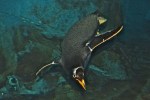
When I head down to the penguins, I pull out my tripod.  I crank up the ISO setting, open up my aperture, and set up the tripod so I get some stability, but can still swing the lens around to follow swimming penguins.  This turns out to be an impossible task.  Fortunately, the instructor comes along and does something surprising:  he stops down my aperture setting, turns down the ISO setting, and turns on my flash.  I have never had much success with my flash and have pretty much avoided using it as much as possible instead of learning what I can do with it.  Flash has been one of those things on my list of skills to worry about later.  Today, I learn how much a flash, even the built-in variety, can help, even when shooting through glass.  By choosing the proper angle to the glass, I’m able to get some halfway decent shots of swimming penguins.  Although they do all have red-eye.  Something to correct later.

I have a harder time shooting the penguins on land.  There is about 4 inches of glass between the top of the water and the bottom of the water spray splattered all over the glass.  That 4 inches remains clear because the water sloshes back and forth as the penguins swim around, rinsing the glass.  So, the trick to shooting the penguins on land is to shoot through those four inches when the water is sloshing the opposite direction.  I have a hard time getting my timing of when the penguins are doing something interesting and when the water is sloshing the right direction down.  Or perhaps the penguins are just toying with me.  In any case, I can’t say I got a great shot of the penguins, but at least it was an improvement on what I was able to do on my own.  Plus, I now have come face-to-face with my flash-phobia, the first step in getting better.

We spend some time in the classroom going through some shots of the instructors and talking about the choices they made given the circumstances to create the images they share.  One trick that I’ve never heard before was that, if your sky is going to be white, make it go all the way across the top of the picture.  I often end up with white skies.  I will have to pay more attention to that the next time my sky is going to be overexposed.  Alternatively, I could learn how to layer together two different exposures so I don’t have white skies, but I already feel like I spend more time than I’d like processing photos.

We return to the aquarium to watch a bird show where they bring out an Eastern Screech Owl and a Eurasian Eagle Owl.  I love owls.  My camera picks this moment to stop working.  I take it to the instructor to see if he can tell what’s going on.  In the end, I have to reboot.  Turning the camera on and off solves whatever hiccup happened.  But, now I am at a bad angle to the owls and they are in shadow.  For having someone holding a bird posing to take a picture, you’d think I’d be able to get a really good shot.

Next we head to the seahorses where we, once again, practice using flash in front of glass.  It’s tricky to get my lens to focus on the seahorses.  I’m using my 100mm macro lens and I have to focus it manually to get it close and then let it refocus automatically since I can’t see well enough without my reading glasses to tell if I’m in focus or not and the seahorses move enough that the focus changes rapidly.  I spend so much time trying to get decent shots of the seahorses that I run out of time to shoot any jellies.

After another classroom session and lunch, we go outside.  Unfortunately, it’s now early afternoon and the light is about as bad as it gets.  I put my polarizer on my lens in the hope of getting rid of some of the glare, but the sharp shadows make it challenging to get good shots.  I end up walking around with one of my the other attendees and as we talk, I learn that not only does he also work for the same company I do, but he works with the same guy that sat next to me on the way to Germany.  While I suppose the fact that they all came from an acquired company based in Atlanta combined with the fact that Atlanta is close enough that a lot of people come from there to Chattanooga on the weekend for a get away makes it more probable that this guy and I would end up in the same workshop, but still.  What are the odds?

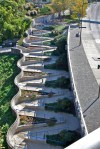
We work our way around from the Hunter Museum and Walnut St bridge to the Bluffview Art District and the sculpture garden.  Then, we head back in the direction of the aquarium.  We end up walking down the waterfall steps that go down the side of the aquarium.  I’ve never walked down them before.  They go under the street where there are interesting reflections and a cool view of the large fountain that shoots into the river.  He shows me a gate that allows us to go through and walk out to the waterfront–I never knew you could get through there.  We work our way back around to the aquarium until we return to the final part of the workshop.

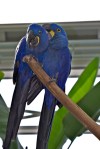
After we wrap up, I return to the tropical display to shoot the Macaws.  They are out now, each performing their own tricks.  One likes to groom on the other non-stop.  The other periodically breaks away from the grooming to go hang on the end of the stand by his beak.  He watches me shoot him as he performs this trick and I’m pretty sure he’s used to star treatment.

Leaving the aquarium, I decide to walk back instead of having Pat pick me up.  Although I’m tired from lugging my gear around all day, I want to shoot our side of the river from the bridge.  I don’t spend a lot of time doing this–I take only hand-held shots–but I do get a few nice views of our building and the falls colors on the hill behind it.

Returning home, I can’t wait to see what my pictures look like on the computer.

Seeing Eagles and Shooting Soccer

It’s our second day visiting my brother, sister-in-law, and nephew in Indianapolis.  We are at a lull in the day where each of us has found our own way to entertain ourselves.  I am working on photos.  Paul is doing something related to work.  Megan has gone for a run.  Scott is off somewhere.  We have a few hours before we will reconvene to go to the next soccer game.  Pat is the only one devoid of entertainment.  He wants to do something fun and he wants someone to do it with.

I ponder this for a while.  While Pat used to do things on his own quite often, they typically involved having a workshop and building something.  It’s not the kind of interest that you take with you when visiting others or even relocating temporarily.  His tools are being used by a friend instead of in storage, but they remain in Columbus.  It dawns on my why he wants to go back to Columbus so frequently.

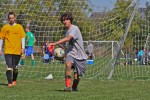
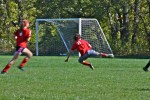
In the meantime, my brother gets up and finds some sort of game for the two of them to go outside and play.  It looks like Jai Lai, which I would have never heard of except that we had a restaurant in Columbus when I was a child named “The Jai Lai,” so we all learned what it was.  Since Paul has taken care of entertaining Pat, I return to my photos.  Sorting through the shots from yesterdays soccer game is a challenge.  I actually had many decent shots (given that my goal was to shoot my nephew), but they mostly look the same.  I missed the crucial moment many, many times.  For example, when my nephew scored, I couldn’t get my lens turned fast enough and ended up with shots of the grass.  I have a new respect for sports photographers.  But now, I have hundreds of similar shots that really should be discarded because they are dull.

Pat suddenly returns to the room I’m working in all excited.  He tells me that he and Paul have seen an eagle diving into their neighbor’s yard and that I should come outside.  While I’m somewhat skeptical that they saw a Bald Eagle diving out of the sky in the middle of their suburban neighborhood, there have been eagles nesting by their neighborhood lake, so this is not as far fetched as it would have been even 5 years ago.  The only part that is at all surprising to me is that a Bald Eagle would choose to hunt rodents when there is a lake full of fish just a block away.  I make a mental note to google Bald Eagle eating habits later.

When I step outside, I am surprised by the bright sunshine.  While the weather was improving yesterday, it’s downright perfect now.  I suddenly regret that we didn’t decide to go for a short hike before the soccer game.  Instead, we walk the streets of my brother’s neighborhood looking for an eagle eating something.  We never spot that eagle.  Pat doesn’t take nearly as much interest in birds as I do, but he is interested in birds of prey.  So, when he tells me the bird they saw was much bigger than a Red-tailed Hawk, I tend to believe him.  But, now it’s getting close to time to leave, so we return to the house to get ready to go.

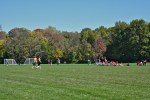
When we get to the soccer fields, I haul out my big lens again on it’s monopod.  As Pat and I settle in at the sidelines, a father sits next to us and says, “Are you with the Indianapolis Star?”  He points at my camera.  I assume that the Star is the local paper.  I laugh but before I can say anything, Pat jokes that we’re from the Chattanoogan some-name-he-made-up and that this game is getting big coverage.  The guy laughs mightily at that–this is a co-ed recreational soccer league–and says, oh, yeah, big, big game!
As I practice zeroing in on my nephew as he plays goalie (making my job much easier) the first half of the game, I periodically pause and look around.  It’s an interesting shift when I am thinking only about shooting a subject and I’m looking through a telephoto at that subject, and then I suddenly look outside the lens and allow the full scene to enter my consciousness.  It’s a good analogy for tunnel vision, I guess, which is, of course, an analogy for narrow thinking.

I think about one of my least favorite corporate expressions that’s being overused these days:  “Laser Focused.”  Remaining “laser focused” allows me to shoot my nephew without getting distracted by the pretty leaves across the field, the crooked lines drawn on the field, or even the ball.  But failing to look around causes me to miss all of those things, including who’s actually winning the game.  I experiment with looking for other things to shoot when the ball is at the other end of the field.  This creates an interesting tension between keeping an eye on the ball so that I know when my nephew is likely to be back in action and peering down that telephoto lens at some other subject, when I’m most likely to miss what’s going on in the game.

Then, Pat points out a big bird circling over the woods across the field.  I had seen it and dismissed it as a vulture because of its size.  Now, as I look again, I realize that it is not a vulture, but I can’t tell what it is.  It’s too far away and I don’t have my binoculars with me.  We watch it circling and then it suddenly tucks it’s wings into a shape you would expect to see on a military fighter plane and dives towards the earth at break-neck speed.  Pat sees a white head and is convinced we’ve seen another Bald Eagle.  I’m less convinced.  I didn’t see a white head (although it could have been a juvenile) and I’m still not confident that eagles commonly hunt on land.  I make a second note to google eagle eating habits.  However, I can’t say that I’ve ever seen a hawk that big or one that dove like that.
I hope that it was a Bald Eagle.  I remember the first time I saw one in the wild.  It was 1992 and I was on a trip to the East coast of Maine.  At that time, I’m not sure if there were any places closer to Columbus, OH where you could see a Bald Eagle in the wild than the East Coast of Maine?  DDT destroyed the population.  It’s unbelievable to me that I was able to drive 15 minutes from our home in Columbus to a metro park to watch a nesting pair of Bald Eagles for the past two years and that my brother has a pair nesting in his neighborhood.  It’s one of those stories of hope that makes me think it’s possible to correct the damage that we’ve done and restore some sort of balance to the ecosystems we depend on.

But returning to the game, I get to practice panning (a lot) when my nephew plays defense in the second half.  Turns out, panning it pretty difficult when you’re following a subject that is unpredictable.  I also get to use an autofocus setting that I don’t use often–it keeps refocusing as your subject moves.  It’s a little tricky to get used to, but a couple of my shots come out reasonably clear (out of about 100).  I definitely need more practice!  It’s funny that I’ve been trying to learn this hobby for about 7 years now, but I’ve been so sporadic that it’s like I have to start over each bout of shooting–I even have to get the manual for my camera out and relearn what’s what periodically.  Oh well, at least it’s a hobby that’s likely to last a lifetime.

After watching my nephew’s team win their second game of the end-of-the-season tournament, we all head home.  We pack up the van and we take two cars to dinner.  We eat at an Indian restaurant that’s on the way out of town for us and not far for everyone else.  Pat and I will drive to Columbus straight from dinner.  I am dubious about eating Indian–I like Indian, but it doesn’t always like me–but I order something mild.  As we say our goodbyes, I am suddenly sorry to be leaving.  For a moment, I ponder what it would be like to have a close-knit family that lives within a couple blocks of one another and walks in and out on a daily basis.  Then, we get into the van and go on our way.

American Tourists in Berlin

We get up on our first full day in Berlin surprised at how well we slept. I am starting to feel like I might be ahead of the cold I’m holding at bay and we realize that the room was so quiet that we slept undisturbed. We go to the hotel breakfast before hitting the streets. An American woman complains loudly to her friends about not having any soap in her room–I wonder if she has failed to realize that there is liquid hand soap in a pump by the sink and a bottle of shower gel for the bath.

A small man sits at the table next to us. There is only 12 inches of space between the tables, so it is almost like he’s joined us. He looks like a troll transported through time and space from a Brothers Grimm fairy tale and stuffed into a too small button-up shirt and khakis. His face is covered with hair that looks just a little too much like fur and the girth of his torso exceeds its length. I keep waiting for one of the buttons on his shirt to give up its tenuous grip and fly across the table to hit me in the forehead. This fear is heightened by his constant coughing and snorting; he apparently is losing his battle against a cold. Each time he coughs, I can almost hear the threads ripping. He continually paws at his dripping nose, using the backs of his short, stubby arms as a tissue even though there is a paper napkin at hand and more on the buffet. I find his presence takes the edge off my appetite.

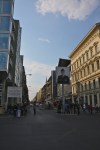
After breakfast, we head first to Checkpoint Charlie. After all, we have only today to see Berlin and we feel obligated to stick to the beaten path of the millions of tourists who have come before. Checkpoint Charlie is a bit of a let down. There are only small pieces of the wall displayed on the buildings that line the street, none of the wall itself is still standing here. Men dressed in American and German soldiers uniforms offer to pose for tourist pictures for a fee–none of then are actually in the military. We decide to skip the museum and head back towards the Fernsehturn tower again, this time with the intent of going to the top.

When we arrive at the tower, there is a long line to get tickets–another place where planning in advance would have paid off. We wait for nearly an hour and then have to wait 40 more minutes for our turn in the elevator. As we wait for the elevator, a second line forms of people with VIP passes and reservations in the rotating restaurant up in the tower. They get to ditch our line 2x before the Germans in the front put up a protest and get our line moving again.

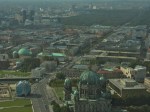
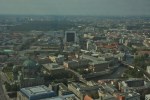
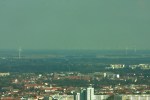
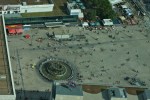
When at last we get up into the tower, we find that half of the observation deck is closed for a private event, the restaurant is completely booked, and we cannot even go up into the restaurant to see the other half of the view because the bar is closed. I am a little disappointed that we spent 20 euros and, worse, 2 hours of our one day, for half a view, but in the end, decide it was worth it. The view really is spectacular.

After returning to earth, we head for a motorcycle museum Pat spotted from the tower. However, when we get there, it’s all East German bikes, which Pat isn’t interested in, so instead of going in, we stop to eat lunch at a near by restaurant. We sit outside again and order beer and sausages (is there anything else?) and relax while we decide where to go next. We had planned to take a boat tour, but feel like we’re running out of time. We decide to take a tram over to the zoo and check that out.

We get on a train that takes us two stops towards the zoo and then announces it’s the end of the line and everyone must get off. We get off, but then not quite believing it’s turning around, we get back on. It goes the opposite direction. We get off and catch another train, which returns us to where we got off. We pick up a third train and get two stops further before the same thing happens. We are befuddled. We make it to the zoo in 2 more trains, each going two stops further, but are unable to determine why they are each turning around after 2 stops.

I always have mixed feelings about going to zoos. Besides feeling bad for the animals (although they seem to have a pretty good life and often help preserve endangered species), most zoos are similar enough to one another that you don’t really feel like you’ve visited a unique city by going there. However, entering the Berlin zoo felt like stepping out of the frenetic energy of the city and into a sudden state of relaxation. The zoo is literally called an animal park here, and that’s exactly how it felt–like a park with animals. Although the display style is not so unique from, say, the Columbus zoo, they have an amazing collection of animals that includes a giant panda, African lions, polar bears, bizarre warthogs, birds I’ve never even heard of, and hippos. When we walk into the cat house (resisting making a joke here), we start looking at some of the small cats that look suspiciously like house cats when the African lions at the other side of the building start roaring at each other. I’ve never heard anything like it–the roaring of lions reverberates off every surface of the building, making us feel like we’re surrounded by an entire pride. We move quickly towards the source of the sound, wanting to see what all the commotion is about. As we pass displays of small prey animals, I realize this must be a frequent occurrence because none of the smaller critters appear the least bit perturbed. As we arrive at the lion pens, they fall silent. We can’t tell what exactly happened, but there are two males in side-by-side pens, each with a single female. It looks as if they have recently been fed. I have to wonder if the two males smelling each other are frustrated by not being able to claim adequate territory. We watch these huge beasts pace and pant for several minutes. They are so beautiful. The might of their muscles rippling under their fur is awe inspiring. I imagine them chasing down an antelope and wonder if perhaps their protest was that someone had already killed their food?

We return to browsing the other displays in the building, but we don’t get very far before the roaring starts up again. We move back towards the lions and see that each male roars almost continually, still pacing, while the females appear to be providing harmony with smaller roars panted between the longer, rolling roars of the males. Perhaps they are not upset at all–maybe they are a quartet?

We walk outside for a while, glad of the fresh air after the intense smells of the cat collection. We pass by a collection of birds hanging out by several ponds. A huge hawk flies up from one of the ponds and lands in a tree, her shift apparently over for the day. The number of local birds just enjoying the free lunch vs the birds who are part of the collection is difficult to say. Dozens of herons hang out here, flying in in low circles looking for the best place for a snack. I’m pretty sure not one of them is a resident. The ducks get a little more confusing–there are many more types of ducks than listed on the signs. It reminds me of the Calgary zoo where wild turkeys perched on the fences of their outdoor deer display–whatever grain they were feeding the deer was apparently quite a treat for the local turkeys.

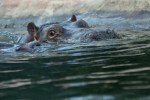
We head towards the hippo display, finally finding it almost by accident. When we do, I am so glad we came. The display is a huge pond with a glass wall that lets us see almost the full depth of the water from the side. There are fake rocks and ledges that lead to a land area for the hippos as well, but right now, the hippos are taking a swim. They circle around the pool, looming through the green water and suddenly appearing clearly up against the glass, floating by with unimaginable grace. Watching these huge, awkward animals fly through the water like ballerinas makes me laugh out loud. I have a vague recollection of a children’s story about hippos in tutus and wonder if this is where the author got the idea. I could have sat there until we were kicked out, I was so fascinated by this hippo dance, but, conscious that it is getting late, we move on.

The wart hogs (or whatever variety of pigs these are) make us laugh with their funny faces and the birds fascinate us with their fancy plumes. We walk by to se the polar bears before departing, but they seem to be frozen in a stand off, one in the water and one on the shore glaring at the one below. We head on out the gate and decide to walk a ways and try to find a taxi. Pat guesses we’ve walked 10 miles; I guess it’s something closer to 5, but we’re tired and both our backs are aching.

We end up stopping at a restaurant recommended by a woman at a small grocery store where we stopped to buy water. I have a really good snitzel. The restaurant owner calls a cab for us and we ride back to the hotel grateful for the ride.

Hiking at Clingman’s Dome

When we arrive at Clingman’s Dome, the highest point in Great Smokey Mountain National Park, we discover a long line of cars in the parking lot waiting for spaces.  Pat does a quick U-turn and we drive a quarter of a mile back down the road and find a space on the side of the road.  The space is tight against a sudden drop-off and long grass hides where the slope disappears.  I step out of the car and take a step that misses the firm shoulder, but catch myself before I slide off the slope into the thick weeds.  More cautiously, I move around to the trunk to start getting out gear.  I strap on my camera with the wide-angle lens, expecting to shoot panoramic views from the lookout point, and screw my long lens into my monopod to carry over my shoulder.  I pull out my day-pack and stuff it with food from the grocery store–enough to keep us energized for a day of hiking.  I pull on my fivefingers trekking shoes, tie on my rain jacket since the clouds don’t seem to be clearing, and stuff my head into my sun hat, which it doesn’t look like I’ll need, but it keeps my hair out of my face.  Dozens of tourist walk by on their way to and from their cars.  They wear shorts and T-shirts and flip-flops–I’m sure they wonder what in the heck we’re doing.  Pat straps on a canister of pepper spray just in case we encounter an angry bear and we lock up the car and head for the look out point looking completely ridiculous.

The walk to the overlook is a half mile from the parking lot.  It’s on a paved path that climbs up several hundred feet.  We pass exhausted tourists who stop to rest along the way.  I wonder how their feet are feeling in their flip-flops.  When we get to the peak, we are surprised by a bizarre structure standing at the top.  It’s a tower with a circular viewing platform with a roof that looks somewhat like a UFO hovering over the landscape except for the long, spiral ramp that leads up to it.  It’s an interesting way to provide a view over the trees, but the ramp occupies so much space that I have to wonder if any trees were actually spared in the construction.  We climb up the ramp in spite of the heavy cloud cover.  We have lost hope that the skies would clear.  At the top, the view is still amazing with the nearest mountains looming like shadows through the clouds.  We don’t linger for long–the lack of visibility makes gazing off into the distance fruitless and we are anxious to get out of the crowd and onto the trail.

The din of hundreds of people gathered at this one point surprises me.  I’m not sure why, but maybe I expect people to be silenced by the awe of nature?  As we enter the trail and head out, we encounter several large groups of people who are clearly enjoying themselves, talking and laughing loudly.  I guess we all enjoy our experiences differently.  Recognizing that I am crabby in the morning, I put on a smile and try not to judge their exuberance.  We walk on for another tenth of a mile or so with the trail getting rockier and steeper.  Suddenly, it’s like someone hit a mute button.  All of the noise has disappeared and we hear only the sound of the wind blowing through the trees.  I sigh audibly.  This is the experience I seek when I go into the woods–the quieting of activity and the internal quieting that comes with it.  For a moment I wonder that we’re so quickly able to leave all the busyness behind–it strikes me as odd that so few people venture no further than this into the woods when they come to a national park, but I am grateful for the solitude.

The trail flattens out as we reach a valley between the first mountain and the next.  The trees open up and we find ourselves surrounded by berry-laden slopes.  Given the lateness of the season, we’re not surprised that the berries here have been picked clean, just as they had been on the Flat Creek trail.  The trail is tight and winding, so it’s probably a good thing that there the main attraction for bears is gone.  We step over bear scat about every 20 feet or so, knowing that a few weeks earlier probably would have guaranteed a bear encounter in tight quarters.  But then we see fresh scat and we perk up our ears, keeping one part of our brains focused on any sounds that might indicate we’re not alone.  We hear a snapping branch and rustling that’s too loud for a squirrel and freeze for a moment on the trail.  Then we hear voices and realize we’re encountering another group of hikers.

Moving on, we find two groups of hikers have stopped to eat lunch on large rocks at the side of the trail.  We greet them as we pass and learn that they thought we were bears–I guess we are not the only ones who noticed fresh scat on the trail.  Moving on, we enter deep woods as the trail moves lower in elevation.  The forest floor is covered in ferns and bright green moss.  The voices of our fellow hikers has died away in the wind and we are once again surrounded by solitude.  As the trail starts it way up again, we come into a slight clearing that hosts a collection of birds that dart back and forth across the trail.  I’m surprised to recognize Juncos given that they are a winter bird in Ohio.  Apparently the mountains make a good summer home for those less interested in travel.  Several other birds flit by, but I left my binoculars in the car, wanting to lighten my load.  They are all moving so fast and hiding so well when they land, that I don’t bother to try to set up for a shot.  We move on, listening to their calls and I wish I had spend more time learning bird songs as I’m only able to recognize a couple of them.

As we continue up the next mountain, climbing over rocky terrain, we encounter another group of hikers.  This time, they are clearly on a trek on the Appalachian trail, carrying full backpacks.  The three young men pass us a we stand aside, the third commenting on the size of the lens I am still carrying over my shoulder, as yet unused.  I notice that he is wearing flip flops and wonder how that is possible, but do not comment out loud.  We continue a little further and encounter two more young guys who have passed other day hikers.  They ask us where the next entry point is on the trail, wondering why there are day hikers headed that direction.  We explain that we’re dong an out-and-back from Clingman’s Dome, which satisfies their curiosity, but it seems as if they’ve never considered re-tracing their steps on a hike.  I like through-hiking when backpacking because it allows us to get to places that can’t be reached in a single day, but Pat prefers hiking without the backpack and I have to admit that my body prefers day hiking as well.  As we continue down the trail, I wonder if we’ve gotten too old to get back in shape for through hiking and long for a multi-day adventure on the trail.  I decide that it’s more of a question of how much discomfort we’re willing to put up with than how old we are–however, tolerance for discomfort seems to have an inverse relationship with aging.

We continue on until we find a breezy spot along the ridge.  Pat is sweating profusely and pauses in the breeze, enjoying the coolness.  We do a time check and decide we need to turn around in ten more minutes.  The clouds have continued moving in all day and thunder rumbles ominously in the distance.  We hike a little further and then come to a log where we decide to pause for lunch.  The salty beef jerky and peanuts make a good snack after sweating for so long.  We carefully hold our peanuts in cupped hands, cautious not to drop any out of concern for the bears.  Bears finding human food leads to bears attacking humans, which leads to bears being euthanized and we have no desire to contribute to the unfair death of a bear.

Having satiated our hunger, we head back the way we came, walking more quickly when the trail allows it and keeping our heads down, having given up on the views from the ridge.  We pause only when we encounter a breezeway in the woods or when we hear a noise that we can’t identify immediately.  We make better time on the return than we did on the way out with me stopping only once to shoot–this always happens on out-and-back hikes.  We slow down as we make our way back up to Clingman’s dome.  The trail is steep and rocky, requiring careful foot placement and a strenuous climb.  At one point, we both freeze when we hear a low, guttural roar seemingly from the brush off the side of the trail.  Then we laugh out loud when we realize the sound of a Harley has reached us from the parking lot still far off on the mountain.  Relieved, we walk on, now racing against the increasing thunder.

As we get closer to the trailhead, occasional raindrops bounce off my hat.  I contemplate stopping to put on my rain jacket, but I’m hot and so far the rain is too intermittent to worry about.  As we approach the fork in the trail and I head in the direction we came from, we encounter two tourists who have ventured into the woods from the other fork and Pat suggests we take the trail they’ve come from.  They tell us it came from the parking lot at Clingman’s Dome and it appears to be downhill while the trail we came in on is uphill back to the peak.  We glance at the sky and feel the increasing rain drops and decide to take the shorter route to the parking lot.  Going downhill over rocks is actually harder than going up, but we make fairly good time on creaky knees.  I’m happy with the stickiness of my shoes that let’s me climb over the rocks with a sure-footness I’ve never had in hiking boots.

As we get closer to the trailhead, the rain starts for real and I decide even though I’m too hot and sweaty to worry about staying dry, I need to at least cover my camera and lens.  Pat helps me tuck my rain jacket around my gear and we continue on at a faster pace.  When we think we’re at the trailhead, it takes a sudden turn uphill and I’m disappointed that we still can’t see the trailhead after we make the turn.  The trail is now smooth and covered in gravel, so the going is easier and we reach the parking lot in just a few more minutes.  It strikes me as funny that I suddenly want to get off the trail quickly when a few hours earlier, I couldn’t wait to get on the trail, but carrying heavy camera equipment is no fun when it’s raining too hard to use it.

We make our way back to our car and get in a quickly as possible in the now pouring rain.  We are soaked and get most of the car wet in the process.  As Pat pulls out into the stream of cars evacuating the mountain, I change into a dry shirt and pull on an extra layer, now chilled from the rain and the accompanying drop in temperature.  As we near the intersection with the main road through the park, we make a quick decision to go South instead of North as we had planned–traffic is backed up to the North and we are not prepared to spend hours sitting in traffic in our wet clothes.  We head back to Cherokee to find a dry hotel room tired but happy.

Sleeping (or not) in a Tent

Having filled our stomachs in Maggie Valley, gotten ready for bed on our way back to camp, and now arrived at our campsite as the remaining twilight fades into darkness, we decide there’s nothing left to do but sleep.  I think this is a key difference between backpackers and “campers.”  People who think “camping” means loading up their car with all kinds of goodies, setting up chairs around the fire ring, and sitting around all day think differently from people who backpack.  Backpacking means being able to haul everything you need on your back all day, rarely, if ever, gathering wood for a campfire (depending on where you are, the rules, and the fire danger level), and retiring with the sun.  Cooking is done on a super-light burner in one titanium pot because anything more than that means you’ll have more to carry.  We camp because we like to sleep outdoors, not because we like parking ourselves at a campsite and hanging out all day drinking beer around a camp fire.  While, in the state parks, beer is not allowed, which makes for a family-friendy experience, there still seems to be a set of people that hang out at their campsite all day.

We are staying next to one such group of people.  As we get our sleeping bags positioned and our food safely tucked into the trunk, they start winding up instead of down.  Somehow, they have cell reception here.  And they seem to really like the push-to-talk feature on their phone that causes them to shout at their phone from several feet away and broadcasts the responses.  I’ve been told that push-to-talk phones come with the option to talk privately, but for some reason, it seems that push-to-talk users want to broadcast both ends of their conversation as far as possible.  I find it disturbing enough to have neighbors on cell phones when I’m trying to get away from mine, but to have to listen to their conversation blaring across the quiet night challenges my ability to be patient.  Fortunately for all of us, the conversation is a short one and our neighbor puts away his phone for the night.  I figure I have to cut him some slack given that it isn’t even 9PM yet.

As we settle into our sleeping bags (or, more accurately, on them as it’s too warm to crawl inside), I nestle into my air mattress and think what an amazing invention.  I used to sleep on one of those super-thin Thermarest, self-inflating jobs, but never felt comfortable.  More recently, I invested in a Big Agnes air mattress that weighs about the same as the Thermarest and packs up almost as small, but makes me feel like I’m in the most comfortable bed when I lay down.  The only down side is if it gets a hole, but I carry a patch kit and enjoy the comfortable resting place.

Once I am situated, my eyes start to close immediately.  Just as my lashes hit my cheeks, a wail starts up in the tent behind us that does not bode well for a peaceful night.  The family behind us has 3 small children.  Two of them are small infants that don’t seem too enamored with camping.  When one starts crying, a second starts crying, then there is the fussing of the toddler.  Mom and Dad seem calm and quiet as they shush them, at least.  But Pat and I glance at each other and wonder at the wisdom of selecting a front-country campsite.

I doze off as soon as the babies go quiet.  But I’m startled from my sleep a few minutes later by another wail.  I awake with the vague feeling that I was hearing a rumble.  Pat tells me I was snoring like never before.  I laugh sheepishly and sleepily.  Apparently the neck pillow I’m sleeping on is not good for snoring.  Perhaps my snoring is what set off the crying babies again?  I rearrange the pillow and roll onto my side, hoping that will keep me quiet.  Once the babies stop crying again, I fall into the sleep of the dead.

I wake up in the middle of the night, as invariably happens when we’re camping.  I need to use the facilities and realize that it’s a long walk to get there (another disadvantage to front-country camping).  I start looking for the zipper to the tent, but there is no light, not even from the moon.  I dig around until I find a flashlight and shine the beam on the door.  I find the zipper and unzip it with a sound as loud as a gunshot in the stillness of the night.  I stick my feet out and slide them into my sandals, sitting under the vestibule formed by the rain fly.  I lean out the door and open the rain fly so I can step out of the tent, turning back as quickly as possible to re-zip the door to prevent insects from making themselves at home in my bed while I’m out.  I get myself oriented and shine the flashlight on the ground, making a small circle of light just in front of my feet so I can safely navigate the steps out of the campsite and down to the road.  I expect to be able to navigate the road without the flashlight, but it’s such a dark night and my eyes are now used to the light, I can’t see my hands in front of my face.  I turn the flashlight back on, but keep it pointed at my feet so as not to disturb sleeping campers by inadvertently shining light into their faces.

I’m concerned that I will walk on by when I get to the restrooms since it’s so dark out, but there is a concrete sidewalk outside the building that manages to reflect back what little light escapes from my flashlight beam.  It is just bright enough to allow me to see it so that I safely find my way.  On the way back, it seems even darker–probably because I managed to shine the flashlight directly into my eyes when I set it on a ledge above the sink so I could wash my hands.  I trip going up the stairs to the road, but make it up the road the 10th of a mile or so without any more tripping incidents.  When I get to the tent, Pat is wide awake, sitting up at the door.

“Do you need to go out?” I ask, thinking he’s waiting for the flashlight.

“No!  Did you call me?” he replies, sounding slightly flustered.

“No,” I say, confused.  Just then a small child let’s loose a wail that sounds just like, “Paaaaaaaaaaat!”  Pat laughs and realizes that he was awakened from a sound sleep by the cry of the child, but in his sleepy state, thought I was hurt and calling his name.  We chuckle and lay back down, listening to the child cry for a few more minutes and then hearing the call of a Barred Owl when the child settles back down.  Pat tells me that he has been awake most of the night and that the owl (and the kids) have been calling off and on.  He also tells me that I snored my way through the children screaming.  He said that it sounded like the babies were being eaten by raccoons and the older one was completely freaking out.  He couldn’t remember ever hearing children scream like that and was fairly certain they were all dead except that he heard the parents talking to the kids and calming them down and no adults screaming.

I am impressed that as a poor sleeper I managed to sleep through such havoc.  I appreciate my air mattress even more.  I settle back down and try to get back to sleep.  But, it must be close to 4AM–my body seems to think it’s time to be up.  I lay there anyway and before I know it, I am opening my eyes and darkness has been replaced with a dull gray.

A Room with No View

Pat and I arrive at the South entrance to Great Smoky Mountain National Park around 3PM on Saturday.  We pull into the visitors’ center and I ask for available front-country campsites.  The ranger at the visitor’s center checks her list and rattles off all the campgrounds that are full.  It’s the first time we’ve had to ask a Southerner to slow down–we can’t keep up.  She shows us the list and advises us on which camp grounds with vacancies are closest.  We opt for Balsam Mountains even though there were only 12 sites left there as of 11AM.  It’s relatively close and it’s less popular, so we figured the odds that it will have filled are slim.

We drive through the Cherokee reservation to get to that part of the park, taking the Blue Ridge Skyway for a stretch.  It’s such a beautiful part of the country.  While Colorado and the Rockies have long been personal favorites, the Smokies have their own charm, covered in trees and draped in “smoky” clouds.  We enjoy the drive up to Balsam Mountain campgrounds although it takes longer than we expected.  It’s something I forget each time we go to a remote place–8 miles doesn’t take 8 minutes like on a highway.  As we crawl our way up the winding mountain road, we see wild turkeys along the road.  Each time, I get a step further in getting my camera together, but they disappear into the underbrush before I can get a shot off.

Then, Pat comes around a corner to see a motorcyclist pulled off in the grass on the left.  Across the grass field, a large bull elk stands with his head down, eating grass.  Pat stops the car and I get my camera out.  Having been well versed on personal safety and elks in the Canadian Rockies (where we were told that the vast majority of animal/people encounters resulting in injury are between elk and humans), I stay in the car.  However, I’m shooting with my big lens and sitting in a running vehicle.  I curse my aging eyes that I can’t tell if the pictures are clear or not from the LCD on the camera.  As soon as I put my camera down and we start to roll forward, the elk lifts his head and looks at us straight on with a mouth full of grass.  What a great shot that would have been.  We wind our way slowly by the elk, who watches us go as if he appreciates the entertainment of us stopping to gawk.

We make it to the camp grounds and go on a quest to find an empty site.  The first site in is empty, but it has a handicapped sign.  We debate the rules of occupying a handicapped site.  Is it like a parking place, which you can never park in without a sticker?  Or is it like a handicapped stall in the restroom, which you would only use if all other stalls are full?  We decide to drive on and see if anything else is open just so we don’t have to deal with the dilemma.  Fortunately, there is another site that looks to have good shade.  The sites are smaller than in most state parks and a little more on top of each other than I would like, although still more private than some of the commercial campgrounds I’ve seen.  There is a gravel pit framed with wood for pitching the tent.  The gravel is fine enough not to be bumpy but large enough to hold stakes.  We pitch our 2-man tent (which Pat says is perfect for 1 person) quickly, spread the rain-fly over it, stake it all down, blow up our Big Agnes air mattresses, and I crawl inside to get things positioned properly.  It’s good that there is no view from the campsite because the rain-fly prevents us from seeing anything other than an orange glow from inside the tent anyway.  Deciding not to put our sleeping bags in the tent yet, we head back to the entrance to fill out our site information and pay our $14 for the night.  We also make a pit stop at the restroom, which has running water, although only cold.

When we return to the site with our permit, two rangers are making rounds.  They stop to warn us about bears and about not keeping food in our tent.  One is familiar with Chattanooga and he and Pat end up chatting while I talk to the other about potential places to go for an evening hike.  He recommends Flat Creek Trail, which has one end near the campground and the other end a few miles down the road.  He says there have been many bear reports in that area and I look forward to the opportunity to see a bear (although preferably not too close).  We’ve encountered black bears several times on various hikes and have never had a problem.  However, I wouldn’t want to run into one in close proximity or come between a mother and her cubs.

We gather up the gear we’ll need for the hike.  We plan to go no more than 5 miles round trip with the amount of light left, so only one day pack will be needed.  I will, of course, haul my camera gear along with us just in case I get the chance to shoot a black bear.  Packing everything we don’t need back into the trunk of the car for security, we load back into the car and head back the way we came, deciding to start at the far end of the trail where we will be further from the humans at the campground.

As we pull out of the camp grounds, Pat spots 3 wild turkeys on the side of the road.  I’m excited by the number of wild turkeys in the park–they were once such a rare occurrence.  They, of course, dart behind tall grasses and disappear down the slope before I can get a shot.  If only they would pose for me instead of running away!  But, I suppose their quick retreat into hiding partly explains the resurgence of the population, so I’m glad that they know not to trust humans.  After we go around a few more curves, we encounter our elk friend again.  This time, a white SUV is stopped in the middle of the road and a woman is standing outside the vehicle with the door closed shooting our friend who has bedded down in the grass.  We stop and wait.  The SUV pulls off to the side to allow us to pass and the elk decides to stand.  Now, if I were that woman standing there completely exposed with no quick escape, I would start walking backwards and get into the car.  However, she takes two more steps forward, trying to get a close-up shot with a small point-and-shoot camera.  Pat passes the SUV slowly, although I really want to stay and watch just to see what happens.  As we go by, the elk looks at us with an expression that makes me think he’s asking us, “What the heck is up with this woman?”

We head on down the road and just a few curves later, find our trailhead.  We gear up and prepare to head down the trail.  Pat wears the day pack with our water and I sling my big lens on its monopod over my shoulder and we start off.