Bat Cave

In my early 20’s, a co-worker invited me on a group caving trip.  In preparation, I put on approximately 7 layers of cotton.  Cotton underwear, cotton long underwear, cotton jeans, cotton shirt, cotton sweatshirt, cotton everything.

We, of course, decided to do a crawl (more like a drag–there wasn’t enough space to actually get up on your hands and knees) through a 160 foot long “tunnel.”  I was immediately behind the leader, who was wearing waterproof coveralls.

My co-worker was the last person in the group.  When we caught up in a large cavern, I was soaked through.  I said, “I thought you said it was a dry cave?”  He replied, “What are you talking about?  It was completely dry.”

This was probably true, but only because my 7 layers of cotton had absorbed every drop out of every puddle I drug my body through.  I have since read that you will actually stay warmer stark naked than you will wearing wet cotton.  I believe it.

I shivered for about 3 hours straight.  The group debated on whether to take me to the hospital, figuring I was on the verge of hypothermia.  I was OK as long as I kept shivering.  I’ve never been so cold in my life.

Since then, I haven’t been so excited about caves.  But when I learned that Outdoor Chattanooga offered a kayaking tour to a bat cave, I couldn’t resist.

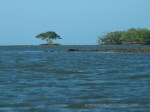
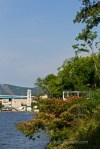
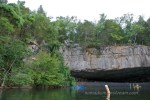
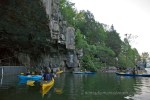
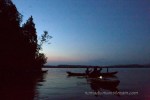
We kayaked across a small section of Nickajack lake to the entrance of the bat cave.  This is not a lair for a superhero, but rather a cave occupied by approximately 80,000 gray bats.

We sat in our kayaks near the fence that keeps people from getting too close to these endangered mammals.  While we waited, we learned that the gray bat is not just important for mosquito control (one of the reasons I adore bats), but that it’s also a major pollinator.  The fact that it’s endangered has vast implications for our ecosystem.

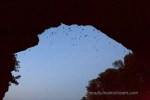
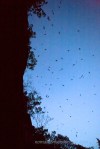
As the sun dropped, a whir started deep within the cave.  After a while, there were so many bats flying out of the cave, it was like a blur of black motion rising from the opening and heading into the woods.

When we looked against the still-light sky, we could see hundreds of them darting around above our heads, collecting the insects around us.

It took at least 20 minutes, maybe 30, for all the bats to exit the cave.  We sat in awe, watching until our necks ached.  Then, we paddled back in the dark, each with a single light on our kayak.

As we arrived back at the launch, the crescent moon sank towards the horizon, setting very early (or late).  It loomed larger as it approached the horizon, beginning to take on a golden cast.

We sighed and said out loud what a nice way it was to spend a Saturday evening. I wasn’t wearing a single stitch of cotton.

Fourscore

Fourscore years ago, Rock City was created.  80 years later, in honor of their anniversary, Rock City held a naming contest for a rescued Peregrine Falcon recuperating on their property.  The winning name was Fourscore.

Fourscore was the offspring of a mom who wasn’t mature enough to take motherhood seriously.  His more mature father took over incubating the eggs and doing the feeding.  But, as the two brothers grew, the father couldn’t keep up with their eating needs without the help of the mother.

One of the chicks died before a human intervened.  The other, Fourscore, survived, but he was too weak from underfeeding to survive on his own.  Fortunately for Fourscore, his rescuer turned him over to S.O.A.R. and Rock City for rehab.

Kept safe inside a box perched high on Lookout Mountain, the little guy gained in strength until he was well prepared to fledge for real.

Pat and I were invited to Fourscore’s launch.  It meant getting up at 4:30 AM to have time to take care of the dogs before driving up to the top of Lookout Mountain, but we were game.  I, of course, packed my backpack full of camera gear.  I wanted my 100-400mm lens to get a good shot of the falcon launching, but they were opening the box at 6:00AM–the light would be low.  Since my 70-200mm lens is faster, I figured I would have a better chance of getting something usable with the extra speed than with the extra length.

As the Eastern horizon started to show the first signs of dawn, I crouched behind a shrub while John and Dale lowered the front of the box, creating a shelf that the falcon could step out on.  I sat with my face pressed against my viewfinder, resting the lens on my knee in an attempt to hold still while we waited.  Nothing happened.

John had warned us that sometimes it can take a couple of hours for a bird to fly when released after being rehabbed.  We waited.

I realized I could not possibly keep my face pressed up against my camera for two hours.  I was getting a cramp in the muscles I use to close my left eye.  I pulled back and started to relax my arms, which were also cramping.  Then I realized we’d only been waiting about 3 minutes.

This was not the first time I questioned my desire to shoot wildlife.

Then, just as I was about to stretch my wrists, there was a noise.  I got back into position as quickly as I could, but I missed.  I managed to catch a dark silhouette against the sky when Fourscore circled back around and flew for the woods.  Not exactly what I was hoping for.

We spent the next half hour with John wielding an antenna to track a radio transmitter on Fourscore.  As we were about to leave, we saw him being chased by a group of swallows.  He looked like he was having a ball.


Tiger Key and the Manatee

The tiny keys that dot the Gulf Coast of the Everglades are countless.  But the ones that are big enough to land a canoe on and pitch a tent have names.  They are supposedly named after the shape of the key when viewed from the air, but I suspect Tiger Key was actually named in honor of the ferocity of the insects there.

Fortunately for us, when we climbed cautiously out of our tent on Boxing Day, the wind had kicked up and we were spared the brutal attack of the night before.  It was an enormous relief not to do battle again first thing in the morning.

It was time to return to the mainland.  We were somewhat concerned that we would not be able to find our way back having gotten so lost on our way out.  Fortunately, we were traveling via major channels most of the day.  While this made navigation easier, it greatly reduced the wildlife we saw.

By the time we were in the main channel, we got into a rhythm like we’d been paddling a canoe every day of our lives.  We laughed at a couple heading out.  They were struggling to go downstream because they were paddling against each other–the wife was literally paddling backwards.  We felt like canoe paddling champions as we dug into the water and pulled our canoe against the current.

Then, we got to the final stretch.  We could see our destination.   It was a short distance compared to the many miles we’d paddled over the last three days.  But the current was so strong that it pushed us sideways across the channel.

We spotted a small island along the way where we could land and catch our breath.  We made it to the closest end of the island.  After resting for a few minutes and saying a few choice words, we pushed off for what we thought would be our final launch.

We paddled for all we were worth, but the current pushed us back to the far end of the island we’d just left.  We’d have spent less energy walking the canoe along the shore.  Neither of us felt much like a champion paddler anymore.

We took a longer rest.  We ate a snack.  We got out of the canoe.  We stretched.  Then, we rallied and drove that canoe right across the current until we suddenly found ourselves in calm waters and could relax for the final 50 yards of our trip.

As we slowed down, a large, dark mass rose towards the surface of the water.  Pat yelled, “Manatee!”  We were so excited we nearly capsized the canoe after 3 days of remaining afloat.

As we glided closer to the slowly moving mass, we felt ourselves blush as we realized it was a mass of algae.  No manatees in sight.

Despite the disappointment, we really felt like we’d done something when we beached the canoe for the final time.  It was the best Christmas ever.

Jumping the Moat

Continued from Lost and Found.

Christmas morning we woke up early and laid there in the dark, realizing we could no longer hear the Gulf slapping the banks of our tiny island.  Even when we held our breath, we couldn’t hear the waves.

When at last dawn lightened the sky, we decided to get up and get an early start in our canoe.  We had about 8 miles of paddling in store for us and we were already sore from paddling yesterday.

When we stepped out of the tent, we discovered our tiny island had become a giant island at low tide.  Actually, it was still a tiny island, but now it was surrounded by a giant moat.  The Gulf was suddenly so far away, it was almost unbelievable last night we were worried our canoe would get washed away by high tide.

We ate breakfast slowly.  We walked around the island and watched the sunrise.  We packed up our campsite.  We loaded up the canoe.  All the while, the water was slowly rising, coming closer, but it still looked hopelessly far away.

Having nothing left to do, we sat and waited.  But then, the wind died and we were sitting ducks for biting insects.  We were suddenly motivated to find a way across the moat, dragon or not.

We slid our canoe along the murky shore while we walked as far as we could on dry land.  We found that the opposite end of the island was closer to deep water than our end, so we edged our way through thick mangroves until we finally stepped into the muck and pushed our canoe and gear through the shallows until there was enough water that we could get in and paddle away.  We were itchy with drying muck as we paddled off into the sun.

We hadn’t been out too long when we saw a strange line of evenly spaced white dots stretched across the horizon.  As the dots got larger, we realized it was a large group of American White Pelicans flying in precise formation, sweeping the surface in search of prey.  They flew to a shoal where a huge conglomeration of pelicans gathered.  That might have been the best Christmas present ever.

When we stopped for lunch somewhere between Rabbit Key and Tiger Key, we discovered a family of Osprey.  The young were nearly the size of their parents and angrily demanded to be fed while their parents seemed to argue that it was time for them to leave their nest.

We arrived at Tiger Key without any navigational hiccups.  But the wind soon died and we discovered “no-see-ums.”  I tried a trick someone told us–smearing baby oil on my exposed skin.  I ended up looking like human fly paper and they still bit me–my skin looked like a basketball.

Thankfully, we managed to keep the bugs out of the tent and fell asleep with smiles on our faces, dreaming of Osprey and Pelicans.

See Ya Later

Nearly a week into our 2008 Christmas road trip, we made it to Everglades City, Florida.  We were looking forward to 3 days of canoeing and camping along the Gulf Coast.  But, the day we arrived, we decided just to enjoy the surroundings and spend the night comfortably in a local bed and breakfast (who also happened to rent canoes).

Before we could really enjoy ourselves, we decided to head to the local grocery store and stock up on supplies for our camping trip.  This did not take long because the local grocery store was about the size of a large convenience store at a gas station.  There was very little selection and only one brand of anything they carried.  This had the advantage of making decisions very easy.  Do you want bottled water?  1 liter or 2 gallons?  Do you want beef jerky?  Oh, they’re buy 3 get one free.  Do you want granola bars?  1 box or 2?  I love easy decisions!

On the way back to the hotel, we discovered a roadside park with a lovely swamp occupied by so much wildlife, at first I thought it was a zoo.  I couldn’t get over the birds.  If all birds were that big, birding would be so much easier!

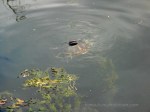
The Cormorants stood around drying their wings.  The Little Blue Heron posed while stalking fish.  And the Anhinga, well, they were the most amazing of all.  I saw a stick poking up through the surface of the water and suddenly realized it wasn’t a stick at all!  It was the beak of an Anhinga who was walking along the bottom of the pond with its beak sticking up through the surface like a breathing tube.  I don’t know if it was really breathing, but I was blown away by the scuba diving bird!

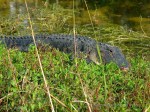
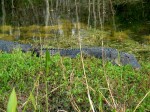
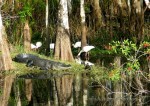
If the birds weren’t enough, the alligators added a whole new level of excitement.  While you can’t tell from the photos, there was a fence between the closest alligators and us.  Although, it was a fence they could have run around to get to us.  I’ve heard alligators are pretty fast, but Pat kept an eye on the gators to make sure none were sneaking up behind me when I was looking at his brother.  You have to respect any animal that has been around for as many millennium as the alligator.  They reek of ancientness.

Amazed, loaded with images, and stocked with food for our trip, we decided to try a local restaurant that was recommended to us by the bed and breakfast.  It was one of those hyper casual places that served on picnic tables with paper plates.  But I had the best salad I’ve ever had in my life there–the greens, herbs, and flowers (yes flowers) were all grown in the restaurant’s own garden.  Just writing about it makes me want to return just to have another one of those salads.

It was a great way to prepare for our canoeing adventure.

Swamp or Park?

When I planned our route and where we would stop on our way to the Everglades and Key West back in 2008, I picked some places on the map I had never been to, including Congaree National Park.  When I googled it, I discovered that it had, until recently, been called Congaree National Swamp.  I guess I can understand why someone might think Congaree National Park was a better name.  After all, how many people think pleasant thoughts when they think of a swamp?

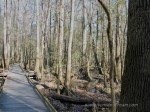
It only made me more curious to see it, however.  As we started down the very fancy boardwalk that kept less enthusiastic hikers’ feet dry, we spotted several woodpeckers and a couple of warblers in about 5 minutes.

We continued well beyond the boardwalk and onto the trails for those with waterproof boots.  As we walked, a Barred Owl called over and over, completely oblivious to the fact it was 2 o’clock in the afternoon.  We heard a Pileated Woodpecker and saw it fly.  We followed it as long as the trail allowed, but I never did get a shot of it.  Of course, still toting my Powershot G3 that trip, I’m not sure how much of a shot I would have gotten anyway.

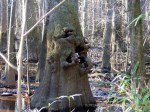
We continued along to a beautiful stream with giant swamp trees growing along the banks.  I assume they were Cyprus–the number of knees that threatened impalement to anyone who dared to trip was overwhelming.  I expected to see a few knees popping up here and there–the fact that acres of swamp were nothing but knees was quite a surprise to me.

But the biggest surprise was when we heard some rustling in the underbrush as we approached a darkly shadowed part of the woods.  We paused and looked at each other, unsure of what we were hearing.  Then, suddenly, several boar jumped up from their cover and went squealing off through the woods.

While I generally seem to lack the appropriate level of fear of wild animals, I have to admit that I definitely jumped when those pigs ran off through the woods.  Although I was disappointed I didn’t get a picture, I preferred missing the shot over having them run towards me.

At the time, I didn’t know that wild board were supposedly introduced here in the 16th century for hunting.  Who knew that the boar would go nuts and start taking over?  The amount of damage they can do is pretty frightening.  I don’t mean just to humans (although that’s frightening too) but to land, farms, and ecosystems in general.

I was a lot less excited about our wild boar encounter when I learned just how common they had become in the region and what a problem they are.  Much more recently, I discovered there’s a reality TV show about boar hunters.  Like most of the reality TV shows I’ve heard about, that just seems wrong.

In spite of the boar, I highly recommend hiking in the Congaree.

The Last Mimosa

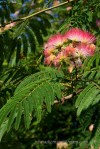
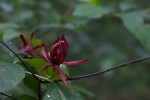
I’m saddened to learn that the Mimosa tree is an invasive tree from Asia that doesn’t belong here.  In fact, the Tennessee Exotic Pest Council ranks it as a severe threat.  This makes me sad because I was really enjoying the blossoms, but I feel strongly that invasive plant species need to be removed from non-native habitats.  Now I feel like a traitor–aggrandizing the enemy.

But, I can’t help but indulge my irresponsible self one last time before I turn my back on the Mimosa tree (don’t worry, I’m sure I’ll continue to indulge in the beverage on the rare occasions the opportunity presents itself–too bad it’s not the drink that’s invasive instead of the tree).

In case you are unfamiliar with the problem of invasive species, I confess it’s a bit of a sore spot with me.  Having spent many weekends trying to remove plants that were taking over my own yard as well as the neighborhood, I know how difficult these plants are to control first hand.

In the US, we tend to plant what we think is pretty and/or is easy to grow. We fiercely defend our property rights and believe what we plant in our yard is our own business.  Unfortunately, invasive plants don’t stay on our property.  They spread through an amazing variety of means and grow quickly out of control since whatever keeps them in check in their native habitat doesn’t exist in the ecosystem they have been introduced to.

While we sometimes call native plants “weeds” because we don’t like the way they look and they grow in places we don’t want them to, these aren’t the same as invasives.  Invasive species do outright harm to an ecosystem.

As we all know (I hope), every living thing has interdependencies with other living things.  Whether it’s for shelter, food, temperature control–all of the above, no creature can exist without other creatures to support it (depending on what you call a “creature,” I guess).  Plants are a critical component of this web.

Invasive trees like the Mimosa reek havoc upon the availability of necessities by crowding out the native trees and plants that would provide them.  Because invasives didn’t evolve with the rest of the ecosystem, they fail to provide the critical (and often subtle) requirements that the native plants would provide.

This is my plea:  the next time you plant something, remember that what you plant will spread far and wide whether you know it or not.  Make a choice that everyone can live with (including wildlife) instead of just what looks good.

A chunk of our tax dollars is spent trying to control these invasive species–even if you care nothing about your ecosystem, why would you want to make a choice that will be an ongoing cost to you and the rest of the tax-paying population for generations to come?

All right, I’m off my soapbox now.  Back to taking pictures.  🙂

Native Song

Having survived the Japanese garden at Gibb’s Gardens, I moved on with my co-shooter, John, to another part of the park.  This time, we entered an area that looked like natural woods.

As much as I enjoy gardens, natural woods are still my favorite.  By “natural,” I mean woods with plants that belong there.  This is not the same as, say, a woods covered in kudzu or so overgrown with privet or honeysuckle, you can’t even see through it.

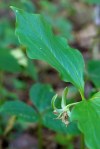
Here, the woods had only native plants and we were both tickled when John discovered a Jack-in-the-Pulpit.  Soon, we were finding more of them.

Near by, we also found some spent Trillium, Solomon’s Seal, Virginia Creeper, and the one native I don’t like to see, Poison Ivy.  I should rephrase that.  I like to see it (it is a beneficial native), but I don’t like to be anywhere near it.  I’m starting to itch just thinking about it.

As we hunted for wild flowers, a wood thrush started serenading us.  The wood thrush’s song is my favorite.  Thrushes can sing more than one note at the same time–they harmonize with themselves.  The wood thrush in particular has a haunting, flute-like song that always makes me want to stop and listen.  You can play a clip of its song here (scroll down a bit).

Although I have heard a wood thrush many times–in fact, one used to summer near our house and was my alarm clock many mornings–I have only actually seen one once.  I have never even gotten close to getting a picture of one.  This relative of the robin is reclusive by comparison.  Wood thrushes hang out in the lower story and underbrush of the woods, magically disappearing behind the tiniest of leaves.  Their brown camouflage helps them disappear, I guess.

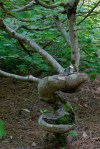
We eventually moved on from the wood thrush and made our way towards the rose gardens.  Along the way, John pointed out a tree that was growing at a nearly 90-degree angle.  He told me native americans used to train trees to grow at angles as a directional indicator towards water or other resources.  However, he felt this tree was too young to be an example of a pointer.  We never did get an explanation for it.

When we got to the base of the hill covered with roses, I was pooped.  Carrying around my 40+ pound backpack and tripod all day had wiped me out.  I suddenly realized I hadn’t had any water since 9:30AM and it was now nearly 3:30PM.  I looked up the hill and decided I really didn’t need to shoot any roses.

John, carrying less than 3 pounds of equipment including a bottle of water, was still feeling energetic enough to head on up to not only the roses, but also the day lilies at the top of the hill.  I guess that’s what a lifetime of experience shooting does for you.

Fearless and Foolish

When I returned to Yosemite with my husband in 2004, after spending a night up on Clouds Rest, we hiked over to Sunrise Lakes and spent a night there.

Sunrise Lakes consists of three lakes that are at different elevations on the mountain.  We hiked our way up to the top lake, eventually coming to an area that was a popular place to camp.  As we passed a group’s campsite, a young woman stepped out of a tent.  She told us her friends went on a day hike and she decided to stay behind and read.  After chatting for a bit, we continued on, hiking over a ridge and finding a spot to set up our own, much smaller camp.

After getting our site setup, we were about to take a dip in the lake when the girl from next door appeared.

“Uh. . . can I hang out with you guys for a little bit?” she asked.

As it turned out, there was a black bear in her campsite.  I insisted we go back and chase it away or it would never leave them alone.

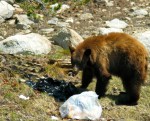
So, we returned to her site to discover a relatively small black bear (who was actually brown) had found a bag of trash that had been left in an open bear canister.

I have to take a moment to get on a soap box here.  We had never backpacked in a park where you had to use bear canisters before.  But, when we got our permit, the ranger explained to us why we needed them and how to use them.  We followed the instructions carefully.  They were simple:

  1. Anything that has a scent must go into the bear canister.
  2. Your kitchen area must be at least 50 feet from your tent
  3. Any and all leftover food, pot scrapings, wrappers, trash, etc have scent; refer to rule 1.
  4. The bear canister must be properly closed.
  5. A properly closed bear canister can be set on the ground in the kitchen area.

Although we found evidence the next morning that a bear had come through our campsite, as the rangers promised, when it discovered all the goodies were unobtainable in our canisters, it quietly moved along without even knocking over a canister.

But, back at our neighbors’ campsite, I should have been afraid of a roughly 400 pound bear with scary claws, but, he just seemed like a bigger version of our dog.  I experienced no fear.  I led the three of us as we shouted, clapped, and threw rocks.  Between throwing and clapping, I took as many photos as I could.  I can’t say I spent a lot of time on composition.

We chased the bear away, but, unfortunately, our neighbors didn’t learn their lesson.  A13 year old in the group left a container of Gatorade in her backpack and the bear harassed them all night long.

It makes me sad to think that bear may have eventually paid the ultimate price because people couldn’t follow simple instructions.

Gaslight

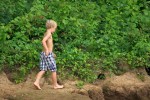
While we were on Maclellan Island, several of us got ahead of the rest of the group.  When we arrived at the meeting place to wait for our ride home, one of the women suddenly asked, “One of you doesn’t have a tow-headed boy on the island, do you?”

None of us did.  She explained that she had just seen a boy in a pair of plaid bermuda shorts on the path.

We all looked.  No boy.

A few seconds later, she said, “There he is!” We all turned to look.  No boy.

This repeated at least 3 times.  The boy was playing hide-and-seek.  The poor woman was sure we all thought she was crazy.

Eventually, we all saw him, but he immediately ran away.  We decided he was a wild boy.  Of course, I’m not sure how common it is for wild children to wear plaid bermuda shorts.

On the theme of unusual sightings, I continue to try to create photographic evidence of my white-tailed starling.  I have, over the course of the last few days, come to think of this bird as my own personal starling.

I have made a habit of taking my camera with a long lens every time I take Tisen to the park.  But having seen it 3 times when I couldn’t get a picture, I have yet to see it when I’ve had my camera at the ready.

I managed to get a few shots of other birds, including a cedar waxwing.  The cedar waxwing, like the wild boy, always plays hide-and-seek with me.  I feel fortunate to have gotten one in my frame at all even though it’s not a great image.

I also spot a very strange looking turtle.  I’ve seen one like it at the aquarium.  I guess I will have to go back to find out what it is.  It has a long neck and a pointed nose and a very long tail.  I couldn’t hold still enough without a tripod to get a good shot of it–it really is like some of the pictures of big foot you see!

This morning I slept in.  When I got up, poor Tisen had decided to let me sleep even though he couldn’t hold it anymore because of his medication.  We had quite a puddle.

I rushed outside with him feeling guilty that I was so late taking him out.  It was raining and Tisen really didn’t want to spend a lot of time in the rain, so he started heading on the short route we usually only take at night.  When we got to the parking lot, there, pecking at some trash from Krystal burger, was a group of starlings.  Sure enough, the white-tailed youth I’ve been hunting was among them!  And, as one might predict, I was there without even a cell phone.

Oh well.  At least I know it’s still hanging out in the neighborhood.