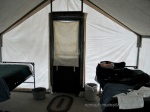
Tent Cabins

On our trip to Yosemite several years ago, we spent one night in a tent cabin at Tuolumne Meadows.  This was long before the recent scare related to the Hantavirus infection in Curry Village.  Plus, Tuolumne Meadows is a long way from Curry Village.

There are many differences between Curry Village and Tuolumne Meadows.  Curry Village is located in Yosemite Valley, where the temperature is far warmer.  It’s also the most popular part of the park, so Curry Village is larger and has more people in it.  This results in a lot more noise and a lot more bears.

It’s really hard to get that many people to comply with rules about keeping anything scented in a bear locker.  Even well-intentioned people overlook things like lost M&Ms in their cars or in pockets.  Cars parked at Curry Village are often in danger of bear raids.

By comparison, Tuolumne Meadows is cold.  It’s at a much higher altitude in a remote location above the valley, resulting in much cooler temperatures.

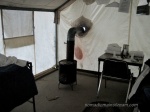
We were there in July–and it was even a warm July.  We slept in sleeping bags rated to -10 degrees.  We wore fleece, warm hats, and zipped our mummy-style bags securely around our heads to stay warm.  Thankfully, the bags were warm enough even after the fire in our tiny, inefficient wood-burning stove went out.  There is nothing about a tent cabin that is energy efficient, unlike our 2-person tent that can often get quite warm with our bodies in it.

But the advantage of the cold temperatures and more remote location is that it’s a smaller village with fewer, quieter people who tend to be more serious about hiking and more conscientious about storing their stuff properly.  There are far fewer bear encounters in Tuolumne Meadows as a result.

Another advantage was that, because of the remote location and smaller number of people, they served a really awesome hot breakfast right in the village.

The biggest challenge we faced was identifying our bear locker in the long row of lockers.  People used unique rock arrangements on the lockers to mark theirs.  We made the mistake of remembering the rock arrangement on the locker next to ours, which had changed by morning.

Anything with a scent must go in a bear locker.  This includes toothpaste, hair gel (if you happen to have brought hair gel), deodorant.  If it could possibly smell like food to a bear, into the locker it goes.

The black canisters are a portable equivalent of a bear locker–all things with scent go in one on the trail.  The Yosemite bears are so familiar with bear canisters they don’t even try to break into them if they see one that’s been properly closed.  We left extra stuff that didn’t go on the trail with us in a bear locker at the trailhead.

There was often evidence a bear had checked out our campsites, but they’d always left quietly without disturbing anything.

Biking, Birding, and Bystanding

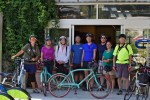
Biking and birding reminded me of several life lessons I have learned, forgotten, and learned again.  First, speed causes us to miss details.

I think back to the native prairie by the bike path back in Columbus, Ohio.  I used to ride by wondering why I didn’t see more birds.  When I went by on roller blades, I saw more birds, but was surprised I didn’t see any hummingbirds.  When I walked by, I saw hummingbirds but was surprised there weren’t any bees.  When I stood completely still, it was like a magical veil was lifted and suddenly I saw an amazingly dense array of life, buzzing and hovering and dipping among the flowers.  I am frequently reminded that sometimes, to really see the abundance of life, you have to sit still.

The second lesson was:  it probably isn’t a good idea to point out birds–even really big ones–to a bunch of people on bicycles.

When we all pulled well off to the side of the path to stop and look, everyone was able to see the differences between a Turkey Vulture and Black Vulture, and many got to see an Osprey soaring overhead with no injuries.

As I watched these birds of prey, I had to wonder if they experienced the same kind of joy in catching a thermal and soaring on the wind as I was experiencing pedaling my bike through the early autumn breeze.  Some may think that birds just do what they do for the purpose of finding food, but I have to believe there is a joy that comes from doing what you were born to do that even birds experience, particularly on a beautiful day.  I find it impossible to watch the grace of soaring raptors without being moved.

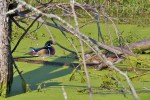
As we made our way up the Riverwalk to the Curtain Pole Road swamp area, I learned the third lesson of the day.  Sometimes, it’s not the birds that are the most interesting part of a bird walk.  One of the other participants spotted turtles and frogs.  Although the wood ducks were still my favorite (see photos from yesterday’s post), the turtles and frogs were pretty darn fascinating.  By the way, one attendee pointed out that in the last Wood Duck photo in yesterday’s post, there is a camouflaged turtle right in front of the Wood Duck.  I totally missed that!

The final lesson for the day was that we all have different levels of excitement about the same birds.  I was so excited to stand and watch the Belted Kingfishers at Amnicola Marsh.  I could have stood there all day with them swooping across the marsh, chattering away.  In the meantime, most everyone else was looking for something more interesting.

Regardless, I think we all enjoyed the outing. For me, it doesn’t get any better.  A beautiful day, a bike, a new group of interesting people to meet, some really cool birds, and my camera.  What more could anyone ask for?

Bike and Then Bird

I have been riding the Tennessee Riverwalk twice a week for a few months now.  It’s one of those places that makes me happy.  It’s just a beautiful way to wake up.  Riding along the river on the mostly quiet trail, exchanging smiles with the dozen or so pedestrians who also haunt the riverwalk just after dawn–there just isn’t a better way to start the day.

I have also been leading bird walks a couple times a month.  And, I went on a biking tour of the Chickamauga and Chattanooga National Military Park last year, which was organized by Outdoor Chattanooga.

Thus, it was only natural that, as I rode past great birding spots along the riverwalk, I would think “I should organize a bike and bird!”

Allow me to clarify for safety reasons:  I am not advocating birding while riding a bike.  That would be dangerous.  However, a bird walk is a usually a slow meander through a relatively small area with a good bird population and does not afford the opportunity to cover much distance without driving.  It seems counter-intuitive to me that we would increase the amount we drive in order to pursue an activity motivated by the desire to learn about and appreciate creatures quite dependent on an unpolluted environment.

To give credit where credit is due, a friend of mine back in Columbus, OH previously organized “eco bird walks” where all participants agreed to walk, bike, or take public transportation to the starting point and they walked from there.

So, I my idea was not exactly unique.  Regardless, I get a special pleasure out of combining activities.  I formed a plan:  Outdoor Chattanooga organizes bike tours all the time.  Why not ask them to do a bike and bird?  They have a fleet of bicycles so even people without bikes could join.  I would invite the Chattanooga chapter of TOS and the Audubon Society and we could have a lovely morning of riding and birding.  Or, to be more accurate, riding, stopping, and then birding.

And so it was.  It took a few emails and phone calls, but that was it.  Outdoor Chattanooga did the rest–and what a great group of people they are!

Finally, the Saturday selected was upon us.  I’m not sure which of the folks at Outdoor Chattanooga was in charge of arranging the weather, but they did a fabulous job.  I suppose if it would have been a little less breezy, we might have had an easier time spotting small birds among the trees, but the clear blue sky with little humidity and the cool breeze kept me smiling the entire ride.

We saw quite a few good birds, although not quite the bonanza I was hoping for.  As I told our guide from Outdoor Chattanooga, it was such a beautiful day that I would have enjoyed it even if we hadn’t seen a single bird.

Renaissance Rodents

Across the street, Renaissance Park beckons.  It calls to me with its manmade hills hiding secrets left behind by the manufacturers who occupied this park long ago.  And before that, the civil war soldiers who crossed the Tennessee here at Ross’ Landing.  And even before that, the Cherokee on their tragic walk on the Trail of Tears.

I don’t know what all was encapsulated in the mounds of Renaissance Park, but Renaissance is a good name for it.  Reborn from the pit of industrial waste it had become, it’s now a haven for birds, butterflies, the occasional deer, perhaps a fox family, and for sure coyote.

The thing is, you don’t get predators if you don’t have prey.  Fortunately, prey doesn’t care if the hills are manmade or if the wetland was created by a backhoe, or that the plants were carefully inserted into the earth by the hands of a human being.

The fact that the western hill in Renaissance is covered in native grasses and flowers means it’s a living feeder.  It feeds the American Goldfinches who love to cling to the stems of flowers that have gone to seed while they munch away.  And, underneath the foliage, it also feeds a more mysterious colony of life.

This colony becomes massive in the fall when the young have matured enough to rustle amongst the long grass on their own.  They scamper and disappear quickly enough that all I’d been able to determine is that they were rodents.  I’ve been afraid to consider the possibility that they’re rats.  Not because I’m afraid of rats but because I fear the reaction of the public to the notion of a large population of rats nesting in the park.

To me, this just makes the hillside a better feeder–it provides food for more than one link in the food chain.  But, for many, the word “rat” causes a different reaction.

When Tisen and I walked into the park a few evenings ago, these mystery creatures were showing themselves.  In fact, one sat on top of a clump of grass staring at me.  I was so caught off guard, having tried to see what they looked like for so long without success, that I barely had time to process what it looked like before it took a closer look at Tisen and decided to duck back under cover.  It looked a lot like a small brown rat.  I decided I’d better bring my camera over the next evening.

Back we went, me armed with my 70-200mm lens.  As Tisen’s tags jingled, the little critters scampered around, not holding still long enough for me to get a look, let alone a shot.  But, finally, I spotted one sitting still.  I am happy and relieved to report that it is not a rat; it’s a Meadow Vole (I think).  After all, no one ever got up in arms about exterminating a bunch of cute little voles, did they?  My favorite hawk feeder is safe.

Butterfly Business

I’m embarrassed to admit that I am capable of naming only one butterfly.  The monarch.  There are 125 butterflies found in Tennessee, according to a local chapter of butterfly enthusiasts.  I have heard of exactly 1 of them.  Yes, it’s still the Monarch.

These are the kinds of things that make me wonder what I’ve been doing all my life.  I mean really, as someone who spends as much time outdoors as I do and who particularly enjoys wildlife, how did I make it this far without realizing there were so many kinds of butterflies right outside my door?

I am trying to stick to working on birding rather than shifting over to butterflies now.  I’m a bit jealous because it seems like many of my new birding acquaintances are as good at identifying butterflies as they are at identifying birds.  I’m still working at getting good at identifying birds.  It’s been a couple decades in the making, so if I start in on butterflies, too, I will never be good at either of them.

Failing identification, I figure I can at least capture the butterflies permanently as an image.  So, I sneak up on a tiny little yellow butterfly flitting in the grass.  Apparently I am not so good at sneaking.  It flies away with a particularly aggressive flap, which I take as an expression of its disgruntlement over having its meal interrupted.

The next butterfly I chase is a red and black one.  It lands on a plant briefly, right next to a grasshopper and then immediately flies away again.  This is a great survival strategy as I am, of course, now interested in shooting the grasshopper instead of trying to chase the butterfly into tall weeds.  The grasshopper, however, is no more cooperative, just more of a tease.  It stays still just long enough for me to get it in focus and then hops just far enough away to require me to refocus.  We play this game for several minutes before Tisen gets impatient and insists we go on our way.

(Photographers note:  Do I get bonus points for not only hand-holding macro shots, but doing it while holding my dog’s leash?  I just can’t help multi-tasking.)

Next, we encounter a larger black and red type butterfly who seems content to be photographed.  I take no chances, shooting from far back, taking a step closer, refocusing, shooting again.  I work my way closer and closer until I get almost the shot I wanted.  Then, when I am so close to getting exactly what I was hoping for, my new model decides it has had enough and abandons its post.

I have similar luck with some kind of skipper (did you know there was such a thing as a skipper?) on a dark purple flower.  I’m fascinated by it’s big, fake eyes.  It doesn’t fly far, but it won’t hold still.

Once again, Tisen gets impatient with me and we head back towards home.

Fall Friends

Tisen and I have been discovering friends new and old on many of our walks of late.  The other day, for example, we crossed the street to enter the park and found Tisen’s girlfriend Twiggy out for a stroll with her mom and dad.

Twiggy wasn’t up for romance, however.  Today, her mind is all about the rampant rodent population living in the tall grasses growing on the hillside.  It’s fall, after all, and the busy critters have been breeding all summer.  Now, the entire population is fattening up for winter.  From Twiggy’s perspective, it probably seems like a buffet.

In spite of Twiggy’s amazing leaps and bounds, she comes up empty mouthed.  Tisen, however, looks at her with adoration like he can’t believe her athletic prowess and is imagining her bringing home venison for dinner.

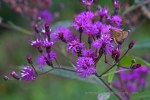
We say our goodbyes and are soon greeted by deep purple flowers that I’m going to guess are some sort of variety of fall asters, although they look far more cultivated than the wild variety that used to grow in our garden up North.

They bob and curtsy at us as our friends the Goldfinches, who are not looking so gold these days, land and depart on the dried seed pods of nearby plants.  I believe these were once our friends the purple coneflowers that have now shriveled into thin, brown mummies.  The goldfinches continue visiting them and harvesting their seed, storing it as fat for their winter coat.

I am reminded of the lateness of the season by all of this activity.  The days are shorter, the temperatures nearly tolerable, and the birds are far quieter.  I pause for a moment and listen.  A month ago, I would have heard a Titmouse, a Chickadee, a Cardinal, a Wren, a Towhee, a Robin, and an Indigo bunting in this park.  Today, all I hear are the cicadas buzzing away with their strange song.

While Twiggy may be too busy hunting to think about romance, for me, this is always the most romantic time of year.  A sense of nostalgia sets in along with the inevitable awareness of time passing that comes with it.  Another year wrapping up.  Autumn is more poignant than new year’s when it comes to reminding me of my own mortality.  In the fall, everything seems to be moving on in one way or another.  Perhaps as a nomad (at least in my imagination), I long for my own migration.

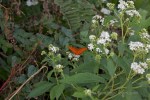
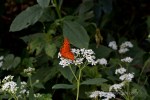
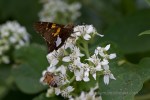
When Tisen and I encounter our next group of friends, the bees and butterflies, so dense on a brilliant white flower I don’t recognize that they’re sharing blossoms, I remember that this is migration season for the butterflies, too.  While the bees will hole up for the winter, the butterflies will take to the winds and head for warmer climates.  I look at these tiny, delicate insect-birds and wonder how they can possibly migrate a few dozen miles, let alone thousands.  One of life’s many wonders.

The iPhone is Not Enough

On Labor Day, I was hiking my way back from an overnight in the backcountry.  The next morning, I was up at 5:30AM so I could get on a plane to Orlando for a work conference at Disney World.

Because our conference hotels overflowed, I was moved to The Animal Kingdom Lodge.  Having not been inside the Disney World gates since I was 9, I didn’t know that there would be an actual animal kingdom outside my window.

Had I known, I might have figured out a way to pack my camera.

Having reduced our worldly possessions by about 80% over the course of many years and moved into a small apartment with ridiculously limited storage space, one of my greatest challenges has been not to keep acquiring more stuff that won’t fit anywhere.

I make this point because I am starting to think about getting a small, point-and-shoot camera.  Something that will do a better job than my iPhone camera.  And something I can carry backpacking without getting an ache in my neck.

Now, some might argue that I should think about trading in my iPhone 4S for a phone that has a decent built-in camera.  But, I’ve had my iPhone for less than a year and I really don’t believe there is a phone with a built-in camera that’s going to suffice.

Let’s look at the camera in the iPhone 4S. Like all built-in phone cameras, all zoom capability is digital.  By this, I mean that when you are zooming, it’s enlarging the image in software, no moving glass around to magnify the image before it is captured digitally (also known as Optical Zoom).

When you look at the images in the gallery, you can see that as you move from left to right, the buffalo get bigger and the quality of the image gets worse.  This is the same thing that happens when you enlarge a low resolution photo on your computer and the pixels get spread too far apart for the image to look good.

In comparison, when optical zoom is used, the image is magnified by the glass and then captured on the sensor at that size, so there is no loss of resolution in the image.  Maybe instead of a point-and-shoot, I just need an adapter so I can use my lenses with my iPhone?  They really exist:

http://photojojo.com/store/awesomeness/iphone-slr-mount/


But, then I’d have to carry heavy lenses plus an adapter.  Besides, that little adaptor costs $250.  I’m pretty sure I can get a really good point-and-shoot for that much money.

I started investigating MILCs (Mirrorless Interchangeable Lens Cameras), which are smaller and lighter.  I’m not ready to spend that much money on a new technology that’s step down in quality, although they do seem quite promising.

Maybe fuzzy animal pictures on work trips and an aching neck on backpacking trips will just have to do for now.

Hummingbird Band

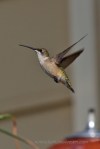
Pat and I were planning to set out for two days of backpacking on Labor Day weekend.  However, a friend asked if I would like to attend a hummingbird banding on the 1st.  It was a long weekend, so of course I decided to postpone our backpacking trip by a day so I could see hummingbirds being banded.

Who wouldn’t postpone a backpacking trip to see hummingbirds being banded?  I would have postponed all kinds of plans to see how, exactly, this works.

When we arrived at the banding location on Saturday morning, the first stop was the banding table.  The bander educated us while she banded.

The house we were at was someone’s home who happened to love hummingbirds.  They put out feeders every year like so many of us do to attract them to their home.  What was unique about this location was that it was in the middle of two ridges that created a funnel effect for migrating hummers.  So, this time of year, hundreds of hummers would stop at the feeders to fill up on their way South for the winter.  By replacing the feeders with specially designed traps that wouldn’t harm the hummers, the banders were able to capture about 35 birds before we’d even arrived, about an hour after the event started.  1 bird every two minutes is pretty impressive.

I was a bit disturbed when I was asked not to show any photos of a complete trap on the internet.  Apparently there are people in the world who think Hummingbirds would make good pets and are looking for information on how to create a trap.  If you are such a person, please be assured that you cannot keep a hummingbird as a pet and that all will be much better served if you simply feed them and let them go on their merry way.

Watching the bander handle the tiny hummers with a confidence that belied how delicate these birds really are made me wish I had the dexterity to perform such a task.  I asked her if she had started as a jewelry maker–it seemed like the appropriate skill set to me.  She laughed.  Apparently she also didn’t believe she had the dexterity to handle hummingbirds when she got started.

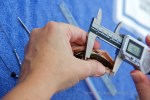
I watched her move through the measurements performed on each bird with a systematic rhythm, rarely interrupted by talking to us.  She measured each beak, each tail, each wing, used a straw to blow apart the feathers to see if there was fat, and then placed each bird on a scale.  She always banded them first.  She said that was in case they got away before she got through all the measurements.

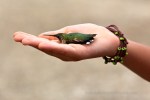
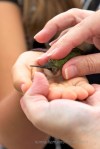
When she was done, she carefully set the bird in a waiting child’s hand and they held it until it suddenly decided it could fly and buzzed away.  Sometimes, this took several minutes.  It was fascinating to see a hummingbird hold so still.

Finding Sanctuary

I discovered tonight that I’m almost out of digital photos I haven’t used in a blog post!  Who knew a year of blogging could use up 9 years of digital photos?  I’m going to have to start searching the archives again–there have to be more photos in there!

I did discover these series of shots taken two years ago during an annual trip to Portland, Oregon.  Pat and I went to the local Audubon Society Preserve there and did a hike through their woods.

It’s an amazing property for many reasons.  First, it’s been meticulously maintained as a natural, native habitat.  Most people don’t associate “meticulous maintenance” with “natural, native habitat.”  Usually, we think of a golf course.  Unfortunately, as I know from volunteering at the Audubon Society here in Chattanooga, without ongoing hard labor to remove the invasive species that pop up every time one turns one’s head, they get out of control and turn native habitat into something completely foreign.  It’s unfortunate we humans can’t agree that invasive species shouldn’t be sold or planted.  Until we do, those of us who value preserving native ecosystems have a lot of work to do to prevent those habitats from being overrun by the rest of the population’s right to decide what to plant on their own property.  But, don’t let me get on that soapbox.

The Portland Audubon Sanctuary is a 150 acre property of dense forest, including a stand of old growth trees, a pond, and a creek that’s carved some small hills within the already hilly Portland topography.

Walking through the forest area made us think we were in the rain forests of the Olympic Peninsula of Washington state.  We didn’t see too many birds while we were hiking.  Those we did see were a tough for me to ID–somehow, even the birds that also live in the East looked different enough that I couldn’t feel confident I’d correctly identified them.

When we stopped at the lovely gazebo on the pond at the sanctuary, we discovered a group who was out watching a Northern Saw-whet Owl perched in a tree and up so high that without binoculars, it couldn’t be spotted.  Fortunately, a kind man let me look through his so I could see it, too.  It was about the size of a Screech Owl (tiny) and very adorable.

The Portland Audubon Sanctuary also boasted some spectacular fungal growths.  Between the mushrooms and the weird, coral-like growths, I didn’t mind my limited success at birding (especially since I was without binocs).

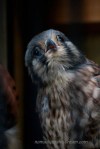
In addition to the Sanctuary, they also provide rescue services for injured birds and keep some unreleasable birds on display for educational purposes.  This mean being guaranteed to see some interesting birds even if nothing in the woods showed itself.  I particularly liked the Americal Kestrels on display.  They looked like they were making faces at me.

It’s a great place to visit and support if you’re ever in the Portland area.

Wild Things

One of my favorite past adventures was in Columbus, Ohio shortly before we moved to Tennessee.

One of the curious things about living in a place the vast majority of one’s life is the propensity to take it for granted.  For me, making friends with someone who was more connected to the Columbus scene introduced us to some experiences we would have missed completely.

These images are from one such experience.  Our friend learned of a behind-the-scenes tour available at the Columbus Zoo and organized a group of people to divide up the fee.  Even better, much of the money went to a Cheetah rescue program.

The animals we met were the animals who travel with Jack Hannah when he appears on television.  Jack himself was off at his Montana home, so we didn’t get to meet him.  I don’t think any of us felt like the experience was diminished by his absence; after all, it’s the animals who are the stars.

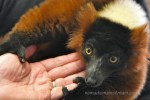
What was so cool about the experience is that these are animals who are used to educate people about endangered species and who have been handled enough to be touchable.  How often do you get to go to the zoo and pet a Lemur or cradle a baby Wallaby?

There are two things about the program I particularly like.  First, they are very serious about trying to save the extremely endangered Cheetah.  Not only do they operate a breeding program, but they also use the funds raised to donate Anatolian Shepherds to farmers where Cheetahs are still wild.  The Anatolian Shepherds protect the farmers’ flocks from the Cheetahs and, inversely, protect the Cheetahs from being shot by the farmers.  It’s a novel approach to solving a root cause that’s win-win.

At the Columbus Zoo, you can buy a children’s book about an Anatolian Shepherd raised with a Cheetah and those funds go to help save the Cheetahs too.  This is a somewhat ironic twist on the plot.  At the Columbus Zoo, instead of scaring the Cheetahs, the dogs provide comfort and confidence to otherwise skittish cats.  I don’t recall the story of what made them decide to raise the first cheetah-dog pair, but the result was a happier cheetah, so they have been raising puppies with the captive cheetahs ever since.

The puppy friend we met along with the cheetah babies there that day was a frisky yellow lab who didn’t seem to quite understand his place in the food chain next to his best friends.

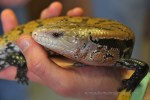
The second part of the program I particularly liked was the number of rescues who were part of it.  The tortoise, the puppy, and the Python were all rescued critters.  In the case of the tortoise and the python, the Humane Society wasn’t equipped to deal with them.  The python had been released in a Columbus Metro Park and was at risk of freezing to death when it was rescued.  What a beautiful snake it is!