Ravine Critters

I swear there is a mouse in this photo

I swear there is a mouse in this photo

Sometimes when you go for a walk, even if it’s in a relatively familiar place, you end up seeing something you’ve never seen before.  Gina and I took a short walk to a ravine at the end of her street.  The ravine has a lovely little park in it, complete with an arched bridge over a large creek.  Given that it was one of the first sunny, warm days of the season, the park was fully of people.

A little bit more of our white-footed friend is showing in this one, but not much

A little bit more of our white-footed friend is showing in this one, but not much

We were there to do a little practice portrait shooting.  As we wandered around looking for a good spot, we saw a group of tables set up under an overpass where the creek flows under a major roadway and continues its course downhill towards the nearest river.

Under this overpass, about 5-6 naturalist-looking people wearing naturalist-like attire had a bunch of critters they had collected on display, along with a microscope and some  other types of collections that weren’t moving.  I wasn’t well equipped for shooting these critters, but I did the best I could given they were in glass containers and I was shooting with my 70-200mm lens.

I forget what this was, but I think it's some kind of salamander

I forget what this was, but I think it’s some kind of salamander

Having to stand back when shooting through glass is a major disadvantage.  The smudges and reflections on the glass show up quite a bit more than I would like.  But, to be honest, I didn’t take these images with the expectation that they would win any photography awards.  It’s just pretty darn interesting to learn what critters are crawling all around us that we’re mostly oblivious to.

We were introduced first to a white-footed mouse.  The mouse ran out and posed for us just long enough for me to get my lens cap off and my camera turned on.  Then, he ran back under the leaves in his cage, rolled up in a ball, and promptly fell asleep.  I tried shooting from several angles, but all I could get was a spot of brown fur amongst brown leaves.  Trust me.  He was really cute.

One of the most frightening creatures in the mid-west:  the Wolf Spider

One of the most frightening creatures in the mid-west: the Wolf Spider

The group had also collected a snake and a couple of spiders.  While I am a fan of snakes, I have a bit of a problem with spiders.  I love spiders and their contribution to the balance of the ecosystem.  I particularly love their webs.  However, I love both their webs and them a lot more when they are not on the same side of a window as I am

I appreciated when the ladies holding the spiders for us decided to put them back in their containers–I would never have shot them when they were running around outside the containers, I was too busy jumping.
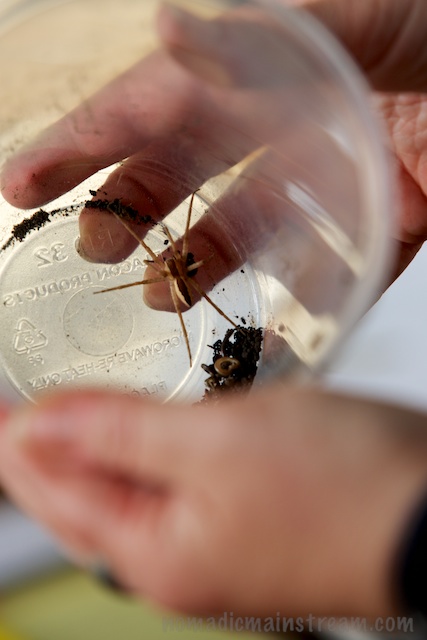
I was too nervous to remember what kind of spider this was

I was too nervous to remember what kind of spider this was

When we asked the group what they were doing, they told us they were both trying to get people interested in the flora and fauna in the ravine and getting a baseline of what was there so that as they work to restore the native habitat, they can see how many more species start appearing.

My baby boy in a blur--I'm so happy he rejoined me

My baby boy in a blur–I’m so happy he rejoined me

Chatter

Jerry, an Eastern Screech Owl, Hipstamatized

Jerry, an Eastern Screech Owl, Hipstamatized

After spending a good hour or so entertaining a small crowd at the Little Owl Festival, the crowd began to thin out.  A handful or so hung around, petting Jerry the Screech Owl and asking the questions that didn’t get answered during the program.  A few stragglers wandered over in time to get a chance to see the birds.

In this moment of relative quiet, Paul with Artie, I with Gilbert, and Megan with Jerry lined up for a photo op.  We lined up in this order because Artie has a way of making Jerry nervous–in the wild, Jerry would be prey for Artie.

Gilbert suddenly started a shrill alarm call, looking around frantically.  One of the remaining fans spotted a Coopers Hawk in the woods.  It took several minutes of pointing and moving about for the half dozen or so humans hanging about to spot the hawk.  Gilbert had spotted his mortal enemy without so much as turning his head.  I remain bewildered as to how he noticed the hawk slip into the woods 500 yards away.

At the same time, Gilbert doesn’t have the same reaction to a Barred Owl sitting 3 feet away.  With me and Gilbert between Jerry, a tiny Screech Owl, and Artie, all would have been quiet were it not for the Coopers Hawk in the woods.

Lining up so Jerry can't see Artie

Lining up so Jerry can’t see Artie

Pat managed to get a series of shots in any case.  In the meantime, the last remnants of the crowd faded off to the next act, leaving us to pack up the birds and call it a day.  Pat and Dale had a face-off with the cameras before we went our separate ways.

Dale wins in the camera battle with her polka-dotted case

Dale wins in the camera battle with her polka-dotted case

I walked across the field back to our car feeling high.  I stopped to visit with the Audubon folks at the tent selling tickets and couldn’t stop smiling about how much fun it had been to share the birds with the audience.  I think they might have been jealous.

We loaded into the mini-van and headed down the road talking about where we should have lunch.  As we rounded a curve through the wooded neighborhood that surrounds Audubon Acres, we spotted a huge flock of wild turkeys, with what appeared to be a dozen toms strutting about displaying their plumage, competing for the attention of the hens.

I, of course, called to Pat to stop the van as I grabbed the camera, hopped out of the car, and tried my best to get a shot without scaring them off.  Wild turkeys are not very cooperative, I’ve found.  They look perfectly content to hang out in the open like they own the world and there are no predators they have to worry about until the moment someone shows up with a camera.  Then they seem to rapidly disappear.

My 24-70mm lens was no match for the distance the turkeys were able to cover in the time it took me to get lined up.  But, we enjoyed their show none-the-less.

Wild turkey toms doing their best to attract a mate

Wild turkey toms doing their best to attract a mate


Cayce Rocks the House

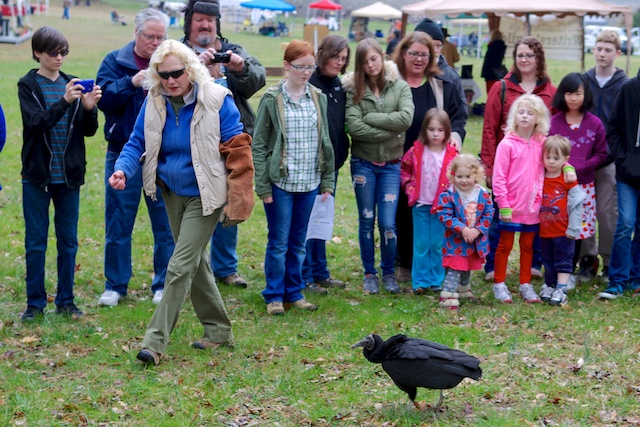
Cayce follows Dale around much like a faithful dog

Cayce follows Dale around much like a faithful dog

Cayce is my favorite vulture.  Is it normal to have a favorite vulture?

Normal or not, I suspect anyone who has ever met Cayce falls into the same camp–Cayce is their favorite vulture.  Of course, for most people, there’s a high probability that Cayce is the only vulture they’ve ever seen (or at least realized they’ve seen).

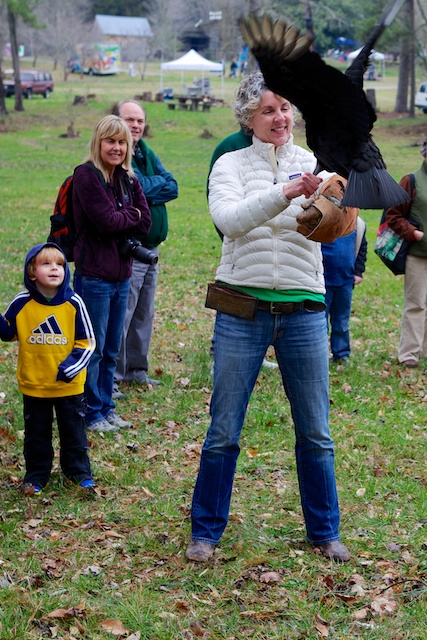
Cayce hops to my glove in exchange for a piece of beef

Cayce hops to my glove in exchange for a piece of beef

This reminds me of when Pat and I went on a tour of Taliesin West (Frank Lloyd Wright’s Arizona-based school of architecture) and the tour guide told us that on almost every tour someone says, “Frank Lloyd Wright is my favorite architect.”  He said he always has to stop himself from asking who their second-favorite architect is–he’s pretty sure most people who say this can’t name a second architect.

Sometimes Cayce prefers to hop from glove to ground, run, and then hop up to the next glove--it's pretty funny the way she hops

Sometimes Cayce prefers to hop from glove to ground, run, and then hop up to the next glove–it’s pretty funny the way she hops

Like Wright, Cayce has the advantage that vultures (and apparently architects) don’t usually become household names.  However, unlike the stories we heard about Wright, Cayce has an irresistible personality.

Dale spends a few minutes setting the stage by telling the audience about vultures, their role in preventing the spread of disease and their importance to the environment.  Then she explains how Cayce was erroneously rescued and became a human imprint.

The young lady celebrated her birthday holding a vulture

The young lady celebrated her birthday holding a vulture

When everyone is wondering what it’s going to be like to see a Black Vulture up close, Dale calls “Here’s Cayce!”  and I open Cayce’s travel crate.  Cayce comes charging out and starts looking around like she’s trying to get oriented.  I toss a small piece of beef towards the center of the circle formed by the audience and Cayce runs front and center.  Once she sees Dale, she is good to go.

Cayce heads back to my glove having just passed over the heads of the surprised audience

Cayce heads back to my glove having just passed over the heads of the surprised audience

As Dale continues to tell the small audience about Cayce, she walks along the circle of spectators with Cayce following at her heels.  It’s pretty clear that Cayce would follow Dale anywhere.

Usually, when the birds are going to fly during a program, they get their breakfast during the show, flying for their meal.  This both keeps them properly fed and motivated to fly.  However, on this day, Dale forgot and fed Cayce her full breakfast.  Often, a bird of prey won’t fly if it isn’t hungry–after all, their instinct is to expend energy flying purely for the purpose of seeking food.

Fortunately for us, Cayce loves to please a crowd.  In spite of her full stomach, she launched perfectly several times, buzzing the heads of the audience.  Everyone ducked as Cayce barely clearer their foreheads–her feathers brushed back the hair of one taller gentleman.  This is always a crowd pleaser.

The second time Cayce buzzes the audience, they are a little better prepared and start to duck early

The second time Cayce buzzes the audience, they are a little better prepared and start to duck early

One of the reasons an unreleasable vulture makes a great entertainer is because, unlike Cayce’s raptor relatives, vultures don’t have talons.  Their feet more closely resemble a large chicken’s, making close fly-by’s much safer.

Of course, we humans would be happier if Cayce could live out her life in the wild.  But I doubt Cayce agrees–after all, she returned to humans after being released several times.  I think she found her calling.

Cayce comes in for a surprisingly gentle landing

Cayce comes in for a surprisingly gentle landing


*Photography credit goes to Pat, my wonderful husband who took all shots of the birds of prey program.

Huff and Puff

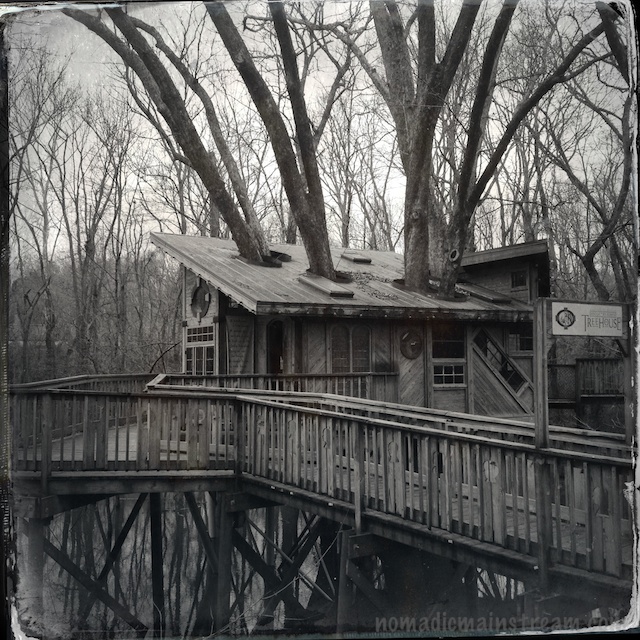
Before the treehouse, another house on stilts provided a nice subject for tintype

Last Saturday, we decided to find something interesting to do that didn’t involve too much physical effort.  I suggested we go to the Chattanooga Arboretum and Nature Center to see the Red Wolves.  The Nature Center has one of the few red wolf breeding programs.  We have been to the Nature Center a few times, but we’ve never seen the red wolves.

I decided to take my DSLR with the 70-200mm lens, figuring we’d be pretty close to the wolves in their exhibit area, but I might need to zoom in.

The treehouse with its tree coming through the roof

The treehouse with its tree coming through the roof

We took Tisen with us, although he’s not allowed in the nature center because it’s a wildlife preserve.  We figured we wouldn’t be there very long and he could hang out in the car.  Then, we’d take him somewhere he could get out and romp around a bit.

I put my DSLR around my neck, my iPhone in my pocket, and grabbed my wallet when we arrived.  We headed into the visitor’s center where we learned it would cost $10 each for our 20 minute visit to see the red wolves.  We decided to buy an annual family membership–it was a much better deal.

We headed down the boardwalk towards the Wildlife Wanderland exhibit.  Along the way, we discovered a really cool treehouse on stilts in a wetland.  Of course, my 70-200mm lens was too tight to get a good shot.  So, there I was, standing on the boardwalk with my expensive gear hanging around my neck while I used my iPhone to take Hipstamatic shots of the treehouse.  It reminded me of a photo someone shared on Facebook of a professional photographer standing on a sidewalk with 3 cameras, extra lenses, and various other equipment hanging off of him holding up his iPhone to take a picture.

The treehouse at the end of the boardwalk

The treehouse at the end of the boardwalk

The treehouse made a good subject for the tintype effect because of its setting.  But the contemporary angles of the roof, like the Tennessee Aquarium in earlier posts, create an anachronism in this old-fashioned style.

After exploring the treehouse, we moved on down the boardwalk to the canoe launch.  That was truly modern.  They have a dock that has a mini-canal in the middle of it to make it easier to get in and out of the canoe.  They also have a rack full of canoes–we’ll have to give those a try when the weather gets warmer.

Up close look at the crazy angles of the treehouse--love the diagonal window

Up close look at the crazy angles of the treehouse–love the diagonal window

Next stop: red wolves.  When we got to the junction leading to the Wildlife Wanderland, there was a chain across it with a “closed” sign hanging from it.  I guess we’ll have to take advantage of our new membership to see the red wolves–at least we won’t have to pay $20 every time.

When we returned to the car, Tisen was barking.  This is rare.  Usually he sits in the front seat and looks out the window quietly.  I’m not sure what got him barking, but he was happy to see us.

Tisen the cuddly wonder

Tisen the cuddly wonder

Otters and Smiles

This playful otter had quite a routine established--he used every inch of his tank that simulated a rushing river

This playful otter had quite a routine established–he used every inch of his tank that simulated a rushing river

There are certain things in life that make it impossible not to smile.  A toddler laughing.  A dog wagging like mad.  An amazing sunset.  And otters.

Who can possibly watch otters at play without smiling?

The Tennessee Aquarium has otters in their River Journey display.  I have been to the aquarium at least a dozen times in the past year and a half.  The otters have always been sleeping.  Otters sleeping are cute, but not quite so provocative of a smile as when they’re playing.  Discovering they were wide awake and having a ball on our recent visit with friends was quite a joy for me.

One might think the otter needed a rest, but he really was looking for a diving board

One might think the otter needed a rest, but he really was looking for a diving board

The Otter takes a spinning leap as he makes a dramatic dive back into the water

The Otter takes a spinning leap as he makes a dramatic dive back into the water

This might have been a great time to switch over to the video mode on my camera.  But, alas, I keep forgetting it will shoot video.  So, I have created a video from a series of rapid fire stills instead.  I didn’t actually shoot with the intention of making a video, so there are gaps.  The biggest gap is that I missed when they were swimming upside down.  How is it that otters can swim upside down as easily as right side up?   According to the National Geographic website, they can close their ears and noses.  I imagine that would be a big advantage during graceful rolls and swirls through the water.

The first time I thought I saw a river otter in the wild was in Colorado.  As it turned out, it was a beaver.  When it smacked its flat tail against the water at us, I realized my mistake.  In retrospect, a sea otter would be closer to the size of a beaver than a river otter, so I really should have known it was a beaver.  Seeing a beaver was pretty exciting, but I’ve always wanted to see wild otters at play.  So far, the closest I’ve come is when we saw river otters in a mountain lake near Mt. Hood in Oregon last fall.  They were fun to watch, but we were a bit far away to get to see much besides their heads when they would pop back to the surface after diving for fish.

The only pair of wild river otters I've ever seen taking a break from fishing in Oregon

The only pair of wild river otters I’ve ever seen taking a break from fishing in Oregon

River Otters are one of the many creatures I envy.  They are perfectly equipped for their lifestyle.  They have all the special features they need to not just survive through cold winters and hot summers, but to thrive in them.  They embrace their lifestyle with verve and frolic through life.

Of course, there are downsides.  For one, they are apparently very vulnerable to environmental pollutants.  For another, that warm, waterproof coat is something humans want to have.  They had disappeared from much of the country as a result.  Fortunately, through reintroduction and habitat management, they’ve made quite the comeback and are even considered a nuisance in some localized areas.  However, there are still many parts of the country that have very few river otters.  These must be the parts of the country I usually go hiking in.  I keep hoping, though.


Raised Hands

Today’s photos provided by my guest photographer and husband, Pat.

Today, I did a volunteer gig instead of eating lunch.  The company I work for provided a grant to fund taking an educational program using birds of prey to underfunded schools that can’t afford special programs.  I’m psyched about having the opportunity to work with both the kids and the birds.

But, when I arrived at the school, I got a text message from one my best friends in the world, Gina.  She was having a bad day.  Her text to me was representative of something I feel all the time.  It was along the lines of “I feel invisible.”  Dismissed, unheard, unimportant, irrelevant.

These are the words that describe the worst feelings any person who regards herself as a valuable asset in the workplace can have, except maybe fired.  But, I suspect it’s the fear of being fired and what that represents to us that makes these feelings so difficult to deal with.  We all want to feel indispensable.  Invisible and indispensable don’t work in the same sentence (except, of course, this one).

I returned from vacation vaguely disappointed that the entire company didn’t come to a halt while I was gone.  It hurts my ego to realize the company didn’t even skip a beat.

But there I was, about to meet two 3rd grade classes with a bunch of birds and I’m getting this text that reminds me about my own fears of inadequacy in a corporate, adult world that often feels foreign to me.

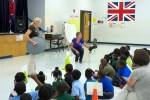
I set my phone aside and focus on the event at hand.  The 3rd graders file in and the program begins.  The children are fascinated.  They smile, laugh, and look amazed.  Not mildly interested and politely faking amazement.  No, they ARE amazed.  And I don’t mean that in the over-used, can’t-think-of-a-better-word sort of amazed.  I mean they were surprised and delighted that something so wondrous as the opportunity to pet a Screech Owl and feed a Black Vulture was happening to them.

And then, they start raising their hands.  They want to be called on.  As each takes their turn, it becomes evident they often don’t know the answer to the question they volunteered to answer or they don’t actually have a question even though that’s why they were supposedly raising their hand.

I had the sudden realization that these were children who feared invisibility.  They raised their hands not because they had something to say but because they didn’t want to disappear in the crowd of their peers or the rules of their teachers who seemed to largely focus on making sure they behaved.

Behaving seemed to be an act of making oneself invisible.  But raising your hand, speaking out, those are acceptable actions that allow you to stand alone and be recognized.  A statement of being worthwhile, important, relevant, and noticeable.

It all suddenly seemed so simple–it’s all about raising your hand.

Shooting Elk

I really enjoy wildlife.  The more wild, the better (well, until I start to look like dinner).  I get a bigger thrill out of seeing a deer in the park than I do at the zoo.  I get an even bigger thrill seeing a deer in the backwoods than I do at a park.  The more remote an area, the bigger the thrill.

Elk are more exciting than deer proportional to their weight.  I think there’s probably an algorithm out there that someone has developed to calculate the level of excitement any given creature produces based on their size, elusiveness, rarity, and number of people they encounter in an average year.

Seeing an elk is more exciting both because it’s bigger and because it’s more rare.  At least for someone who’s lived East of the Mississippi for most of her life it’s more rare.  Where elk can be found in the East, they have been recently reintroduced.  They wear large tags around their necks that I suspect say things like “My name is Leroy.”

I don’t know why they look less wild than their relatives in the West, but they do.  Even though it’s more likely that you’ll run into an Elk while cruising down a highway in the Canadian Rockies than in Great Smokey National Park, when you see the Elk in Great Smokey National Park, you’ll swear it’s one of the ranger’s pets.  The “more rare = more wild” equation just doesn’t hold true in the East.

What all this adds up to is an inappropriate level of excitement about seeing a bunch of elk who live about an hour from Portland.  I thought we would have the best chance of seeing the Elk at dusk, so we stopped on our way back from Astoria at the Jewell Meadows Wildlife Preserve.  Granted, the website told us that the best time to see the elk was between November and April, but since we weren’t planning to be in Oregon between November and April, we figured we’d better take our chances.  Besides, it was pretty much on the way back to my dad’s.

We did not get to see the full herd of 200 elk, but we did get to see a couple dozen elk from a distance.  I thought they would be roaming around grazing a bit more than they were–I guess they go to bed earlier on the coast.

For about the thousandth time during our trip I wished I had a lens longer than 400mm.   I shot the elk anyway, hoping the resolution of my camera would be enough to allow me to crop the heck out of the photos.  Unfortunately, the photos didn’t withstand the crop.  Between the motion of me hand-holding the camera and the motion of the elk, the images are just not sharp enough.

Regardless, I’m still glad we stopped to shoot the elk.  I’m also glad I was shooting with a camera.  🙂

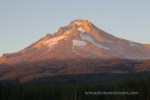
Mt Hood and the Mighty Ducks

If the Tualatin River Wildlife Preserve wasn’t enough for one day, taking a drive up to Trillium Lake by Mt Hood sure did top it off nicely.  Trillium lake has a lovely two-mile trail  around it and we were promised a great view of Mt Hood by the internet, which is always right.

We decided to get there a couple hours before sunset so we’d have plenty of time to walk the two miles and pick out the perfect spot to shoot Mt Hood as the light changed.

We didn’t get there two hours ahead of sunset.  In fact, by the time we parked and were walking to the lake, sunset was about 45 minutes away.

Thankfully, the best view of Mt Hood was about a 5 minute walk from the car.  In fact, they built a deck there and put some benches on it so we could be comfortable while we watched the sunset.

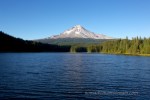
Instead of sitting and relaxing, I got busy setting up the tripod I’d borrowed from my father and getting my camera ready to go.  Moving quickly kept me warm–even with my many layers (a light fleece plus a leather jacket plus a huge, thick fleece borrowed from my dad), it wasn’t exactly toasty.  The wind was whipping up a pretty good froth on the lake, meaning there were no glass-like reflections to be had of Mt Hood.  But, it was still beautiful.

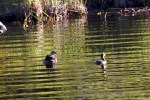
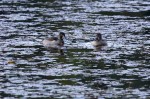
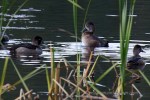
And, sunset took long enough that we had time to take a break from shooting the mountain to walk part way around to get up close enough to identify some ducks that eluded me.

After looking at them through binoculars, shooting them with a 400mm lens, and after enlarging the images to look closely at them, I’m pretty sure the little ones are Pie-billed Grebes and the larger ones are Ring-necked Ducks.  I feel more certain about the Pie-billed Grebes than I do about the Ring-necked Ducks.  They were fun to watch in any case.

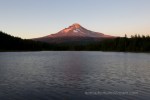
We returned to the deck so I could shoot as the sun faded.  The light turned amber and the mountain shifted from gray rock to glowing orange.  The trees below timber line moved from green to purple on the color wheel.  It’s almost hard to believe I didn’t change the tint or white balance between the early and late shots, but the sun did all that for me.

I kept hoping the wind would die and let me get one good shot of the mountain reflected on smooth water, but the wind only got stronger and I only got colder.  About the time we were going to call it quits, we spotted two otters making their way towards us across the lake.  This was the first time I’d seen wild otters anywhere other than the ocean.

Pie-billed grebes, check.  Ring-necked ducks, check.  River otters, check.  Mt Hood at sunset, check.  Definitely time to call it a day.

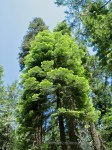
Quiet Giants

Even as a dedicated tree hugger, I never thought going to stare at trees was particularly exciting. Arboretums, for example, fail to move me.

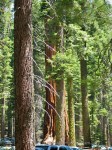
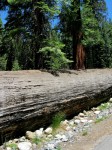
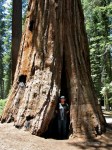
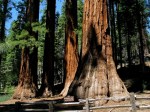
But, several years ago, after 6 days of backpacking in Yosemite, it was a nice respite to head to Mariposa Grove and see the giant sequoia there.

In the same inexplicable way in which the mountains evoke a quietude, these giant trees spoke to me like individual mountains standing amongst a forest of tiny hills. They are the largest living things on the planet by volume.

I once read a historical novel about the settlers of the Pacific northwest in the 1800’s. In that book, they had an intense hatred of trees. The trees stood between them and fertile farmland, sustenance, and shelter.

When I saw the sequoia looming down, as they had in some cases for over 3000 years, among some of the world’s oldest living creatures, I found myself wondering what the early settlers thought of these giants. The Sequoia survived in part because they were fire resistant, bug resistant, rot resistant, and not particularly useful for building anything.

The settlers couldn’t burn them–in fact, fires are quite helpful in promoting Sequoia reproduction and over-controlling forest fires led to a demise in their population.

Their seed cones are tiny pods that pop open and spread seeds when properly dried. The heat of fire, which has the additional benefit of clearing out most of the Sequoias’ competitors, dry out the cones and allow the seeds to disperse.

The Chickaree squirrel can also help disperse sequoia seeds. This little guy will eat sequoia cones and help spread the seeds in part by storing the cones.

Luckily for both the sequoia and the Chickaree in Mariposa Grove, controlled burns are helping to restore the natural ecosystem of the area, encouraging new generations of giant sequoia trees.

The famous “California Tunnel Tree” in the middle of the park probably serves as the best representation of how the early settlers felt about these giant trees. They cut a big hole through the middle of a tree wide enough to drive a wagon and a team of horses through it. Not exactly a sign that they had a sense of awe and wonder about the trees. Seems more like a Graceland tourist trap than a healthy respect for the diversity of life.

In any case, we are all fortunate that Galen Clark did come along with a healthy respect. He saw the testament to grace these trees represented and managed to preserve them.

I imagine life from the trees’ perspective, in which thing move at a pace proportional to a 3000+ year life expectancy. I imagine what a tree “sees” in the course of 3000 years as the make up of the air, the water, and even the very soil at its feet shifts and changes. I wonder if the older trees complain about kids these days or if evolution occurs at an altogether different pace?

Visitors at the Visitor’s Center

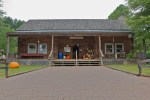
Last Saturday, I watched the visitor’s center at Audubon Acres from 9AM-1PM.  It’s one of those volunteer jobs I don’t mind doing, but the visitor’s center isn’t often a busy place.

I guess it’s helpful for a volunteer to be there to deal with visitors who stop by so the various other folks who might be there can work on projects uninterrupted.  The property manager was off running an activity, which was a tour of a wetland at the local VW factory.  I was covered the front desk until he got back.

After taking advantage of the quiet to finish up some work of my own, I got out my camera.  I took the cordless phone with me, staying close enough that I could get back inside before a visitor could pull in, park, and walk in.

Someone had spent quite a bit of time decorating the front of the center for halloween.  They had found or grown giant pumpkins and strategically placed them in front of the center to make it look like a pumpkin patch.  I’ve never seen such large pumpkins.  I thought they were fake until I knocked on them.

A Brown Thrasher perched in the open across the parking lot from the center.  I, of course, couldn’t resist crossing to the other side to see if I could get a shot of him.  Brown Thrashers are amazing teases.  I believe they instinctively recognize a camera even if they’ve never seen one before.  They perch where they can be seen clearly with no obstructions just until the moment when the camera achieves sharp focus.  Then, they hop behind a bunch of leaves, disappearing completely out of the frame and forcing the photographer to take her eye away from the camera to locate said bird again.

Now, this kind of hide-and-seek is expected when you’re shooting a hummingbird or a warbler.  Tiny little birds that move quickly can disappear completely behind a single leaf.  But a Brown Thrasher is a big bird.  It’s bigger than a Robin and has a much longer tail.  It should NOT be able to evade my lens so effectively.  Yet, there it is and there it isn’t.  I rarely get a shot of a thrasher even though I see them almost daily here.  I hear their loud clicking and know they are making fun of me from their favorite hiding spots.

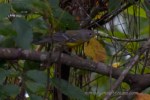
Fortunately for me, although I had no luck getting a shot of a thrasher, I did get to spend a few minutes walking around the property before I left for home.  Within minutes I’d spotted some warblers flitting around in the trees.  The first one I got several shots of was a Magnolia Warbler in fall colors.  The second was a Wilson’s Warbler–one I’ve never seen before.  I love it when I get to add a bird to my life list!  Unfortunately, 400mm is not enough for warblers, so the photos are heavily cropped.