
Practice Hike

Back in 2004 (yes, more stories from my PowerShot G3 era), I talked my not-yet-husband into going backpacking in Yosemite.  He had never been backpacking before and he had never been to Yosemite before, so he was both excited about the prospect and nervous that I, the slightly more experienced backpacker, would mislead him in his preparations.

Since I hadn’t been backpacking for many years, I did the only logical thing.  I bought a stack of books about backpacking.  Then, I began equipping both of us.  The next logical step was to test it all out.

I also got to test my setup for taking pictures.  Instead of a strap, I used an elastic harness that took all the weight of my camera off of my neck, which was such a relief.  It also left my hands completely free.

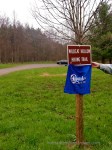
Well equipped, we headed to Wildcat Hollow in Wayne National Forest.  It was the only place I found within a 2 hour drive that allowed backwoods camping.  The entire trail was about 12 miles–just long enough for a day and a half trip for us.

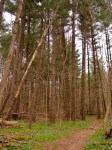
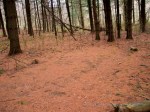
Although the hike started through a grove of evergreens, most of the trail went through deciduous forest.  In early April, just the beginning of spring growth was starting on the ground–the trees showed no signs of life at all.

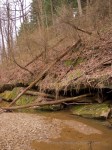
As we made our way through the woods, we came to a stream with a beaver lodge.  Something was laying on top of the lodge.  We approached quietly, thinking we were going to get to see a beaver.  But, as we crept forward, I found myself wondering what a beaver would be doing on top of its lodge and how on earth it would get there.  I frantically tried to remember everything I knew about beavers.  I was pretty certain their lodges were supposed to only be accessible from underwater.

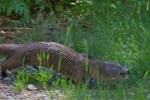
I guess when people say “only accessible from underwater,” they aren’t thinking about geese.  That’s what was stretched over the dome of the lodge–a large canada goose.  We watched for a long time trying to decide if it was alive, dead, or dying.  We saw it breathing, but decided it must be dying because it had its head down.  Coming up with no way to help this goose, we hiked on and tried to come up with alternative, more cheerful explanations.

When at last we found the perfect site to camp, we discovered how easy our new tent was to put up–it took 5 minutes.  We heated up instant soup on our tiny burner and hunkered over our hot soup cups as the temperature dropped.

We put on warm, dry long underwear and our warm wool hats before snuggling into our sleeping bags.  We slept pretty well, staying warm and dry all night.  When we woke up, it was snowing.

We hiked out with our bellies full of oatmeal and hot coffee feeling like we were quite the survivors.

Olympic Adventure

Whenever I go through old photos, I look for things I’ve learned as a photographer.  Sometimes it’s a little depressing.  It’s hard to say what improvements have come from skill vs luck vs improvement in technology.

However, I found one obvious improvement that can only be attributed to me having learned something–straight horizon lines.

Well, it’s not actually true that only my skill has straightened my horizon lines.  In truth, it wasn’t until I recently upgraded cameras and started using the in-camera electronic level that I can truly claim I had straight horizon lines.  But, setting that aside for a moment, as I look through images taken on my first trip to the Olympic Peninsula, shortly after I’d purchased my trusty old Powershot G3 circa 2003, I realize I didn’t even think about straight horizon lines back then.

So, there you have it. Solid evidence that I have retained one piece of information about how to have better images in 9 years.  I feel much better now.
The trek to the Olympic Peninsula from just North of Seattle seemed somewhat epic.  When you look on a map, Olympic National Park looks like it’s right next to Seattle–like it should take a couple of hours to drive there.  But the first hint that maybe it’s not so straight forward is when you try to get driving directions from Seattle to Olympic National Park–google says, “We could not calculate directions . . .”

Our route may not have been the most direct.  We went North through Deception Pass to Whidbey Island and, from somewhere in the general vicinity, we took a ferry over to Port Angeles on the Northern end of the Olympic Peninsula.  From there, we made our way along the coast down into the park where we visited an ancient lodge and trekked through an even more ancient rain forest.

Oh wait . . . that’s how we got there on our second trip to Olympic National Park.  Sorry.  On our first trip, we went South to Mount St. Helen first and then North to Olympic and then back via Port Angeles and Whidbey Island.  I had things reversed.

If Olympic were in the Northeastern United States and you asked someone for directions, they would tell you, “You cahn’t get theyah from heeah.”

I would love to go back to Olympic for a week.  Both times we went before, we did more of a drive by, taking only a couple of very short hikes.  I would love to do a through hike of many miles in the rain forest.  The number of elk that we saw in just a mile or so of walking in the midst of the deep shadows of giant trees was amazing–it wasn’t the kind of terrain I expected to find elk in.

It’s too bad it’s so difficult to get to–otherwise we would probably go every year as a short side trip from Portland when we’re out visiting my dad.

Maybe next year.

Lessons from the Archives: Toronto

This is another set of photos from my archive of the past. These were taken on a business trip to Toronto. I had gotten my PowerShot G3 a few weeks before the trip and was too excited not to bring it. I’m glad I did for several reasons.
First, it turned out to be the only trip to Toronto where I flew in on a Sunday and had time to explore downtown Toronto. I had many great photo ops as a result.

Second, I got to experiment with several challenges, which taught me why photographers use polarizing filters, tripods, and unexpected angles.

Third, and most importantly, it was the last business trip I went on with my office mate at the time, who was a great traveling companion. A dedicated family man and an all around considerate person, he had a knack for putting everyone at ease. Plus, he was up for exploration, which is always more fun with a companion than by yourself.

Sadly, he suffered a major heart attack and died at the age of 44 only a few months later. I was grateful to have a few photos of him to share with his wife.

It’s something we don’t think about much, but we often spend more time with colleagues (especially office mates) than we do with the people we love. Yet, our relationships often do not extend outside the office. As a result, all of those hours become a mystery to our families. It’s so rare to have photos of colleagues who are “work friends.”

I have chosen not to share the pictures of my former office mate, but the pleasure of seeing Toronto with such an unassuming, easy going colleague who died far too soon is one that I continue to cherish.

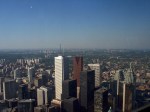
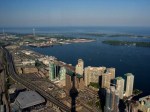
From a photographic perspective, I learned several things from shooting in Toronto. From the top of the CN Tower, looking down upon the world, I discovered the challenges of shooting through glass. Later, when I shared with a photographer friend how problematic the glare was, he suggested a polarizer might help.

From the bottom of the tower, I learned how changing your angle changes perspective. Shooting up the height of the CN Tower against the blue sky was a whole new view of the world, not just of the tower.

Down the walk from the tower, a giant Pileated Woodpecker statue clinging to a pole provided a whole new way to play with perspective. Already giant in its dimensions, with the sky scrapers in the background far enough away to appear tiny by comparison, the woodpecker appears to be Godzilla-sized.

That night, alone in my hotel room, I tried to shoot my first long exposure through the window. Those pictures turned out so horrible that I couldn’t include them, but that was when I first understood why my photographer friends kept telling me to get a tripod.
All in all, it was one of the best business trips I was ever on.

Field Trip

Today, I went on my first field trip with the photography club I recently joined.  We went to Gibbs Gardens in Ball Ground, Georgia.

While it was quite a drive (2 hours), driving in this part of the country is always scenic, which makes the time pass quickly.  Today’s drive was no exception, although I did feel a bit guilty for not riding with someone else to limit gas consumption.  But, I’m having some back issues and thought I might need to leave early.  Fortunately for me, my back made it until 3:30.

Gibbs Gardens is a private garden created by someone who owns a landscape company and recently opened to the public (for a price).

Getting there was interesting.  As has often happened when I’ve ventured out with a group, I ended up on what seemed like remote, two-lane highways that go from 55 to 45 to 35 mph as they pass through small . . . let’s say “villages,” these places are too small to call towns.

And, another common occurrence, I inevitably find myself behind someone who wants to go at least 10 mph slower than the speed limit.  Today, I was afraid I was going to end up going 35 mph for 30 miles.  Fortunately, the very sweet looking little old lady ahead of me turned after only a few miles.

As I accelerated back to the speed limit and entered some sharp turns, I found myself wishing I’d driven our old BMW instead of the mini-van.  Let’s face it, even a bicycle would be more fun to drive than a mini-van.

When everyone arrived, we gathered and posed for a group photo and then scattered to go shoot.  Luckily, one of the guys I’d met before was company-tolerant and we ended up shooting together.  Otherwise, besides the $2 discount on the entry price by coming as a group, there wouldn’t have been any advantage to going with the group.

The one big disadvantage was that we didn’t get started until after 10AM by the time everyone arrived.  The light was already starting to get bad.  That is the one thing I would suggest to Gibbs Gardens–they should offer early or late entry to photography groups.

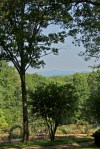
We headed up to the Manor House first, hoping to get to see the view of the mountain before it got hazy.  We didn’t immediately figure out where the mountain was visible from, so it was quite hazy by the time we found the view.

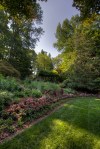
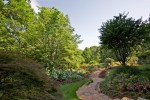
Regardless of the less than optimal time of day, the manor house and its surrounding gardens were amazing.  There is so much stone in the garden walls and walkways that I have to wonder how they got it all there.  The pool was so inviting, it’s a good thing we didn’t go there latter in the day–I probably would have jumped in.  I’m pretty sure they kick you out if you start swimming in the pool.

Climbing Up the Walls

Having made space in my photo library, I, of course, had to fill it.  I did this by importing an old archive of photos into my favorite photo management tool, Aperture.

An interesting thing happens when you import an old archive:  you watch your life flash before your eyes in the most literal of ways.

As I sat there going through time, I was reminded of many amazing things I’ve experienced in my life.  Of course, I find a starling with white tail feathers (which still eludes my camera) amazing, so I guess I’m easy to amaze.  I consider that a virtue.

Among these memories are a few moments when I was scared and not sure I could do something, but I did it anyway.  I’m sharing one of those today.

I had traveled to Yosemite with some friends I’d been training with for my first triathlon.  We went to San Francisco first where some of them (not me) did Escape from Alcatraz.  That was above my pain tolerance level.

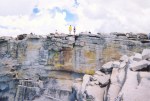
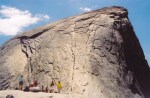
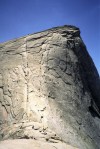
In Yosemite, at the base of Half Dome, I stood looking up at the climb to the top of the dome and nearly didn’t attempt it.  If I am completely honest, it was only pride that motivated me to do the climb.

It’s hard to describe the climb.  I guess if you imagined people walking across a rope bridge and then imagine the bridge is vertical, hanging down the side of a mountain, and only has a floor-board every 10 feet, that would be close.

The boards are flat against the rock so you can perch and rest for as long as the people behind you will tolerate.  It’s probably not quite as vertical as it seems, but I felt like we were walking up a wall.

You are not tied to anything and you do not use any special gear.  Gloves are highly recommended, however.  If you arrive without a pair, there is a pile of gloves at the start of the climb left by those who completed it.  These are simple work gloves–nothing special.

I don’t know how long it took to complete this climb.  I just remember feeling grateful that someone slower than me was ahead of me–that gave me the time I needed to recover between resting perches.

When I made it to the top, what breath I had left was completely taken away.  There is an interesting phenomena that the harder I have to work for a view, the more amazing it is.  Part of the amazement is the sense of incredibly great fortune that I, a mere mortal of lower-than-average athleticism, am among the few to see it.

When Pat and I went to Yosemite together a couple years later, I tried to talk him into doing the climb.  That was a non-starter.  We hiked to several other views that were probably just as mind blowing, but they didn’t come with quite the same sense of elation.

*Photograph Credits:  these are not mine (in fact, I’m in 2 of them).  I’m not sure which friends took them, but I’m happy to have them.  Especially since I haven’t found my own photos from this trip–they may be in print only.

Clutter vs. Hoar Frost

In the process of going through old photos and clearing out the masses of virtual junk that I have collected, I am reminded both of how much I prefer a life uncluttered and how much I enjoy reliving the past.

On the topic of de-cluttering, there was a time when this referred to clearing clothes out of closets, emptying the junk drawer that collects unrecognizable objects that we’re sure we’ll need someday, selling the collection of hobbits or beanie babies, and donating excess household goods.

For us, we started the process of reducing things several years ago.  But having focused for so long on getting rid of physical items, I completely ignored the virtual ones.  My main problem, as you might guess, is photos.  As long as all my images fit on the hardware I already owned, I don’t think of it as clutter.

But having grown my capacity to over 7 TB between old devices, new devices, backup devices, and spare devices, I’m thinking it’s time to start eliminating the multiple copies of the same photo, the really bad images, the slightly different angles of the same thing, the series of 300 shots of the same person making different facial expressions–in short, the crap.

Having cleared out this virtual junk, I find the important memories and the images I’m almost proud of suddenly jumping out at me.  Just as clearing out the 4 potato mashers, the endless collection of useless appliances (useless to me since I don’t cook), and the endless odds and ends that filled our kitchen cabinets made the kitchen a place I didn’t mind hanging out in (because I could suddenly, for example, find the corkscrew when I brought home a bottle of wine), I find myself suddenly having a hard time pulling away from perusing the past.

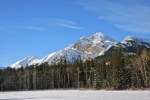
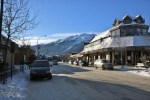
When I stumble upon photos from one of my favorite places, Jasper, Alberta, I decide to share a few from our hike near Pyramid Lake in December of 2009.

Jasper National Park is located in what I used to think was Northern Canada–until I looked at map.  It is North of Banff, but, it turns out that’s not even far enough North to be Northern Alberta, let alone Northern Canada.

Given that the town of Jasper is located within Jasper National Park, which encompasses a pretty big chunk of the Canadian Rockies, it was far enough North (or perhaps just far enough in altitude) that the high temperature those two weeks of December was -15 degrees Fahrenheit.

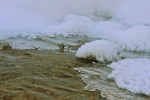
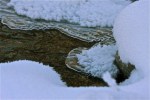
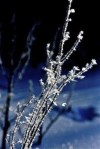
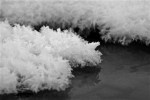
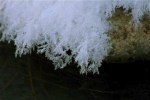
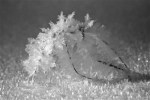
When we hiked around Pyramid Lake, we discovered something I’d only read about–hoar frost.  I never actually knew what hoar frost was until after I showed some of these shots to a friend.  If Pat wouldn’t have been with me, I probably would have frozen to death because I was so fascinated with the hoar frost, I would undoubtedly have forgotten to return until it was too dark to see.

I don’t consider these images clutter.

Above Infinity

Now that the heat has returned to Chattanooga, it seems like the perfect time to re-live part of our trip to Glacier National Park a couple years ago, where it was cool enough that it even snowed.

We started in Portland, visiting my dad, jumped on a train to Seattle where we met some friends.  Then, we went on across the continent (or so it seemed) overnight until we arrived at the tiny West Glacier train station.

Deposited at the depot so early in the morning that it wasn’t open yet, we stood on the asphalt area that served as a platform. surrounded by our rolling luggage.  We looked around in wonder.

By the time we discovered our rental car hadn’t been dropped off for us, got picked up by the rental company, and were outfitted with a four-wheel drive vehicle that was twice as big as anything I’d ever driven, we’d seen enough to be reminded why we love the Rockies.

But these Rockies seemed . . . rockier.  More rugged, bigger, bolder somehow than the Rockies of Colorado or Alberta.  But then again, I think I feel that way every time I return to the Rockies, no matter which part.

Our friends were only staying a couple of nights and then they were heading back without us.  Since they weren’t hikers, we took advantage of having a couple of non-hiking days to adjust to the altitude by doing things like driving to overlooks and walking on gentle paths around lakes.  There was an amazing amount of beauty to take in without pulling any muscles.

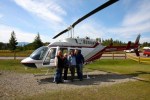
When we drove past a helicopter tour place, we girls were determined to get the guys on the copter.  I have often skipped helicopter tours opting to spend my money on a nice dinner with a decent bottle of wine instead.   But I always regretted skipping the helicopter tour in Hawaii Volcanoes National Park.  This time, I wasn’t about to miss it.

I laugh as I remember how hesitant the guys were to join us.  I really think they wanted to save the money.  I don’t think either one regretted having spent it by the time we landed.

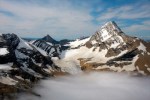
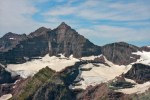
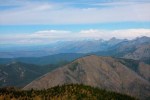
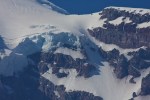
There is something so spectacular about mountains.  To see them from above, with clouds nestling below their peaks . . . I imagine scenes from Greek mythology of the gods having a meeting or perhaps playing chess.  If I were immortal, this is definitely where I would hang out.

I cannot logically explain the effect mountains have on me, but I think it’s a common experience.  That sense of awe, grandeur, amazement.  The sudden stillness that follows the feeling of inspiration.  Feeling part of something bigger than my imagination. Perhaps a sense of being part of something infinite–the world seems so endless from a mountain top.

I wish these few photos contained that feeling.  Unfortunately, these are very low resolution versions of the originals (which, I hope, are stored away in an archive somewhere).

Scenic View

One of the more sedate things I enjoy is riding in trains.  Whether it’s as transportation or a scenic route (or, better yet, both), I really enjoy knowing that no one (who isn’t getting paid to be there) gets stuck doing the driving.

When we saw a PBS documentary on scenic train rides with steam engines, I made note of the Mt. Rainier Scenic Railroad.  I had yet to make it to Mt. Rainier and taking a train ride there sounded like the perfect way to enjoy seeing Mt. Rainier with my father and his wife on our next visit to Portland.

Many weeks later when Pat and I were out on our annual visit, the four of us headed out of Portland towards Elbe, Washington early in the morning.

A little too early, in fact.

When we arrived in the “town” of Elbe, no one seemed to be up yet.  Fortunately, one of the 3 businesses at the only intersection was a quiet restaurant where we got a good, down-home breakfast.

After filling our bellies, we headed out and discovered the volunteers who run the train had arrived.  I guess if you are excited by steam engines, this would be a great event.  However, once we were on the train, we discovered two things:  first, you really can’t see the engine when you’re in the train; second, you really can’t see much of anything when you’re in the train.

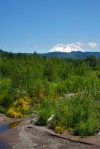
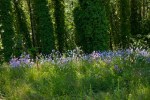
There were 2 moments totally 18 seconds during the ride where we could see beyond the immediate vegetation surrounding the tracks.  During 11 of those seconds, we saw Mt. Rainier off in the distance (2nd photo).  The rest of the time, we saw scenery like the dense trees and ferns in the 3rd photo or an occasional flower-covered slope like the 4th photo.

While I enjoy hiking in the woods, they’re tough to appreciate from a train.  Besides, this was supposed to be the “Mt. Rainier Scenic Railway.”  Call me crazy, but I expected to see Mt. Rainier for more than 11 seconds.

I suppose it’s all about expectations.  Had it been called “Get-a-Glimpse-of-Mt.-Rainier-During-an-Hour-and-a-Half-Train-Ride-Through-Dense-Woods Railway,” I probably would have been thrilled.

Fortunately, we were returned to the station with plenty of time to drive to Mt. Rainier National Park.  We got spectacular views just driving up to the visitor’s center and made plenty of stops so our driver (aka, Dad) could also enjoy the view.  Photos 5-13 were all taken from within the park.  It wasn’t the best time of day for good light, but the area was so beautiful, I didn’t really care.

The final image is of Tisen, taken with my iPhone using the Hipstomatic app.  I love the irony of having an app on a smart phone so you can take pictures that look like you took them with a cheap camera from the 1960’s.  It’s awesome.

The High Desert

Going back in time again to a previous trip to Oregon, I’ve pulled together a few photos from the High Desert Museum in Bend near Lava Lands National Park.

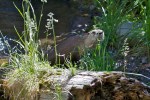
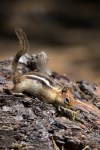
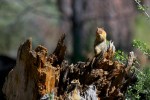
A recurring theme is the number of golden mantle ground squirrels that posed for me.  I noticed a marked improvement in the poses at the museum over the ones at the park.  I suspect the ground squirrels at the museum are professionals.

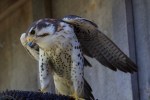
Besides the ground squirrels who scurry along the many paths, they also have native creatures on display.  Since shooting captive wildlife is far easier than sitting around waiting for it in the wild, I took full advantage of the opportunity.

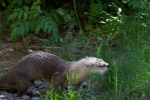
Given that it was mid-afternoon, many of the animals were content to lie in the sun and let me shoot.  However, the river otter was not so cooperative.  I can only recall having been to a facility with river otters who were actually visible and active once in my life–it was nearby at the Seattle aquarium.  There must be something about the Pacific Northwest that makes otters more active.  I guess that makes sense since the people of the Pacific Northwest tend to be more active, too.

In any case, first I tried getting shots of the river otter through a glass wall on one side of the “pond” he was swimming in.  I thought it would be really cool to have underwater shots.  With little light, I was stuck with a slow shutter speed, so none of the underwater shots are worth looking at.  Just dark, blurred shapes moving through water.

Next, I headed outside hoping for better light to shoot in.  I did get more light, but it wasn’t exactly better light considering the time of day.  It was enough that I was able to shoot at 1/160th of a second, though.  That allowed me to stop at least some motion.  My favorite pictures of the otter are the two that show him shaking off.  The first one is the start of the shake with only his head in motion.  The second one is slightly later.  The shake has propagated down to his neck.  If I would have taken a bunch of shots, you could have seen how the shake moves from the head all the way down the length of the otter’s body.  It’s pretty amusing to watch.

Another critter that posed for me was the porcupine (hedge hog) who was part of the animal show we caught the tail end of (pun!).  He didn’t pose just for me–there was a big crowd in the amphitheater, but the porcupine remained amazingly focused on the bottle his handler was feeding him.

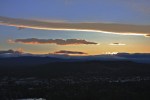
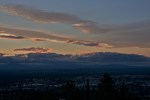
At the end of our day, Pat and I went to Pilot Butte State Park to enjoy the sunset.  It’s basically a giant hill in the middle of an otherwise flat town.  At the top, we were treated to spectacular views of the mountains, the clouds, and the setting sun.

Squirrel!

Every year, we go to Portland, Oregon to visit my father and his wife.  Every year, we discover some new and fascinating part of Oregon that makes us think about living there.

For example, I thought hiking in Hawaii Volcanoes National Park was the kind of experience that nothing on the mainland could even suggest.  As it turns out, Oregon has Lava Lands National Park.  While you can’t creep out over still crackling hot lava that’s only a couple of weeks old, you certainly can experience walking through a vast stretch of nothing but cooled lava.  Who knew?

The entire area is amazing.  The Three Sisters mountains stand watching over the lava fields, a reminder of where the lava originated from.

But an interesting reality came home to me while we explored the area:  there is something about me that attracts mosquitoes and chipmunks.  To be honest, I discovered the mosquito thing many years ago when I realized that I averaged anywhere from 5 to 10 times as many mosquito bites as the people sitting around me at a campfire.  Anytime I need to feel attractive, I just take a walk in the evening while the mosquitos are buzzing.  But, it wasn’t until we were walking around lava lands that I realized chipmunks seem to follow me wherever I go–especially when I’m carrying a camera.

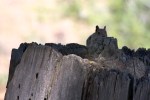
To be more accurate, these are golden-mantled ground squirrels, but they look like overgrown chipmunks to a mid-westerner.

I have nothing against chipmunks.  They are extremely cute.  I was slightly embarrassed when I tried to identify a bird I kept hearing for about two years until I finally saw a chipmunk making the mysterious chirping I could never identify.  But, I don’t hold it against the chipmunks.

I appreciate their willingness to pose for me when no other wildlife dares to appear.  I particularly enjoy the range of caution these little guys display.  Some seem to be out trying to attract attention while others appear to practice careful camouflage.

They all freeze when they see me swing my lens their way.  I wonder what they think?  I suspect what they think is something like, “I wonder if I sit real still and let that woman take pictures of me if she’ll eventually throw me something to eat?”

The lava fields make for an incredible playground for the ground squirrels.  They have an infinite number of crevices to jump into, tunnels to run through, and rocks to sun on.  If it weren’t for the predators, I imagine there would be a ground squirrel on every rock, every one of them hoping for a hand out.

As it is, they appear and disappear frequently enough to demonstrate that the static field of lava pulses with life.  The rhythm of their movements becomes the heartbeat of a place that might appear dead to the casual observer.  They remind me to stop and look closely.