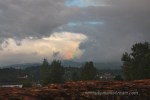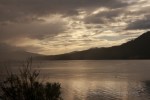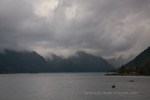
Everything’s Better with a Beach

Several years ago, we had the opportunity to attend a special event in St. Lucia.  We’d always wanted to vacation on a Caribbean island, so it seemed like a good time to go.

I’m not usually one to stay in resorts.  I prefer an experience that is less homogenized.  However, having been to Jamaica once for a work conference (yeah, I know) and having been warned not to go “off the reservation” without an appropriate escort due to issues with crime outside the resorts (I was always suspicious the risks were exaggerated to keep unsuspecting business women from taking their American dollars elsewhere), staying a resort eliminated concerns about crime.  To be fair, I didn’t do much research about St. Lucia because we were meeting a group at a resort.

I’m glad we had the resort experience.  Now I know what I’ve been missing.  It was exactly what I expected it to be–predictable, uninspired, stripped of virtually all local culture, and overall less than what it should be for the prices they charge.  It’s like going to Italy and eating at McDonald’s.

That said, who can complain about being on a gorgeous island at a luxurious resort in the middle of the Caribbean?

Small islands with a large number of inhabitants are probably not the best place to do things like backpacking.  But quite honestly, I wouldn’t know since we only walked around outside the resort once.

We saw quite a bit of the island from the back of the airport shuttle, winding around tight mountain turns to the point that I got motion sickness for the first time in my life.  Interestingly, having never been motion sick before, I interpreted the nausea I was experiencing as been intense hunger.  Maybe that’s what kept me from throwing up?

We also got a peek of the island when we went SCUBA diving.  We were shuttled to the port and then taken out to sea to dive.  I had never been diving before and only had a resort certification to dive only to 20 feet.  Unfortunately, I didn’t learn how to properly equalize and my head felt like it was going to explode.  After the first painful minutes, I finally took a deep breath and relaxed.  The pain subsided and I was truly excited.  Then, I realized all the other divers were swimming below me.  I decided to look up to see how far down I was.  When I raised my head, it popped out of the water.  I probably should have just stuck to snorkeling.

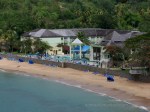
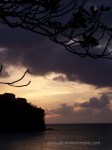
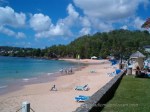
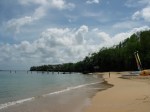
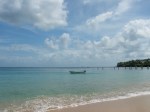
Besides the great group of people we were with and the fun we had celebrating with them, the best part of the trip was the beach.  I signed up for a yoga class on the beach one day.  That might have been the highlight of the trip–no one else signed up.  I got a private yoga lesson in a gazebo on the beach, witnessed by the rising sun and the cool sea breeze.

*Note:  Images starting with “img” are mine.  The rest were from members of the group.

The Long Walk Home

We decided we had to hike the Grinnell Glacier trail while we were in Glacier National Park in 2010.  However, given that we weren’t exactly in top hiking condition and the trail gains 1600 feet in about 3 miles, we thought we’d better take a short cut by taking the Glacier boat across Josephine Lake, cutting a little over a mile and a half off the total distance.  While the part we skipped was a flat, easy hike, I knew my knees would thank me by the time we descended the 1600 feet on our way back.

We made our way gradually up the trail.  Pat hiked in rubber boots he’d bought at the Indian Trading Post the day before.  He was wearing these boots because, for whatever reason, he hadn’t packed his hiking boots and the sudden fall of about 5 inches of snow made his running shoes impractical for hiking.  So, we’d taken a detour to the trading post and gotten him some socks and muck boots.  He said they were the most comfortable boots he’d ever hiked in.

My boots were not feeling so comfortable.  In fact, they were feeling a lot like lead weights designed for use when you need to drown someone and concrete isn’t readily available.  But, the scenery was so beautiful, it was easy to ignore my boots on the way up.
As we hiked, the sun came out, the temperature rose, the snow melted, and we worked up a sweat.  Pat stripped down to a cotton T-shirt (don’t get me started on cotton on the trail!) and shorts.  But as we made our way up higher, the temperature dropped, the wind became fierce, and the ground was once more snow covered.

People coming down the trail gave Pat looks as the passed us in fully zipped winter shells with hoods up.  I stopped to pull out my warm winter hat, put on mittens, and add a fleece under my rain jacket.  Pat kept putting off adding more layers.
When we reached the top of the trail, the wind was so strong, I had to brace myself against it to keep from losing my balance.  Pat finally pulled on a jacket.  We didn’t spend a lot of time at the top because of the bitter cold, but the entire hike was so spectacular, we didn’t feel cheated.

We had to make double-time on the way back down to catch the last boat back to the hotel.  This downhill trek was the first time I ever experienced sharp stabs of pain in my knees with every step.  By the time we got to the ferry, I could barely walk.  This was our 4th hike in 3 days (and, more problematically, also our 4th hike in about 3 months).  I would not have made it without my trekking poles.

In spite of the sore knees (which did heal for the most part), this was one of my all-time favorite hikes.

Through the Window

Perhaps the simplicity of rhyme is what caused me to think of riding on a train today: rain-train.  Or maybe it was the sound of the water drumming on a metal roof that reminded me of our train journey from Portland, Oregon to West Glacier, Montana and back.

Whichever it was, I perused my photos from the train and was surprised to find a collection of landscape shots from our ride home.  Shot through the windows of a moving train in the low light of sunrise with a Canon 40D and the Canon 17-55mm EF-S f/2.8 lens, I’m pretty amazed I managed to get any shots at all.

Riding on the train was quite an adventure.  It seemed so easy–you hop on the train at one station and, eventually, hop off at another.  The lines were short, access to the stations were easy, and it took us right to our destination, unlike a plane.

There were a couple of down sides.  First, the 14 hours spent on the train each way.  Second, the seats were described as reclining with leg rests, so we didn’t book a bedroom.  That turned out to be a big mistake.

The reclining seats didn’t recline far enough.  The foot rests were made for someone under 4 feet tall.  On me, the footrest ended just below the knee and left my feet dangling until gravity pulled them back to Earth with the footrest jamming me in the back of the thighs.

On the way back, we managed to add a “roomette.”  It was a little private cabin for just the two of us.  We faced each other while we rode and when it was bed time, a Porter (or is that on a ship?) came and helped us convert our seats into two bunk beds with sheets and pillows.  It was pretty impressive.

Unfortunately, I’m not sure traveling by train in a sleeper car is cost effective for most locations, but it is a nice way to get to remote places.  We both got to enjoy the scenery when there was scenery.

I think it would take some time to get used to sleeping on a train, however.  Even with our flat bunk beds (which were a vast improvement over the reclining seats), the train rocked side-to-side and we were lying lengthwise to the car.  I had this constant sensation I was going to rock out of the bed.

The next morning, we woke early and headed up to the dining car.  It was one of those big, glass bubble cars that allows you to see the whole landscape.  I could have sat there all day, but we only had a couple of hours after sunrise before we arrived back in Portland.

Taking the train was low stress and allowed us to see some things we would have missed from a plane.  If time and money were not factors, I would probably always choose the train over a plane.

Reconstructing History

While in the Canadian Rockies at Jasper National Park several years ago (still shooting with the PowerShot G3), we decided to take a “rest” day by hiking a relatively easy trail to a lake at the base of Mt Robson.  We drove from Jasper Park in Alberta to the Robson Provincial park in British Columbia in about an hour.

When we started out, the sky kept promising rain (in fact, it even sprinkled briefly), but then the clouds would part and a deep blue sky would appear.  When the sun was out, we broke a sweat working our way up the easy, but uphill, trail.  When cloud cover moved in, it was like someone had cranked up the air conditioning and I would get chilled almost immediately.

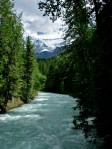
For most of the walk, the trail ran parallel to a treacherous but beautiful stream swelling with the “spring” snow melt (this was in July).  We didn’t see anyone attempting to navigate the stream, so I’m guessing the water was too intense for even really good kayakers.  It seemed like getting in the stream would be a really bad idea with or without a kayak to me.

When we arrived at Moose Lake, we were further away from the base of Mt. Robson than we expected, but given that Mt Robson is the tallest mountain in the Canadian Rockies, we still had plenty of good views of it, including the glacier nearby.

As I went through these photos from 2005, I discovered an interesting phenomenon.  I believe I was feeling lazy on this particular day not only in choosing an easy trail, but in my shooting.  I notice that the metadata in my pictures indicated I was mostly shooting with a wide-open aperture, with the smallest aperture setting being an f/8.

This was remarkable to me in two ways.  First, this is another thing to add to my list of things I’ve learned–I would not shoot these scenes with that setting today.  Second, it seems like they have much more depth of field than I would expect for such wide aperture settings.  This caused me to look at focal lengths.  They are mostly under 20mm with the shortest being 7mm (if I recall correctly).  Is that even possible?  Assuming my metadata is correct, the extremely short focal lengths are most likely contributing to the extra depth of field.  I assume I was shooting with an open aperture because we were walking in the shade quite a bit, so perhaps there wasn’t much light.

It’s always fun to try to reconstruct what happened 7 years ago based on the evidence collected in the metadata of your photos!

What I do remember clearly about this hike is that Pat and I were quite irritated with one another at the beginning of the hike, but back to laughing together by the time we were ready to return to the car.  Maybe that’s why I love hiking so much–it’s restorative in more ways than one.

Maligne Lake

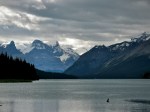
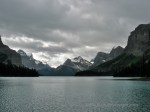
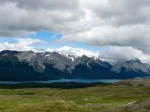
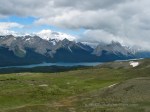
Maligne Lake takes its name from the Maligne River that feeds it. The river was apparently treacherous enough to be dubbed “malicious,” although it sounds better in French. Located in Jasper National Park in the Canadian Rockies, it’s one of those places that I had never heard of before I started researching the area while planning our first trip there.

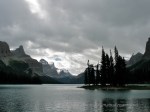
Maligne Lake is a popular destination. The tiny island, Spirit Island, located in the lake is apparently an extremely popular destination among tourists. One cruise to the island states the island “epitomizes the Canadian Rockies.” the island is supposedly one of the most photographed sites in the Rockies.

Whenever I see a claim like that, I have to wonder how anyone knows how often a particular site has been photographed. I didn’t notice any photo detectors going off while I and the boatload of people on our cruise started shooting like mad.

I did however notice a certain calm. I don’t know if it was a case of self-fulfilling prophecy with all the build up, but the place seemed aptly named. There is something about journeying across this lake to see this tiny island that makes the trip worth it, even if it’s been done by a million people before and will be done by a million people after.
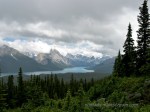
Having done our tourist duty by contributing to the Jasper economy by joining a boat tour, we then separated from the crowd and headed up to hike the Bald Hills that were immediately past the lake.

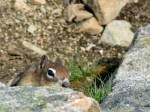
We spent the better part of the day climbing in elevation. By the time we got into the hills, we were starving. At the same time, the temperature was dropping rapidly and a cold wind kicked up. We found a rocky outcropping to shelter us from the wind and quickly learned that not only big, scary predators can be a pest if they’ve been fed. At least today we had only to outsmart the chipmunks.

After a few minutes, they were so bold that we were afraid we were going to get bit. When one actually stopped and nudged Pat with its tiny little paw as if to say, “Hey, feed me!” I started to get more nervous than when we had encountered a bear! I just kept envisioning a finger getting nipped off while we hunkered down on this remote mountain and dying of some horrible illness like rabies.

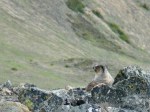
We did manage to complete our lunch without any injuries, although we did lose a crumb or two. As we walked on, we passed a slumbering yellow bellied marmot soaking up what little was left of the sun. in fact, sunshine came to an abrupt and frightening end when dark clouds rolled in and snow started falling fast. Unprepared to spend the night in a snow drift, we moved out quickly, taking the chipmunks’ last hope for a grand feast with us.

Lost and Found

The first day of our canoeing adventure along the Gulf Coast in the Everglades, I discovered a key difference between canoeing in the Everglades and canoeing down a river.  There’s only one way to get lost when you canoe downstream on a small river:  failure to stop at the pick up point.

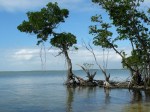
Canoeing in the Everglades was a completely different story.  We had a permit to camp on a particular Key each night of our trip.  Our first day, we were supposed to paddle about 7 miles to Rabbit Key.  Unfortunately, we started out heading down the wrong channel through the mangroves.  As we paddled around trying to identify openings between tiny mangrove islands that matched shapes on our map, I realized how little a map drawn from an aerial perspective reflects what land looks like from the water.

As the navigator, I eventually gave up on the map all together, picked a channel that pointed generally Southwest, and took us through the maze of mangroves until we hit the Gulf.  Assuming we were West of our destination, we paddled East.

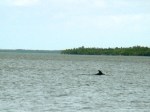
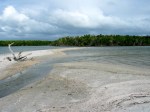
Paddling along the Gulf Coast through swells of salt water in a canoe identical to the canoes we’d paddled as children was a completely surreal experience in and of itself.  Then, we spotted a dolphin about 50 yards from our canoe.  It was a joyful sort of strange.

After having paddled long and hard in the Gulf (which is not at all like paddling down a river) we decided to break for food and try to locate ourselves on the map.  We figured we might just stay where we were.  We were rapidly running out of daylight and we really wanted to have our campsite setup before dark.

We took a walk around the island we’d stopped on, trying to get a sense of what it might look like on our map.  Fortunately, we stumbled across a sign that identified the Key we had landed on.  It was Rabbit Key, the key we were supposed to spend the night on.  While this was mostly pure luck, Pat was still impressed by my sense of direction (too bad it doesn’t seem to work in the Chattanooga area).

Taking some advice someone had given us, we found a suitable spot to pitch our tent where there was plenty of wind.  Then, we pulled our canoe well up out of the water so it wouldn’t float away at high tide.  We ate quickly and went to bed, exhausted.

In the middle of the night, I woke up and went out to heed the call of nature.  When I looked up at the night sky, I’d never felt so close to the stars.  I’ve been to the top of Maunakea, which is supposed to be one of the best places in the world to see the stars, but here at sea level on a tiny key in the Everglades, it seemed like the stars were within arms reach.  It was astonishing.

Swamp or Park?

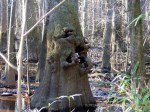
When I planned our route and where we would stop on our way to the Everglades and Key West back in 2008, I picked some places on the map I had never been to, including Congaree National Park.  When I googled it, I discovered that it had, until recently, been called Congaree National Swamp.  I guess I can understand why someone might think Congaree National Park was a better name.  After all, how many people think pleasant thoughts when they think of a swamp?

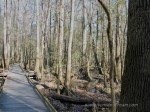
It only made me more curious to see it, however.  As we started down the very fancy boardwalk that kept less enthusiastic hikers’ feet dry, we spotted several woodpeckers and a couple of warblers in about 5 minutes.

We continued well beyond the boardwalk and onto the trails for those with waterproof boots.  As we walked, a Barred Owl called over and over, completely oblivious to the fact it was 2 o’clock in the afternoon.  We heard a Pileated Woodpecker and saw it fly.  We followed it as long as the trail allowed, but I never did get a shot of it.  Of course, still toting my Powershot G3 that trip, I’m not sure how much of a shot I would have gotten anyway.

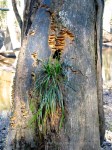
We continued along to a beautiful stream with giant swamp trees growing along the banks.  I assume they were Cyprus–the number of knees that threatened impalement to anyone who dared to trip was overwhelming.  I expected to see a few knees popping up here and there–the fact that acres of swamp were nothing but knees was quite a surprise to me.

But the biggest surprise was when we heard some rustling in the underbrush as we approached a darkly shadowed part of the woods.  We paused and looked at each other, unsure of what we were hearing.  Then, suddenly, several boar jumped up from their cover and went squealing off through the woods.

While I generally seem to lack the appropriate level of fear of wild animals, I have to admit that I definitely jumped when those pigs ran off through the woods.  Although I was disappointed I didn’t get a picture, I preferred missing the shot over having them run towards me.

At the time, I didn’t know that wild board were supposedly introduced here in the 16th century for hunting.  Who knew that the boar would go nuts and start taking over?  The amount of damage they can do is pretty frightening.  I don’t mean just to humans (although that’s frightening too) but to land, farms, and ecosystems in general.

I was a lot less excited about our wild boar encounter when I learned just how common they had become in the region and what a problem they are.  Much more recently, I discovered there’s a reality TV show about boar hunters.  Like most of the reality TV shows I’ve heard about, that just seems wrong.

In spite of the boar, I highly recommend hiking in the Congaree.

Almost Shenandoah

In 2008, I took my trusty PowerShot G3 for it’s final trip.  While I would have preferred my Canon 40D by then, since our plan included canoeing/camping in the Everglades, I was content to take a camera I wasn’t worried about ruining.

On our way to the Everglades and Key West, we stopped in Shenandoah.  It was on a list of places to see before you die, so we thought we’d check it out.  On our way through Virginia, we entered the North end of the park and managed to get in a short hike in thick fog before heading on toward lower elevations.  The fog was forming hoarfrost on the trees as we exited the trail.  We crept along the main road through the park, barely able to see a young buck walking along the road.

We made it safely to our hotel, where it was completely clear and much warmer.  The next morning, we learned the entire park was closed due to ice, but we were told to call back in a few hours–things might improve.

We decided to go for a cave tour nearby to kill the morning.  Luray Caverns was interesting. Although, because it’s privately owned, it’s treated commercially instead of for preservation purposes.  This means there were formations we could touch, lots of colored lights, a wishing well, and an organ that played a song by triggering mallets that hit various formations.  The cave was pretty astounding none-the-less.  I just hope it survives being shown off long enough for many to enjoy.

Returning to daylight, the valley was sunny and relatively warm for late December.  We decided we needed to get on the road whether we were able to hike in Shenandoah or not, so we drove on up to the park.

As we continued upward in elevation, the skies got cloudier and more and more of the scenery was blanketed in white.  As it turned out, all of the trees and roads were still frozen in a coat of ice.  It was beautiful to see, but the entrance to the park was closed.

Instead of hanging out for an extra day to see if things improved, we decided to take the Blue Ridge Parkway South and enjoy the scenery as we drove.

This turned out to be a surprisingly good decision considering the weather.  The further South we went, the sunnier the skies and we encountered no ice at all.  I guess the Parkway South of the park is a little lower in elevation.

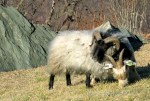
We not only got to enjoy beautiful views of the valley below, but we were treated to spotting a couple of mountain goats tussling at the side of the road.  They were so entangled with one another, they looked like a two-headed goat.

We were sorry to leave the parkway behind, but we did make it to Congaree National Park early enough to take a long hike there and work the kinks out.

The Trail Less Traveled

The last installment (for now) from our backpacking trip to Yosemite . . .

Waking up that morning, we were the kind of tired you get from hiking a 1500 foot rise in elevation twice carrying close to 40 pounds on your back combined with not sleeping well.  One of my bad decisions to reduce the weight of my pack was to use an ultra-thin thermal sleeping pad that was 3/4 long.  That was a decision I would regret every night of our trip.  If there’s one thing a body needs when you’re pushing it hard is good rest and an ultralight, 3/4 length sleeping pad is not the way to get it.

So, there we were, still with no appetite although the nausea had subsided some, super tired, and in the middle of a mosquito festival.  We moved extraordinarily quickly getting out of camp that morning.  That’s one thing about through hiking–if you hate where you camp the first night, it’s only one night.

We were headed up the final ascent to El Capitan.  Although our tired bodies could feel the climb, it was a relatively gradual ascent.  Given we were already suffering from some altitude sickness, going up was not the best direction, but it wasn’t like we were climbing Everest and potentially going to die from altitude sickness.  We did not, however, move very quickly as we made our way up those last couple of miles to the top of El Capitan.

Fortunately for us, we weren’t far from the top.  We made it before lunch even at our snail’s pace.  Even more fortunately, our appetites started to return and we managed to snack and feel a little more energized before we got there.

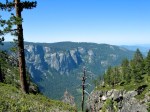
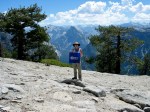
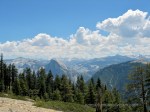
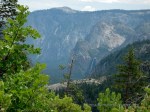
As we walked out onto the top of El Capitan, any aches or pains were forgotten.  It was the first time we stood together looking at the panoramic view of Yosemite valley.  It was Pat’s first time in Yosemite, and I was relieved that he felt the same amazement I felt when I saw a similar view from the top of Half Dome a couple years earlier.

After the nausea, fatigue, poor night’s sleep, and mosquitos, I felt giddy with relief that Pat thought it was worth it to stand there with me.

We spent an hour there.  We had our lunch on top of El Capitan, enjoying the view and the sense of achievement.  While we didn’t climb up the face like the rock climbers who come every year, we had pushed ourselves enough to still feel that rush of “I really did something.”

Although we were there during peak tourist season, we didn’t see anyone until after we got past El Capitan.  Up until that point, we’d had the trail completely to ourselves.  Of the tens of thousands of people in the park at the same time we were there, not one of them crossed paths with us for that day and a half. We truly felt like wilderness explorers.

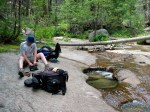
P.S.  In case you’re wondering, the photo with the “Outdoor Source” bandanna is because they offered a discount if you brought them a picture with their logo on the trail.

The Long Hike

Continuing from my last post, I’ll skip the other backpacking practice trips we went on between Wildcat Hollow and Yosemite–let’s just say that I experimented with “ultra-light backpacking” methods and decided having rain covers for the backpacks, a dry change of clothes, and a waterproof tarp was really worth the extra weight.

That said, we arrived in Yosemite fully prepared.  However, having spent the day flying across the country and driving to the park, we weren’t up for hitting the trail as soon as we got there.  Instead, we stayed in the Tent Cabins where we got to watch a video of a black bear peeling open a car door to get to a forgotten cookie.

We were very careful about using approved bear containers.

Our first day on the trail was a bit more complicated than we thought.  First of all, by the time we ate breakfast, got our gear packed, got our backcountry permit and bear canisters, and figured out where to safely store stuff we weren’t taking with us, it was nearly noon.

We also had a complication to deal with.  The trail we were going to take was closed.  We were going to have to take a different, longer route with more elevation ups and downs.  We hitchhiked for the first time (this is really not like hitchhiking on the freeway–even the park rangers suggested hitching to the trailhead).

It seemed quite a coincidence that a German picked us up given that my husband is German.  They chatted in their native tongue until our driver almost ran into oncoming traffic.  Then my husband decided maybe it wasn’t such a good idea to talk while the guy was driving.

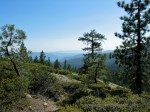
We made it safely to our trailhead.  We started the long climb from the valley floor toward or goal, the top of El Capitan.  There are only two ways to get to the top of El Capitan:  hike the slow climb up the back or climb the steep face with ropes.  We picked the long, slow route.

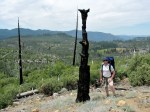
The start of the trail was through what seemed like miles through a burned out area of the forest.  With no shade, we felt like we were being cooked like ants under a magnifying glass.  We were both relieved when we made it into the woods.

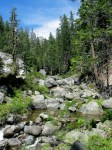
From then on, the scenery improved, water sources were plentiful, and Pat stopped complaining.  However, we both started suffering from mild altitude sickness.  Not something we expected at those elevation.

We ended up stopping short of our distance goal for the night.  We had trouble forcing ourselves to eat, feeling slightly nauseous.  We happened to pick a mosquito resort area, so we quickly retreated to our tent and went to bed early.  I realized as I fell asleep that the one thing I’d forgotten was gatorade–it’s awesome when altitude sickness is an issue and you need calories that don’t make you nauseous.

Oh, and the non-toxic mosquito repellant didn’t work.