The Climb to Schlossberg Tower

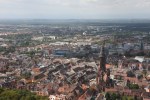
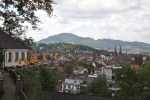
In contrast to yesterday morning, I wake up feeling like whatever bug Pat was fighting has been evicted only to find it’s way over to me. I get up groggily at 6AM, but end up returning to bed until 9AM. When at last I wake up, Pat is already out of bed. We get ourselves ready and head to breakfast, debating what today’s agenda should be. Pat suggests we go hiking again. I suggest we hike up the mountain this time and take the cable car down, as my knees will not take another day of downhill. Pat does not want to work that hard, so I suggest we walk over to Shlossberg and walk up to the tower, which is supposed to be a fantastic view of Freiburg. I’m not sure why I wasn’t tipped off to the fact that if we walk up to a scenic overlook, we will also have to walk down, but I cheerfully propose this alternative, thinking it will give our knees a day to recover.

After breakfast, we wind our way through Freiburg to the restaurant the marks the start of the ascent to the tower. The sign says 1.2 KM to the tower and I smile encouragingly at Pat that it’s such a short walk. As we start up the path, we quickly learn how cramped our poor calves are from walking downhill all day yesterday–each step feels like a massive stretch. But, it feels good and we take it slow. A little too slow, perhaps–a group of octogenarian Germans passes us like we’re standing still. We pick up the pace a bit. After winding our way through several steep switchbacks, we reach a restaurant and realize it’s the same restaurant that we thought we were at below. I am a little perplexed that it seems like we’ve gone at least 500 meters, yet we have only made it from the entry point to the restaurant.

We continue up the incline, much of it as steep as basement stairs. We pass enormous trees covered in graffiti as well as ancient ruins also covered in graffiti–we are surprised by the tagging every where in this relatively small town. At last, the climb gives way to a flat place where a playground with large wood structures provides a place for young children who aren’t exhausted to burn off energy while their parents catch their breath. I notice there aren’t any children here. I recline on a chain link hammock in the middle of the structure long enough for Pat to take a rare photo of me. When I view the photo on my camera, I remember why I prefer to stay on the other side of the lens.

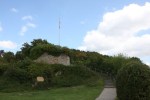
We continue on to the next stretch of the path, winding our way up even steeper climbs. Finally, we come to the ruins of a tower with a serpentine path up to the top. We look over the view and I shoot, enjoying the breeze as much as the scenery. I turn around to shoot the other side and see another mountain behind us. I lean back to take a shot and, there in my lens at the very top of the next mountain is a structure silhouetted against the sky that looks remarkably like the symbol we have seen marking the path to the tower. Yes, I have just discovered that we are not at the tower at all, but only at a stopping place on the way.

I break the news to Pat. The tower looks far off in the distance, but we are determined to make it there. All wisdom about “enjoy the journey as much as the destination” abandons me as I focus on putting one foot in front of the other to finish this climb. I wonder how they measured the 1.2 KM–perhaps it was as the crow flies or, perhaps they meant it was 1.2KM straight up? Whatever the case, we redouble our efforts and leave the octogenarians in the dust (I am not proud to say that I was pleased that they turned around at the first tower because I would have been humiliated if the climb to the top was just an afternoon stroll for them). At last, we come upon the steps leading up to a grassy field where the viewing tower sits. It’s a crazy looking structure–giant logs support a spiral staircase up the middle with viewing platforms at multiple heights.

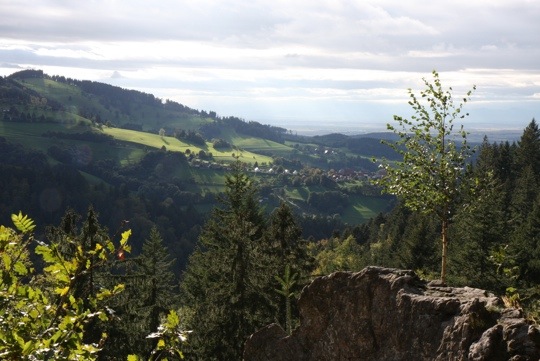
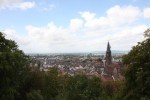
We enter the spiral stairs and I start counting each step. Then, I realize that perhaps in Germany this is not considered OCD as they have actually numbered the steps for me. 159 steps later, we arrive at the second to last viewing platform, but the steps narrow and continue, unnumbered. I climb up 16 more steps to the next platform and discover that the steps go up even further, past the viewing platform and shooting into the sky like an abandoned step ladder. I climb to the very top, but the stairs sway side to side. I take a step backwards and brace myself against the rail, every fear of heights I’ve ever had suddenly screaming in my ears, “Get down!” But I will not retreat until I have at least a couple of shots from this vantage point–it truly is an incredible view of Freiburg below and, for once, there is no fog. I manage to let go of my death grip on the rail long enough to snap a few careless photos and then I retreat to the platform where Pat waits. A man comes up the stairs below and the entire tower sways as his weight shifts with each step. Although the swaying is less amplified on the platform than it was on the stairs to no where, I am happy when Pat suggests we go down another level and sit on a built in bench for a while. When we sit, we notice a small lock snapped on the fence below the rail. It is engraved with two people’s names and a date. It seems like a nice way to tag something.

We cautiously make our way back down, but my left knee immediately starts with it’s shooting pains after only a few steps. I use the handrails to lift myself down, trying to save my knee for the descent down the hill. My knee really shouldn’t hurt this much–oddly, it’s my right knee that I previously injured, yet my left knee always starts with the pain first, my right knee catching up later. We limp our way down to the restaurant, feeling very old indeed. We decide it’s past time for lunch, so we might as well take a break and eat here. Unfortunately, the nice restaurant is no longer serving lunch, only coffee and dessert, and they send us up to the beer garden above. It’s only one flight of stairs up, so we settle at a table there and Pat goes up to the stand and orders food for us. He returns with what looks like a plate of worms. It turns out, it’s some meat like bologna that’s been sliced into thin strips and tossed with vinaigrette. Pat frowns at it–he says it’s not prepared properly and that it isn’t what he had in mind. We each try it. While it isn’t as bad as a plate of worms, it’s not significantly better. We manage to get down a couple bites each and then shift our focus to our beers. The beer is good. We sit in the sun filtered through heavy trees and drink our beer thinking life is pretty good in spite of the bologna salad. The view was worth the climb and the sore knees and, after all, we’re sitting in a lovely beer garden enjoying German pilsner with nothing else that has to be done today.

Hiking the Black Forest

I wake up at 6AM, surprisingly on schedule for having gotten so little sleep the night before. Pat, however, sleeps until I wake him at quarter to nine in spite of the fact that he fell asleep two hours before I did the night before. He jumps out of bed and throws on some clothes–we have purchased breakfast with our room and he doesn’t want to miss it.

The breakfast is a large buffet that offers foods that range from the same kind of fare at American hotels to a very German assortment of meats and cheeses. I opt for a small plate of fruit, a croissant, smoked salmon, and a small piece of cheese. I go back to make a waffle, but someone else is using both irons, so I eat corn flakes instead. After filling up, we return to the room with me thinking we’ll get ready to go to the Black Forest immediately.

Pat, however, has other plans. He lays back down “only for a minute” and falls sound asleep. I get out my iPad and read. This has happened every time we’ve gone to Europe together. Pat can’t get started before noon and I can’t stop until I collapse around 1PM. I resign myself to trying to stay awake all afternoon and let Pat sleep, slipping out to the terrace to read since it’s more pleasant than our room and I think the sunlight will help reset my biological clock.

I return to our room around noon and wake Pat up. We are not going to spend an entire day in bed. Pat says he feels like he’s fighting something and I feel bad for waking him, but he gets up anyway. We pack a single day-hike pack, filling the water bladder and stuffing it with an extra lens for my camera, his rain jacket, two pairs of reading glasses, and an assortment of maps–our loot from the tourist center yesterday.

We walk to the street car and purchase two tickets. The ticket machine is in German and I am grateful that he is the one figuring out how to buy the tickets. When we get on the street car, we stamp our tickets in a timestamp machine, i ask Pat what happens if we don’t stamp them and he tells me that there is a big fine for not having a ticket. As we come to the next stop, a blonde woman gets on wearing a T-shirt and cropped jeans and carrying a black messenger bag. She could be a college student, but she looks closer to our ages than to a 20-something. Continuing our conversation, I suggest to Pat that if he sticks to speaking English, we might get away with not stamping the ticket, but he seems quite nervous about this suggestion–apparently, Germans follow the rules. A minute later, the blonde woman approaches us, holding out an ID that shows she is “control” and asks to see our tickets. Pat gives me the “I told you so look” as she examines our properly stamped tickets.

The street car takes us to the end of the line where we transfer to a bus on the same tickets. The bus takes us to the cable car, which will take us to the top of the mountain. I suggest that we hike up instead, but it’s over a 1200 meter rise in elevation and Pat isn’t feeling up to that kind of climb. A woman with two small daughters rides up with us. She tells us they were there the day before and have returned to retrieve a forgotten teddy bear. She was forced to pay for the cable car a second time, which hasn’t made her happy, but her ire is directed at the cable car operate, not her daughter. They talk softly and laugh often. Upon discovering that I speak only English, the girls practice their English a little on me–they start learning English and French in the first grade. One girl asks me, “What is your name?” in perfectly clear English. I reply with, “My name is Dianne” and we both giggle as if we’ve told a joke. I giggle because I think we sound like every language book I’ve ever used and not at all like a real conversation. I’m not sure why she giggles, but maybe I am the first person she’s talked to who can only communicate in English (as far as she knows) and she’s delighted that her English worked.

As we rise towards the top of the mountain, we go from lovely views of the valley up into a massive cloud of fog and rain. I’m not sure which gods I’ve offended, but it seems a continual theme that whenever I get to a great view point, there is fog. When Pat and I were here last, several years ago now, we spent a day hiking to the Feldsberg (the highest point in the Black Forest) after reading that the morning fog clears in the afternoon. The fog didn’t clear and we could barely see each other if we got more than a few feet apart. We also went to the Zutgsptiz, the highest point in Germany, on a cable car and had a similar experience. You’d think I would learn.

When we arrive at the top, we’re hungry. Realizing we have only a leftover bag of peanuts for a snack, we decide to get lunch at the restaurant. We gorge on lentils with a wiener and snitzel. Of course we each have a pilsner to wash it down. Pat orders a piece of cheese cake to top it off. I have a few bites, but it’s not as good as his Mother’s cheese cake–it took me a few times to get used to the less sweet version of cheese cake German’s make, but now it’s a favorite.

After filling our stomachs, we head for the trail. We have only 2 1/2 hours left until the last cable car goes back down the mountain, and Pat wants to do an out-and-back. I tend to think we might as well just walk all the way down, but I keep this to myself since Pat does better making these kinds of decisions on the fly than in advance. We set the alarm on his iPhone for about ten minutes before half our time will be up, so we can decide then.

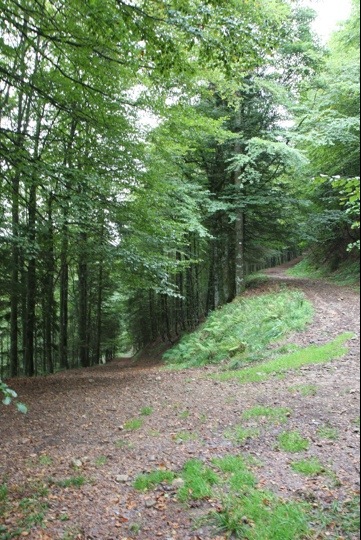
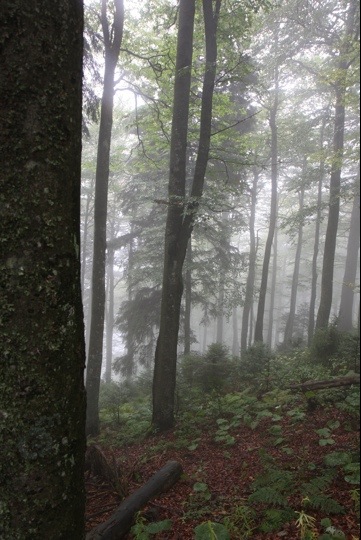
The forest is different than Pat remembers it from his many childhood trips here. There are many deciduous trees and he remembers only pines. When we get lower, there are more pines, but they are younger and less dense than he remembers. It’s beautiful none-the-less and we see few people on this Tuesday afternoon. We hike slowly down a broad path, trying to preserve our knees. The forest is quiet, and so are we. Just as Pat comments that there are no critters, a huge woodpecker appears from behind a tree. I get out my telephoto lens, but as typical, it disappears again before I can get a shot. If we were in the states, I would say it was a Pileated Woodpecker, but it looks different and I don’t know the birds here.

We walk on, the trees clear briefly and we look down into a pasture full of reddish brown creatures that I am sure are cows. Pat thinks they are deer, but the long lens on my camera proves my eyes are better than his. We wonder if there are deer here–we have seen no signs of them.

As we continue down the mountain, the path gets narrower, steeper, and rockier. My left knee reminds me that I am 44 and I’ve asked a lot of my knees over the decades. We take smaller steps, careful of the rocks, trying to step lightly on now painful knees. I don’t like hiking as much when my knees are shooting sharp pains up my legs with every step, but it still beats laying around. I think again that we would have been better off hiking up than down, but I don’t say anything.

We find ourselves at a junction that doesn’t match anything on our map and has no signs. We debate which way to go. A man on a mountain bike appears from the path above us and Pat asks him for directions. We follow his advice and walk on. A few minutes later, our alarm goes off. Pat looks up the hill we have been working our way down, the grade seems daunting, and suggests we continue down instead of going back up. I agree, since that was my plan anyway, but I’m glad he thinks it’s his idea. We walk on as the trees grow thicker and the forest darker. Pat wonders if we will make it back before dark. I realize that we didn’t take anything out of my pack and put it in his when we left mine behind–the first aid kit, the emergency blankets, the flashlight are all back in our hotel room. If we were confident that we are on the right path, we wouldn’t have these worries, but we are not.

We continue down the trail, reaching another confusing junction. The problem with tourist trail maps is that they don’t have all the trails on them. I don’t know why people think you don’t need that information–it’s hard to locate yourself on a map if you can’t recognize the drawing compared to the situation. I suppose this is life, however, you never really know exactly where you are, but you keep moving forward in the hope that it’s the right direction. Another cyclist appears as we ponder the signs at this junction. He comes up behind us, pondering as well. I say, “Do you know where you are?” to him. Pat laughs because I have spoken to the man in English without warning. But the man answers, he thinks he does. Pat consults with him and we head down one of the trails.

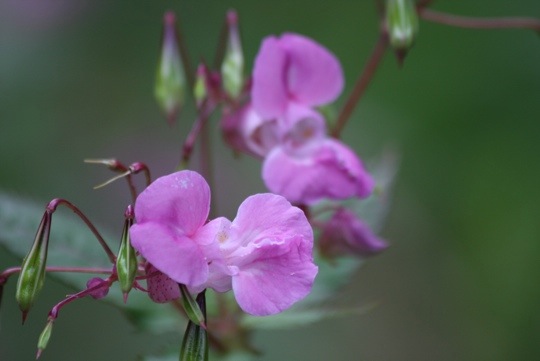
The sound of hammering reaches us from the valley below and we think we must be getting close to civilization. We reach a dirt road that runs along a stream, with banks covered in purple flowers. They are so fragrant, the air drips with their sweetness. We pause to check the time; it’s nearly 6PM. We wonder what time the last bus stops at the cable car station. The trail cuts to the left from the road and winds through a pasture surrounded by electric fences containing goats. We pass by, watching the goats, especially a baby. They are preoccupied with eating and barely notice us except one, who follows us along the fence as if he thinks we might be good for a hand out.

The trail goes back into the woods, down another steep incline, and then comes out to a paved road. It is a country highway and we cross it at a blind curve, hurrying so as to avoid surprising any drivers. Then, it returns to woods. We are going slowly again, now. In spite of feeling time pressure, our knees will not tolerate a fast pace as long as we are headed downhill. When the path looks clear, we take turns turning around and walking backwards, stretching our calves and resting our knees. Walking backwards, however, is not easy, so we give up when the trail becomes rocky again. Eventually, we can see the cable car. We wind our way through an open field and one more wooded area to the parking lot, relieved that we made it, but still not sure of the bus.

We walk to the bus stop and read the signs. There is no where to buy a ticket and the signs are somewhat confusing, besides being in German. I decide that the sign indicates a bus will come in 7 minutes. Pat has to be convinced that the numbers are times–apparently the words only make the sign more confusing. We sit and wait, the cable car station is completely shut down, looking as if it’s been boarded up for the season, although I know the wooden shutters will open again tomorrow. The bus arrives in just 2 minutes, ending our worry, but it’s going the opposite direction. The driver tells Pat we can get on now and she will turn around in a few stops. So we board and ride. I’m glad we did because the views from the mountain road of the setting sun are fantastic.

When we stop at the turn around point, the driver turns off the bus and we sit for a few minutes. I notice a ticket machine on the bus and Pat goes to purchase tickets for us. He’s unable to decipher which tickets to buy and another man, having just gotten on the bus, comes over and helps him. Germans do not understand why my husband speaks German with no accent but doesn’t know how to do things like buy bus tickets. This man is patient, however. Now that we are legal again, we sit back down and enjoy the views once more as the bus takes us back towards town. We are tired and ready for our next meal.

20110917-013031.jpg

20110917-013043.jpg

20110917-013102.jpg

20110917-013126.jpg

20110917-013136.jpg

20110917-013150.jpg

20110917-013213.jpg

20110917-013231.jpg

Getting to Germany

Having driven to the Atlanta airport, checked our luggage and picked up our boarding passes, we head for the MARTA station. We pause to do a time check and debate whether we’re better off spending the 3 hours until our plane starts boarding in the airport or going downtown for lunch. We want to allow plenty of time, figuring security will be tighter since it is the tenth anniversary of 9-11. I say, “Let’s go downtown–it will be more of an adventure than sitting in the airport.” Pat agrees.

Once we settle onto the MARTA train, we start calculating how long we will need to get back, get our carry-on bags out of our car and get in the security line. We have allowed ourselves 30 minutes of travel time in each direction and still have an hour and a half to get lunch. We get off at the Peachtree station since it’s an area I’m familiar with. I forgot that it’s a Sunday and the Atlanta downtown is not exactly hopping. We head towards the Olympic park once we find ourselves back above ground. It’s a beautiful day and the walk more welcome since we are about to take a 9+ hour flight.

We find a Googie’s hamburger place in the middle of the park. I order a coke float with my burger and we sit outside. There are plenty of people in the park. Some are playing a sport I can’t identify because they are downhill and all we can see is the top halves of people moving around a field. I assume it’s soccer. After relaxing in the shade of a giant old tree while we finished our meal, we head back towards the MARTA station. The walk is now uphill, the sun is higher, and the temperature is rapidly rising. Pat starts sweating through his shirt and then worrying about being all sweaty getting on the plane which probably makes him sweat even more. The platform is surprisingly warm considering how far underground we are. I think back to how long the escalator was and wonder if we are now so close to the center of the earth that the temperature is higher. 🙂 Pat, in the meantime, moves us to the center of the platform between two giant fans that circulate the air. He stands with his arms spread, trying to get his shirt to dry.

Back at the Atlanta airport, we are surprised that security does not seem any worse than usual. We get through the line in 15 minutes and neither of us is randomly scanned in the new “naked” scanners. When we amble up to the gate 45 minutes before our flight, they are all ready boarding all passengers. The boarding process for long flights is different than the short domestic hops–people take their time and settle in gradually. Yet, the entire airbus is full and everyone is ready to go well before our take off time.

The man sitting next to me (I took the middle seat) starts up a conversation. He tells me he’s on a business trip and I ask who he works for. It turns out he and I work for the same company! I wonder aloud how many people on this flight are our colleagues and what the odds are that we would end up sitting next to each other. He also was part of a smaller company acquired by our now mutual corporation. We swap stories of integration and he tells me that everything will settle down and seem normal in three more years. I was really hoping it would only be one more year.

As the plane reaches altitude and the movies become available, he reaches for his ear buds and I reach for my iPad. We do not talk again in the 9 hours that we sit next to each other until we are arriving in Frankfurt and he points out the location of the office he’s going to on the flight map. That’s OK. We’re unlikely to ever see each other again anyway.

The flight goes smoothly, although my knees start twitching when I get tired and it is impossible to get comfortable. I long for the days when I used to fly business class, but it’s hard to justify paying 4x the price for an already expensive ticket when the trip is only 9 hours. I nod off in fits and starts and wake again every 10 minutes. I think I managed to collectively get a couple hours of sleep, but I feel like I was up all night when the flight crew turns the lights back on and starts serving breakfast. Having lost 6 hours between dinner and breakfast, I’m not really sure I’m hungry, but I eat anyway.

When we deplane, there are no restrooms between the plane and immigration. The line is endless and moving slowly. We wait for over half an hour crossing our legs and trying not to think of water. A man is escorted away just before we are called to a desk. This often happens to Pat–he apparently has the same name as someone on the no-fly list. Having been detained 4 times now, we cross our fingers that this won’t be the fifth. Luck smiles on us and the agent stamps our passports. We find a restroom and our luggage and look for the train.

We take a bus to terminal 1 to get to the train. But, having done very little planning for this trip, we have to wait in another long, slow line to get our train passes. On most our trips, I take care of these arrangements, usually in advance. But here, Pat takes the lead since this is his birth country and German is his first language. I am reminded of a man who recently told me I need to learn how to follow; it doesn’t come naturally to me. I would like to think I am a natural leader, but I suspect I’m really just a control freak. While the ticket agent speaks fluent English, Pat’s command of German gets us 4 days of train travel in first class at a reduced rate, saving us about $550 Euros. Not bad for just letting him do the talking.

I have ridden the train in Germany before, but it’s more impressive to me this trip having taken the train from Portland to Glacier National Park back in the states since then. First, German trains are on time. Second, they run as efficiently as subways, often having only 3 minutes between arrival and departure. Finally, they are so quiet and smooth that you have to remind yourself you’re on a train. The first class car is an extra bonus–after being so cramped on the plane, it’s nice to lay back and stretch our of legs fully. I am always amazed at how tired sitting on a plane makes me feel.

In spite of being re-routed once on the way to Freidberg due to weather, we arrive only 10 minutes late. We find a cab and get to our hotel only to learn that our room won’t be ready for 2 1/2 more hours–it’s only 12:30PM. We check our bags and drag our tired selves around this ancient black forest town for an hour. Then we sit outside in a square by the farmer’s market and eat. Oh do we eat! I allowed Pat to order for me and he has chosen two dishes that we share. One is a “fine” bratwurst with fries and the other is some kind of dumpling stuffed with vegetables neatly ground and mixed with cheese. Both are good, but the brat particularly hits the spot today–maybe because it goes so well with the pilsner we drink?

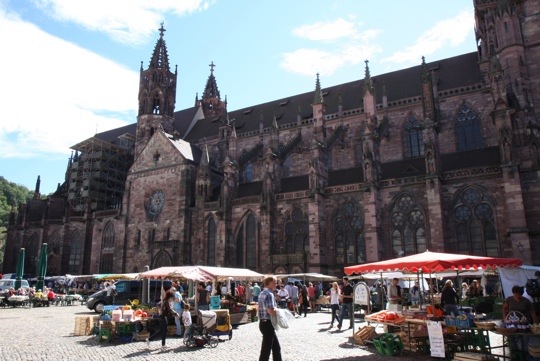
We sit in the shadow of an enormous church that was razed to the ground during World War II and has since been reconstructed, stone by stone. They are still working on it or working on it again; scaffolding shrouds the main steeple. The courtyard below is full of vendor’s tents–it’s an open farmer’s market that apparently opens every morning and shuts down every afternoon. By the time we are done with our entrees, the tents are disappearing.

We sit a while longer, ordering meringues for dessert. They are served with ice cream, whipped cream, and carmel sauce. I resign myself to gaining weight this trip and relish the dessert. We are surrounded by locals and tourists alike. One table over, a group of Americans discuss their plans while failing at keeping their young children entertained, resulting in crying and whining. I wonder if German children expect to be entertained all the time, but none are around to watch.

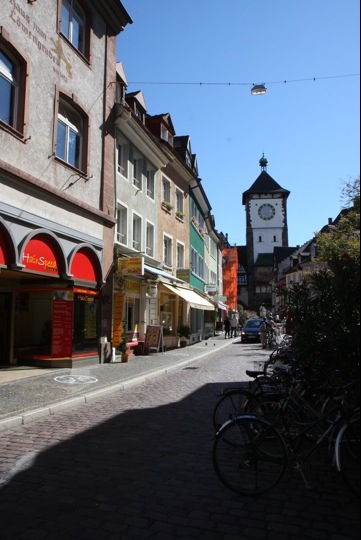
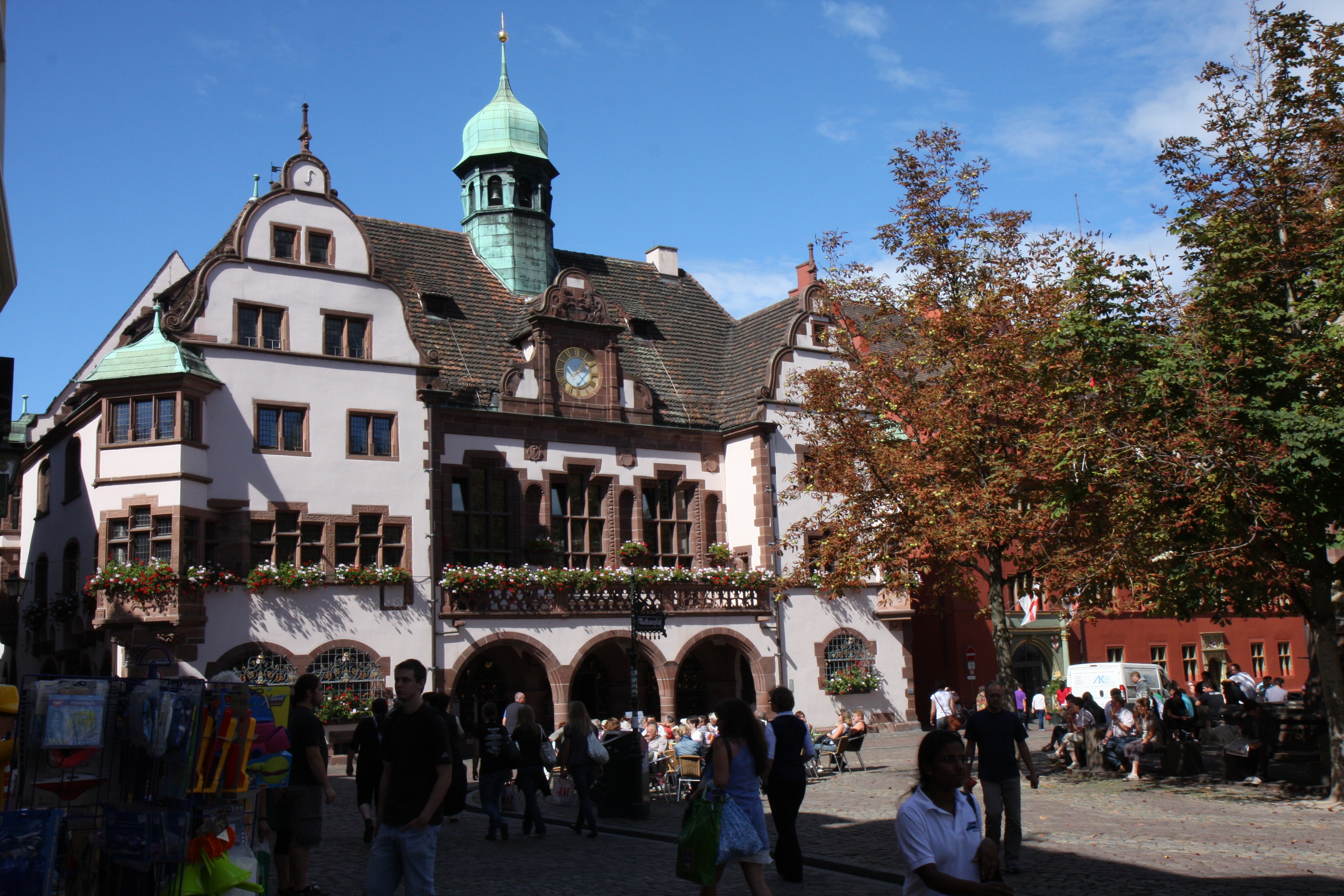
We wander around the town some more, struck by the stone streets and the old architecture laden with flowers. Nearly every building has flower boxes at every window. We attempt to walk to the river, but get ourselves mixed up. At 3PM, we stop in a coffee shop to use the restroom, get directions, and buy a bottle of water. We head back to the hotel more than ready for a nap.

20110917-012527.jpg

20110916-071055.jpg

20110916-071005.jpg

20110916-070945.jpg

20110916-070924.jpg

Traveling on the Tenth Anniversary of 9-11

It’s just after 10AM and we are packed and ready to leave for our two week vacation in Germany. We are flying out of Atlanta because the flight schedule to leave from Chattanooga will not get us home in one day. We have a plan for today: we will drive to the Atlanta airport, check two of our bags, leave our carry ons in the trunk, and take the MARTA downtown for a few hours before our flight. We divide our bags between us and head out the door looking somewhat like pack mules.

The weather has cleared and warmed up again. It’s cool this morning, but promising to get into the upper eighties. We are preoccupied with our plans and have not given much more than a passing thought to the significance of this day. But as we cruise down the highway around Chattanooga, we pass under a high overpass with a group of people on it unfurling a huge American flag and waving. I wave back as we pass under the enormous flag, and am instantly returned to ten years ago.

I was at my desk on 9-11, thankfully on a reprieve from the constant travel that I did at that time of my career. My phone rang and a colleague in NJ excitedly informed me that a plane had just crashed into one of the World Trade Center towers. At first, I waited for the punchline, assuming it was a joke. He didn’t yet know that it was an attack; it was just a crazy event for the next half hour until he called me back and told me that a second plane had crashed into the other tower.

I went down the hall to talk to my boss. He was getting updates and it was clear now that this was, in fact, the first attack on American soil since Pearl Harbor. In that moment, the sense of security I’d never known I had was shattered. Many of us gathered in the halls, talking quietly of people we knew who worked in the area. More news came in and we heard of the two other planes, one still in the air. Most of us decided to go work from home the rest of the day–it felt safer not to be in a building that once (decades ago) employed over 18,000 people.

When I got home, I turned on the TV and watched the news. I was on the phone with more friends and colleagues in the NY area, each of us recounting the stories we had learned of missing loved ones. For me, it seemed close to home even though it was a distant event. I was happy that all travel was suspended for two weeks–no one seemed to want to have a meeting in light of the tragedy. I had no desire to go get on a plane.

When I flew into Newark two weeks later, the airport seemed like a ghost town. I met with customers that day who had regular meetings in the trade center prior to 9-11. Two of them recounted their 9-11 stories. One missed being on the 11th floor of the first building when it was hit only because he’d stopped to get a cup of coffee. The other was in the street when the first tower collapsed, diving behind a dumpster with a woman he’d never met before and running for shelter in an abandoned building, barely escaping unharmed. They still didn’t know if the people they were on their way to meet had survived. I never learned the outcome.

I add these stories to my collection from people who had relatives in the city that day–one of my colleague’s daughters had a terrifying day just trying to leave the city to get to the safety of her parents’ home. Photos of one of our customer sites across the street from the destruction were forwarded around. An entire wall is missing from a data center that houses the equipment we make. Those of us who know the people that work there are stunned by these photos. These stories make what might just seem like something in the news feel next door. I am reminded of a person I once met who was sent to Grenada (or was it Panama?) in the military. He described walking through a suburban neighborhood while under attack. I imagine war in a whole new way when I hear his descriptions. I try to imagine where I would hide while soldiers go through my quiet suburban neighborhood shooting at one another.

These are the images that come to mind as we cruise along the highway. I think about what it would be like to live somewhere where personal safety is a foremost concern on a daily basis. In the ten years since 9-11, we have collectively forgotten the fear that the attack created and been more annoyed by ridiculous security rules in the airports that are hard to connect to increased security than worried about repeat attacks. I suppose that’s a good thing. After all, what would being afraid accomplish? At the same time, prior to 9-11, no one would have thought that a terrorist would crash a hijacked plane. Since that day, I’ve swapped many stories of “what we would do” with fellow travelers, each of us feeling personal responsibility for the safety of each flight in a way we never considered before.

I received a news alert from the Wall Street Journal that plans for car bombings on 9-11 were discovered and foiled. I feel oddly reassured by this news, I suppose the fact that they were found out and prevented is reassuring, but it always makes me wonder what else is going on that they haven’t found out about yet? I think the majority of the relief is purely selfish–the attacks were about car bombs and not planes and, after all, it’s a plane I’m getting on.

I feel like I should pause for a moment and honor the dead, the injured, and the chronically ill that resulted from 9-11. Yet, in some respects, do I honor them by flying on this day? Does the fact that I feel confident enough to get on a long, international flight say that we recovered well? It is impossible to know what the people most horribly affected by the attack would say, but since I am going to Germany today regardless, I choose to think they would be pleased. I say a silent thank you to the men and women who responded to the attack and an apology to those who did not survive. Then, I tuck away my fears and focus on the road ahead.

Rain Day

After camping next to noisy neighbors our first night in Great Smoky Mountain National Park, we opt for a hotel in Cherokee, NC our second night.  All night long, it rains hard.  I wake up only once in the night and am confused by the sound of rain hitting the roof–I realize that it hasn’t rained since we moved to Chattanooga 3 weeks ago.  I lay in the comfortable bed warm and dry, listening to the rain for a minute or two until my eyes close and I return to sleep.

When I wake up in the morning, I step out onto the balcony.  The river behind the hotel doesn’t look anymore swollen than it did when we went to bed the night before.  I’m puzzled by its ability to move so much water without rising perceptively, but it’s cold outside so I don’t contemplate for long before returning to the room.  Even though I showered just before going to dinner the night before, I decide to shower again just for good measure.  As the warm water wakes me up, I contemplate where we should hike today.  When I get out of the shower, Pat is up and ready to go down for the breakfast included with our room.  I get out the trail map and start pointing to different options on where we can go hiking.  Pat gives me the “I didn’t think you were insane, but now I’m not so sure” look.  Apparently he is not up for hiking in the rain.  I’m disappointed and ask what are we going to do if we don’t hike.  Pat responds with, “Indoor stuff.”  I look at him confused, unable to think of anything we would do indoors that we couldn’t do at home.  “Like what?” I ask.  “I don’t know,” he replies, “we could go to a museum or an arcade or a flight simulator.”  A flight simulator sounds interesting, so I do a quick google.  There are no flight simulators open to the public anywhere within 200 miles.  Pat suggests we discuss it over breakfast.

We walk downstairs and it has actually stopped raining just in time for us to walk over to the lobby entrance.  We go into the breakfast room and I wait in line for the waffle maker.  I think adding a waffle iron to the free breakfast buffet was the best idea in hospitality in the past 20 years.  Once I get my waffle cooking, I sit down with Pat to eat yogurt.  As I stuff a spoonful into my mouth, Pat says, “We cannot hike today.  We’ll get all wet and end up driving home in wet underwear.”  This strikes me as so funny that I nearly splutter yogurt all over Pat.  Containing myself (and my yogurt), I swallow and am forced to admit that he has a point.  There really is nothing comfortable about riding in a car in wet underwear for several hours.  The timer goes off on the waffle iron and I go retrieve my hot, fresh waffle.

When we leave to return to the room, it has started raining again.  We dive through the rain towards the walkway under an overhang and manage to get back to the room without getting soaked.  Once in the room, we debate what we can do for entertainment.  Pat votes for heading home.  I propose a compromise that will take us to the Junaluska Museum in Robbinsville, NC on a scenic route home.  Agreed that this is a reasonable plan, we pack up and get on our way.

I plug the address into the GPS and off we go.  The GPS takes us to Robbinsville without any hiccups, but when it comes to the final destination, we end up on a dead-end road lined with depressing houses in various states of disrepair.  We see a large building behind the houses on one side and think maybe that’s the museum.  After going around the block, we determine that building is an Ace Hardware.  But, we spot a brown road sign that says “Junaluska Museum” and points us down another road in the opposite direction.  We follow that sign to another sign and then to another.  But then the signs disappear and we’ve seen nothing that resembles a museum.  We decide that we are not meant to go to this museum and head on towards Cherohala Scenic Skyway.

Even though the rain won’t stop and the visibility is poor, the Cherohala truly is scenic.  We wind our way around tree-lined curves with frequent breaks in the trees that allow for views over a cliff.  The mountains look like shadows in the clouds.  As we go around one curve, Pat spots a painted box turtle (well, maybe–it’s definitely a turtle in any case) standing just on the other side of the double-yellow line.  He sees it too late to stop, but finds a place to turn around about a quarter mile down the road.  We return in the rain so I can hop out of the car and safely transport the turtle to the other side of the road.  I’m not sure if he was grateful for the lift, but it makes my day in any case.

Continuing towards home, we pass a resort.  Then, a mile further, we see an entrance to another resort with a drive that goes straight up the mountain.  Pat slams on the brakes and pulls in, saying he’s hungry and maybe we can get something to eat.  We find ourselves at the Snowbird Mountain Lodge.  We pull up our hoods and head into the lobby.  Across the parking lot, a large Bernese Mountain Dog lays on a slanting drive, oblivious to the rain.  We go up the stairs to the lodge entrance and a Newfoundland mix lays just outside the door, looking at us nervously as we approach.  We call to him in our high-pitched happy-puppy voices, but he doesn’t seem comfortable with strangers.  We enter the door around him, trying not to scare him with the swinging screen door.

When we enter the lobby, we are instantly immersed in a sense of calm.  The lodge is an old, log lodge with big over-stuffed chairs in a library-like room with a 20 foot or so ceiling and shelves of books lining the walls.  A half a dozen guests look up at us when we walk in.  All of them look like they are just too relaxed to go home.  We approach the inn keeper at the desk and inquire about lunch.  Unfortunately, they don’t serve lunch and the restaurant is closed until dinner, but he invites us to look around.  He asks us if we’ve been in “the park” and when we tell him we’ve been hiking there, he says, “Well, maybe next time you’ll come and hike in the real mountains!”

We walk through the dining room and into the bar.  The bar is full of dark hard wood and seems every bit as relaxing as the lobby even though it’s abandoned now.  The dining room has a large screened porch off of one side with tables overlooking the woods.  Back to the front of the lodge, we find a wrap-around deck with big adirondack chairs lined up facing what must be an incredible view over the mountains on a clear day.  An elderly man is standing under a sheltered portion of the deck when we step outside beside him.  He is watching the squirrels attack the bird feeders.  He tells us we just missed seeing a squirrel get stuck on a feeder, sliding back down every time he tried to climb up until he finally slipped off and fell to the ground.  His delight in the squirrel story is contagious and we find ourselves giggling.  I grab a brochure and add this place to the list of places I want to spend a weekend at.

We pull up our hoods and dash through the pouring rain back to the car–it’s time to find a place to eat lunch.

Our First Visitor

Once again, I am on the balcony when I receive a call from my sister-in-law, Megan. She is somewhere nearby but trying to follow my directions instead of her GPS got her slightly lost. She tells me the street names of the intersection she’s at and I don’t recognize them. I am startled by the realization that I have never driven in Chattanooga and, therefore, I haven’t learned the names of more than 3 streets. She and both start googling, trying to figure out where she is relative to where she wants to be. fortunately, she figures it out–she is only a block or two away. I walk down to the street corner and flag her down as she approaches our building, catching her just before she makes a wrong turn and directing her to our parking lot. Note to self: drive the next time we go somewhere so I can at least tell people how to get to my own home!

The next morning, we run through the list of place we’ve been for breakfast and the list of places we haven’t tried yet. Megan chooses the creperie near Coolidge park. The three of us walk the long way, down along the riverfront. We point out the wetland, the civil war remnants, the aquarium across the river, the pedestrian bridge, all the sights that have become so familiar to us shared with our first visitor. Now we feel like we really live here.

We reach the creperie and it is open (the last time we tried to eat there, the neon “open” sign glowed brightly, but a bolted door sent us elsewhere). The guy working there sits at one of the booths, moves slowly to get up as we enter. We take the booth he was sitting in. He slowly moves to get us menus, then goes behind the counter and starts doing something, still slowly. He seems to have forgotten that we’re there, even though it is a tiny space and we are in his immediate view. We decide what we want to eat and what questions we have and make all of the gestures indicating we need him, but he doesn’t see us. Eventually, we think maybe we’re supposed to walk up to the counter to order; we catch his attention and ask. He looks slightly startled to have his attention drawn from his slow task and comes back around to our table. We ask our questions. I am especially curious about the specials on the chalk board with names like “Diesel.” He describes half of the specials when a family arrives. He says, “We’ll talk about the rest later” and moves away to give them menus. He turns as if to return to the counter and is startled once more when we stop him and remind him he was in the middle of describing the specials. Once we get through the ordering process, which includes coffees, he goes off and starts making coffee. I wonder what he was doing sitting at a booth when we arrived with no coffee made–we are the first customers of the day.

He brings our coffee eventually and we sit and talk, making it through an entire cup with no sign of food. Our waiter/chef seems to get distracted each time someone new arrives and it’s become obvious that he had done no prep for the Saturday morning crowd before we got there. He notices that we are out of coffee and asks if we want more on one of his passes. I hand him my cup and he turns, sets it on the counter, and then goes back to cooking. Another waiter arrives then. He checks on us and we point out the empty cup still sitting, forgotten on the counter. He brings me coffee and our food arrives about 10 minutes later. Now that there are 2, things seem to move along a little faster, but we cannot help but wonder if the first guy is high.

The food is hot and good, although Pat says his mushroom crepe is greasy. Megan and I are both pleased with our crepes that wrap around combinations of eggs, meat, and cheese. We finish up and head out, walking down to the park and continuing our tour of the North Shore waterfront, ending up on the Walnut St bridge and walking over to the South side. We pause often along the way, enjoying the view, the breeze, and the mass of people out on a beautiful Saturday morning. On the other side, we debate where to go–the Hunter Museum or the aquarium. Megan opts for the aquarium and we head downhill.

The Tennessee aquarium rivals the biggest aquariums in the US with a building for ocean exhibits and another for rivers, plus a butterfly exhibit and a huge atrium with otters playing in a simulated river below and many native birds flying freely overhead (although there is so much space, you need binoculars and patience to see them). I love aquariums. Today, I have the new experience of hand-feeding a shrimp to a sting-ray. It’s fascinating to watch the rays in a shallow pool where you can pet them, but feeding one causes it to come up out of the water to position its mouth high enough to grasp the shrimp. It’s my turn to be startled when I feel its teeth graze the backs of my fingers. I wonder how life would be different if our mouths were positioned where our belly buttons are.

We move through the exhibits slowly, not remembering many of them from our last visit, we are fascinated by the diversity of life captured behind glass. The penguins put on a good show for us. Watching them shoot out of the water, popping up several feet in the air to land on the rock ledge above the water with impossible grace, makes me marvel at the specialities represented by other species. Their feet are what really catch my attention, though. Thick and strong when they’re on the rock, but flipped back like tiny paddles when in the water, I cannot comprehend how feet can transform so dramatically in an instant.

We enter the butterfly exhibit and hunt for the species of butterflies fluttering around us. A woman with a toddler on a leash walks around us. As she tries to point out butterflies to her young son, he spots a “caution, wet floor” sign painted with butterflies, smiles and giggles and runs up to it, fascinated by the pictures at eye level. The woman jerks slightly on the leash and says, “No” firmly as he grabs the sign with both hands. She looks disgruntled and maybe embarrassed as she sees me smiling at him and says, “Of all the things for you to look at!” I am slightly disturbed when I witness parents who lack the insight to recognize that the world looks different to a child. I would have liked to have seen her get excited that he recognized the butterflies, even though they were drawings, and used that excitement to draw him into to recognizing the real thing if an opportunity arose, but not all parents are teachers. I turn away wondering if I could have or should have helped with that situation, but involving oneself with strangers’ children is always tricky.

We enjoy the rest of the aquarium, wrapping up our visit mesmerized by the jelly fish displays. Why is it that jellies floating calmly through gentle currents are so hypnotic? Returning to the bright sunlight outdoors, we decide to take Megan to our favorite Mexican place, Taco Mamacitos, for lunch. The waiter gives Megan the full introduction to the menu and sells us both on trying their most popular taco, which I’ve not had before. It is a hard shell wrapped in a soft taco filled with goodness. It’s the first time I’ve ever eaten a hard shell taco without half of the shell crumbling all over my plate. Finishing up our margaritas, we decide a nap is in order. We return to home base for an afternoon siesta and I think, “What a perfect Saturday.”