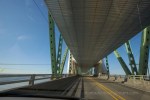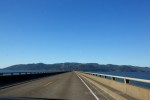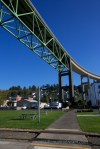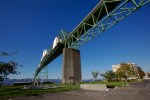
The Open Road in Sepia

Hanging out on the tip of Washington in a place called “Dismal Nitch” might sound depressing.  However, according to the National Park Service, its name was derived from the journal of Capt. William Clark who referred to the site as a “Dismal Nitch” after being stuck there for 6 days in a storm waiting for supplies.  For the Lewis and Clark expedition, it was the last miserable stop on the Columbia River between them and the Pacific ocean.

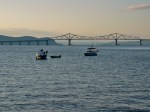
For us, it was a beautiful, sunny day that gave us great views of the Astoria-Megler Bridge, the Columbia River, and the mountains beyond.  However, having driven over the ridiculously long bridge, stopped at Dismal Nitch, watched the pelicans diving after fish, and watched the sun start to sink lower in the sky, we decided it was time to start heading back towards Portland.  We had one more stop in mind and we wanted to get there by dusk.

On the way back, I did some more “through the windows” shooting.  I’m fairly certain there is some law of photography that starts with, “Thou shalt not do landscape photography from a moving vehicle.”  Oh well, rules are made to be broken.

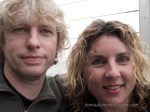
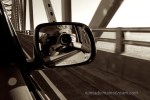
I know for sure there is some law of photography that says all photographers must at some point take a shot of themselves in a mirror.  I’ve resisted for a really long time.  But when I caught my reflection in the side-view mirror, my will power crumbled.  Like being drawn into a black hole, I felt compelled to press the shutter button.  Too bad I didn’t have try a slower shutter speed–it might have been interesting with the bridge blurred in the background.

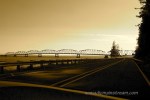
Having captured some similar images of the bridge going the opposite direction, I found myself somewhat bored with today’s selection of photos.  I decided to change them all to the sepia preset.  I went a little wild with the orange tones in the first image–it evoked the idea of sunset for me.

The pairs of images are yet another semi-happy accident I wish I would have thought of when I was shooting because I would have shot them a little differently.  Maybe with the road going left and then right or something.

Regardless of what I might have shot differently or whether I shot something similar before, there is still something evocative to me about looking down the road.

What is it about an empty road that seems so prophetic?  My nomadic desires were suddenly reawakened by the sight.  The possibilities promised by going somewhere new seemed irresistible.  But on this day, the road didn’t lead to a place we hadn’t been before.  Just like life, sometimes we drive in circles.

Through the Glass

There is only one thing disappointing about the Astoria Megler Bridge:  there’s no place for pedestrians.  I guess it would be expensive to add a pedestrian walkway to a bridge that spans over 4 miles, but the views from the bridge stretch over the bay to the distant mountains in Washington and back to the South in Oregon.  Plus, the pelicans and gulls fly over the bridge at eye level.  It would be a great place to shoot.

I decided to try shooting through the windshield.  I have a lot of experience shooting through car windows–one of the sadder ironies in life is that wildlife tends to be more afraid of humans walking in the woods than of cars racing down a freeway, often to their own demise.  This leads to me trying to capture images of moose, elk, bears, etc through car windows more often than on foot.

On the positive side, I have learned a few tricks.  First and always applicable, get as close to the glass as possible.  This puts all the crap stuck to the glass completely out of focus so it doesn’t show up in the photos (the spots in the last image are actually birds that were flying too fast to be in focus).

Second, if you can’t roll down the windows and stick your head out, shoot through the front windshield if you’re shooting wide angle.  There is just nothing appealing about a composition that looks like this:

Third, if you’re shooting with a long lens, it’s easier to shoot out the side window, but watch for the blasted rearview mirror.  Shoot tighter, sit cross-legged to get up higher in your seat, roll down the window and prop the lens on top of the rearview mirror (not recommended in a rapidly moving vehicle).  Do something to get that mirror out of the frame.

Fourth, don’t forget about reflections.  If you have a polarizer, you might be able to get rid of them that way.  Unfortunately, sometimes you have to live with them (like in the first photo in the gallery).

Fifth, if you’re shooting though the windshield of a car going 50+ MPH down the road and you’re trying to get lots of depth of field, you can focus on whatever spot is in front of the car and then shoot, even though the spot you just focused on is gone by the time you push the button.

Finally, if you are shooting while the car is in motion (hopefully because someone else is driving it), remember that the speed your moving affects the shutter speed you want to use, depending on whether you want sharp or blurred images.  Oh! I just had a great idea for shooting the drive down the far side of the bridge (yes, I just smacked myself in the forehead since I am not planning to be back in Portland again for a year).

Bridge Over Troubled Water

On our trip to Portland oregon, we made a stop at Astoria, a town as on the corner of Oregon as it gets.  In fact, the 4 mile long Astoria Megler bridge crosses from The north-most, west-most corner of Oregon to Washington.

We planned to drive across the bridge, but decided to make a stop to see the under-side of the bridge before making the crossing.  To be honest, this was because we couldn’t figure out how to get onto the bridge and were circling around confused when we spotted a Naval memorial under the bridge.  We pulled off and checked out the nautical monument and coastal scene.

The nautical monument is like a miniature wall that captures the names of those who have died in service to the sea.  The roles of the people range from boat captains to daughters of boat captains.  It’s an interesting exercise to read the names of the people and what is described as their job. I wonder if it was difficult work to be a sea captain’s daughter?

Mt Hood and the Mighty Ducks

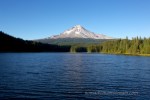
If the Tualatin River Wildlife Preserve wasn’t enough for one day, taking a drive up to Trillium Lake by Mt Hood sure did top it off nicely.  Trillium lake has a lovely two-mile trail  around it and we were promised a great view of Mt Hood by the internet, which is always right.

We decided to get there a couple hours before sunset so we’d have plenty of time to walk the two miles and pick out the perfect spot to shoot Mt Hood as the light changed.

We didn’t get there two hours ahead of sunset.  In fact, by the time we parked and were walking to the lake, sunset was about 45 minutes away.

Thankfully, the best view of Mt Hood was about a 5 minute walk from the car.  In fact, they built a deck there and put some benches on it so we could be comfortable while we watched the sunset.

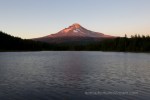
Instead of sitting and relaxing, I got busy setting up the tripod I’d borrowed from my father and getting my camera ready to go.  Moving quickly kept me warm–even with my many layers (a light fleece plus a leather jacket plus a huge, thick fleece borrowed from my dad), it wasn’t exactly toasty.  The wind was whipping up a pretty good froth on the lake, meaning there were no glass-like reflections to be had of Mt Hood.  But, it was still beautiful.

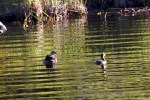
And, sunset took long enough that we had time to take a break from shooting the mountain to walk part way around to get up close enough to identify some ducks that eluded me.

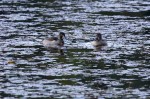
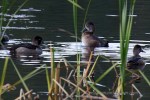
After looking at them through binoculars, shooting them with a 400mm lens, and after enlarging the images to look closely at them, I’m pretty sure the little ones are Pie-billed Grebes and the larger ones are Ring-necked Ducks.  I feel more certain about the Pie-billed Grebes than I do about the Ring-necked Ducks.  They were fun to watch in any case.

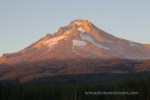
We returned to the deck so I could shoot as the sun faded.  The light turned amber and the mountain shifted from gray rock to glowing orange.  The trees below timber line moved from green to purple on the color wheel.  It’s almost hard to believe I didn’t change the tint or white balance between the early and late shots, but the sun did all that for me.

I kept hoping the wind would die and let me get one good shot of the mountain reflected on smooth water, but the wind only got stronger and I only got colder.  About the time we were going to call it quits, we spotted two otters making their way towards us across the lake.  This was the first time I’d seen wild otters anywhere other than the ocean.

Pie-billed grebes, check.  Ring-necked ducks, check.  River otters, check.  Mt Hood at sunset, check.  Definitely time to call it a day.

In a New York Minute

New York City is . . . You could finish that sentence with just about anything. For me, it’s mostly been a place I go for work or a place I go through on the way to somewhere else. However, there have been a few times when I’ve gotten to spend a justo here for fun.

The most recent time was a few years ago now. I stayed with a friend for the 4th of July weekend on a lagoon in NJ. Most of the Jersey shore lagoons are trapped in concrete and look like man made creations, much like the characters on the reality show (sorry, couldn’t help myself). But it’s surprising to someone who has spent as much time in “The Garden State” as I have just how much of the inner inner coastal areas are as dedicated to boating as the actual coastline is.

As someone who grew up as inland as it gets, the coast always seemed like a definitive line between land and ocean. In reality, the ocean gives way gradually to land, meandering its way deeply into every crevice. While me might intuitively guess at the movement of water, I tend to think of it as moving outward from the land to the ocean and had been oblivious to the interplay of water coming in.

My friend and I took a day off work and took the train from Brick, NJ to somewhere in New York City. We saw so many boats on the way, I thought we had taken a train to Miami.
Once we arrived in the city, however, the boats were all but forgotten. It’s hard to remember Manhattan is an island. It’s amazing it doesn’t just sink under the weight of all the sky scrapers it supports.

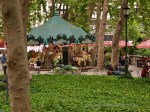
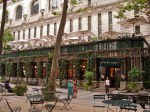
I suppose it comes as no surprise that of the dozen or so photos I took in the city, the majority were in the one park we stopped in. As much as I love visiting cities, I’m always relieved to find a bit off green space producing enough oxygen I feel I can breathe again. We were no where near Central Park, but Bryant Park provided exactly what I needed.
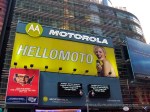
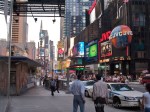
We had a fantastic dinner at a place that specialized in artisan cheeses and then headed to Times Square and Broadway where we saw Mama Mia–it had been running for so long, we had no trouble getting tickets.

The usher/bouncer yelled at me for taking a picture before the show had even started, so I put my camera away and enjoyed the show. I’ve only seen two broadway shows on Broadway, but it is way better than seeing the Columbus, Ohio version. Only London compares to New York for Broadway shows in my limited experience.

At about 11PM, we hauled our shopping bags from Broadway to the train and made our way back to Brick feeling like we couldn’t have stayed awake through one more New York minute.

Quiet Giants

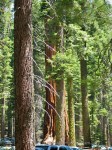
Even as a dedicated tree hugger, I never thought going to stare at trees was particularly exciting. Arboretums, for example, fail to move me.

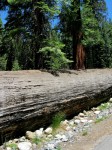
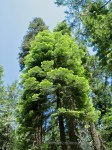
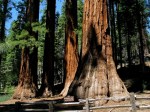
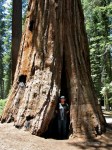
But, several years ago, after 6 days of backpacking in Yosemite, it was a nice respite to head to Mariposa Grove and see the giant sequoia there.

In the same inexplicable way in which the mountains evoke a quietude, these giant trees spoke to me like individual mountains standing amongst a forest of tiny hills. They are the largest living things on the planet by volume.

I once read a historical novel about the settlers of the Pacific northwest in the 1800’s. In that book, they had an intense hatred of trees. The trees stood between them and fertile farmland, sustenance, and shelter.

When I saw the sequoia looming down, as they had in some cases for over 3000 years, among some of the world’s oldest living creatures, I found myself wondering what the early settlers thought of these giants. The Sequoia survived in part because they were fire resistant, bug resistant, rot resistant, and not particularly useful for building anything.

The settlers couldn’t burn them–in fact, fires are quite helpful in promoting Sequoia reproduction and over-controlling forest fires led to a demise in their population.

Their seed cones are tiny pods that pop open and spread seeds when properly dried. The heat of fire, which has the additional benefit of clearing out most of the Sequoias’ competitors, dry out the cones and allow the seeds to disperse.

The Chickaree squirrel can also help disperse sequoia seeds. This little guy will eat sequoia cones and help spread the seeds in part by storing the cones.

Luckily for both the sequoia and the Chickaree in Mariposa Grove, controlled burns are helping to restore the natural ecosystem of the area, encouraging new generations of giant sequoia trees.

The famous “California Tunnel Tree” in the middle of the park probably serves as the best representation of how the early settlers felt about these giant trees. They cut a big hole through the middle of a tree wide enough to drive a wagon and a team of horses through it. Not exactly a sign that they had a sense of awe and wonder about the trees. Seems more like a Graceland tourist trap than a healthy respect for the diversity of life.

In any case, we are all fortunate that Galen Clark did come along with a healthy respect. He saw the testament to grace these trees represented and managed to preserve them.

I imagine life from the trees’ perspective, in which thing move at a pace proportional to a 3000+ year life expectancy. I imagine what a tree “sees” in the course of 3000 years as the make up of the air, the water, and even the very soil at its feet shifts and changes. I wonder if the older trees complain about kids these days or if evolution occurs at an altogether different pace?

The iPhone is Not Enough

On Labor Day, I was hiking my way back from an overnight in the backcountry.  The next morning, I was up at 5:30AM so I could get on a plane to Orlando for a work conference at Disney World.

Because our conference hotels overflowed, I was moved to The Animal Kingdom Lodge.  Having not been inside the Disney World gates since I was 9, I didn’t know that there would be an actual animal kingdom outside my window.

Had I known, I might have figured out a way to pack my camera.

Having reduced our worldly possessions by about 80% over the course of many years and moved into a small apartment with ridiculously limited storage space, one of my greatest challenges has been not to keep acquiring more stuff that won’t fit anywhere.

I make this point because I am starting to think about getting a small, point-and-shoot camera.  Something that will do a better job than my iPhone camera.  And something I can carry backpacking without getting an ache in my neck.

Now, some might argue that I should think about trading in my iPhone 4S for a phone that has a decent built-in camera.  But, I’ve had my iPhone for less than a year and I really don’t believe there is a phone with a built-in camera that’s going to suffice.

Let’s look at the camera in the iPhone 4S. Like all built-in phone cameras, all zoom capability is digital.  By this, I mean that when you are zooming, it’s enlarging the image in software, no moving glass around to magnify the image before it is captured digitally (also known as Optical Zoom).

When you look at the images in the gallery, you can see that as you move from left to right, the buffalo get bigger and the quality of the image gets worse.  This is the same thing that happens when you enlarge a low resolution photo on your computer and the pixels get spread too far apart for the image to look good.

In comparison, when optical zoom is used, the image is magnified by the glass and then captured on the sensor at that size, so there is no loss of resolution in the image.  Maybe instead of a point-and-shoot, I just need an adapter so I can use my lenses with my iPhone?  They really exist:

http://photojojo.com/store/awesomeness/iphone-slr-mount/


But, then I’d have to carry heavy lenses plus an adapter.  Besides, that little adaptor costs $250.  I’m pretty sure I can get a really good point-and-shoot for that much money.

I started investigating MILCs (Mirrorless Interchangeable Lens Cameras), which are smaller and lighter.  I’m not ready to spend that much money on a new technology that’s step down in quality, although they do seem quite promising.

Maybe fuzzy animal pictures on work trips and an aching neck on backpacking trips will just have to do for now.

Sunless in Seattle

I love flying over Seattle.  There’s almost always clouds below the plane, blanketing the sky.  Then, suddenly, the peak of a mountain pops through like a giant whitehead.  Only an attractive one.  Mt Rainier particularly stands out.  Perhaps because it’s so rarely been visible from the ground on any of my trips to the area.

These photos are from the first time I went to Seattle, which wasn’t until 2004.  We went to visit some friends who had moved out there from Columbus.  We spent most of our time North of Seattle, but we decided to spend the last day of our trip downtown, exploring the city.

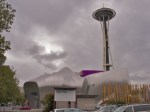
The Experience Music Project and Space Needle were two of the sites on our “must see” list.  Since they were co-located, it was pretty easy to work them both into our schedule.  As luck would have it, we had beautiful blue skies and sunshine that entire trip until the day we went into downtown Seattle.  I don’t know if this is because there is some sort of vortex over Seattle and causes it to be cloudy and rainy there all the time or if the maximum number of sunny days had been reached and the clouds were turned back on.

As we approached the EMP Museum, it looked mostly like a sheen of gray against a gray sky, drenched in gray mist.  We were happy to go inside.

Seeing the collections of guitars was pretty exciting to my husband.  A little less so to me.  But, the tornado of guitars was pretty impressive.  In truth, there could have been absolutely nothing inside that building and I could have spent the entire day trying to figure out how to shoot its strange curves and intersecting angles.  Armed only with my PowerShot G3 at the time, I struggled with the lighting conditions for starters.  But more than that, trying to find a logical edge to decide on what to include and exclude from the frame seemed impossible as each shape flowed into the next.  Each attempt at framing a shot seemed like I was cutting off the flow.  Most of my shots are not even interesting enough to include with this post.

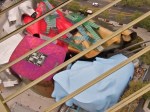
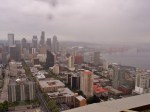
After exploring the interactive exhibits in the EMP, we made our way over to the Space Needle.  In spite of he rain, the view was pretty impressive.  We looked straight down on the EMP and got to look at the shape of tis exterior.  We also got a clearer view of how colorful the exterior really is.

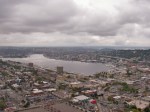
The Space Needle also afforded some great looks at the ports below.  Down in the park below, a group of kids were playing with giant water canons permanently mounted there.  I found it amusing that they were squirting each other with water while it was raining.

By the time we’d stood out on the observation deck for 10 minutes, we were both looking like drowned rats.

White Plains

Back a few years, which now seems like a lifetime ago, I used to go to White Plains, New York for work on a fairly regular basis.  There are several things I recall about White Plains, NY.  First, if you ever have to go there and someone suggests you should fly into LaGuardia or Newark, just say no.

The first time I went there, I flew into Newark on a Sunday and spent 3 hours trying to get across one bridge–there are really only 2 bridges to choose from when coming from Newark to White Plains and apparently the entire world is divided between those two bridges on a Sunday afternoon.

My second trip, I flew into LaGuardia and my transit time was cut to about an hour and a half.  On my third trip, when I arrived in Cleveland and ran for my connection, arriving at the gate all flushed and flustered just after the door closed, the gate agent asked me where I was going.  Not thinking, I replied, “White Plains.”  She looked at me and said, “The flight to White Plains is at that gate,” pointing at a gate across the aisle.  I managed to switch flights in time to go to White Plains.  When I arrived, I discovered that airport was exactly 8 minutes from the customer site I was visiting.

I asked the customer why they had recommended Newark or LaGuardia.  They’d assumed I wanted a direct flight.  They didn’t realize that I had to connect pretty much anywhere I flew to.  Still, I haven’t figured out why someone would think it was better to have a direct flight and a 3 hour drive (or even an hour and a half drive) than to have a connection and an 8 minute drive.  Even if I had an hour and a half layover, it’s more productive than an hour and a half sitting in traffic.
White Plains itself is quite beautiful.  Like most of the parts of New York I’ve been to (other than New York City), you see more trees than buildings.  Everything is cloaked behind stands of evergreens.  It’s hard to even tell when you’ve arrived at an office park.

For the less nature-centric, there is also good shopping, good food, great access to planes, trains, and any other imageable form of transportation (including horses, although I think they were all privately owned).  Just don’t try to drive there.

I had the rare pleasure of spending an evening alone with my camera on one of my trips to White Plains.  I made an exploratory pass around the neighborhood and found a lovely Spanish restaurant on the shore of the Hudson along with a park.  After filling my belly, I walked along the dock, taking pictures of the scenes on the river.

What was most surprising to me was the view of New York City.  Looking down the Hudson, Manhattan spread itself across the river like a bridge in the distance.

Moon Meetings

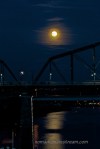
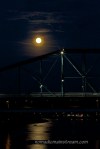
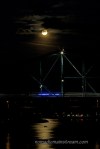
Rushing to catch the full moonrise, I turned the corner onto Market St and got my first view of the horizon, a thin line of orange glowing just over the tree tops.  I started running again.  By the time I got far enough across the bridge to have good angle, the orange glow had disappeared.

I got my camera set on the tripod, got focused on the bridge, and waiting.  Then I waited more. About the time I got tired of waiting and decided to swing the camera around to shoot the sunset until the moon appeared, I saw a movement out of the corner of my eye and about jumped into traffic with surprise.  A man apologized for scaring me and then said something about my camera.  I smiled and he smiled back and then he walked away.  I have no idea what he said, but apparently a smile was an appropriate response.

Moments later, another man showed up.  This one with a camera in hand asking me if I knew where the moon would rise tonight.  I told him about the orange glow I’d seen.  He told me that he was the architect for the current, restored version of the Walnut St bridge and he’d been wanting a picture of the full moon rising over the bridge for years.

We waited together for the moon to reappear.  Eventually, I spotted another band of orange glowing through the heavy clouds.  We both started shooting like mad.

He wanted a very specific image with the moon centered over a pier of the bridge (or whatever it’s called).  I was hoping more for images with people in front of the moon.  Unfortunately for me, the moon was too high by the time it appeared from behind the clouds for anyone to be in front of it.  I lined up behind my new acquaintance and shot over his head as he bent over the rail of the Market St bridge in front of me.

Eventually, the architect’s wife pulled up in a car, pulling over in heavy traffic just long enough for him to jump in.  I was left to continue shooting on my own.  I shot as wide as my lens and teleconverter would allow, fascinated by the reflection of the moonlight on the water.

Then, another car pulled over.  A third man asked if I could send him some photos–he and his wife were trying to take pictures of the moon with a cell phone.  I asked if he had a card and his wife, apparently hidden in the back seat, leaned forward with a car from a vineyard in Ringgold, GA.  The man said, “Send us a picture and we’ll send you a bottle or wine!”  I wondered how good my picture had to be for a bottle of wine.

It’s funny how people seem to assume you’re going to get a great image when you’re shooting with a long lens.