The Open Road in Sepia

Hanging out on the tip of Washington in a place called “Dismal Nitch” might sound depressing.  However, according to the National Park Service, its name was derived from the journal of Capt. William Clark who referred to the site as a “Dismal Nitch” after being stuck there for 6 days in a storm waiting for supplies.  For the Lewis and Clark expedition, it was the last miserable stop on the Columbia River between them and the Pacific ocean.

For us, it was a beautiful, sunny day that gave us great views of the Astoria-Megler Bridge, the Columbia River, and the mountains beyond.  However, having driven over the ridiculously long bridge, stopped at Dismal Nitch, watched the pelicans diving after fish, and watched the sun start to sink lower in the sky, we decided it was time to start heading back towards Portland.  We had one more stop in mind and we wanted to get there by dusk.

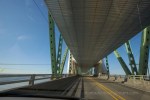
On the way back, I did some more “through the windows” shooting.  I’m fairly certain there is some law of photography that starts with, “Thou shalt not do landscape photography from a moving vehicle.”  Oh well, rules are made to be broken.

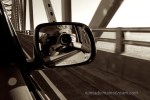
I know for sure there is some law of photography that says all photographers must at some point take a shot of themselves in a mirror.  I’ve resisted for a really long time.  But when I caught my reflection in the side-view mirror, my will power crumbled.  Like being drawn into a black hole, I felt compelled to press the shutter button.  Too bad I didn’t have try a slower shutter speed–it might have been interesting with the bridge blurred in the background.

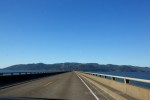
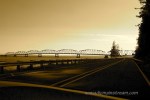
Having captured some similar images of the bridge going the opposite direction, I found myself somewhat bored with today’s selection of photos.  I decided to change them all to the sepia preset.  I went a little wild with the orange tones in the first image–it evoked the idea of sunset for me.

The pairs of images are yet another semi-happy accident I wish I would have thought of when I was shooting because I would have shot them a little differently.  Maybe with the road going left and then right or something.

Regardless of what I might have shot differently or whether I shot something similar before, there is still something evocative to me about looking down the road.

What is it about an empty road that seems so prophetic?  My nomadic desires were suddenly reawakened by the sight.  The possibilities promised by going somewhere new seemed irresistible.  But on this day, the road didn’t lead to a place we hadn’t been before.  Just like life, sometimes we drive in circles.

Through the Glass

There is only one thing disappointing about the Astoria Megler Bridge:  there’s no place for pedestrians.  I guess it would be expensive to add a pedestrian walkway to a bridge that spans over 4 miles, but the views from the bridge stretch over the bay to the distant mountains in Washington and back to the South in Oregon.  Plus, the pelicans and gulls fly over the bridge at eye level.  It would be a great place to shoot.

I decided to try shooting through the windshield.  I have a lot of experience shooting through car windows–one of the sadder ironies in life is that wildlife tends to be more afraid of humans walking in the woods than of cars racing down a freeway, often to their own demise.  This leads to me trying to capture images of moose, elk, bears, etc through car windows more often than on foot.

On the positive side, I have learned a few tricks.  First and always applicable, get as close to the glass as possible.  This puts all the crap stuck to the glass completely out of focus so it doesn’t show up in the photos (the spots in the last image are actually birds that were flying too fast to be in focus).

Second, if you can’t roll down the windows and stick your head out, shoot through the front windshield if you’re shooting wide angle.  There is just nothing appealing about a composition that looks like this:

Third, if you’re shooting with a long lens, it’s easier to shoot out the side window, but watch for the blasted rearview mirror.  Shoot tighter, sit cross-legged to get up higher in your seat, roll down the window and prop the lens on top of the rearview mirror (not recommended in a rapidly moving vehicle).  Do something to get that mirror out of the frame.

Fourth, don’t forget about reflections.  If you have a polarizer, you might be able to get rid of them that way.  Unfortunately, sometimes you have to live with them (like in the first photo in the gallery).

Fifth, if you’re shooting though the windshield of a car going 50+ MPH down the road and you’re trying to get lots of depth of field, you can focus on whatever spot is in front of the car and then shoot, even though the spot you just focused on is gone by the time you push the button.

Finally, if you are shooting while the car is in motion (hopefully because someone else is driving it), remember that the speed your moving affects the shutter speed you want to use, depending on whether you want sharp or blurred images.  Oh! I just had a great idea for shooting the drive down the far side of the bridge (yes, I just smacked myself in the forehead since I am not planning to be back in Portland again for a year).

Bridge Over Troubled Water

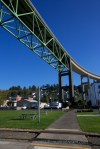
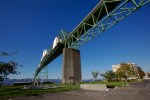
On our trip to Portland oregon, we made a stop at Astoria, a town as on the corner of Oregon as it gets.  In fact, the 4 mile long Astoria Megler bridge crosses from The north-most, west-most corner of Oregon to Washington.

We planned to drive across the bridge, but decided to make a stop to see the under-side of the bridge before making the crossing.  To be honest, this was because we couldn’t figure out how to get onto the bridge and were circling around confused when we spotted a Naval memorial under the bridge.  We pulled off and checked out the nautical monument and coastal scene.

The nautical monument is like a miniature wall that captures the names of those who have died in service to the sea.  The roles of the people range from boat captains to daughters of boat captains.  It’s an interesting exercise to read the names of the people and what is described as their job. I wonder if it was difficult work to be a sea captain’s daughter?

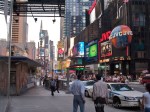
In a New York Minute

New York City is . . . You could finish that sentence with just about anything. For me, it’s mostly been a place I go for work or a place I go through on the way to somewhere else. However, there have been a few times when I’ve gotten to spend a justo here for fun.

The most recent time was a few years ago now. I stayed with a friend for the 4th of July weekend on a lagoon in NJ. Most of the Jersey shore lagoons are trapped in concrete and look like man made creations, much like the characters on the reality show (sorry, couldn’t help myself). But it’s surprising to someone who has spent as much time in “The Garden State” as I have just how much of the inner inner coastal areas are as dedicated to boating as the actual coastline is.

As someone who grew up as inland as it gets, the coast always seemed like a definitive line between land and ocean. In reality, the ocean gives way gradually to land, meandering its way deeply into every crevice. While me might intuitively guess at the movement of water, I tend to think of it as moving outward from the land to the ocean and had been oblivious to the interplay of water coming in.

My friend and I took a day off work and took the train from Brick, NJ to somewhere in New York City. We saw so many boats on the way, I thought we had taken a train to Miami.
Once we arrived in the city, however, the boats were all but forgotten. It’s hard to remember Manhattan is an island. It’s amazing it doesn’t just sink under the weight of all the sky scrapers it supports.

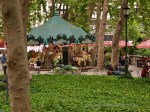
I suppose it comes as no surprise that of the dozen or so photos I took in the city, the majority were in the one park we stopped in. As much as I love visiting cities, I’m always relieved to find a bit off green space producing enough oxygen I feel I can breathe again. We were no where near Central Park, but Bryant Park provided exactly what I needed.
We had a fantastic dinner at a place that specialized in artisan cheeses and then headed to Times Square and Broadway where we saw Mama Mia–it had been running for so long, we had no trouble getting tickets.

The usher/bouncer yelled at me for taking a picture before the show had even started, so I put my camera away and enjoyed the show. I’ve only seen two broadway shows on Broadway, but it is way better than seeing the Columbus, Ohio version. Only London compares to New York for Broadway shows in my limited experience.

At about 11PM, we hauled our shopping bags from Broadway to the train and made our way back to Brick feeling like we couldn’t have stayed awake through one more New York minute.

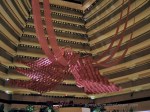
The Marriott Marquis

I was recently at a Photographic Society of Chattanooga meeting when the speaker displayed an image so familiar to me, I almost thought is was one of mine.  But, then I realized it was better than my version.

I don’t feel bad about this–the subject was the Marriott Marquis hotel in downtown Atlanta.  It may be one of the more striking architectural features in Atlanta (from the inside), but it’s also quite a challenge to shoot.  Plus, the day I got to shoot inside the Marriott Marquis, I had owned my PowerShot G3 for about 2 weeks and knew about as much about photography as my elderly aunt (who couldn’t figure out how to use a camera with only one button).

I was in Atlanta for work at the time.  There was a huge tradeshow there and I was playing “booth babe.”  This is a joke because I worked in the telecom industry at the time and it was considered bad form to have anyone in any booth looking anything other than geeky.  I got to don a men’s button-down shirt that would have fit great if I were shaped like a large block and was long-waisted and short-legged.

But, I digress.

Just by good fortune, I was staying at the Marriott Marquis.  I had no idea at the time that it was going to be a photographic opportunity.  I brought my brand new, fancy point-and-shoot camera purely because I was so excited about having what was then by far the nicest camera (digital or film) I’d ever owned that I brought it along purely out of the desire to learn how to use it.

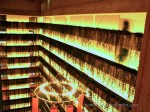
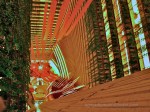
The problem with the Marquis is the difficulty of getting what you want in the frame without getting what you don’t want.  For example, you cannot get the entire stunning view of the balconies into the frame.  My focal length was 7mm for these shots.  I don’t know of an SLR lens that will go that wide unless it’s a fisheye.  Additionally, it’s a hotel with lots of people milling about doing what they want without concern for your shot–they’re there day and night.  A long exposure on a tripod might have done the trick for removing some people, but there are always people standing on the balconies gazing down and up and taking in the incredible structure.

Another problem is the lighting.  Higher up, the balconies get quite dark.  It’s difficult to get a balanced exposure that shows both the lower and upper balconies.

As someone who was:  there for business, without a tripod, in a hurry, and using a point-and-shoot I barely knew how to use, I think I walked away with some surprisingly good shots.  Of course, I cannot look at them now without thinking about how much better I could do today.  Atlanta is only a 2 hour drive–maybe I’ll have to actually go test myself one of these days.

Lost and Found

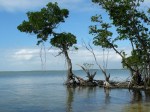
The first day of our canoeing adventure along the Gulf Coast in the Everglades, I discovered a key difference between canoeing in the Everglades and canoeing down a river.  There’s only one way to get lost when you canoe downstream on a small river:  failure to stop at the pick up point.

Canoeing in the Everglades was a completely different story.  We had a permit to camp on a particular Key each night of our trip.  Our first day, we were supposed to paddle about 7 miles to Rabbit Key.  Unfortunately, we started out heading down the wrong channel through the mangroves.  As we paddled around trying to identify openings between tiny mangrove islands that matched shapes on our map, I realized how little a map drawn from an aerial perspective reflects what land looks like from the water.

As the navigator, I eventually gave up on the map all together, picked a channel that pointed generally Southwest, and took us through the maze of mangroves until we hit the Gulf.  Assuming we were West of our destination, we paddled East.

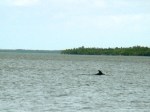
Paddling along the Gulf Coast through swells of salt water in a canoe identical to the canoes we’d paddled as children was a completely surreal experience in and of itself.  Then, we spotted a dolphin about 50 yards from our canoe.  It was a joyful sort of strange.

After having paddled long and hard in the Gulf (which is not at all like paddling down a river) we decided to break for food and try to locate ourselves on the map.  We figured we might just stay where we were.  We were rapidly running out of daylight and we really wanted to have our campsite setup before dark.
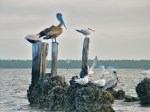
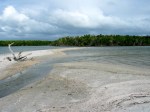
We took a walk around the island we’d stopped on, trying to get a sense of what it might look like on our map.  Fortunately, we stumbled across a sign that identified the Key we had landed on.  It was Rabbit Key, the key we were supposed to spend the night on.  While this was mostly pure luck, Pat was still impressed by my sense of direction (too bad it doesn’t seem to work in the Chattanooga area).

Taking some advice someone had given us, we found a suitable spot to pitch our tent where there was plenty of wind.  Then, we pulled our canoe well up out of the water so it wouldn’t float away at high tide.  We ate quickly and went to bed, exhausted.

In the middle of the night, I woke up and went out to heed the call of nature.  When I looked up at the night sky, I’d never felt so close to the stars.  I’ve been to the top of Maunakea, which is supposed to be one of the best places in the world to see the stars, but here at sea level on a tiny key in the Everglades, it seemed like the stars were within arms reach.  It was astonishing.

See Ya Later

Nearly a week into our 2008 Christmas road trip, we made it to Everglades City, Florida.  We were looking forward to 3 days of canoeing and camping along the Gulf Coast.  But, the day we arrived, we decided just to enjoy the surroundings and spend the night comfortably in a local bed and breakfast (who also happened to rent canoes).

Before we could really enjoy ourselves, we decided to head to the local grocery store and stock up on supplies for our camping trip.  This did not take long because the local grocery store was about the size of a large convenience store at a gas station.  There was very little selection and only one brand of anything they carried.  This had the advantage of making decisions very easy.  Do you want bottled water?  1 liter or 2 gallons?  Do you want beef jerky?  Oh, they’re buy 3 get one free.  Do you want granola bars?  1 box or 2?  I love easy decisions!

On the way back to the hotel, we discovered a roadside park with a lovely swamp occupied by so much wildlife, at first I thought it was a zoo.  I couldn’t get over the birds.  If all birds were that big, birding would be so much easier!

The Cormorants stood around drying their wings.  The Little Blue Heron posed while stalking fish.  And the Anhinga, well, they were the most amazing of all.  I saw a stick poking up through the surface of the water and suddenly realized it wasn’t a stick at all!  It was the beak of an Anhinga who was walking along the bottom of the pond with its beak sticking up through the surface like a breathing tube.  I don’t know if it was really breathing, but I was blown away by the scuba diving bird!

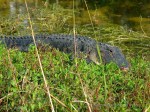
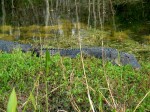
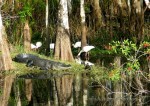
If the birds weren’t enough, the alligators added a whole new level of excitement.  While you can’t tell from the photos, there was a fence between the closest alligators and us.  Although, it was a fence they could have run around to get to us.  I’ve heard alligators are pretty fast, but Pat kept an eye on the gators to make sure none were sneaking up behind me when I was looking at his brother.  You have to respect any animal that has been around for as many millennium as the alligator.  They reek of ancientness.

Amazed, loaded with images, and stocked with food for our trip, we decided to try a local restaurant that was recommended to us by the bed and breakfast.  It was one of those hyper casual places that served on picnic tables with paper plates.  But I had the best salad I’ve ever had in my life there–the greens, herbs, and flowers (yes flowers) were all grown in the restaurant’s own garden.  Just writing about it makes me want to return just to have another one of those salads.

It was a great way to prepare for our canoeing adventure.

Swamp or Park?

When I planned our route and where we would stop on our way to the Everglades and Key West back in 2008, I picked some places on the map I had never been to, including Congaree National Park.  When I googled it, I discovered that it had, until recently, been called Congaree National Swamp.  I guess I can understand why someone might think Congaree National Park was a better name.  After all, how many people think pleasant thoughts when they think of a swamp?

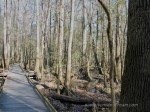
It only made me more curious to see it, however.  As we started down the very fancy boardwalk that kept less enthusiastic hikers’ feet dry, we spotted several woodpeckers and a couple of warblers in about 5 minutes.

We continued well beyond the boardwalk and onto the trails for those with waterproof boots.  As we walked, a Barred Owl called over and over, completely oblivious to the fact it was 2 o’clock in the afternoon.  We heard a Pileated Woodpecker and saw it fly.  We followed it as long as the trail allowed, but I never did get a shot of it.  Of course, still toting my Powershot G3 that trip, I’m not sure how much of a shot I would have gotten anyway.

We continued along to a beautiful stream with giant swamp trees growing along the banks.  I assume they were Cyprus–the number of knees that threatened impalement to anyone who dared to trip was overwhelming.  I expected to see a few knees popping up here and there–the fact that acres of swamp were nothing but knees was quite a surprise to me.

But the biggest surprise was when we heard some rustling in the underbrush as we approached a darkly shadowed part of the woods.  We paused and looked at each other, unsure of what we were hearing.  Then, suddenly, several boar jumped up from their cover and went squealing off through the woods.

While I generally seem to lack the appropriate level of fear of wild animals, I have to admit that I definitely jumped when those pigs ran off through the woods.  Although I was disappointed I didn’t get a picture, I preferred missing the shot over having them run towards me.

At the time, I didn’t know that wild board were supposedly introduced here in the 16th century for hunting.  Who knew that the boar would go nuts and start taking over?  The amount of damage they can do is pretty frightening.  I don’t mean just to humans (although that’s frightening too) but to land, farms, and ecosystems in general.

I was a lot less excited about our wild boar encounter when I learned just how common they had become in the region and what a problem they are.  Much more recently, I discovered there’s a reality TV show about boar hunters.  Like most of the reality TV shows I’ve heard about, that just seems wrong.

In spite of the boar, I highly recommend hiking in the Congaree.

Almost Shenandoah

In 2008, I took my trusty PowerShot G3 for it’s final trip.  While I would have preferred my Canon 40D by then, since our plan included canoeing/camping in the Everglades, I was content to take a camera I wasn’t worried about ruining.

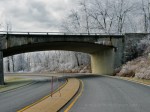
On our way to the Everglades and Key West, we stopped in Shenandoah.  It was on a list of places to see before you die, so we thought we’d check it out.  On our way through Virginia, we entered the North end of the park and managed to get in a short hike in thick fog before heading on toward lower elevations.  The fog was forming hoarfrost on the trees as we exited the trail.  We crept along the main road through the park, barely able to see a young buck walking along the road.

We made it safely to our hotel, where it was completely clear and much warmer.  The next morning, we learned the entire park was closed due to ice, but we were told to call back in a few hours–things might improve.

We decided to go for a cave tour nearby to kill the morning.  Luray Caverns was interesting. Although, because it’s privately owned, it’s treated commercially instead of for preservation purposes.  This means there were formations we could touch, lots of colored lights, a wishing well, and an organ that played a song by triggering mallets that hit various formations.  The cave was pretty astounding none-the-less.  I just hope it survives being shown off long enough for many to enjoy.

Returning to daylight, the valley was sunny and relatively warm for late December.  We decided we needed to get on the road whether we were able to hike in Shenandoah or not, so we drove on up to the park.

As we continued upward in elevation, the skies got cloudier and more and more of the scenery was blanketed in white.  As it turned out, all of the trees and roads were still frozen in a coat of ice.  It was beautiful to see, but the entrance to the park was closed.

Instead of hanging out for an extra day to see if things improved, we decided to take the Blue Ridge Parkway South and enjoy the scenery as we drove.

This turned out to be a surprisingly good decision considering the weather.  The further South we went, the sunnier the skies and we encountered no ice at all.  I guess the Parkway South of the park is a little lower in elevation.

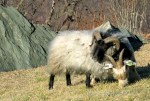
We not only got to enjoy beautiful views of the valley below, but we were treated to spotting a couple of mountain goats tussling at the side of the road.  They were so entangled with one another, they looked like a two-headed goat.

We were sorry to leave the parkway behind, but we did make it to Congaree National Park early enough to take a long hike there and work the kinks out.