Fire in the Sky

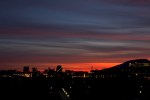
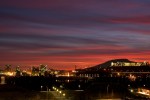
Tonight, as the sun sinks, I look up just in time to see the clouds streaking across the sky, brilliantly lit in red and orange.  I’ve never seen the sunset in such a way as to create a striped backdrop for the skyline before.  I drop everything and run up to the roof.  Well, maybe not run, but walk as quickly as I can without falling on my face while carrying a tripod and camera.

When I get to the roof, I am amazed by the stillness of the air and the feeling of warmth rising from the roof.  I stand up my camera and start to shoot.  I would like to shoot nothing but the sky, but I can’t get the roof top across the street out of the frame.

The clouds create a blaze of fire over the horizon.  I stand there pondering whether my photos will look fake, the color is so brilliant.  I wonder what about Chattanooga causes so many glorious sunsets?  Is it just that because our windows give us a great view of the sunset that I notice how beautiful it is?  Or does Chattanooga have some sort of special set of circumstances that generates spectacular sunrises and sunsets on a regular basis?  Perhaps it’s just that coming from Columbus, Ohio, we so seldom saw the sun.

I stand for a moment between shots.  I let the light change a little before taking the next one.  I zoom out and try to capture the vastness of the sky.  It’s impossible.  I decide right then and there I’m buying a wider-angle lens.  I breathe in the evening air, moist with humidity rising off the cooling river.  I breathe out and let go of every worry.  All I see, think, and feel is the blazing sky.

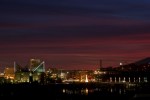
I look closely and take aim.  I capture a moment of light and clouds and manmade structures all combined in a way that they have never been combined before and will never be combined again.  I adjust my exposure until, at last, what I see in my LCD is as spectacular as the sky that surrounds me.  I breathe again as I look at the Christmas tree reflecting in the river.  I wonder if it will show up in my picture.

I watch as the sunlight fades and the sky turns to more subtle shades of fire against twilight blue and then I shoot again, this time zoomed in to capture the reflection of the city on the river.

When the last of the light has faded away and I stand shivering on the roof top as the wind picks up, I pack up my tripod and camera and head back inside.  I take a look at my photos on my monitor and I am pleased.  While I have much to learn, at least there is one shot that perfectly captured what I wanted to capture while standing on the roof, shooting fire.

If the Boats a Rockin’

It’s Saturday.  Marcy’s Playground comes to mind every time I say that.  With “It’s Saturday” running as the soundtrack in my head, I start gathering up the stuff I will take with me on our kayaking trip today.  We have signed up for an Outdoor Chattanooga outing kayaking at the Hiwassee Wildlife Refuge.  The Sandhill Crane is migrating through the area and it’s an opportunity to see (hopefully) thousands of them up close.

I, of course, want to shoot.  I’ve never tried to shoot from a kayak before–it will be interesting.  But, I have gone to great pains to make sure I can keep my camera dry when not shooting.  I purchased a Pelican waterproof box and carefully sculpted the foam in the box to hold my camera safely.  I’m not quite clear on where I will put this special box so that I can get the camera in and out without rolling the boat, but we’ll worry about that when we get there.

Pat is convinced that we will be going into the river today.  In spite of the fact that we will be in a sea kayak (much more stable than river kayaks) and that we will be in a tandem (even more stable), Pat is sure we are going to roll.  He bases this assuredness on past experience.  We were once on a tandem sea kayak in the Caribbean sitting perfectly still and I (at least, he thinks it was me) managed to flip up.  I contend that it was him, or the ocean, or the wind.  But I have to admit that my track record is at least pretty good circumstantial evidence against me.

However, it’s December and it’s not exactly a warm day with a high expected in the mid-40’s.  I’m pretty determined that we are not going in the river.  I find myself somewhat superstitious about this, however.  I take the approach of fully preparing for a dip in cold water as a measure of ensuring that it doesn’t happen.  It’s the theory of, “If you don’t want it to rain, carry an umbrella and put off washing your car.”

As I dress for our adventure, I choose carefully.  Under Armour tights, hiking pants, rain pants, Under Armour top, wool pullover, fleece, rain jacket.  Each under layer dries quickly and retains heat even when wet.  The waterproof top layer will protect me from splashes and help retain heat as well.  I hate being cold.  I also pick out a goofy hat.  The wind is pretty strong out there and it will only be worse on the water.  I want to be comfortable more than I want to look good.

Satisfied that my camera is well-protected and my clothes will keep me warm even if we fall in, we load up and head on out.  We have a bag with a change of dry clothes so we won’t have to ride home wet in the worst case.  We also have both of our day packs with a bladder of water each and big lunches, two pairs of binoculars, and my waterproof box.  For people who have been downsizing for years, we manage to look like pack mules every time we go somewhere.

We arrive at the park where we’re meeting for the tour.  One of the guides has a Newfoundland dog.  When we walk up, the dog leans against me, laying the weight of his head against my belly.  I rub his big old head and think for the millionth time how much I miss our dogs.

When everyone is ready to go, we load all of our crap and ourselves into the van and head on down the road.  By the time we get to the refuge, I think my body temperature is over 100 and I’m stripping off layers.  As soon as we get out of the van, I am quickly putting them back on.

Everyone gets settled in their boats, adjusting foot pedals and positioning their stuff.  One of the guides, Terry, helps Pat lash my waterproof box to the top of the kayak in front of me so I can easily get my camera in and out.  This is a good thing–I couldn’t figure out how I was going to get the thing in and out of the tiny space for my legs.

Before we get started, Pat has troubles with the rudder and while a guide is helping him sort it out, I spot a juvenile Bald Eagle soaring overhead.

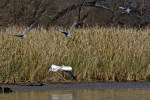
We paddle our way across the main channel and then head along the shore of the refuge, trying not to get close enough to scare the birds.  A large white bird is standing on the shore ahead of us.  It turns out it’s a White Pelican, not a typical bird for the area.  We were hoping for Whooping Cranes, which migrate through Hiwassee every winter, but no such luck.  The pelican decides to take off as we approach, but manages to fly at an angle so that he has his back to us the entire time.  I’m frustrated by my shots.

As I shoot the White Pelican, I see a cluster of Sandhill Cranes standing on the shore behind the flight of the pelican.  There are only a dozen or so gathered there, but we can hear what must be hundreds of Sandhill Cranes gabbing away at one another.  They are an impossibly loud bird whose voice can carry a mile or more.

Across the channel we spot a group of smaller white birds floating on the water.  Someone says they are ring-billed gulls, but I don’t get a close enough look to decide if I agree.  I’m busy looking at the grassy bank above them.  Pat asks me if the bank is covered in Sandhill Cranes.  Unfortunately, the kayak won’t hold still and we bob up and down as I try to look through my binoculars.  For a moment I am convinced they are cows, then I realize I’ve misjudged the distance (and therefore the size).  They are Sandhill Cranes after all.  I blush at having thought they were cows.

We continue on our way, seeing many Great Blue Heron, Double-Crested Cormorants, Coots, possibly Lesser Scaups, and Bald Eagles.  I’m not as familiar with water birds, so I don’t even attempt to identify the gulls that fly by.

We make our way around the island, paddling ferociously against the current until we get around the tip of the island and start floating back with the current.  As we complete the trip, three more bald eagles appear and a group of cranes fly by.  It’s hard to believe we’ve been out on the water for nearly 3 hours.  Even more unbelievable, we never fell in!

When I click through my photos, I have to laugh out loud.  If I scroll through fast enough that the shots are movie-like, I feel like I’m back in the boat again.  The rocking of the boat is capture in the movement of my subject in the frame from one shot to the next.  I can’t tell on the small LCD if anything is in focus or not, but I hope my fast shutter made up for all the motion in the boat.

The Digital Dark Room

I have previously resisted editing photos, feeling like it’s cheating somehow.  However, when one of my photography mentors explained to me that “editing” RAW format pictures is like developing negatives in a  dark room, I started thinking about it differently.

Unfortunately, I find that processing photos is not a task I really enjoy.  For one, I spend the vast majority of my waking hours at a computer for work, having personal time end up on a computer as well is a little depressing.  Second, when I’m on the computer, I’m not out shooting.  But, the thing that I am beginning to realize is that part of what changes a photo from a form of documentation to a work of art is what the photographer does with it after the shot is taken.

It’s possible that I may need to bite the bullet and take a class in Photoshop at some point, but for now, I am content to play with Aperture and see if I can do what I need to do with it.  So far, the one thing I know enough to miss is how to layer together two shots into one.  I suspect Aperture doesn’t do that, but it’s possible I just haven’t found it yet.  That would be handy–outdoor shooting often leads to having to choose between an over-exposed sky or an under-exposed subject.  Being able to combine two shots would solve this problem.

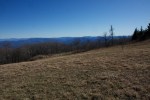
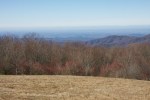
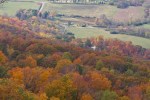
For today, I decide to play with a shot from our recent trip to the Smokies.  This was taken from a “knob” where there was an endless panoramic view of the smokies surrounding us.  While there is something about the shot that appeals to me, it completely fails to look like what I want to convey.  I’m not sure how to explain it, but the gap between what I see in my mind and what I see in the photo is large.  Normally, I would just trash this photo and call it done.  But, because there is that little something there that I like, I decide this is a good candidate to start experimenting with.

As I stare at this photo and start making adjustments, I think about something my brother once said to me.  I showed him a photo I was processing  with and without a certain adjustment and asked him which he liked better.  He said (roughly), “Which one is more like what it actually looked like?  That’s the one that’s better.”  I suppose on the surface this seems like a logical way to look at it, but his statement has haunted me ever since.

First, what does something look like?  Is that an absolute that can be monitored and measured and set objectively in stone?  Second, is capturing what something looks like the real goal of photography?  As I ponder this, I realize that it’s not about “what it looks like;” it’s about what I saw.  What I saw is probably a massive brain computation starting with light reflected into my eyes but then processed in the context of my personal experiences, interests, filters, and openness.

What I want to show is a new way to see the same thing.  When photography moves into the realm of creativity, you stretch your mind so you don’t ignore the shimmering light off one small leaf, miss the shadow of a soaring hawk that suddenly appears in your frame, fail to see the contrasting shadows under each blade of grass.  It’s not about “what it looks like”; it’s about learning how to see in new ways.

Having that realization, I find myself wanting to push myself out of documenting mode and into creative mode.  And I’ve realized that by concentrating solely on my shooting skills (which still have a long way to go), I’m completely missing out on half the formula.  So, today, I turn to my computer and play with what I can do in the digital dark room.

The Musings of a Passenger

It’s our final day in the Smokies.  Checkout time is at 11:00AM and I have a massage scheduled at 11:00AM.  As it turns out, it’s the last day the lodge will be open for the season.  Having fed us all breakfast, packed us all one last lunch for the road, and checked us all out, they are closing down the lodge for the winter.  I feel a little bad about the timing of my massage, but since I didn’t pick the time, I decide not to worry about it.

Pat takes another walk out to sunrise point while I head off to the massage room with the massage therapist.  After he walks, he will sit in the lodge lobby, in front of the giant fire place, reading something from the large library accumulated there.

The massage is wonderful.  I feel like jelly afterwards, oozing back into my clothes, out into the cold, and into the car.  It’s a nice state to go for a ride in, actually.  I try to sit so I’m not hunching up my shoulders, maintaing the state of relaxation I’ve obtained.  I look out the windows and absorb the limited view with little going on in my head (for once) besides the occasional reminder to relax a muscle that’s tightened up again.  After several minutes, Pat asks me if I’m sleeping.  I laugh at this–like I must be asleep if I am this relaxed.

I rouse myself a little.  Enough to engage in conversation with Pat.  I try to keep part of my mind checking in to make sure I’m staying relaxed periodically.  This gets a little tricky as we wind our way along the Cherahola Skyway where a storm apparently went through last night.  Fallen trees and other debris surprise us around many curves.  Fortunately, any of the trees that were all the way across the road have been cut and hauled away by now.  I find myself wondering if Snowbird Mountain was not hit by the storm or if we just slept through it.

The thick fog makes the views limited today.  I’m grateful that we had a couple of days of great visibility to see the spectacular views.  While I’ve never been one to go for scenic drives unless it was on the way to somewhere else, on a clear day, this drive is one that would be well worth going out of the way for.  Even from the car, it makes you feel connected to the world around you in a spectacular way.

One of the things that has caught both Pat and me by surprise since moving to Chattanooga is how beautiful this part of the country really is.  Even though we have both been to this region many times earlier in our lives, we both sort of dismissed it.  Perhaps it’s like the way we tend to mind our manners less with people we know will continue to love us anyway–the Smokies were accessible.  You would think this would make them more desirable, but we both tended to prefer trips out West when we started planning vacations.  The Rockies and Sierra Nevadas seemed far more appealing than the Smokies.

Now, discovering another incredibly beautiful place nearly every time we turn a corner, I feel dismayed that we missed earlier opportunities to more fully explore this area of the country.  Like I’ve been a bad friend, taking the Smokies for granted, thinking they would be there waiting for me to find time for them.  As it turns out, they did.  But, to use a photography analogy, I previously saw “the Smokies” through a wide angle lens–a single scene to take in one shot.  I now see “the Smokies” through a macro lens–an infinite collection of possibilities, each with their own virtues.  I don’t have enough life left to see the things I now want to see just in this area.  Then again, I suppose even a full lifetime wouldn’t be enough time anyway.

This causes me to ponder the whole concept of being nomadic.  If the purpose is to see and experience new things, can’t that be achieved while standing in one place?  After all, when I get out my macro lens, I discover the closer I get to a subject, the more of its details that are revealed, the more magnificent my subject seems.  Each time I experience this, I am awed by the things I never noticed before.

Here is an example of a Katydid (I think), which I normally would just see as a large, green bug, but its beauty is revealed in its intricate details and varying colors when viewed up close:

I am reminded of an experience I had back in Columbus that I may have mentioned before.  I used to ride my bike to work regularly.  My favorite part of the ride was the short stretch along the Olentangy multi-use trail.  I would enter a section of the trail that was in thick woods.  Then, the woods fell away abruptly to an open field that had been turned into a prairie habitat, full of wild flowers.  I could hear the birds all around me and I felt certain there were birds all over the flowers in that field, but I could never see any.

Then, on a Sunday, I went roller blading on the same trail.  At that speed, I was able to see some song sparrows and goldfinches popping in and out among the flowers.  I was surprised I didn’t see more birds, though.

One day, on a weekend, I went for a walk and ended up strolling through the prairie.  I spotted motion and stopped and stood still to better see.  When I stopped moving, it was like a curtain lifted.  For the first time, I saw that the prairie was buzzing (literally) with life–bees, hummingbirds, several types of sparrows, chipmunks, mosquitos, so many forms of life moving all around me that I couldn’t begin to count them all.  But I had to stand still to notice they were there.

I suppose, as is true of virtually everything in life, it’s all about balance.  A balance between seeing the forest and seeing the trees means a balance between moving and standing still.  A balance between seeking and finding means a balance between dreaming and realizing.  I wonder how you know when you’ve found the balance point?

Sunny Black Friday

It’s the day after Thanksgiving.  For some people, going to the malls before dawn and waiting in lines is the best way to spend this day.  Our agenda is the extreme opposite.  We start by sleeping in.  Well, maybe not exactly sleeping.  I wake up earlier than I’d like, but I simply lay in bed and refuse to get up.  I’m not sure exactly what is so wonderful about being able to just lay in bed knowing you don’t have to go anywhere, but it is.

Of course, I eventually get hungry and start thinking about breakfast.  Pat is also awake and lounging.  We clean up enough to be presentable and then head to the dining room.  After a leisurely breakfast, we return to our room to change and pack for hiking.  We have no grand plans today.  I get out the notebook in the room provided by the lodge that has a section on nearby trails.

We overheard the innkeepers parents talking about Huckleberry Knob as a short hike with a spectacular view.  Today promises to be a clear and sunny day, so this seems like a good choice.  The hike is listed in the notebook.  Since it’s only 2 miles round trip, I select a second hike that’s 4 miles round trip that also goes to a high spot with a great view.

As we leave, we pick up our brown bag lunches from the cooler next to the lodge door.  They don’t serve lunch in their restaurant, but they pack everyone a lunch in either a brown bag or a backpack to take with them.

I decide to try my fivefingers trekking shoes on the first trail since it is short.  I want to test whether my feet will be warm enough to wear them on a longer hike or not.  If a trail isn’t very rocky, is dry, and the ground isn’t too cold, I prefer my trekking shoes.  But it is late November and my feet can get painfully cold.  I decide the first trail is a good test because it’s long enough that my feet will have time to warm up and short enough that I won’t be miserable for long if they don’t.

The trail is actually a forestry access road that’s wide and flat with ruts in it.  In many places, it’s still puddled and muddy from recent rains.  I do my best to walk around the mud, but the tiniest bit of moisture seeps into my shoes, soaking my feet.  Each time my feet get wet, they get very cold.  With movement, they warm up until I get to the next puddle.  I’m glad that I choose a short trail to try them on.

While the walk to the first “knob” is not particularly interesting, or if it is, I was so busy watching for mud that I missed it, the view from the knob is amazing.  If the mountains had snow covered peaks in the distance, I would feel like we were on the set of The Sound of Music.

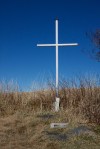
The first knob has a view of the second knob, which appears far away.  A huge cross looms up on the hill and we wonder what’s up there.  We enjoy the view a bit longer and then continue up to Huckleberry Knob.  We are upon it in no time–the distance is far less than what we thought from down below.  Oddly, the giant cross turns out to be a rather small.  So much so that we walk around the knob looking for the giant cross we saw from below.  I just recently relearned that looking up at something makes it appear larger, but this seems ridiculous.  Neither one of us can believe the 3’ cross that marks the grave of a man that died by getting drunk on the mountain and dying of exposure is the same cross we saw from below, but it has to be.

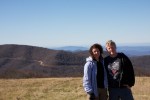
We run into a couple of women we saw at breakfast who are also enjoying the view.  We take turns taking pictures of each other.  It’s an incredibly beautiful day, but it’s noon and the lighting is not good for taking pictures.

Pat and I sit on the side of the knob for a while, looking at the sky and the mountains below.  It’s nice to just relax here for a bit.  After a while, we decide to walk back and go on to our next hiking destination, Mud Gap.

While Pat drives us to the next trail head, I slip out of my shoes and prop my feet up near the defrost vents so they can dry before I switch to my socks and boots for the next hike.  We eat our brown bag lunch while we drive and finish it in the parking lot at the trailhead.  Two other vehicles are in the parking lot.  One is a small pickup truck with Sierra Club stickers on it.  The other is a big pickup truck with an older man in an orange vest in it.  He is hunting.  It’s a little nerve wracking to realize we’re out hiking in a national forest the first official day of deer season.  It occurs to me we really should be wearing orange.  Fortunately, the trail is another well known trail that’s easily identified, so hopefully that will reduce our chances of being mistaken for deer.

We pause at the sign in the parking lot before heading up the trail.  I learn that this is actually part of the Benton-MacKaye trail.  This will be the second time I’ve hiked on part of this 275-mile trail that starts at the same point as the Appalachian trail, loops around, and then reconnects with the Appalachian trail in Smoky Mountain National Park.

As we study the sign, the hunter calls out to us.  He tells us about the hike, the view, and an alternate route that allows you to drive almost to the knob.  As we thank him and start walking, he calls out loudly, “I’m 77 years old; if I can walk up there, y’all sure can!”  We laugh and agree as we continue on our way.

As we make our way up the wet and rocky first 100 yards or so of the trail, I decide switching to my waterproof hiking boots was a good idea.  Pat interrupts my thoughts with, “How would that guy get a deer out of here if he shot one?”  We continue to contemplate that question as the trail gets steeper, rockier, and wetter.  I finally say, “Maybe he’s one of those guys that really just wants an excuse to go hiking.”

As we continue, we pause every once in a while to listen.  Sometimes we hear birds or squirrels, but more often, what we hear is the wind.  It starts like a far away swell, gathering in the distance.  Then it rolls its way up the side of the mountain, rising towards us as it gradually gets louder and louder.  Finally, it crashes over us and lifts my hair off my face.  The experience is like standing on the beach as the tide rolls in without getting wet.  I could stand and listen to the rise and fall of the wind all day, but we start moving again after the current wave starts to recede.

When we arrive at the knob, we are startled to see that it is littered with trash.  Then, two piles of trash jump up and start running towards us with wagging tails and a third assimilates itself into a man sitting up suddenly after having been caught in a nap.  As it turns out, it’s a couple with two dogs who have blankets and picnic gear with them.  We assume they are the owners of the Sierra Club pick up truck.

The dogs greet us and we pet them as the owners try to call them away.  I never know what to do in these circumstances.  The owners want the dogs to listen, but we want to pet the dogs.  Since these don’t seem like people who will abuse their dogs for being friendly, we go with petting them.

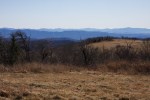
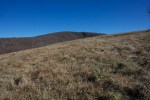
After being welcomed to the knob, we settle down on the side of it, slightly downhill from the Sierra Club couple and their dogs.  I work my way around the circumference, shooting the panoramic views even though the light isn’t any better than it was at Huckleberry knob.  I’m so happy to have finally gone somewhere with a spectacular view on a day when it’s clear.  Usually we only go to high spots on cloudy or foggy days.  I guess it pays to check the weather before you pick a hiking trail.

After shooting the view, we lay in the short, dormant grass on the knob and stare at the blue sky.  It’s so blue that I have a hard time focusing on it.  Not a single trace of cloud gives my eyes something to tell what an edge is.  I feel like the lens of my camera when I point it at a solid-colored surface.  I can’t say I’ve ever experienced that before.

As we lay there, Harry the dog suddenly appears standing over Pat’s head.  Apparently he was worried about us when he saw us lay down.  Pat pets him and he wags his tail.  Convinced we’re OK, he returns to his owners.

We get up and attempt to brush the dead grass off our shirts, but it really wants to stick to us.  We make our way back to the car, pausing to see a downy woodpecker, a grasshopper, and a squirrel.  By the time we get back down to the parking lot, my knees are starting to ache and I’m wondering if I should have worn my trekking shoes after all.  My feet are warm and dry, though, so I won’t be able to decide which was better until I know how long my knees will hurt.

We return to the van, hot inside from the sun.  We strip off some of our extra layers, extraneous in this sunshine.  We climb into the warm van and I am transported to the feeling of getting into a hot car after spending a summer day at the local swimming pool.  I love that feeling.  Any part of my skin that feels chilled suddenly feels like it’s been wrapped in a blanket.

We return to the lodge before sunset–enough time to shower, change, and sit and relax before dinner.  This has been a perfect day.  No crowds.  No traffic.  Just beautiful weather and a great view.  Sometimes I think that’s all I really need.

Throwing In

It’s Monday again.  I get up early, still hurting from Saturday’s adventure on the hang gliding hills.  As I unkink my body getting out of bed, I feel grateful that it’s not a workout day.  I vow that I will take a walk, however, in the hope of loosening up my sore muscles.

Since I also discover that there is no food in the house, I talk Pat into taking a short walk through the park and then a detour to the grocery store.  As we walk through the aisles trying to decide what we need, we realize that we are leaving tomorrow.  We limit ourselves to just enough food for breakfast, hoping the last of the milk will go far enough for two bowls of cereal.

Today is full of meetings.   Meetings where I have to pay attention the whole time, if not actually run the call.  I work late trying to get the things done I couldn’t get done during the day.  As it gets later, I get more stressed, realizing that I have personal work to do to get ready to leave tomorrow, too.

For one, I need to get the photos I will use in my blog ready before I go on the road.  I ran into issues with my photos exceeding my hard drive space on my (in tech years) ancient macbook pro.  After repeatedly spending hours cleaning out extra photos trying to make more space, I finally got tired of it and bought a mac mini server with a total of 1TB of drive space.  I thought I would move everything except my pictures and still have my photos on my laptop.

That didn’t work out.  I still kept running my 120GB drive out of space.  Funny out big 120GB sounded when I bought my macbook pro.

When I downloaded Aperture, Apple’s photo editing software, it turned out to be the final domino.  Not only did Aperture motivate me to start shooting in RAW again, which increased the file size of my photos by a factor of 3, but it also had all kinds of performance problems with my laptop’s 2GB of memory.

Not wanting my mac mini to go to waste, I moved my photo library and Aperture to it and started using it for photo processing.  This, however is not the best set up for a nomad into digital photography and blogging.  It means my pictures are all on a box sitting at home.  Although the server is small enough that I have taken it with me on a couple of road trips, packing a monitor is not practical and trying to use Aperture using “share screens” from my macbook pro is just painfully slow.

I would love to hear if there are other digital-photographer-want-to-be nomads out there who struggle with their IT setup and how they cope.

Today, my tactic is to plan ahead so that the photos I want to use during my trip are already uploaded to my blog site.  It’s been dark a while and the clock is telling me I’m running out of time.  I wrap up the critical things I need to do for work as quickly as I can and then get to work on my pictures.

I cut corners on my photo processing–I make faster decisions about which pictures to use, I don’t give them meaningful titles, and I don’t do much in the way of adjusting. Then I go through the process of exporting them all to small JPEG files and uploading them to wordpress.  Viola!  All pictures for the next 6 days ready to roll.

But, having packed for my blog, I now have to pack for me.  As someone whose job used to be described as a “road warrior” job, I have taken pride in my ability to pack light and quickly.  Part of the joy of traveling for me has come from my ability to minimize the difficulty of packing and hauling crap from one place to another.  Unfortunately, this nomad thing seems to complicate my traveling requirements significantly.

First, there is the fact that we drive most places.  Having a mini-van (or even just a small car) invites me to consider everything I might possibly want to have with me vs looking at what I can fit into one small carry-on and a small backpack.  Second, I feel compelled to take my camera bag at least.  Since I have yet to shoot while on a trip back to Columbus, I talk myself into leaving my heaviest lens and tripod at home as a compromise.  Third, I plan to workout with the group in Columbus, which means I need a workout bag so I can take the stuff I need to get ready for work at the gym.  Fourth, my IT needs have to be met for both home and work, meaning two laptops, an iPad, iPhone, Verizon MiFi, and all the associated power supplies.

I look at my laptop bag, laptop backpack, camera bag, and workout bag piled on the floor and shake my head.  It looks like I’m moving.  Then, I realize I haven’t actually packed any clothes yet.

I am stumped.  What clothes do I need for this trip?  The office clothes are easy enough.  But I have to check the weather forecast to decide what else to bring.  Now I’m in a panic because it’s 11PM, I’m still packing and we’re planning to get an early start in the morning.

I start the behavior that always results in poor packing; I call it “throwing in.”  This is when you stop thinking about what you’re going to wear each day and start just throwing in whatever you see on the basis of “Oh, I might wear this.”  This is how I end up places with 5 shirts that don’t go with a single pair of pants I’ve packed or with 15 pairs of socks and no underwear.

I try to stop myself.  I pull out half of what I’ve thrown in, making sure what’s left will work together, and counting underwear.  Somehow I still end up with a bag so full I have to unzip the expansion zipper to accommodate the bulk.  I set my bag aside and start getting ready for bed.

As I get ready for bed, I keep thinking of things I’ve forgotten to pack–a headband, deodorant, lotion, a brush–basically a myriad of toiletries that I wish I didn’t think I needed, but that I really miss when I go without.  I gather up what I won’t need in the morning and stuff it into my suitcase.  Oh!  My travel makeup kit–I’d forgotten about putting on makeup.

Convinced that I have more than enough stuff to make it through the days in Columbus, I call it a night, setting the alarm for 5:00AM.  But I lay awake in bed for a while, wondering how I could simplify this process and un-clutter my life.  After all, isn’t that one of our biggest goals?  I ponder the “throwing in” response and why the thought of not having one little convenience creates panic.  It’s a little hard to simplify without giving up something.  My last thoughts as I drift off to sleep are about throwing out.

Full Moon Risin’

This is my 100th blog post.  It’s not relevant to the rest of this entry, but feels like a milestone worth mentioning in any case.  100 days of 100 posts.  About 120,000 words.  That’s about 480 pages of blogging.  I wonder how many pages of interesting reading I would end up with if I went back and carefully edited it all?

Having shared that little milestone with you, it seems somehow appropriate to me that my 100th entry should be about the full moon.

I’ve had a busy week–or should I say busier than usual?  But I’ve marked the full moon on my calendar.  It’s a moment I’ve been waiting for.  In August, I went out to the Market St bridge and shot the full moon rising behind the Walnut St bridge but I didn’t have a tripod that could hold my telephoto yet.  I thought I might get at least one or two good shots with my monopod, but the lens was too heavy and the wind was too strong and all my pictures were blurred, although I still found them interesting.

Since then, I’ve acquired a new tripod that’s up to the job.  However, we’ve been traveling a lot and I’ve missed the full moon until now.  In August, I didn’t think it was that big a deal I missed the opportunity to shoot the moon rising behind the bridge.  I forgot everything I learned in Astronomy 101, I guess, and didn’t think about the fact that the moon wouldn’t be rising there for long.  The moon now rises from behind the hills behind our building.  There is no opportunity to catch people walking in front of the moon.

But, I want to shoot the full moon anyway.  I am fascinated by the moon.  Having been shooting the moon for many nights the past few weeks, I’ve been experimenting with what I’ve learned from some of my photographer friends.  I’ve watched the moon moving across the LCD on my camera as I try to set up for a shot and realized how quickly you really have to move to keep up with it.

I’ve also learned to cut way back on the exposure if you want to see the craters in the moon.  And, that the fuller the moon is, the less interesting it actually looks in photos because the light flattens out all the details.  In spite of this new knowledge, I love capturing the full moon behind objects on the horizon.  Tonight, I take my camera and tripod up to the roof to see what the options are.

I go to the roof and discover gusting winds.  I position my camera on the tripod and experiment with holding the strap so it won’t catch the wind and introduce movement.  I am ready to go, but where is the moon?  It’s well past the official moonrise, but I’ve learned that the moon appears at the horizon later here, probably because of the hills.

I am poised and ready to pounce–the moments the moon will be at the horizon are so short and I have to focus manually before I start shooting.  I look along the horizon for signs of light in the approximate area I expect the moon.  For a moment, I am like a 50’s housewife with dinner on the table, scanning the street for her husband returning home late from work.

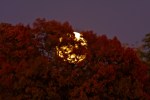
Then, I see light.  Through the red leaves of a tree being whipped about by the wind, a tiny bit of glow appears just above the horizon.  I have to wait for enough of it to rise that I can use it to focus and then start shooting.  I adjust the exposure again and again, torn between being able to see the color in the trees and not over-exposing the moon.  I keep shooting as the moon is released from the branches of the tree, making me think, oddly, of an egg bursting from an ovary.

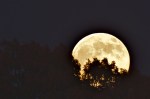
As the moon rises into the sky, I keep shooting, but the photos of just the moon really aren’t interesting to me.  They show a round disk, yellowish in the light from the setting sun, with splotches of brown on it.  Prime time is over and it’s time to shoot something else or go in.  Since the wind is getting only more fierce, I choose to go in.

I slide the legs of the tripod in enough that I can carry the whole thing over my shoulder without running into too many things.  Then, I head back down the stairs and into the apartment.  I pop out the CF card and pop it into the computer to see what I’ve got on the big screen.

My shutter speeds were slow enough that the tree in front of the moon appears in motion.  I decide I like that.  I decide my favorite shot is one that shows the color of the leaves in the tree with the moon flaring through it.  The leaves are in motion, the moon is frozen but overexposed.  I decide that I like that too.

I sit at my computer and stare at my shot for a while.  I consider whether it would have been better at a faster shutter speed so the tree was sharp instead of in motion.  Or if I should try to turn down the exposure on the moon in my editing software.  Or if I should crop it so the moon is less centered in the frame.  I consider copying the photo and trying all of these things.  Then, I decide once more that I just like it and to let go of how anyone else will judge it.  After all, the shot is for me.

Shots

A funny thing happens to me after the time change.  I don’t know when to stop working anymore.  I was doing pretty well at getting to a stopping place and wrapping up my work day at a reasonable hour for a while there.  But now, the sun sets while I’m still in the thick of my work day and is no longer a good clue that it’s time to start winding down.

Oddly, I no longer notice the sun setting even though I face a large set of windows while I work.  Usually, my first realization that the sun has set occurs when I need to use special characters on my keyboard–I look down to find them and realize it’s dark.  This leads to me turning on a light so I can see the keyboard and then all bets are off as to when I will next resurface to notice that it’s getting late.

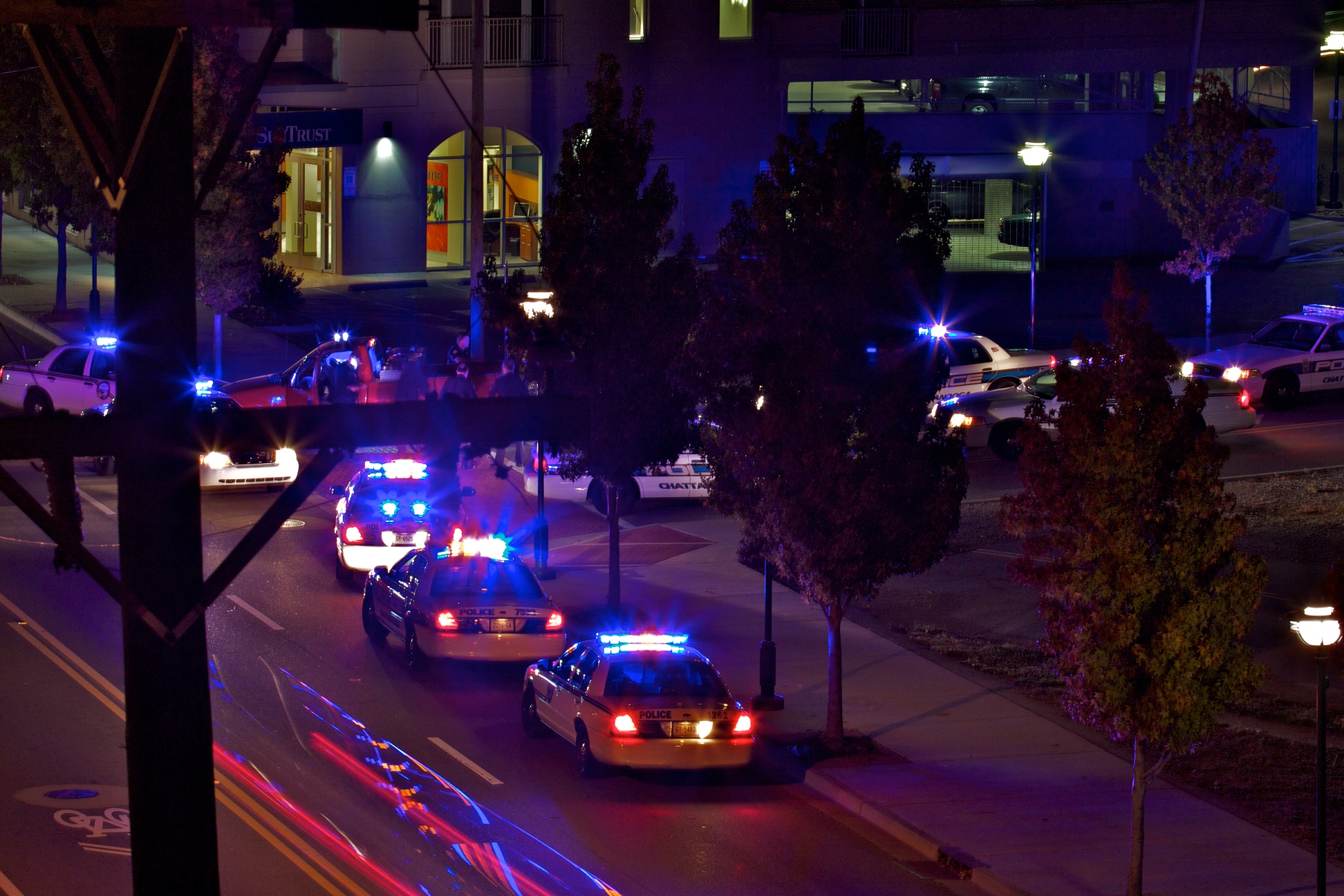
But tonight, I am determined to do a little shooting.  I’ve been practicing shooting the moon now that it’s the main subject available by the time I’m done working.  I want to get at least a few minutes of shooting in.  When I walk out to the balcony to see if the moon is visible, I see a collection of cop cars about half a block away.  More keep arriving.  I’m surprised I haven’t noticed sooner–usually the screaming sirens catch my attention.

In fact, Pat and I have a joke that Chattanooga is a 3-emergency town.  Every day, sirens go screaming by the apartment at least 3 times.  Usually this happens while I am on a conference call.  Since I use VoIP calling that’s integral to the instant messaging application we use at work, I often lose the window for my call amongst the many things open on my PC and then struggle to locate the right window to mute my phone.  Unfortunately, the built-in mute button on my laptop doesn’t mute my microphone.

Chattanooga also seems to have a 6-cop minimum.  Whenever something happens, you can count the cops that go flying by and usually it’s 6.  Often, they go by silently, thankfully, so the screaming sirens are usually limited to the fire trucks.

As I look at the scene before me tonight, I see a pick-up truck and one man standing outside the truck talking to a cop.  Surrounding the pick up are about 8 cop cars with their lights on, four of which are in the street blocking both lanes of traffic.  Traffic is backing up on Cherokee Blvd, many cars giving up and making U-turns.

After a while, two cops come back and move their cars out of the flow of traffic, clearing one lane.  As I watch the traffic start to flow around the scene again, two more cop cars join the party.  A third drives by, but apparently decides there’s no place to park and keeps going.

I think back to the cops in Columbus.  We had an interesting mix.  There was our neighborhood liaison who was helpful and gave us tips about when to call the police, which number to use, and why we should never hesitate to report suspicious activities in the neighborhood (statistics on calls are used to determine how the police force is staffed–essentially, the squeaky wheel gets oiled.)  But, the actual cops who came to the scene were often surly, annoyed that you expected them to do something, or just observers there to watch.

There was an incident where a car was abandoned in front of our property (fortunately a side lot and not our house) and set on fire.  The exploding gas tank woke me and most the neighborhood.  When the cops arrived, they basically stood around watching the fire fighters do everything.  I don’t even recall them filling in any paperwork.  When the fire was out, there was no search for clues.  There was just waiting for a tow truck to come.  The only investigation that ever happened came from the insurance company.

Similarly, someone crashed a stolen Mustang into a utility pole also on our property.  Within an hour, a second one was crashed into our neighbor’s stone bridge up the road.  When the cops arrived and I told them what little we knew, they stood there and nodded like we were just swapping stories over coffee.  Again, they were just waiting for the tow truck to arrive.  I asked the cops on the scene if anyone was going to dust for prints or collect any evidence to attempt to find the person who stole the car.  They looked at me like I had 8 heads.  Apparently finding car thieves is outside the purview of the Columbus police department.

I suspect that the entire Chattanooga police department would be on you like glue if you committed a crime here.  After all, there are so many surveillance cameras in the city, it sometimes feels like Big Brother.  But if someone crashed a stolen car on our street here, they would be caught on film trying to exit the scene.  As I’ve gotten used to the notion that I’m on camera when I take a walk through the park, I’ve noticed less.  Given that I’m not one to commit crimes, I think I’ll take the tradeoff.  I like the idea that if you commit a crime, there’s a good chance you’ll get caught.

But tonight, I can’t help but wonder what this man has done that caused 11 cops to surround his truck.  Is it that he’s believed to be armed and dangerous?  I see no drawn weapons and all looks calm.  Maybe they are just a highly motivated police force and they all want to be on the scene and ready for action.

I decide to set up my camera and take a few shots of the scene before I start shooting the moon.  As I get my big lens set up and turn on the wireless remote, I have a sudden fear that one of the cops will see my lens or the red dot on my remote and think I’m setting up a high-powered rifle or something.

I take a few quick shots, but then turn my lens to the moon in the hope of avoiding the imagined scene of panicked cops taking cover and ordering me to drop my weapon that unfolds in my mind.  I pack up and go inside after only a few minutes, my imagination getting the best of me.  Perhaps If I were more familiar with what a high-powered rifle actually looked like I would be a little less worried.  But, the humor in worrying about getting shot over getting a shot makes me smile as I call it a night.

Head of the Hootch

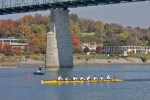
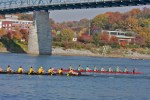
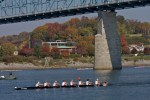
After a morning of hang gliding, we return to Chattanooga in time to check out the Head of the Hootch scene. The first thing about the Head of the Hootch is the sheer number of boats on the water. In spite of the fact that the river is closed to both recreational and commercial traffic for the regatta, and the fact that these boats are as sleek and trim as it gets, the river looks like it could not possibly have room for one more boat on it. As we walk over the Market St bridge to the aquarium, we have to stop and stare several times and gawk while we count the number of boats in a small space.

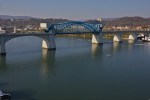
As we make our way across Market St bridge, the next thing that stands out is the number of people standing on the bridge. There are so many people jammed on the sidewalks on either side of the bridge at the South end that they are jumping off the sidewalks and onto the roadway to go around each other. When a close race goes under the bridge, people dart across between traffic to see how it comes out on the other side. This seems so dangerous that I wonder why they didn’t close Market St all together.

The third thing that catches our attention (oh, all right, so we could see this from our apartment before we left) is the number of tents lining the riverfront by the aquarium. There are market-style tents set up practically on top of each other. They line the street and spread out onto the grass between the road and the river. The road is closed and rowers walk in large groups, the teenagers oblivious to other pedestrians and not bothering to move out of the way when they occupy the entire sidewalk.

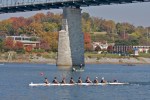
We make our way through the crowd looking somewhat like we need press passes. I have my tripod bag over my shoulder and Pat carries my camera bag over his. We walk down the steps next to the aquarium bridge to get under the street and out to the pier next to the fountain. I figure we’ll be able to get some good shots from under the bridge. Pat helps pick a setting by suggesting I shoot boats as they appear from behind the bridge support. These turn out ot be some of my favorite shots.

I’ve put my big lens on my camera and mounted it on my tripod. I stand behind the camera and discover that I can barely zoom out far enough to get half of an eight person boat from here. I contemplate changing lenses, but decide to stick with the 100-400mm for a while yet. I shoot the boats on the other side of the river. I zoom in and see how tight I can get from this far away. I’m pretty impressed with my lens. I’m feeling like I could pass as a professional with my lovely tripod and my nice big lens.

That’s about the time that the real professional (or wealthy want-to-be) shows up. He’s carrying what must be at least a 300mm f/2.8 lens, if not a 400mm or more. For those of you not familiar with camera lenses, we’re talking a $7,000 – 13,000 lens here. It has an enormous circumference and looks like it could gather enough light to shoot the stars at a high shutter speed. Suddenly, my big lens looks pitiful.

That’s the trouble about comparing your lenses to other people’s–someone always has a bigger lens. But when I look through my lens again at 100mm and just fit half a boat in the frame, I suddenly wonder what the heck the other guy is shooting. From here, I wonder if he can get more than one eye in the frame. I imagine some of the more dramatic sports shots I’ve ever seen and decide he can probably get some really great facial expressions. While I may have the same reach with my lens (or not, I can’t actually tell), I don’t have the same aperture opening. That means I have to have slower shutter speeds to get the same exposure that he can get by opening up his aperture wider. This allows him to freeze those rapidly moving facial expressions sharply in time when they would likely be blurred for me. I would love to see his shots.

I contemplate briefly walking over to him and asking him about his lens, but decide there’s no point in finding out what it is since I already have 2 lenses on my wish list that are in a far more practical price range. Plus, I don’t feel like embarrassing myself today by asking stupid questions. I would love to see the shots he’s getting, though. My main confusion is that he isn’t using a tripod. I wonder how he can hold that big lens without one. As I contemplate whether to talk to the photographer or not, Pat points out a large Swallow condominium complex built on the underside of a bridge structure. Their little mud huts hang, now abandoned, in a line, somehow making me think of a row of abandoned beach houses.

I turn my attention back to the boat races for a few minutes. Watching two boats neck and neck as they come to the finish line gets me excited. I am thrown back in time to my brief lessons in a learn to row class and the feeling of flying across the river in a 4-person boat when we all got into a good rhythm. I think about about how delicious it felt to kick the rears of the competing boat that day (especially when the average age of their boat was about 10 years younger than ours).

However, I don’t know who is competing against whom in this race. It makes it tough to follow or to decide whom to celebrate with. Boats just keep coming in. Then, I see the OSU women and then some OSU men. I’m somewhat excited that I recognize them by their paddles–the rowing class I took was held out of the OSU boathouse on the Scioto River in Columbus.

After shooting some more, we head to Thai Smile for lunch. I have my leftovers packed up and even think to ask for plasticware and napkins. I’m all ready for any homeless we encounter on the way home. However, it looks like all the homeless were shuttled off somewhere. All that are left on the Walnut St Bridge are a group of rowdy partiers who are having the time of their lives. We continue back across the river and go home with our leftovers still in tact.

A Very Blustery Day

We are running late.  I hate that.  I got up at 6:00AM in the hope of not running late, but it seems I needed to get up a half hour earlier.  We are running around frantically trying to gather up the last of our gear, knowing that we are now barely going to make it to the training hills on time.  We remember our bottles of water at the last possible second, grab them, and finally get out the door.

I set up the GPS in a hurry while Pat starts driving in the general direction.  We’ve been there enough times that the GPS should just be a back up.  However, Pat zones out and starts listening to it only to wonder why it’s taking us the way it’s taking us long after we’ve missed the correct exit.  As it turns out, I picked the flight park office, up on top of the mountain at the mountain launch, instead of the training hills.  This will cost us another 10 minutes at least.

We keep going because now it will be further to turn around.  Pat takes corners like he’s driving the BMW instead of the mini-van.  I bite my lip to stifle a scream.  We turn off before we get to the mountain office, saving ourselves a few minutes at least.  Then, Pat takes on the dirt road back to the hills with a gusto that should really only be attempted in an all-terrain vehicle–the road is full of pot holes big enough to swallow a VW beetle.  We do make it, but we are late.

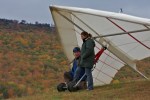
Dan, one of the instructors, advises us to set up a condor and share it.  We are nearing the end of our weekend package, so there’s no reason for us to fly falcons, I guess.

We follow instructions and soon have the condor assembled, pre-flight checked, and loaded onto a trailer for a tow up to the hill.

We fly like never before.  I get airborne so easily, I’m sure that I’m almost ready to start learning to land on my feet.  It’s a great feeling to fly over the grassy field.  Unfortunately, the wind picks up quickly.  By my second flight, I get blown around in a cross-wind after I launch.  Although this is not particularly scary to me, the instructor calls it.  She doesn’t like beginners to fly in gusting winds.  She says it’s too hard to tell what we’re doing vs what the wind is doing to make it useful to us, not to mention the potential dangers.

I am left with the high of having flown.  Plus, I am prepared to take our first written test, required to graduate to the big hill.  This is a new milestone for me–I’ve not previously cared if I ever graduate to the big hill.  In fact, I’d grown convinced that I never would.  But today, I am full of myself.  I flew!  Not only am I excited about graduating, but now I have the fleeting thought that maybe, just maybe I could launch off that mountain some day.

We go into town and grab lunch after putting away the glider.  Then we head up to the top of the mountain and sit outside in the van studying.  Pat hasn’t done the required reading yet, but I’ve now talked him into taking the written test, too.  I’m reading the book to him because he didn’t bring a pair of reading glasses.   We make it through the 4 chapters covered in the test and then head indoors.

I finish the test in about half the time Pat does.  I do not suffer from test anxiety and I try not to go back and second guess myself when I finish a test.  Pat, however, not only has major anxiety about tests, but he also is not particularly well prepared given that I read the chapters to him.  But, we both manage to pass.  This emboldens us further and causes us to decide to take the dramatic step of upgrading our package to an Eagle Package.  The Eagle Package includes 4 mountain launches.  I, however, have been assured that I do not have to go off the mountain if I change my mind.  We get the full tour of the facilities and the orientation that we didn’t get when we signed up for the introductory experience.  We even get to see the repair shop and the sewing shop next door.  It’s pretty cool.

But coolest of all, when we go outside, there are two pilots waiting for the wind to calm a bit so they can take off from the mountain.  Finally!  After so many trips up the mountain to watch this event that I’ve lost count, we will get to see a mountain launch!

Unfortunately, in my rush to get out the door today, I only brought my worst lens.  Although the 70-300mm focal range will be good and the lens is light enough that I can usually get away with hand holding it, it mis-behaves on me frequently.  I’m sure this has nothing to do with the fact that I dropped it on a ceramic tile floor in Montana over a year ago and have yet to get it repaired.
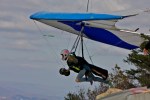
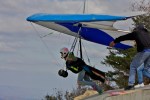
As the first pilot sets up, I snap a few shots and then move down below the launch to try to get a good angle of the launch process.  The moment when he starts the launch is the moment my lens decides it doesn’t want to focus anymore.  And, of course, I have my camera set to not shoot if it’s not in focus.  I completely miss the launch.  Not only do I miss shooting it, but I miss seeing it because I’m so panicked over my camera.

I take a deep breath and fiddle with the camera until I get the lens focusing again.  I manage to accomplish this prior to the second pilot, Meg, launching.

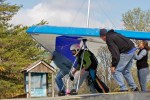
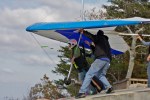
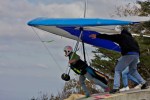
The launch is every bit as exciting as I expected it to be, but much shorter.  The longest part is setting Meg up at the launch line with 3 people holding the wires of her glider to prevent her from blowing away prematurely.  Then, Meg, in her sock feet, calls, “Clear,” and takes 2 steps before she is airborne and tucking her colorful feet into her pod.  I stand in awe.

We watch the two of them soar back and forth along the ridge, gaining altitude from the wind rushing up the face of the mountain.  They look so pretty against the blue sky.  However, watching hang gliders after they’ve launched is not really all that exciting for me yet.  I suppose I don’t have enough knowledge to know what they’re doing up there enough to appreciate it.  In any case, we decide it’s time to call it a day for hang gliding and to head on back to Chattanooga in time to catch the Head of the Hootch.