


In a New York Minute

New York City is . . . You could finish that sentence with just about anything. For me, it’s mostly been a place I go for work or a place I go through on the way to somewhere else. However, there have been a few times when I’ve gotten to spend a justo here for fun.

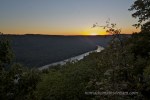
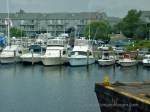
The most recent time was a few years ago now. I stayed with a friend for the 4th of July weekend on a lagoon in NJ. Most of the Jersey shore lagoons are trapped in concrete and look like man made creations, much like the characters on the reality show (sorry, couldn’t help myself). But it’s surprising to someone who has spent as much time in “The Garden State” as I have just how much of the inner inner coastal areas are as dedicated to boating as the actual coastline is.

As someone who grew up as inland as it gets, the coast always seemed like a definitive line between land and ocean. In reality, the ocean gives way gradually to land, meandering its way deeply into every crevice. While me might intuitively guess at the movement of water, I tend to think of it as moving outward from the land to the ocean and had been oblivious to the interplay of water coming in.

My friend and I took a day off work and took the train from Brick, NJ to somewhere in New York City. We saw so many boats on the way, I thought we had taken a train to Miami.
Once we arrived in the city, however, the boats were all but forgotten. It’s hard to remember Manhattan is an island. It’s amazing it doesn’t just sink under the weight of all the sky scrapers it supports.

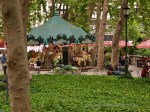
I suppose it comes as no surprise that of the dozen or so photos I took in the city, the majority were in the one park we stopped in. As much as I love visiting cities, I’m always relieved to find a bit off green space producing enough oxygen I feel I can breathe again. We were no where near Central Park, but Bryant Park provided exactly what I needed.
We had a fantastic dinner at a place that specialized in artisan cheeses and then headed to Times Square and Broadway where we saw Mama Mia–it had been running for so long, we had no trouble getting tickets.

The usher/bouncer yelled at me for taking a picture before the show had even started, so I put my camera away and enjoyed the show. I’ve only seen two broadway shows on Broadway, but it is way better than seeing the Columbus, Ohio version. Only London compares to New York for Broadway shows in my limited experience.

At about 11PM, we hauled our shopping bags from Broadway to the train and made our way back to Brick feeling like we couldn’t have stayed awake through one more New York minute.
Quiet Giants

Even as a dedicated tree hugger, I never thought going to stare at trees was particularly exciting. Arboretums, for example, fail to move me.

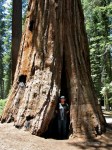
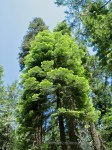
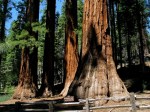
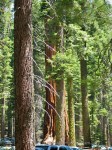
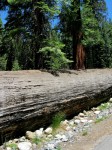
But, several years ago, after 6 days of backpacking in Yosemite, it was a nice respite to head to Mariposa Grove and see the giant sequoia there.

In the same inexplicable way in which the mountains evoke a quietude, these giant trees spoke to me like individual mountains standing amongst a forest of tiny hills. They are the largest living things on the planet by volume.

I once read a historical novel about the settlers of the Pacific northwest in the 1800’s. In that book, they had an intense hatred of trees. The trees stood between them and fertile farmland, sustenance, and shelter.

When I saw the sequoia looming down, as they had in some cases for over 3000 years, among some of the world’s oldest living creatures, I found myself wondering what the early settlers thought of these giants. The Sequoia survived in part because they were fire resistant, bug resistant, rot resistant, and not particularly useful for building anything.

The settlers couldn’t burn them–in fact, fires are quite helpful in promoting Sequoia reproduction and over-controlling forest fires led to a demise in their population.

Their seed cones are tiny pods that pop open and spread seeds when properly dried. The heat of fire, which has the additional benefit of clearing out most of the Sequoias’ competitors, dry out the cones and allow the seeds to disperse.

The Chickaree squirrel can also help disperse sequoia seeds. This little guy will eat sequoia cones and help spread the seeds in part by storing the cones.

Luckily for both the sequoia and the Chickaree in Mariposa Grove, controlled burns are helping to restore the natural ecosystem of the area, encouraging new generations of giant sequoia trees.

The famous “California Tunnel Tree” in the middle of the park probably serves as the best representation of how the early settlers felt about these giant trees. They cut a big hole through the middle of a tree wide enough to drive a wagon and a team of horses through it. Not exactly a sign that they had a sense of awe and wonder about the trees. Seems more like a Graceland tourist trap than a healthy respect for the diversity of life.

In any case, we are all fortunate that Galen Clark did come along with a healthy respect. He saw the testament to grace these trees represented and managed to preserve them.

I imagine life from the trees’ perspective, in which thing move at a pace proportional to a 3000+ year life expectancy. I imagine what a tree “sees” in the course of 3000 years as the make up of the air, the water, and even the very soil at its feet shifts and changes. I wonder if the older trees complain about kids these days or if evolution occurs at an altogether different pace?

Product Testing

In yesterday’s post, I mentioned that I was convinced I was born to row because I made it through a Learn to Row class without falling in the water.  Let me take another moment to brag–I made it through the entire two weeks of classes without falling in.

Fortunately, one of the requirements for the class was to get back into the boat from the water.  This is fortunate in that, having not fallen in, I didn’t get to learn this on my own.

Getting back into a sculling shell from the water is no easy task.  You have to get your body up onto the boat while holding the oars into position so the boat doesn’t tip back over again.  It took me several tries and I was badly bruised by the time I made it back into the boat.

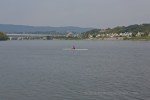
Since then, I’ve been feeling like I was never going to fall in.  I’ve been rowing twice a week and I’ve managed to catch myself every time I started to tip.  Then, the other morning when it was about 54 degrees out, I did my usual route around a section of the river that is mostly still within sight of the rowing center.

When I got to the downstream end of my rowing route, as usual, I stopped rowing to drift by part of Maclellan Island and see what birds were out.  Just then, four Great Blue Heron came swooping overhead.  I turned to see where they were headed and the next thing I knew, my head was completely underwater.  I didn’t feel the boat tip at all; I was just suddenly submerged.

Fortunately, the river was still toasty warm.  But, I had a moment of panic.  Once I got my mind around the fact that I was, in fact, in the water, I realized several things:

  1. One oar had come out of the oarlock and was floating away from me and the boat
  2. The boat was completely upside down
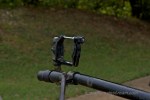
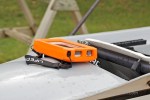
  3. My iPhone was strapped to the boat in a waterproof case and cute little lifejacket
  4. I had lights suction cupped to the boat since it was dark when I’d started rowing–they were now completely submerged.

Accepting that there was nothing to do but get the boat back together and myself back in it, I swam after the lose oar, pleased to find that it does, as advertised, float.  I got the boat righted and was equally pleased to discover that my lights were not only still attached, but also still it.

I got the oar back in the oarlock and managed to get myself back into the boat in one smooth try like I’d been tipping sculling boats for years.  And, the moment of pure delight came when I confirmed that my iPhone had floated and remained dry inside its case.

For once, all products performed as expected!

The only down side was riding my bike home in 54 degree weather soaking wet.

Learning to Row

I took the Learn to Row class offered by the Lookout Rowing Club here in Chattanooga back in July, but rowing a sculling shell and cameras don’t mix well.

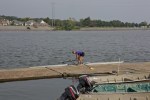
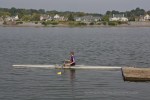
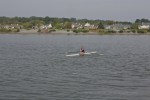
At long last, I got my husband out to the rowing center to help do some shooting.  In these shots, I am demonstrating some of the basic skills we learned in the class:  carrying the boat by yourself, getting into the boat without falling in, getting off the dock without falling in, and rowing without falling in.

Note the “without falling in.”  That is an important qualifier.  A sculling shell is a long and narrow boat; the fact that it doesn’t roll all the time is a denial of physics (and the result of long oars that float on the water’s surface).

In fact, during the first class in which we got into boats and pushed off the dock, I was the only person in my class who didn’t end up in the water, including the instructor.  This is such a remarkable fact that I have to think that perhaps I was born to be a rower.  After all, I once scraped my face eating a breakfast bar; the odds that I would be the only one to make it through the class without falling in at some point are pretty astronomical.

I did not fare so well on learning how to carry the boat.  In fact, I found that to be the most challenging part of the class.  It was also something I was determined to master because I knew I was going to be coming out to row by myself early in the morning and there was no way I was going to ask anyone for help.

First, I tried carrying the boat on my shoulder instead of my head.  I thought this would be more stable and give me better control over the boat.  It did.  However, I couldn’t see one entire side and I kept running into things like railings, buildings, other boats, and occasionally other people.

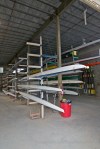
I eventually found carrying the boat on my head gave me much better visibility and the only time I ran into things was trying to put the boat back onto the racks.  I eventually learned to carry the boat in and out of the boathouse on my hip, place it on the slings out front, and then put it on my head to walk to the dock.  So far, I haven’t broken anything.

On this day, as I was rowing, my port oar popped out of the oarlock.  I was pretty proud that I managed to get the oar back into the oarlock without tipping the boat.  This is no easy feat–the oars are like training wheels and keeping both of them on the water evenly keeps the boat from rolling over.  For some reason, my husband didn’t shoot my amazing dexterity.  Maybe he was waiting for the moment when I would fall in?

Visitors at the Visitor’s Center

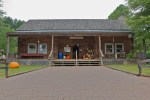
Last Saturday, I watched the visitor’s center at Audubon Acres from 9AM-1PM.  It’s one of those volunteer jobs I don’t mind doing, but the visitor’s center isn’t often a busy place.

I guess it’s helpful for a volunteer to be there to deal with visitors who stop by so the various other folks who might be there can work on projects uninterrupted.  The property manager was off running an activity, which was a tour of a wetland at the local VW factory.  I was covered the front desk until he got back.

After taking advantage of the quiet to finish up some work of my own, I got out my camera.  I took the cordless phone with me, staying close enough that I could get back inside before a visitor could pull in, park, and walk in.

Someone had spent quite a bit of time decorating the front of the center for halloween.  They had found or grown giant pumpkins and strategically placed them in front of the center to make it look like a pumpkin patch.  I’ve never seen such large pumpkins.  I thought they were fake until I knocked on them.

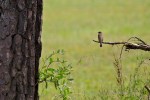
A Brown Thrasher perched in the open across the parking lot from the center.  I, of course, couldn’t resist crossing to the other side to see if I could get a shot of him.  Brown Thrashers are amazing teases.  I believe they instinctively recognize a camera even if they’ve never seen one before.  They perch where they can be seen clearly with no obstructions just until the moment when the camera achieves sharp focus.  Then, they hop behind a bunch of leaves, disappearing completely out of the frame and forcing the photographer to take her eye away from the camera to locate said bird again.

Now, this kind of hide-and-seek is expected when you’re shooting a hummingbird or a warbler.  Tiny little birds that move quickly can disappear completely behind a single leaf.  But a Brown Thrasher is a big bird.  It’s bigger than a Robin and has a much longer tail.  It should NOT be able to evade my lens so effectively.  Yet, there it is and there it isn’t.  I rarely get a shot of a thrasher even though I see them almost daily here.  I hear their loud clicking and know they are making fun of me from their favorite hiding spots.

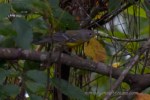
Fortunately for me, although I had no luck getting a shot of a thrasher, I did get to spend a few minutes walking around the property before I left for home.  Within minutes I’d spotted some warblers flitting around in the trees.  The first one I got several shots of was a Magnolia Warbler in fall colors.  The second was a Wilson’s Warbler–one I’ve never seen before.  I love it when I get to add a bird to my life list!  Unfortunately, 400mm is not enough for warblers, so the photos are heavily cropped.

Night Lights

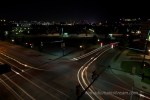
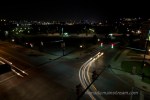
I haven’t shot the Chattanooga skyline at night for a long time.  And I probably shouldn’t have now, either.  The sky wasn’t doing anything particularly interesting.  What attracted me though, was the changing lights on the aquarium.

The aquarium hadn’t been lit at all for many months.  Then, suddenly, the lights turned on and they were red.  As were the lights on the Blue Cross Blue Shield building.  And the lights running along the pier, the lights on the Riverwalk on this side of the river, and even the lights running along the  Walnut Street bridge were covered in red film.

I asked someone if they knew why the lights had suddenly appeared in red.  They guessed it was for the upcoming “Wine over Water” event, but that really didn’t make sense.

I googled Chattanooga and red lights.  I got hits on all the traffic cameras at intersections in Chattanooga.

Then, on the night when I finally broke out the camera, the Blue Cross Blue Shield building was lit in pink and the aquarium lights started changing colors.  The aquarium lights rotated from pink to red to orange to yellow to pale blue to dark blue to purple to pink, and finally, back to red.

I guess I should have just made a video of it because I ended up taking way too many pictures trying to get one of each color.

Then, like a kid suffering from ADD, I was more taken by the streaking head and tail lights of the traffic going through the scene than by the lights on the aquarium.  What is it about long exposures with steaks of car lights going through them that’s so much fun?

But, back to the mystery of the colored lights.  After shooting these, several things happened that made me suspect the red and pink lights were for breast cancer awareness.  It started when I saw a “Save the Tatas” bumper sticker on a car in the grocery store parking lot.

Then, when I crossed the Walnut Street bridge, I realized there was a lighted ribbon symbol that could have been for heart disease awareness, but that’s in February.  Then,  the building lights were appearing in pink more often than in red.  And, I learned that the 30th was the Chattanooga Race for the Cure.

So, I have concluded that the colored lights are supposed to be for breast cancer awareness and that they just started a little early (October is breast cancer awareness month) in honor of the race.  That’s my theory anyway.

I still haven’t figured out why most of the lights are red instead of pink.  Perhaps my theory will be proven or disproven as the month of October progresses.

In the meantime, I’m having fun with lights of all colors.

Tent Cabins

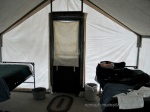
On our trip to Yosemite several years ago, we spent one night in a tent cabin at Tuolumne Meadows.  This was long before the recent scare related to the Hantavirus infection in Curry Village.  Plus, Tuolumne Meadows is a long way from Curry Village.

There are many differences between Curry Village and Tuolumne Meadows.  Curry Village is located in Yosemite Valley, where the temperature is far warmer.  It’s also the most popular part of the park, so Curry Village is larger and has more people in it.  This results in a lot more noise and a lot more bears.

It’s really hard to get that many people to comply with rules about keeping anything scented in a bear locker.  Even well-intentioned people overlook things like lost M&Ms in their cars or in pockets.  Cars parked at Curry Village are often in danger of bear raids.

By comparison, Tuolumne Meadows is cold.  It’s at a much higher altitude in a remote location above the valley, resulting in much cooler temperatures.

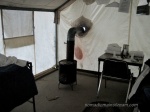
We were there in July–and it was even a warm July.  We slept in sleeping bags rated to -10 degrees.  We wore fleece, warm hats, and zipped our mummy-style bags securely around our heads to stay warm.  Thankfully, the bags were warm enough even after the fire in our tiny, inefficient wood-burning stove went out.  There is nothing about a tent cabin that is energy efficient, unlike our 2-person tent that can often get quite warm with our bodies in it.

But the advantage of the cold temperatures and more remote location is that it’s a smaller village with fewer, quieter people who tend to be more serious about hiking and more conscientious about storing their stuff properly.  There are far fewer bear encounters in Tuolumne Meadows as a result.

Another advantage was that, because of the remote location and smaller number of people, they served a really awesome hot breakfast right in the village.

The biggest challenge we faced was identifying our bear locker in the long row of lockers.  People used unique rock arrangements on the lockers to mark theirs.  We made the mistake of remembering the rock arrangement on the locker next to ours, which had changed by morning.

Anything with a scent must go in a bear locker.  This includes toothpaste, hair gel (if you happen to have brought hair gel), deodorant.  If it could possibly smell like food to a bear, into the locker it goes.

The black canisters are a portable equivalent of a bear locker–all things with scent go in one on the trail.  The Yosemite bears are so familiar with bear canisters they don’t even try to break into them if they see one that’s been properly closed.  We left extra stuff that didn’t go on the trail with us in a bear locker at the trailhead.

There was often evidence a bear had checked out our campsites, but they’d always left quietly without disturbing anything.

Therapy Dog

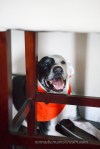
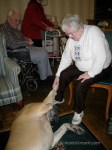
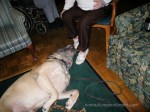
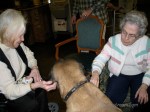
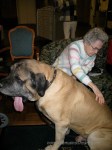
There are many reasons to love dogs.  Each dog has his or her own unique personality.  Since I was revisiting old photos recently, I discovered this set of not-so-great-shots of one of the best dogs ever, Bogart.

Unfortunately, Bogart is no longer with us.  But, for over half of his life, he acted as a therapy dog at the assisted living facility where my aunt lived for the last 6 years of her life.

Bogart went to visit every two weeks.  We would sit in the common area outside the dining room at lunch time on Sundays.  As the residents would come out of the dining room, they would stop and pet Bogart.  As a therapy dog, Bogart’s job was to look cute, be calm, and accept love and affection from anyone who wanted to offer it.  He was really good at his job.

Because many of the residents suffered from Alzheimer’s or other forms of dementia, the conversation was the same every two weeks:

“Oh, my!  I’ve never seen such a big dog!  How much does he weight?”

“He has gray on his face–how old is he?”

“What’s his name?”

“How much does he eat?”

These questions were typically repeated about every 3 minutes by each resident.  I went mentally prepared to repeat the answers endlessly with a tone of voice that sounded like I’d never been asked those questions before.  I concentrated on how much they loved my dog and how much joy he brought to them–that made irritation impossible.

Interestingly, my aunt had always been afraid of Bogart prior to his visits.  I don’t know if she just forgot her fear as part of the process of dementia or if seeing others enjoy petting him made her feel proud that he was there to see her and she wanted to claim him.  Whatever the reason, she went from only being comfortable looking at him from a distance to enjoying sitting right next to him and petting his head.

There was one lady in particular who loved Bogart.  I always thought she would be able to remember him because she loved him so much.  And she did remember him sometimes.  But if she missed one of his visits, we would start over the next time we came in.  Although, there is something to be said for being able to be joyfully surprised by the same thing over and over again.

Bogart clearly knew the people.  He knew who was comfortable enough with him that he could stick his giant head in their lap, who was nervous and preferred if he kept his distance, and who would figure out a way to rub his belly, even if it meant they would need to sit in a chair and use their foot because they couldn’t bend over so well.

It made visits with my aunt something I looked forward to–Bogart was quite the ambassador.

Stringer’s Ridge

Among the many places in the vicinity of Chattanooga to hike, Stringer’s ridge is both new and old.  It’s old in terms of having been there for a very long time.  But it’s new in that a group is now working hard on creating new trails throughout the ridge area.

For us, it made a great Sunday hike when Pat was tired, having been on his feet all week working on building guitars.  Instead of driving an hour and hiking a a strenuous path, we drove about 5 minutes to get to Stringer’s Ridge.

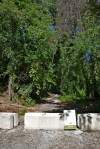
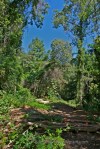
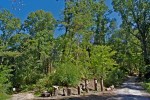
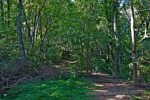
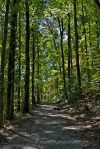
The area has many trails still under construction; they are marked with signs indicating they’re closed.  But, in spite of the closures, we found a lovely loop open by following the deteriorating roadway that seems to be a remnant from when people had homes in what is now a preserve.  It went from deteriorating asphalt to gravel, which was actually easier to walk on.

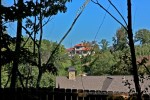
Where the road intersected several trails (most still under restoration efforts, but one open to traffic), it appeared someone had been expressing their artistic talents in wood.  A collection of what appeared to be bird houses lined the main intersection.  A giant sculpture of a hiking man created by creatively placing a forked log and adding appendages made a very cool trail marker.

We’re excited to see the progress.  We could see some of the trails under construction winding their way through the woods below us and were certain they would be a great walk when they’re open.

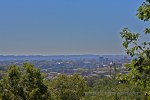
We were also thrilled to discover the fantastic view of the Chattanooga riverfront and north shore areas from the South side of the ridge road.  Who knew we could find such a view just minutes away from home?

Date Night Plus One

Last weekend, my husband suggested something fun, a little romantic, not strenuous, and inclusive of Tisen.  He suggested getting take out and going up to Signal Point to watch the sunset.

He had a craving for fried chicken.  This is monumental.  I have known my husband for going on 18 years now; he’s eaten chicken exactly twice in those 18 years.  The first time was last March.  I’m beginning to think southern culture is getting to him.

This craving resulted in me waiting inside NIkki’s Drive In for our dinners to be prepared while Pat waited in the car with Tisen.

While I sat, I pondered the meaning of “drive in.”  Nikki’s is a place that is most easily reached by driving.  However, there are certainly houses well within walking distance and even more within biking distance.  I’m certain they don’t turn customers away who get there by either of these means.  They aren’t one of those places where you can pull up and park and order through a microphone and they come out on roller skates to serve you.  In fact, they don’t even have a drive through window.  They have a parking lot.  Does having a parking lot qualify a restaurant as a “drive in”?

When I got our food, we drove up to Signal Point without using the GPS.  Pat took 2 wrong turns in spite of me pointing and saying, “turn, turn, turn! TURN!”  I think this is a common marital problem.

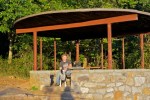
When we got to Signal Point, a couple was already at the only picnic table.  We picked a rock along the hillside to sit on while we ate.  Pat, my romantic husband, had spent an inordinate amount of time packing Tisen’s elaborate dinner so Tisen could eat with us.

Tisen is on a special diet.  It consists of all raw foods.  His fur is softer and stays cleaner longer.  His teeth look cleaner.  He has more energy and seems to limp less.  Yet, he still suffers from the allergies that caused us to change his diet in the first place.

He gets a mixture of reconstituted foods along with herbs and supplements that put our own diets to shame.  This is all mixed with organic coconut oil.  Pat prepared it all and had it ready to go for Tisen while we picked at our fried chicken.
Tisen was pretty sure the fried chicken would taste better than his health food.  I’m pretty sure he was right.

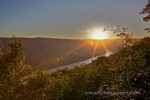
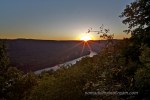
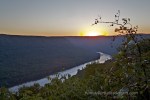
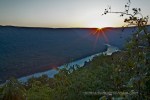
As the sun started to set, the moon rose higher in the sky.  I couldn’t resist trying to get a vertical shot with both the river valley and the moon.  Then, I couldn’t decide which one I liked better.  The one with the sun still hitting the foreground, the one with the foreground in shadow, or something in between?  There wasn’t much going on with the sky, but it was still a lovely evening as are most evenings on Signal Mountain, I suspect.