

Powell’s Books

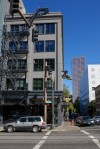
Every town has a store that everyone who visits must go to.  It’s a rule.  If you’re going to build a town and people are going to come visit it, there must be at least one retail establishment that everyone wants to go to while they’re there.  I don’t know what this place is for a lot of towns I’ve been to, but I know it’s there.  In Portland, Powell Books is the must-see tourist store (although it seems to have a lyal local following too, which has to help financially).

I used to think the OSU library was enormous.  Towers and towers of books.  I don’t know if a city block of book is larger or not, but it sure feels bigger.  When you walk into Powell’s, you have to reference a map with a color-coded key that tells you where different types of books are.  I guess you don’t have to reference it, really.  But, having spent a considerable amount of time wandering around looking for something, I strongly advise it.

Once you figure out which wing of the building the book you’re looking for resides in, you still must navigate the building that corresponds to that selection to find it.  It’s one of those bookstores that makes you understand why bookstores have librarians on had to find books you’re looking for and direct you to it.

There was a time when I could spend an entire day wandering around a book store.  These days, only the Apple store could keep me occupied that long.  Instead of lingering among books that smell like they’ve been lingering far longer, I have gravitated to the electronic version of books.  Given that I carry an iPad and iPhone with me virtually everywhere I go, it seems like a better use of the products I already own to double up the value of my investment.

Besides, who wants to haul more than 1 big dusty volume from the 18th century or earlier?

We are at Powell’s Books with our friends from Seattle today.  They have never been inside before, so we suddenly feel like tour guides.  We step inside and consult the map.  We point to different sections of the store.  My friend wants one particular book.  she asks for assistance to find it.  It’s located right next to where we’re standing.  We go get in line, check out, and leave.  We walked out without remembering to take them through the entire building.  Some tour guides!

Shooting Elk

I really enjoy wildlife.  The more wild, the better (well, until I start to look like dinner).  I get a bigger thrill out of seeing a deer in the park than I do at the zoo.  I get an even bigger thrill seeing a deer in the backwoods than I do at a park.  The more remote an area, the bigger the thrill.

Elk are more exciting than deer proportional to their weight.  I think there’s probably an algorithm out there that someone has developed to calculate the level of excitement any given creature produces based on their size, elusiveness, rarity, and number of people they encounter in an average year.

Seeing an elk is more exciting both because it’s bigger and because it’s more rare.  At least for someone who’s lived East of the Mississippi for most of her life it’s more rare.  Where elk can be found in the East, they have been recently reintroduced.  They wear large tags around their necks that I suspect say things like “My name is Leroy.”

I don’t know why they look less wild than their relatives in the West, but they do.  Even though it’s more likely that you’ll run into an Elk while cruising down a highway in the Canadian Rockies than in Great Smokey National Park, when you see the Elk in Great Smokey National Park, you’ll swear it’s one of the ranger’s pets.  The “more rare = more wild” equation just doesn’t hold true in the East.

What all this adds up to is an inappropriate level of excitement about seeing a bunch of elk who live about an hour from Portland.  I thought we would have the best chance of seeing the Elk at dusk, so we stopped on our way back from Astoria at the Jewell Meadows Wildlife Preserve.  Granted, the website told us that the best time to see the elk was between November and April, but since we weren’t planning to be in Oregon between November and April, we figured we’d better take our chances.  Besides, it was pretty much on the way back to my dad’s.

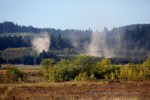
We did not get to see the full herd of 200 elk, but we did get to see a couple dozen elk from a distance.  I thought they would be roaming around grazing a bit more than they were–I guess they go to bed earlier on the coast.

For about the thousandth time during our trip I wished I had a lens longer than 400mm.   I shot the elk anyway, hoping the resolution of my camera would be enough to allow me to crop the heck out of the photos.  Unfortunately, the photos didn’t withstand the crop.  Between the motion of me hand-holding the camera and the motion of the elk, the images are just not sharp enough.

Regardless, I’m still glad we stopped to shoot the elk.  I’m also glad I was shooting with a camera.  🙂

The Open Road in Sepia

Hanging out on the tip of Washington in a place called “Dismal Nitch” might sound depressing.  However, according to the National Park Service, its name was derived from the journal of Capt. William Clark who referred to the site as a “Dismal Nitch” after being stuck there for 6 days in a storm waiting for supplies.  For the Lewis and Clark expedition, it was the last miserable stop on the Columbia River between them and the Pacific ocean.

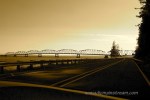
For us, it was a beautiful, sunny day that gave us great views of the Astoria-Megler Bridge, the Columbia River, and the mountains beyond.  However, having driven over the ridiculously long bridge, stopped at Dismal Nitch, watched the pelicans diving after fish, and watched the sun start to sink lower in the sky, we decided it was time to start heading back towards Portland.  We had one more stop in mind and we wanted to get there by dusk.

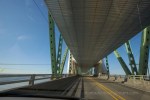
On the way back, I did some more “through the windows” shooting.  I’m fairly certain there is some law of photography that starts with, “Thou shalt not do landscape photography from a moving vehicle.”  Oh well, rules are made to be broken.

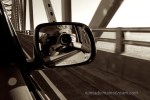
I know for sure there is some law of photography that says all photographers must at some point take a shot of themselves in a mirror.  I’ve resisted for a really long time.  But when I caught my reflection in the side-view mirror, my will power crumbled.  Like being drawn into a black hole, I felt compelled to press the shutter button.  Too bad I didn’t have try a slower shutter speed–it might have been interesting with the bridge blurred in the background.

Having captured some similar images of the bridge going the opposite direction, I found myself somewhat bored with today’s selection of photos.  I decided to change them all to the sepia preset.  I went a little wild with the orange tones in the first image–it evoked the idea of sunset for me.

The pairs of images are yet another semi-happy accident I wish I would have thought of when I was shooting because I would have shot them a little differently.  Maybe with the road going left and then right or something.

Regardless of what I might have shot differently or whether I shot something similar before, there is still something evocative to me about looking down the road.

What is it about an empty road that seems so prophetic?  My nomadic desires were suddenly reawakened by the sight.  The possibilities promised by going somewhere new seemed irresistible.  But on this day, the road didn’t lead to a place we hadn’t been before.  Just like life, sometimes we drive in circles.

Pelican Jarts

While birds are pretty darn fascinating to watch, there is no bird like a Brown Pelican for entertainment.  I don’t know what it is about watching their repetitive pattern of rising over the water, nearly hovering as they reposition their bodies for a dive, and their sudden transformation from giant seabird to giant feathered jart as they dive, leaving behind a splash that probably wouldn’t get them a gold medal if this were the Olympic diving competition.  But, I could watch them perform this dance between feast and famine over and over again.

On the Washington side of the Astoria-Megler Bridge, which, if I were inclined to bet, I would bet is called “Megler,” we found a park where we could sit and watch the Brown Pelicans in their unique approach to dinner.  It’s amazing to me that such a large bird can so completely disappear under the water for several seconds after diving head first after a fish.  I feel certain the military could learn a lot from these birds.

The Brown Pelican is, in fact, the only pelican who dives from the air after its prey.  If I were a White Pelican and I watched the Brown Pelicans I shared my territory with snatching up fish from below the surface of the water this way, I would probably want to give it a try–it looks awfully fun.

Through the Glass

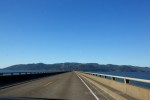
There is only one thing disappointing about the Astoria Megler Bridge:  there’s no place for pedestrians.  I guess it would be expensive to add a pedestrian walkway to a bridge that spans over 4 miles, but the views from the bridge stretch over the bay to the distant mountains in Washington and back to the South in Oregon.  Plus, the pelicans and gulls fly over the bridge at eye level.  It would be a great place to shoot.

I decided to try shooting through the windshield.  I have a lot of experience shooting through car windows–one of the sadder ironies in life is that wildlife tends to be more afraid of humans walking in the woods than of cars racing down a freeway, often to their own demise.  This leads to me trying to capture images of moose, elk, bears, etc through car windows more often than on foot.

On the positive side, I have learned a few tricks.  First and always applicable, get as close to the glass as possible.  This puts all the crap stuck to the glass completely out of focus so it doesn’t show up in the photos (the spots in the last image are actually birds that were flying too fast to be in focus).

Second, if you can’t roll down the windows and stick your head out, shoot through the front windshield if you’re shooting wide angle.  There is just nothing appealing about a composition that looks like this:

Third, if you’re shooting with a long lens, it’s easier to shoot out the side window, but watch for the blasted rearview mirror.  Shoot tighter, sit cross-legged to get up higher in your seat, roll down the window and prop the lens on top of the rearview mirror (not recommended in a rapidly moving vehicle).  Do something to get that mirror out of the frame.

Fourth, don’t forget about reflections.  If you have a polarizer, you might be able to get rid of them that way.  Unfortunately, sometimes you have to live with them (like in the first photo in the gallery).

Fifth, if you’re shooting though the windshield of a car going 50+ MPH down the road and you’re trying to get lots of depth of field, you can focus on whatever spot is in front of the car and then shoot, even though the spot you just focused on is gone by the time you push the button.

Finally, if you are shooting while the car is in motion (hopefully because someone else is driving it), remember that the speed your moving affects the shutter speed you want to use, depending on whether you want sharp or blurred images.  Oh! I just had a great idea for shooting the drive down the far side of the bridge (yes, I just smacked myself in the forehead since I am not planning to be back in Portland again for a year).

Bridge Over Troubled Water

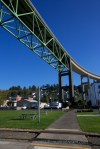
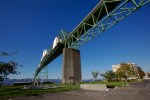
On our trip to Portland oregon, we made a stop at Astoria, a town as on the corner of Oregon as it gets.  In fact, the 4 mile long Astoria Megler bridge crosses from The north-most, west-most corner of Oregon to Washington.

We planned to drive across the bridge, but decided to make a stop to see the under-side of the bridge before making the crossing.  To be honest, this was because we couldn’t figure out how to get onto the bridge and were circling around confused when we spotted a Naval memorial under the bridge.  We pulled off and checked out the nautical monument and coastal scene.

The nautical monument is like a miniature wall that captures the names of those who have died in service to the sea.  The roles of the people range from boat captains to daughters of boat captains.  It’s an interesting exercise to read the names of the people and what is described as their job. I wonder if it was difficult work to be a sea captain’s daughter?

Seaside Seagulls

From Cannon Beach, we drove North to Seaside.  Perhaps we needed to do a little more research and there is a really beautiful beach somewhere in Seaside.  However, what we found was a ridiculously overdeveloped tourist trap looming over a nondescript stretch of sand with more litter than we’d seen in downtown Portland.

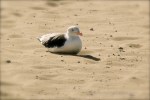
Having just come from Cannon Beach, I was so unimpressed that I didn’t shoot a single beach scene.  Instead, I put my 100-400mm lens on and started shooting the gull stragglers that didn’t seem to know the gull party scene was down at Cannon.

Two observations about photography:

  1. While 100mm sometimes surprises me with how tight it really is when I point it at a landscape scene, 400mm always surprises me at how wide it really is when I point it at a bird.  Even a big bird that’s relatively close to me physically.
  2. Number 1 often leads me to shoot the eye of the bird near the middle of the frame to make cropping easier.  Unfortunately, by focusing both the lens and my brain on the eye of the bird, sometimes I all together lose sight of composition.

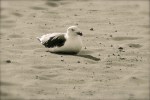
With regard to the first observation, the 4th photo in the gallery is the original, unadjusted image out-of-the-camera (other than having been converted to JPEG and greatly reduced in resolution for the purpose of posting).  As you can see, the gull appears quite far from the camera.  This isn’t helped by the fact that I was standing on an observation area raised well above the beach.

As for the second observation, it frustrates me when I sit down at my computer and look at my shots on my big bright screen and smack myself in the forehead and say, “Man–that would have been a great shot if . . . ”

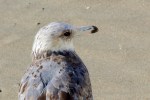
For example, the young Herring Gull checking out its own shadow probably would have been a more interesting shot than the one I brought home.  I don’t know if he was actually checking out his shadow, but that’s the story the image would have told if I’d back up far enough to get the entire shadow of the bird into the frame.

Sometimes my husband walks up behind me and says, “Oh, that would have been great if you would have . . .” when I am reviewing images.  That’s even more frustrating.  A word of relationship advice:  if you’re in a relationship with a wannabe photographer, don’t ever say that.

As it is, these gulls gave me a good opportunity to expand my horizons a bit in Aperture.   Normally, I don’t do much beyond cropping, adjusting the levels, and balancing highlights and shadows.  The poor lonely Herring Gull looked like it really needed something more than that.  So, I played with edge blur and antique effects and Black and White.  Nothing ground breaking here, but it was fun.

Mt Hood and the Mighty Ducks

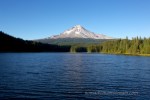
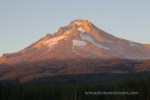
If the Tualatin River Wildlife Preserve wasn’t enough for one day, taking a drive up to Trillium Lake by Mt Hood sure did top it off nicely.  Trillium lake has a lovely two-mile trail  around it and we were promised a great view of Mt Hood by the internet, which is always right.

We decided to get there a couple hours before sunset so we’d have plenty of time to walk the two miles and pick out the perfect spot to shoot Mt Hood as the light changed.

We didn’t get there two hours ahead of sunset.  In fact, by the time we parked and were walking to the lake, sunset was about 45 minutes away.

Thankfully, the best view of Mt Hood was about a 5 minute walk from the car.  In fact, they built a deck there and put some benches on it so we could be comfortable while we watched the sunset.

Instead of sitting and relaxing, I got busy setting up the tripod I’d borrowed from my father and getting my camera ready to go.  Moving quickly kept me warm–even with my many layers (a light fleece plus a leather jacket plus a huge, thick fleece borrowed from my dad), it wasn’t exactly toasty.  The wind was whipping up a pretty good froth on the lake, meaning there were no glass-like reflections to be had of Mt Hood.  But, it was still beautiful.

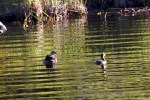
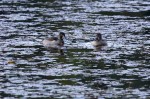
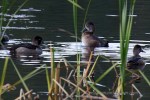
And, sunset took long enough that we had time to take a break from shooting the mountain to walk part way around to get up close enough to identify some ducks that eluded me.

After looking at them through binoculars, shooting them with a 400mm lens, and after enlarging the images to look closely at them, I’m pretty sure the little ones are Pie-billed Grebes and the larger ones are Ring-necked Ducks.  I feel more certain about the Pie-billed Grebes than I do about the Ring-necked Ducks.  They were fun to watch in any case.

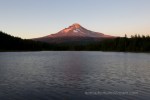
We returned to the deck so I could shoot as the sun faded.  The light turned amber and the mountain shifted from gray rock to glowing orange.  The trees below timber line moved from green to purple on the color wheel.  It’s almost hard to believe I didn’t change the tint or white balance between the early and late shots, but the sun did all that for me.

I kept hoping the wind would die and let me get one good shot of the mountain reflected on smooth water, but the wind only got stronger and I only got colder.  About the time we were going to call it quits, we spotted two otters making their way towards us across the lake.  This was the first time I’d seen wild otters anywhere other than the ocean.

Pie-billed grebes, check.  Ring-necked ducks, check.  River otters, check.  Mt Hood at sunset, check.  Definitely time to call it a day.

Two Strangers at Tualatin

While in Portland, we made a stop at the Tualatin River Wildlife Preserve to see what birds had stopped over on their way South.

When a sparrow appeared to me, I was hoping it was going to be something I don’t see at home.  However, I would say it’s either a Chipping Sparrow or a young White Crowned Sparrow, both of which are also found out east.  I’m rooting for a White Crowned Sparrow–it’s more exciting than a Chipping Sparrow.  Plus, it has an orange beak–although this isn’t normal for a young White Crowned Sparrow as far West as we saw this one according to Sibley.  But a Chipping Sparrow doesn’t have an orange beak, either, so I’m going with the White Crowned.

Sparrows are often tortuous to identify.

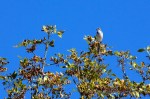
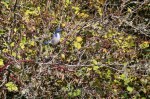
This leads me to a species definitely not seen East of the Mississippi–the Scrub Jay.  I don’t know who named this poor guy after something that sounds like it should be used to clean toilets, but they really must have been annoyed with these noisy, persistent buggers when they named them.  After all, the Scrub Jay is a beautiful, brilliant blue bird with gorgeous markings.

My appreciation of the Scrub Jay reminds me of a visit from a Korean family when I was a teenager.  They were amazed by the Northern Cardinal.  We had dozens of them visiting the feeders during their visit and the Korean children couldn’t get over how beautiful they were.

What is it about rarity that makes us prize beauty more?  Once it becomes a common occurrence, we forget to be amazed.  This seems related to the old adage, “we only want what we can’t have,” usually applied to dysfunctional relationships.

Instead of appreciating the ubiquitous Northern Cardinal when we are in the East and the equally ubiquitous Scrub Jay when out West, we look for the birds that are hard to find.  We revel in sighting the birds yet to get a check mark on our life list.  We yearn to see a bird we’ve never seen before.

I admit I fall into this thinking.  I was excited to add two birds to my life list while at the preserve.  First, there was the Cackling Goose (or the Crackling Goose as it seemed to come out more often than not).  I had dismissed them as Canada Geese to be honest.  I had no idea there even was such a thing as a Cackling Goose.

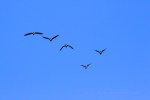
Fortunately, my father had recently learned about the Cackling Goose, which led me to play its call compared to a Canada Goose.  Sure enough, different calls.  All of the birds in flight were Cackling Geese.  They seemed to be confused as they tried to create a formation.  Perhaps that’s why they were still as far North as Portland in October.

But more exciting than the Cackling Goose, we also got to see a Red-breasted Sapsucker.  Definitely a nice treat, although probably a daily sighting in this preserve.

Little Things

We have just returned from our annual trek to Portland, Oregon to visit my dad and his wife.  We made this a relatively low-key trip.  In the past, we’ve taken longer trips to Portland to allow time to meet our friends in Seattle and do things like take a side trip to Olympic National Park in Washington or spend a week in Glacier National Park.

This time, we spent a lot of time debating if there was a way to go to Portland with Tisen.

The reality was that we would need to spend 6 days driving if we didn’t fly and there was no way I was going to load Tisen into the cargo hold of a plane.  If we were going to take 6 days to drive to Portland, I wanted to make it an adventure through Yellow Stone–a place I have yet to go.  But, neither Pat nor I could afford to take that kind of time off work.

In the end, we opted for asking our friends to watch Tisen and keeping our trip short.  Our friends from Seattle offered to come down to Portland to spend a day with us so we didn’t have to take 2 or more days to see them.  My dad didn’t plan any multi-day side trips; we would have plenty of flexibility in our schedule to visit with our friends.

So, last Monday morning, the alarm went off at 4:00AM and I hopped out of bed like that was the time I got up every day.  By 5:45AM, Tisen was fed and walked and we were packed and ready to roll.  Tisen excitedly ran for the van just sure he was going on a new adventure with us.  I had a hard time dropping him off at our friends’ house.

We made it to Portland a little early and by 2PM were sitting in my dad’s family room with full bellies (having stopped for lunch on the way from the airport) and suffering from only mild separation anxiety.

It felt good to just sit and hang out, catching up.  I, of course, got out my camera and started looking for things to shoot.

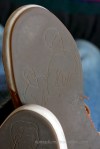
Pat sat across from me with his feet up on a foot rest.  I noticed for the first time that his shoes, which he has had for at least a couple of years, have outlines of the shoemakers on the soles.  I couldn’t resist trying to shoot the soles of his shoes.

Then, my dad was telling a story and chuckling.  I had to capture some of his facial expressions (although most of them didn’t come out so flattering).

Finally, I put my macro lens on my camera and went out to the garden.  My dad’s wife is an amazing gardener and can always be counted on to have beautiful flowers.  Although the surprisingly cool temperatures sent be back inside after only shooting a couple of flowers.