The Last Mimosa

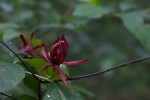
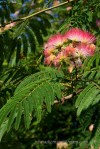
I’m saddened to learn that the Mimosa tree is an invasive tree from Asia that doesn’t belong here.  In fact, the Tennessee Exotic Pest Council ranks it as a severe threat.  This makes me sad because I was really enjoying the blossoms, but I feel strongly that invasive plant species need to be removed from non-native habitats.  Now I feel like a traitor–aggrandizing the enemy.

But, I can’t help but indulge my irresponsible self one last time before I turn my back on the Mimosa tree (don’t worry, I’m sure I’ll continue to indulge in the beverage on the rare occasions the opportunity presents itself–too bad it’s not the drink that’s invasive instead of the tree).

In case you are unfamiliar with the problem of invasive species, I confess it’s a bit of a sore spot with me.  Having spent many weekends trying to remove plants that were taking over my own yard as well as the neighborhood, I know how difficult these plants are to control first hand.

In the US, we tend to plant what we think is pretty and/or is easy to grow. We fiercely defend our property rights and believe what we plant in our yard is our own business.  Unfortunately, invasive plants don’t stay on our property.  They spread through an amazing variety of means and grow quickly out of control since whatever keeps them in check in their native habitat doesn’t exist in the ecosystem they have been introduced to.

While we sometimes call native plants “weeds” because we don’t like the way they look and they grow in places we don’t want them to, these aren’t the same as invasives.  Invasive species do outright harm to an ecosystem.

As we all know (I hope), every living thing has interdependencies with other living things.  Whether it’s for shelter, food, temperature control–all of the above, no creature can exist without other creatures to support it (depending on what you call a “creature,” I guess).  Plants are a critical component of this web.

Invasive trees like the Mimosa reek havoc upon the availability of necessities by crowding out the native trees and plants that would provide them.  Because invasives didn’t evolve with the rest of the ecosystem, they fail to provide the critical (and often subtle) requirements that the native plants would provide.

This is my plea:  the next time you plant something, remember that what you plant will spread far and wide whether you know it or not.  Make a choice that everyone can live with (including wildlife) instead of just what looks good.

A chunk of our tax dollars is spent trying to control these invasive species–even if you care nothing about your ecosystem, why would you want to make a choice that will be an ongoing cost to you and the rest of the tax-paying population for generations to come?

All right, I’m off my soapbox now.  Back to taking pictures.  🙂

Cloud 9

Every once in a while, things come together unexpectedly in small ways.  I say in small ways because, after all, creating an image that I like is not like curing cancer.  But, sometimes, just every once in a while, something happens that gives me hope.

I don’t know what for, exactly.  There’s the hope that maybe I can capture images that matter to me.  There’s the hope that life will have more moments of stunning beauty and the joy of witnessing them.  And then there’s the hope that life is really about these moments and none of the other crap really matters.

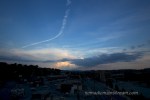
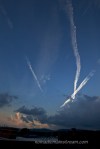
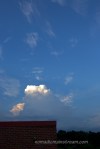
On this particular day, the three of us were loaded in our mini van.  Me in the front passenger seat, Pat driving, and Tisen riding in the back with Lion (or maybe it was ‘Possum?).  As we made our way to the Rice Boxx to pick up dinner (side note:  the food is decent, but if you judge chinese food by the quality of the fortunes in their fortune cookies, steer clear), I looked up and saw the most amazing clouds in the sky.  They were the fluffiest, most interestingly lit clouds I can remember.  Of course, the time to see the most interesting clouds is not when you’re in a car on your way to pick up dinner and camera-less.

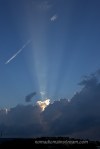
This is the part where things just came together.  We got dinner and went home and when I looked out the window, I saw an enormous ray popping through the clouds going straight up.  I had to choose between trying to capture an image that might last the rest of my life and eating a hot dinner that would last about 10 minutes.  It was an easy decision.

I grabbed my camera, tripod, an extra lens, and headed up to the roof.  I found a neighbor up there, already enjoying the sky.  She had her back to the sun rays coming through the clouds, enjoying the puffy clouds–although they were somewhat less puffy now.  Like me, she really enjoys unwinding on the roof.  Unlike me, she didn’t bring a camera.

While I set up and started shooting, she and I talked.  I managed to set up and get at least one image I’m happy with (well, at least on my monitor) and get to know a little about my neighbor at the same time.  This might be a new milestone for me.

One of the things I’ve discovered about my 5D Mark III that was a nice surprise is its built-in level.  I can push a button and it displays a level on the LCD.  Having discovered that I view the world at a tilt, this is an awesome feature for me.  Especially when shooting in Chattanooga–there are no straight lines on the horizon to line up with.

Returning to finish my dinner, I discovered Tisen was not at all interested in the clouds–only in getting comfortable on the couch.

Mimosa Anyone?

For those of us who appreciate an excuse to drink champagne for breakfast, a mimosa is a tasty beverage that someone invented most likely because they spent too much money on a bad bottle of champagne (my apologies to any French readers, I really mean sparkling white wine that may or may not be from the Champagne region of France) and didn’t want to waste it.  Sweetening up sparkling wine with orange juice was a stroke of genius in my opinion.

But it does not explain how it got its name.  For that, I am forced to google.  Apparently, I have never had a mimosa that was made correctly–they are supposed to have a foamy head that resembles the flower on the mimosa tree.

In Ohio, the crabapple trees bloom fantastically in the early spring.  But I can’t remember ever being over powered by their smell.  And they burst into blossoms that seem to disappear within a week.

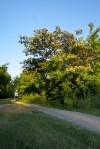
This is my first spring where mimosa’s are common.  In Ohio, you might discover this strange tree tucked into a protected corner of someone’s garden, but I can’t recall ever seeing one in the wild.  Here in Tennessee, they start a sneak attack with their sweet scent.  I walked through the park smelling the perfume in the air for days before I finally figured out what it was.  That was at least 2 weeks ago–they are still blooming like mad.

Unlike the crabapples, the mimosa trees tend to be tall, keeping their blooms out of reach.  This makes them a bit of a photographic challenge.  And, as you may know by now, I seem to gravitate towards challenges.  But it’s not the challenge of capturing them from a distance that attracts me, it’s the way the light hits them in the evening, suddenly spotlighting their pink foam flowers in golden light.

I may have to get a ladder and go back for some close-ups.  I wonder what the maintenance crew would do if they saw me carrying a step ladder?

I spotted a small mimosa tree down by the river.  The best time to shoot it would be around 8AM when the sun is still low but high enough above the Eastern horizon to send a few rays over the steep bank above the tree.  But, I decided evening would be a good time to experiment with my flash outdoors.

I set up my flash on a stand so I could put it as close to the tree as possible while I shot further back and to the side enough to keep the flash out of my frame.  However, if there is any light on the mimosa, it’s because I lightened it in post-processing, not because the flash threw so much as a single random shiny spot on it.  A disappointing experiment.

The good news is that the mimosas seem to just keep on blooming.  Maybe I’ll get a chance for that close up over the weekend.

New Camera, Same Photographer

I love amazing shots of lightening. Perhaps because I’ve never managed to capture one? I have tried many times, but I always miss. At one of the workshops I attended recently, they mentioned a few tips on how to capture lightening, and then, not having any opportunities, I forgot about it.

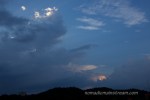
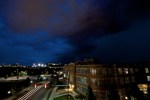
But, at last, as I was sitting on the couch reading the instructions for my new 5D Mark III the other evening, a brilliant flash lit up the sky. I grabbed the tripod and set my camera up on the balcony, attempting to remember those tips.

I tried a low ISO with a small aperture and a very long shutter speed. I tried a high ISO with a small aperture and a fast shutter speed. Then I remembered the suggestion to set the shutter on bulb (stays open until you close it). Of course, I hadn’t gotten that far in the instructions yet and the bulb setting isn’t where it was on my 40D, so I went with 30 seconds.

This led to several images that looked like it was daylight out except for the streaks of the car lights.
You may have noticed by now that none of the photos in the gallery actually contain any lightening. At least not obvious lightening. I think part of the problem was that the lightening was so far behind cloud cover that it wasn’t bright enough to make a huge difference in the exposure. While the clouds lit up like paper lanterns to my eye, the difference in light over a 30 second exposure was too subtle for my camera.

This theory led to me remembering another tip.

The tip was to cover the lens with a piece of paper or your hand and uncover it only when the lightening flashes. In case you were wondering what the dark shadow is over some of my shots, that’s my hand. Apparently, I didn’t actually cover the entire lens, so I have some fun finger shadows. I can see this turning into a whole new style of shooting. Look forward to many photos with animal shadows cast over them in the future!

I thought if I could block all light until the moment when the lightening was flashing, maybe the difference would be great enough to capture the flickering clouds.
I think I need to try this again with a different way of covering the lens to see if my theory has any merit.

Another thing I would like to try is shooting lightening from out in the country where there is little ambient light. The street lights in my neighborhood contribute to the problem, I believe.

I googled shooting lightening to see what other tips I could find. The biggest one I hadn’t considered before–and perhaps the skill I most lack–is to be patient.

I guess I was secretly hoping my new camera would magically solve these kinds of difficulties for me. Next time, I’ll upgrade the photographer instead of the camera.

Native Song

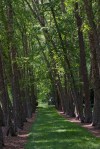
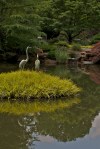
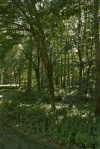
Having survived the Japanese garden at Gibb’s Gardens, I moved on with my co-shooter, John, to another part of the park.  This time, we entered an area that looked like natural woods.

As much as I enjoy gardens, natural woods are still my favorite.  By “natural,” I mean woods with plants that belong there.  This is not the same as, say, a woods covered in kudzu or so overgrown with privet or honeysuckle, you can’t even see through it.

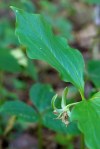
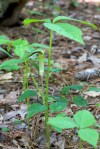
Here, the woods had only native plants and we were both tickled when John discovered a Jack-in-the-Pulpit.  Soon, we were finding more of them.

Near by, we also found some spent Trillium, Solomon’s Seal, Virginia Creeper, and the one native I don’t like to see, Poison Ivy.  I should rephrase that.  I like to see it (it is a beneficial native), but I don’t like to be anywhere near it.  I’m starting to itch just thinking about it.

As we hunted for wild flowers, a wood thrush started serenading us.  The wood thrush’s song is my favorite.  Thrushes can sing more than one note at the same time–they harmonize with themselves.  The wood thrush in particular has a haunting, flute-like song that always makes me want to stop and listen.  You can play a clip of its song here (scroll down a bit).

Although I have heard a wood thrush many times–in fact, one used to summer near our house and was my alarm clock many mornings–I have only actually seen one once.  I have never even gotten close to getting a picture of one.  This relative of the robin is reclusive by comparison.  Wood thrushes hang out in the lower story and underbrush of the woods, magically disappearing behind the tiniest of leaves.  Their brown camouflage helps them disappear, I guess.

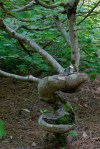
We eventually moved on from the wood thrush and made our way towards the rose gardens.  Along the way, John pointed out a tree that was growing at a nearly 90-degree angle.  He told me native americans used to train trees to grow at angles as a directional indicator towards water or other resources.  However, he felt this tree was too young to be an example of a pointer.  We never did get an explanation for it.

When we got to the base of the hill covered with roses, I was pooped.  Carrying around my 40+ pound backpack and tripod all day had wiped me out.  I suddenly realized I hadn’t had any water since 9:30AM and it was now nearly 3:30PM.  I looked up the hill and decided I really didn’t need to shoot any roses.

John, carrying less than 3 pounds of equipment including a bottle of water, was still feeling energetic enough to head on up to not only the roses, but also the day lilies at the top of the hill.  I guess that’s what a lifetime of experience shooting does for you.

Gear Envy

Continuing the Gibbs Garden field trip, my cohort and I made our way down from the Manor house back towards the main entrance in time for lunch.  Along the way, we frequently paused to shoot.

Below the Manor House, looking back up the hill, an arbor stretched across the hillside below the house, surrounded by flowers.  It was so beautiful, we had to stop to shoot.  Unfortunately, the sun was high and the house was lost in dark shadows.

As we worked our way back down, we found numerous water features.  Between natural looking creeks and man-made ponds and streams, each had a distinct character.  The bridges that accompanied them were just as varied.

It’s funny how I can look at a scene, know that the lighting is not going to allow me to get the image I want, but not be able to resist trying anyway.  I wonder if this is the difference between digital and film?  Between knowing I can just delete any bad shots and that I can do quite a bit in post processing to improve the harshness of the light, I can’t walk away without shooting.

I haven’t quite figured out how to fix bad lighting in software, though.  While I can lift the shadows and pull down the highlights and do all kinds of interesting adjustments, in the end, it’s still bad lighting.

My first impulse in dealing with harsh lighting is to reach for a polarizer.  While it can’t fix the light, it can at least remove a lot of glare.  Two things have recently changed, however.  First, I have been shooting wide angle with a lens I added a couple months ago, which requires an 82mm filter.  My polarizing filter is 77mm.   So, I had to switch lenses to my most recent addition, a 24-70mm, which takes a 77mm filter.

After switching lenses just so I could use a polarizer, the second recent change come into effect.  I now have enough gear that I need two bags.  This has created a whole new problem.  I only brought one bag with me and I forgot to put my filters in it before I left.  So, I had picked a lens to fit a filter I didn’t have with me.

It seems like getting more stuff complicates photography in the same way it complicates the rest of my life.  The cost of more gear is more than the price–it also means more time organizing it, looking for it, and switching back and forth.  I think I’m about to hit my limit on wanting to further complicate my hobby.

Interestingly, the photographer I shot with at Gibbs Garden has been into photography since he was a boy.  Once film became too expensive and inconvenient, he switched to a high-end point-and-shoot with full manual control.  He carried his small, light-weight camera, a proportional tripod, and nothing else.  I was extremely envious by the time we sat down for lunch.

Climbing Up the Walls

Having made space in my photo library, I, of course, had to fill it.  I did this by importing an old archive of photos into my favorite photo management tool, Aperture.

An interesting thing happens when you import an old archive:  you watch your life flash before your eyes in the most literal of ways.

As I sat there going through time, I was reminded of many amazing things I’ve experienced in my life.  Of course, I find a starling with white tail feathers (which still eludes my camera) amazing, so I guess I’m easy to amaze.  I consider that a virtue.

Among these memories are a few moments when I was scared and not sure I could do something, but I did it anyway.  I’m sharing one of those today.

I had traveled to Yosemite with some friends I’d been training with for my first triathlon.  We went to San Francisco first where some of them (not me) did Escape from Alcatraz.  That was above my pain tolerance level.

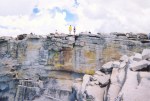
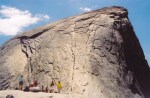
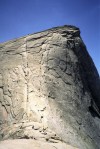
In Yosemite, at the base of Half Dome, I stood looking up at the climb to the top of the dome and nearly didn’t attempt it.  If I am completely honest, it was only pride that motivated me to do the climb.

It’s hard to describe the climb.  I guess if you imagined people walking across a rope bridge and then imagine the bridge is vertical, hanging down the side of a mountain, and only has a floor-board every 10 feet, that would be close.

The boards are flat against the rock so you can perch and rest for as long as the people behind you will tolerate.  It’s probably not quite as vertical as it seems, but I felt like we were walking up a wall.

You are not tied to anything and you do not use any special gear.  Gloves are highly recommended, however.  If you arrive without a pair, there is a pile of gloves at the start of the climb left by those who completed it.  These are simple work gloves–nothing special.

I don’t know how long it took to complete this climb.  I just remember feeling grateful that someone slower than me was ahead of me–that gave me the time I needed to recover between resting perches.

When I made it to the top, what breath I had left was completely taken away.  There is an interesting phenomena that the harder I have to work for a view, the more amazing it is.  Part of the amazement is the sense of incredibly great fortune that I, a mere mortal of lower-than-average athleticism, am among the few to see it.

When Pat and I went to Yosemite together a couple years later, I tried to talk him into doing the climb.  That was a non-starter.  We hiked to several other views that were probably just as mind blowing, but they didn’t come with quite the same sense of elation.

*Photograph Credits:  these are not mine (in fact, I’m in 2 of them).  I’m not sure which friends took them, but I’m happy to have them.  Especially since I haven’t found my own photos from this trip–they may be in print only.

Clutter vs. Hoar Frost

In the process of going through old photos and clearing out the masses of virtual junk that I have collected, I am reminded both of how much I prefer a life uncluttered and how much I enjoy reliving the past.

On the topic of de-cluttering, there was a time when this referred to clearing clothes out of closets, emptying the junk drawer that collects unrecognizable objects that we’re sure we’ll need someday, selling the collection of hobbits or beanie babies, and donating excess household goods.

For us, we started the process of reducing things several years ago.  But having focused for so long on getting rid of physical items, I completely ignored the virtual ones.  My main problem, as you might guess, is photos.  As long as all my images fit on the hardware I already owned, I don’t think of it as clutter.

But having grown my capacity to over 7 TB between old devices, new devices, backup devices, and spare devices, I’m thinking it’s time to start eliminating the multiple copies of the same photo, the really bad images, the slightly different angles of the same thing, the series of 300 shots of the same person making different facial expressions–in short, the crap.

Having cleared out this virtual junk, I find the important memories and the images I’m almost proud of suddenly jumping out at me.  Just as clearing out the 4 potato mashers, the endless collection of useless appliances (useless to me since I don’t cook), and the endless odds and ends that filled our kitchen cabinets made the kitchen a place I didn’t mind hanging out in (because I could suddenly, for example, find the corkscrew when I brought home a bottle of wine), I find myself suddenly having a hard time pulling away from perusing the past.

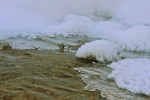
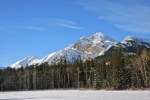
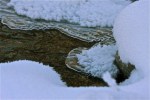
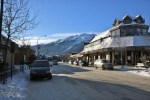
When I stumble upon photos from one of my favorite places, Jasper, Alberta, I decide to share a few from our hike near Pyramid Lake in December of 2009.

Jasper National Park is located in what I used to think was Northern Canada–until I looked at map.  It is North of Banff, but, it turns out that’s not even far enough North to be Northern Alberta, let alone Northern Canada.

Given that the town of Jasper is located within Jasper National Park, which encompasses a pretty big chunk of the Canadian Rockies, it was far enough North (or perhaps just far enough in altitude) that the high temperature those two weeks of December was -15 degrees Fahrenheit.

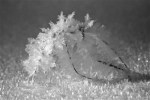
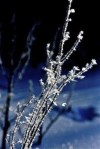
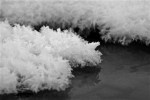
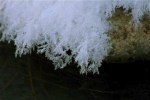
When we hiked around Pyramid Lake, we discovered something I’d only read about–hoar frost.  I never actually knew what hoar frost was until after I showed some of these shots to a friend.  If Pat wouldn’t have been with me, I probably would have frozen to death because I was so fascinated with the hoar frost, I would undoubtedly have forgotten to return until it was too dark to see.

I don’t consider these images clutter.

Above Infinity

Now that the heat has returned to Chattanooga, it seems like the perfect time to re-live part of our trip to Glacier National Park a couple years ago, where it was cool enough that it even snowed.

We started in Portland, visiting my dad, jumped on a train to Seattle where we met some friends.  Then, we went on across the continent (or so it seemed) overnight until we arrived at the tiny West Glacier train station.

Deposited at the depot so early in the morning that it wasn’t open yet, we stood on the asphalt area that served as a platform. surrounded by our rolling luggage.  We looked around in wonder.

By the time we discovered our rental car hadn’t been dropped off for us, got picked up by the rental company, and were outfitted with a four-wheel drive vehicle that was twice as big as anything I’d ever driven, we’d seen enough to be reminded why we love the Rockies.

But these Rockies seemed . . . rockier.  More rugged, bigger, bolder somehow than the Rockies of Colorado or Alberta.  But then again, I think I feel that way every time I return to the Rockies, no matter which part.

Our friends were only staying a couple of nights and then they were heading back without us.  Since they weren’t hikers, we took advantage of having a couple of non-hiking days to adjust to the altitude by doing things like driving to overlooks and walking on gentle paths around lakes.  There was an amazing amount of beauty to take in without pulling any muscles.

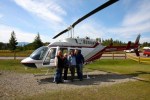
When we drove past a helicopter tour place, we girls were determined to get the guys on the copter.  I have often skipped helicopter tours opting to spend my money on a nice dinner with a decent bottle of wine instead.   But I always regretted skipping the helicopter tour in Hawaii Volcanoes National Park.  This time, I wasn’t about to miss it.

I laugh as I remember how hesitant the guys were to join us.  I really think they wanted to save the money.  I don’t think either one regretted having spent it by the time we landed.

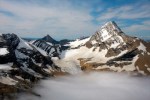
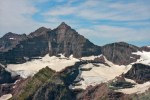
There is something so spectacular about mountains.  To see them from above, with clouds nestling below their peaks . . . I imagine scenes from Greek mythology of the gods having a meeting or perhaps playing chess.  If I were immortal, this is definitely where I would hang out.

I cannot logically explain the effect mountains have on me, but I think it’s a common experience.  That sense of awe, grandeur, amazement.  The sudden stillness that follows the feeling of inspiration.  Feeling part of something bigger than my imagination. Perhaps a sense of being part of something infinite–the world seems so endless from a mountain top.

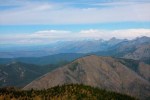
I wish these few photos contained that feeling.  Unfortunately, these are very low resolution versions of the originals (which, I hope, are stored away in an archive somewhere).

Big Moon

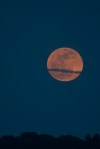
Yes, it’s that time of the month again–the full moon!  But not just any full moon.  No, this is the super-moon!  Not only is the moon at perigee tonight, but it’s also Cinco de Mayo.

Seems like a recipe for disaster, but according to one article, there is no truth to the belief that crime and wild behavior increases with the full moon.  I’m not so sure.

Another special aspect about tonight’s moonrise is the time.  The moon will rise before the sun sets.  This means there will still be light on the trees along the ridge top.  I’m excited about the possibility of capturing the moon in this kind of lighting.

Pat and I had some logistical issues in our plan today.  I volunteered at the Audubon Society’s visitor’s center most of the day and Pat worked.  Tisen got to go to doggy daycare.

By the time Pat came home, it was 6:30PM.  We wanted to celebrate Cinco de Mayo at Taco Mamcito’s next door, so Pat jumped in the shower while I took Tisen for a walk.  Then Tisen had to be fed and we had to wait for him to eat before we could leave (he won’t eat when I’m gone).  By the time we were headed out the door, it was past 7:30PM.

While this may seem plenty early to begin a Cinco de Mayo celebration, the problem was that the moonrise was going to happen at 8:21PM and I didn’t want to miss it.  By that, I mean I wanted to be set up on the roof of our building with my camera ready to start shooting by the time the super-moon appeared on the horizon.

We went next door quickly, but when we saw the crowd, we gave up all hope of getting food and just ordered margaritas.  Fortunately, the margaritas were small because a margarita was probably the last thing I needed having still not eaten.

We drank our margaritas quickly as we huddled in a corner of the patio, trying not to crowd the people sitting next to us.  At 8:15PM, we are racing out the back door to get me up to the roof on time.

I manage to grab my gear and Tisen and get set up on the roof before the first glimpse of the moon appears over the ridge.  I am helped by the fact that it takes an extra 10 minutes for the moon to get from sea level to the top of the ridge.

I shoot and check focus and exposure and shoot some more.  I don’t know what it is about this giant, orange moon rising over the ridge that I find so exciting, but I wish the moon would pause for a few minutes so I could get all the adjustments just right and perfectly capture it as it hangs as a glowing backdrop to the ridge.  I never get tired of the moon.