Owl Prowl

As my regular readers know, I love birds.  I can’t help it.  There’s something profoundly beautiful about birds.  I love watching them maneuver in the sky completely denying gravity.  I particularly admire birds of prey.

It only follows that I would end up volunteering for the Chattanooga Audubon Society.  And, when they scheduled an owl prowl, that I would sign Pat and me up.  (Unfortunately, Tisen is not welcome on the Audubon property–it’s a wildlife preserve and domestic animals and wildlife don’t mix well.)

Pat and I arrived just before 8PM, in time to deliver a load of bird seed I’d picked up for the feeders at the visitors’ center.  Then, Kyle, the property manager, gave a presentation on owls including their “songs” to remind us what we were looking for.

Kyle had been hearing Barred Owls on the property even in the middle of the afternoon; we were confident we would at least hear one.

Kyle had also recruited an owl expert to lead the walk who was extremely good at calling the owls.  Barred Owls are known for flying in to see who’s imitating them when called.  I once went birding with a group of experts in Columbus.  We started at 5:00AM.  The leader called twice and had 4 Barred Owls show up within minutes.  It was very cool.  I think the owls were just as amused by us.

However, here, the Barred Owls must have been up too much during the day–they had no interest in checking us out although our leader called and called.  Even in the area where they were most frequently seen, they remained silent.  He also tried Screech Owls, but we were not rewarded.  As our expert pointed out, it’s best to call Screech Owls first–they won’t go near Barred Owls (because Barred Owls will eat the much smaller Screech Owl).

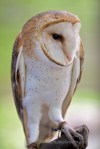
While a Barn Owl might also find Audubon Acres a suitable place to live (especially if it could find a way into one of the many buildings), none had been spotted on the property, so we really didn’t expect to find any of those.

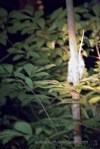
While the owls were not cooperative, we had started off the walk with an Indigo Bunting catching a late-night snack at the feeder.  We also saw many spiders and bats.  At one point, we were sure there was a silent owl in a tree, but it turned out to be a young opossum.  It blinked in our bright flashlights and gradually decided to move.  We watched it with fascination as it slowly made its way down the tree trunk.  Every part of it was help perfectly straight, including its tail, as is calmly made it’s way head down the side of the tree.

At the end of the walk, the moon was shining and we stood outside chatting.  While we talked, we heard a Barred Owl calling, “Who cooks for you all?”  Or maybe it was saying, “Who are the fo-ols?”

Mountain vs Couch

As much as I love to be active, there’s a part of me that would really prefer to lay on the couch all day.  That part of me was screaming when we decided to try mountain biking for the first time in Jasper National Park several years ago.

Fortunately for me, I was still shooting with my PowerShot G3 at the time, which weighed approximately 1/3 what my current camera with a wide angle lens would weigh.

When the locals we talked to assured us that there was a “super easy” trail just outside of town that was only 10 miles long, I imagined it would take about an hour to cruise around this loop trail.  I planned for us to take it easy, stopping for a picnic lunch by a lake and having a leisurely day.  As we headed out for the trail, I wondered what we would do the rest of the afternoon.

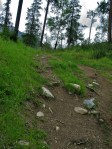
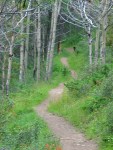
When we got to the trailhead, we found if we went to the South, it looked flat.  If we went North, it was a very steep climb right from the start.  We, naturally, went South.  Of course, after about 100 yards, the trail turned uphill and we began the most painful climb of our lives.  Painful for two reasons:  first, our lungs (and every muscle in our bodies) were burning trying to keep the bikes moving up and over roots, rocks, bumps, and pot holes as we climbed.  Second, we were crawling along at such a slow pace that the plentiful mosquitos were keeping up with us.

When we encountered objects beyond our skill level to get over or around, we fell over.  Once we fell over, we had to push the bike along until we got to a flat enough place to get started again.

I pushed the bike up a hill at a run with my rain jacket on and the hood up trying to get away from the mosquitos.  I’ve been riding bikes a long time.  I’m pretty sure that “riding” doesn’t mean taking your bike out for a run.

After stopping for a quick lunch (due to the mosquitos) in a spot where we could watch loons on a lake, we turned around and started heading downhill back home.  We came to a screeching halt when Pat spotted a black bear peeking at us from behind a shrub.  Eventually, the bear figured out we were humans and took off.  We went on our way singing loudly in the hope of scaring the bear away (anyone who has heard me sing would appreciate how effective this would be).

Then, we out-peddled the mosquitos and discovered how much fun mountain biking is when you’re going downhill!  Much better than laying on the couch.  Going up, not so much.

When at last we arrived back home, over 3 hours had passed in spite of our brief lunch.  We both needed a nap–the perfect time to hit the couch.

Reconstructing History

While in the Canadian Rockies at Jasper National Park several years ago (still shooting with the PowerShot G3), we decided to take a “rest” day by hiking a relatively easy trail to a lake at the base of Mt Robson.  We drove from Jasper Park in Alberta to the Robson Provincial park in British Columbia in about an hour.

When we started out, the sky kept promising rain (in fact, it even sprinkled briefly), but then the clouds would part and a deep blue sky would appear.  When the sun was out, we broke a sweat working our way up the easy, but uphill, trail.  When cloud cover moved in, it was like someone had cranked up the air conditioning and I would get chilled almost immediately.

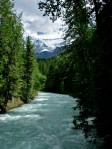
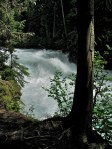
For most of the walk, the trail ran parallel to a treacherous but beautiful stream swelling with the “spring” snow melt (this was in July).  We didn’t see anyone attempting to navigate the stream, so I’m guessing the water was too intense for even really good kayakers.  It seemed like getting in the stream would be a really bad idea with or without a kayak to me.

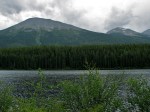
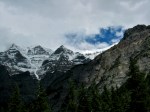
When we arrived at Moose Lake, we were further away from the base of Mt. Robson than we expected, but given that Mt Robson is the tallest mountain in the Canadian Rockies, we still had plenty of good views of it, including the glacier nearby.

As I went through these photos from 2005, I discovered an interesting phenomenon.  I believe I was feeling lazy on this particular day not only in choosing an easy trail, but in my shooting.  I notice that the metadata in my pictures indicated I was mostly shooting with a wide-open aperture, with the smallest aperture setting being an f/8.

This was remarkable to me in two ways.  First, this is another thing to add to my list of things I’ve learned–I would not shoot these scenes with that setting today.  Second, it seems like they have much more depth of field than I would expect for such wide aperture settings.  This caused me to look at focal lengths.  They are mostly under 20mm with the shortest being 7mm (if I recall correctly).  Is that even possible?  Assuming my metadata is correct, the extremely short focal lengths are most likely contributing to the extra depth of field.  I assume I was shooting with an open aperture because we were walking in the shade quite a bit, so perhaps there wasn’t much light.

It’s always fun to try to reconstruct what happened 7 years ago based on the evidence collected in the metadata of your photos!

What I do remember clearly about this hike is that Pat and I were quite irritated with one another at the beginning of the hike, but back to laughing together by the time we were ready to return to the car.  Maybe that’s why I love hiking so much–it’s restorative in more ways than one.

Bat Cave

In my early 20’s, a co-worker invited me on a group caving trip.  In preparation, I put on approximately 7 layers of cotton.  Cotton underwear, cotton long underwear, cotton jeans, cotton shirt, cotton sweatshirt, cotton everything.

We, of course, decided to do a crawl (more like a drag–there wasn’t enough space to actually get up on your hands and knees) through a 160 foot long “tunnel.”  I was immediately behind the leader, who was wearing waterproof coveralls.

My co-worker was the last person in the group.  When we caught up in a large cavern, I was soaked through.  I said, “I thought you said it was a dry cave?”  He replied, “What are you talking about?  It was completely dry.”

This was probably true, but only because my 7 layers of cotton had absorbed every drop out of every puddle I drug my body through.  I have since read that you will actually stay warmer stark naked than you will wearing wet cotton.  I believe it.

I shivered for about 3 hours straight.  The group debated on whether to take me to the hospital, figuring I was on the verge of hypothermia.  I was OK as long as I kept shivering.  I’ve never been so cold in my life.

Since then, I haven’t been so excited about caves.  But when I learned that Outdoor Chattanooga offered a kayaking tour to a bat cave, I couldn’t resist.

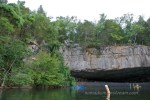
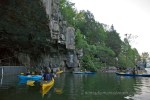
We kayaked across a small section of Nickajack lake to the entrance of the bat cave.  This is not a lair for a superhero, but rather a cave occupied by approximately 80,000 gray bats.

We sat in our kayaks near the fence that keeps people from getting too close to these endangered mammals.  While we waited, we learned that the gray bat is not just important for mosquito control (one of the reasons I adore bats), but that it’s also a major pollinator.  The fact that it’s endangered has vast implications for our ecosystem.

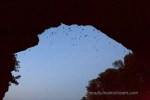
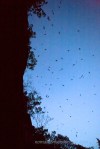
As the sun dropped, a whir started deep within the cave.  After a while, there were so many bats flying out of the cave, it was like a blur of black motion rising from the opening and heading into the woods.

When we looked against the still-light sky, we could see hundreds of them darting around above our heads, collecting the insects around us.

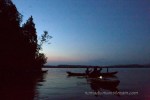
It took at least 20 minutes, maybe 30, for all the bats to exit the cave.  We sat in awe, watching until our necks ached.  Then, we paddled back in the dark, each with a single light on our kayak.

As we arrived back at the launch, the crescent moon sank towards the horizon, setting very early (or late).  It loomed larger as it approached the horizon, beginning to take on a golden cast.

We sighed and said out loud what a nice way it was to spend a Saturday evening. I wasn’t wearing a single stitch of cotton.

Fourscore

Fourscore years ago, Rock City was created.  80 years later, in honor of their anniversary, Rock City held a naming contest for a rescued Peregrine Falcon recuperating on their property.  The winning name was Fourscore.

Fourscore was the offspring of a mom who wasn’t mature enough to take motherhood seriously.  His more mature father took over incubating the eggs and doing the feeding.  But, as the two brothers grew, the father couldn’t keep up with their eating needs without the help of the mother.

One of the chicks died before a human intervened.  The other, Fourscore, survived, but he was too weak from underfeeding to survive on his own.  Fortunately for Fourscore, his rescuer turned him over to S.O.A.R. and Rock City for rehab.

Kept safe inside a box perched high on Lookout Mountain, the little guy gained in strength until he was well prepared to fledge for real.

Pat and I were invited to Fourscore’s launch.  It meant getting up at 4:30 AM to have time to take care of the dogs before driving up to the top of Lookout Mountain, but we were game.  I, of course, packed my backpack full of camera gear.  I wanted my 100-400mm lens to get a good shot of the falcon launching, but they were opening the box at 6:00AM–the light would be low.  Since my 70-200mm lens is faster, I figured I would have a better chance of getting something usable with the extra speed than with the extra length.

As the Eastern horizon started to show the first signs of dawn, I crouched behind a shrub while John and Dale lowered the front of the box, creating a shelf that the falcon could step out on.  I sat with my face pressed against my viewfinder, resting the lens on my knee in an attempt to hold still while we waited.  Nothing happened.

John had warned us that sometimes it can take a couple of hours for a bird to fly when released after being rehabbed.  We waited.

I realized I could not possibly keep my face pressed up against my camera for two hours.  I was getting a cramp in the muscles I use to close my left eye.  I pulled back and started to relax my arms, which were also cramping.  Then I realized we’d only been waiting about 3 minutes.

This was not the first time I questioned my desire to shoot wildlife.

Then, just as I was about to stretch my wrists, there was a noise.  I got back into position as quickly as I could, but I missed.  I managed to catch a dark silhouette against the sky when Fourscore circled back around and flew for the woods.  Not exactly what I was hoping for.

We spent the next half hour with John wielding an antenna to track a radio transmitter on Fourscore.  As we were about to leave, we saw him being chased by a group of swallows.  He looked like he was having a ball.


Tiger Key and the Manatee

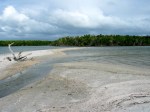
The tiny keys that dot the Gulf Coast of the Everglades are countless.  But the ones that are big enough to land a canoe on and pitch a tent have names.  They are supposedly named after the shape of the key when viewed from the air, but I suspect Tiger Key was actually named in honor of the ferocity of the insects there.

Fortunately for us, when we climbed cautiously out of our tent on Boxing Day, the wind had kicked up and we were spared the brutal attack of the night before.  It was an enormous relief not to do battle again first thing in the morning.

It was time to return to the mainland.  We were somewhat concerned that we would not be able to find our way back having gotten so lost on our way out.  Fortunately, we were traveling via major channels most of the day.  While this made navigation easier, it greatly reduced the wildlife we saw.

By the time we were in the main channel, we got into a rhythm like we’d been paddling a canoe every day of our lives.  We laughed at a couple heading out.  They were struggling to go downstream because they were paddling against each other–the wife was literally paddling backwards.  We felt like canoe paddling champions as we dug into the water and pulled our canoe against the current.

Then, we got to the final stretch.  We could see our destination.   It was a short distance compared to the many miles we’d paddled over the last three days.  But the current was so strong that it pushed us sideways across the channel.

We spotted a small island along the way where we could land and catch our breath.  We made it to the closest end of the island.  After resting for a few minutes and saying a few choice words, we pushed off for what we thought would be our final launch.

We paddled for all we were worth, but the current pushed us back to the far end of the island we’d just left.  We’d have spent less energy walking the canoe along the shore.  Neither of us felt much like a champion paddler anymore.

We took a longer rest.  We ate a snack.  We got out of the canoe.  We stretched.  Then, we rallied and drove that canoe right across the current until we suddenly found ourselves in calm waters and could relax for the final 50 yards of our trip.

As we slowed down, a large, dark mass rose towards the surface of the water.  Pat yelled, “Manatee!”  We were so excited we nearly capsized the canoe after 3 days of remaining afloat.

As we glided closer to the slowly moving mass, we felt ourselves blush as we realized it was a mass of algae.  No manatees in sight.

Despite the disappointment, we really felt like we’d done something when we beached the canoe for the final time.  It was the best Christmas ever.

Jumping the Moat

Continued from Lost and Found.

Christmas morning we woke up early and laid there in the dark, realizing we could no longer hear the Gulf slapping the banks of our tiny island.  Even when we held our breath, we couldn’t hear the waves.

When at last dawn lightened the sky, we decided to get up and get an early start in our canoe.  We had about 8 miles of paddling in store for us and we were already sore from paddling yesterday.

When we stepped out of the tent, we discovered our tiny island had become a giant island at low tide.  Actually, it was still a tiny island, but now it was surrounded by a giant moat.  The Gulf was suddenly so far away, it was almost unbelievable last night we were worried our canoe would get washed away by high tide.

We ate breakfast slowly.  We walked around the island and watched the sunrise.  We packed up our campsite.  We loaded up the canoe.  All the while, the water was slowly rising, coming closer, but it still looked hopelessly far away.

Having nothing left to do, we sat and waited.  But then, the wind died and we were sitting ducks for biting insects.  We were suddenly motivated to find a way across the moat, dragon or not.

We slid our canoe along the murky shore while we walked as far as we could on dry land.  We found that the opposite end of the island was closer to deep water than our end, so we edged our way through thick mangroves until we finally stepped into the muck and pushed our canoe and gear through the shallows until there was enough water that we could get in and paddle away.  We were itchy with drying muck as we paddled off into the sun.

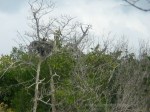
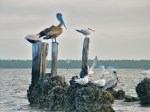
We hadn’t been out too long when we saw a strange line of evenly spaced white dots stretched across the horizon.  As the dots got larger, we realized it was a large group of American White Pelicans flying in precise formation, sweeping the surface in search of prey.  They flew to a shoal where a huge conglomeration of pelicans gathered.  That might have been the best Christmas present ever.

When we stopped for lunch somewhere between Rabbit Key and Tiger Key, we discovered a family of Osprey.  The young were nearly the size of their parents and angrily demanded to be fed while their parents seemed to argue that it was time for them to leave their nest.

We arrived at Tiger Key without any navigational hiccups.  But the wind soon died and we discovered “no-see-ums.”  I tried a trick someone told us–smearing baby oil on my exposed skin.  I ended up looking like human fly paper and they still bit me–my skin looked like a basketball.

Thankfully, we managed to keep the bugs out of the tent and fell asleep with smiles on our faces, dreaming of Osprey and Pelicans.

Lost and Found

The first day of our canoeing adventure along the Gulf Coast in the Everglades, I discovered a key difference between canoeing in the Everglades and canoeing down a river.  There’s only one way to get lost when you canoe downstream on a small river:  failure to stop at the pick up point.

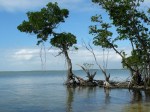
Canoeing in the Everglades was a completely different story.  We had a permit to camp on a particular Key each night of our trip.  Our first day, we were supposed to paddle about 7 miles to Rabbit Key.  Unfortunately, we started out heading down the wrong channel through the mangroves.  As we paddled around trying to identify openings between tiny mangrove islands that matched shapes on our map, I realized how little a map drawn from an aerial perspective reflects what land looks like from the water.

As the navigator, I eventually gave up on the map all together, picked a channel that pointed generally Southwest, and took us through the maze of mangroves until we hit the Gulf.  Assuming we were West of our destination, we paddled East.

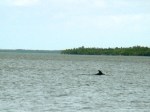
Paddling along the Gulf Coast through swells of salt water in a canoe identical to the canoes we’d paddled as children was a completely surreal experience in and of itself.  Then, we spotted a dolphin about 50 yards from our canoe.  It was a joyful sort of strange.

After having paddled long and hard in the Gulf (which is not at all like paddling down a river) we decided to break for food and try to locate ourselves on the map.  We figured we might just stay where we were.  We were rapidly running out of daylight and we really wanted to have our campsite setup before dark.

We took a walk around the island we’d stopped on, trying to get a sense of what it might look like on our map.  Fortunately, we stumbled across a sign that identified the Key we had landed on.  It was Rabbit Key, the key we were supposed to spend the night on.  While this was mostly pure luck, Pat was still impressed by my sense of direction (too bad it doesn’t seem to work in the Chattanooga area).

Taking some advice someone had given us, we found a suitable spot to pitch our tent where there was plenty of wind.  Then, we pulled our canoe well up out of the water so it wouldn’t float away at high tide.  We ate quickly and went to bed, exhausted.

In the middle of the night, I woke up and went out to heed the call of nature.  When I looked up at the night sky, I’d never felt so close to the stars.  I’ve been to the top of Maunakea, which is supposed to be one of the best places in the world to see the stars, but here at sea level on a tiny key in the Everglades, it seemed like the stars were within arms reach.  It was astonishing.

Practice Hike

Back in 2004 (yes, more stories from my PowerShot G3 era), I talked my not-yet-husband into going backpacking in Yosemite.  He had never been backpacking before and he had never been to Yosemite before, so he was both excited about the prospect and nervous that I, the slightly more experienced backpacker, would mislead him in his preparations.

Since I hadn’t been backpacking for many years, I did the only logical thing.  I bought a stack of books about backpacking.  Then, I began equipping both of us.  The next logical step was to test it all out.

I also got to test my setup for taking pictures.  Instead of a strap, I used an elastic harness that took all the weight of my camera off of my neck, which was such a relief.  It also left my hands completely free.

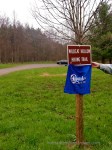
Well equipped, we headed to Wildcat Hollow in Wayne National Forest.  It was the only place I found within a 2 hour drive that allowed backwoods camping.  The entire trail was about 12 miles–just long enough for a day and a half trip for us.

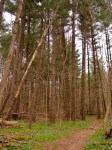
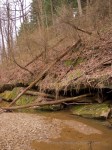
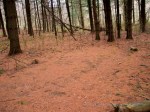
Although the hike started through a grove of evergreens, most of the trail went through deciduous forest.  In early April, just the beginning of spring growth was starting on the ground–the trees showed no signs of life at all.

As we made our way through the woods, we came to a stream with a beaver lodge.  Something was laying on top of the lodge.  We approached quietly, thinking we were going to get to see a beaver.  But, as we crept forward, I found myself wondering what a beaver would be doing on top of its lodge and how on earth it would get there.  I frantically tried to remember everything I knew about beavers.  I was pretty certain their lodges were supposed to only be accessible from underwater.

I guess when people say “only accessible from underwater,” they aren’t thinking about geese.  That’s what was stretched over the dome of the lodge–a large canada goose.  We watched for a long time trying to decide if it was alive, dead, or dying.  We saw it breathing, but decided it must be dying because it had its head down.  Coming up with no way to help this goose, we hiked on and tried to come up with alternative, more cheerful explanations.

When at last we found the perfect site to camp, we discovered how easy our new tent was to put up–it took 5 minutes.  We heated up instant soup on our tiny burner and hunkered over our hot soup cups as the temperature dropped.

We put on warm, dry long underwear and our warm wool hats before snuggling into our sleeping bags.  We slept pretty well, staying warm and dry all night.  When we woke up, it was snowing.

We hiked out with our bellies full of oatmeal and hot coffee feeling like we were quite the survivors.

Venus Spotting

The Transit of Venus is one of those phenomena you have to get excited about, even though there’s a little voice that says, “it’s a black dot on the sun.”  You must ignore that little voice and get caught in the frenzy surrounding an astronomical event that won’t happen again for 105 years.

For me, the frenzy began when I read an article about it this morning, thanks to a post from a friend who is far better informed than I am.  I thought about trying to find a station on TV that was showing it instead of trying to see it.

Then, the frenzy ended about 10 minutes later when I promptly forgot all about.

After a long day of work, I decided to share Signal Point with my husband as a nice way to relax.  I promised him we wouldn’t hike any further than the 100 yards to the overlook from the parking lot.

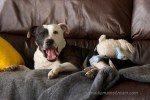
I, of course, then packed up my camera, a couple of lenses, and my tripod.  Tisen packed as well.  As soon as he heard the first zipper, he started jamming toys into his mouth.  He managed to get both Tiger and Baby Beaver into his mouth at the same time.

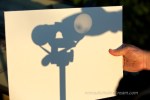
When we arrived at the overlook, a man was already there with a pair of binoculars on a tripod and a camera sitting on the wall.  I was puzzled by his binocular setup–they were positioned about 3 feet above the ground and I couldn’t imagine how he could look through them at that height.  I asked him if he was seeing anything good, assuming he was looking for birds (what else are binoculars for?).

This is when I was reminded of the once-in-a-lifetime (well, twice) event I’d read about only a few hours before.  He used the binoculars to project an image of the sun onto a white card.  That way, we could safely view Venus passing in front of the sun.  Honestly, I was more excited to learn you could view the sun that way than by the black dot in front of the sun.  But it was pretty cool to be able to say we saw it.

I put a neutral density filter that blocks 10 stops of light (that’s a lot of light) and tried to shoot the sun.  However, I was worried about pointing my camera at the sun and, for whatever illogical reason, didn’t want to do so with my 70-200mm lens on it.  I’ve never heard of pointing the sun doing damage to a lens, just the sensor (and the photographer’s eyes), so I don’t know why I was worried about the lens, but shooting with a wide angle zoom only got me to 35mm–not exactly the best focal length for capturing  black dot on the sun.

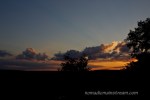
I did get some interesting sunset shots and, even if we can’t see it, we know Venus is in there somewhere.