Stone Door

Continuing our weekend adventure, having made it from the asphalt to the “unimproved” part of the trail (does anyone actually think asphalt is an improvement?), we continued on our journey to the Stone Door.

I don’t know exactly what image “Stone Door” conjures in your mind, but in my mind, when I read the description that said:

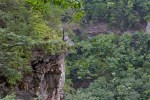
Stone Door, a 10 ft. wide by 100 ft. deep crack, forming from the top of the escarpment into the gorge below. It looks like a giant door left ajar and was once used by Indians as a passageway.

What I envisioned was a giant slab of rock standing straight up in the middle of two cliffs and standing ajar so that one can walk between the “door” part and the cliff part.  I guess I skipped over the “deep crack” part.

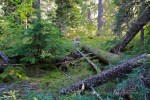
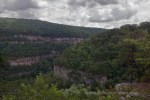
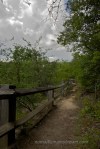
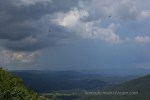
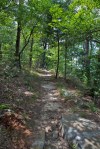
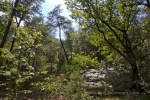
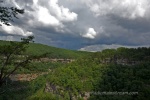
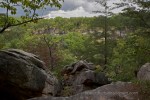
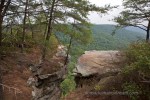
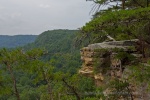
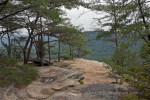
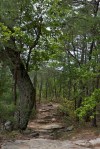
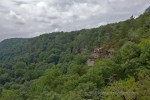
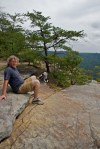
When we arrived at Stone Door, the view of the valley was fantastic.  Plus, the top of the cliffs provides some really interesting scenery in and of itself.  The only part I didn’t like was being anywhere near the edge.  The drop off was terrifying.

Pat and Tisen sat patiently while I worked my way around the top of the cliff, shooting everything I dared to shoot.  I really wanted to get a great shot looking down on the crack in the cliff, but it was tough to get a good angle without rock climbing gear.  I always knew I should have become a rock climber.

I have to pause here for a moment to do a mental double take on whether those words actually came out of my fingers.  Me . . . a rock climber?  Well, maybe not.

In any case, I couldn’t get the shot I wanted mainly out of pure fear.  Or perhaps fear in this case was good sense?  I was pretty determined not to fall into the crevasse never to be found again.

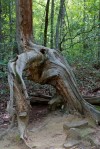
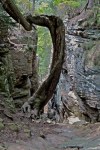
We worked our way back down with me stopping to shoot straight on to the crack.  There was a large tree in the opening that created a key hole sort of image for me.  I played with that for a while and contemplated walking down the steps a bit to see what kind of interesting views I could get, but Pat was concerned about time and we needed to drive to the other side of the park to see the next part of our adventure:  Savage Gulf Day Loop.

So, I packed it in without getting a great shot of the crack.  As we walked away, Pat said to me, “I wonder where the Stone door is?”  I wasn’t the only one who didn’t picture a big crack!

Tisen seemed nonplussed by the whole stone door thing.  I imagine there are certain advantages to being a dog.  One of them is probably no expectations.  Don’t get me wrong, Stone Door is really cool and definitely worth the effort to get there.  Just don’t expect something that looks like a door.
In Lieu of Backpacking

We are trying to get a hike in at least once a weekend.  Since it’s a big reason we chose to move to Chattanooga, we figured we ought to take advantage.  However, the hot and humid August weather has made hiking slightly less enticing.

I did a little research to pick a place to hike that wasn’t too far away.  I learned about South Cumberland State Park and the Savage Gulf State Natural Area, located inside the park.

There was a 17 mile hike that sounded intriguing, but 17 miles for us means spending the night.  Since I had a lot going on this past week, we didn’t have time to prepare for backpacking.  Plus, we weren’t quite sure where Tisen would sleep given that our 2 person tent is really only big enough for a person and a half.

So, we opted to do two short day hikes instead.

We headed out Saturday morning loaded down like we were spending the night after all (the joys of too much photography equipment).

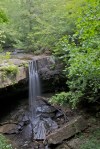
When we arrived at the Stone Door ranger station, we saw a sign that said Laurel Falls was only 250ish yards from the parking lot.  So, of course, we had to walk there first.  What they didn’t mention was that it was 250 yards down a bunch of stairs and 250 yards back up those stairs.  But, still, who wouldn’t go 250 yards to see a waterfall?

I’m not sure how excited Tisen was about the waterfall after the stairs, but he made it and I was happy I had my tripod so I could shoot with long exposures, creating smooth water.

We headed back up the steps and on towards Stone Door from there.

The walk to Stone Door started on a paved path.  Paved as in asphalt.  We noticed blazes on the trees marking the trail and Pat commented that he was glad they’d marked the trail because otherwise we might have gotten lost.  It did seem a bit odd to hang metal trail blazes on the trees along a trail that was paved, but I guess they haven’t lost anyone yet.

The first overlook was the end of the asphalt, thankfully.  Although, we passed a woman coming back the other way with only one leg.  I don’t know if she was able to walk on the unpaved portion of the trail or not, but it did make me appreciate the asphalt.

From the overlook, we not only got a nice panoramic view of the mountains, but we spotted a rocky outcropping in the general direction we were headed.  We suspected it was our destination.

Tisen was not any more excited by me setting up my tripod at the overlook than when I pulled it out at Laurel Falls, but he waited fairly patiently once Pat took him off the asphalt and into the shade.

If there was one thing that would have made the day nicer, it would have been cooler temperatures and less humidity.

Monkey Feet

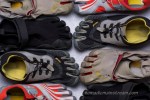
It all started on the hike to Grinnell Glacier in Montanna.  Pat and I were working our way up the mountain trail with me in my hiking boots that felt like giant led-filled balloons when we passed a couple on their way back down.  They looked impossibly fresh.  They weren’t limping.  They looked relaxed and comfortable.  As I looked down to find footing, I noticed their feet.  Low and behold, they were wearing fivefingers shoes.  I had heard of fivefingers before, but it hadn’t occurred to me people would wear them on the trail.

After limping our way back at the end of the hike with me barely able to put weight on my knees and hips, I found myself wanting to try fivefinger shoes.

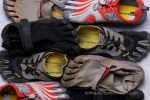
When we got home, I bought a pair like the ones we saw on the trail–black neoprene.  Although I didn’t give them a true trail test for many months, they turned out to be a miracle on the treadmill.  My knees and hips felt better than they’d felt in years after the initial adjustment period.

There definitely is an adjustment period!  A whole bunch of tiny muscles in my feet and ankles had to be reborn and developed before I could walk as fast or as far as I had been walking.  But, once I’d adjusted my stride and footfall and developed weakened muscles, I was pretty sure I could walk forever without getting the shooting pains I’d become accustomed to.

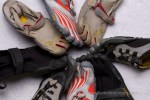
Alas, the neoprene was hot.  It was hot indoors and hot in the fall and spring, but not warm enough for the colder temperatures I’d hoped to wear them in.  That led to the trekking pair.  They have a mesh weave that breathes.  Unfortunately, they weren’t made to be drug across the ground on their tops, which is exactly what happens when one is learning to hang glide, resulting in excess wear and tear.  My feet also do not like the tread on those shoes.  If I walk on hard surfaces in them, I get blisters on my big toes.

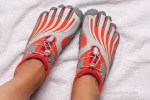
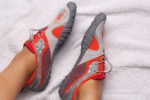
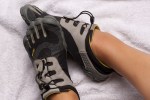
This led to the much softer and cushier black and gray pair, which I love.  However, they are a little too soft for the trail, which brings us to the orange pair.  They are supposed to have some extra support to protect against rocks.  I’m testing them tomorrow for the first time on the trail.

There are definitely tradeoffs.  Kicking a rock or stepping on something sharp feels a lot different (and not good!) in fivefinger shoes than in hiking boots.   They are also not good in cold and/or wet conditions.  My feet turned to blocks of ice on a short 2 mile walk that started off slogging through mud last November.  I was glad I’d brought my boots for the longer hike we did right after that.  For this reason, I bought a new pair of boots, too, much lighter than my previous pair.  I wish I didn’t need them.

Three Sisters

Perhaps because I don’t have any sisters, I am particularly attracted to the area called Three Sisters in Oregon.  In this case, however, they are mountains.

The area is one of those places you don’t expect to see in the lower 48 when you grow up in the midwest.  I assume people who live in the Northwestern US know better.

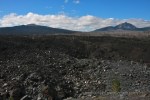
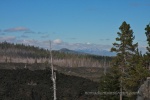
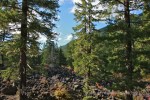
Approaching the lava fields is astounding.  It’s as if some giant construction company in the sky dumped an enormous load of asphalt in great big chunks all over the landscape.  At the edge of a lava field, there is a miniature cliff formed where the lava suddenly comes to a halt.  I never would have predicted the transition from lava to none lava would be so distinct.  I guess having been to Hawaii Volcanoes National Park, I expected the lava to have melted together in a single, molten form, freezing into a solid black river.  But in Oregon, the lava is in giant rock form.  I imagine a mountain spewing out black boulders like a BB gun aimed towards the sky.  The image is as mysterious as the reality.

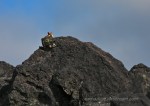
Besides lots and lots of black rocks, the Three Sisters are offers spectacular views and many golden-mantle squirrels.  There are also some un-lava’d areas of forests that offer really good hiking.

We picked a short, flat trail that went to a couple of waterfalls.  This was mainly because my dad’s wife had a lot of knee issues at the time.  But, in the end, we were glad we picked the trail we did regardless of the ease–it was gorgeous.

The only thing that would have made that trail better was if it would have been easier to get a good angle on the water falls.  It was extremely challenging to get into a position where the falls were fully visible.  Not that I would ask anyone to cut down any trees to improve my images.

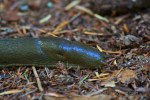
Perhaps the most amazing thing we saw was the biggest slug I’ve ever encountered in my life.  I don’t know if it was an actually banana slug or not, but it was bigger than some bananas!  I’m not a huge fan of slugs.  I know they serve their purpose and all, but it’s just not a species I find it easy to connect with.  But maybe it’s just a matter of size.  Looking at this 6-inch long beauty, I felt appreciative of slugs in a whole new way.

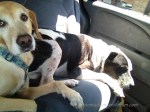
Back in the present day, we dropped Twiggy off to her parents today.  When we put the dogs in the car, they each picked their own seat and were sitting up side-by-side.  Of course, by the time I got my phone unlocked to take a picture, Tisen had laid down.  I also missed–it’s surprisingly difficult to shoot over one’s shoulder holding an iPhone while sitting in a car going down the road (I was not driving, just for the record).

A Different Kind of Flash

As many of you may know by now, I am fascinated by the sky.  The one subject in the sky I’ve had absolutely zero success with is lightning.  This comes with some irony as my brother has been an engineer on a project that monitors and predicts lighting for over 25 years now.

I’ve never managed to capture an actual lightning bolt.  In truth, this is probably because I haven’t put a lot of effort into it.  I have, for example, never asked my brother to let me know when they are expecting lightning storms in my area so that I might plan to shoot lightning.

On the infrequent occasions when I had my gear, I have rarely been in a place where I could get a good view of the lightning to shoot it.

At long last, I live in a place where I have a great view of the sky and I often see lightning while I am at home doing nothing more important than shooting lightning.  That doesn’t necessarily mean I actually attempt to shoot it.  Why?  What causes a person who really wants to capture a great image of lightning to sit on one’s duff and watch the light show unfold without so much as pulling one’s camera out of its bag?

Frustration.

That is the crux of it.  The times I have gone to the trouble of setting up, adjusting the settings (usually involving a few googles along the way), and then shot and shot and shot some more only to come up empty have made me bitter when it comes to lightning.

Oddly, when I see a bolt of lightning flash across the sky, it doesn’t necessarily look that fast.  Perhaps it’s because it’s burned an image of itself onto my retina?

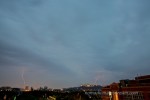
For this morning’s shoot, I started out setting a fairly open aperture for a sky (f/8) based on some advice from the web along with 100 ISO and a long shutter speed.  I quickly realized that the guy who wrote this advice assumed the sky would be dark.  With lightning at sunrise, I really wanted more depth of field.  I also wanted a fast shutter speed to freeze the clouds, which were blowing fast across my field of view.  However, I sacrificed on the fast shutter speed in favor of capturing a lightning bolt.

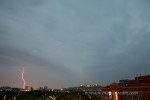
The lightning kept flashing within the clouds, refusing to show itself.  Then, suddenly, it flared straight at the ground.  Lucky for me, the shutter was still open.  My first lightning bolt!  Then I caught another a few minutes later.

I combined the two into one image using Photomatix (which is not what it’s designed for), but it turned my lightning bolts pink.

I shot for a long time, but there were no more bolts.  I returned indoors to comfort the dogs (Twiggy is visiting again).  As soon as I sat down, a web of lightning bolts flashed across the sky.  Shoot!  I mean, Darn–I didn’t shoot!

Crap Shoot

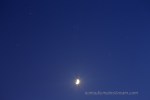
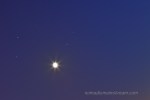
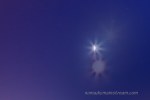
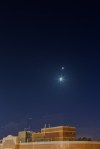
When Pat called to tell me that Mars, Saturn, and Spica were all going to be in the vicinity of the moon the other night, I, of course, had to get out my camera.  It’s a funny thing about astronomical events.  I get all excited because I get a chance to get a picture of white dots in the sky.  I could probably put white dots in a shot of twilight a lot more easily and I wouldn’t have to wait for the actual event to occur.

But, as it turns out, I’m somewhat old fashioned when it comes to photography.  This is rather strange given that I’m a relative new comer to the art.  For whatever reason, I prefer to attempt to capture the real white dots in the sky as opposed to creating my own.

That said, what does one do when one walks away from shooting and, the next day, looks at the images and smacks oneself in the forehead and rolls one’s eyes while wondering what in the heck one was thinking during the previous evening’s shoot?

I had a vague notion that maybe I could take a bunch of exposures and then combine them using Photomatix to create star trails, I guess.  I think I would have needed to shoot for about 3 more hours to create decent star trails.

But there were other problems with my shooting.  First, I couldn’t see Saturn, Spica, or Mars when I looked through the view finder.  As a result, I didn’t shoot as tight as I should have and I ended up with the moon lower in my frame than I would have liked because I guessed wrong as to where they were.

I have to pause here for a moment.  Why is it you can look at the sky and see something plain as day and then look through your viewfinder and have it disappear?  It was even worse trying to use live view mode.  I had to give up on that entirely.  Perhaps if I would have waited longer after twilight the planets and star would have shown up better in the sky.  As it was, I was trying to catch the deep blue of twilight–was there ever a better color of blue?

Having come up with mostly crap, I decided to play with HDR processing a bit more than usual.  I tried combining photos that were not actually shot in a sequence for combining.  I turned off the features that align images and remove ghosts.  I created a scene where we have two moons in one image.  In another, I just ended up with what looked like sun spots reflected in the lens.  It was fun to play with it even though I didn’t really get anything I like out of it.

As an aside, Tisen’s girlfriend, Twiggy, is staying with us again this week.  I caught them napping on the couch together.  They swore they were just napping.  I believe them.

Shoot

I haven’t used the flash in many weeks.

I actually bought the flash because I needed it when trying to shoot a couple for their “Save the Date” announcements.  The plan was to do a follow up shoot to get something they can use for a decorative idea the bride had for their wedding reception.  However, it took weeks for me to get the flash unit and figure out how to use it.  Then, I had the new camera I was trying to learn to use and they were busy.  Finally, we scheduled a date but then it rained.  I would love to shoot in the rain, but I don’t think that’s what they’re looking for.
At long last, this Sunday I pulled out my flash stand and flash again and we went off to the Nature Center and Arboretum.  Assignment:  Get a shot of the happy couple in a natural setting that reflects how much they enjoy the outdoors.

Fortunately, they are members of the Nature Center so we were able to shoot up until dusk.  This was very helpful.


When we arrived, the first problem was the weather.  It was so incredibly hot and humid.  It hurt to breathe.  I felt a little sorry for myself lugging around so much equipment in the heat, but the bride-to-be was wearing what looked to be the most uncomfortable dress, so I stopped feeling sorry for myself and was grateful I didn’t have to wear anything hot.

The second problem was the insects.  I know my precious birds wouldn’t survive long if there weren’t a gazillion insects for them to eat, but I really resent that insects find me so tasty.  I guess better me than the bride.

The third problem was the sun.  It was far too bright when we arrived, leading to many squinty pictures.  We moved into a shady area to shoot until the sun started to drop, but this led to the fourth problem:  the place was completely surrounded by trees.  The sun went from too high and bright to too dark in a matter of minutes.

But the final, and most difficult problem to solve was me.  I find myself having no interest in thinking of interesting poses (or looking for poses on the internet).  I’m so focused on the subjects faces that I have to force myself to notice anything else.  I’m looking for a moment of expression when the muscles relax and just do what they really do.  Sometimes it’s very subtle.  I don’t really care if the hair is perfect or if the clothes are smooth or anything else because all I want to see is that split second when the muscles of the face sink into an unforced expression.

I find I do care about the out-of-place clothes and hair after the fact, unfortunately.  They make a difference when they distract, I find.  I just wish they would distract me a bit before I shot the photo.

Cloudland

We made it back to Cloudland Canyon for the 3rd time a weekend ago.  We managed to hike the West Rim trail after going there once completely unprepared to hike and once just to show friends the views from the parking lot overlooks.

This time, we went prepared.  Well, semi-prepared.  I decided to wear my monkey feet (as Pat calls them)–my black five fingers shoes–since they’re by far the most comfortable shoes I’ve ever hiked in.  However, they’re not so good on sharp stones and there were plenty of those.  That led to Tisen and Pat having to wait on me while I picked my way over the trail.

The other issue was that I opted not to bring a tripod, but I had a polarizer on my wide angle lens since we were hiking during some of the worst light of the day.  I love my polarizer when I need it.  I does wonders to cut out the bright reflections and remove glare from a scene.  However, there are two problems with a polarizer.  First, a stop and a half of light is a pretty high cost to pay when you are tripod-less.  Second, a polarizer works best when it is used at 90 degrees to the sun.  When hiking, one does not have control over what the angle to the sun is.  So, sometimes it does it’s thing well and sometimes it doesn’t.
The part I didn’t think about before taking off down the trail was whether I would want to remove the polarizer and, if so, what I would do with it when I did.  This meant I either had to shoot with it on or I had to recruit Pat to hold it for me.  Given that it was mostly overcast that day, I probably would have been better off without it.  I had to scrap many photos because of movement blur due to slow shutter speeds.

But enough technical talk.  Cloudland Canyon was beautiful that day.  With big puffy clouds appearing and disappearing as sunshine streamed around them one minute and rain streamed from them the next.

We got wet more times than I counted.  This was another thing I was unprepared for, rain.  It was so hot, I had no need for a rain jacket–the water simply steamed off of my skin.  But, my camera wasn’t that hot.  Fortunately, I had packed a wide-brimmed hat which worked well to shield my camera each time it rained.

Tisen did amazing on the trail.  He stayed much closer than he has in the past and stopped when told to stop.  He could teach Pat a thing or two.

After completing the 5 mile hike around the West Rim of the canyon, we got a nice shower on our way to the car.  We piled in as quickly as possible–the rain started to pour down hard about the time we were ready to go.

It was a great day.

Through the Window

Perhaps the simplicity of rhyme is what caused me to think of riding on a train today: rain-train.  Or maybe it was the sound of the water drumming on a metal roof that reminded me of our train journey from Portland, Oregon to West Glacier, Montana and back.

Whichever it was, I perused my photos from the train and was surprised to find a collection of landscape shots from our ride home.  Shot through the windows of a moving train in the low light of sunrise with a Canon 40D and the Canon 17-55mm EF-S f/2.8 lens, I’m pretty amazed I managed to get any shots at all.

Riding on the train was quite an adventure.  It seemed so easy–you hop on the train at one station and, eventually, hop off at another.  The lines were short, access to the stations were easy, and it took us right to our destination, unlike a plane.

There were a couple of down sides.  First, the 14 hours spent on the train each way.  Second, the seats were described as reclining with leg rests, so we didn’t book a bedroom.  That turned out to be a big mistake.

The reclining seats didn’t recline far enough.  The foot rests were made for someone under 4 feet tall.  On me, the footrest ended just below the knee and left my feet dangling until gravity pulled them back to Earth with the footrest jamming me in the back of the thighs.

On the way back, we managed to add a “roomette.”  It was a little private cabin for just the two of us.  We faced each other while we rode and when it was bed time, a Porter (or is that on a ship?) came and helped us convert our seats into two bunk beds with sheets and pillows.  It was pretty impressive.

Unfortunately, I’m not sure traveling by train in a sleeper car is cost effective for most locations, but it is a nice way to get to remote places.  We both got to enjoy the scenery when there was scenery.

I think it would take some time to get used to sleeping on a train, however.  Even with our flat bunk beds (which were a vast improvement over the reclining seats), the train rocked side-to-side and we were lying lengthwise to the car.  I had this constant sensation I was going to rock out of the bed.

The next morning, we woke early and headed up to the dining car.  It was one of those big, glass bubble cars that allows you to see the whole landscape.  I could have sat there all day, but we only had a couple of hours after sunrise before we arrived back in Portland.

Taking the train was low stress and allowed us to see some things we would have missed from a plane.  If time and money were not factors, I would probably always choose the train over a plane.

The Return of Dunwoody Fourscore

When my friend Dale (from S.O.A.R.) called me and told me that the Peregrine Falcon they recently released at Rock City was continuing to return for meals and that I might get some good close ups of him eating if I could come up to Rock City soon, I decided it was the perfect time to take Pat’s family (who was visiting) up to see the birds.

We arrived early and walked out to the feeding platform with John and Dale.  John tossed a chick into the feeding box while he looked for Dunwoody (as named by Dale and John because the falcon was found in Dunwoody, Georgia) Fourscore (as named by the Rock City naming contest in honor of Rock City’s 80th anniversary).  Pat and his family crouched further back behind a tree while I hid behind a bush closer to the feeding platform.  John walked around in the open, known to the bird and symbolic of breakfast, he figured Dunwoody Fourscore might be enticed to come eat.  However, the falcon was no where to be seen.

Since it was about time for the first Rock City Raptor show of the day, we all returned to the amphitheater.

Watching the intro video for the 4th time, I still got chills watching the birds maneuver through the air.  It’s an amazing feat to watch and the video shows just how agile these birds are in slow motion.  I could watch that video all day.

But, seeing the birds live is an even bigger thrill.  Cayce gave me a special treat by flying straight at my head.  Unfortunately, she got so close I would have needed extension tubes to get a good shot of her just before her tail rearranged my hair, causing the whole audience to take a collective gasp.  It’s always fun to be part of the show.

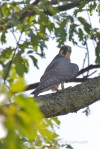
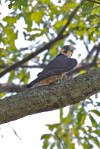
After the show, Pat and his family went off to explore Rock City and I followed Dale and John back to the feeding platform to see if we could find Dunwoody Fourscore.  The first clue that he had been by was the missing chick.  Of course, he’s not the only raptor in the area, so that wasn’t solid proof of his presence.  We walked around looking to see if we could spot him.  Eventually, John managed to spot him hanging out in a tree nearby.  He had his wings partially spread, trying to cool off.  It was about 102 degrees by then, a few degrees cooler than down in Chattanooga below.  Dunwoody Fourscore was making the most of the breeze coming up over the cliff.

Fourscore didn’t move while I circled underneath him.  Well, not quite a circle–a true circle would have taken me off the cliff.  As I came around to the other side of him, he switched his stance, looking down at me as if he was thinking, “What in the heck are you with that big glass thing growing out of your face?”