
Migrants in Disguise

This past Saturday was the first October beginning bird walk.  Fall is an interesting time to bird.  In the fall, I have a love-hate relationship with birding because the birds are migrating, so there are tons of species in town who haven’t been here since at least last spring.  On the other hand, they are wearing their drab fall colors, blending in with the fading colors of the leaves.  And they are quietly eating everything in sight with little more than a peep to even let us know they’re there.

This means paying careful attention to ever flutter and flick among the leaves.  It also means throwing out all the learned images and looking for pale yellows and browns where, in the spring, one might have looked for brilliant red.

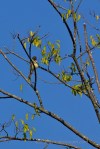
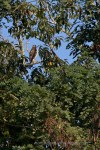
Take, for example the Scarlet or Summer Tanager. We eventually decided it was a Summer Tanager after we saw it several times, but it was almost impossible to decide for sure until looking at the photos.

The Summer Tanager is an all-red bird in the summer.  In September, it’s yellow and green.  Not only are these birds busy getting ready for their long journey to warm climates, but they’re also expending energy completely replacing their wardrobe each fall.  I guess it’s necessary.  I know that I’ve seen many Scarlet Tanagers prior to the leaves on the trees growing in the spring.  I’ve seen only 1 after the leaves are fully out.  In spite of having neon red coloring, the Scarlet (and Summer) Tanager manages to stay well hidden in the canopy of the trees.  Once the trees drop their leaves, however, all bets are off.  So, I guess it makes sense that they would turn to a dull yellow before beginning on their annual trek to mecca.

We saw Magnolia, Nashville, Tennessee, Yellow, Yellow throated, Common Yellowthroat, and Chestnut-sided Warblers. If you have never seen these birds, take a look.  They are tiny, beautiful birds that don’t come to feeders.  Many people die having never seen one, yet they are often nearby (at least during migration season).

While the changes between the breeding and non-breeding plumages for these tiny warblers is not as dramatic as for the male Scarlet and Summer Tanagers, they still got through some dramatic changes.

I wonder how their parents prepare them for this?  Do they tell them that they shouldn’t despair over their dull colors when they’re young?  Do they sit them down and have the “birds and bees” talk?  Or do they call it something different like “the humans and the fish”?  And do they warn them that they will return to the dull yellow every fall like some sort of magical curse in a fairy tale?  And do they have controversy over whether this needs to be taught in the public schools or handled at home?

However bird parents handle preparing their young for “the change,” the birds are well-prepared for blending in.  They all look like leaves.


Butterfly Business

I’m embarrassed to admit that I am capable of naming only one butterfly.  The monarch.  There are 125 butterflies found in Tennessee, according to a local chapter of butterfly enthusiasts.  I have heard of exactly 1 of them.  Yes, it’s still the Monarch.

These are the kinds of things that make me wonder what I’ve been doing all my life.  I mean really, as someone who spends as much time outdoors as I do and who particularly enjoys wildlife, how did I make it this far without realizing there were so many kinds of butterflies right outside my door?

I am trying to stick to working on birding rather than shifting over to butterflies now.  I’m a bit jealous because it seems like many of my new birding acquaintances are as good at identifying butterflies as they are at identifying birds.  I’m still working at getting good at identifying birds.  It’s been a couple decades in the making, so if I start in on butterflies, too, I will never be good at either of them.

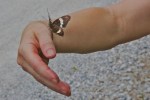
Failing identification, I figure I can at least capture the butterflies permanently as an image.  So, I sneak up on a tiny little yellow butterfly flitting in the grass.  Apparently I am not so good at sneaking.  It flies away with a particularly aggressive flap, which I take as an expression of its disgruntlement over having its meal interrupted.

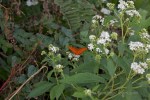
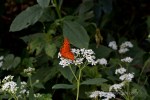
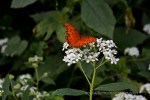
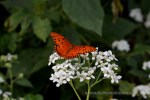
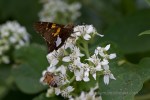
The next butterfly I chase is a red and black one.  It lands on a plant briefly, right next to a grasshopper and then immediately flies away again.  This is a great survival strategy as I am, of course, now interested in shooting the grasshopper instead of trying to chase the butterfly into tall weeds.  The grasshopper, however, is no more cooperative, just more of a tease.  It stays still just long enough for me to get it in focus and then hops just far enough away to require me to refocus.  We play this game for several minutes before Tisen gets impatient and insists we go on our way.

(Photographers note:  Do I get bonus points for not only hand-holding macro shots, but doing it while holding my dog’s leash?  I just can’t help multi-tasking.)

Next, we encounter a larger black and red type butterfly who seems content to be photographed.  I take no chances, shooting from far back, taking a step closer, refocusing, shooting again.  I work my way closer and closer until I get almost the shot I wanted.  Then, when I am so close to getting exactly what I was hoping for, my new model decides it has had enough and abandons its post.

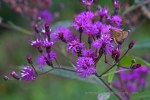
I have similar luck with some kind of skipper (did you know there was such a thing as a skipper?) on a dark purple flower.  I’m fascinated by it’s big, fake eyes.  It doesn’t fly far, but it won’t hold still.
Once again, Tisen gets impatient with me and we head back towards home.

Fall Friends

Tisen and I have been discovering friends new and old on many of our walks of late.  The other day, for example, we crossed the street to enter the park and found Tisen’s girlfriend Twiggy out for a stroll with her mom and dad.

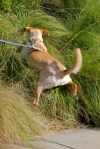
Twiggy wasn’t up for romance, however.  Today, her mind is all about the rampant rodent population living in the tall grasses growing on the hillside.  It’s fall, after all, and the busy critters have been breeding all summer.  Now, the entire population is fattening up for winter.  From Twiggy’s perspective, it probably seems like a buffet.

In spite of Twiggy’s amazing leaps and bounds, she comes up empty mouthed.  Tisen, however, looks at her with adoration like he can’t believe her athletic prowess and is imagining her bringing home venison for dinner.

We say our goodbyes and are soon greeted by deep purple flowers that I’m going to guess are some sort of variety of fall asters, although they look far more cultivated than the wild variety that used to grow in our garden up North.

They bob and curtsy at us as our friends the Goldfinches, who are not looking so gold these days, land and depart on the dried seed pods of nearby plants.  I believe these were once our friends the purple coneflowers that have now shriveled into thin, brown mummies.  The goldfinches continue visiting them and harvesting their seed, storing it as fat for their winter coat.
I am reminded of the lateness of the season by all of this activity.  The days are shorter, the temperatures nearly tolerable, and the birds are far quieter.  I pause for a moment and listen.  A month ago, I would have heard a Titmouse, a Chickadee, a Cardinal, a Wren, a Towhee, a Robin, and an Indigo bunting in this park.  Today, all I hear are the cicadas buzzing away with their strange song.

While Twiggy may be too busy hunting to think about romance, for me, this is always the most romantic time of year.  A sense of nostalgia sets in along with the inevitable awareness of time passing that comes with it.  Another year wrapping up.  Autumn is more poignant than new year’s when it comes to reminding me of my own mortality.  In the fall, everything seems to be moving on in one way or another.  Perhaps as a nomad (at least in my imagination), I long for my own migration.

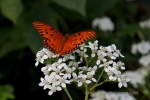
When Tisen and I encounter our next group of friends, the bees and butterflies, so dense on a brilliant white flower I don’t recognize that they’re sharing blossoms, I remember that this is migration season for the butterflies, too.  While the bees will hole up for the winter, the butterflies will take to the winds and head for warmer climates.  I look at these tiny, delicate insect-birds and wonder how they can possibly migrate a few dozen miles, let alone thousands.  One of life’s many wonders.
Hummingbird Band

Pat and I were planning to set out for two days of backpacking on Labor Day weekend.  However, a friend asked if I would like to attend a hummingbird banding on the 1st.  It was a long weekend, so of course I decided to postpone our backpacking trip by a day so I could see hummingbirds being banded.

Who wouldn’t postpone a backpacking trip to see hummingbirds being banded?  I would have postponed all kinds of plans to see how, exactly, this works.

When we arrived at the banding location on Saturday morning, the first stop was the banding table.  The bander educated us while she banded.

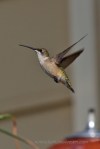
The house we were at was someone’s home who happened to love hummingbirds.  They put out feeders every year like so many of us do to attract them to their home.  What was unique about this location was that it was in the middle of two ridges that created a funnel effect for migrating hummers.  So, this time of year, hundreds of hummers would stop at the feeders to fill up on their way South for the winter.  By replacing the feeders with specially designed traps that wouldn’t harm the hummers, the banders were able to capture about 35 birds before we’d even arrived, about an hour after the event started.  1 bird every two minutes is pretty impressive.

I was a bit disturbed when I was asked not to show any photos of a complete trap on the internet.  Apparently there are people in the world who think Hummingbirds would make good pets and are looking for information on how to create a trap.  If you are such a person, please be assured that you cannot keep a hummingbird as a pet and that all will be much better served if you simply feed them and let them go on their merry way.

Watching the bander handle the tiny hummers with a confidence that belied how delicate these birds really are made me wish I had the dexterity to perform such a task.  I asked her if she had started as a jewelry maker–it seemed like the appropriate skill set to me.  She laughed.  Apparently she also didn’t believe she had the dexterity to handle hummingbirds when she got started.

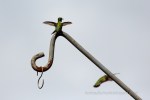
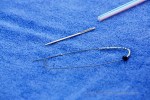
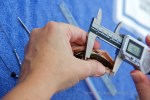
I watched her move through the measurements performed on each bird with a systematic rhythm, rarely interrupted by talking to us.  She measured each beak, each tail, each wing, used a straw to blow apart the feathers to see if there was fat, and then placed each bird on a scale.  She always banded them first.  She said that was in case they got away before she got through all the measurements.

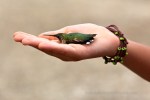
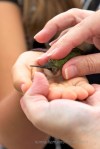
When she was done, she carefully set the bird in a waiting child’s hand and they held it until it suddenly decided it could fly and buzzed away.  Sometimes, this took several minutes.  It was fascinating to see a hummingbird hold so still.

The Necessaries

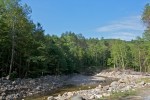
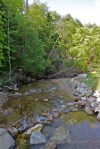
Our second hike in Vermont was on a gravel road that ran next to a stream.  The stream spoke the usual stream language, babbling to us as we walked.  Something we don’t always think about when we imagine the sound of a happily babbling stream is the way it seems to connect directly with our bladders.  Or, at least, mine.

I love the sound of running water diving and dipping and dropping over stones in a shallow bed as it makes its way downhill.  I love it less when I really need to use the non-existent facilities.  This is a case where perhaps the advanced hike might have been more accommodating–finding a private place at least 50 yards from water to go off and take care of one’s needs when walking along a relatively popular dirt road with a group of 15-20 people is not such a simple undertaking.  I endeavored to prove I still have good bladder control.  I made it to the turn around point, through the snack break, and about halfway back, but then we arrived at the juncture between the road and the stream.  The very thought of water rushing beneath my feet as it crossed under the road was more than I could bear.

I made a break for the woods and climbed up an overgrown hillside, bushwhacking my way to a private spot, trying to do as little damage to the hillside in the process as possible.  Fortunately for me, my selected site was in fact private and no one caught me in the somewhat awkward act of re-positioning clothing after the fact.

This, did however, evoke a memory from a long ago jeep trek up a mountain jeep trail near Ouray, Colorado in Yankee Boy Basin.  It was a trip I took with my father, brother, and elderly aunt to deliver my mother’s ashes to her favorite location in the world.  About half way up the jeep trail, my elderly aunt needed to use the facilities.  When I explained to her that there weren’t any facilities, she exclaimed, “What??!!!  They should have a bathroom if they’re going to let people come up here!!!”  The concept of wilderness was a bit lost on her.

I took her to find a spot in the woods.  I don’t think she’d ever walked through the woods except on a fairly flat and easy to follow trail before, let alone found a hidden spot to squat.  I found a secluded spot for her and walked around to another secluded spot for myself not far away.  About the time I was getting re-situated, I heard squealing.  I ran over to where I’d left my aunt and was greeted by two feet, pants circling the ankles above them, kicking in the air amongst the underbrush.  My aunt had fallen over backwards.  Now that is a sight I wish I could forget!

Thankfully, I managed to enjoy the hike in Vermont and leave un-traumatized.

Being Moderate

At the New Life Hiking Spa, everyone gathers outside the front door and the staff announces the hikes each morning.  They’re categorized into “Nature Walk,” “intermediate,” and “Advanced.”  The Nature Walk being mostly flat, a non-challenging surface to walk on (like a gravel road), and only about 4 miles or so in distance.  The Intermediate walks have more ups and downs, and may require a little scrambling over rocks.  The Advanced hikes are more vertical and are on “unimproved” trails.

While I might have opted for the Advanced or Intermediate hikes, I was there more for the company of my friend and less for the physical challenge, so I was more than happy to do the nature walk.  Plus, I wanted to shoot and I figured I’d have more opportunities on the nature walk than on an advanced hike.

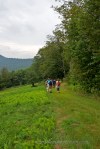
This happened to be the day for the most difficult Nature Walk of the week.  It had a long, slow climb in the middle of it.  This worked to my advantage.  I got to take my time shooting because the group wasn’t moving as fast as they would have been on a flat trail.  I had time to shoot and then run to catch up to my friend.

This was even more perfect than I realized at first.  I got a great workout by running hard to catch up (when I say running hard, I mean any attempt to run on my part is hard–I don’t run fast or far or at all if I can help it).  We would walk along together chatting until the next photogenic subject appeared.

I would have hated being on an advanced hike and feeling like I was holding other people up every time I stopped for a shot.

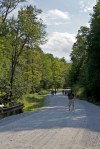
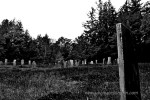
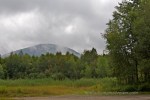
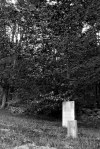
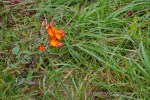
Plus, the road we walked was lovely.  We were afforded many views of the mountains and lots of pretty open fields full of wildflowers.  The only slightly traumatic part was the graveyard near the beginning of the walk.  We had to wonder what kind of message they were sending us by not only walking us past the graveyard on the way out, but stopping there for our snack break on the way back.  I loved it for the photographic opportunities it provided, but it’s a little odd to snack amongst the dead.

We extended the hike by going past the trailhead to another trail that led up a hill to a lovely view of the valley below and mountains in the distance.  One of our fellow hikers was starting to worry us with his heavy breathing, profuse sweating, and red face.  It was hard to believe the hike was that much of a workout for anyone, but it was a pretty good uphill, I guess.  We were concerned he had heat stroke.  In the end, he, along with the rest of us, did survive and we left no one in the graveyard.

Finding Sanctuary

I discovered tonight that I’m almost out of digital photos I haven’t used in a blog post!  Who knew a year of blogging could use up 9 years of digital photos?  I’m going to have to start searching the archives again–there have to be more photos in there!

I did discover these series of shots taken two years ago during an annual trip to Portland, Oregon.  Pat and I went to the local Audubon Society Preserve there and did a hike through their woods.

It’s an amazing property for many reasons.  First, it’s been meticulously maintained as a natural, native habitat.  Most people don’t associate “meticulous maintenance” with “natural, native habitat.”  Usually, we think of a golf course.  Unfortunately, as I know from volunteering at the Audubon Society here in Chattanooga, without ongoing hard labor to remove the invasive species that pop up every time one turns one’s head, they get out of control and turn native habitat into something completely foreign.  It’s unfortunate we humans can’t agree that invasive species shouldn’t be sold or planted.  Until we do, those of us who value preserving native ecosystems have a lot of work to do to prevent those habitats from being overrun by the rest of the population’s right to decide what to plant on their own property.  But, don’t let me get on that soapbox.

The Portland Audubon Sanctuary is a 150 acre property of dense forest, including a stand of old growth trees, a pond, and a creek that’s carved some small hills within the already hilly Portland topography.

Walking through the forest area made us think we were in the rain forests of the Olympic Peninsula of Washington state.  We didn’t see too many birds while we were hiking.  Those we did see were a tough for me to ID–somehow, even the birds that also live in the East looked different enough that I couldn’t feel confident I’d correctly identified them.

When we stopped at the lovely gazebo on the pond at the sanctuary, we discovered a group who was out watching a Northern Saw-whet Owl perched in a tree and up so high that without binoculars, it couldn’t be spotted.  Fortunately, a kind man let me look through his so I could see it, too.  It was about the size of a Screech Owl (tiny) and very adorable.

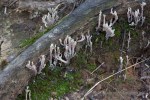
The Portland Audubon Sanctuary also boasted some spectacular fungal growths.  Between the mushrooms and the weird, coral-like growths, I didn’t mind my limited success at birding (especially since I was without binocs).

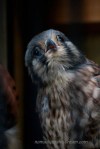
In addition to the Sanctuary, they also provide rescue services for injured birds and keep some unreleasable birds on display for educational purposes.  This mean being guaranteed to see some interesting birds even if nothing in the woods showed itself.  I particularly liked the Americal Kestrels on display.  They looked like they were making faces at me.

It’s a great place to visit and support if you’re ever in the Portland area.

Ice Walk

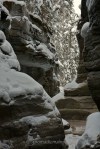
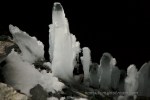
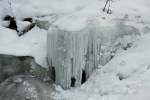
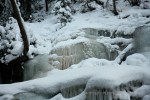
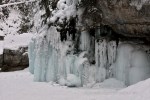
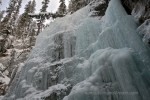
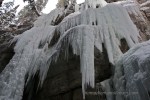
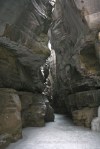
I find myself searching for photos of frozen things.  These are from a guided hike we did in the Maligne Canyon our first day out in Jasper on a winter trip a few years ago.

When the temperature is dropping to -25 fahrenheit, what better way to spend the day than touring ice formations?

We were nervous about our first hike in those temperatures–we weren’t sure we’d be able to stay warm in a group hike where we were constrained to the pace of the slowest hiker.  I decided to layer up.

I take layering very seriously.  For anything less than -10, if I’m not going to be moving quickly, this is my tried and true approach:

Layer 1:  quick-dry undergarments, including a long-line bra top that adds warmth all the way to my waist.

Layer 2:  panty hose

Layer 3:  silk long underwear, top and bottom

Layer 4:  Sock liners

Layer 5:  Under Armor for very cold weather top and bottom

Layer 6:  Wool long underwear top and bottom

Layer 7:  Fleece top and bottom

Layer 8:  Waterproof pants and heavy wool socks

Layer 9:  Down sweater up top

Layer 10:  Waterproof shell

To Top it All Off:  A very sexy balaclava with a super thick wool beanie over it.

Add waterproof snow boots with HotHands toe warmers, windblocker glove liners and a pair of waterproof down mittens and I’m ready to roll.

The most difficult part of all these layers is getting into them without breaking into a sweat.  Usually, I’ve soaked through layers 1-6 by the time I get to layer 8 and I have to carry layers 9 and 10 outside with me to cool off before putting them on.

The second most difficult part is walking.  If you have ever seen the moving “A Christmas Story” with the classic scene of the kid so bundled up that when he falls over, he is stuck on his back waving his arms and legs like an over-turned turtle, that’s what I feel like when I dress for really cold weather.  In truth, technology is pretty amazing these days so each layer is impressively thin for the insulating factor and I can walk pretty well.

I eschew cotton because of the sweat factor.  Cotton loses its insulating properties when it gets wet.  With fabrics that keep me warm even when they’re wet, I worry less about wearing too many layers.

Right at the moment, I’m looking out the window at heat lightning flashing in the sky and wondering how on earth I got from thinking about ice to thinking about wearing 10 layers of warm clothes.  The last thing I’d want right now is an extra layer.

But in Maligne Canyon, among the giant ice formations, I was perfectly warm with the cold air against the only exposed skin on my face, content to stand with my mouth wide open in amazement, blowing out clouds of frost with each breath.

Savage Falls

One of the things I love the most about hiking is the solitude.  There is nothing like hearing only the wind whistling quietly through the trees.  It’s like the secrets of the universe being spoken quietly in your ear.

When we did the Stone Door hike, we were surprised at the solitude we found.  In spite of it being a short, easy trail that started out with a paved segment, we only saw people going the opposite direction.  At the top of Stone Door, a breeze blew through the pines and we enjoyed that hard-to-find solitude that usually only less accessible wilderness offers.

For me, this sense of solitude somehow always generates a wondrous feeling of connectedness in what might be one of life’s great paradoxes.  It was so palpable at the top of Stone Door that I had to set my camera aside for 10 minutes and just sit and listen to the wind and feel part of life.

When we decided to walk at least part of the Savage Gulch Day Loop trail, we thought we might see even fewer people–it’s more remote.

When we arrived at the parking lot, another couple was getting ready to head down the trail.  I overheard the man ask the woman, “Got what’cha need?  Need what’cha got?” What a profound question.  One of the greatest mistakes I’ve made in my lifetime is not asking the second question.  But I digress.

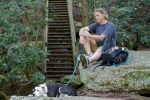
Tisen has been limping and so have we, so we didn’t expect to make it all the way around the 5 mile loop trail.  We also got a bit confused because there are about 5 trails that converge with the loop trail.  So, we didn’t start out with the intention of going to Savage Falls, but that’s where we ended up.  But we were OK with having gotten slightly lost–who can resist a waterfall?

When we arrived at Savage falls, we were a little jealous of the people swimming in the water.  We contemplated getting in, but we didn’t see a good path for Tisen to get down to the water and Tisen has put on a few too many pounds to be carried easily.  So, we sat in the shade and watched.

I attempted to shoot with my 100-400mm lens since there was enough of a crowd that my 24-70mm wasn’t giving me tight enough compositions.  Plus, I was shooting for a lot of depth of field, so I figured my faster lens wasn’t doing me that much good anyway.

There were two wrong assumptions about this.  First, the faster lens has an easier time focusing no matter what aperture I have it set on.  Second, the shorter focal length is easier to hold still even though that lens lacks Image Stabilization.

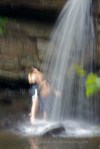
But, I did my best to steady the lens.  If only my subjects would have held still–I had to refrain from yelling “freeze!” at the couple under the water fall.

The Fungus Among Us

I’m a big fan of mushrooms.  I like to eat them (when someone else has tested them first) and I like the way they look.

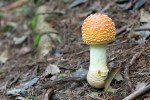
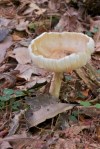
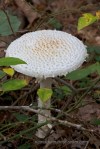
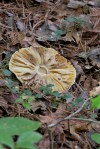
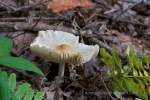
When we started off down the Savage Gulf Day Loop trail, it seemed like there was a new mushroom we’d never seen before every 10 feet or less.

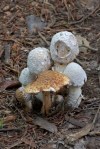
In fact, sometimes there were whole families of mushrooms and, in some cases, it looked like the children were adopted.

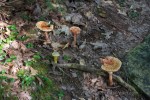
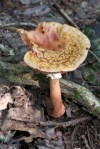
I was blown away by the colors and sizes and varieties of mushrooms that added color to the trail in a way previously left to flowers.

Unfortunately, after toting the tripod around for 2.5 miles at Laurel Falls and Stone Door, I’d decided I didn’t want to tote it around for potentially 5 miles on the loop trail.  I opted for my camera with the 24-70mm lens and a 100-400mm lens in my bag in the hope of having less weight on my shoulders.  I also made a mental note to myself to, in the near future, look for a backpack with a hip belt that I can use to carry photography equipment–I have got to get the weight off my shoulders.

I’m fairly certain that the decision to leave my 100mm macro lens and tripod behind actually caused a massive mushroom bloom from the time we left the car to the time we started down the trail.  I would bet a lot of money that had I carried my tripod and macro lens, we wouldn’t have seen a single thing interesting enough to shoot up close.

As it was, I was left to try to simulate shooting macro in a dark environment with a hand held camera.  I was thankful that my Canon 5D Mark III has such awesome higher ISO performance (well, compared to my 40D, which I also left behind).  Were it not for that, I wouldn’t have captured a single mushroom.

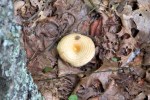
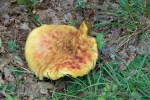
On the way out, I shot mushrooms at 70mm, getting as close as possible, which isn’t that close since it’s not a macro lens.  The images are all cropped as a result.

On the way back, I shot mushrooms at up to 400mm, standing back further and desperately trying to hold the lens still.  I’m impressed that I got any decent shots at all.  I think this speaks to the amazing technology of image stabilization built into the lens.

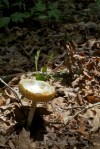
Granted, some of the shots are a bit blurred from too much movement with too long of a shutter speed.  The second image is an example of this.  It’s one I should probably just delete.  But, when I looked at it in post processing, I was so pleasantly surprised to discover what I assumed was leaf debris was actually a tiny snail sitting on the mushroom cap, I couldn’t think of deleting the image.

It’s funny how sometimes the most pleasure comes not from executing a shot well but by discovering something in a shot completely by accident.