Playing Peek-a-boo

Blooms hiding amongst the leaves, waiting to burst forth at dawn

Blooms hiding amongst the leaves, waiting to burst forth at dawn

In my high-speed journey around the park grabbing macro shots Sunday (macro shots really should not be “grabbed”), I paused long enough between mosquito bites to notice a few surprises peeking through the lush greenery that seems to have grown to gigantic proportions lately.

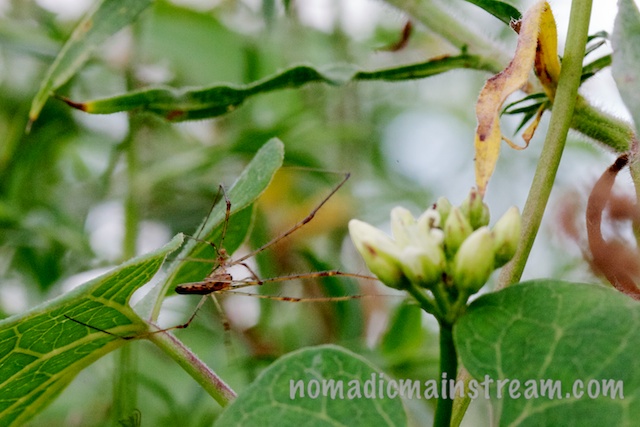
A spider checks out some flowers about to bloom

A spider checks out some flowers about to bloom

Tisen did not notice any of these things.  He did, however, manage to catch a fly in mid-air while I was in the middle of trying to catch a spider.  I caught the spider, too, but only in an image.

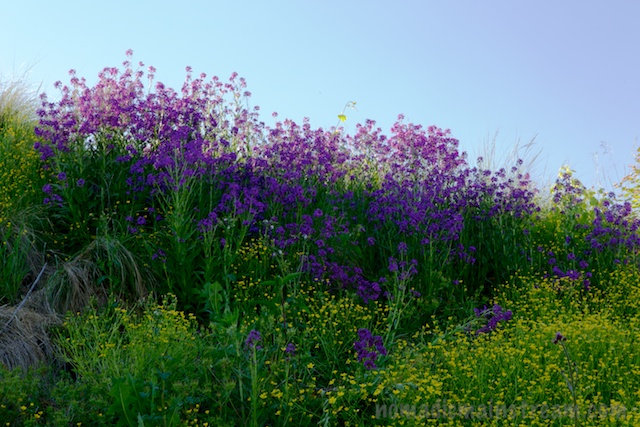
Some bright purple blooms pop up out of the undergrowth

Some bright purple blooms pop up out of the undergrowth

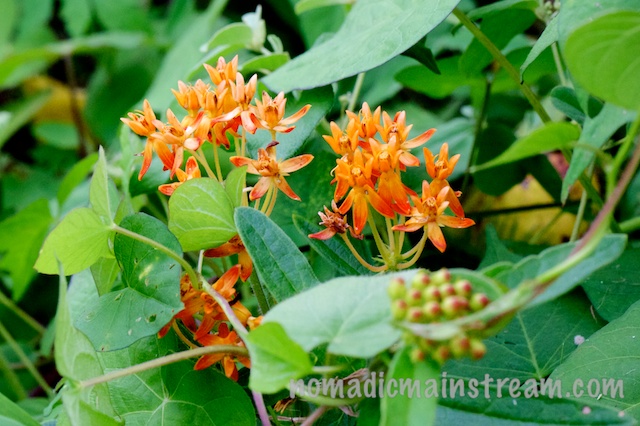
In spite of their bright colors, these orange flowers were hard to spot from the sidewalk

In spite of their bright colors, these orange flowers were hard to spot from the sidewalk

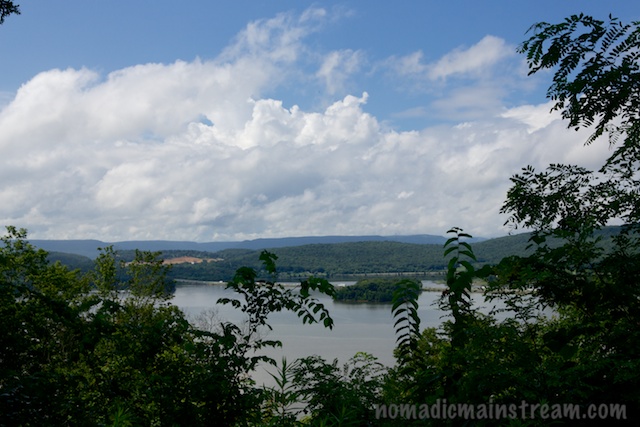
Nickajack Lake

Roadside view of Lake Nickajack

Roadside view of Lake Nickajack–I needed a hedge trimmer

On Sunday, our journey through the Tennessee River Gorge ended when we got to the portion of the river where it becomes Bennett Lake.  This corner of what is nearly a 180 degree bend in the river marks the first time a major road intersects Mullins Cover Rd, the road we were on, after a lot of slow miles.

We opted to stick to major roads at this point.  In part because we’d had enough sitting in the car and in part because we were starting to get low on gas and we hadn’t seen a gas station for many miles.  We worked our way back to I-24 and headed back towards Chattanooga.  We were surprised to discover we were in the Central time zone and on the Nashville side of Nickajack Lake.

I decided we should stop and get some shots of Nickajack lake since we hadn’t managed to get any really great shots from down in the gorge.  Unfortunately, I didn’t decide this until after we had passed the best exit for views of the lake.  We went down several dead ends trying to find a road to the lake.

Another roadside view

Another roadside view

We ended up driving up the ridge around the lake a ways when just by chance I saw a break in the trees.  We parked down the road and I walked back to the spot.  It wasn’t much of a break in the trees, but it at least provided a view of the lake.

Driving through (the highway literally goes right over the middle of the lake) Nickajack lake is one of my favorite parts of the drive to Nashville (or the West end of Cumberland State park), although almost all of the drive is full of great views.

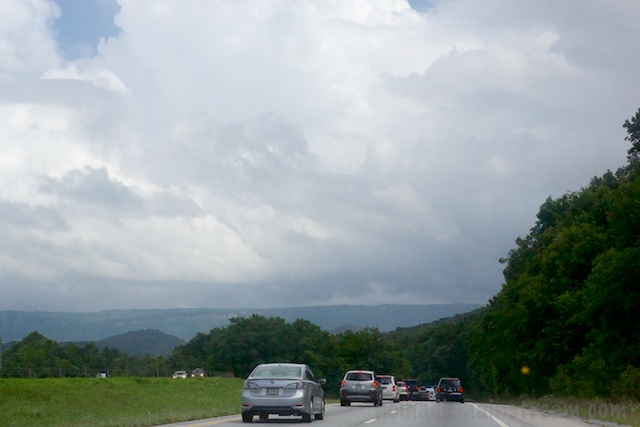
When we got back on the freeway to make our way rapidly towards food, we soon found ourselves in a traffic jam.  I started taking pictures from the car.  It’s always a bad sign when I start shooting through the windshield, but it gives you an idea of the kind of scenery that unfolds as you drive through this part of Tennessee . . . uh . . . Georgia?  No, this was Tennessee.  Barely.  We crossed the Georgia state line about a mile after this image was taken.

Scene from the actual road--a "through the windshield" image

Scene from the actual road–a “through the windshield” image

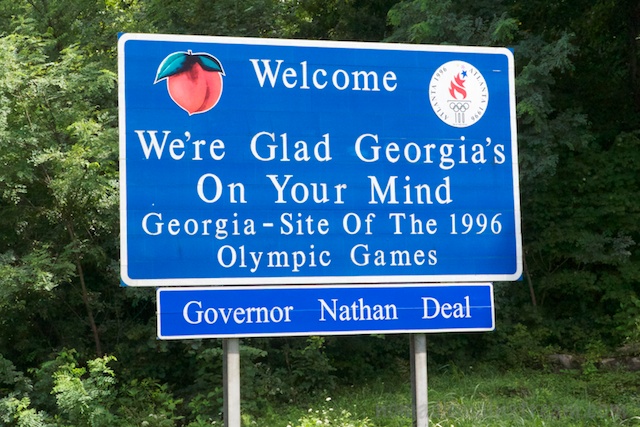
That’s another interesting thing about driving from Chattanooga to Nashville–you have to go through Georgia to get there–at least if you take I-24.  I-24 dips across the state line for about 3-4 miles as it winds it way through the mountains.

Every time we drive down I-24, I am amazed that such spectacular scenery surrounds the freeway.  Having grown up in flat Columbus, Ohio where you could drive for 2 hours in either direction and barely see a bump in the landscape, the ancient mountains of the Southeast make my mouth drop open.  I used to always think I preferred the Rockies.  I do love the Rockies, but the gentler slopes of the Appalachians have equal, if different, charm.

The moment Georgia entered my mind

The moment Georgia entered my mind

Tennessee River Gorge

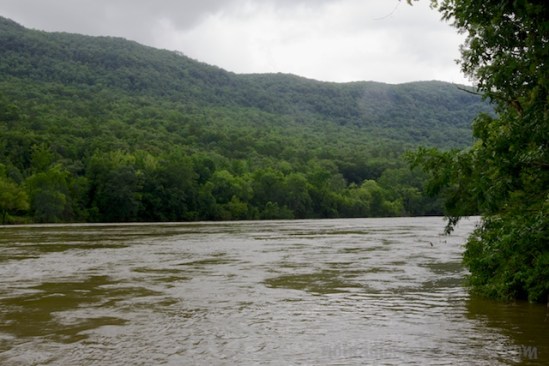
The height of the river testifies to the amount of rain we've had

The height of the river testifies to the amount of rain we’ve had

When you see stock images from the 4th of July other than fireworks, they all have one thing in common:  sunshine.  It’s so engrained in my memory that the 4th of July is always bright and sunny that I am unable to conjure any memories of a rainy 4th, even though I’m sure there were some.

This year, in spite of the great fortune of having 4 days mostly off work, the weather refused to cooperate.  We had nothing but rain.  Instead of spending 4 days hiking as we’d planned, I ended up working part of the first two days, rearranging the office in the afternoon of the 5th, and then spending the better part of that Saturday hanging shelves in the newly arranged office.
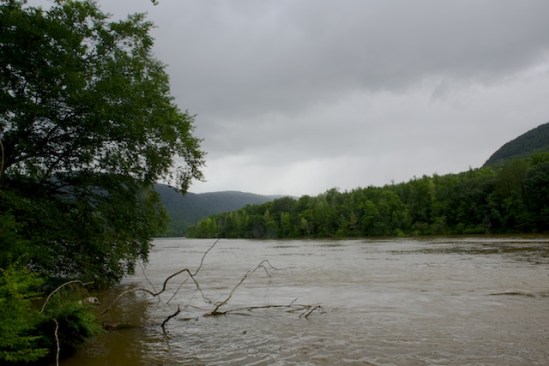
We watched several large logs racing down the rapidly moving water

We watched several large logs racing down the rapidly moving water

Granted, it needed to be done.  I’m very happy that we managed to get the office into some sort of order–I was tired of hunting through baskets on the floor when I needed something.  But, to be honest, it’s not quite what I had in mind when I thought about how I wanted to spend my 4-day weekend.  But, the deep gray skies that continually spouted rain day after day did make it easier to get motivated to work on the office.

On Sunday, the rain gradually eased up to a gentle mist and then evaporated.  The sun popped through the first gap in the clouds we’d seen for days sometime around noon.  When I took Tisen outside, I had no sunglasses or sunscreen on because I’d pretty given up on ever seeing the sun again.  When the sun suddenly appeared, I had to hold my hand over my eyes and squint, worried I’d perhaps turned into a vampire and I would soon turn to dust.

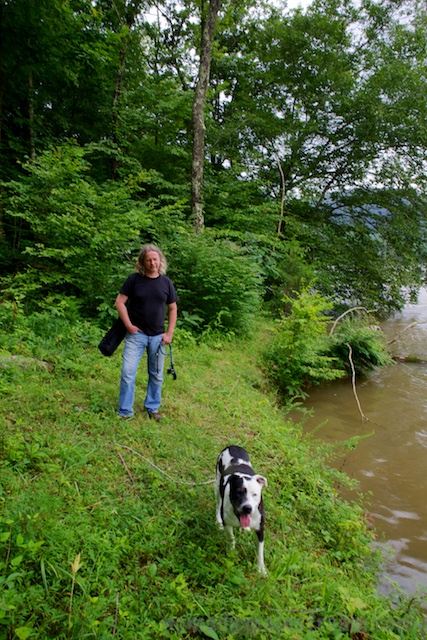
I was worried about Tisen falling into the river while I was shooting

I was worried about Tisen falling into the river while I was shooting

We made a quick decision to take a drive through the Tennessee River Gorge to a place  called, “The Pot House.”  I kid you not.  In fairness, it’s officially called Pot Point House or Pot Point Cabin, but everyone calls it “the pot house” for short–even the parks and recreation department refers to it in the vernacular in some of their web pages.

Even the storm sewer looked navigable via kayak

Even the storm sewer looked navigable via kayak

I have yet to find an explanation as to why the point is called “Pot Point.”  Perhaps the cabin was once the location of a clay pot maker?

Whatever the case may be, the views of the river gorge from Pot House were not quite what I was hoping for.  After snagging a few shots, the sun decided we’d had enough and was quickly replaced with yet another torrential downpour.

One of the 2 turtles we stopped to help cross the road

One of the 2 turtles we stopped to help cross the road

While it didn’t turn out to be quite the photographic opportunity I’d been hoping for, we did get some lovely views of the river gorge (unfortunately mainly at places where it was impossible to pull off the road).  We also assisted two turtles on their journey across the road, stopping to pick them up and put them where we hope they were headed.  They didn’t seem grateful, but it made us feel better.
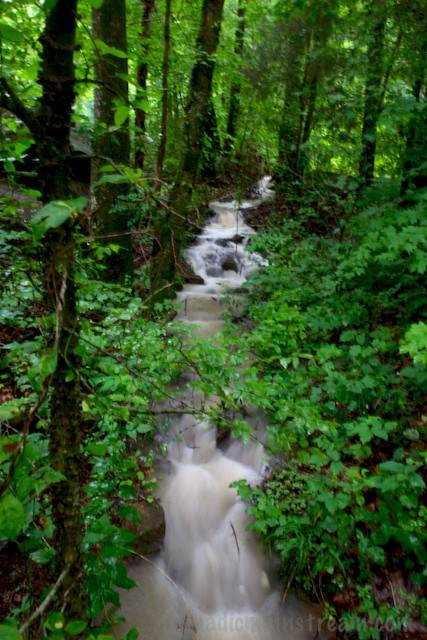
A stream running down the hillside had turned into a waterfall

A stream running down the hillside had turned into a waterfall

Renaissance

Looking down the sidewalk that runs along the long side of The Ramp

Looking down the sidewalk that runs along the long side of The Ramp

Renaissance Park is appropriately named.  The riverfront on this side of the river was lined with large manufacturing facilities.  I am having trouble remembering what exactly was where Renaissance is–I guess I need to stop and read the signs in the park again.

Whatever was on the 20+ acres that now make up the park, it left a mess.

Looking up at some of the brightest blooms backlit by the sun

Looking up at some of the brightest blooms backlit by the sun

Rather than haul the mess off and dump it somewhere where it could be someone else’s mess, the people who designed the park (which is apparently this firm, who has posted some cool aerial photos) created a way to “store” the waste that supposedly prevents toxic waste from reaching the Tennessee River.  According to the signs in the park (which, yes, it’s been a long time since I’ve read), the mounds we regularly refer to as “the Sledding hill” and “the Ramp,” were created as part of the program to encapsulate and stabilize the industrial waste.

I always find myself particularly tickled when I think about the kids sledding down a hill that’s simultaneously protecting them from the pollutants it houses inside.  I just hope we don’t learn sometime down the road that it’s having ill-effects on anyone.  I have to imagine the ill-effects are less than if the pollutants were continuing to leach into the Tennessee River.

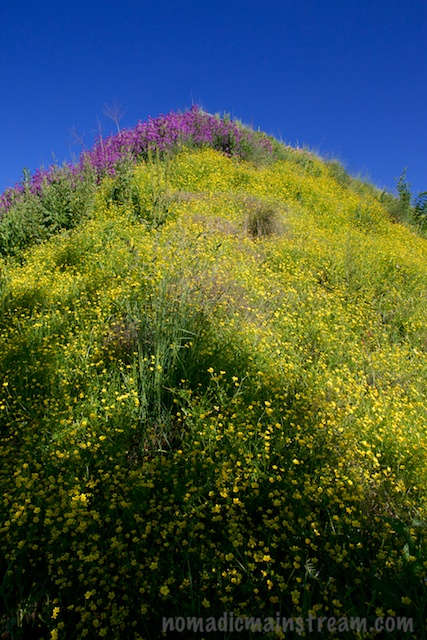
A mixture of bright flowers and native grasses rises up to a deep blue sky

A mixture of bright flowers and native grasses rises up to a deep blue sky

In any case, the thought of an industrial dumping ground being turned into park that’s not only lovely, but also effective at removing pollutants from the water that flows through the property is pretty inspiring.  It truly is a renaissance.

The hill we call “the Ramp” is particularly clever innovation.  It’s landscaped as a cleanly angled plain running up the front, planted in grass and kept mowed short.  It’s one of those things that you see for the first time and wonder what on earth it’s for.  Then, you walk by when there’s an exercise class out on it and you realize someone really did have vision.

The ridge the runs up the spine of backside of The Ramp

The ridge the runs up the spine of backside of The Ramp

The popularity of outdoor fitness classes in the park is amazing.  There is not one thing that appears to have been purpose-built for fitness classes, yet the giant steps down to the wetland, the Sledding Hill, the Ramp, and even the concrete bases of park benches all provide great equipment for the most ambitious exercisers.

But it’s the other side of the Ramp that caught my focus on this day.  Or, the other 3 sides.  The Ramp is only a ramp on one end.  The rest of the hill is long and rounded and covered in native flowers and grasses.  Many of the plants produce bird seed, making the hill a favorite for many seed eaters like Goldfinches and House Finches.  It’s also a favorite for a large collection of voles who like to torment dogs passing by.

Right now, the Ramp’s backside has burst into blooms.  Looking up its slopes at the flowers backlit by the evening sun makes me think every spring is its own renaissance.

The Ramp makes for an awesome display of wildflowers

The Ramp makes for an awesome display of wildflowers

Up

Orange flowers viewed from below

Orange flowers viewed from below

It’s funny how looking up at something can change the way it looks.  The paths of Renaissance park have many elevations.  Some of them run parallel to one another in what is an accidental switch-back.  The effect is that, in one direction, you look up a small slope that leads to a flat area where plantings line the sidewalk above–you’re looking up at the same flowers you look down on when on the other walkway.

Even the volcano (as some call it) or the sledding hill (as I usually call it) is elevated so that the lower sides of the slopes seem more prominent and obvious.

This effect reminds me of what happens when I think I’ve cleaned the house (yes, that is something I’ve done on occasion).  I walk around looking at every surface glowing and I, in turn, glow with pride.  Then, inevitably, I trip on something and end up on the floor where I am suddenly looking up at the same surfaces.  They just never look clean from the other direction.  The vertical surfaces I thought were spotless suddenly reveal just how dirty they are when I find myself looking up from the floor.

Evening primrose climbing up a slope

Evening primrose climbing up a slope

Fortunately, not too many of our guests lay on the floor.

This is not to imply that looking up the slopes revealed dirt.  Rather, it just called my attention to some things I hadn’t really taken in completely before.  The collection of primrose at the base of the tree basking in the sunlight seemed to be standing at attention from this angle.  The bright orange flowers among the grass appeared from no where–I can’t recall having seen them before.  Even the sledding hill with its abandoned cardboard sleds seemed somehow more appealing than usual–and far taller.

Inspired by the new view, I decided to get bold and attempt to shoot a sculpture I have yet to capture an image of that I like enough to share.  Every time I shoot it, I think it looks really cool when I’m standing there and then deleted the image when I got home.

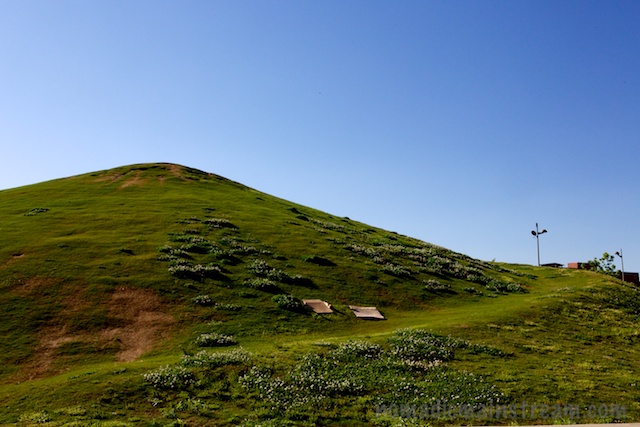
The sledding hill shot from below

The sledding hill shot from below

I noticed the evening sun was creeping towards the horizon behind the sculpture.  I thought I would try to get a sot of the sun sitting on top of it.  This might have been a good time to use HDR with a tripod.  However, I winged it.

Sometimes an image that really sucks makes for a lot of fun when playing with the possible ways to adjust it in Aperture.  The curves feature is especially fun.  It can turn an image into something completely different.  This was my favorite image of the various takes and edits.  I’m not thinking I’ll be hanging it on the wall, but I like how the completely blown out sun turned gray when I used the recovery tool, with its rays shooting over the top of the sculpture.  But then again, I’m easily amused.

A sculpture I have yet to capture a decent image of, but had fun playing with this

A sculpture I have yet to capture a decent image of, but had fun playing with this

Hope and Clover

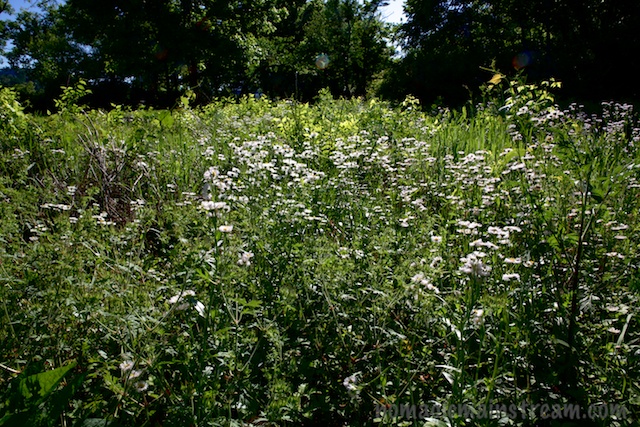
Fleabane (I think) filling a small meadow

Fleabane (I think) filling a small meadow

I have been taking the time to try to identify the flowers in my images.  It’s a little hard to tell because the images I’m finding online do not have good size comparison.

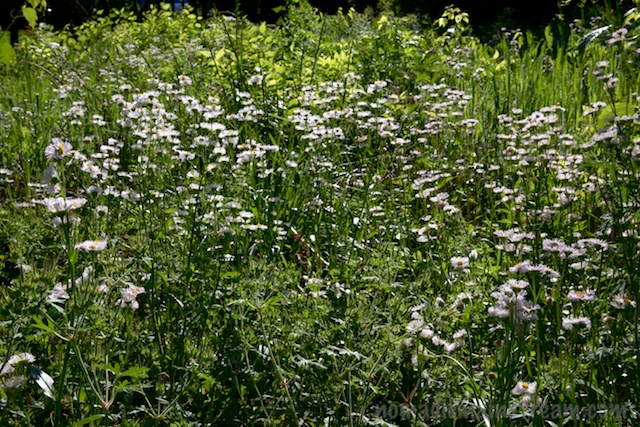
That said, I’m fairly certain that the tiny flowers with the fringe of petals in white are fleabane.  It’s a native wildflower in the aster family (which perhaps I am the last person to learn).  I found its photo on the uswildflowers.com website; the image was taken in downtown Chattanooga.

Tighter view of fleabane

Tighter view of fleabane

I was able to find many photos submitted on the website by the same photographer and even one image in a local Chattanooga newspaper.  However, I was unable to locate a website.  I find myself curious as to whether I have met this photographer or not.  Not that I have met every photographer in Chattanooga, but I have run into quite a few now.

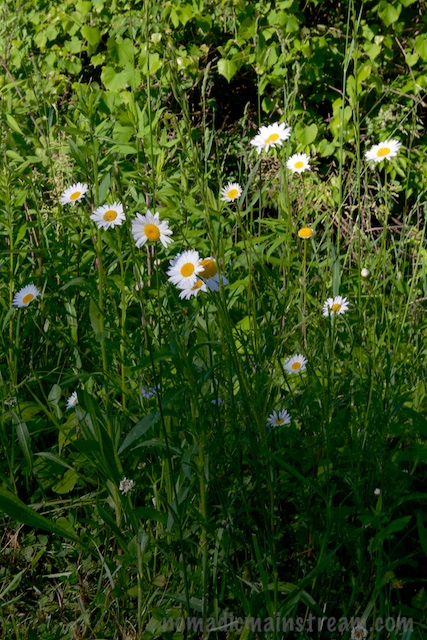
I digress.  The final flower I identified was, I believe, the oxeye daisy.  It seems quite a bit larger in the image on the website than the ones I saw in person, but I can’t find anything else that looks like it.

Oxeye Daisies?

Oxeye Daisies?

These are not native.  They were introduced and are now becoming invasive–they’re officially listed as invasive in quite a few states now, although Tennessee is yet to be one of them.  Fortunately, only a few clumps of these appear in our little park.

They have been working to gradually remove the invaders and seem to only plant natives in the park, so it’s been fun to watch the transformation.

I wish there were a way to send romantic young couples seeking flowers after the invasive species.  The young couple I caught picking evening primrose (see 2 posts ago) might have been put to good use neutering oxeye daisies!

Follow the curb

Follow the curb

As Tisen and I slowly made our way past the meadow of fleabane and daisies, I stopped to catch an angle that interested me looking back at the aquarium.  I didn’t quite get what I wanted, but maybe a little later in the evening when the sun is low enough to light the front of the aquarium would be better.

On our final stretch towards the more landscaped part of the park, after crossing the wetland, we paused to look up the stairs at the sledding hill.  I couldn’t help but notice with surprise that the sledding hill is growing large clumps of clover all over its Eastern face.  This struck me as both improbable and fascinating.  After all, it’s a sledding hill.  Not a northern sledding hill, but a southern one that gets slid upon, climbed up, skated down, run up, slept on, and even bicycled on every day of the year with very few exceptions.  That clover had found a purchase on the side of this hill and somehow evaded cardboard sleds, trampling feet, and rolling children seemed quite an achievement for a living thing bound to the earth by its root.

Stairs lining up with the sledding hill--clover clumps just barely visible on right side

Stairs lining up with the sledding hill–clover clumps just barely visible on right side

The clover made me feel surprisingly hopeful.

Footprints

A wide view of the Evening Primrose in a meadow

A wide view of the Evening Primrose in a meadow

I was walking in the park about a week ago.  It was probably a weekend day fairly early in the morning.  As Tisen and I emerged from the building, we spotted a young couple in the shadows of the hillside in the early light.  I suspect they had been out all night behaving romantically.  At the moment I saw them, they were gathering a bouquet of flowers from the hillside.  Flowers that had magically appeared almost overnight after holding out through one cold snap after another.

A clump of evening primrose

A clump of evening primrose

I felt bad for those flowers–to be heartlessly neutered after having waited so long for the chance to procreate.  It struck me as ironic that the young couple who were clearly caught in the throes of hormonal influences would be the ones to remove the sexual organs of the plants carrying on their own romance on the hillside.

Part of me was tempted to ask the couple how they would feel if they were quietly carrying on wooing one another and some giant came along and plucked their genitalia, but I thought better of it.  It’s hard not to come across as insane and potentially dangerous when you start using words like “plucked” and “genitalia” in the same sentence.

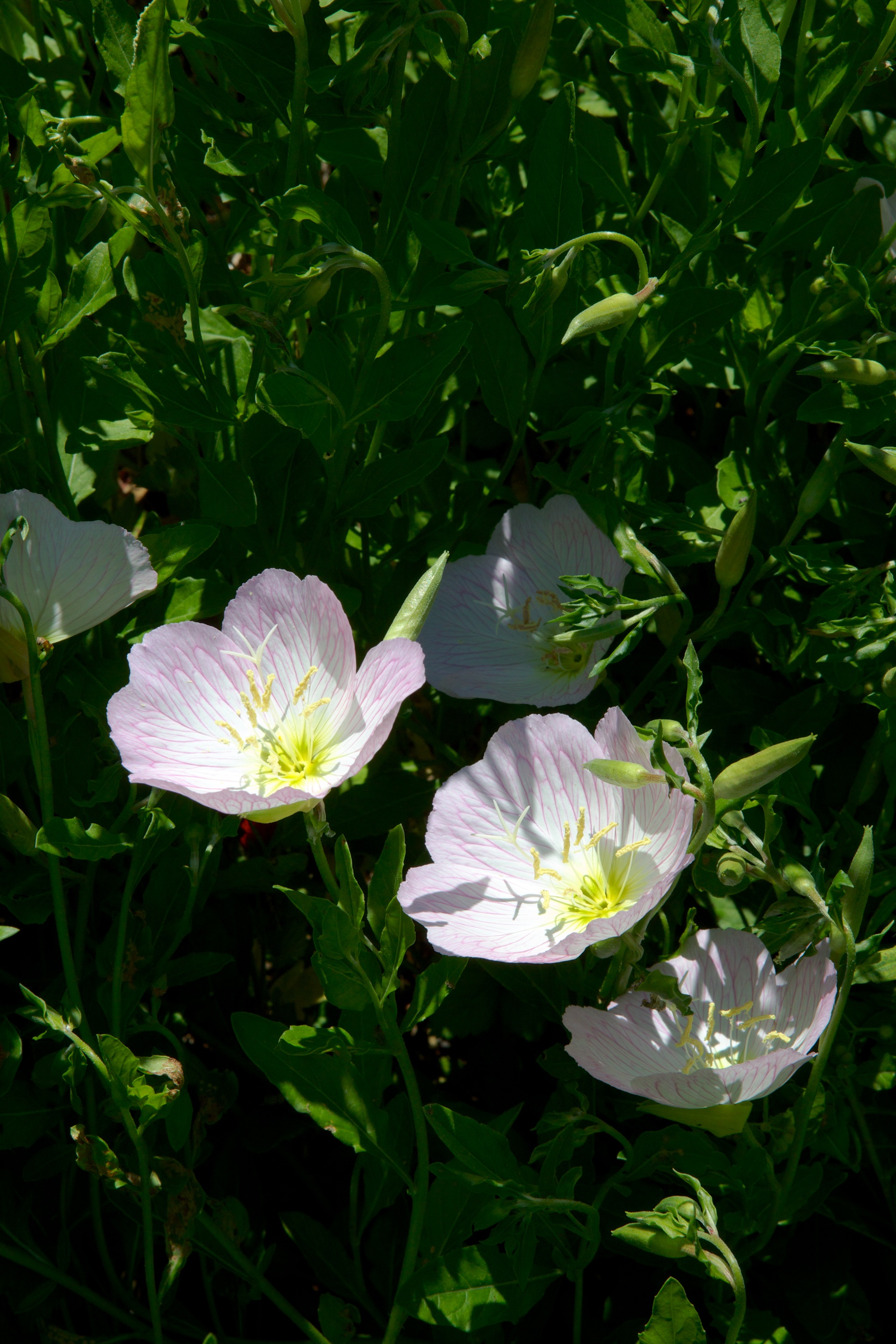
A couple of blooms filling their cups with light

A couple of blooms filling their cups with light

I glanced at the sign that read, “Flowers are here for everyone to enjoy.  Take nothing but photographs; leave nothing but footprints” posted about 20 feet from where they were gathering their bounty.  I considered lecturing them on the inconsiderateness of taking flowers, not only taking from this season, but also stopping the offspring for future seasons to come.  Once again, I decided to hold my tongue.  Perhaps the act of thinking about saying something but not caused me to stare at them in some way that made them uncomfortable.  Whatever the cause, they made their way off the hillside and stopped their pillaging.

Not quite macro with my 24-70mm lens

Not quite macro with my 24-70mm lens

Having witnessed this act, I was doubly happy to notice the sea of flowers taking over the hillside this week.  The evening primrose, a lovely native, seems to have found its way into every space between the other grasses and flowers growing in the park.  They seem to have reached some sort of equilibrium that allows space for a wide variety of flowers at the same time.

The last, but maybe the best

The last, but maybe the best

The evening primrose was looking particularly sparkly about 2 hours before sunset the other day.  Like the blades of grass in yesterday’s post, I had a hard time not shooting it and an even harder time reducing my rather redundant set of photos to just 1.  I guess this was my way of gathering my own bouquet.

Ravine Critters

I swear there is a mouse in this photo

I swear there is a mouse in this photo

Sometimes when you go for a walk, even if it’s in a relatively familiar place, you end up seeing something you’ve never seen before.  Gina and I took a short walk to a ravine at the end of her street.  The ravine has a lovely little park in it, complete with an arched bridge over a large creek.  Given that it was one of the first sunny, warm days of the season, the park was fully of people.

A little bit more of our white-footed friend is showing in this one, but not much

A little bit more of our white-footed friend is showing in this one, but not much

We were there to do a little practice portrait shooting.  As we wandered around looking for a good spot, we saw a group of tables set up under an overpass where the creek flows under a major roadway and continues its course downhill towards the nearest river.

Under this overpass, about 5-6 naturalist-looking people wearing naturalist-like attire had a bunch of critters they had collected on display, along with a microscope and some  other types of collections that weren’t moving.  I wasn’t well equipped for shooting these critters, but I did the best I could given they were in glass containers and I was shooting with my 70-200mm lens.

I forget what this was, but I think it's some kind of salamander

I forget what this was, but I think it’s some kind of salamander

Having to stand back when shooting through glass is a major disadvantage.  The smudges and reflections on the glass show up quite a bit more than I would like.  But, to be honest, I didn’t take these images with the expectation that they would win any photography awards.  It’s just pretty darn interesting to learn what critters are crawling all around us that we’re mostly oblivious to.

We were introduced first to a white-footed mouse.  The mouse ran out and posed for us just long enough for me to get my lens cap off and my camera turned on.  Then, he ran back under the leaves in his cage, rolled up in a ball, and promptly fell asleep.  I tried shooting from several angles, but all I could get was a spot of brown fur amongst brown leaves.  Trust me.  He was really cute.

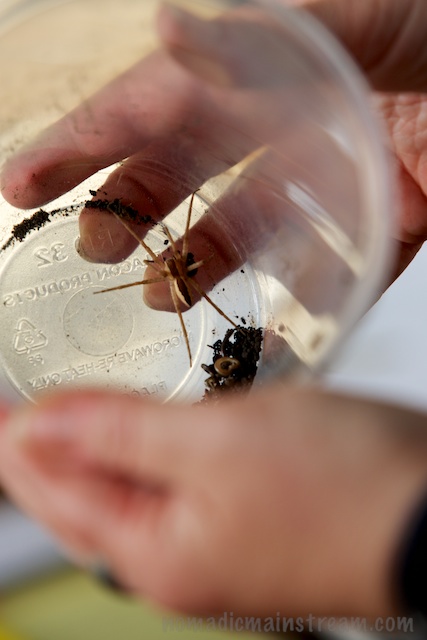
One of the most frightening creatures in the mid-west:  the Wolf Spider

One of the most frightening creatures in the mid-west: the Wolf Spider

The group had also collected a snake and a couple of spiders.  While I am a fan of snakes, I have a bit of a problem with spiders.  I love spiders and their contribution to the balance of the ecosystem.  I particularly love their webs.  However, I love both their webs and them a lot more when they are not on the same side of a window as I am

I appreciated when the ladies holding the spiders for us decided to put them back in their containers–I would never have shot them when they were running around outside the containers, I was too busy jumping.

I was too nervous to remember what kind of spider this was

I was too nervous to remember what kind of spider this was

When we asked the group what they were doing, they told us they were both trying to get people interested in the flora and fauna in the ravine and getting a baseline of what was there so that as they work to restore the native habitat, they can see how many more species start appearing.

My baby boy in a blur--I'm so happy he rejoined me

My baby boy in a blur–I’m so happy he rejoined me

Jumping In

AU0A9186

Momentum is a funny thing.  The tendency of an object at rest to stay rest often feels overwhelming when that object is me.  Conversely, once I start moving, momentum carries me away, often making it hard for me to return.

On Sunday afternoon, curled on the couch and disappointed that I hadn’t been able to actually nap, the thought of putting on my coat and boots, packing up my gear and heading outside to shoot seemed just silly.

But, between the motion of my husband (is motion contagious?) and my need to have photos to post for the next week and a half, I managed to get up and get myself and Tisen ready for the park.

I liken the feeling of steeling myself to unwrap from a blanket and step into the cold to the feeling of preparing to jump into a pool.

I love to swim.  Moving through the water feels like being home.  The feeling of being buoyed up makes me feel weightless.  I’m not fast, but I re-learned how to swim when I undertook triathlons about a dozen years ago.  In the process, I found a relaxed, meditative way of moving through the water that I could sustain well beyond the time I had to swim.  In fact, I often ran late getting out of the pool because I was enjoying being in the water so much.

None-the-less, even now, just sitting here thinking about how much I like to swim, the thought of going out into the night and taking that initial step into the cold water makes me recoil.  There’s something shocking about going from being warm and dry to being suddenly immersed in water that feels like an ice bath (even when it’s actually a little too warm for swimming laps).  It takes a little extra push to move momentum from rest to motion when I feel like I’m about to jump in the pool.

But having made the leap and gotten myself and Tisen out the door, I was soon kneeling on a garbage bag in the mud finding interesting things I’d never seen before.  Once I got started I didn’t want to stop.  The image above is the last image I shot that day.  It was shot after I got the call from my husband that he was making dinner.  I had already collapsed my tripod and put the lens cap back on, determined to head straight home when I saw this plant.

I don’t know what it is.  I don’t know if the image was worth being late to dinner for, but I was perplexed by the arrangement of the dried stems (or were they shriveled petals?) laced with the silk of milkweed.  At least it looks like milkweed.  There are apparently many, many varieties of milkweed, so it seems reasonable this might be one.

The tones of reddish brown intermittent with the silk against the green grasses in the background just caught my eye.

Escape

Milkweed silk dangling from the pod

Milkweed silk dangling from the pod

As Tisen and I made our way around the park with me keeping an eye out for small things to shoot up close, I spied a milkweed plant with an open pod.  The pod dangled in the breeze with a waterfall of filaments cascading out the front.  It would have resembled a frozen waterfall had it not been bouncing in the wind.

I climbed down the embankment between the walkway and the milkweed, coaxing Tisen to follow once he had sniffed the tall weeds along the way to his satisfaction.  I setup my tripod so the lens was at eye level with the spillage from the pod.

As the wind blew, the filaments moved.  They didn’t just move in the breeze; they were gradually released one by one from whatever force suspended them.  In all the time I stood there waiting on cycles of wind, I saw only 3 or 4 filaments spring free.

I wondered about this process.  I always imagined a milkweed springing open and firing its downy interior into the wind, releasing all of its seeds at once.  Instead, like a parent terrified of becoming an empty nester, it clings to its progeny in a delicate finger hold.  And there the seeds stayed (even the next day), hanging by a thread between the safety of the pod and the freedom of the wind.

Perhaps this allows the milkweed to ensure its seed is spread further–it must take a pretty strong wind to blow the down out of the shell.  But what happens if the seeds remain forever suspended?  Eventually, the shell must rot and fall off the plant.  Are the seeds still viable by the time this happens?  Do they plant themselves at the base of the parent plant?  Do they end up living next door to their parent?  Are there advantages to having an extended family all on the same block?

In this arrangement, what I really see is me.  The feeling of being perched on the edge of freedom with a finger hold on security is a familiar one.  What I yearn for and what I’m willing to give up are diametrically opposed.  I want to jerk the pod off the stem and take it with me as I fly into a new world.

Yet, in the effort to keep the pod, I expend the time and energy I need for flight.

I wonder how the milkweed feels about it.  Does the milkweed silk contemplate whether it really wants to fledge while the pod wonders why it was foolish enough to spring open?

Is it a uniquely human attribute to debate what it is we need to do?  Is it a uniquely human attribute to have choice in what action we will take?  Every time someone makes a statement about what distinguishes humans from the rest of life on the planet, someone makes a discovery that debunks the assertion.  I will not make the mistake of presuming ambiguity is unique to humanity.